
Ceramics Ceramics inorganic nonmetallic materials chinadishes cementconcrete functional
- Slides: 37
Ceramics
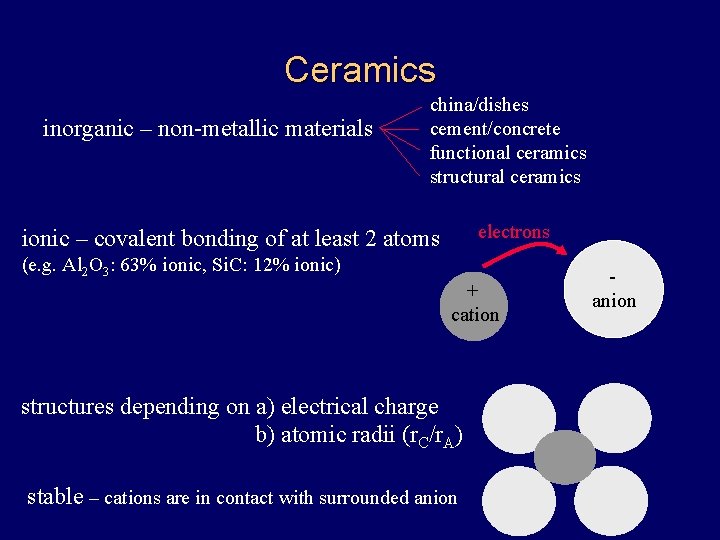
Ceramics inorganic – non-metallic materials china/dishes cement/concrete functional ceramics structural ceramics electrons ionic – covalent bonding of at least 2 atoms (e. g. Al 2 O 3: 63% ionic, Si. C: 12% ionic) + cation structures depending on a) electrical charge b) atomic radii (r. C/r. A) stable – cations are in contact with surrounded anion
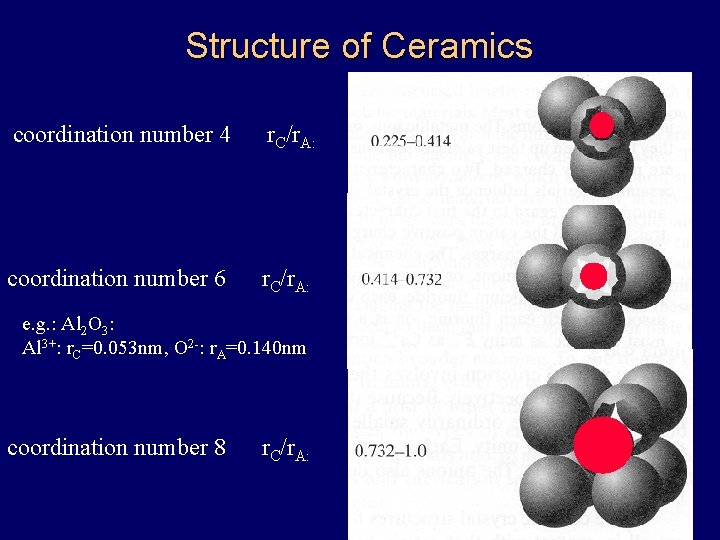
Structure of Ceramics coordination number 4 r. C/r. A: coordination number 6 r. C/r. A: e. g. : Al 2 O 3: Al 3+: r. C=0. 053 nm, O 2 -: r. A=0. 140 nm coordination number 8 r. C/r. A:
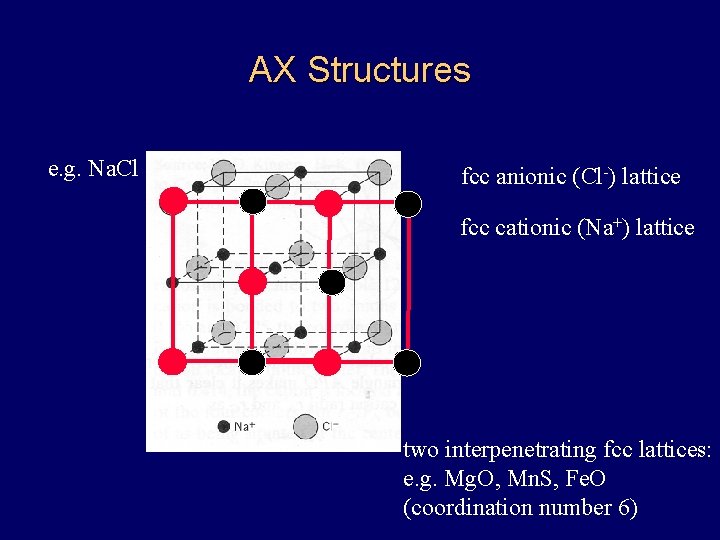
AX Structures e. g. Na. Cl fcc anionic (Cl-) lattice fcc cationic (Na+) lattice two interpenetrating fcc lattices: e. g. Mg. O, Mn. S, Fe. O (coordination number 6)
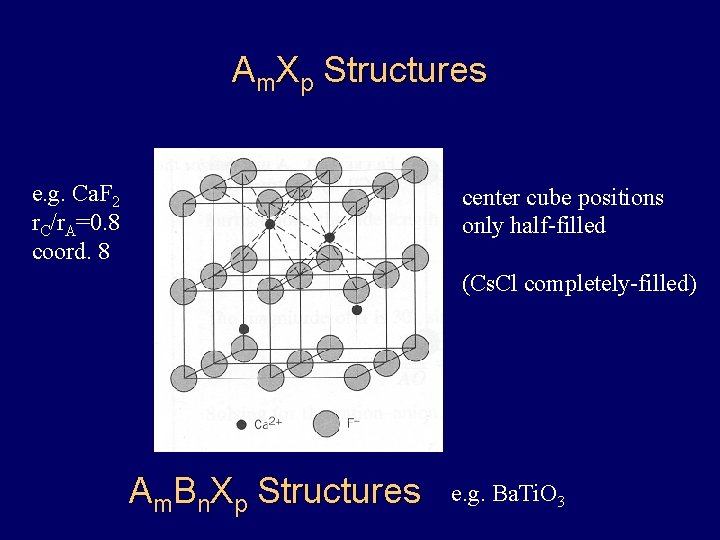
Am. Xp Structures e. g. Ca. F 2 r. C/r. A=0. 8 coord. 8 center cube positions only half-filled (Cs. Cl completely-filled) Am. Bn. Xp Structures e. g. Ba. Ti. O 3
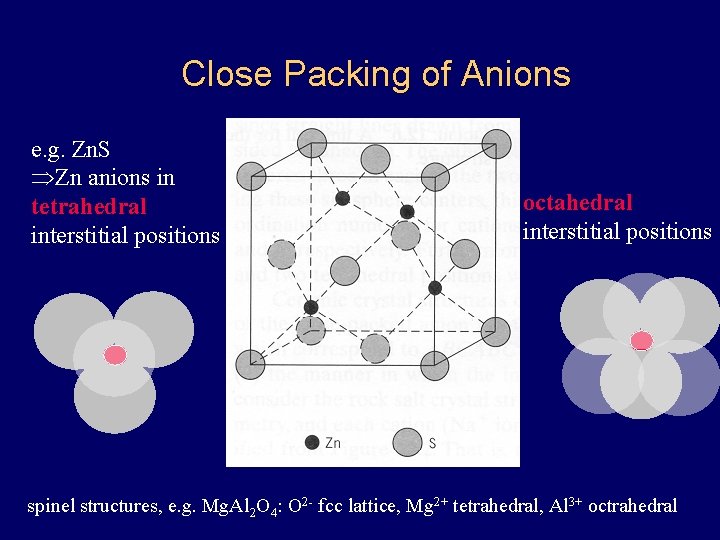
Close Packing of Anions e. g. Zn. S ÞZn anions in tetrahedral interstitial positions octahedral interstitial positions spinel structures, e. g. Mg. Al 2 O 4: O 2 - fcc lattice, Mg 2+ tetrahedral, Al 3+ octrahedral
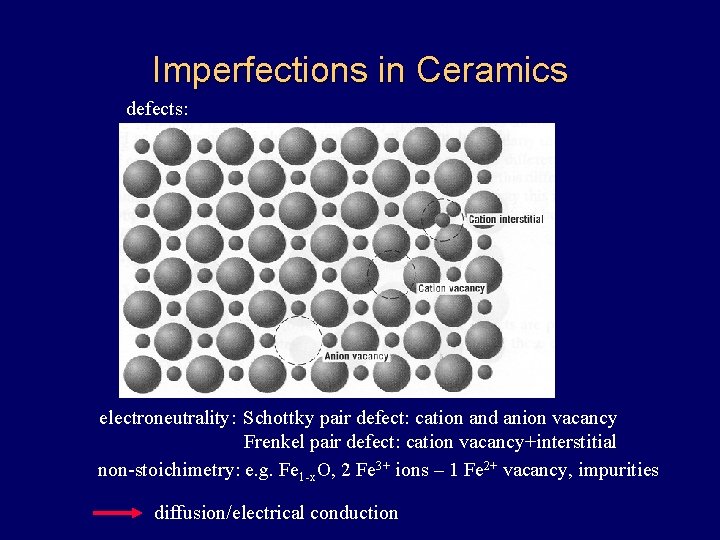
Imperfections in Ceramics defects: electroneutrality: Schottky pair defect: cation and anion vacancy Frenkel pair defect: cation vacancy+interstitial non-stoichimetry: e. g. Fe 1 -x. O, 2 Fe 3+ ions – 1 Fe 2+ vacancy, impurities diffusion/electrical conduction
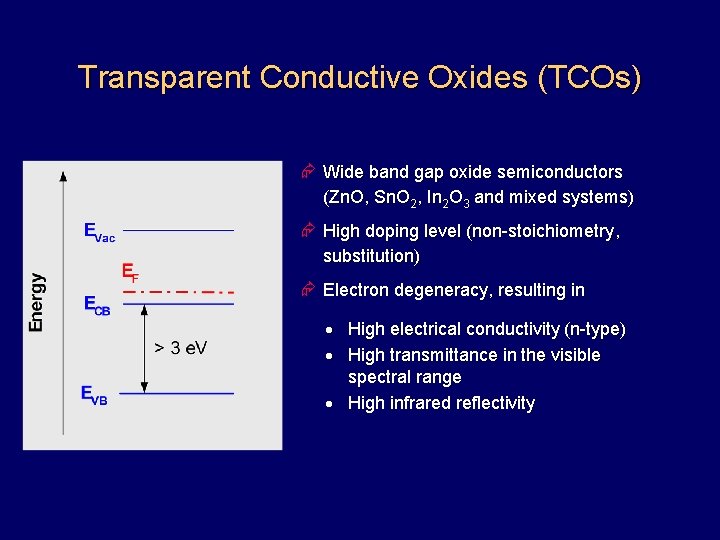
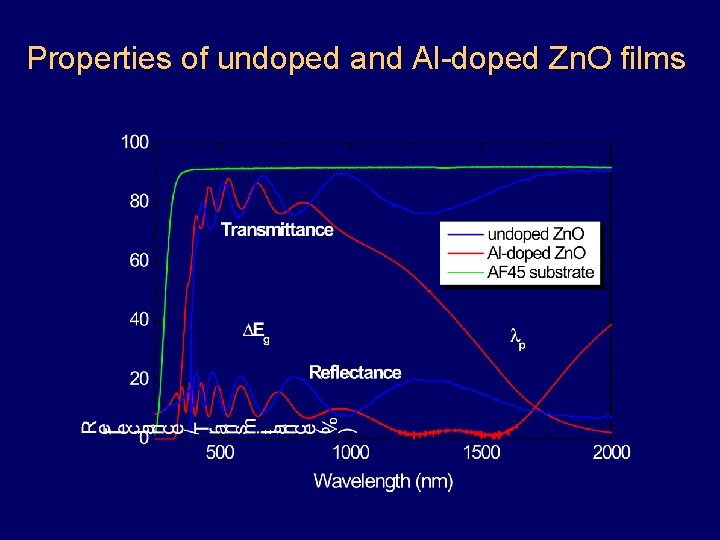
Transparent Conductive Oxides (TCOs) Wide band gap oxide semiconductors (Zn. O, Sn. O 2, In 2 O 3 and mixed systems) High doping level (non-stoichiometry, substitution) Electron degeneracy, resulting in High electrical conductivity (n-type) High transmittance in the visible spectral range High infrared reflectivity
Properties of undoped and Al-doped Zn. O films
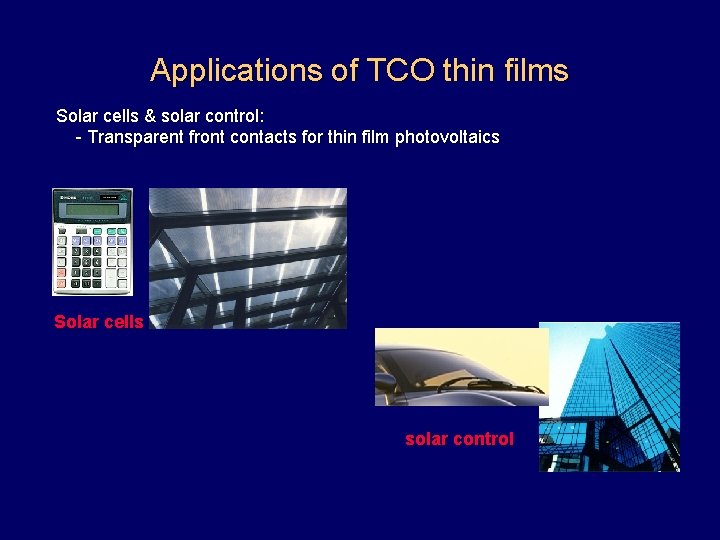
Applications of TCO thin films Solar cells & solar control: - Transparent front contacts for thin film photovoltaics Solar cells solar control
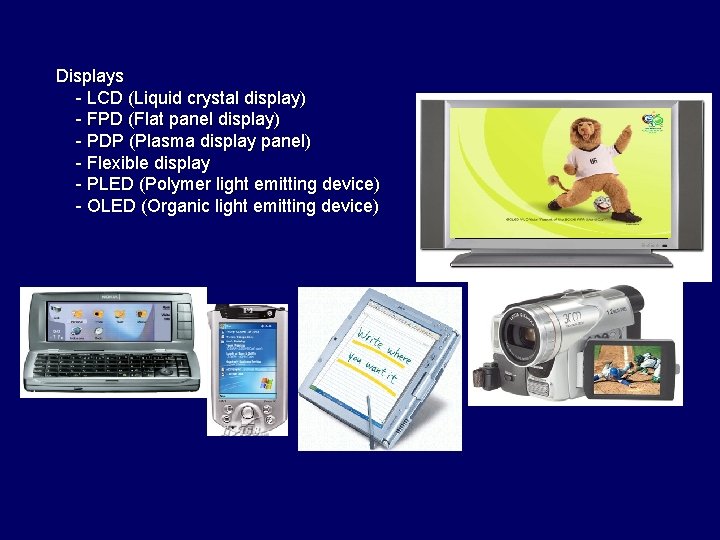
Displays - LCD (Liquid crystal display) - FPD (Flat panel display) - PDP (Plasma display panel) - Flexible display - PLED (Polymer light emitting device) - OLED (Organic light emitting device)
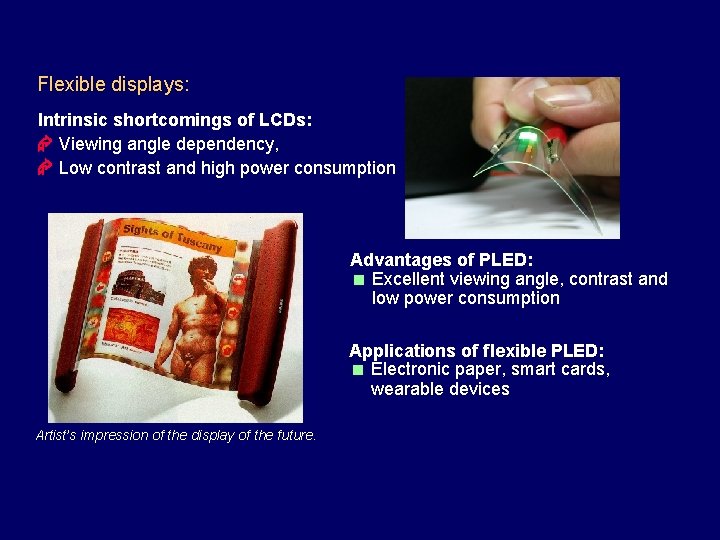
Flexible displays: Intrinsic shortcomings of LCDs: Viewing angle dependency, Low contrast and high power consumption Advantages of PLED: Excellent viewing angle, contrast and low power consumption Applications of flexible PLED: Electronic paper, smart cards, wearable devices Artist’s impression of the display of the future.
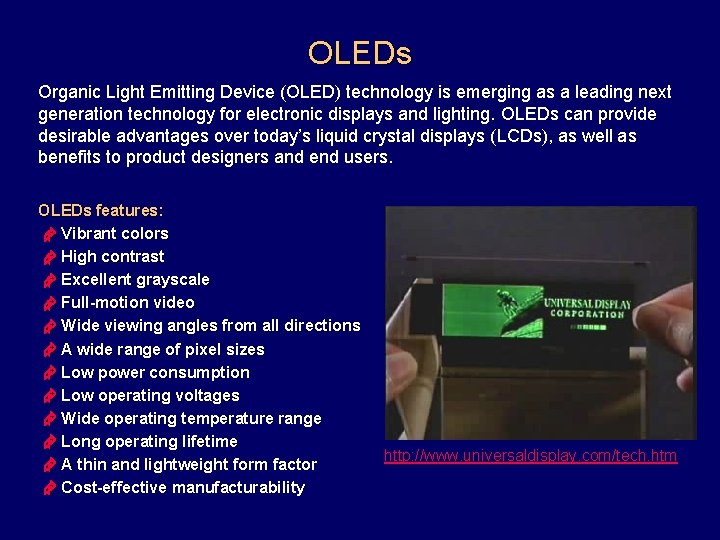
OLEDs Organic Light Emitting Device (OLED) technology is emerging as a leading next generation technology for electronic displays and lighting. OLEDs can provide desirable advantages over today’s liquid crystal displays (LCDs), as well as benefits to product designers and end users. OLEDs features: Vibrant colors High contrast Excellent grayscale Full motion video Wide viewing angles from all directions A wide range of pixel sizes Low power consumption Low operating voltages Wide operating temperature range Long operating lifetime A thin and lightweight form factor Cost effective manufacturability http: //www. universaldisplay. com/tech. htm
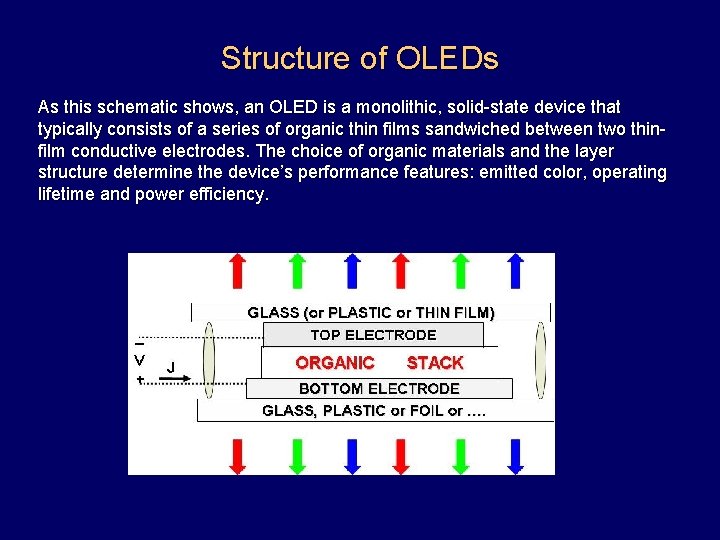
Structure of OLEDs As this schematic shows, an OLED is a monolithic, solid-state device that typically consists of a series of organic thin films sandwiched between two thinfilm conductive electrodes. The choice of organic materials and the layer structure determine the device’s performance features: emitted color, operating lifetime and power efficiency.
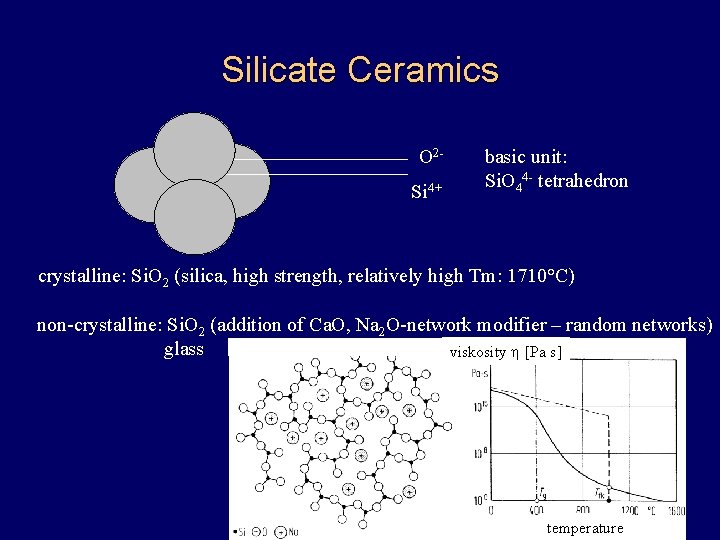
Silicate Ceramics O 2 Si 4+ basic unit: Si. O 44 - tetrahedron crystalline: Si. O 2 (silica, high strength, relatively high Tm: 1710°C) non-crystalline: Si. O 2 (addition of Ca. O, Na 2 O-network modifier – random networks) glass viskosity h [Pa s] temperature
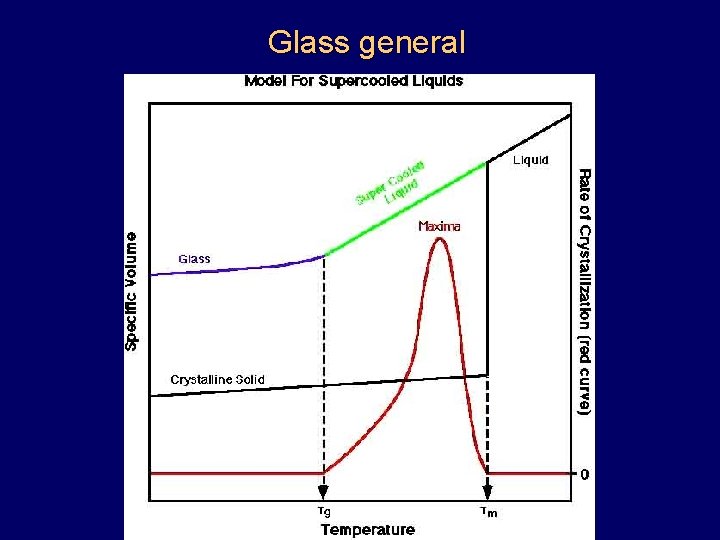
Glass general
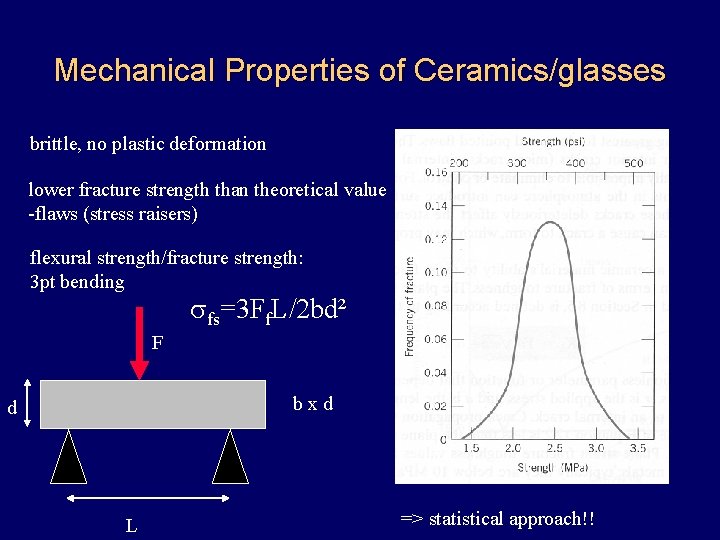
Mechanical Properties of Ceramics/glasses brittle, no plastic deformation lower fracture strength than theoretical value -flaws (stress raisers) flexural strength/fracture strength: 3 pt bending sfs=3 Ff. L/2 bd² F bxd d L => statistical approach!!
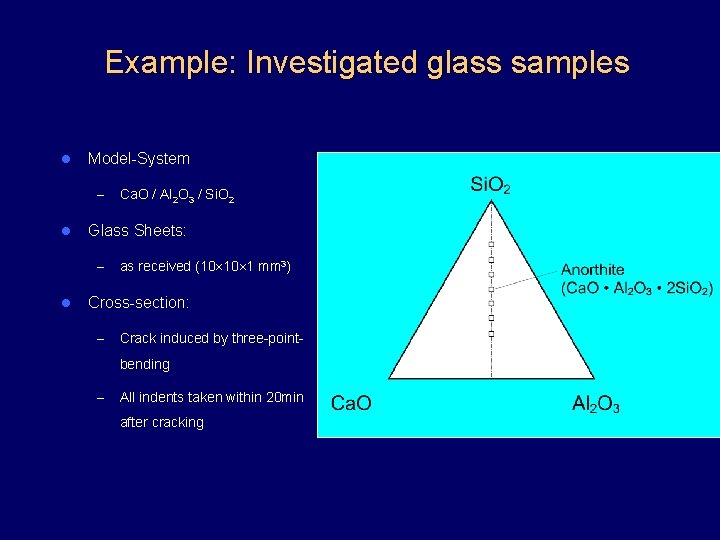
Example: Investigated glass samples l Model-System – l Glass Sheets: – l Ca. O / Al 2 O 3 / Si. O 2 as received (10 10 1 mm 3) Cross-section: – Crack induced by three-pointbending – All indents taken within 20 min after cracking
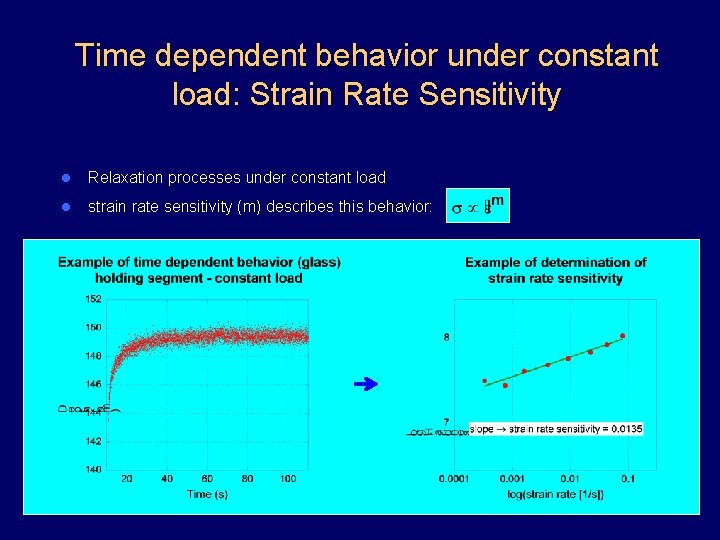
Time dependent behavior under constant load: Strain Rate Sensitivity l Relaxation processes under constant load l strain rate sensitivity (m) describes this behavior:
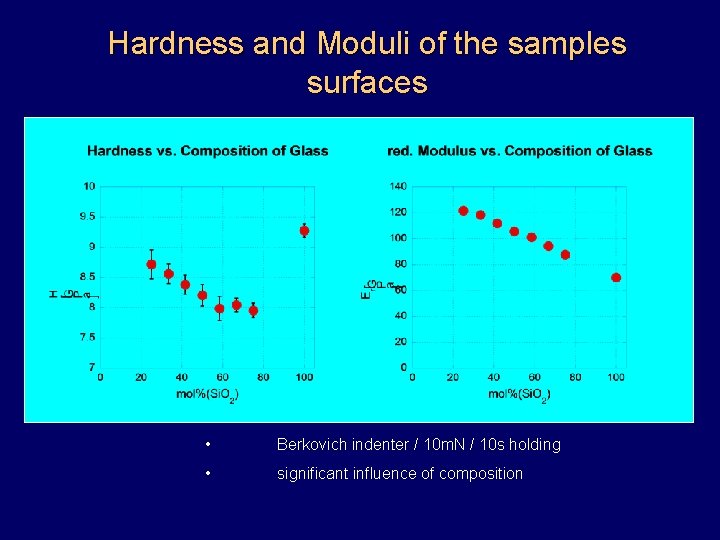
Hardness and Moduli of the samples surfaces • Berkovich indenter / 10 m. N / 10 s holding • significant influence of composition
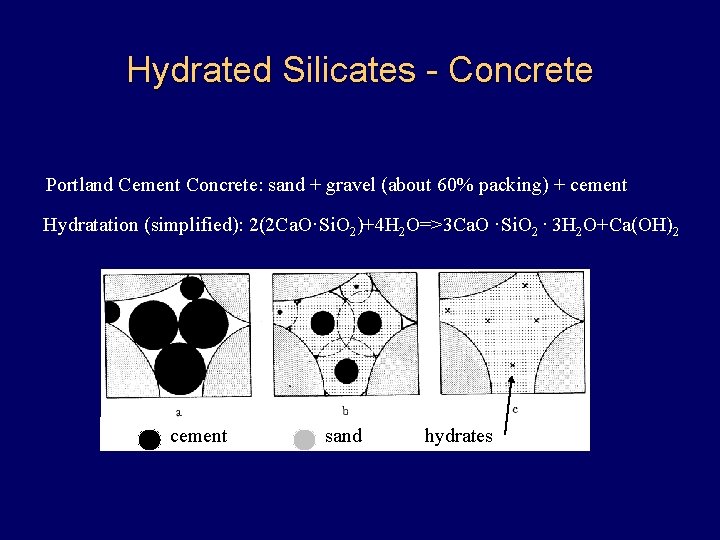
Hydrated Silicates - Concrete Portland Cement Concrete: sand + gravel (about 60% packing) + cement Hydratation (simplified): 2(2 Ca. O·Si. O 2)+4 H 2 O=>3 Ca. O ·Si. O 2 · 3 H 2 O+Ca(OH)2 cement sand hydrates
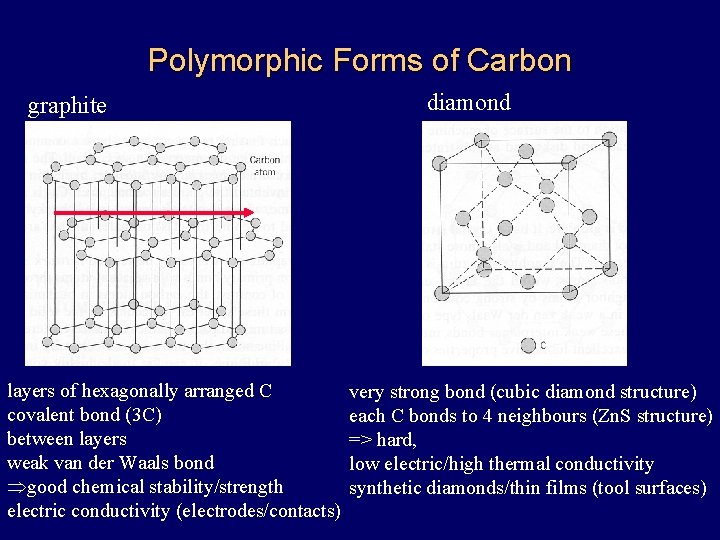
Polymorphic Forms of Carbon graphite layers of hexagonally arranged C covalent bond (3 C) between layers weak van der Waals bond Þgood chemical stability/strength electric conductivity (electrodes/contacts) diamond very strong bond (cubic diamond structure) each C bonds to 4 neighbours (Zn. S structure) => hard, low electric/high thermal conductivity synthetic diamonds/thin films (tool surfaces)
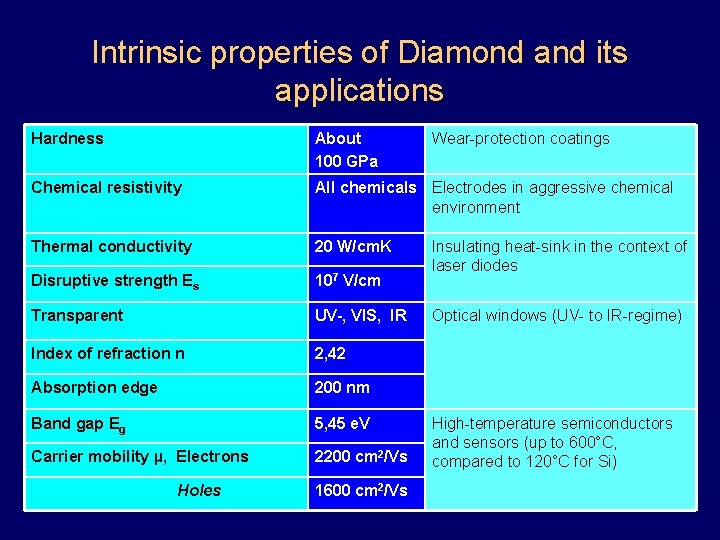
Intrinsic properties of Diamond and its applications Hardness About 100 GPa Chemical resistivity All chemicals Electrodes in aggressive chemical environment Thermal conductivity 20 W/cm. K Disruptive strength Es 107 V/cm Transparent UV , VIS, IR Index of refraction n 2, 42 Absorption edge 200 nm Band gap Eg 5, 45 e. V Carrier mobility µ, Electrons 2200 cm 2/Vs Holes 1600 cm 2/Vs Wear-protection coatings Insulating heat-sink in the context of laser diodes Optical windows (UV- to IR-regime) High-temperature semiconductors and sensors (up to 600°C, compared to 120°C for Si)
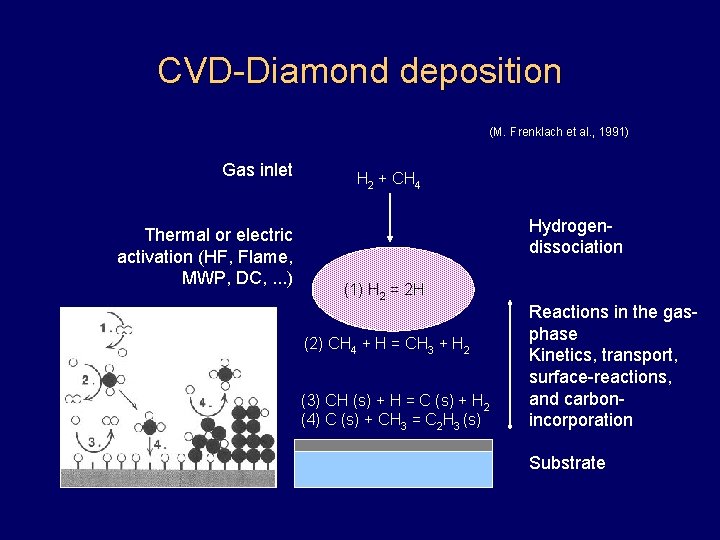
CVD-Diamond deposition (M. Frenklach et al. , 1991) Gas inlet Thermal or electric activation (HF, Flame, MWP, DC, . . . ) H 2 + CH 4 Hydrogendissociation (1) H 2 = 2 H (2) CH 4 + H = CH 3 + H 2 (3) CH (s) + H = C (s) + H 2 (4) C (s) + CH 3 = C 2 H 3 (s) Reactions in the gasphase Kinetics, transport, surface-reactions, and carbonincorporation Substrate
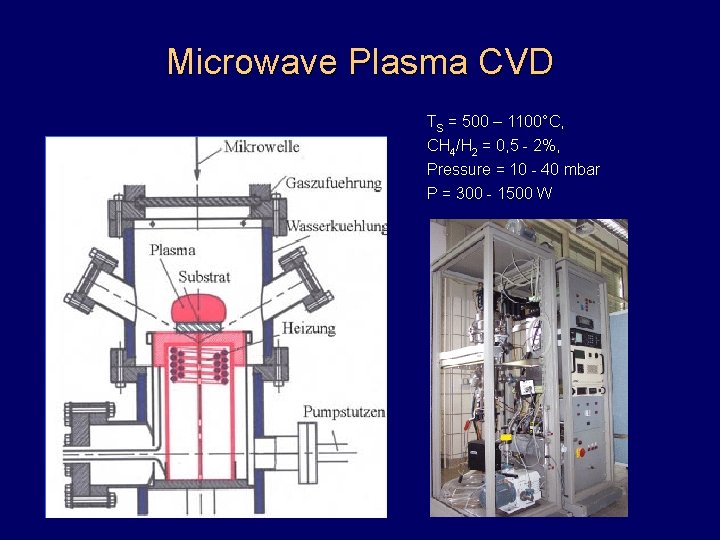
Microwave Plasma CVD TS = 500 – 1100°C, CH 4/H 2 = 0, 5 - 2%, Pressure = 10 - 40 mbar P = 300 - 1500 W
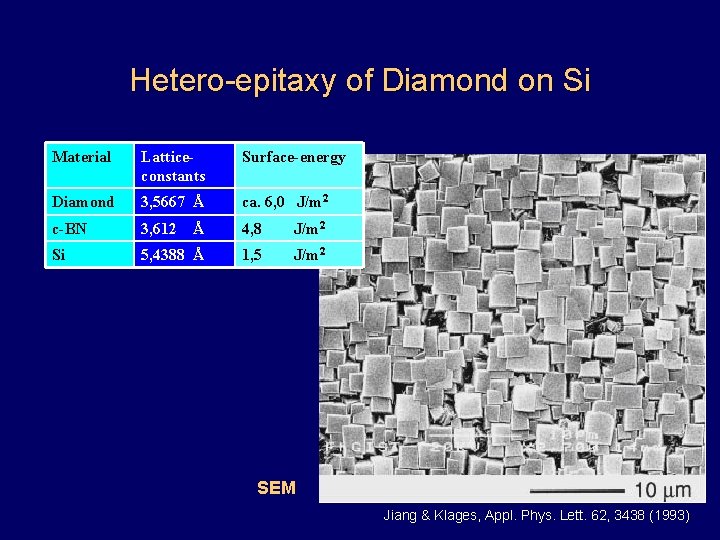
Hetero-epitaxy of Diamond on Si Material Latticeconstants Surface-energy Diamond 3, 5667 Å ca. 6, 0 J/m 2 c-BN 3, 612 Å 4, 8 J/m 2 Si 5, 4388 Å 1, 5 J/m 2 SEM Jiang & Klages, Appl. Phys. Lett. 62, 3438 (1993)
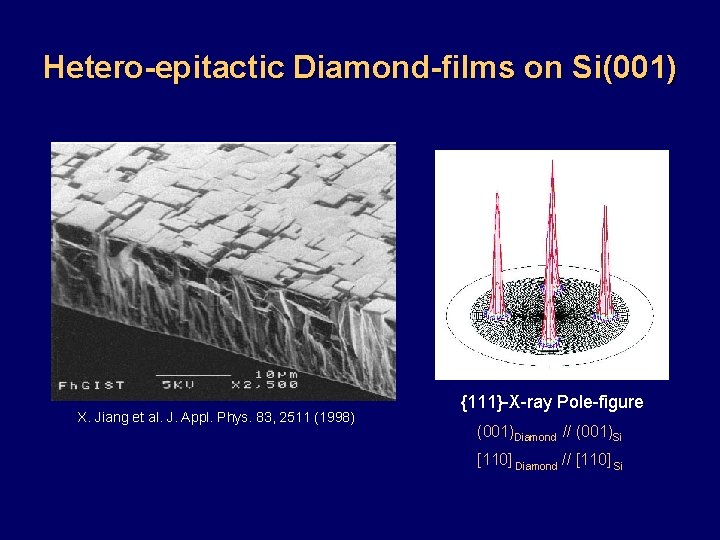
Hetero epitactic Diamond films on Si(001) X. Jiang et al. J. Appl. Phys. 83, 2511 (1998) {111}-X-ray Pole-figure (001)Diamond // (001)Si [110] Diamond // [110] Si
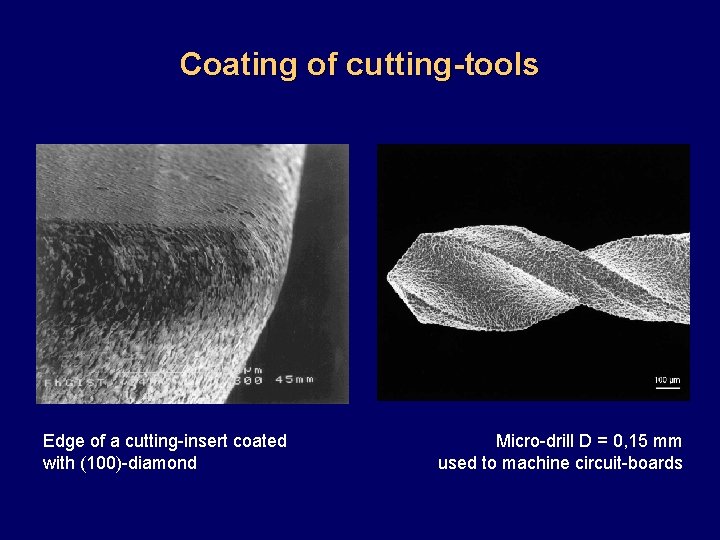
Coating of cutting tools Edge of a cutting-insert coated with (100)-diamond Micro-drill D = 0, 15 mm used to machine circuit-boards
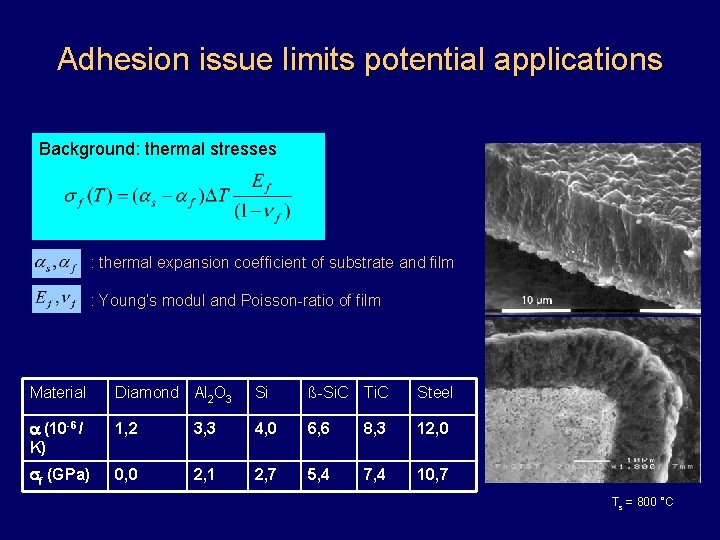
Adhesion issue limits potential applications Background: thermal stresses : thermal expansion coefficient of substrate and film : Young’s modul and Poisson-ratio of film Material Diamond Al 2 O 3 Si ß-Si. C Ti. C Steel a (10 6 / K) 1, 2 3, 3 4, 0 6, 6 8, 3 12, 0 f (GPa) 0, 0 2, 1 2, 7 5, 4 7, 4 10, 7 Ts = 800 °C
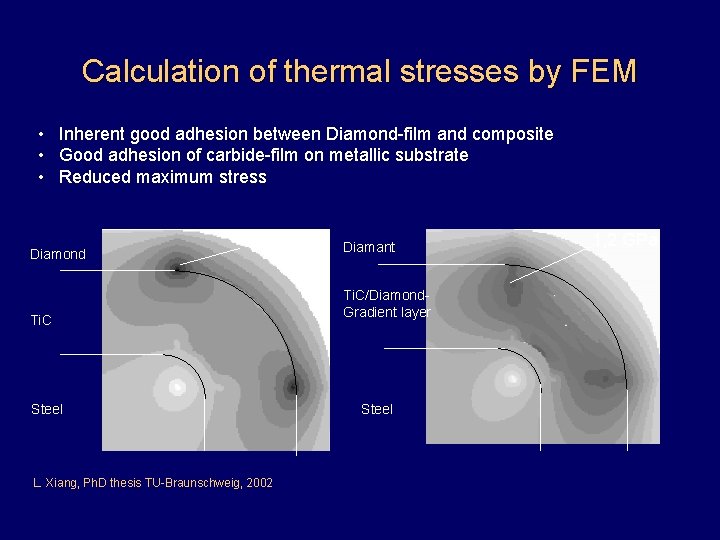
Calculation of thermal stresses by FEM • Inherent good adhesion between Diamond-film and composite • Good adhesion of carbide-film on metallic substrate • Reduced maximum stress Diamond 1, 94 GPa Ti. C Steel L. Xiang, Ph. D thesis TU-Braunschweig, 2002 Diamant Ti. C/Diamond. Gradient layer Steel 1, 2 GPa
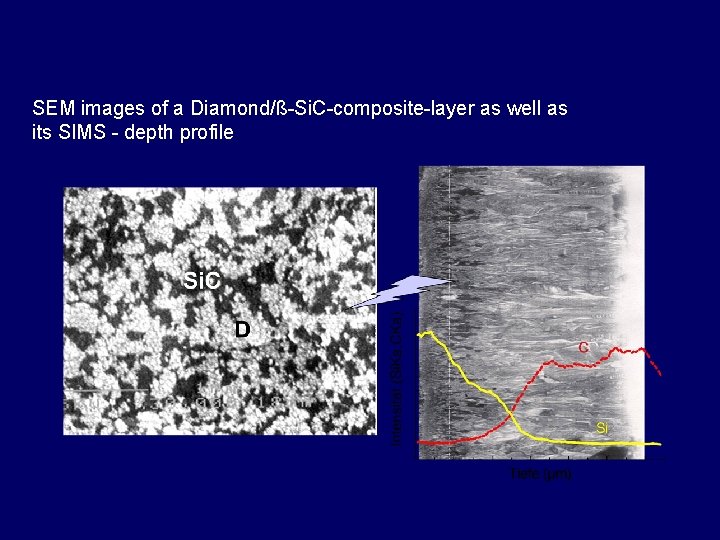
SEM images of a Diamond/ß-Si. C-composite-layer as well as its SIMS - depth profile
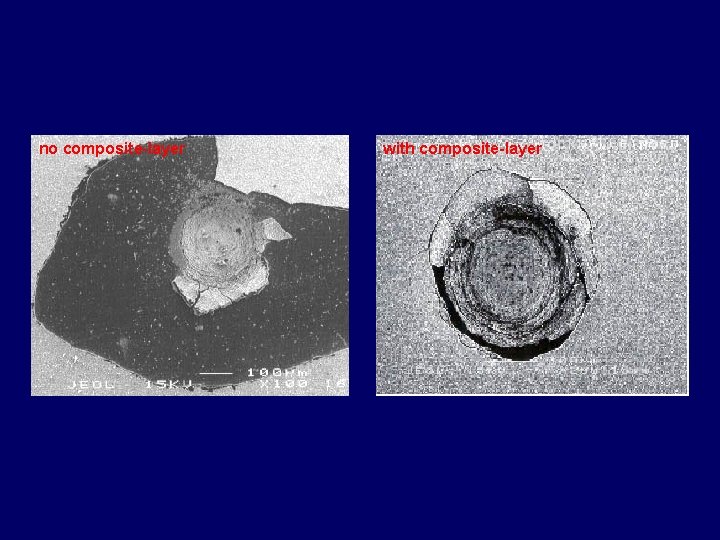
no composite layer with composite layer
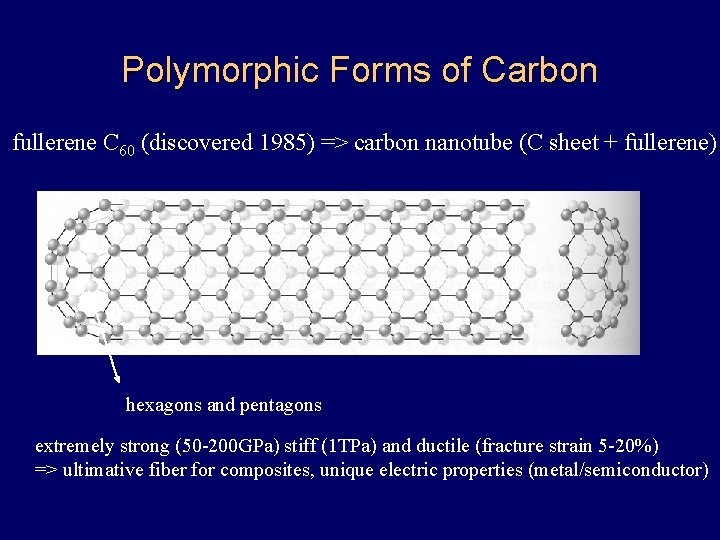
Polymorphic Forms of Carbon fullerene C 60 (discovered 1985) => carbon nanotube (C sheet + fullerene) hexagons and pentagons extremely strong (50 -200 GPa) stiff (1 TPa) and ductile (fracture strain 5 -20%) => ultimative fiber for composites, unique electric properties (metal/semiconductor)
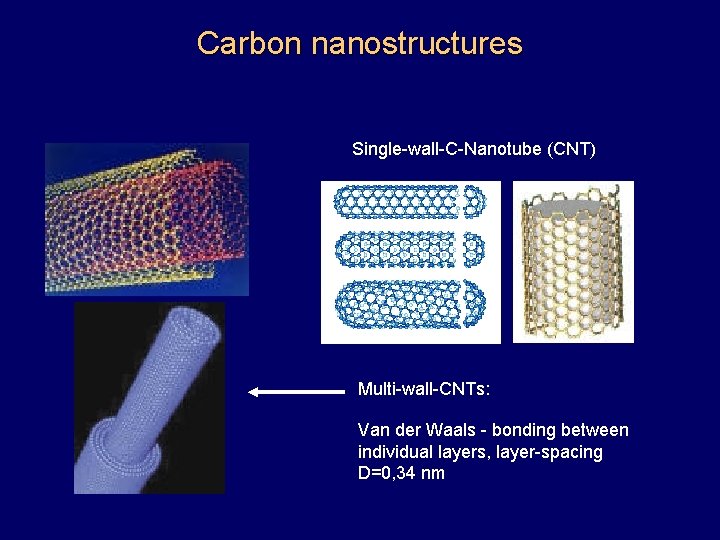
Carbon nanostructures Single-wall-C-Nanotube (CNT) Multi-wall-CNTs: Van der Waals - bonding between individual layers, layer-spacing D=0, 34 nm
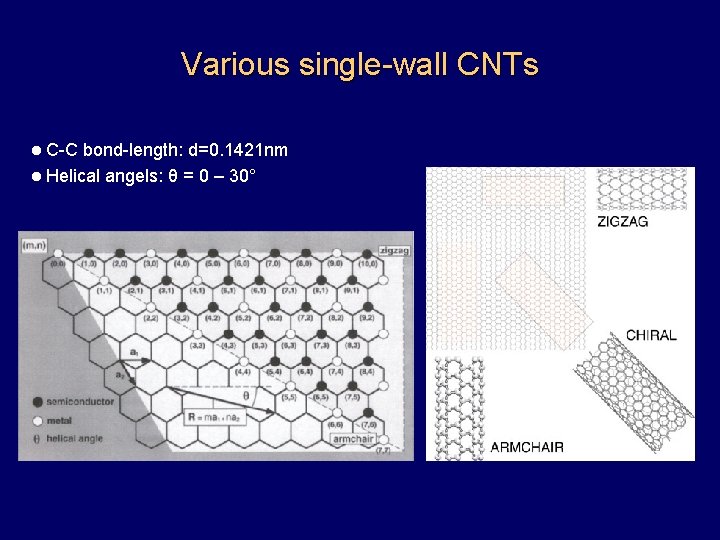
Various single-wall CNTs l C-C bond-length: d=0. 1421 nm l Helical angels: θ = 0 – 30°
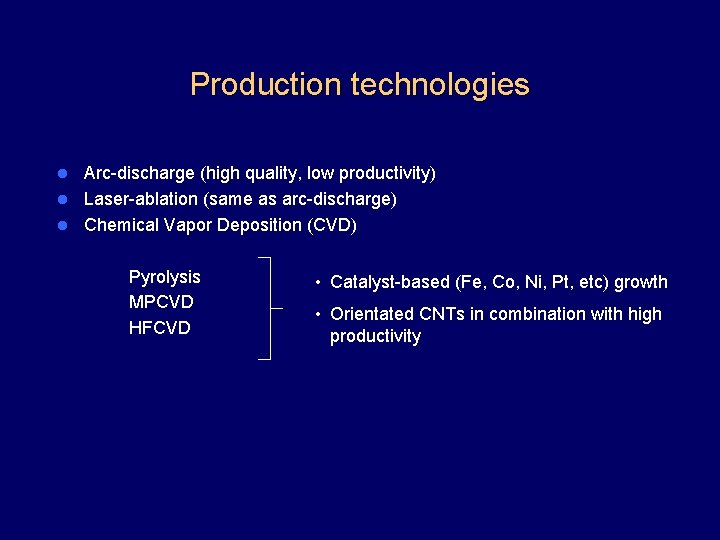
Production technologies Arc-discharge (high quality, low productivity) l Laser-ablation (same as arc-discharge) l Chemical Vapor Deposition (CVD) l Pyrolysis MPCVD HFCVD • Catalyst-based (Fe, Co, Ni, Pt, etc) growth • Orientated CNTs in combination with high productivity
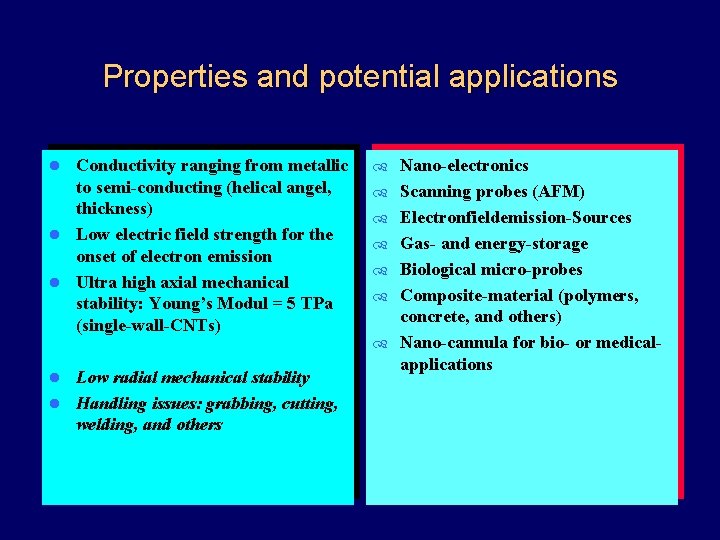
Properties and potential applications Conductivity ranging from metallic to semi-conducting (helical angel, thickness) l Low electric field strength for the onset of electron emission l Ultra high axial mechanical stability: Young’s Modul = 5 TPa (single-wall-CNTs) l Low radial mechanical stability l Handling issues: grabbing, cutting, welding, and others l Nano-electronics Scanning probes (AFM) Electronfieldemission-Sources Gas- and energy-storage Biological micro-probes Composite-material (polymers, concrete, and others) Nano-cannula for bio- or medicalapplications