
CEQA 101 Introduction to the California Environmental Quality
- Slides: 20
CEQA 101: Introduction to the California Environmental Quality Act May 26, 2020
Purpose of CEQA • National Environmental Policy Act (NEPA) (1969) • CEQA (1970)California Environmental Quality Act • Purposes: • Prevent significant, avoidable damage to the environment • Foster informed public decision making • Ensure transparency in governmental decision making process • Encourage public participation See CEQA §§ 21000 -21006; Guidelines 15001 -15003 2
Purpose of the EIR • Purpose of the EIR/HCP is to obtain the Incidental Take Permit - HCP is a required part of the ITP application • It is not the role of this EIR to evaluate existing authorized uses, the parameters of park operations, or regulatory permit conditions • These activities are not subject to CEQA review and don’t require comments • Role is limited to considering the effects of the HCP 3
Lead Agency Duties • CDPR is the lead agency that prepares the EIR to evaluate the environmental effects associated with the HCP when considering its approval. • No other state or local agencies are Responsible Agencies • Trustee Agencies have jurisdiction over natural resources affected by a project and may review the EIR – example – CDFW, CCC, SLOAPCD 4
Oceano Dunes EIR • Oceano Dunes currently has 3 -4 Separate Plans under development • HCP –California State Parks • Particulate Matter Reduction Plan –separate CEQA process (EIR) – Plan developed by CDPR but approved by SLO APCD • Public Works Plan –EIR prepared by DPR , must be certified by CCC – replaces the CDP (Coastal Development Permit). 5
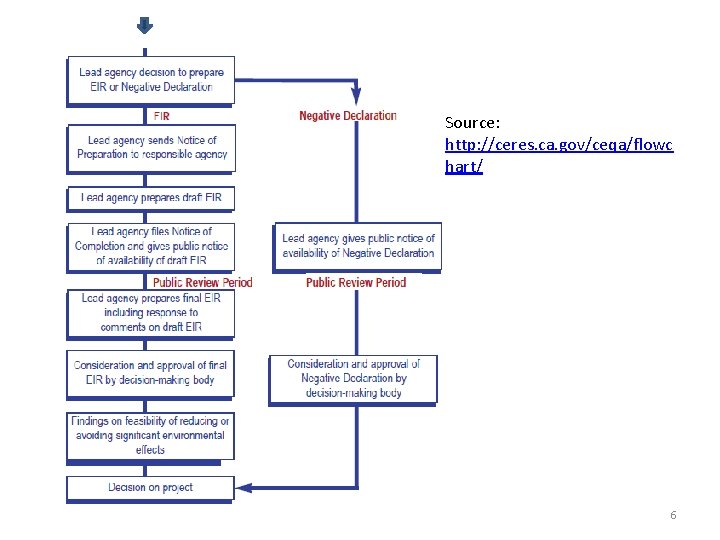
Source: http: //ceres. ca. gov/ceqa/flowc hart/ 6
CEQA • Different from NEPA- EIR must include Equal Consideration of Alternatives • Focus is on a physical change in the environment – Impacts are either direct or indirect – Impacts are significant or less than significant • No requirement to include consideration of environmental justice or economic considerations 7
Oceano Dunes EIR • The EIR impact analysis evaluates in detail potential impacts of the HCP to land use, air quality, biological resources, cultural resources, and recreation. • A summary of project impacts and mitigation is presented in the EIR (Table S-1). • All impacts associated with the HCP can be reduced to less-than significant levels. There are no significant unavoidable impacts. 8
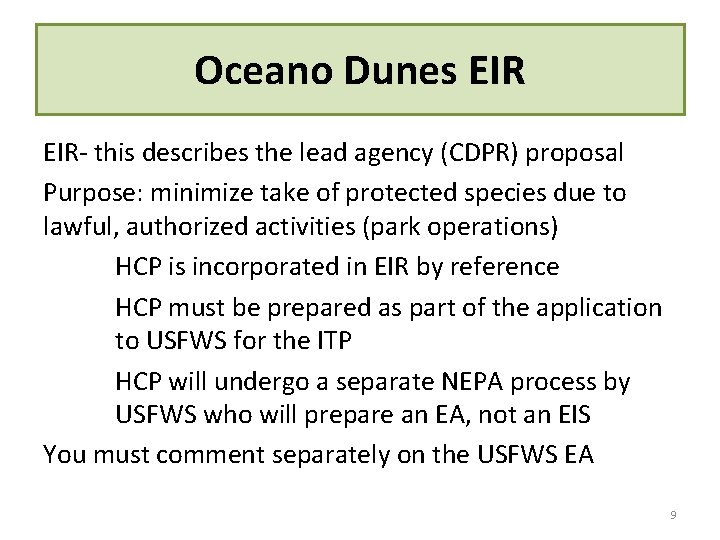
Oceano Dunes EIR- this describes the lead agency (CDPR) proposal Purpose: minimize take of protected species due to lawful, authorized activities (park operations) HCP is incorporated in EIR by reference HCP must be prepared as part of the application to USFWS for the ITP HCP will undergo a separate NEPA process by USFWS who will prepare an EA, not an EIS You must comment separately on the USFWS EA 9
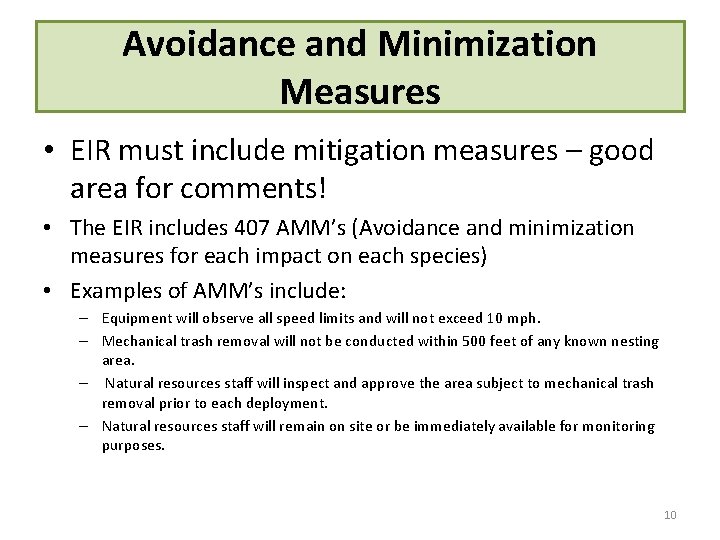
Avoidance and Minimization Measures • EIR must include mitigation measures – good area for comments! • The EIR includes 407 AMM’s (Avoidance and minimization measures for each impact on each species) • Examples of AMM’s include: – Equipment will observe all speed limits and will not exceed 10 mph. – Mechanical trash removal will not be conducted within 500 feet of any known nesting area. – Natural resources staff will inspect and approve the area subject to mechanical trash removal prior to each deployment. – Natural resources staff will remain on site or be immediately available for monitoring purposes. 10
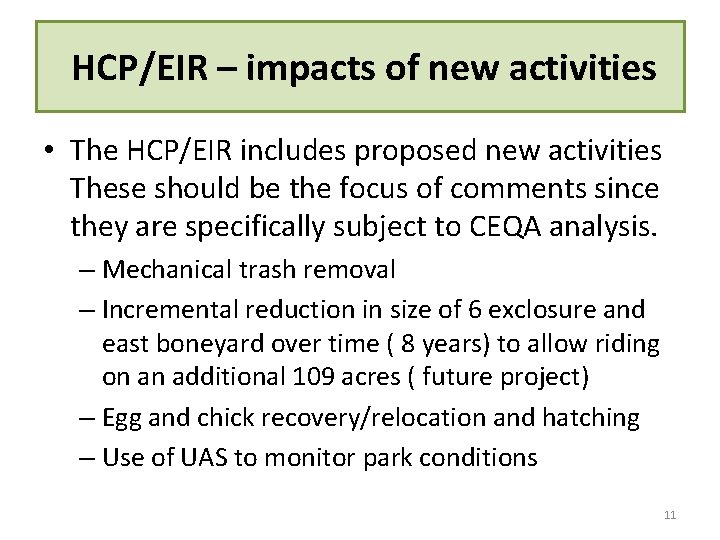
HCP/EIR – impacts of new activities • The HCP/EIR includes proposed new activities These should be the focus of comments since they are specifically subject to CEQA analysis. – Mechanical trash removal – Incremental reduction in size of 6 exclosure and east boneyard over time ( 8 years) to allow riding on an additional 109 acres ( future project) – Egg and chick recovery/relocation and hatching – Use of UAS to monitor park conditions 11
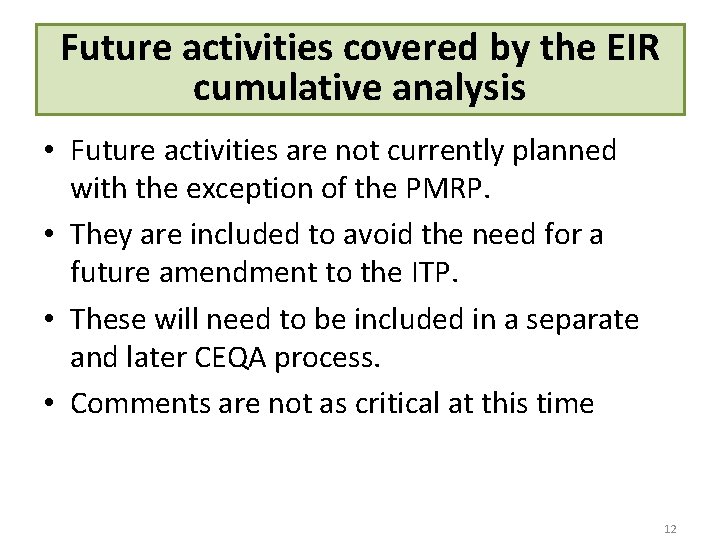
Additional Park Activities Future activities covered by. Covered the EIR cumulative analysis by HCP • Future activities are not currently planned with the exception of the PMRP. • They are included to avoid the need for a future amendment to the ITP. • These will need to be included in a separate and later CEQA process. • Comments are not as critical at this time 12
Commenting on the HCP/EIR • Include suggestions for making the project better • Examples 1. Why or why not should the 6 exclosure be reduced in size? 2. Will the East Boneyard exclosure changes help the public? 3. Current success of current species conservation programs 4. Comment on the wide range visitor activities supported by current Park operations 5. SVRA access – how could it be improved? 6. Reduced riding times 7. increased/reduced vehicle limits – Your goal should be to write something that causes them to respond in a future document based on the evidence you have given. 13
Commenting on the HCP/EIR • Include suggestions for making the project better How could potential impacts from this change be mitigated? Rider education Increased patrols – Your goal should be to write something that causes them to respond in a future document based on the evidence you have given. 14
Additional Park Activities Future activities covered by. Covered the EIR cumulative analysis by HCP • Proposed future activities would need to be covered under a separate CEQA process, but would be covered under the ITP • • • Particulate Matter Reduction Plan (PMRP; CA-44). Riding in 40 Acres (CA-42) replacement of the safety and education center (CA-43) Oso Flaco Lake boardwalk replacement (CA-48) Special projects (CA-49). Pismo Beach Lodge 15
Approving the Project After circulating draft EIR, agency must: • Evaluate and respond to comments (Guidelines, § 15088) • Prepare final EIR (§ 15089) • Certify final EIR (§ 15090) • Make findings concerning significant impacts (§ 15091) • Approve (or reject) the project (§ 15092) • Impose a mitigation monitoring/reporting program (§ 15097) • If necessary, issue a Statement of Overriding Considerations (Pub. Res. Code § 21081; § 15093) 16
Public Participation • Opportunities for public participation at every stage of process. • Commenters can provide recommendations and submit data/information, where available. • Two main opportunities for comments; during comment period on environmental document and before the close of the hearing on project. • Administrative appeal may be available (e. g. , to Board of Supervisors). • Legal challenges governed by strict time limits and criteria in Pub. Res. Code § 21167, et seq. and Guidelines § 15112. • Exhaustion of administrative remedies prerequisite to lawsuit. 17
How to comment • Written comments should be submitted no later than June 1, 2015, to the following address: • Mr. Ronnie Glick, Senior Environmental Scientist, California Department Parks and Recreation, Oceano Dunes District, 340 James Way, Ste. 270, Pismo Beach, CA 93449 or to Oceano. Dunes. HCP@parks. ca. gov 18
Resources California Environmental Quality Act (CEQA), Pub. Res. Code, § 21000, et seq. (available at http: //ceres. ca. gov/ceqa/) Guidelines for the Implementation of CEQA (CEQA Guidelines) (available at http: //ceres. ca. gov/ceqa/) CEQA – Frequently Asked Questions (http: //ceres. ca. gov/ceqa/more/faq. html) CEQAmap (free database of CEQA documents) (http: //www. ceqamap. com/) Governor’s Office of Planning and Research, State Clearinghouse (http: //opr. ca. gov/index. php? a=sch/sch. html) Recent Updates re CEQA and Climate Change (Senate Bill 97) (http: //ceres. ca. gov/ceqa/guidelines/) 19
Questions? http: //gallery. usgs. gov/photos/03_02_2009_c 2 WJb 44 ay 7_03_02_2009_2 20