
Cephalosporins History of Cephalosporins l Cephalosporin compounds were


- Slides: 19
Cephalosporins
History of Cephalosporins l Cephalosporin compounds were first isolated from cultures of Cephalosporium acremonium from a sewer in Sardinia in 1948 by Italian scientist Giuseppe Brotzu l First commercial Cephalosporin was Cephalothin launched by Eli Lily in 1964 l Cephalosporins disrupt the synthesis of the peptidoglycan layer of bacterial cell walls
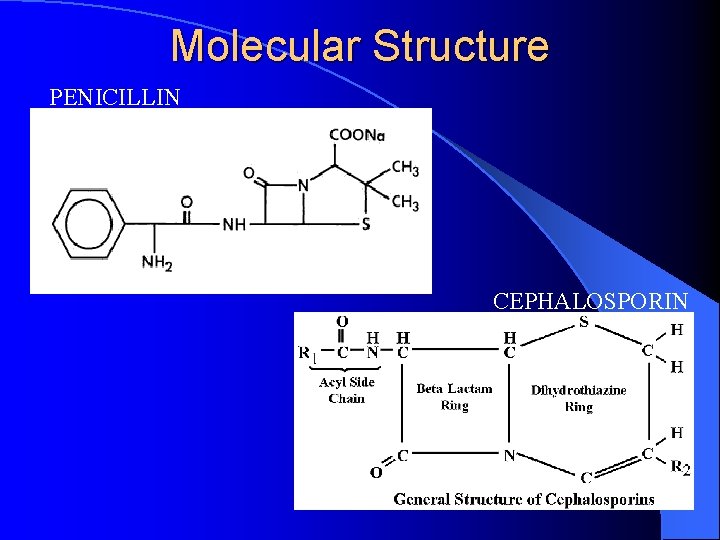
Molecular Structure PENICILLIN CEPHALOSPORIN
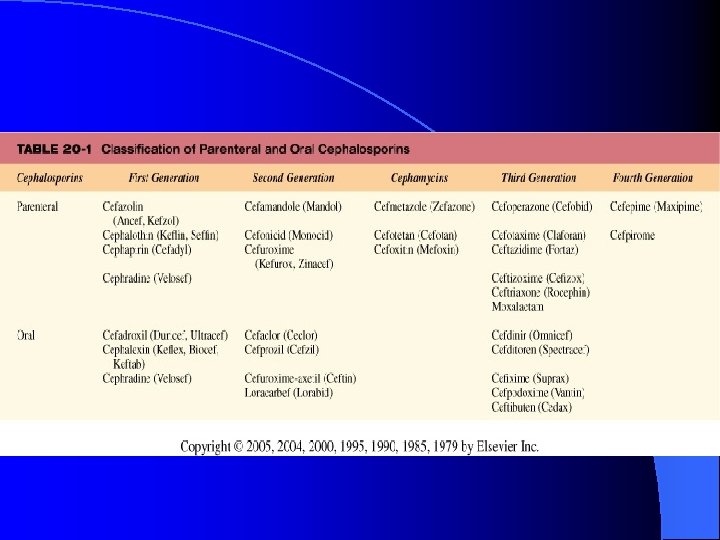
Classification of Cephalosporins l First Generation – Cephazolin l Good activity v Staphs and Streps Second Generation – Cefuroxime Increased activity v Gram Negatives – Cefaclor Slightly less activity against Gram Positives – Cefoxitin (cephamycin) l Third Generation – Ceftriaxone, – Ceftazidime l Very good Gram negative coverage Cefotaxime Reasonable against Gram Positives Ceftazidime has anti-pseudomonal activity Fourth Generation – Cefipime Very broad spectrum activity including Pseudomonas
& 5 th Generation…. l Ceftobiprole Medocaril l Activity v MRSA & PRP. l Has completed Phase III trials for treatment of soft tissue infections and HAP. Licensing probably imminent.
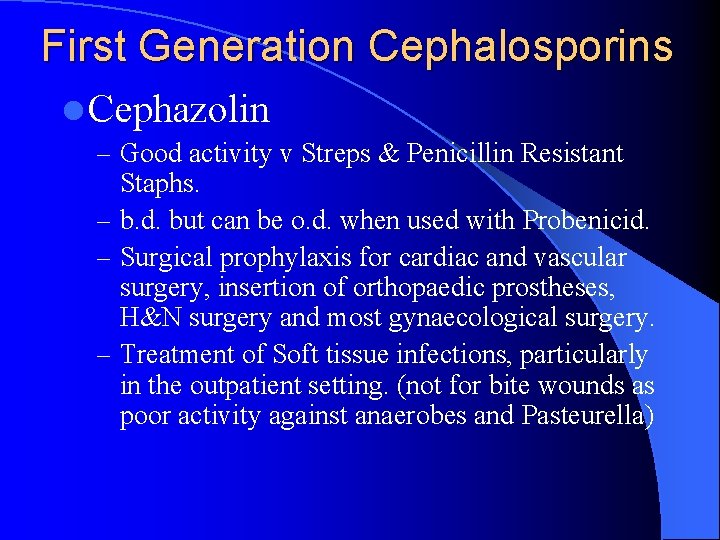
First Generation Cephalosporins l Cephazolin – Good activity v Streps & Penicillin Resistant Staphs. – b. d. but can be o. d. when used with Probenicid. – Surgical prophylaxis for cardiac and vascular surgery, insertion of orthopaedic prostheses, H&N surgery and most gynaecological surgery. – Treatment of Soft tissue infections, particularly in the outpatient setting. (not for bite wounds as poor activity against anaerobes and Pasteurella)
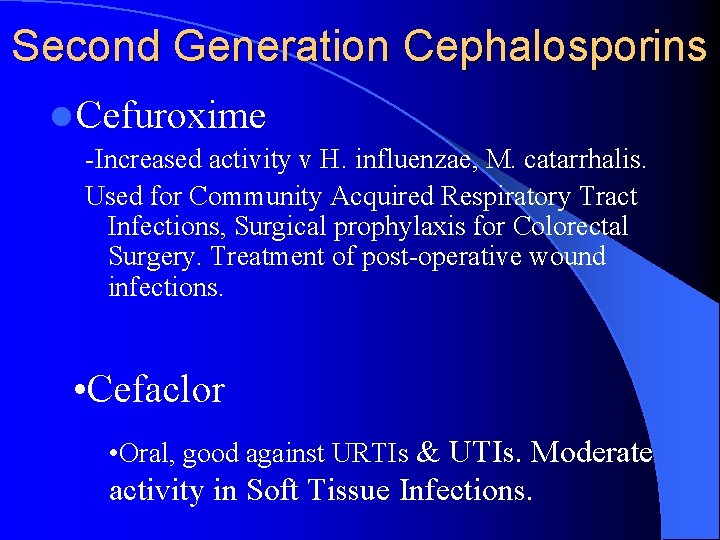
Second Generation Cephalosporins l Cefuroxime -Increased activity v H. influenzae, M. catarrhalis. Used for Community Acquired Respiratory Tract Infections, Surgical prophylaxis for Colorectal Surgery. Treatment of post-operative wound infections. • Cefaclor • Oral, good against URTIs & UTIs. Moderate activity in Soft Tissue Infections.
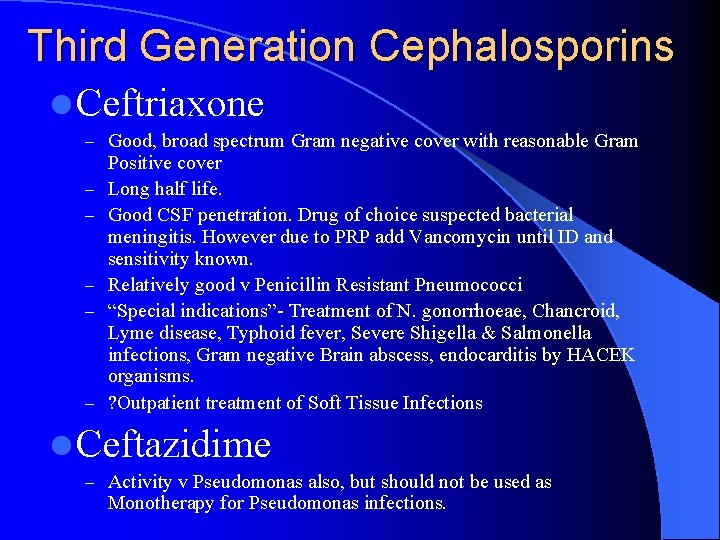
Third Generation Cephalosporins l Ceftriaxone – Good, broad spectrum Gram negative cover with reasonable Gram – – – Positive cover Long half life. Good CSF penetration. Drug of choice suspected bacterial meningitis. However due to PRP add Vancomycin until ID and sensitivity known. Relatively good v Penicillin Resistant Pneumococci “Special indications”- Treatment of N. gonorrhoeae, Chancroid, Lyme disease, Typhoid fever, Severe Shigella & Salmonella infections, Gram negative Brain abscess, endocarditis by HACEK organisms. ? Outpatient treatment of Soft Tissue Infections l Ceftazidime – Activity v Pseudomonas also, but should not be used as Monotherapy for Pseudomonas infections.
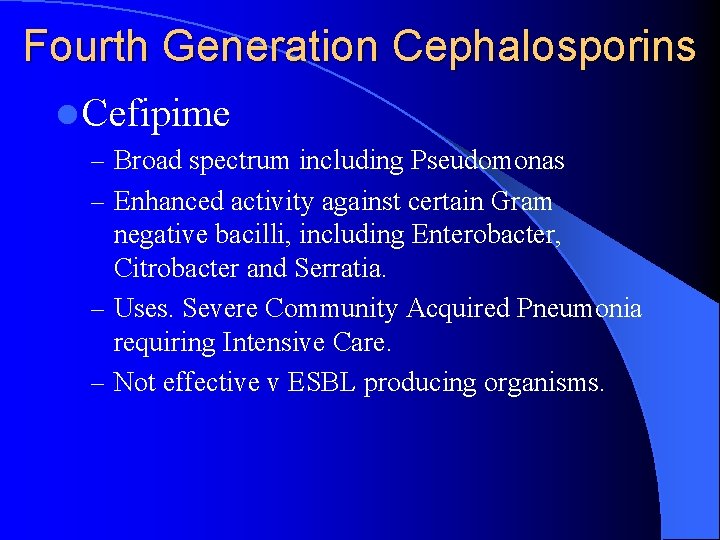
Fourth Generation Cephalosporins l Cefipime – Broad spectrum including Pseudomonas – Enhanced activity against certain Gram negative bacilli, including Enterobacter, Citrobacter and Serratia. – Uses. Severe Community Acquired Pneumonia requiring Intensive Care. – Not effective v ESBL producing organisms.
Cephamycins l l l Eg Cefoxitin, Cefotetan Often grouped with 2 nd generation cephalosporins. Have anaerobic activity (in particular Bacteroides) Also in-vitro activity v ESBL bacteria, but upregulation of efflux mechanisms limits clinical use for these organisms. Clinically useful in Surgical Prophylaxis for Colorectal Surgery.
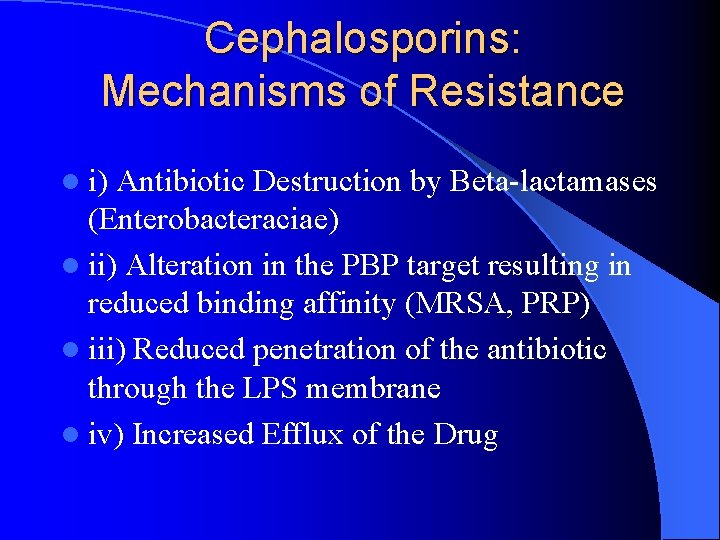
Cephalosporins: Mechanisms of Resistance l i) Antibiotic Destruction by Beta-lactamases (Enterobacteraciae) l ii) Alteration in the PBP target resulting in reduced binding affinity (MRSA, PRP) l iii) Reduced penetration of the antibiotic through the LPS membrane l iv) Increased Efflux of the Drug
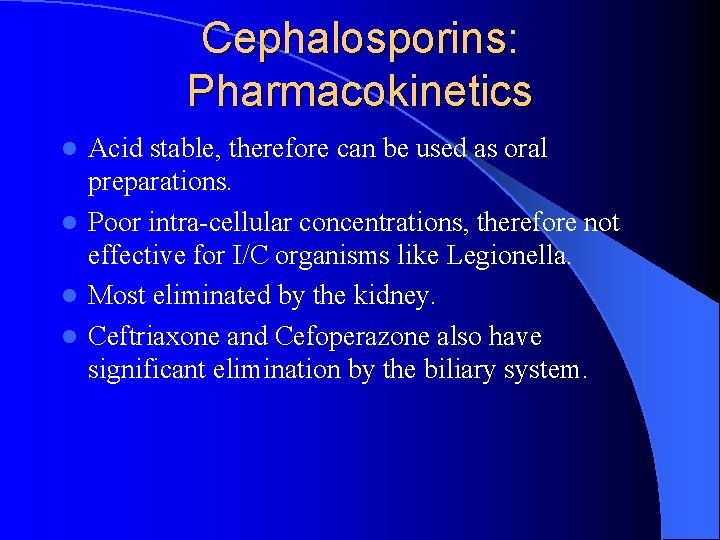
Cephalosporins: Pharmacokinetics Acid stable, therefore can be used as oral preparations. l Poor intra-cellular concentrations, therefore not effective for I/C organisms like Legionella. l Most eliminated by the kidney. l Ceftriaxone and Cefoperazone also have significant elimination by the biliary system. l
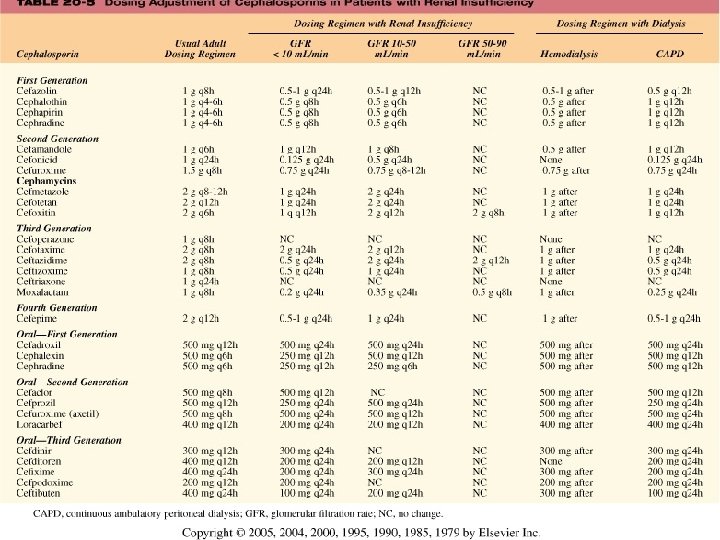
Cephalosporin prescribing in Renal Impairment l Most, apart from Ceftriaxone, need dose adjustment. l Don’t guess, consult with Pharmacist regarding correct dosing.
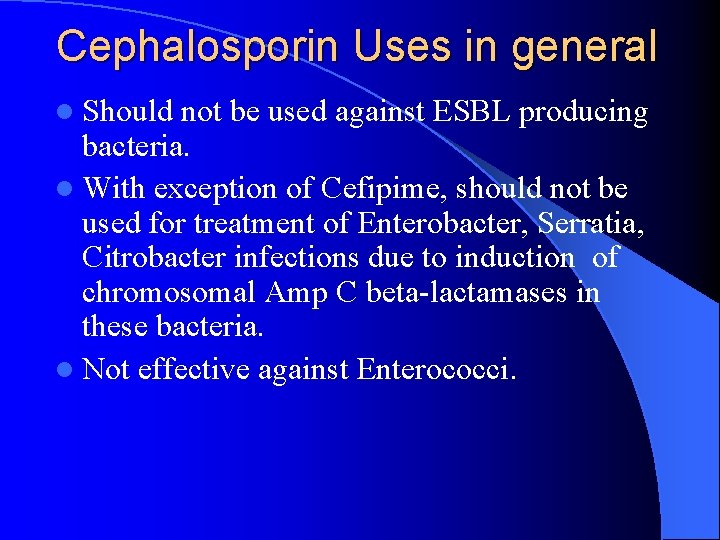
Cephalosporin Uses in general l Should not be used against ESBL producing bacteria. l With exception of Cefipime, should not be used for treatment of Enterobacter, Serratia, Citrobacter infections due to induction of chromosomal Amp C beta-lactamases in these bacteria. l Not effective against Enterococci.
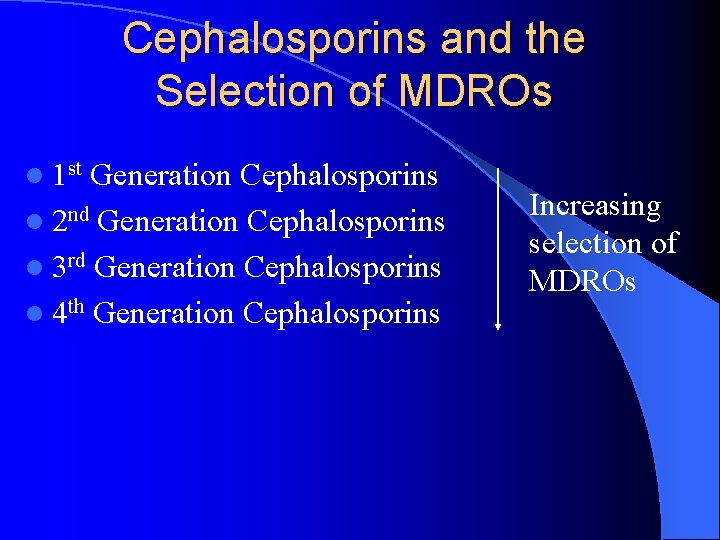
Cephalosporins and the Selection of MDROs l 1 st Generation Cephalosporins l 2 nd Generation Cephalosporins l 3 rd Generation Cephalosporins l 4 th Generation Cephalosporins Increasing selection of MDROs
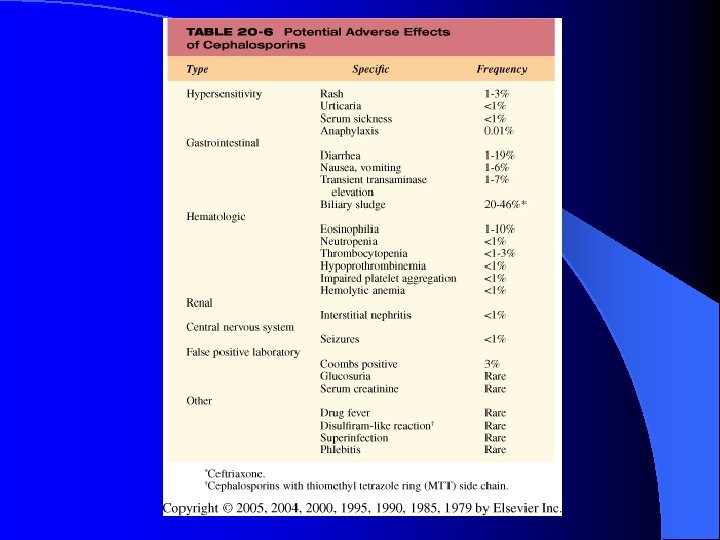
Summary l Cephalosporins are good drugs with a multitude of different uses. l Well tolerated. l Make sure you have a good reason if using a higher generation cephalosporin.