
CEPHALOPODS There are currently about 800 living species
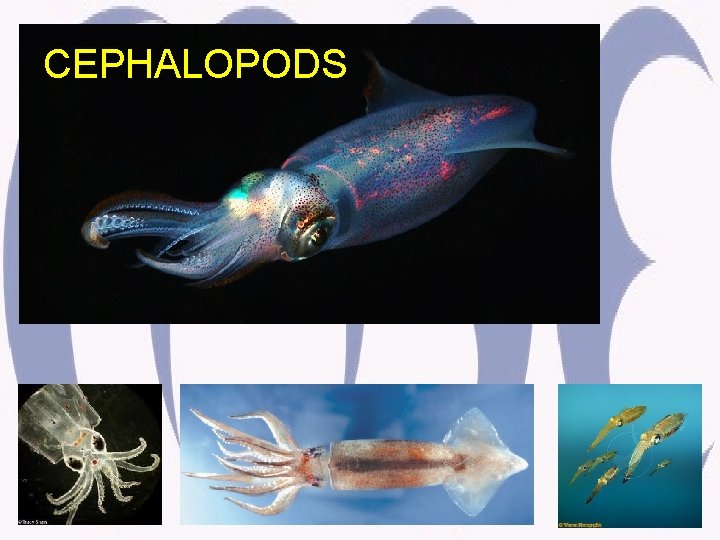
CEPHALOPODS
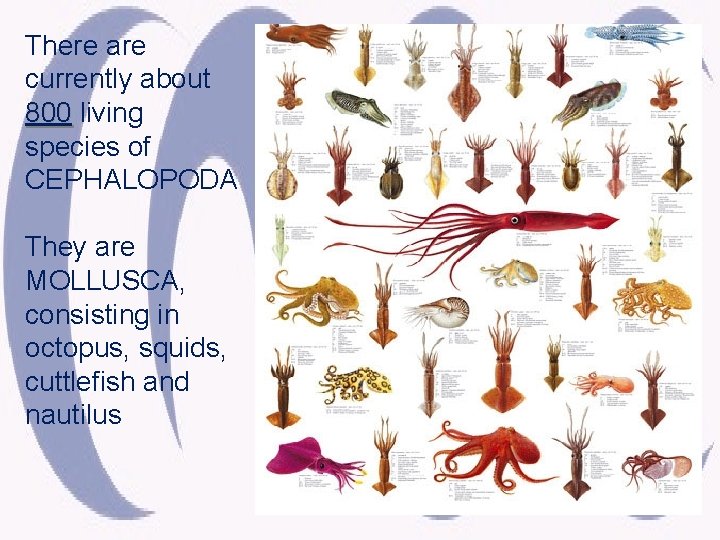
There are currently about 800 living species of CEPHALOPODA They are MOLLUSCA, consisting in octopus, squids, cuttlefish and nautilus
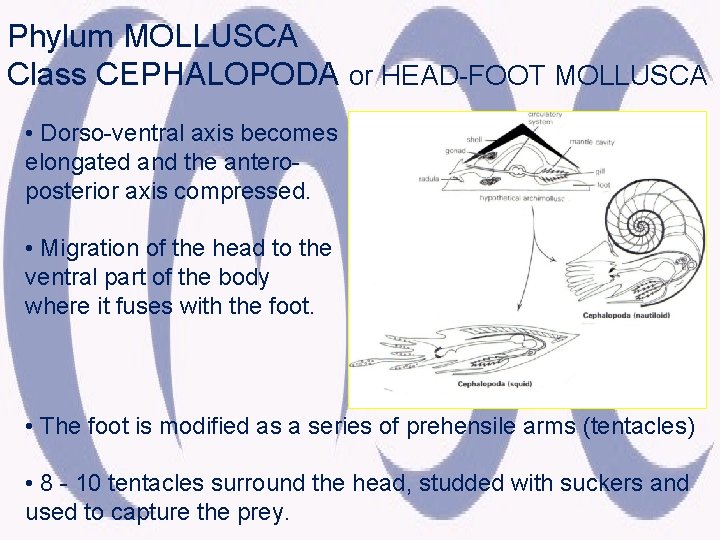
Phylum MOLLUSCA Class CEPHALOPODA or HEAD-FOOT MOLLUSCA • Dorso-ventral axis becomes elongated and the anteroposterior axis compressed. • Migration of the head to the ventral part of the body where it fuses with the foot. • The foot is modified as a series of prehensile arms (tentacles) • 8 - 10 tentacles surround the head, studded with suckers and used to capture the prey.
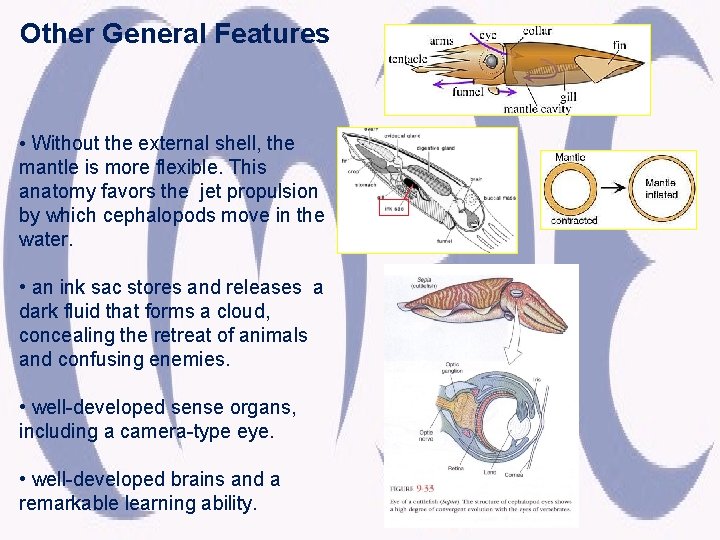
Other General Features • Without the external shell, the mantle is more flexible. This anatomy favors the jet propulsion by which cephalopods move in the water. • an ink sac stores and releases a dark fluid that forms a cloud, concealing the retreat of animals and confusing enemies. • well-developed sense organs, including a camera-type eye. • well-developed brains and a remarkable learning ability.
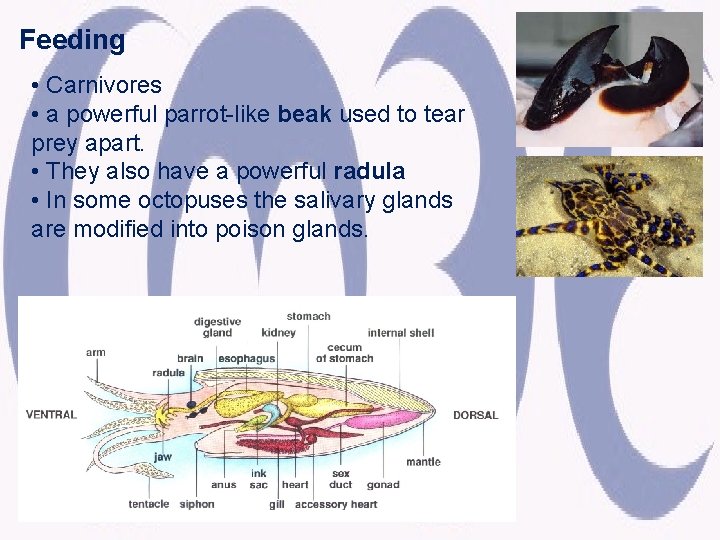
Feeding • Carnivores • a powerful parrot-like beak used to tear prey apart. • They also have a powerful radula • In some octopuses the salivary glands are modified into poison glands.

Shell v Primitively the cephalopods possessed a shell; the fossil record indicates both coiled and non-coiled shells (members with coiled shells include Nautilus, today) Some cephalopods (cuttlefishes and squids) have an internal shell, very reduced in squids. Octopods have lost the shell entirely.
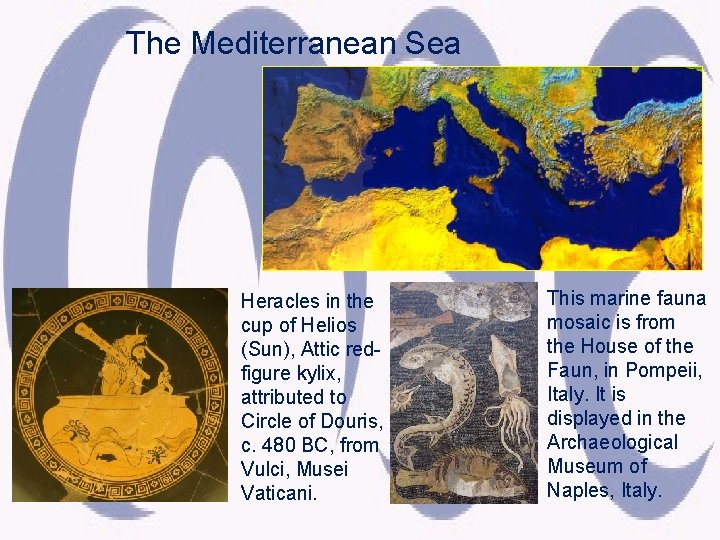
The Mediterranean Sea Heracles in the cup of Helios (Sun), Attic redfigure kylix, attributed to Circle of Douris, c. 480 BC, from Vulci, Musei Vaticani. This marine fauna mosaic is from the House of the Faun, in Pompeii, Italy. It is displayed in the Archaeological Museum of Naples, Italy.
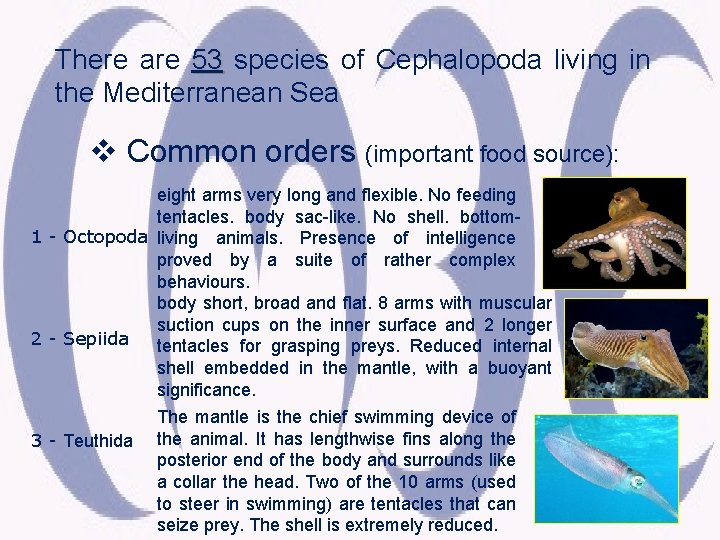
There are 53 species of Cephalopoda living in the Mediterranean Sea v Common orders (important food source): eight arms very long and flexible. No feeding tentacles. body sac-like. No shell. bottom 1 - Octopoda living animals. Presence of intelligence proved by a suite of rather complex behaviours. body short, broad and flat. 8 arms with muscular suction cups on the inner surface and 2 longer 2 - Sepiida tentacles for grasping preys. Reduced internal shell embedded in the mantle, with a buoyant significance. 3 - Teuthida The mantle is the chief swimming device of the animal. It has lengthwise fins along the posterior end of the body and surrounds like a collar the head. Two of the 10 arms (used to steer in swimming) are tentacles that can seize prey. The shell is extremely reduced.
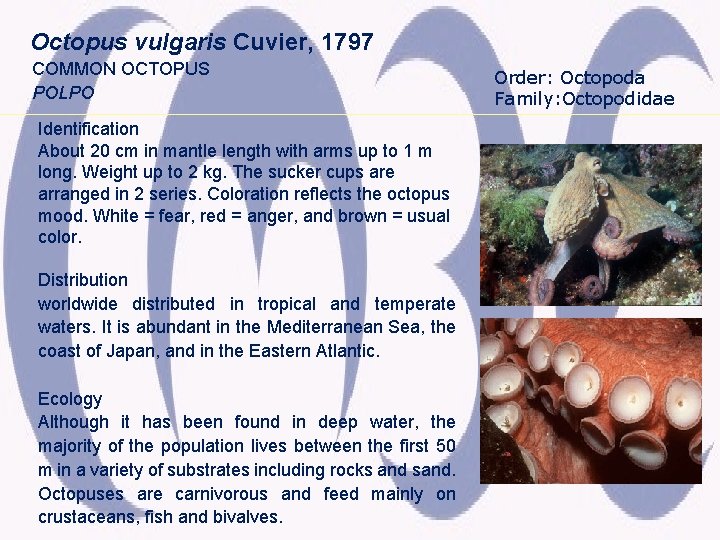
Octopus vulgaris Cuvier, 1797 COMMON OCTOPUS POLPO Identification About 20 cm in mantle length with arms up to 1 m long. Weight up to 2 kg. The sucker cups are arranged in 2 series. Coloration reflects the octopus mood. White = fear, red = anger, and brown = usual color. Distribution worldwide distributed in tropical and temperate waters. It is abundant in the Mediterranean Sea, the coast of Japan, and in the Eastern Atlantic. Ecology Although it has been found in deep water, the majority of the population lives between the first 50 m in a variety of substrates including rocks and sand. Octopuses are carnivorous and feed mainly on crustaceans, fish and bivalves. Order: Octopoda Family: Octopodidae
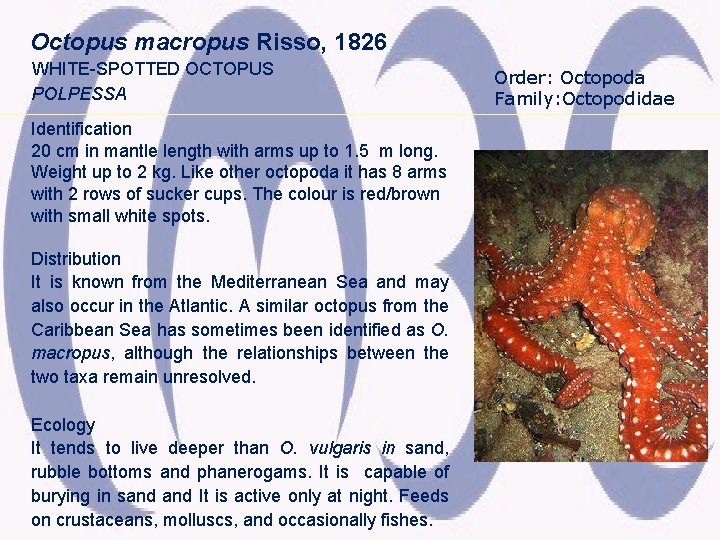
Octopus macropus Risso, 1826 WHITE-SPOTTED OCTOPUS POLPESSA Identification 20 cm in mantle length with arms up to 1. 5 m long. Weight up to 2 kg. Like other octopoda it has 8 arms with 2 rows of sucker cups. The colour is red/brown with small white spots. Distribution It is known from the Mediterranean Sea and may also occur in the Atlantic. A similar octopus from the Caribbean Sea has sometimes been identified as O. macropus, although the relationships between the two taxa remain unresolved. Ecology It tends to live deeper than O. vulgaris in sand, rubble bottoms and phanerogams. It is capable of burying in sand It is active only at night. Feeds on crustaceans, molluscs, and occasionally fishes. Order: Octopoda Family: Octopodidae
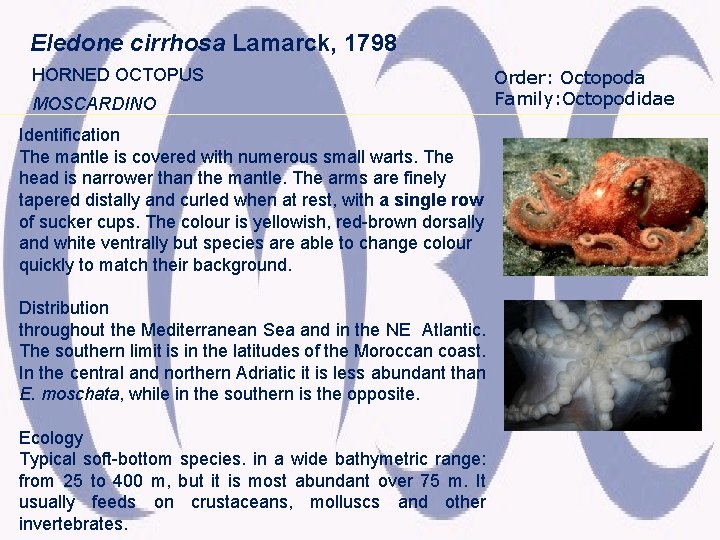
Eledone cirrhosa Lamarck, 1798 HORNED OCTOPUS MOSCARDINO Identification The mantle is covered with numerous small warts. The head is narrower than the mantle. The arms are finely tapered distally and curled when at rest, with a single row of sucker cups. The colour is yellowish, red-brown dorsally and white ventrally but species are able to change colour quickly to match their background. Distribution throughout the Mediterranean Sea and in the NE Atlantic. The southern limit is in the latitudes of the Moroccan coast. In the central and northern Adriatic it is less abundant than E. moschata, while in the southern is the opposite. Ecology Typical soft-bottom species. in a wide bathymetric range: from 25 to 400 m, but it is most abundant over 75 m. It usually feeds on crustaceans, molluscs and other invertebrates. Order: Octopoda Family: Octopodidae
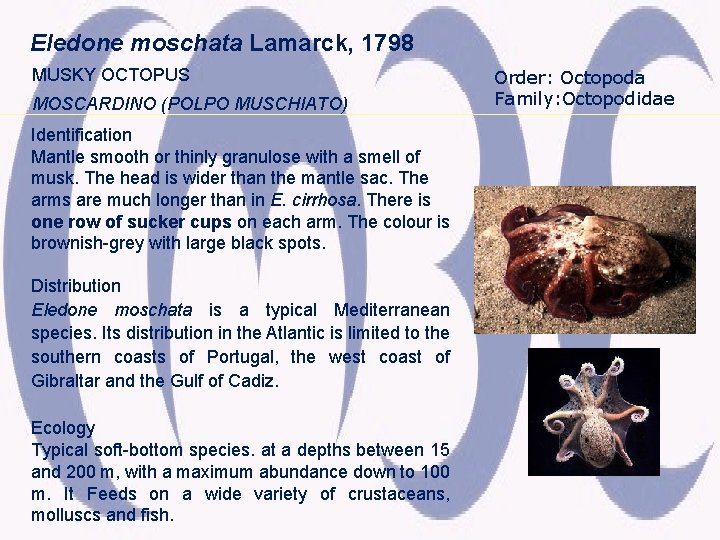
Eledone moschata Lamarck, 1798 MUSKY OCTOPUS MOSCARDINO (POLPO MUSCHIATO) Identification Mantle smooth or thinly granulose with a smell of musk. The head is wider than the mantle sac. The arms are much longer than in E. cirrhosa. There is one row of sucker cups on each arm. The colour is brownish-grey with large black spots. Distribution Eledone moschata is a typical Mediterranean species. Its distribution in the Atlantic is limited to the southern coasts of Portugal, the west coast of Gibraltar and the Gulf of Cadiz. Ecology Typical soft-bottom species. at a depths between 15 and 200 m, with a maximum abundance down to 100 m. It Feeds on a wide variety of crustaceans, molluscs and fish. Order: Octopoda Family: Octopodidae
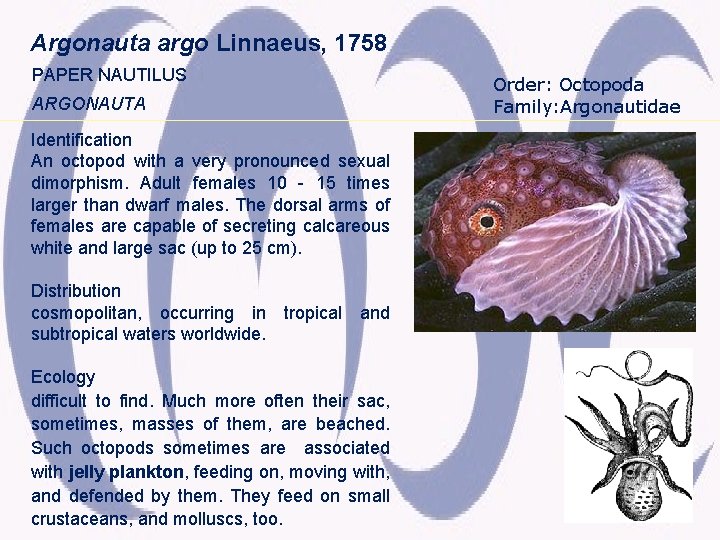
Argonauta argo Linnaeus, 1758 PAPER NAUTILUS ARGONAUTA Identification An octopod with a very pronounced sexual dimorphism. Adult females 10 - 15 times larger than dwarf males. The dorsal arms of females are capable of secreting calcareous white and large sac (up to 25 cm). Distribution cosmopolitan, occurring in tropical and subtropical waters worldwide. Ecology difficult to find. Much more often their sac, sometimes, masses of them, are beached. Such octopods sometimes are associated with jelly plankton, feeding on, moving with, and defended by them. They feed on small crustaceans, and molluscs, too. Order: Octopoda Family: Argonautidae
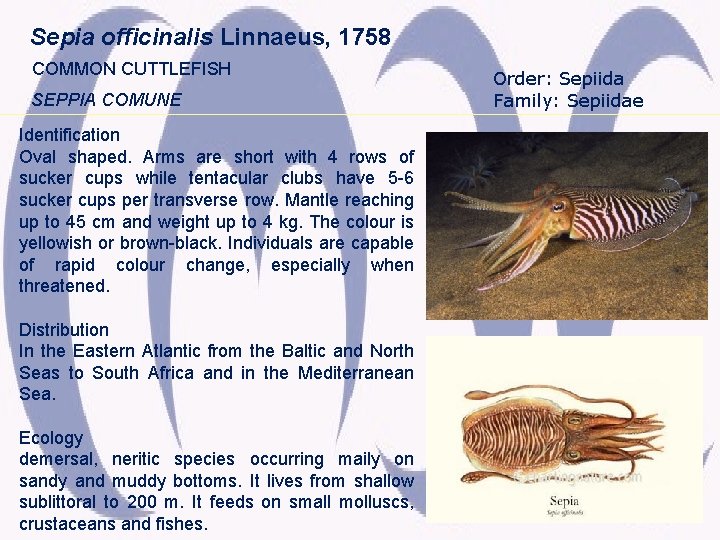
Sepia officinalis Linnaeus, 1758 COMMON CUTTLEFISH SEPPIA COMUNE Identification Oval shaped. Arms are short with 4 rows of sucker cups while tentacular clubs have 5 -6 sucker cups per transverse row. Mantle reaching up to 45 cm and weight up to 4 kg. The colour is yellowish or brown-black. Individuals are capable of rapid colour change, especially when threatened. Distribution In the Eastern Atlantic from the Baltic and North Seas to South Africa and in the Mediterranean Sea. Ecology demersal, neritic species occurring maily on sandy and muddy bottoms. It lives from shallow sublittoral to 200 m. It feeds on small molluscs, crustaceans and fishes. Order: Sepiida Family: Sepiidae
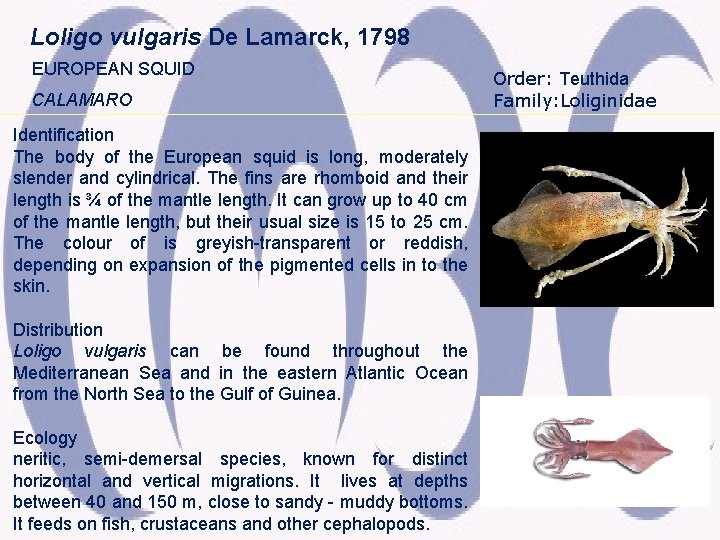
Loligo vulgaris De Lamarck, 1798 EUROPEAN SQUID CALAMARO Identification The body of the European squid is long, moderately slender and cylindrical. The fins are rhomboid and their length is ¾ of the mantle length. It can grow up to 40 cm of the mantle length, but their usual size is 15 to 25 cm. The colour of is greyish-transparent or reddish, depending on expansion of the pigmented cells in to the skin. Distribution Loligo vulgaris can be found throughout the Mediterranean Sea and in the eastern Atlantic Ocean from the North Sea to the Gulf of Guinea. Ecology neritic, semi-demersal species, known for distinct horizontal and vertical migrations. It lives at depths between 40 and 150 m, close to sandy - muddy bottoms. It feeds on fish, crustaceans and other cephalopods. Order: Teuthida Family: Loliginidae
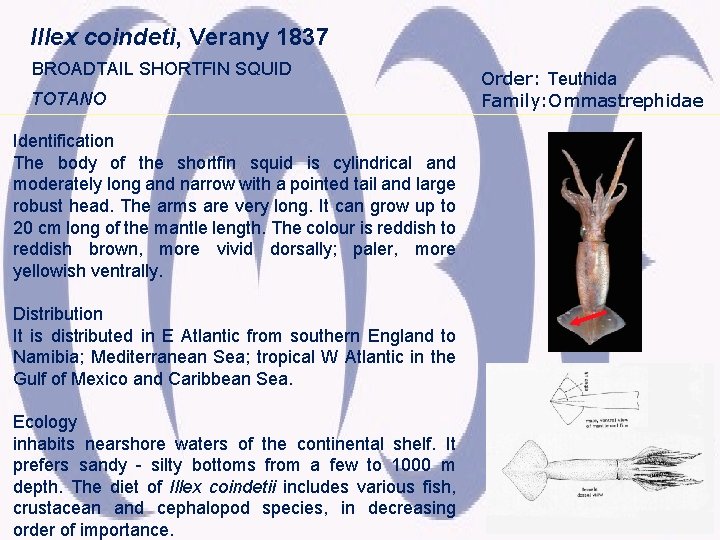
Illex coindeti, Verany 1837 BROADTAIL SHORTFIN SQUID TOTANO Identification The body of the shortfin squid is cylindrical and moderately long and narrow with a pointed tail and large robust head. The arms are very long. It can grow up to 20 cm long of the mantle length. The colour is reddish to reddish brown, more vivid dorsally; paler, more yellowish ventrally. Distribution It is distributed in E Atlantic from southern England to Namibia; Mediterranean Sea; tropical W Atlantic in the Gulf of Mexico and Caribbean Sea. Ecology inhabits nearshore waters of the continental shelf. It prefers sandy - silty bottoms from a few to 1000 m depth. The diet of Illex coindetii includes various fish, crustacean and cephalopod species, in decreasing order of importance. Order: Teuthida Family: Ommastrephidae
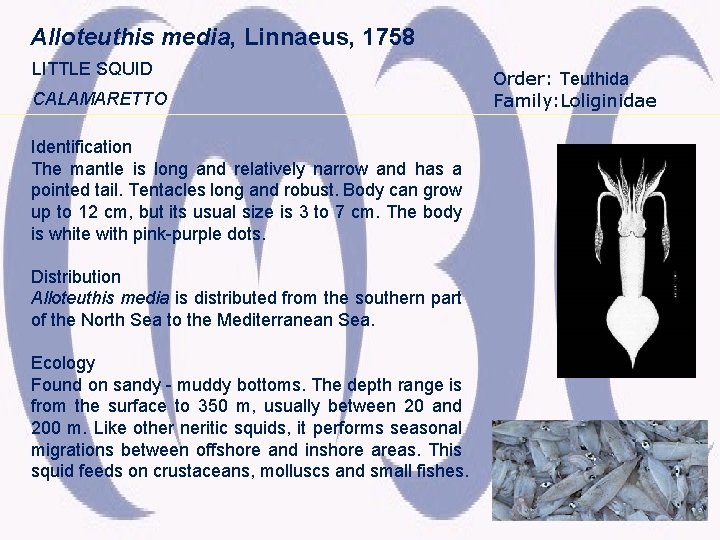
Alloteuthis media, Linnaeus, 1758 LITTLE SQUID CALAMARETTO Identification The mantle is long and relatively narrow and has a pointed tail. Tentacles long and robust. Body can grow up to 12 cm, but its usual size is 3 to 7 cm. The body is white with pink-purple dots. Distribution Alloteuthis media is distributed from the southern part of the North Sea to the Mediterranean Sea. Ecology Found on sandy - muddy bottoms. The depth range is from the surface to 350 m, usually between 20 and 200 m. Like other neritic squids, it performs seasonal migrations between offshore and inshore areas. This squid feeds on crustaceans, molluscs and small fishes. Order: Teuthida Family: Loliginidae
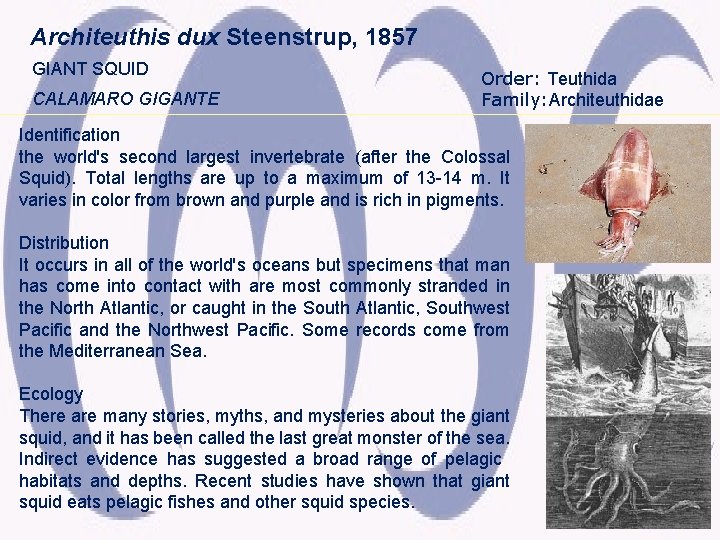
Architeuthis dux Steenstrup, 1857 GIANT SQUID CALAMARO GIGANTE Order: Teuthida Family: Architeuthidae Identification the world's second largest invertebrate (after the Colossal Squid). Total lengths are up to a maximum of 13 -14 m. It varies in color from brown and purple and is rich in pigments. Distribution It occurs in all of the world's oceans but specimens that man has come into contact with are most commonly stranded in the North Atlantic, or caught in the South Atlantic, Southwest Pacific and the Northwest Pacific. Some records come from the Mediterranean Sea. Ecology There are many stories, myths, and mysteries about the giant squid, and it has been called the last great monster of the sea. Indirect evidence has suggested a broad range of pelagic habitats and depths. Recent studies have shown that giant squid eats pelagic fishes and other squid species.
- Slides: 18