
CEPC parameters and booster in TDR Dou Wang
CEPC parameters and booster in TDR Dou Wang (IHEP) on behalf of CEPC AP group CEPC day, Oct. 19 th , 2020
outline Ø CEPC parameters • CEPC parameters update (ttbar & Z) • CEPC high lum. Higgs parameters Ø CEPC booster design status • Refine/update to the CDR design • New design for lower emittance booster - TME - FODO Ø Summary
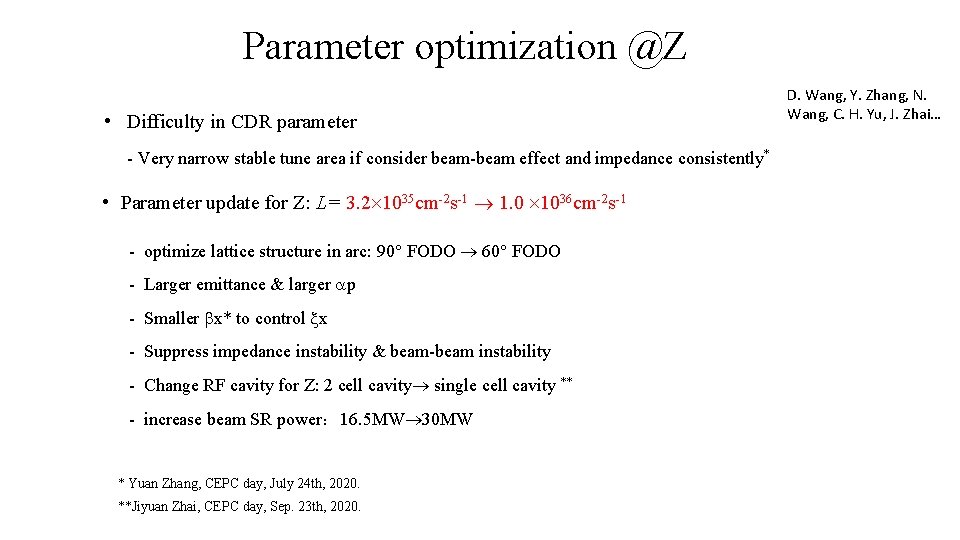
Parameter optimization @Z • Difficulty in CDR parameter - Very narrow stable tune area if consider beam-beam effect and impedance consistently* • Parameter update for Z: L= 3. 2 1035 cm-2 s-1 1. 0 1036 cm-2 s-1 - optimize lattice structure in arc: 90 FODO 60 FODO - Larger emittance & larger p - Smaller x* to control x - Suppress impedance instability & beam-beam instability - Change RF cavity for Z: 2 cell cavity single cell cavity ** - increase beam SR power: 16. 5 MW 30 MW * Yuan Zhang, CEPC day, July 24 th, 2020. **Jiyuan Zhai, CEPC day, Sep. 23 th, 2020. D. Wang, Y. Zhang, N. Wang, C. H. Yu, J. Zhai…
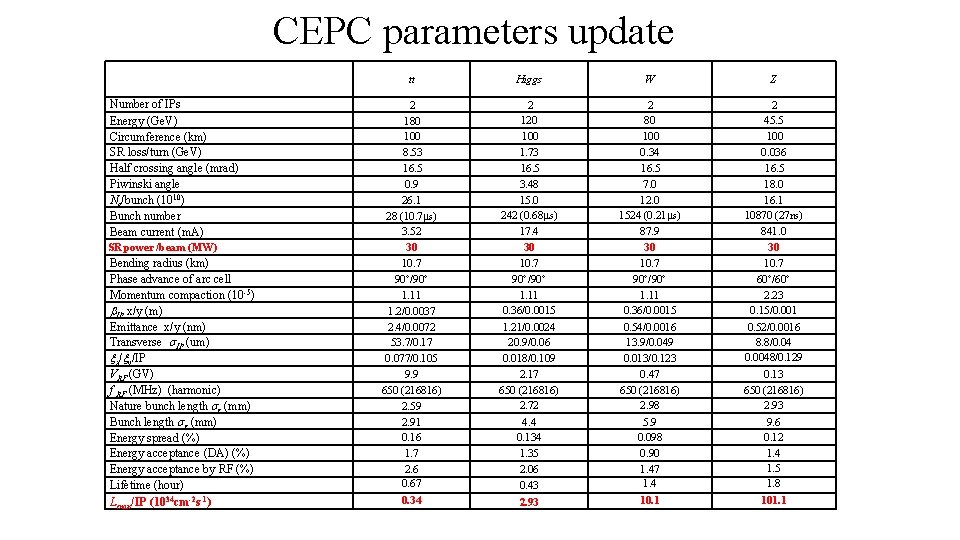
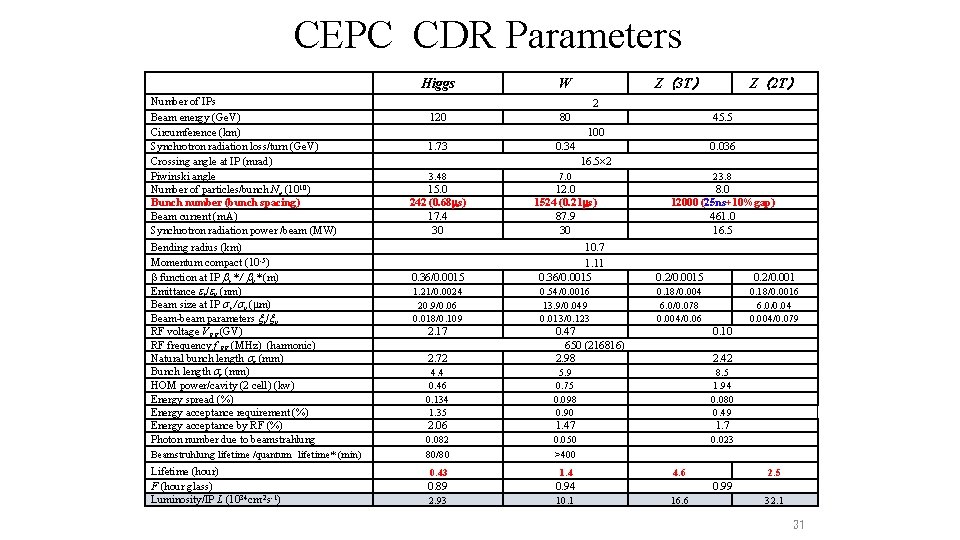
CEPC parameters update Number of IPs Energy (Ge. V) Circumference (km) SR loss/turn (Ge. V) Half crossing angle (mrad) Piwinski angle Ne/bunch (1010) Bunch number Beam current (m. A) SR power /beam (MW) Bending radius (km) Phase advance of arc cell Momentum compaction (10 -5) IP x/y (m) Emittance x/y (nm) Transverse IP (um) x/ y/IP VRF (GV) f RF (MHz) (harmonic) Nature bunch length z (mm) Bunch length z (mm) Energy spread (%) Energy acceptance (DA) (%) Energy acceptance by RF (%) Lifetime (hour) Lmax/IP (1034 cm-2 s-1) tt Higgs W Z 2 180 100 8. 53 16. 5 0. 9 26. 1 28 (10. 7 s) 3. 52 30 10. 7 90 /90 1. 11 1. 2/0. 0037 2. 4/0. 0072 53. 7/0. 17 0. 077/0. 105 9. 9 650 (216816) 2. 59 2. 91 0. 16 1. 7 2. 6 0. 67 0. 34 2 120 100 1. 73 16. 5 3. 48 15. 0 242 (0. 68 s) 17. 4 30 10. 7 90 /90 1. 11 0. 36/0. 0015 1. 21/0. 0024 20. 9/0. 06 0. 018/0. 109 2. 17 650 (216816) 2. 72 4. 4 0. 134 1. 35 2. 06 0. 43 2. 93 2 80 100 0. 34 16. 5 7. 0 12. 0 1524 (0. 21 s) 87. 9 30 10. 7 90 /90 1. 11 0. 36/0. 0015 0. 54/0. 0016 13. 9/0. 049 0. 013/0. 123 0. 47 650 (216816) 2. 98 5. 9 0. 098 0. 90 1. 47 1. 4 10. 1 2 45. 5 100 0. 036 16. 5 18. 0 16. 1 10870 (27 ns) 841. 0 30 10. 7 60 /60 2. 23 0. 15/0. 001 0. 52/0. 0016 8. 8/0. 04 0. 0048/0. 129 0. 13 650 (216816) 2. 93 9. 6 0. 12 1. 4 1. 5 1. 8 101. 1
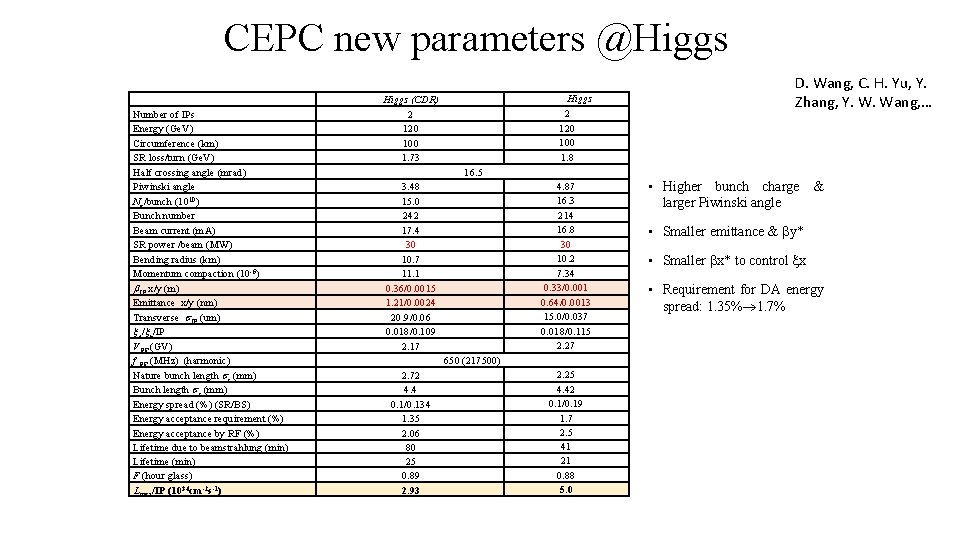
CEPC new parameters @Higgs Number of IPs Energy (Ge. V) Circumference (km) SR loss/turn (Ge. V) Half crossing angle (mrad) Piwinski angle Ne/bunch (1010) Bunch number Beam current (m. A) SR power /beam (MW) Bending radius (km) Momentum compaction (10 -6) IP x/y (m) Emittance x/y (nm) Transverse IP (um) x/ y/IP VRF (GV) f RF (MHz) (harmonic) Nature bunch length z (mm) Bunch length z (mm) Energy spread (%) (SR/BS) Energy acceptance requirement (%) Energy acceptance by RF (%) Lifetime due to beamstrahlung (min) Lifetime (min) F (hour glass) Lmax/IP (1034 cm-2 s-1) Higgs 2 120 100 1. 8 Higgs (CDR) 2 120 100 1. 73 16. 5 4. 87 16. 3 214 16. 8 30 10. 2 7. 34 0. 33/0. 001 0. 64/0. 0013 15. 0/0. 037 0. 018/0. 115 2. 27 3. 48 15. 0 242 17. 4 30 10. 7 11. 1 0. 36/0. 0015 1. 21/0. 0024 20. 9/0. 06 0. 018/0. 109 2. 17 650 (217500) 2. 72 4. 4 0. 1/0. 134 1. 35 2. 06 80 25 0. 89 2. 93 2. 25 4. 42 0. 1/0. 19 1. 7 2. 5 41 21 0. 88 5. 0 D. Wang, C. H. Yu, Y. Zhang, Y. W. Wang, … • Higher bunch charge & larger Piwinski angle • Smaller emittance & y* • Smaller x* to control x • Requirement for DA energy spread: 1. 35% 1. 7%
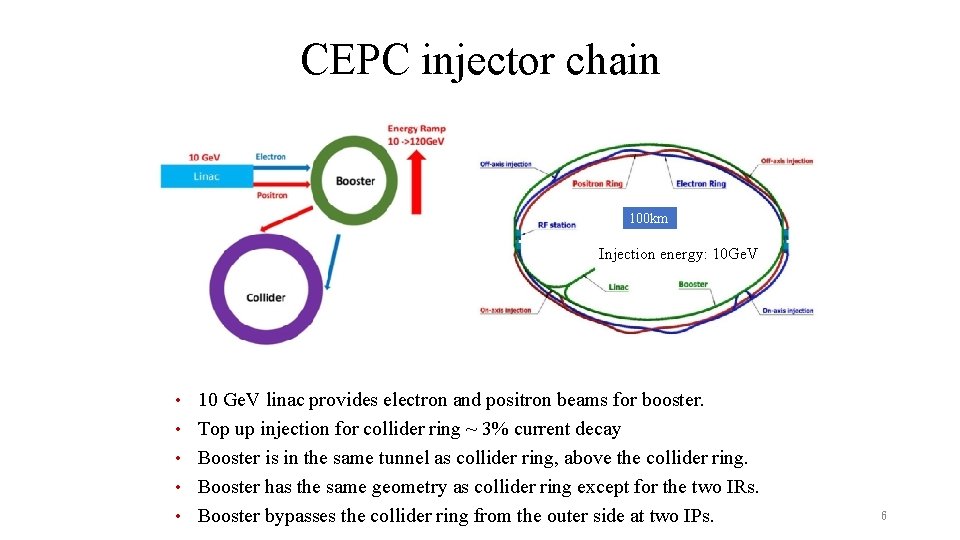
CEPC injector chain 100 km Injection energy: 10 Ge. V • 10 Ge. V linac provides electron and positron beams for booster. • Top up injection for collider ring ~ 3% current decay • Booster is in the same tunnel as collider ring, above the collider ring. • Booster has the same geometry as collider ring except for the two IRs. • Booster bypasses the collider ring from the outer side at two IPs. 6
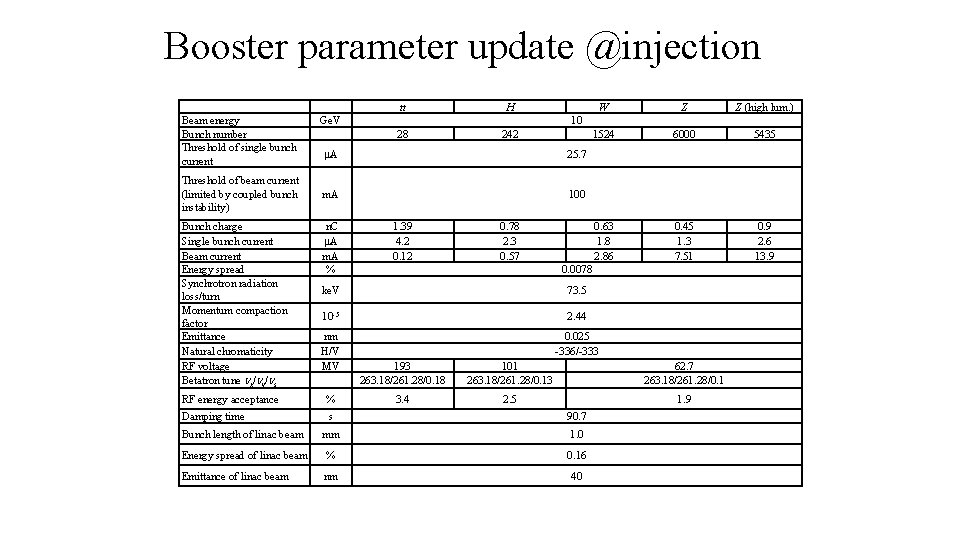
Booster parameter update @injection Beam energy Bunch number Threshold of single bunch current Threshold of beam current (limited by coupled bunch instability) Bunch charge Single bunch current Beam current Energy spread Synchrotron radiation loss/turn Momentum compaction factor Emittance Natural chromaticity RF voltage Betatron tune x/ y/ s tt H 28 242 Ge. V Z Z (high lum. ) 1524 6000 5435 0. 63 1. 8 2. 86 0. 45 1. 3 7. 51 0. 9 2. 6 13. 9 10 A 25. 7 m. A 100 n. C A m. A % W 1. 39 4. 2 0. 12 0. 78 2. 3 0. 57 0. 0078 ke. V 73. 5 10 -5 2. 44 nm H/V MV 0. 025 -336/-333 193 263. 18/261. 28/0. 18 101 263. 18/261. 28/0. 13 62. 7 263. 18/261. 28/0. 1 3. 4 2. 5 1. 9 RF energy acceptance % Damping time s 90. 7 Bunch length of linac beam mm 1. 0 Energy spread of linac beam % 0. 16 Emittance of linac beam nm 40
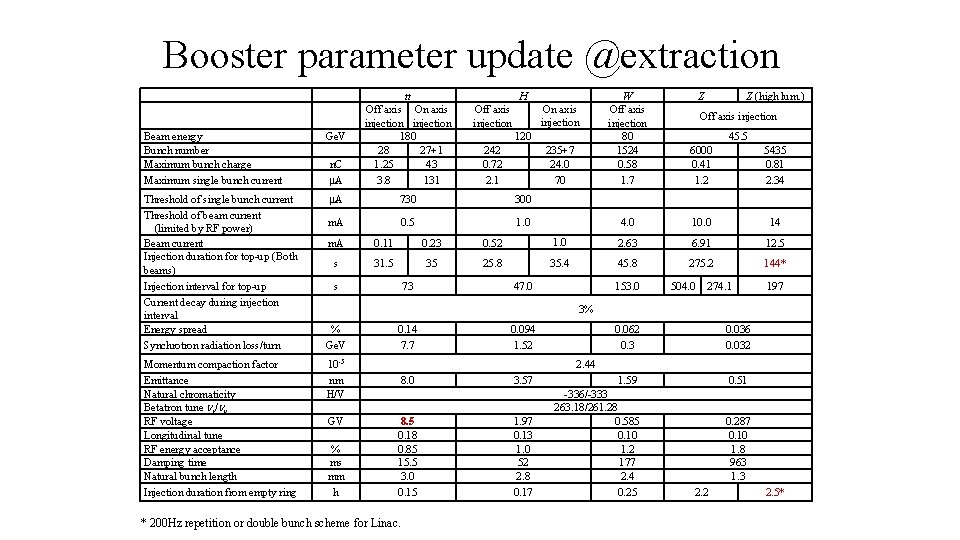
Booster parameter update @extraction tt H On axis injection Beam energy Bunch number Maximum bunch charge Maximum single bunch current Ge. V n. C A Off axis On axis injection 180 28 27+1 1. 25 43 3. 8 131 Threshold of single bunch current A 730 300 m. A 0. 5 1. 0 Threshold of beam current (limited by RF power) Beam current Injection duration for top-up (Both beams) Injection interval for top-up Current decay during injection interval Energy spread Synchrotron radiation loss/turn Momentum compaction factor Emittance Natural chromaticity Betatron tune x/ y RF voltage Longitudinal tune RF energy acceptance Damping time Natural bunch length Injection duration from empty ring Off axis injection 120 235+7 24. 0 70 242 0. 72 2. 1 W Off axis injection 80 1524 0. 58 1. 7 Z Z (high lum. ) 6000 0. 41 1. 2 5435 0. 81 2. 34 4. 0 10. 0 14 Off axis injection 45. 5 m. A 0. 11 0. 23 0. 52 1. 0 2. 63 6. 91 12. 5 s 31. 5 35 25. 8 35. 4 45. 8 275. 2 144* s 73 47. 0 153. 0 504. 0 274. 1 197 3% % Ge. V 0. 14 7. 7 10 -5 nm H/V GV % ms mm h 0. 094 1. 52 0. 062 0. 3 0. 036 0. 032 3. 57 1. 59 0. 51 1. 97 0. 13 1. 0 52 2. 8 0. 17 -336/-333 263. 18/261. 28 0. 585 0. 10 1. 2 177 2. 4 0. 25 2. 44 8. 0 8. 5 0. 18 0. 85 15. 5 3. 0 0. 15 * 200 Hz repetition or double bunch scheme for Linac. 0. 287 0. 10 1. 8 963 1. 3 2. 2 2. 5*
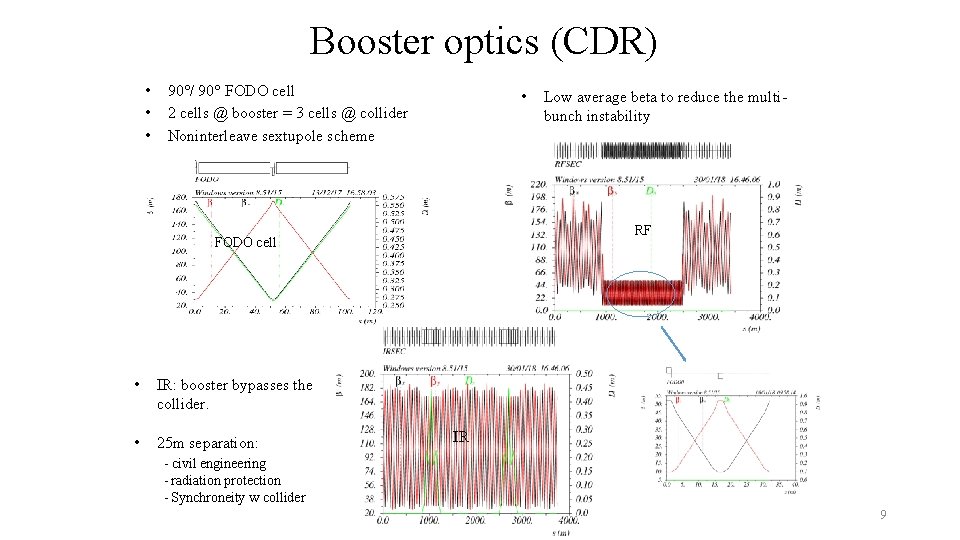
Booster optics (CDR) • • • 90 / 90 FODO cell 2 cells @ booster = 3 cells @ collider Noninterleave sextupole scheme • RF FODO cell • IR: booster bypasses the collider. • 25 m separation: Low average beta to reduce the multibunch instability IR - civil engineering - radiation protection - Synchroneity w collider 9
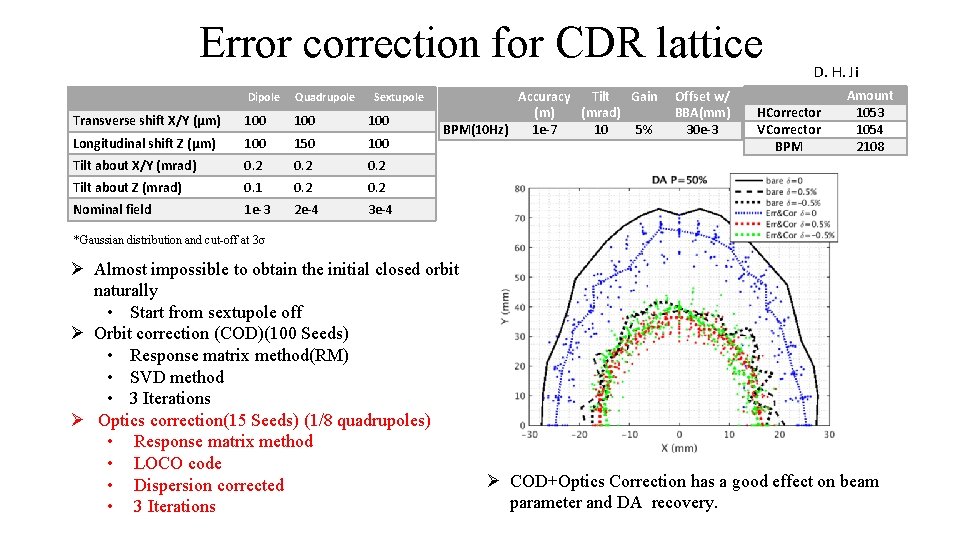
Error correction for CDR lattice Dipole Quadrupole Sextupole Transverse shift X/Y (μm) 100 100 Longitudinal shift Z (μm) 100 150 100 Tilt about X/Y (mrad) 0. 2 Tilt about Z (mrad) 0. 1 0. 2 Nominal field 1 e-3 2 e-4 3 e-4 Accuracy Tilt Gain (m) (mrad) BPM(10 Hz) 1 e-7 10 5% Offset w/ BBA(mm) 30 e-3 D. H. Ji HCorrector VCorrector BPM Amount 1053 1054 2108 *Gaussian distribution and cut-off at 3σ Ø Almost impossible to obtain the initial closed orbit naturally • Start from sextupole off Ø Orbit correction (COD)(100 Seeds) • Response matrix method(RM) • SVD method • 3 Iterations Ø Optics correction(15 Seeds) (1/8 quadrupoles) • Response matrix method • LOCO code • Dispersion corrected • 3 Iterations Ø COD+Optics Correction has a good effect on beam parameter and DA recovery.
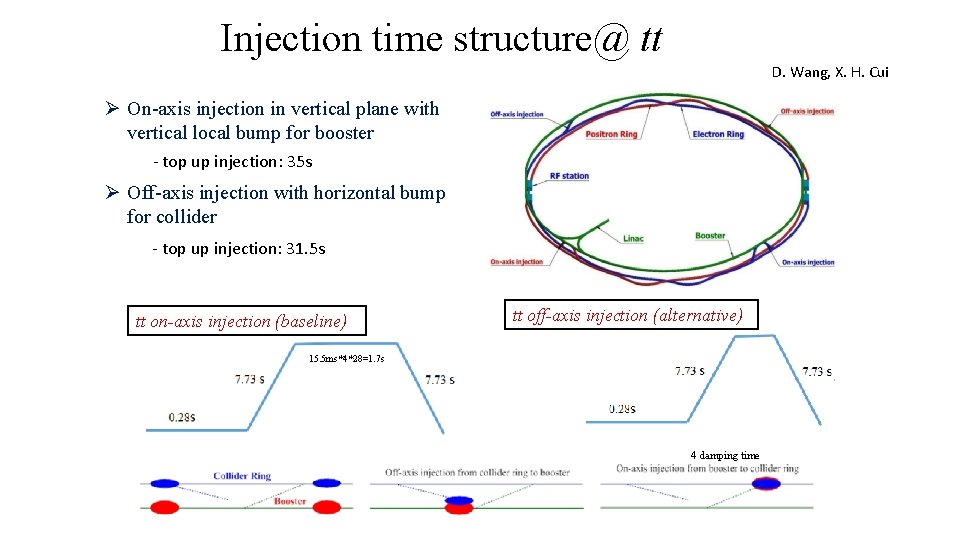
Injection time structure@ tt D. Wang, X. H. Cui Ø On-axis injection in vertical plane with vertical local bump for booster - top up injection: 35 s Ø Off-axis injection with horizontal bump for collider - top up injection: 31. 5 s tt on-axis injection (baseline) tt off-axis injection (alternative) 15. 5 ms*4*28=1. 7 s 4 damping time
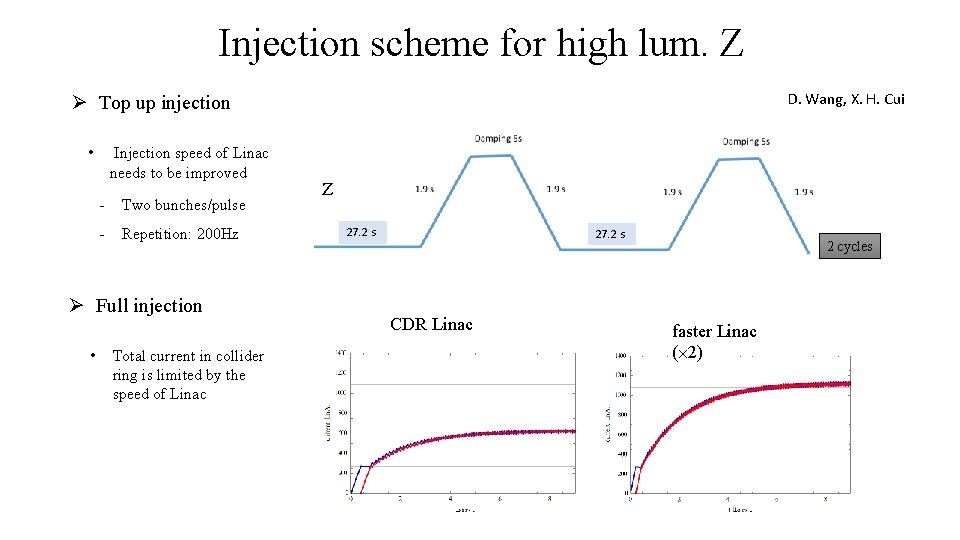
Injection scheme for high lum. Z D. Wang, X. H. Cui Ø Top up injection • Injection speed of Linac needs to be improved - Two bunches/pulse - Repetition: 200 Hz Ø Full injection • Total current in collider ring is limited by the speed of Linac Z 27. 2 s CDR Linac 2 cycles faster Linac ( 2)
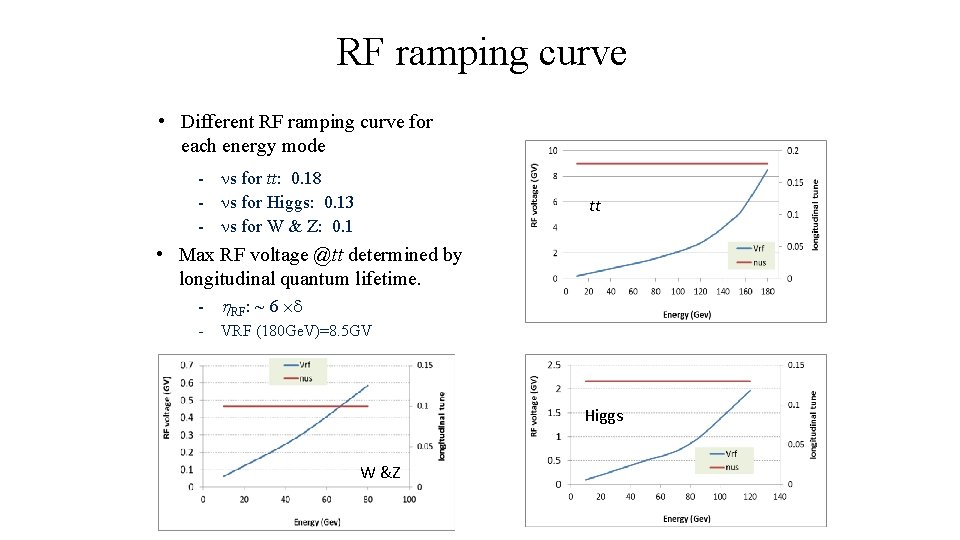
RF ramping curve • Different RF ramping curve for each energy mode - s for tt: 0. 18 - s for Higgs: 0. 13 - s for W & Z: 0. 1 tt • Max RF voltage @tt determined by longitudinal quantum lifetime. - RF: ~ 6 - VRF (180 Ge. V)=8. 5 GV Higgs W &Z
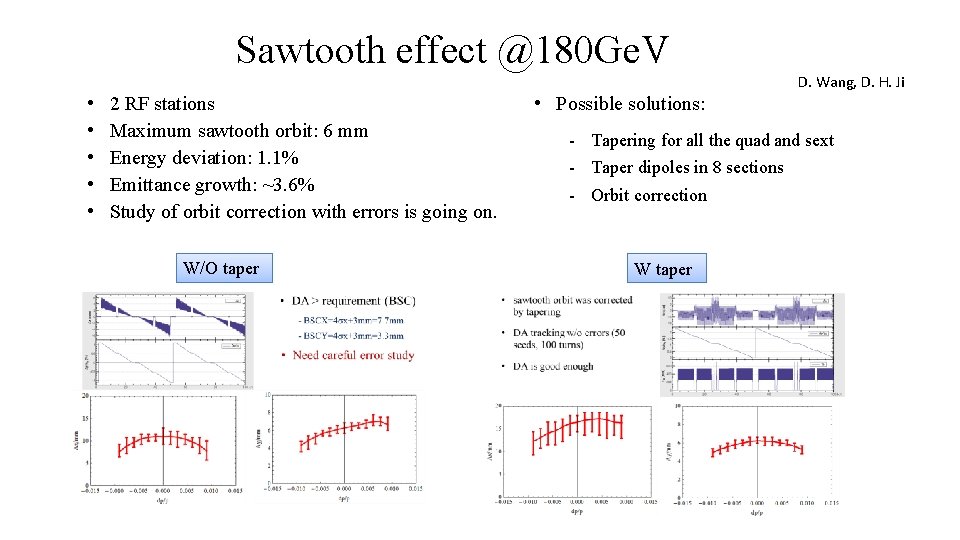
Sawtooth effect @180 Ge. V D. Wang, D. H. Ji • • • 2 RF stations Maximum sawtooth orbit: 6 mm Energy deviation: 1. 1% Emittance growth: ~3. 6% Study of orbit correction with errors is going on. W/O taper • Possible solutions: - Tapering for all the quad and sext - Taper dipoles in 8 sections - Orbit correction W taper
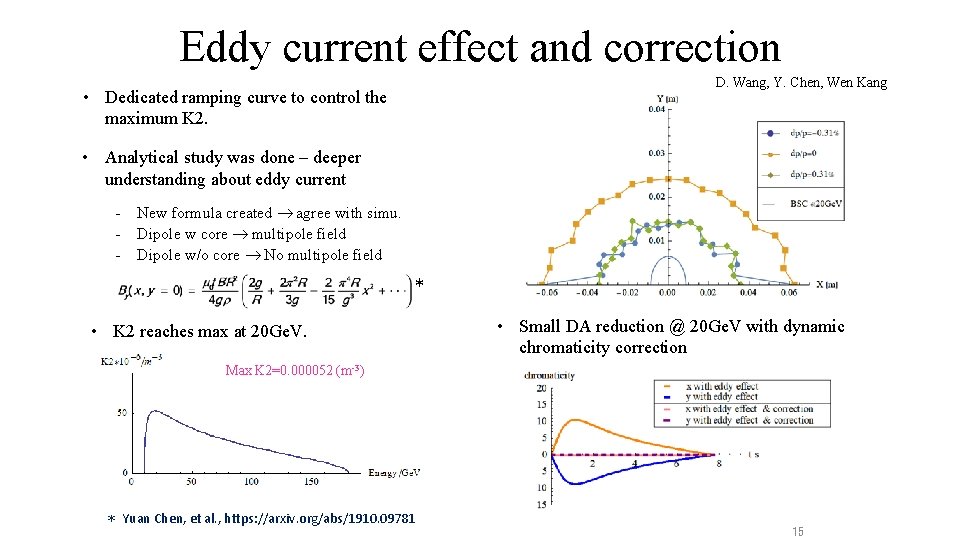
Eddy current effect and correction D. Wang, Y. Chen, Wen Kang • Dedicated ramping curve to control the maximum K 2. • Analytical study was done – deeper understanding about eddy current - New formula created agree with simu. Dipole w core multipole field Dipole w/o core No multipole field * • K 2 reaches max at 20 Ge. V. • Small DA reduction @ 20 Ge. V with dynamic chromaticity correction Max K 2=0. 000052 (m-3) * Yuan Chen, et al. , https: //arxiv. org/abs/1910. 09781 15
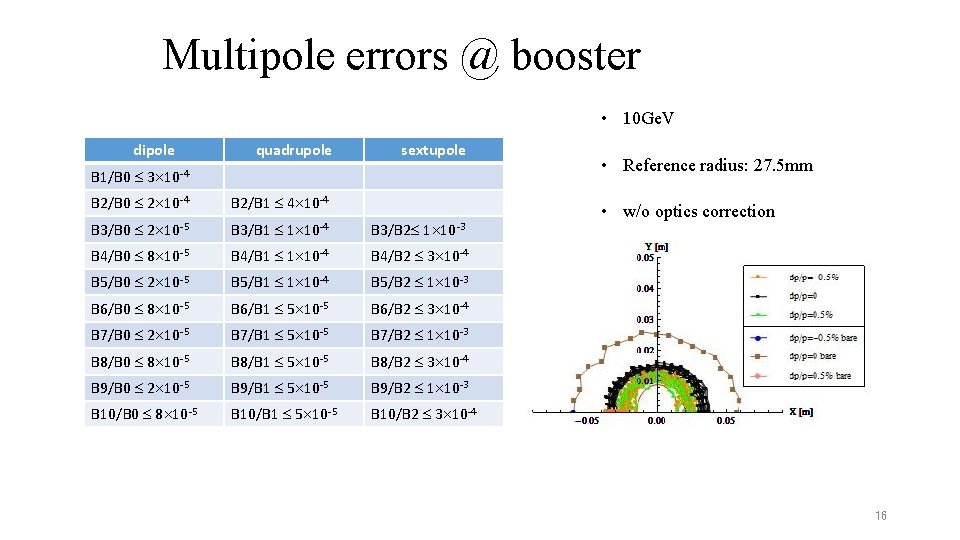
Multipole errors @ booster • 10 Ge. V dipole quadrupole sextupole B 1/B 0 3 10 -4 B 2/B 0 2 10 -4 B 2/B 1 4 10 -4 B 3/B 0 B 3/B 1 2 10 -5 1 10 -4 B 3/B 2 1 10 -3 B 4/B 0 8 10 -5 B 4/B 1 1 10 -4 B 4/B 2 3 10 -4 B 5/B 0 2 10 -5 B 5/B 1 1 10 -4 B 5/B 2 1 10 -3 B 6/B 0 8 10 -5 B 6/B 1 5 10 -5 B 6/B 2 3 10 -4 B 7/B 0 2 10 -5 B 7/B 1 5 10 -5 B 7/B 2 1 10 -3 B 8/B 0 8 10 -5 B 8/B 1 5 10 -5 B 8/B 2 3 10 -4 B 9/B 0 2 10 -5 B 9/B 1 5 10 -5 B 9/B 2 1 10 -3 B 10/B 0 8 10 -5 B 10/B 1 5 10 -5 B 10/B 2 3 10 -4 • Reference radius: 27. 5 mm • w/o optics correction 16
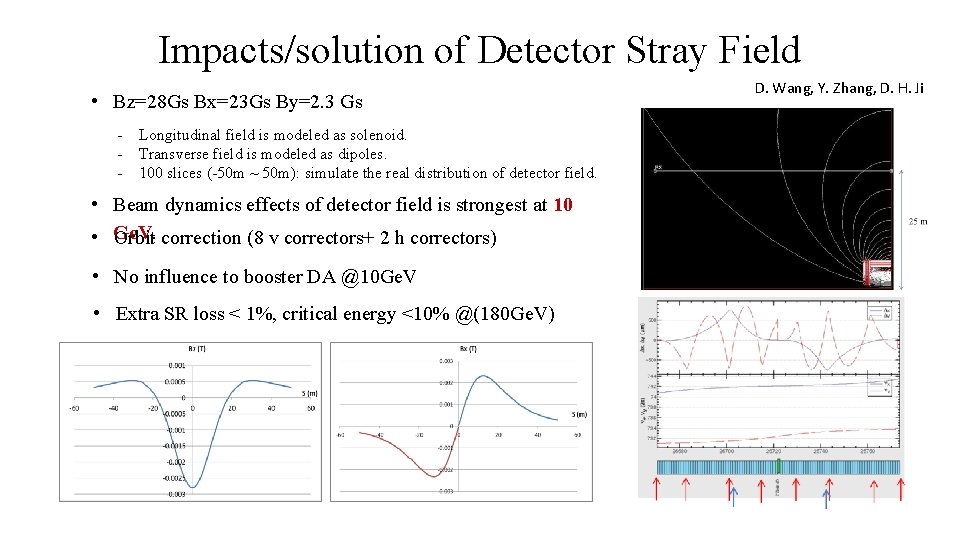
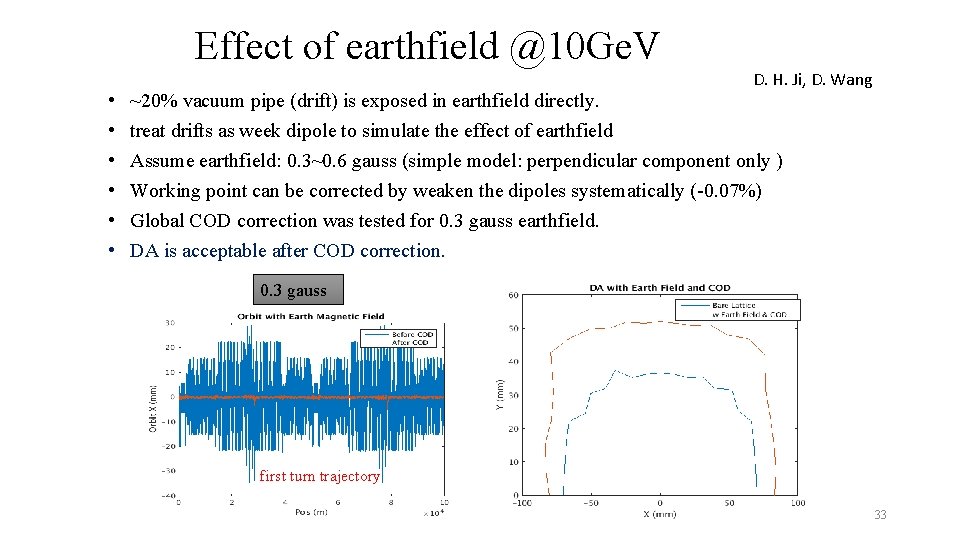
Impacts/solution of Detector Stray Field • Bz=28 Gs Bx=23 Gs By=2. 3 Gs - Longitudinal field is modeled as solenoid. Transverse field is modeled as dipoles. 100 slices (-50 m ~ 50 m): simulate the real distribution of detector field. • Beam dynamics effects of detector field is strongest at 10 • Ge. V. Orbit correction (8 v correctors+ 2 h correctors) • No influence to booster DA @10 Ge. V • Extra SR loss < 1%, critical energy <10% @(180 Ge. V) D. Wang, Y. Zhang, D. H. Ji
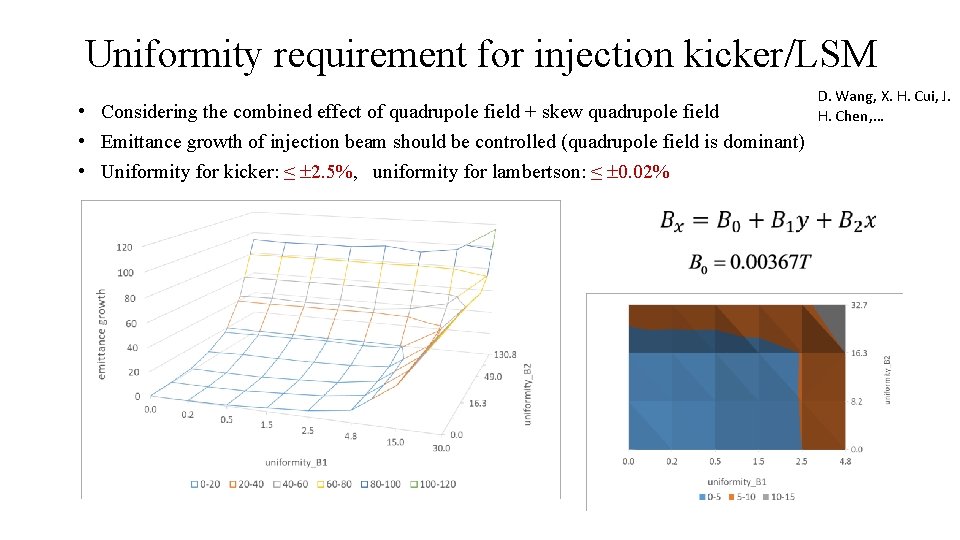
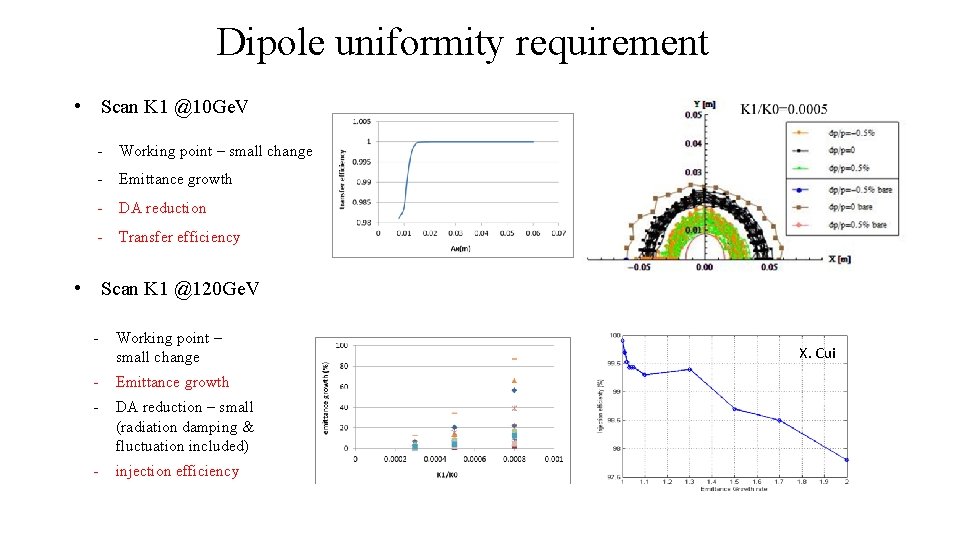
Uniformity requirement for injection kicker/LSM • Considering the combined effect of quadrupole field + skew quadrupole field • Emittance growth of injection beam should be controlled (quadrupole field is dominant) • Uniformity for kicker: ≤ 2. 5%, uniformity for lambertson: ≤ 0. 02% D. Wang, X. H. Cui, J. H. Chen, …
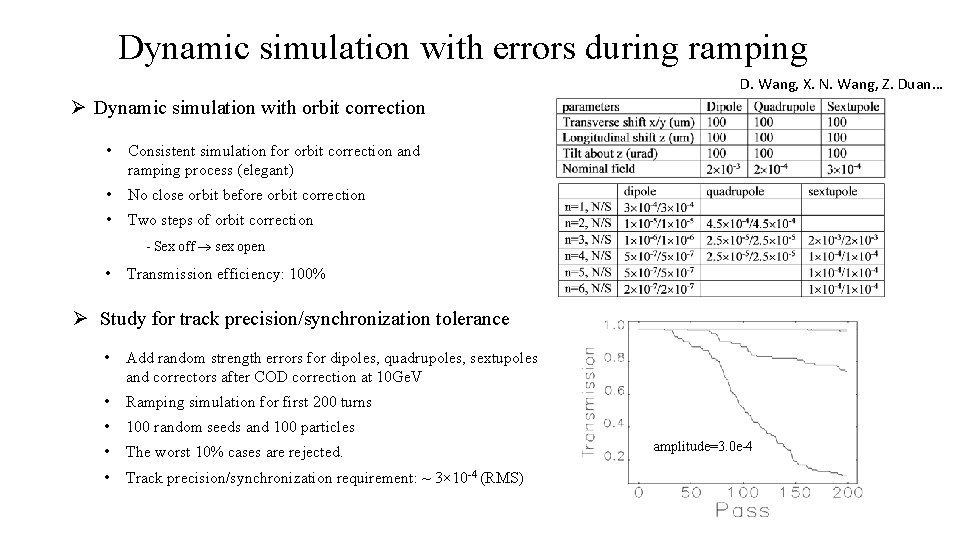
Dynamic simulation with errors during ramping D. Wang, X. N. Wang, Z. Duan… Ø Dynamic simulation with orbit correction • Consistent simulation for orbit correction and ramping process (elegant) • No close orbit before orbit correction • Two steps of orbit correction - Sex off sex open • Transmission efficiency: 100% Ø Study for track precision/synchronization tolerance • Add random strength errors for dipoles, quadrupoles, sextupoles and correctors after COD correction at 10 Ge. V • Ramping simulation for first 200 turns • 100 random seeds and 100 particles • The worst 10% cases are rejected. • Track precision/synchronization requirement: ~ 3× 10 -4 (RMS) amplitude=3. 0 e-4
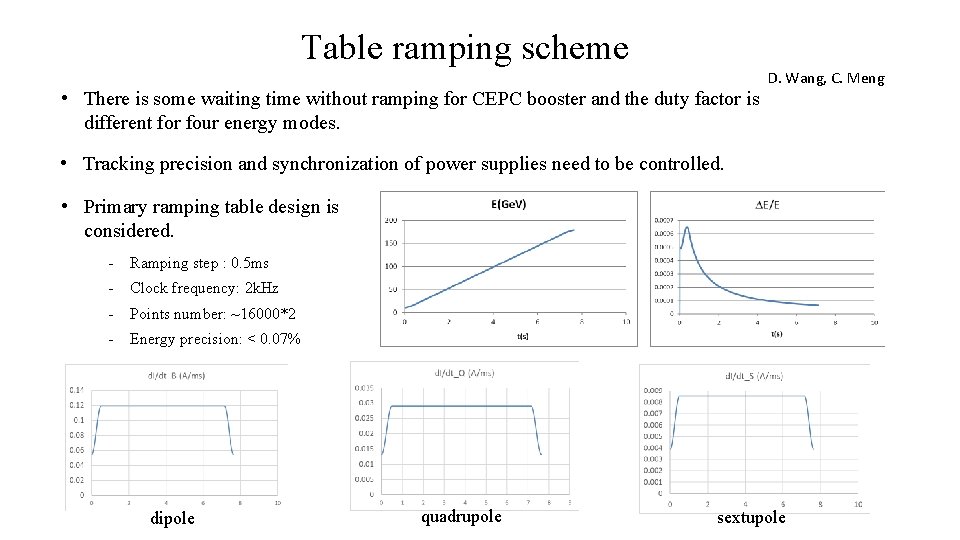
Table ramping scheme • There is some waiting time without ramping for CEPC booster and the duty factor is different for four energy modes. D. Wang, C. Meng • Tracking precision and synchronization of power supplies need to be controlled. • Primary ramping table design is considered. - Ramping step : 0. 5 ms - Clock frequency: 2 k. Hz - Points number: ~16000*2 - Energy precision: < 0. 07% dipole quadrupole sextupole
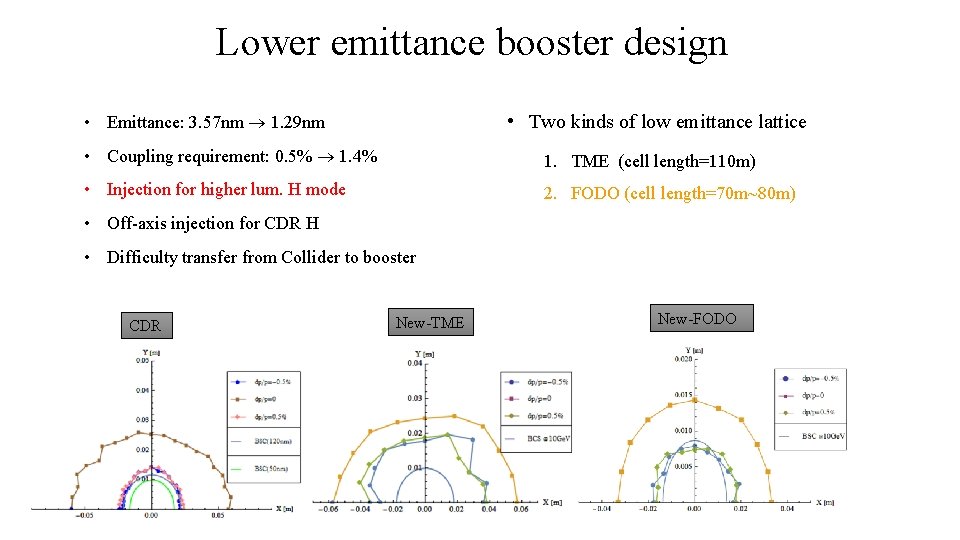
Lower emittance booster design • Two kinds of low emittance lattice • Emittance: 3. 57 nm 1. 29 nm • Coupling requirement: 0. 5% 1. 4% 1. TME (cell length=110 m) • Injection for higher lum. H mode 2. FODO (cell length=70 m~80 m) • Off-axis injection for CDR H • Difficulty transfer from Collider to booster CDR New-TME New-FODO
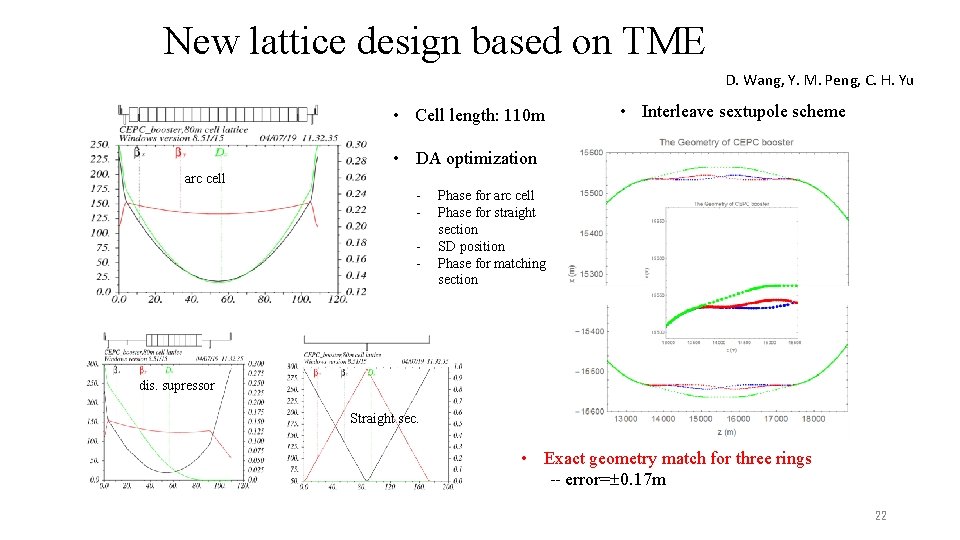
New lattice design based on TME D. Wang, Y. M. Peng, C. H. Yu • Cell length: 110 m • Interleave sextupole scheme • DA optimization arc cell - Phase for arc cell Phase for straight section SD position Phase for matching section dis. supressor Straight sec. • Exact geometry match for three rings -- error= 0. 17 m 22
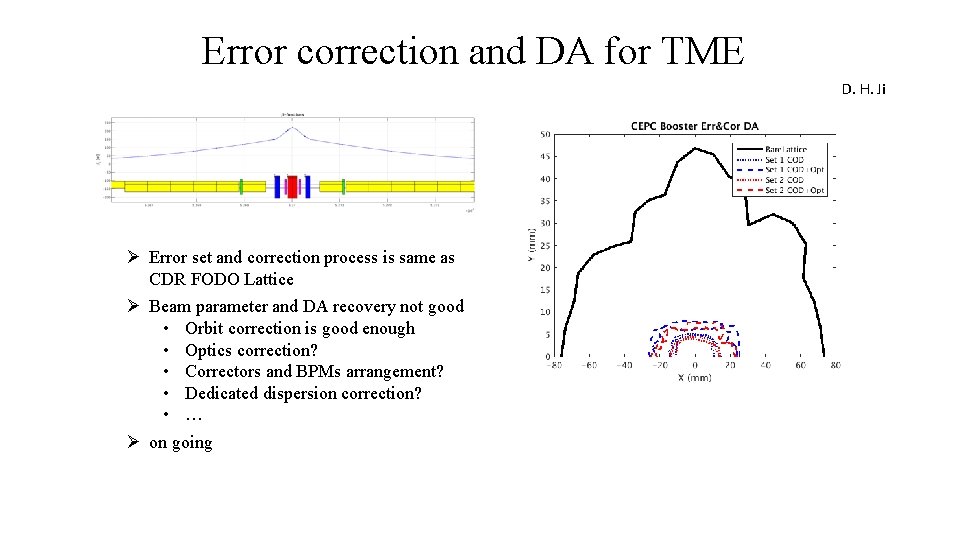
Error correction and DA for TME D. H. Ji Ø Error set and correction process is same as CDR FODO Lattice Ø Beam parameter and DA recovery not good • Orbit correction is good enough • Optics correction? • Correctors and BPMs arrangement? • Dedicated dispersion correction? • … Ø on going

Booster new parameters based on TME Injection *Diameter of beam pipe is 44 mm for instability calculation Extraction 24
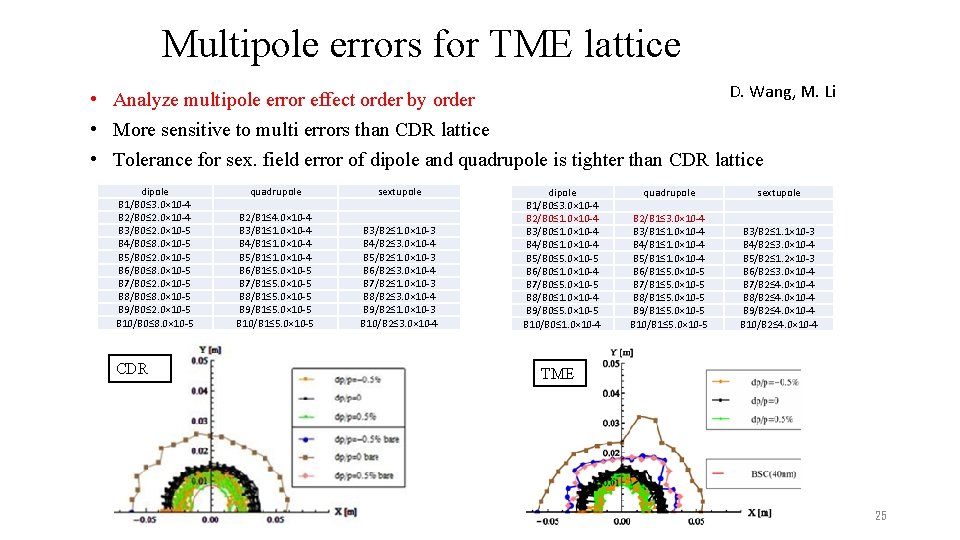
Multipole errors for TME lattice D. Wang, M. Li • Analyze multipole error effect order by order • More sensitive to multi errors than CDR lattice • Tolerance for sex. field error of dipole and quadrupole is tighter than CDR lattice dipole B 1/B 0≤ 3. 0× 10 -4 B 2/B 0≤ 2. 0× 10 -4 B 3/B 0≤ 2. 0× 10 -5 B 4/B 0≤ 8. 0× 10 -5 B 5/B 0≤ 2. 0× 10 -5 B 6/B 0≤ 8. 0× 10 -5 B 7/B 0≤ 2. 0× 10 -5 B 8/B 0≤ 8. 0× 10 -5 B 9/B 0≤ 2. 0× 10 -5 B 10/B 0≤ 8. 0× 10 -5 CDR quadrupole sextupole B 2/B 1≤ 4. 0× 10 -4 B 3/B 1≤ 1. 0× 10 -4 B 4/B 1≤ 1. 0× 10 -4 B 5/B 1≤ 1. 0× 10 -4 B 6/B 1≤ 5. 0× 10 -5 B 7/B 1≤ 5. 0× 10 -5 B 8/B 1≤ 5. 0× 10 -5 B 9/B 1≤ 5. 0× 10 -5 B 10/B 1≤ 5. 0× 10 -5 B 3/B 2≤ 1. 0× 10 -3 B 4/B 2≤ 3. 0× 10 -4 B 5/B 2≤ 1. 0× 10 -3 B 6/B 2≤ 3. 0× 10 -4 B 7/B 2≤ 1. 0× 10 -3 B 8/B 2≤ 3. 0× 10 -4 B 9/B 2≤ 1. 0× 10 -3 B 10/B 2≤ 3. 0× 10 -4 dipole B 1/B 0≤ 3. 0× 10 -4 B 2/B 0≤ 1. 0× 10 -4 B 3/B 0≤ 1. 0× 10 -4 B 4/B 0≤ 1. 0× 10 -4 B 5/B 0≤ 5. 0× 10 -5 B 6/B 0≤ 1. 0× 10 -4 B 7/B 0≤ 5. 0× 10 -5 B 8/B 0≤ 1. 0× 10 -4 B 9/B 0≤ 5. 0× 10 -5 B 10/B 0≤ 1. 0× 10 -4 quadrupole sextupole B 2/B 1≤ 3. 0× 10 -4 B 3/B 1≤ 1. 0× 10 -4 B 4/B 1≤ 1. 0× 10 -4 B 5/B 1≤ 1. 0× 10 -4 B 6/B 1≤ 5. 0× 10 -5 B 7/B 1≤ 5. 0× 10 -5 B 8/B 1≤ 5. 0× 10 -5 B 9/B 1≤ 5. 0× 10 -5 B 10/B 1≤ 5. 0× 10 -5 B 3/B 2≤ 1. 1× 10 -3 B 4/B 2≤ 3. 0× 10 -4 B 5/B 2≤ 1. 2× 10 -3 B 6/B 2≤ 3. 0× 10 -4 B 7/B 2≤ 4. 0× 10 -4 B 8/B 2≤ 4. 0× 10 -4 B 9/B 2≤ 4. 0× 10 -4 B 10/B 2≤ 4. 0× 10 -4 TME 25
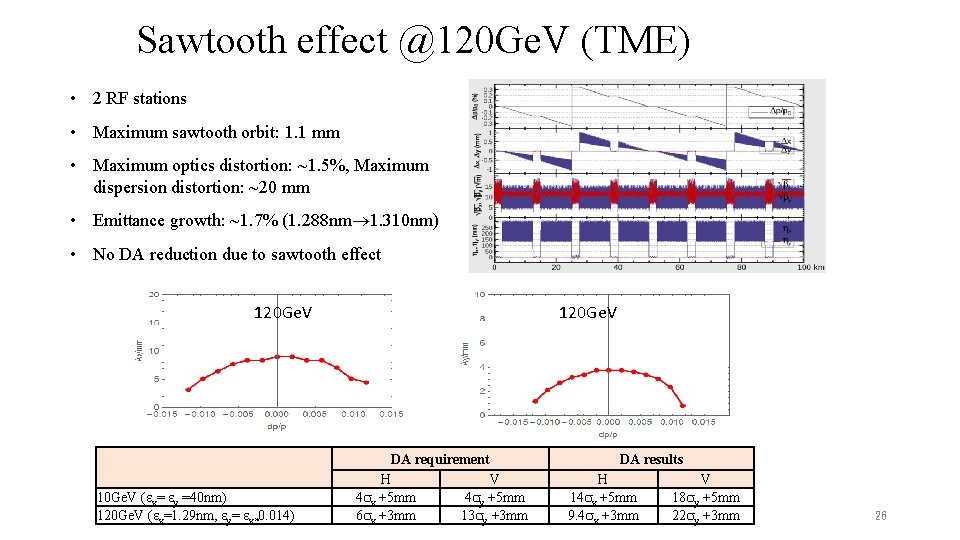
Sawtooth effect @120 Ge. V (TME) • 2 RF stations • Maximum sawtooth orbit: 1. 1 mm • Maximum optics distortion: ~1. 5%, Maximum dispersion distortion: ~20 mm • Emittance growth: ~1. 7% (1. 288 nm 1. 310 nm) • No DA reduction due to sawtooth effect 120 Ge. V DA requirement 10 Ge. V ( x= y =40 nm) 120 Ge. V ( x=1. 29 nm, y= x*0. 014) H 4 x +5 mm 6 x +3 mm V 4 y +5 mm 13 y +3 mm DA results H 14 x +5 mm 9. 4 x +3 mm V 18 y +5 mm 22 y +3 mm 26
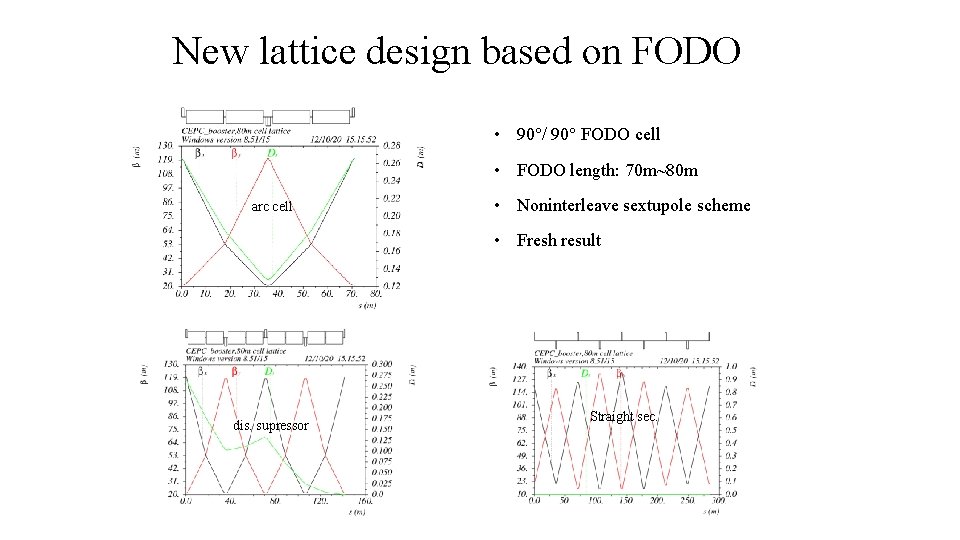
New lattice design based on FODO • 90 / 90 FODO cell • FODO length: 70 m~80 m arc cell • Noninterleave sextupole scheme • Fresh result dis. supressor Straight sec.
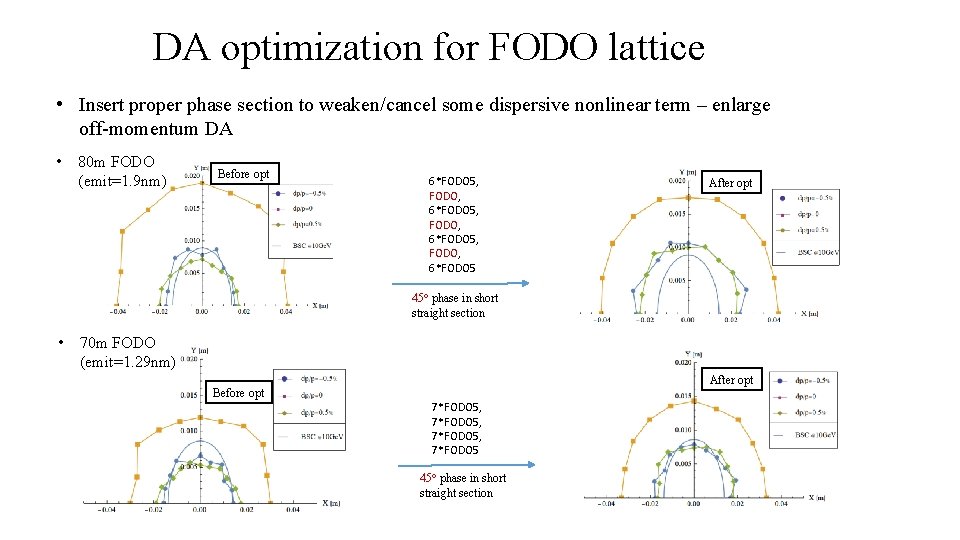
DA optimization for FODO lattice • Insert proper phase section to weaken/cancel some dispersive nonlinear term – enlarge off-momentum DA • 80 m FODO (emit=1. 9 nm) Before opt 6*FODO 5, FODO, 6*FODO 5 After opt 45 phase in short straight section • 70 m FODO (emit=1. 29 nm) After opt Before opt 7*FODO 5, 7*FODO 5 45 phase in short straight section
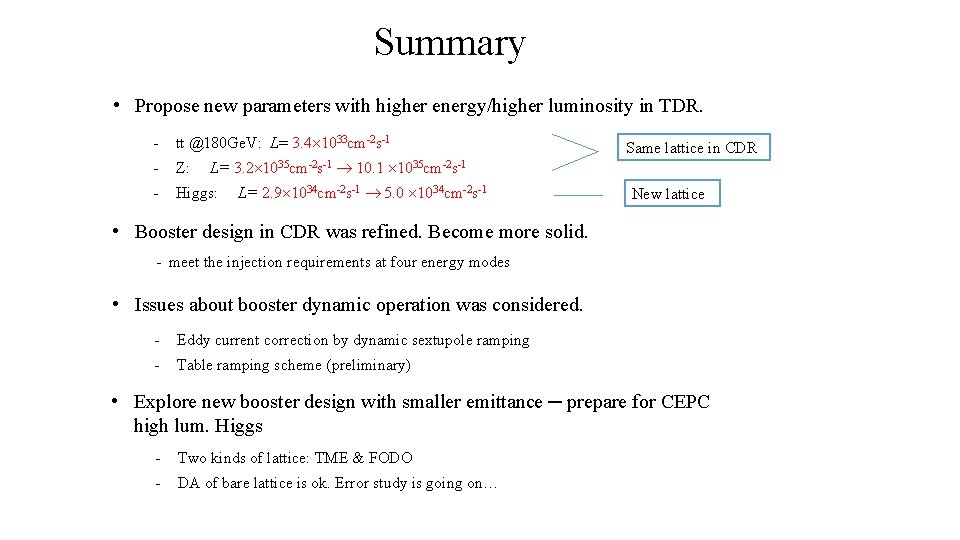
Summary • Propose new parameters with higher energy/higher luminosity in TDR. - tt @180 Ge. V: L= 3. 4 1033 cm-2 s-1 - Z: 3. 2 1035 cm-2 s-1 - Higgs: L= 10. 1 Same lattice in CDR 1035 cm-2 s-1 L= 2. 9 1034 cm-2 s-1 5. 0 1034 cm-2 s-1 New lattice • Booster design in CDR was refined. Become more solid. - meet the injection requirements at four energy modes • Issues about booster dynamic operation was considered. - Eddy current correction by dynamic sextupole ramping - Table ramping scheme (preliminary) • Explore new booster design with smaller emittance ─ prepare for CEPC high lum. Higgs - Two kinds of lattice: TME & FODO - DA of bare lattice is ok. Error study is going on…
Back up
CEPC CDR Parameters Higgs Number of IPs Beam energy (Ge. V) Circumference (km) Synchrotron radiation loss/turn (Ge. V) Crossing angle at IP (mrad) Piwinski angle Number of particles/bunch Ne (1010) Bunch number (bunch spacing) Beam current (m. A) Synchrotron radiation power /beam (MW) Bending radius (km) Momentum compact (10 -5) function at IP x* / y* (m) Emittance ex/ey (nm) Beam size at IP x / y ( m) Beam-beam parameters x/ y RF voltage VRF (GV) RF frequency f RF (MHz) (harmonic) Natural bunch length z (mm) Bunch length z (mm) HOM power/cavity (2 cell) (kw) Energy spread (%) Energy acceptance requirement (%) Energy acceptance by RF (%) Photon number due to beamstrahlung Beamstruhlung lifetime /quantum lifetime* (min) Lifetime (hour) F (hour glass) Luminosity/IP L (1034 cm-2 s-1) Z(3 T) W Z(2 T) 2 120 80 45. 5 100 1. 73 3. 48 15. 0 242 (0. 68 s) 17. 4 30 0. 36/0. 0015 1. 21/0. 0024 20. 9/0. 06 0. 018/0. 109 2. 17 2. 72 4. 4 0. 46 0. 134 1. 35 2. 06 0. 082 80/80 0. 43 0. 89 2. 93 0. 34 16. 5× 2 7. 0 12. 0 1524 (0. 21 s) 87. 9 30 10. 7 1. 11 0. 36/0. 0015 0. 54/0. 0016 13. 9/0. 049 0. 013/0. 123 0. 47 650 (216816) 2. 98 5. 9 0. 75 0. 098 0. 90 1. 47 0. 050 >400 1. 4 0. 94 10. 1 0. 036 23. 8 8. 0 12000 (25 ns+10%gap) 461. 0 16. 5 0. 2/0. 0015 0. 18/0. 004 6. 0/0. 078 0. 004/0. 06 0. 2/0. 001 0. 18/0. 0016 6. 0/0. 04 0. 004/0. 079 0. 10 2. 42 8. 5 1. 94 0. 080 0. 49 1. 7 0. 023 2. 5 4. 6 0. 99 16. 6 32. 1 31
Dipole uniformity requirement • Scan K 1 @10 Ge. V - Working point – small change - Emittance growth - DA reduction - Transfer efficiency • Scan K 1 @120 Ge. V - Working point – small change - Emittance growth - DA reduction – small (radiation damping & fluctuation included) - injection efficiency X. Cui
Effect of earthfield @10 Ge. V • • • D. H. Ji, D. Wang ~20% vacuum pipe (drift) is exposed in earthfield directly. treat drifts as week dipole to simulate the effect of earthfield Assume earthfield: 0. 3~0. 6 gauss (simple model: perpendicular component only ) Working point can be corrected by weaken the dipoles systematically (-0. 07%) Global COD correction was tested for 0. 3 gauss earthfield. DA is acceptable after COD correction. 0. 3 gauss first turn trajectory 33
- Slides: 33