
CEOS Disaster Risk Management Flood Pilot Presented at

- Slides: 25
CEOS Disaster Risk Management Flood Pilot Presented at the 2016 Flood Workshop, Greenbelt MD Flood Pilot Co-Lead Stu Frye (stuart. frye@nasa. gov) Flood Pilot Co-Lead Bob Kuligowski (bob. kuligowski@noaa. gov) 14 -15 June 2016 Slide: 1
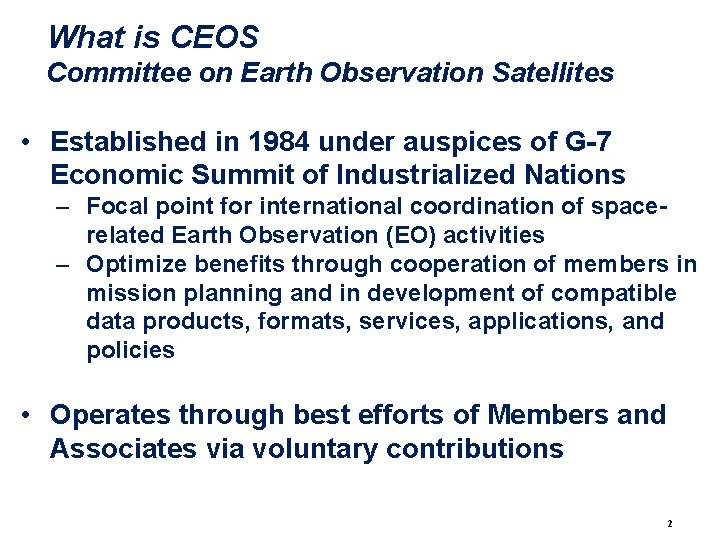
What is CEOS Committee on Earth Observation Satellites • Established in 1984 under auspices of G-7 Economic Summit of Industrialized Nations – Focal point for international coordination of spacerelated Earth Observation (EO) activities – Optimize benefits through cooperation of members in mission planning and in development of compatible data products, formats, services, applications, and policies • Operates through best efforts of Members and Associates via voluntary contributions 2
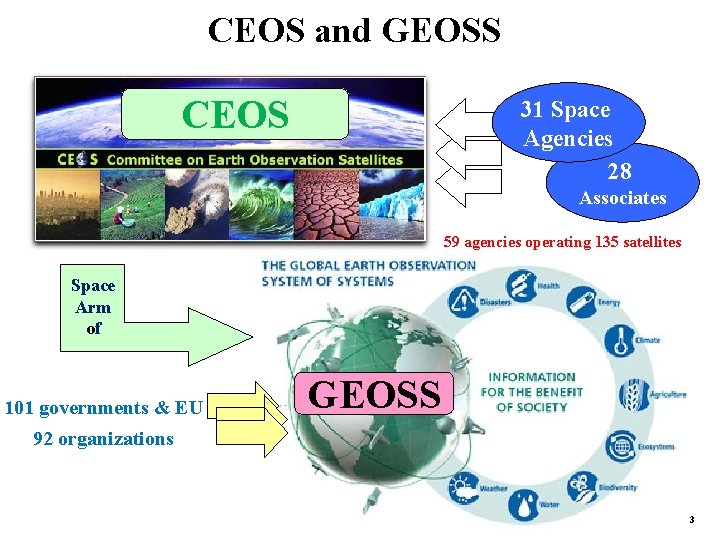
CEOS and GEOSS CEOS 31 Space Agencies 28 Associates 59 agencies operating 135 satellites Space Arm of 101 governments & EU GEOSS 92 organizations 3
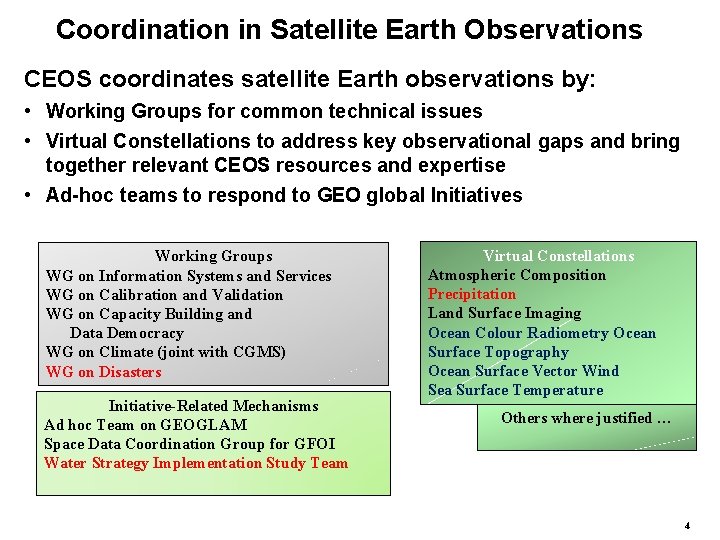
Coordination in Satellite Earth Observations CEOS coordinates satellite Earth observations by: • Working Groups for common technical issues • Virtual Constellations to address key observational gaps and bring together relevant CEOS resources and expertise • Ad-hoc teams to respond to GEO global Initiatives Working Groups WG on Information Systems and Services WG on Calibration and Validation WG on Capacity Building and Data Democracy WG on Climate (joint with CGMS) WG on Disasters Initiative-Related Mechanisms Ad hoc Team on GEOGLAM Space Data Coordination Group for GFOI Water Strategy Implementation Study Team Virtual Constellations Atmospheric Composition Precipitation Land Surface Imaging Ocean Colour Radiometry Ocean Surface Topography Ocean Surface Vector Wind Sea Surface Temperature Others where justified … 4
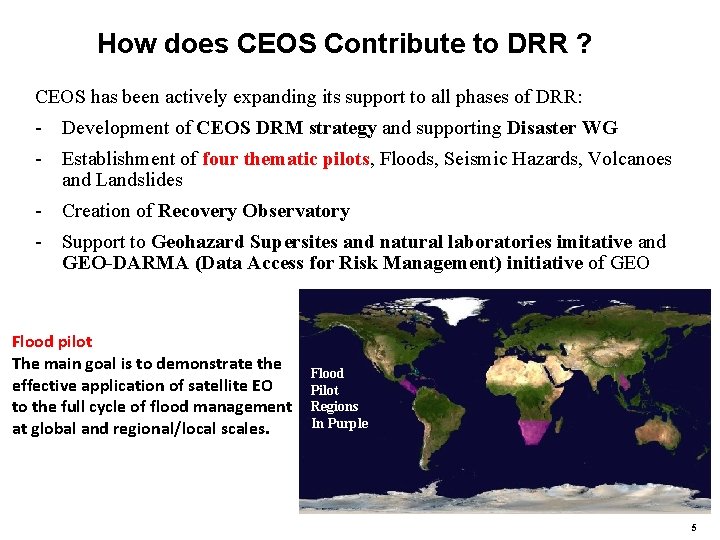
How does CEOS Contribute to DRR ? CEOS has been actively expanding its support to all phases of DRR: - Development of CEOS DRM strategy and supporting Disaster WG - Establishment of four thematic pilots, Floods, Seismic Hazards, Volcanoes and Landslides - Creation of Recovery Observatory - Support to Geohazard Supersites and natural laboratories imitative and GEO-DARMA (Data Access for Risk Management) initiative of GEO Flood pilot The main goal is to demonstrate the effective application of satellite EO to the full cycle of flood management at global and regional/local scales. Flood Pilot Regions In Purple 5
CEOS DRM Flood Pilot Overview • Goal: demonstrate effective application of EO to the full cycle of flood management at all scales by: • Objective A: Integrating information from existing NRT global flood monitoring / modeling systems into a Global Flood Dashboard; • Objective B: Delivering EO-based flood mitigation, warning, and response products and services through regional end-to-end pilots in: • • • Caribbean/Central America (focus on Haiti) Southern Africa (inc. Namibia, South Africa, Zambia, Zimbabwe, Mozambique, and Malawi); Southeast Asia (focus on lower Mekong Basin and Java) • Objective C: Encouraging at least base-level in-country capacity to access EO and integrate it into their operational systems and flood management practices 6
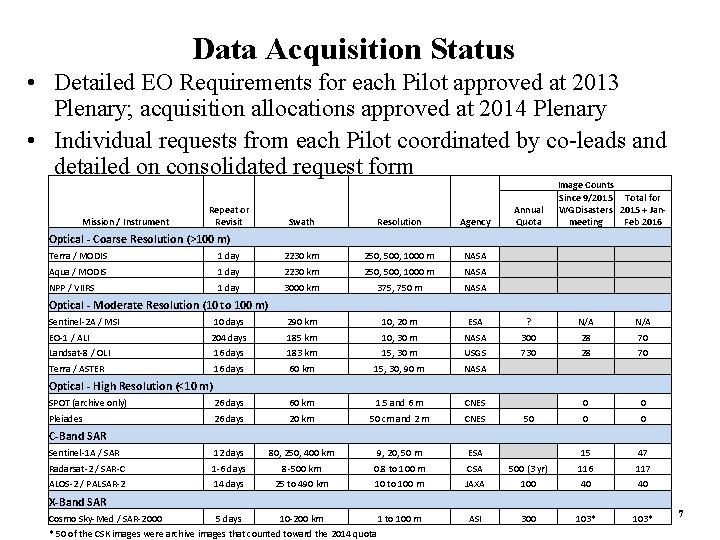
Data Acquisition Status • Detailed EO Requirements for each Pilot approved at 2013 Plenary; acquisition allocations approved at 2014 Plenary • Individual requests from each Pilot coordinated by co-leads and detailed on consolidated request form Mission / Instrument Repeat or Revisit Swath Resolution Agency Annual Quota Image Counts Since 9/2015 Total for WGDisasters 2015 + Janmeeting Feb 2016 Optical - Coarse Resolution (>100 m) Terra / MODIS 1 day 2230 km 250, 500, 1000 m NASA Aqua / MODIS 1 day 2230 km 250, 500, 1000 m NASA NPP / VIIRS 1 day 3000 km 375, 750 m NASA Optical - Moderate Resolution (10 to 100 m) Sentinel-2 A / MSI 10 days 290 km 10, 20 m ESA ? N/A EO-1 / ALI 204 days 185 km 10, 30 m NASA 300 28 70 Landsat-8 / OLI 16 days 183 km 15, 30 m USGS 730 28 70 Terra / ASTER 16 days 60 km 15, 30, 90 m NASA SPOT (archive only) 26 days 60 km 1. 5 and 6 m CNES 0 0 Pleiades 26 days 20 km 50 cm and 2 m CNES 50 0 0 Sentinel-1 A / SAR 12 days 80, 250, 400 km 9, 20, 50 m ESA 15 47 Radarsat-2 / SAR-C 1 -6 days 8 -500 km 0. 8 to 100 m CSA 500 (3 yr) 116 117 ALOS-2 / PALSAR-2 14 days 25 to 490 km 10 to 100 m JAXA 100 40 40 5 days 10 -200 km 1 to 100 m ASI 300 103* Optical - High Resolution (<10 m) C-Band SAR X-Band SAR Cosmo Sky-Med / SAR-2000 * 50 of the CSK images were archive images that counted toward the 2014 quota 7
International Disaster Charter Data Access • As of January 2016 The International Disaster Charter has granted the CEOS Flood Pilot team access to future Charter data: • Access also provided for five 2015 events: Malawi (Jan); Vietnam (July); Myanmar (August), and India (December); and one in 2016 (Mississippi River in January) • To date, the Flood Pilot has been able to obtain images from • • • ALOS-2 (JAXA) RISAT-1, Resource. Sat-1, 2, and Cartosat 1 -2 (ISRO) KOMPSAT-2 (KARI) Kanopus-V 1 and Resurs-P (ROSCOSMOS) UK-DMC 2 (DMC International Imaging) 8
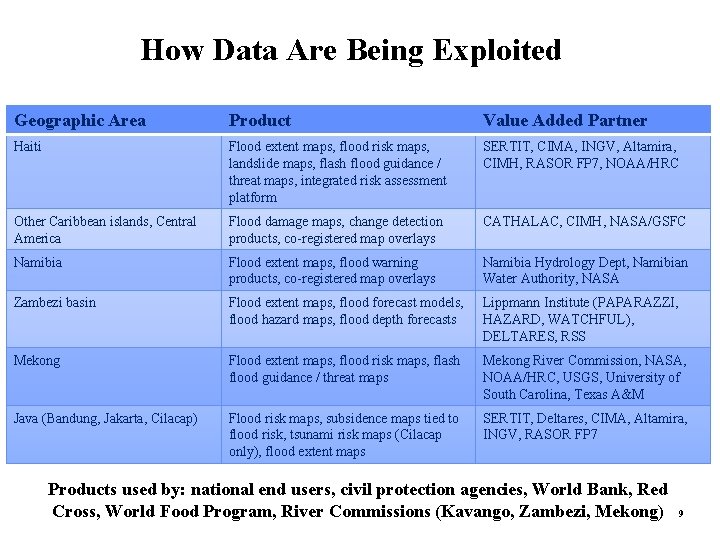
How Data Are Being Exploited Geographic Area Product Value Added Partner Haiti Flood extent maps, flood risk maps, landslide maps, flash flood guidance / threat maps, integrated risk assessment platform SERTIT, CIMA, INGV, Altamira, CIMH, RASOR FP 7, NOAA/HRC Other Caribbean islands, Central America Flood damage maps, change detection products, co-registered map overlays CATHALAC, CIMH, NASA/GSFC Namibia Flood extent maps, flood warning products, co-registered map overlays Namibia Hydrology Dept, Namibian Water Authority, NASA Zambezi basin Flood extent maps, flood forecast models, flood hazard maps, flood depth forecasts Lippmann Institute (PAPARAZZI, HAZARD, WATCHFUL), DELTARES, RSS Mekong Flood extent maps, flood risk maps, flash flood guidance / threat maps Mekong River Commission, NASA, NOAA/HRC, USGS, University of South Carolina, Texas A&M Java (Bandung, Jakarta, Cilacap) Flood risk maps, subsidence maps tied to flood risk, tsunami risk maps (Cilacap only), flood extent maps SERTIT, Deltares, CIMA, Altamira, INGV, RASOR FP 7 Products used by: national end users, civil protection agencies, World Bank, Red Cross, World Food Program, River Commissions (Kavango, Zambezi, Mekong) 9
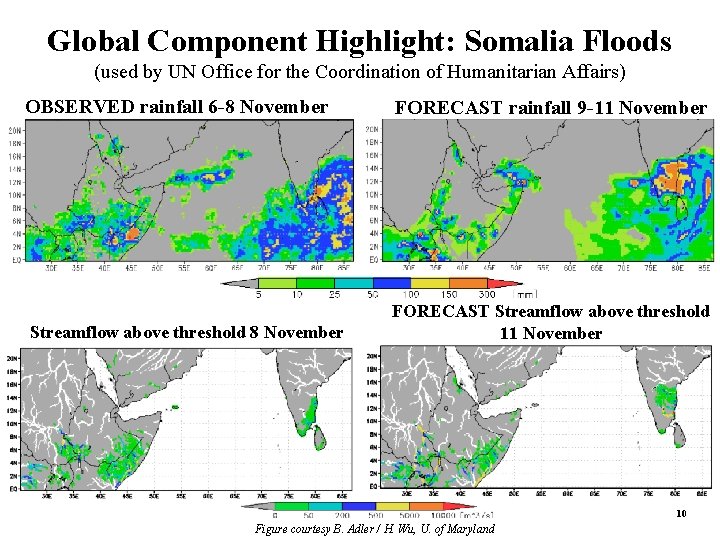
Global Component Highlight: Somalia Floods (used by UN Office for the Coordination of Humanitarian Affairs) OBSERVED rainfall 6 -8 November FORECAST rainfall 9 -11 November Streamflow above threshold 8 November FORECAST Streamflow above threshold 11 November 10 Figure courtesy B. Adler / H. Wu, U. of Maryland
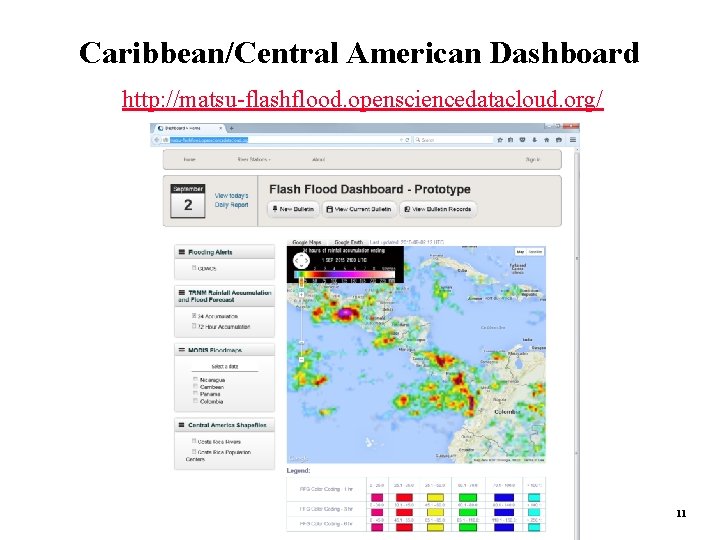
Caribbean/Central American Dashboard http: //matsu-flashflood. opensciencedatacloud. org/ 11
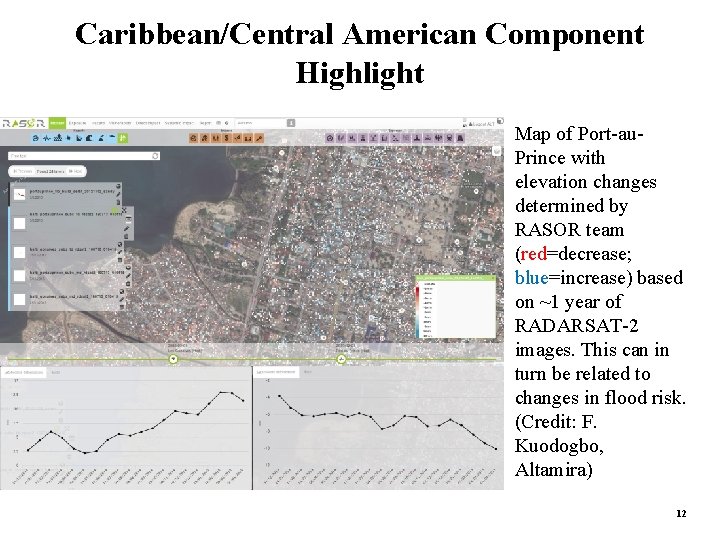
Caribbean/Central American Component Highlight Map of Port-au. Prince with elevation changes determined by RASOR team (red=decrease; blue=increase) based on ~1 year of RADARSAT-2 images. This can in turn be related to changes in flood risk. (Credit: F. Kuodogbo, Altamira) 12
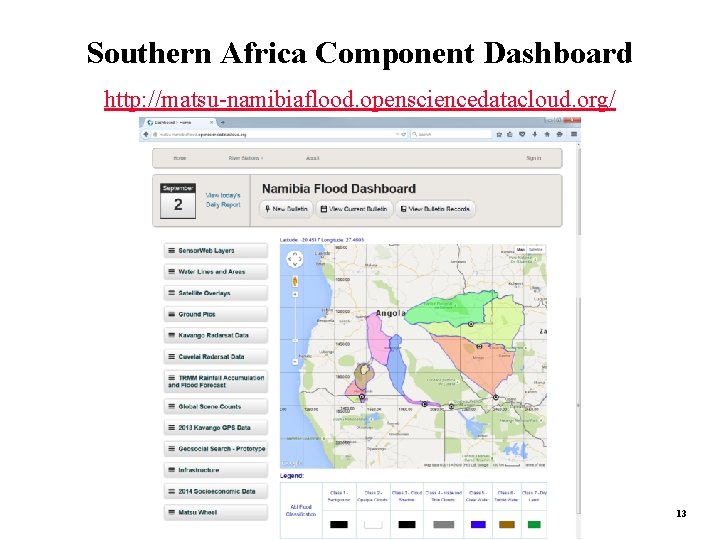
Southern Africa Component Dashboard http: //matsu-namibiaflood. opensciencedatacloud. org/ 13
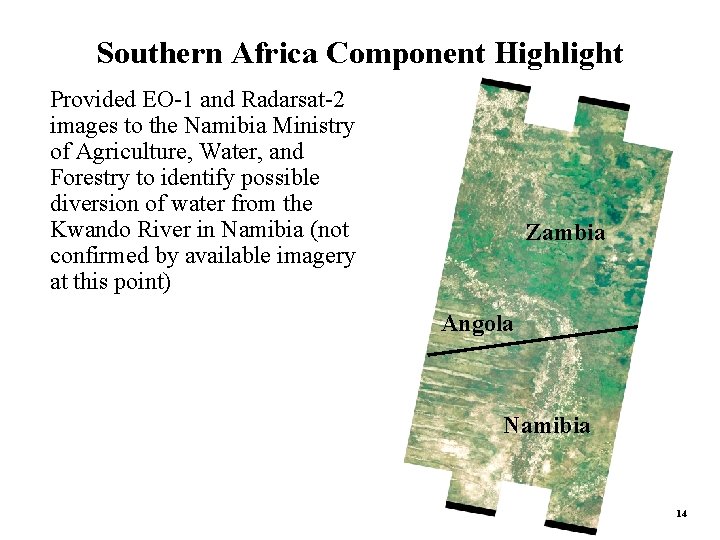
Southern Africa Component Highlight Provided EO-1 and Radarsat-2 images to the Namibia Ministry of Agriculture, Water, and Forestry to identify possible diversion of water from the Kwando River in Namibia (not confirmed by available imagery at this point) Zambia Angola Namibia 14
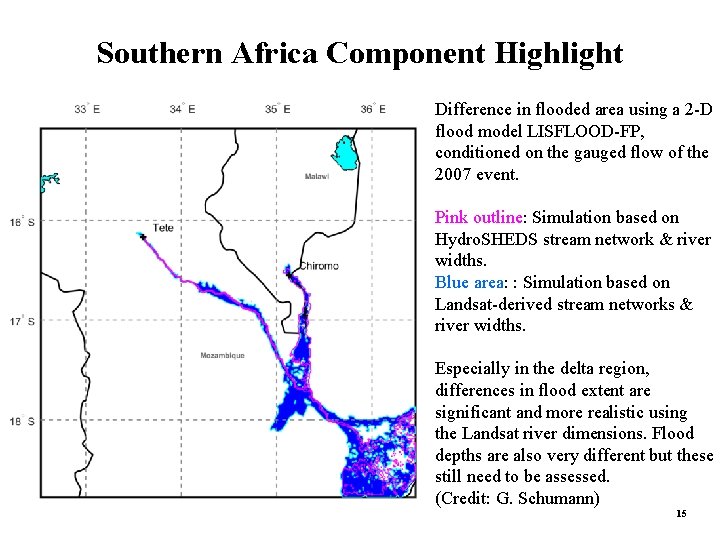
Southern Africa Component Highlight Difference in flooded area using a 2 -D flood model LISFLOOD-FP, conditioned on the gauged flow of the 2007 event. Pink outline: Simulation based on Hydro. SHEDS stream network & river widths. Blue area: : Simulation based on Landsat-derived stream networks & river widths. Especially in the delta region, differences in flood extent are significant and more realistic using the Landsat river dimensions. Flood depths are also very different but these still need to be assessed. (Credit: G. Schumann) 15
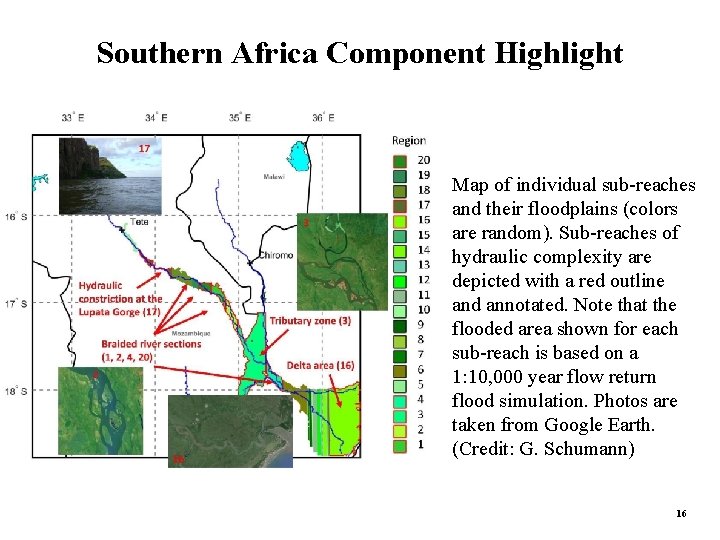
Southern Africa Component Highlight Map of individual sub-reaches and their floodplains (colors are random). Sub-reaches of hydraulic complexity are depicted with a red outline and annotated. Note that the flooded area shown for each sub-reach is based on a 1: 10, 000 year flow return flood simulation. Photos are taken from Google Earth. (Credit: G. Schumann) 16
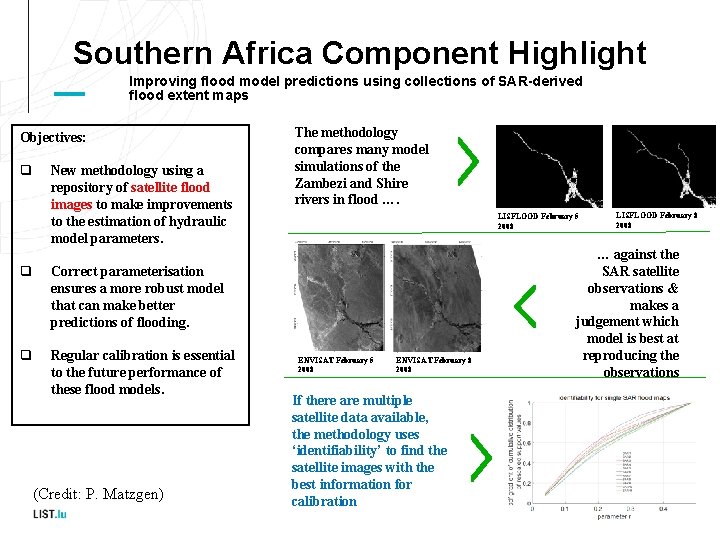
Southern Africa Component Highlight Improving flood model predictions using collections of SAR-derived flood extent maps Objectives: q New methodology using a repository of satellite flood images to make improvements to the estimation of hydraulic model parameters. q Correct parameterisation ensures a more robust model that can make better predictions of flooding. q Regular calibration is essential to the future performance of these flood models. (Credit: P. Matzgen) The methodology compares many model simulations of the Zambezi and Shire rivers in flood …. LISFLOOD February 5 2008 ENVISAT February 8 2008 If there are multiple satellite data available, the methodology uses ‘identifiability’ to find the satellite images with the best information for calibration LISFLOOD February 8 2008 … against the SAR satellite observations & makes a judgement which model is best at reproducing the observations
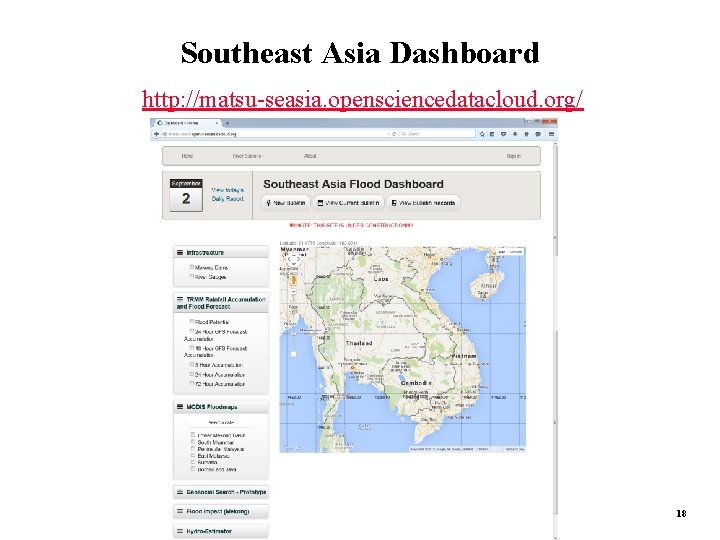
Southeast Asia Dashboard http: //matsu-seasia. opensciencedatacloud. org/ 18
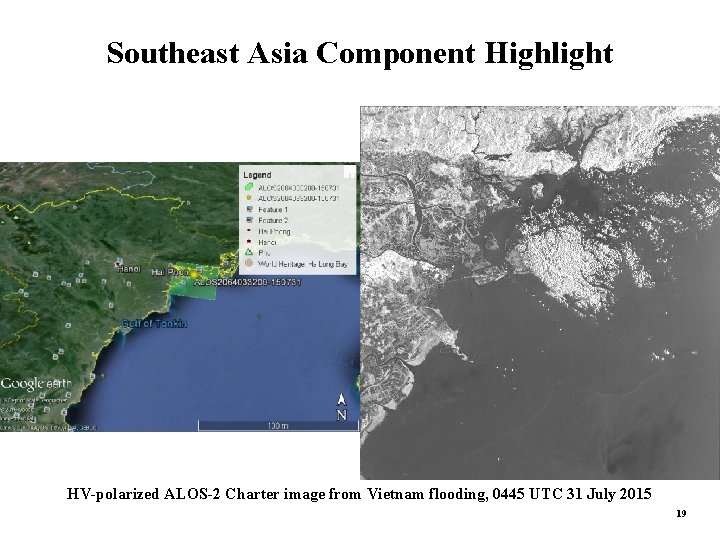
Southeast Asia Component Highlight HV-polarized ALOS-2 Charter image from Vietnam flooding, 0445 UTC 31 July 2015 19
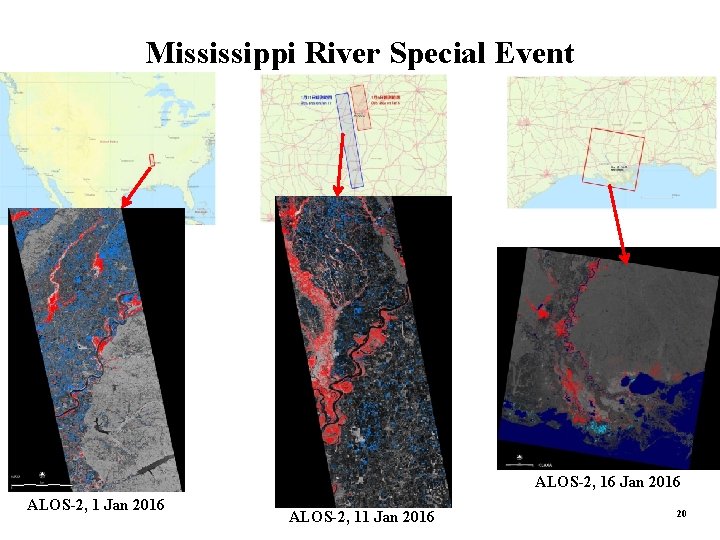
Mississippi River Special Event ALOS-2, 16 Jan 2016 ALOS-2, 11 Jan 2016 20
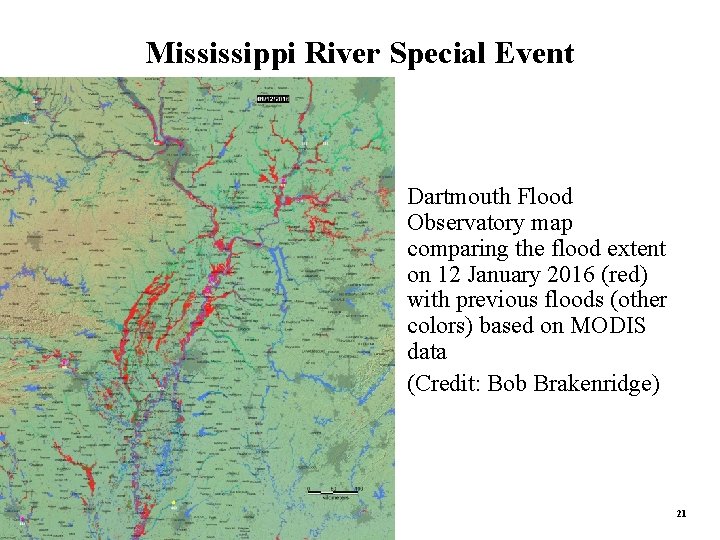
Mississippi River Special Event Dartmouth Flood Observatory map comparing the flood extent on 12 January 2016 (red) with previous floods (other colors) based on MODIS data (Credit: Bob Brakenridge) 21
Capacity Building Status (1/2) • Caribbean/Central American Component: • Coordinated inclusion of Open Geo. Social API Flood Monitoring software suite as disasters component within the Climatic Information Platform for Central America and the Dominican Republic as part of the USAID Regional Climate Change Program (RCCP) • Training workshop by NASA GSFC personnel (supported by SERVIR and USAID) in Costa Rica • Approval of Ameri. GEOSS initiative by GEO; working on Terms of Reference for a Disasters group within the Americas (Chile, Colombia, Costa Rica, Ecuador, Brazil, Argentina, and Mexico) that would need to interact with the CEOS Regional component in the Caribbean and Central America • Splinter session at Latin American Remote Sensing (LARS) Conference March 30 – April 1 in Santiago, Chile • Training session in Bogota Columbia June 7 -10 in conjunction with the Americas Caucus meeting 22
Capacity Building Status (2/2) • Southern Africa Component: • TIGER workshop in Addis Ababa 1 -2 February; 100 participants and 72 h of training on EO for water resources management • New TIGER training kit is being used in “Training of Trainers” with Cap-Net UNDP (119 experts trained so far) • Southeast Asia Component: • ADPC installation of API pending SERVIR grant funding 23
Recent Publications / Conference Presentations Frye S. , Wells G. , Adler R. , Brakenridge R. , Bolten J. , Murray J. , Slayback D. , Green D. , Wu, H. , Kirschbaum D. , Howard T. , Flamig Z. , Clark R. , Chini M. , Matgen. P. , Stough T. , “User. Driven Workflow for Modeling, Monitoring, Product Development, and Flood Map Delivery Using Satellites for Daily Coverage Over Texas May-June 2015”, Poster presentation at the American Geophysical Union 2015 annual meeting, December 2015 San Francisco, CA Schumann G. J-P. , Frye S. , Wells G. , Adler R. , Brakenridge R. , Bolten J. , Murray J. , Slayback D. , Green D. , Wu H. , Kirschbaum D. , Howard T. , Flamig Z. , Clark R. , Chini M. , Matgen. P. , Stough T. , B. Jones, “Unlocking the Full Potential of Earth Observation during the 2016 Texas Flood Disaster”, Water Resources Research, in review. Schumann, G. J-P and K. M. Andreadis (2016). A method to assess localized impact of better floodplain topography on flood risk prediction, Advances in Meteorology, in review. Wu, H. and Adler, R. , “Evaluation of Quantitative Precipitation Estimations (QPE) and Hydrological Modeling at the Iowa Flood Studies Focal Basins. ”, 2016 Journal of Hydrometeorology, in review. Presentation by Chu Ishida on the Flood Pilot at Asian Water Cycle Symposium in March Special Issue in Remote Sensing on “Earth Observation for Water Resource Management in Africa” 24
Questions / Discussion