
Centro Linguistico di Ateneo Universit degli Studi di

- Slides: 16
Centro Linguistico di Ateneo - Università degli Studi di Cagliari CORSO INGLESE LIVELLO B 1 DOCENTI AMBITO 10 Based on: Gerald Nelson, English an essential grammar, Routledge, 2011
WORD FORMATION
THE STRUCTURE OF WORDS Many words in English have a recognizable internal structure. For example, the word unsuccessful can be broken down into the following three parts: un + success + ful Prefixes BASE suffix Prefixes and suffixes are added to existing words to create new words.
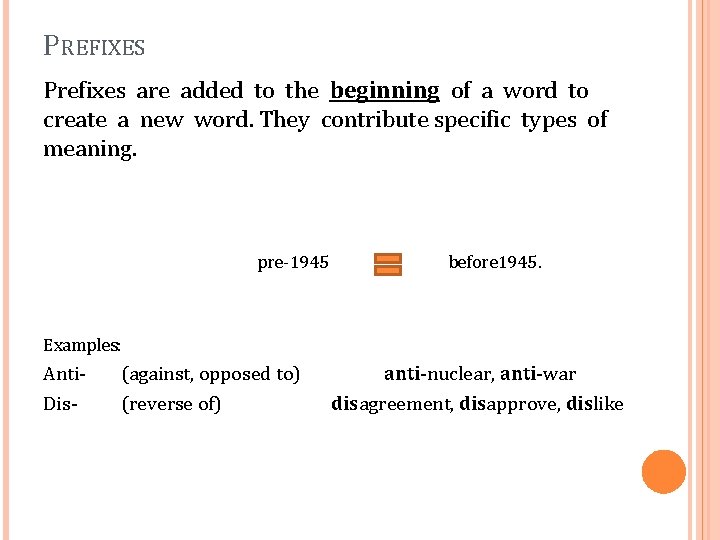
PREFIXES Prefixes are added to the beginning of a word to create a new word. They contribute specific types of meaning. pre-1945 before 1945. Examples: Anti. Dis- (against, opposed to) (reverse of) anti-nuclear, anti-war disagreement, disapprove, dislike
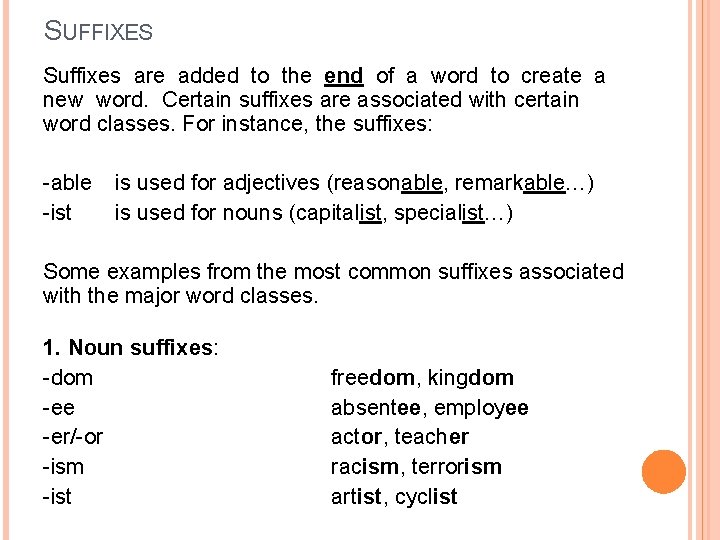
SUFFIXES Suffixes are added to the end of a word to create a new word. Certain suffixes are associated with certain word classes. For instance, the suffixes: -able -ist is used for adjectives (reasonable, remarkable…) is used for nouns (capitalist, specialist…) Some examples from the most common suffixes associated with the major word classes. 1. Noun suffixes: -dom -ee -er/-or -ism -ist freedom, kingdom absentee, employee actor, teacher racism, terrorism artist, cyclist
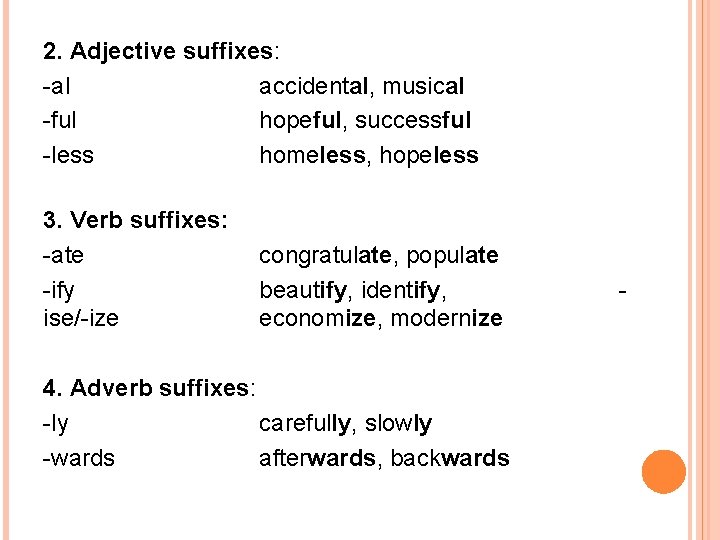
2. Adjective suffixes: -al accidental, musical -ful hopeful, successful -less homeless, hopeless 3. Verb suffixes: -ate -ify ise/-ize congratulate, populate beautify, identify, economize, modernize 4. Adverb suffixes: -ly carefully, slowly -wards afterwards, backwards -
IF YOU WANT TO KNOW MORE ABOUT THIS TOPIC READ THIS… OTHER TECHNIQUES TO CREATE NEW WORDS
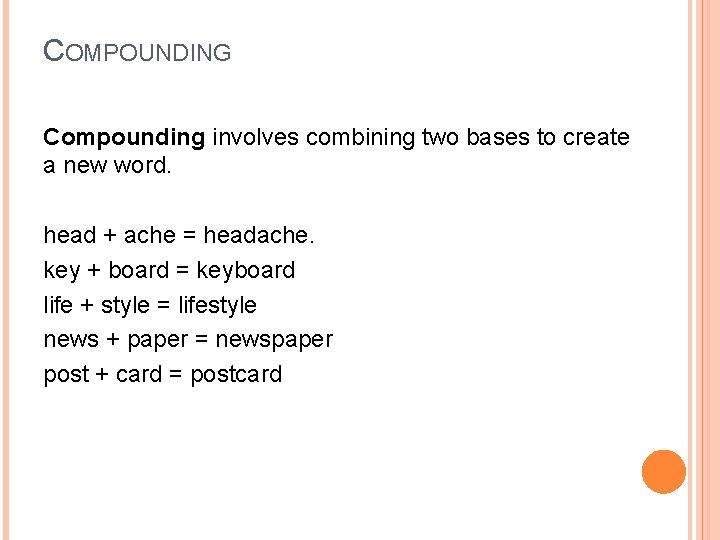
COMPOUNDING Compounding involves combining two bases to create a new word. head + ache = headache. key + board = keyboard life + style = lifestyle news + paper = newspaper post + card = postcard
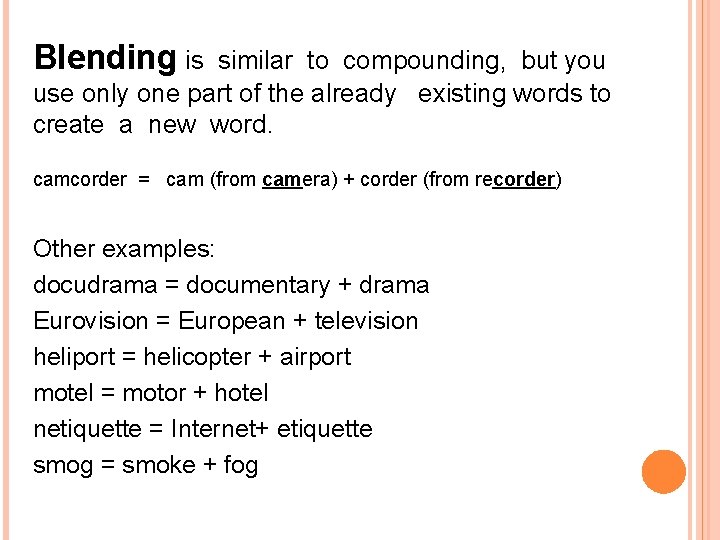
Blending is similar to compounding, but you use only one part of the already existing words to create a new word. camcorder = cam (from camera) + corder (from recorder) Other examples: docudrama = documentary + drama Eurovision = European + television heliport = helicopter + airport motel = motor + hotel netiquette = Internet+ etiquette smog = smoke + fog
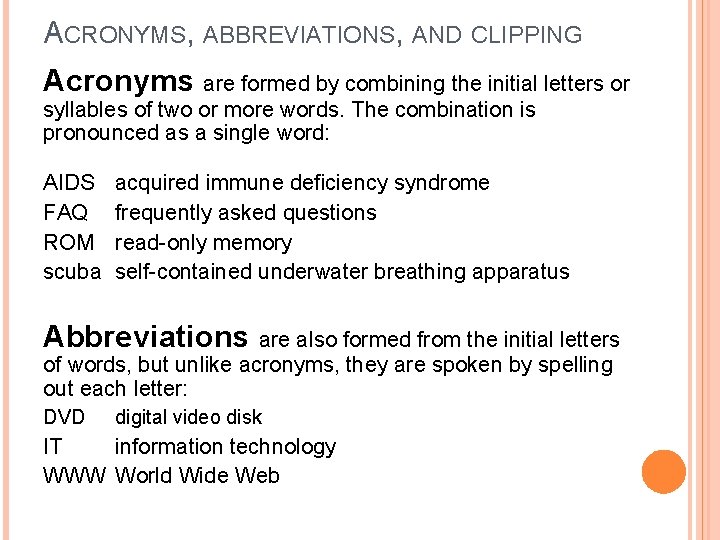
ACRONYMS, ABBREVIATIONS, AND CLIPPING Acronyms are formed by combining the initial letters or syllables of two or more words. The combination is pronounced as a single word: AIDS FAQ ROM scuba acquired immune deficiency syndrome frequently asked questions read-only memory self-contained underwater breathing apparatus Abbreviations are also formed from the initial letters of words, but unlike acronyms, they are spoken by spelling out each letter: DVD digital video disk IT information technology WWW World Wide Web
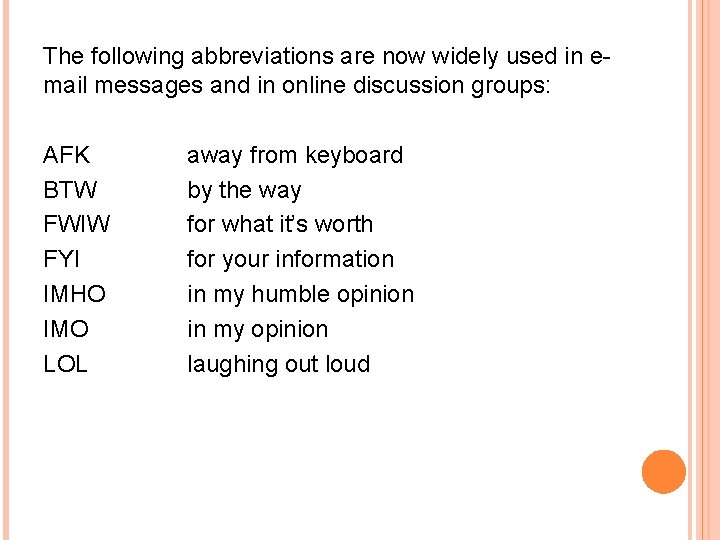
The following abbreviations are now widely used in email messages and in online discussion groups: AFK BTW FWIW FYI IMHO IMO LOL away from keyboard by the way for what it’s worth for your information in my humble opinion in my opinion laughing out loud
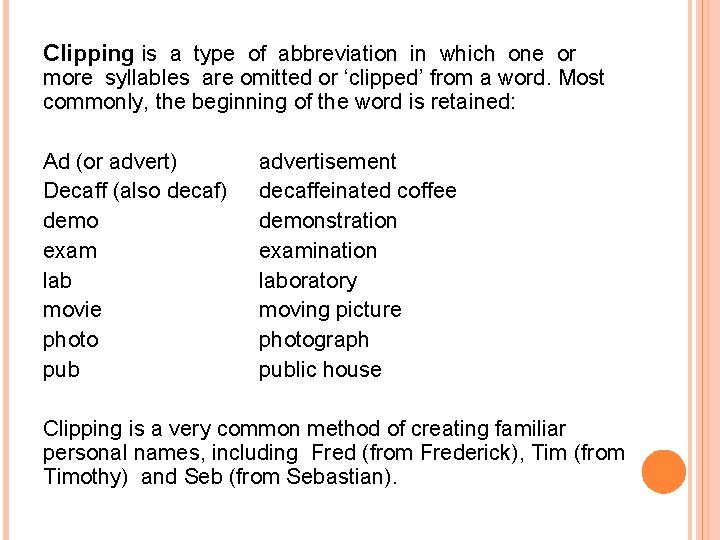
Clipping is a type of abbreviation in which one or more syllables are omitted or ‘clipped’ from a word. Most commonly, the beginning of the word is retained: Ad (or advert) Decaff (also decaf) demo exam lab movie photo pub advertisement decaffeinated coffee demonstration examination laboratory moving picture photograph public house Clipping is a very common method of creating familiar personal names, including Fred (from Frederick), Tim (from Timothy) and Seb (from Sebastian).
Following the complete list of suffixes and prefixes for all the word classes…enjoy A seguire la lista completa dei suffissi e dei prefissi per tutte le classi di parole…buon divertimento
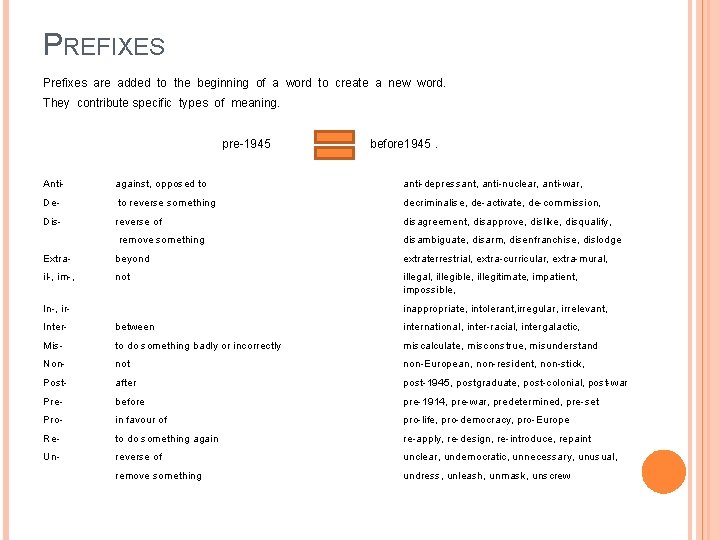
PREFIXES Prefixes are added to the beginning of a word to create a new word. They contribute specific types of meaning. pre-1945 before 1945. Anti- against, opposed to anti-depressant, anti-nuclear, anti-war, De- to reverse something decriminalise, de-activate, de-commission, Dis- reverse of disagreement, disapprove, dislike, disqualify, remove something disambiguate, disarm, disenfranchise, dislodge Extra- beyond extraterrestrial, extra-curricular, extra-mural, il-, im-, not illegal, illegible, illegitimate, impatient, impossible, In-, ir- inappropriate, intolerant, irregular, irrelevant, Inter- between international, inter-racial, intergalactic, Mis- to do something badly or incorrectly miscalculate, misconstrue, misunderstand Non- not non-European, non-resident, non-stick, Post- after post-1945, postgraduate, post-colonial, post-war Pre- before pre-1914, pre-war, predetermined, pre-set Pro- in favour of pro-life, pro-democracy, pro-Europe Re- to do something again re-apply, re-design, re-introduce, repaint Un- reverse of unclear, undemocratic, unnecessary, unusual, remove something undress, unleash, unmask, unscrew
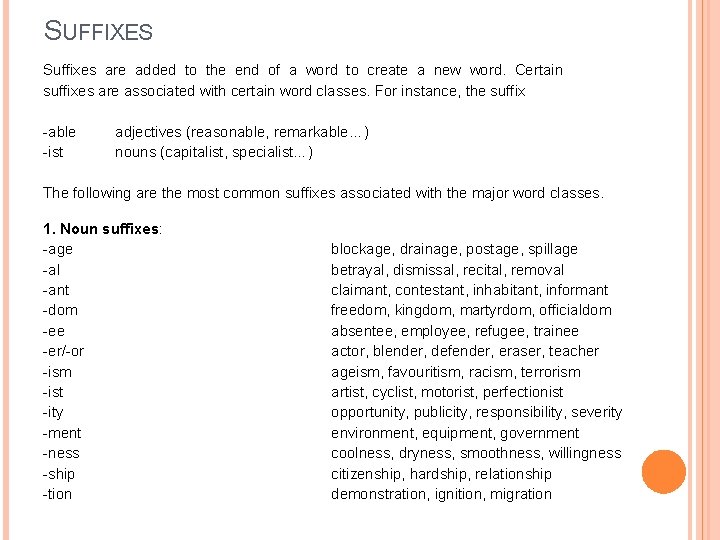
SUFFIXES Suffixes are added to the end of a word to create a new word. Certain suffixes are associated with certain word classes. For instance, the suffix -able -ist adjectives (reasonable, remarkable…) nouns (capitalist, specialist…) The following are the most common suffixes associated with the major word classes. 1. Noun suffixes: -age -al -ant -dom -ee -er/-or -ism -ist -ity -ment -ness -ship -tion blockage, drainage, postage, spillage betrayal, dismissal, recital, removal claimant, contestant, inhabitant, informant freedom, kingdom, martyrdom, officialdom absentee, employee, refugee, trainee actor, blender, defender, eraser, teacher ageism, favouritism, racism, terrorism artist, cyclist, motorist, perfectionist opportunity, publicity, responsibility, severity environment, equipment, government coolness, dryness, smoothness, willingness citizenship, hardship, relationship demonstration, ignition, migration
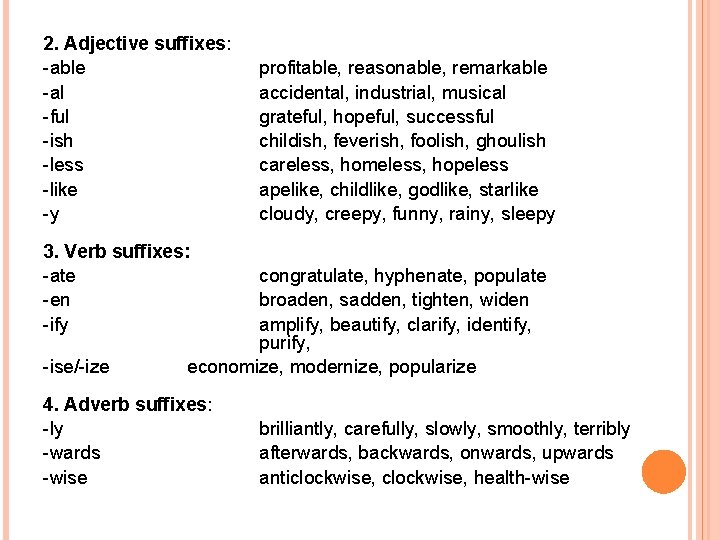
2. Adjective suffixes: -able -al -ful -ish -less -like -y profitable, reasonable, remarkable accidental, industrial, musical grateful, hopeful, successful childish, feverish, foolish, ghoulish careless, homeless, hopeless apelike, childlike, godlike, starlike cloudy, creepy, funny, rainy, sleepy 3. Verb suffixes: -ate -en -ify -ise/-ize congratulate, hyphenate, populate broaden, sadden, tighten, widen amplify, beautify, clarify, identify, purify, economize, modernize, popularize 4. Adverb suffixes: -ly -wards -wise brilliantly, carefully, slowly, smoothly, terribly afterwards, backwards, onwards, upwards anticlockwise, health-wise