
Centripetal Acceleration and Force Motion in a circle
- Slides: 21
Centripetal Acceleration and Force • Motion in a circle at a constant “speed” is still accelerating. • As the direction changes, the acceleration affects the velocity vector. The magnitude of the velocity is unaffected. • A point mass “m” with a constant magnitude of velocity “|v|” travelling in a circle of radius “r” undergoes acceleration. • The acceleration is called the centripetal acceleration and it acts towards the centre of the circle.
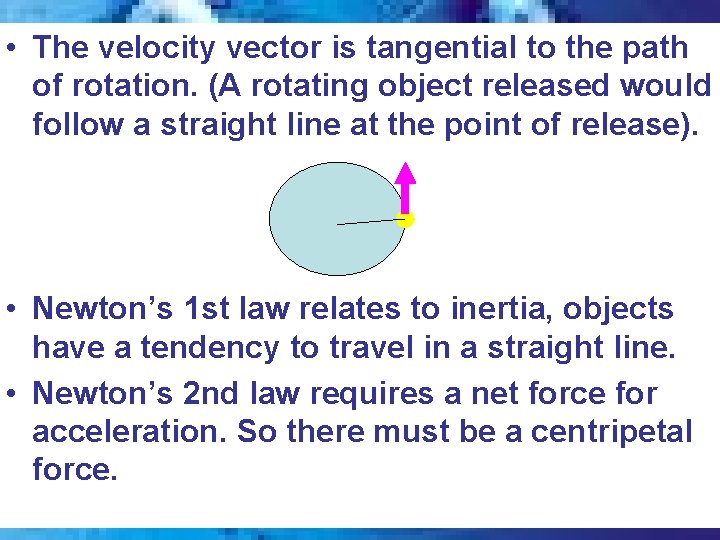
• The velocity vector is tangential to the path of rotation. (A rotating object released would follow a straight line at the point of release). • Newton’s 1 st law relates to inertia, objects have a tendency to travel in a straight line. • Newton’s 2 nd law requires a net force for acceleration. So there must be a centripetal force.
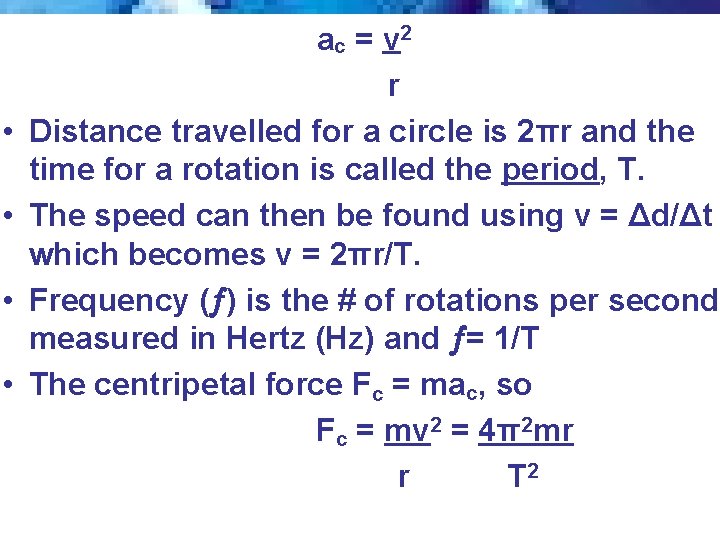
• • ac = v 2 r Distance travelled for a circle is 2πr and the time for a rotation is called the period, T. The speed can then be found using v = Δd/Δt which becomes v = 2πr/T. Frequency ( ) is the # of rotations per second, measured in Hertz (Hz) and = 1/T The centripetal force Fc = mac, so Fc = mv 2 = 4π2 mr r T 2
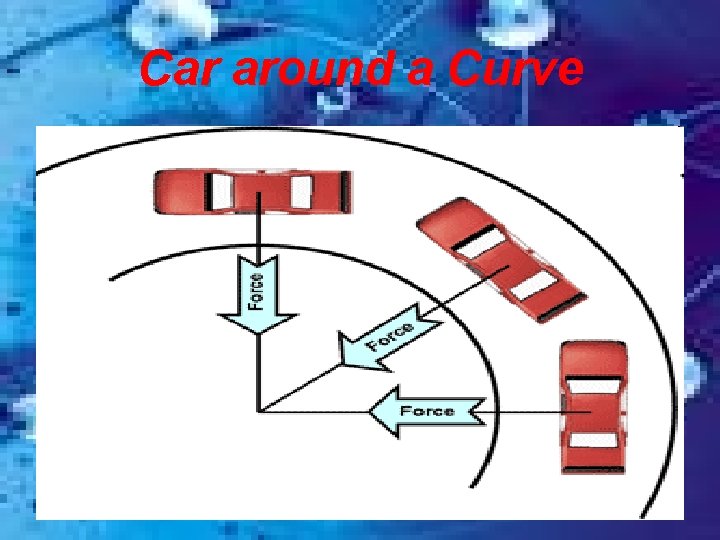
• The centripetal force is supplied by some external source. The attraction of the Earth to the sun maintains its elliptical path so gravity supplies the centripetal force. • Friction supplies Fc for a car going around a curve. • Horizontal rotations are the easiest to study as we can ignore gravity (independent motion) assuming the object is level. The tension supplies Fc. (FT = Fc)
Car around a Curve
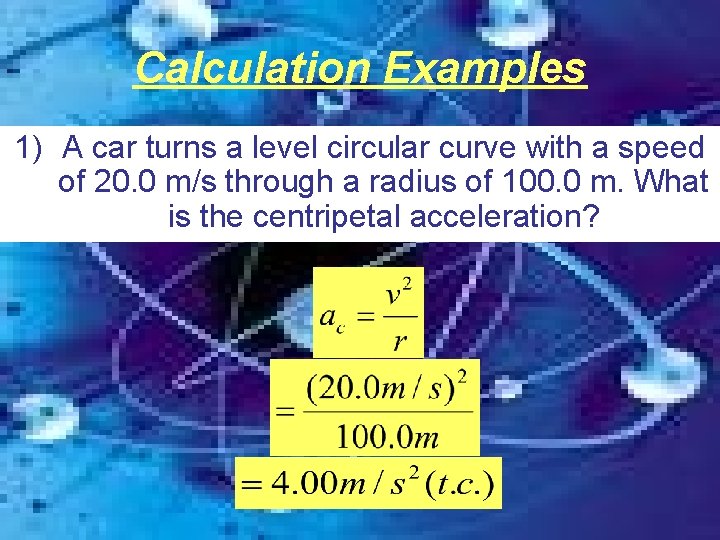
Calculation Examples 1) A car turns a level circular curve with a speed of 20. 0 m/s through a radius of 100. 0 m. What is the centripetal acceleration?
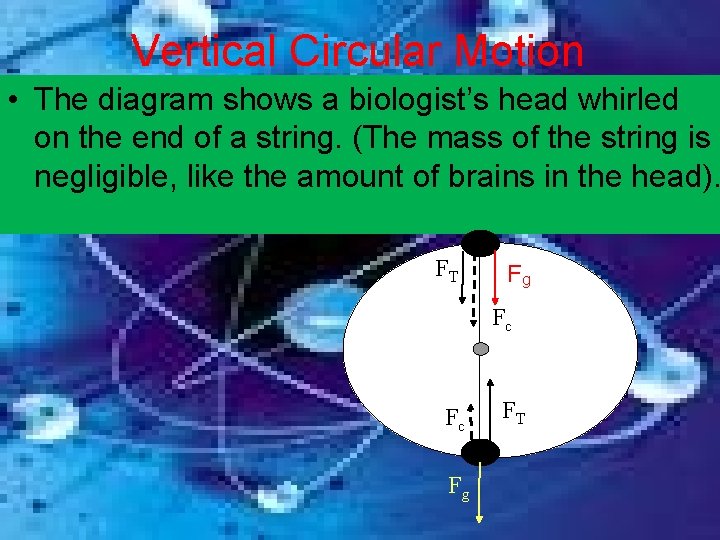
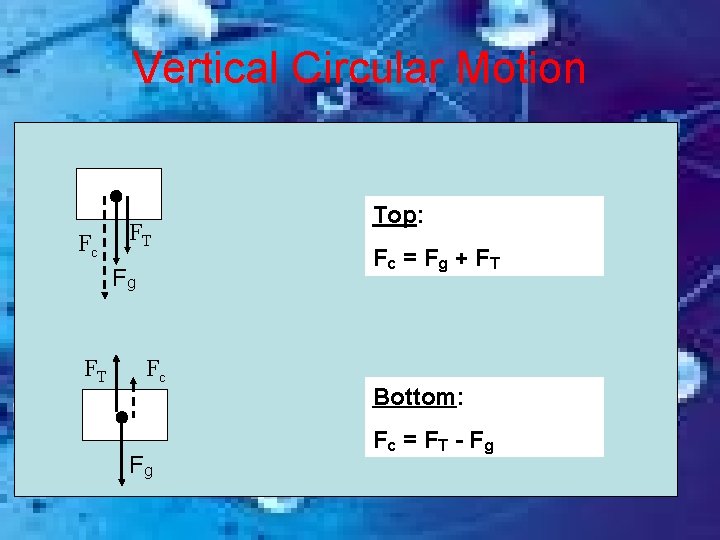
Vertical Circular Motion • Vertical rotations have varying centripetal force at each point of the rotation. (Tension forces in ropes will therefore vary). • The easiest method to solve these problems is to first draw an FBD of the forces involved. • Treat Fc as the net force (the net force supplies Fc) and determine the vector solution that satisfies this result. • We will only solve problems for the top or bottom of a vertical spin (linear forces).
Vertical Circular Motion • The diagram shows a biologist’s head whirled on the end of a string. (The mass of the string is negligible, like the amount of brains in the head). FT Fg Fc Fc Fg FT
Vertical Circular Motion Fc FT Fg FT Fc Fg Top: Fc = F g + F T Bottom: Fc = F T - F g
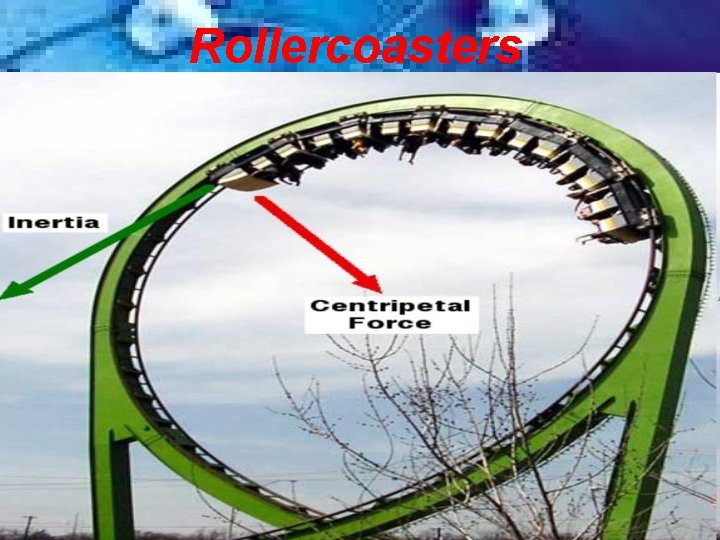
Rollercoasters
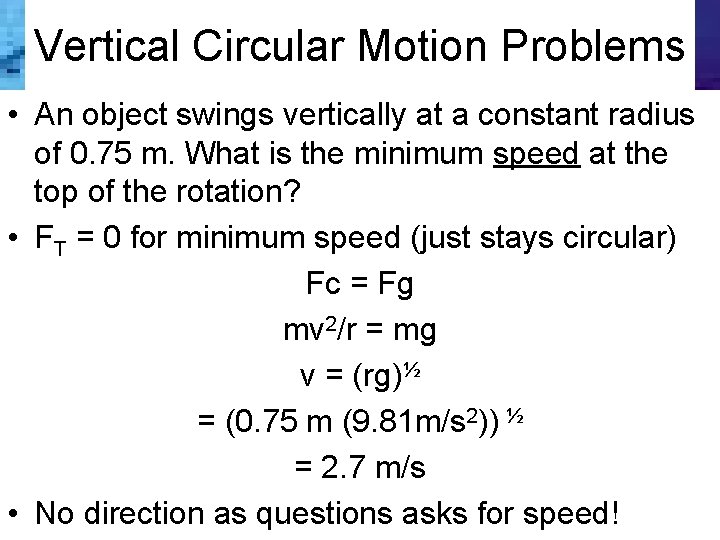
Vertical Circular Motion Problems • An object swings vertically at a constant radius of 0. 75 m. What is the minimum speed at the top of the rotation? • FT = 0 for minimum speed (just stays circular) Fc = Fg mv 2/r = mg v = (rg)½ = (0. 75 m (9. 81 m/s 2)) ½ = 2. 7 m/s • No direction as questions asks for speed!
Vertical Circular Motion Problems • A 1. 7 kg object is swung vertically at the end of a 0. 60 m string. If the period is 1. 1 s, what’s the tension at the top and bottom of the rotation? • Answer: 17 N [S] and 50. N [N]
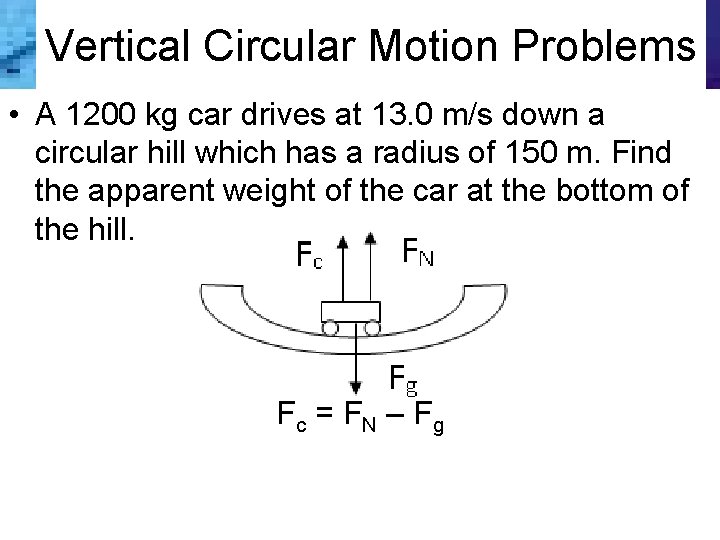
Vertical Circular Motion Problems • A 1200 kg car drives at 13. 0 m/s down a circular hill which has a radius of 150 m. Find the apparent weight of the car at the bottom of the hill. Fc = F N – F g
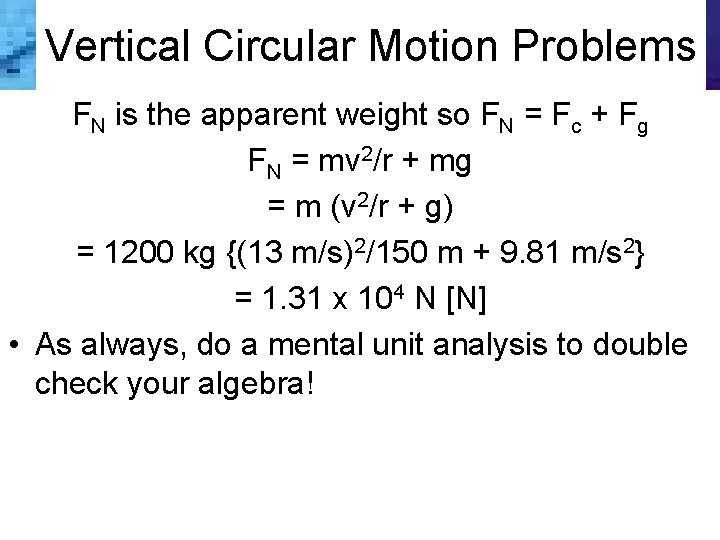
Vertical Circular Motion Problems FN is the apparent weight so FN = Fc + Fg FN = mv 2/r + mg = m (v 2/r + g) = 1200 kg {(13 m/s)2/150 m + 9. 81 m/s 2} = 1. 31 x 104 N [N] • As always, do a mental unit analysis to double check your algebra!
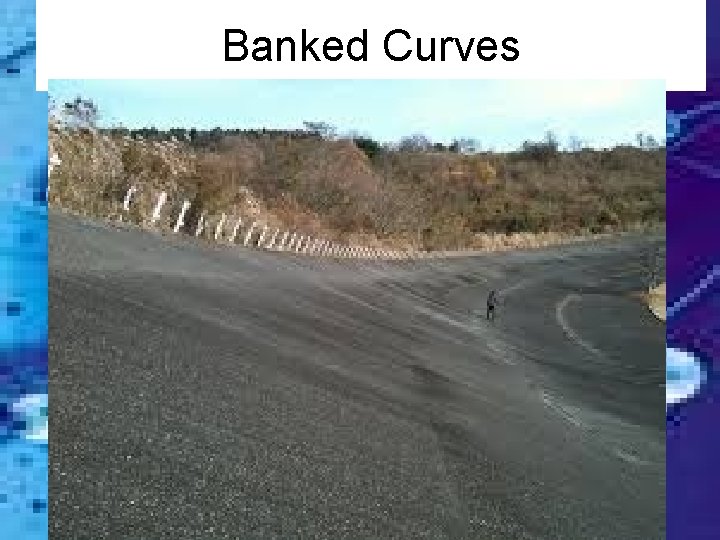
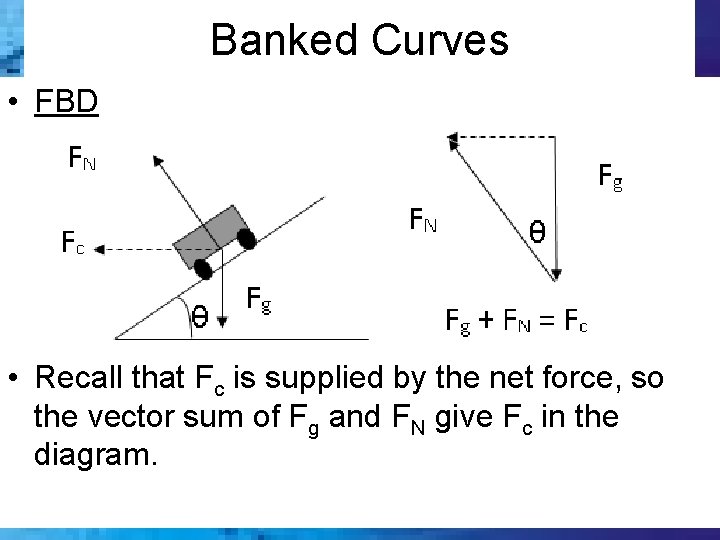
Banked Curves • Curves off highways are curved to minimize the amount of sliding. • A component of the normal force supplies some of the centripetal force (along with friction) such that there is an angle of incline where no friction is needed. • Drawing an FBD will aid us in developing the relationship to calculate the angle.
Banked Curves
Banked Curves • FBD • Recall that Fc is supplied by the net force, so the vector sum of Fg and FN give Fc in the diagram.
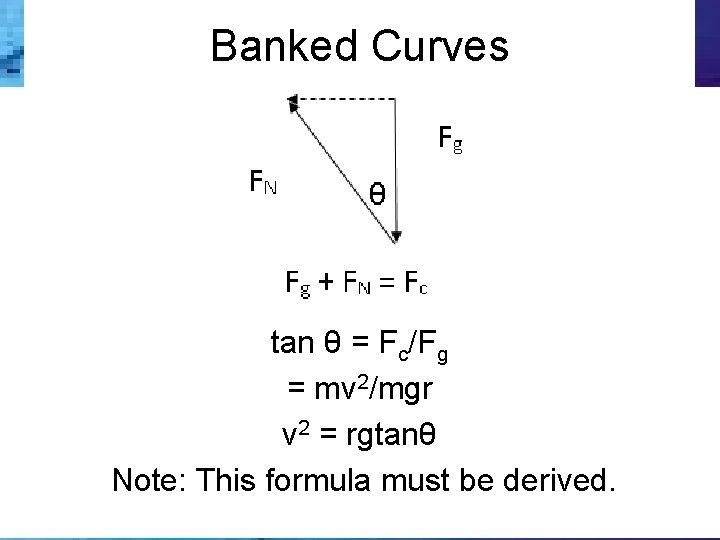
Banked Curves tan θ = Fc/Fg = mv 2/mgr v 2 = rgtanθ Note: This formula must be derived.
Banked Curve Problem • Find the speed for a 80. m radius curve banked at 20. o to maintain non-skidding travel. tan θ = Fc/Fg = mv 2/mgr v 2 = rgtanθ = (80 m)(9. 81 m/s 2)(tan 20 o) = 17 m/s • What would happen to the car if it exceeded this minimum speed (i. e. which way would it slide? )