
CENTRIFUGE WITH ADJUSTABLE SPEED AND DIRECTION OF ROTATION
CENTRIFUGE WITH ADJUSTABLE SPEED AND DIRECTION OF ROTATION
q English military engineer Benjamin Robins (1707– 1751) invented a whirling arm apparatus to determine drag. q In 1864, Antonin Prandtl invented the first dairy centrifuge in order to separate cream from milk. q In 1879, Gustaf de Lavaldemonstrated the first continuous centrifugal separator, making its commercial application feasible.
INTRODUCTION q A centrifuge is a piece of equipment, generally driven by a motor, that puts an object in rotation around a fixed axis, applying force perpendicular to the axis. q The centrifuge works using the sedimentation principle, where the centrifugal force is used to separate substances of greater and less density.
PRINCIPLES OF CENTRIFUGE q The centrifuge works using the sedimentation principle, where the centrifugal force is used to separate substances of greater and less density. q Basis § § § of separation: Size Shape Density
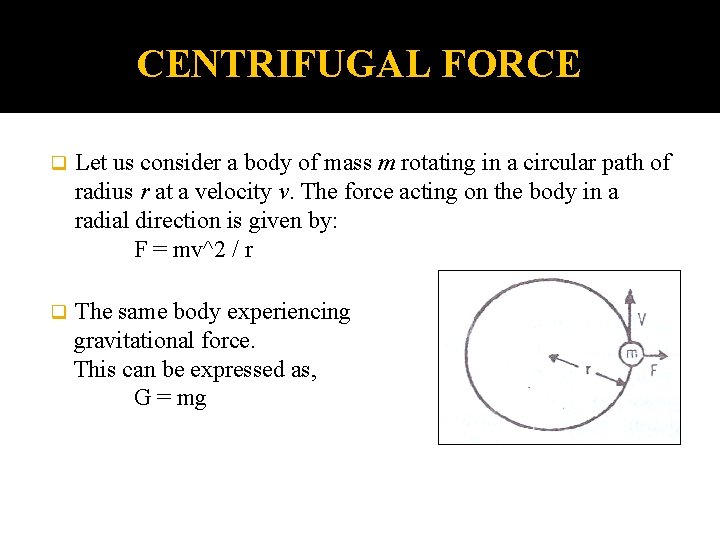
CENTRIFUGAL FORCE q Let us consider a body of mass m rotating in a circular path of radius r at a velocity v. The force acting on the body in a radial direction is given by: F = mv^2 / r q The same body experiencing gravitational force. This can be expressed as, G = mg
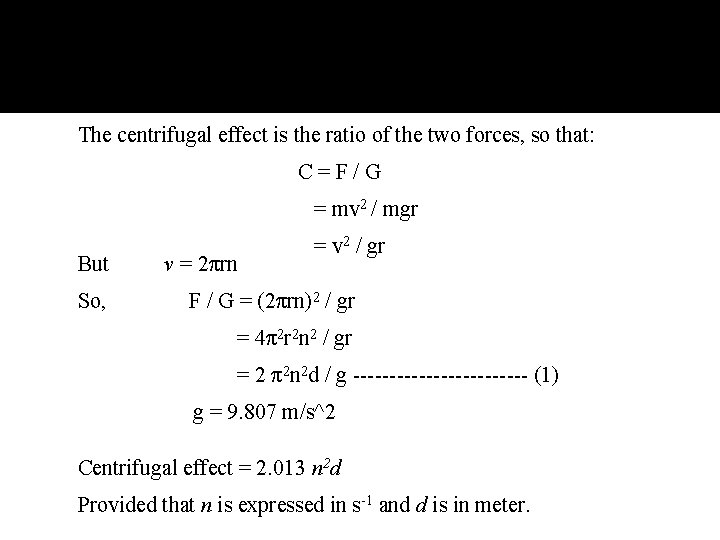
The centrifugal effect is the ratio of the two forces, so that: C=F/G = mv 2 / mgr But So, v = 2πrn = v 2 / gr F / G = (2πrn)2 / gr = 4π2 r 2 n 2 / gr = 2 π2 n 2 d / g ------------ (1) g = 9. 807 m/s^2 Centrifugal effect = 2. 013 n 2 d Provided that n is expressed in s-1 and d is in meter.
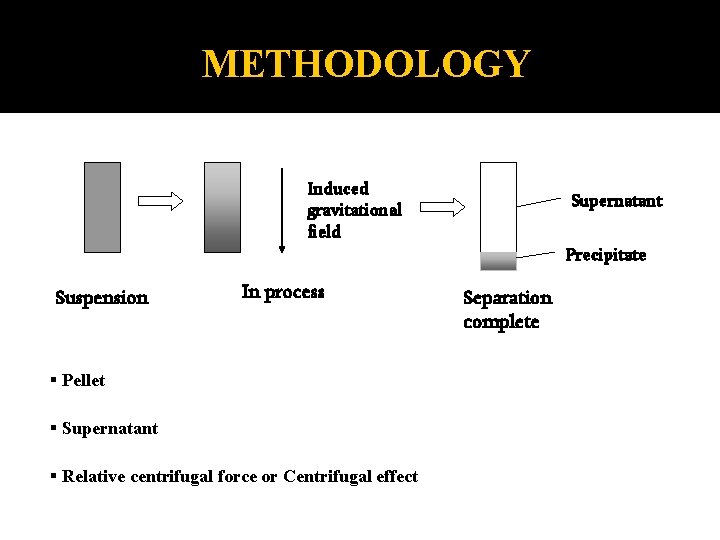
METHODOLOGY Induced gravitational field Suspension In process § Pellet § Supernatant § Relative centrifugal force or Centrifugal effect Supernatant Precipitate Separation complete
MATERIALS OF CONSTRUCTION A centrifuge is comprised of two major components q The drive mechanism is the source of rotary motion, and is powered by an electric motor, by air pressure, or by oil turbines, depending upon the type of centrifuge. q The Rotor The rotor is the large rotating element of a centrifuge into or onto which samples are loaded. It is driven about a fixed axis (or shaft) by the drive mechanism, with expenditure of large amounts of energy.

TYPES OF ROTORS q Fixed Angle Rotor

q Swinging Bucket Rotor
APPLICATIONS OF CENTRIFUGE q Production of bulk drugs q Production of biological products q Biopharmaceutical analysis of drugs q Evaluation of suspension and emulsion q Blood plasma is separated from whole blood q Different particle size fractions are separated by using control of speed of rotation and rate of flow
ADVANTAGES q Faster and reliable q Several specimens can be centrifuged at ago e. g. blood &urine q Not tiresome as compared to manual centrifuge machine q Safe once the specimen are enclosed into the machine
DISADVANTAGES q Time wasting to the patient q Exhausting of the laboratory technician q Specimens may spill out of the test tubes q The capacity is limited.
CONCLUSION q Thus, we can see that the centrifuge machine is an essential medical device for every biological and clinical laboratory as well as medical practice. q The centrifuge may seem a rather common machine, but newer models have become more complex, as higher speeds have become necessary for certain processes and applications and as more precise controls are needed.
BIBLIOGRAPHY q q ezinearticles. com wikipedia. com google. com alibaba. com
- Slides: 15