
CENTRIFUGATION Dr Vinod K V Types of centrifugation
- Slides: 17
CENTRIFUGATION Dr. Vinod K. V.
Types of centrifugation • Based on purpose • ANALYTICAL & PREPARATIVE • Analytical- measuring the physical properties of the sedimenting particles such as sedimentation coefficient or molecular weight • Preparative- Isolate specific particles which can be reused
Analytical Ultracentrifugation – Applications • determine sample purity • characterize assembly and disassembly mechanisms of biomolecular complexes • detect and characterize macromolecular confirmational changes • measure equilibrium constants and thermodynamic parameters for self- and hetero-associating systems characterize the solution-state behavior of macromolecules under various conditions
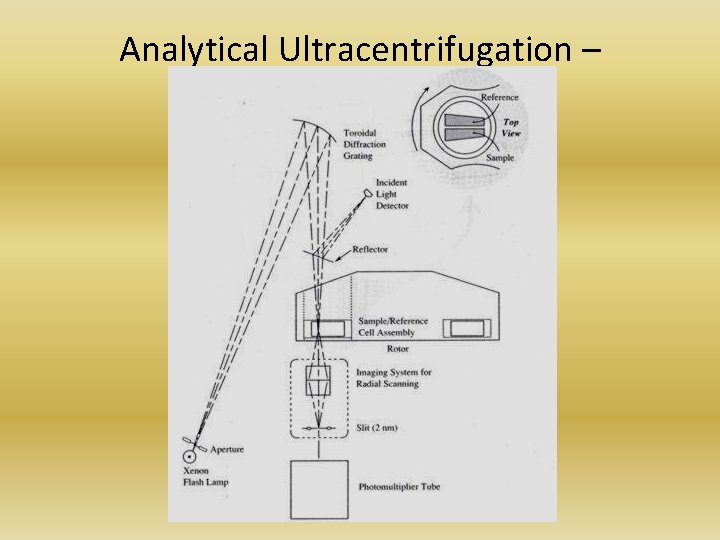
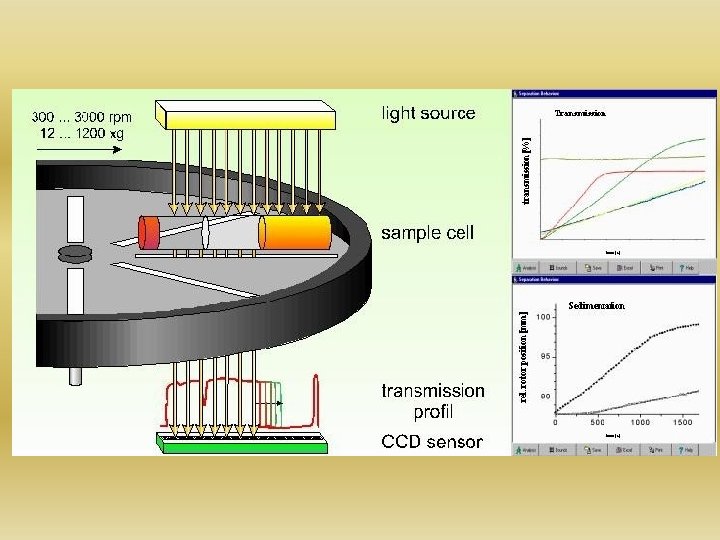
Analytical Ultracentrifugation – Design • analytical ultracentrifuge = preparative ultracentrifuge + optical detection system measure sample concentration inside the centrifuge cell during or after sedimentation • centrifugation parameters and data acquisition under computer control experiments lasting many days performed with minimal operator intervention
Analytical Ultracentrifugation – Design
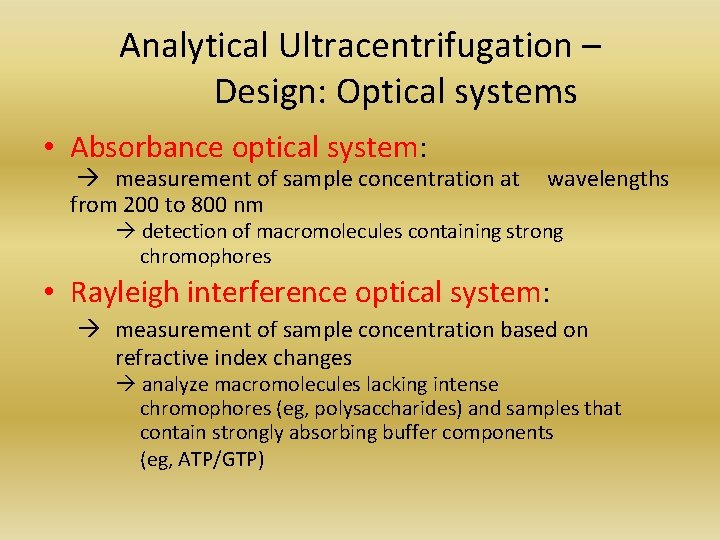
Analytical Ultracentrifugation – Design: Optical systems • Absorbance optical system: measurement of sample concentration at from 200 to 800 nm wavelengths detection of macromolecules containing strong chromophores • Rayleigh interference optical system: measurement of sample concentration based on refractive index changes analyze macromolecules lacking intense chromophores (eg, polysaccharides) and samples that contain strongly absorbing buffer components (eg, ATP/GTP)
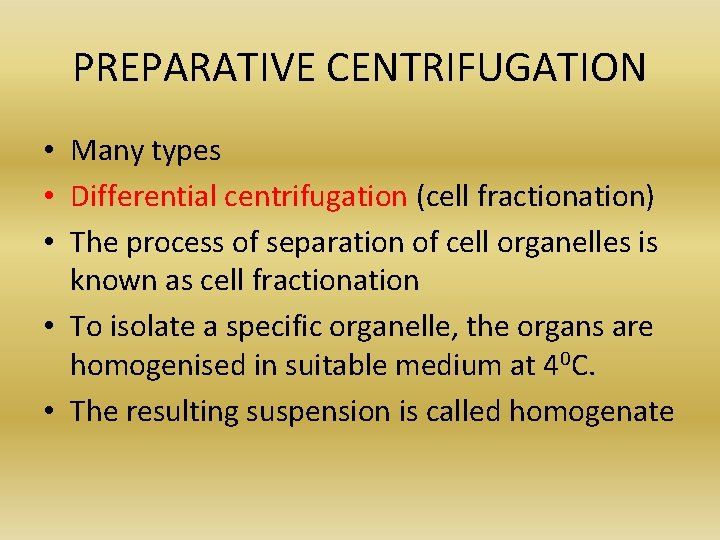
PREPARATIVE CENTRIFUGATION • Many types • Differential centrifugation (cell fractionation) • The process of separation of cell organelles is known as cell fractionation • To isolate a specific organelle, the organs are homogenised in suitable medium at 40 C. • The resulting suspension is called homogenate
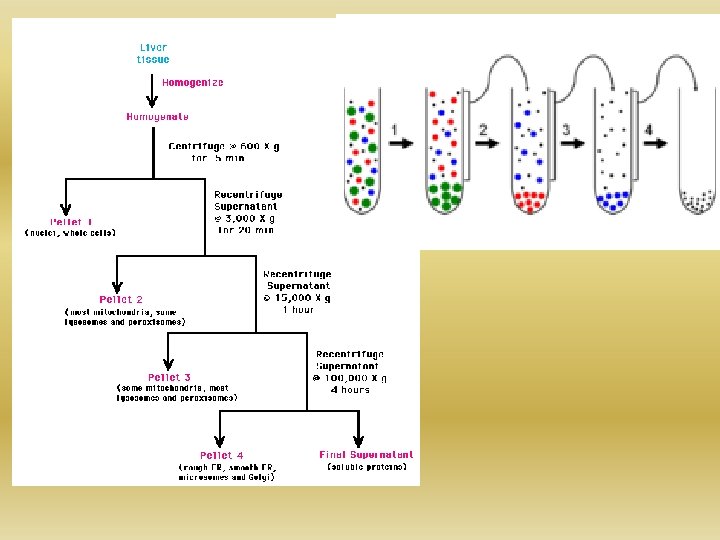
• Fractionation is done by differential centrifugation • This method is based upon the differences in the sedimentation rate of particles of different sizes and density • Uses a series of centrifugation steps at successively greater speeds • Each step yield a pellet & supernatant • The supernatant from each step is subjected to centrifugation in the next step • Provides four pellets- nuclear, mitochondrial, lysosomal & microsomal fractions • At each step, the pellet is washed several times by resuspending in the homo. medium followed by centrifugation under the same conditions
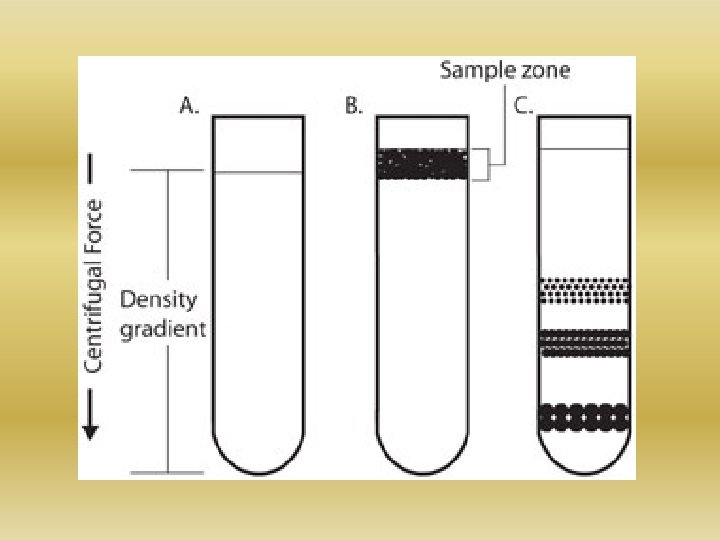
Density gradient centrifugation • Uses a medium that has gradients • Eg: Caesium chloride, C. sulphate, sodium bromide, Glycerol, dextran. . . • Separation depends upon the buoyant densities of the particles • Two types • Rate –Zonal technique & • Isopycnic technique
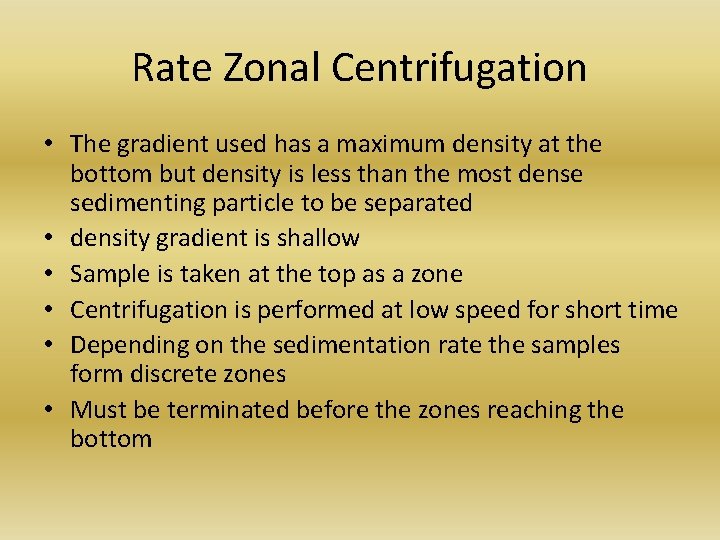
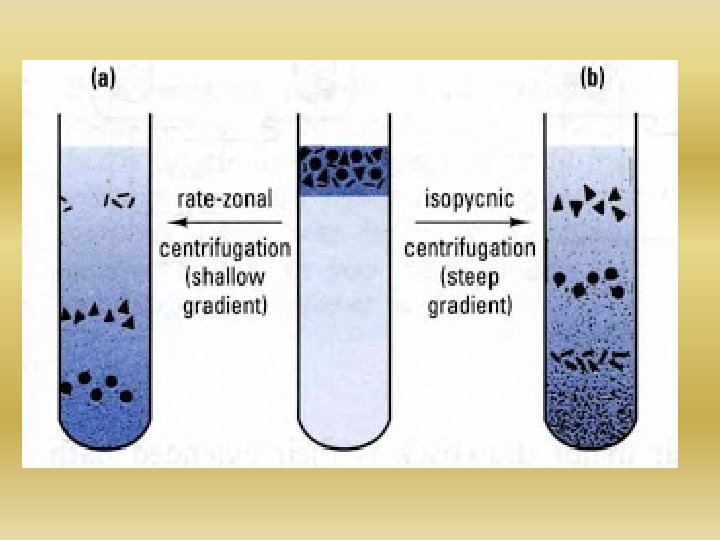
Rate Zonal Centrifugation • The gradient used has a maximum density at the bottom but density is less than the most dense sedimenting particle to be separated • density gradient is shallow • Sample is taken at the top as a zone • Centrifugation is performed at low speed for short time • Depending on the sedimentation rate the samples form discrete zones • Must be terminated before the zones reaching the bottom
Application • Useful for separating proteins with nearly identical densities but differing slightly in size • Used for separation of RNA-DNA hybrids, ribosomal subunits, and subcellular organelles
Isopycnic centrifugation • Depends on the buoyant density of the particle • Does not depend on shape, or size of the particle • Independent of time • Maximum density of the gradient always exceeds the density of the densest particle • At the point of isodensity, no further sedimentation occur
Application • Used to separate particles of similar size, but of differing density • Subcellular organelles such as golgi apparatus, mitochondria can be effectively separated by this method