
Centre dExcellence Acadmique Center for Academic Excellence Le



- Slides: 20
Centre d’Excellence Académique Center for Academic Excellence
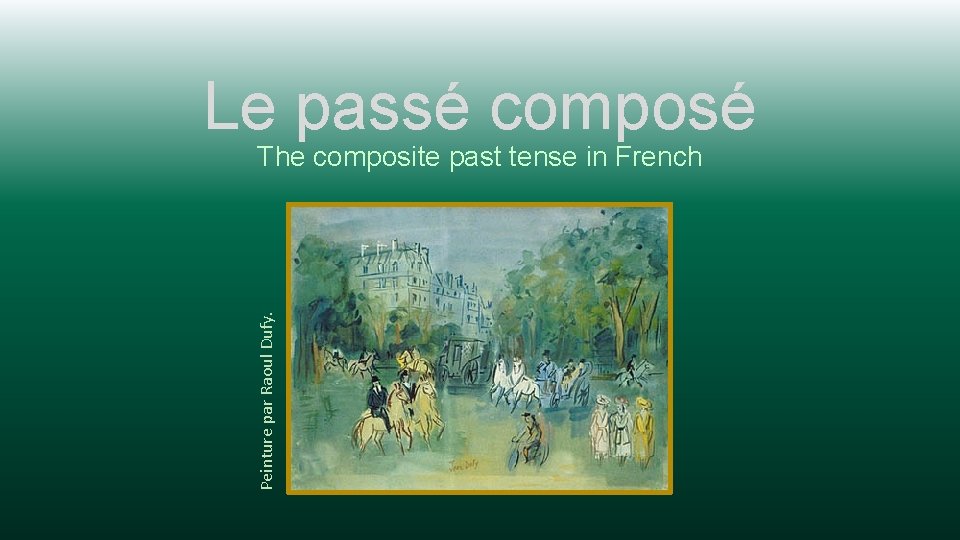
Le passé composé Peinture par Raoul Dufy. The composite past tense in French
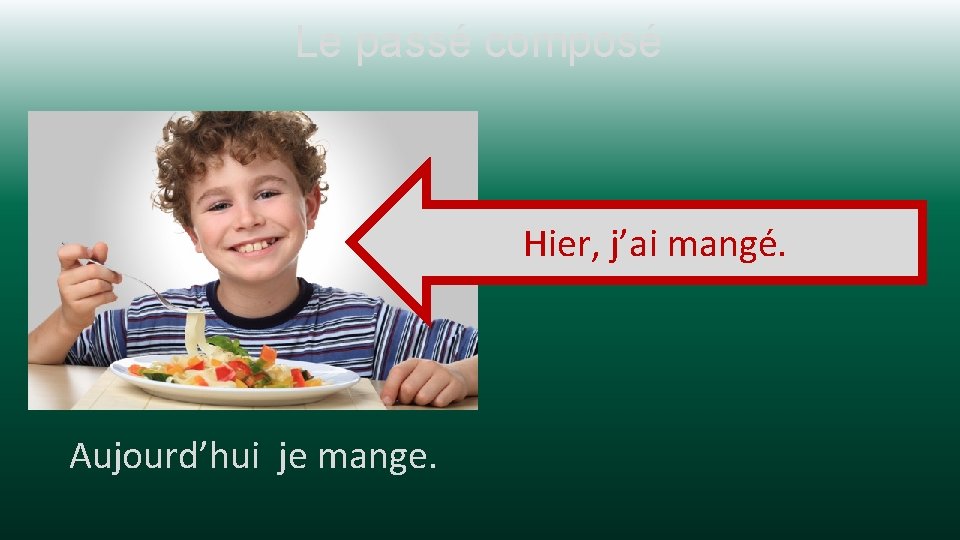
Le passé composé Hier, j’ai mangé. Aujourd’hui je mange.
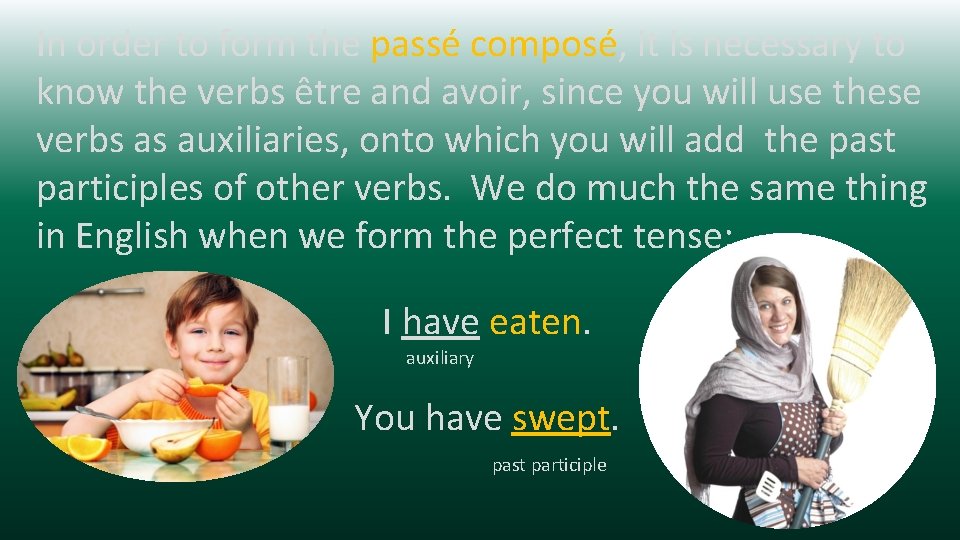
In order to form the passé composé, it is necessary to know the verbs être and avoir, since you will use these verbs as auxiliaries, onto which you will add the past participles of other verbs. We do much the same thing in English when we form the perfect tense: I have eaten. auxiliary You have swept. past participle
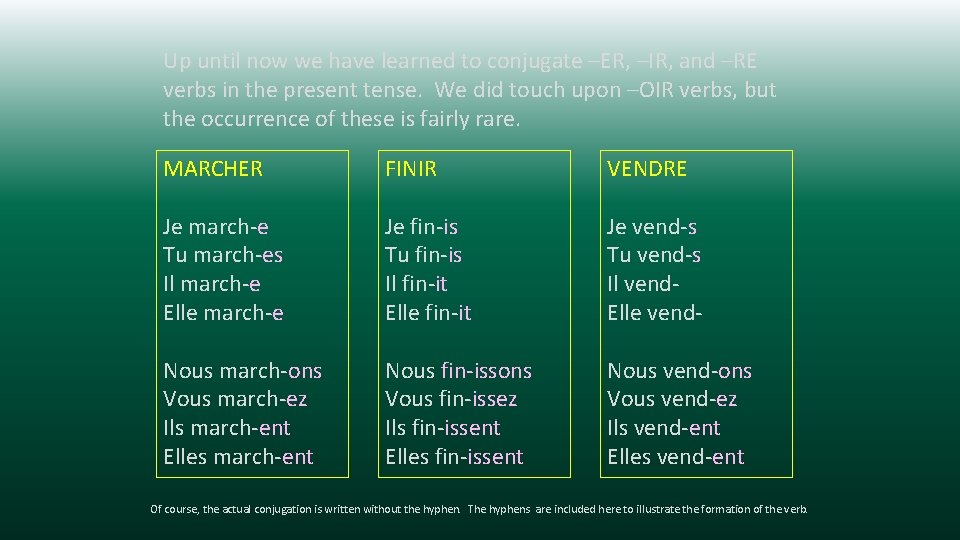
Up until now we have learned to conjugate –ER, –IR, and –RE verbs in the present tense. We did touch upon –OIR verbs, but the occurrence of these is fairly rare. MARCHER FINIR VENDRE Je march-e Tu march-es Il march-e Elle march-e Je fin-is Tu fin-is Il fin-it Elle fin-it Je vend-s Tu vend-s Il vend. Elle vend- Nous march-ons Vous march-ez Ils march-ent Elles march-ent Nous fin-issons Vous fin-issez Ils fin-issent Elles fin-issent Nous vend-ons Vous vend-ez Ils vend-ent Elles vend-ent Of course, the actual conjugation is written without the hyphen. The hyphens are included here to illustrate the formation of the verb.
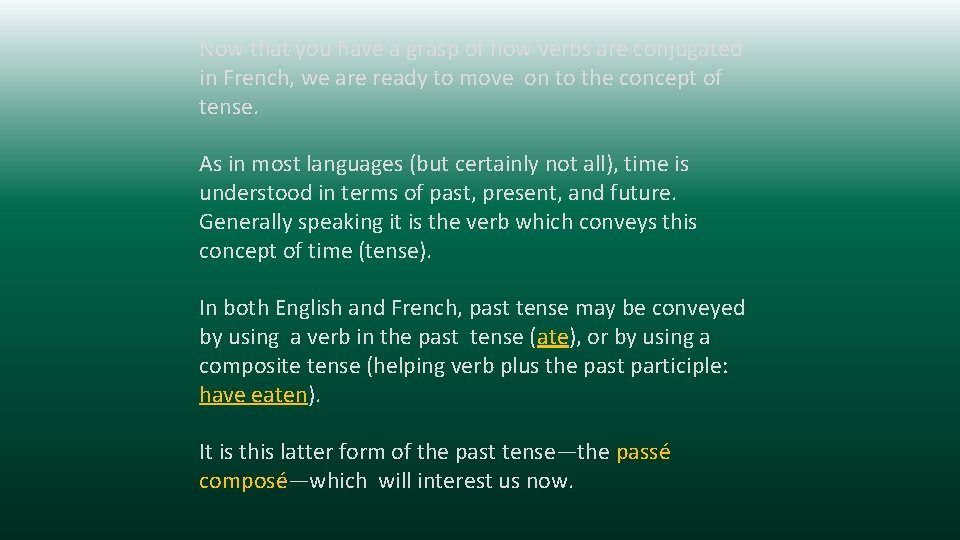
Now that you have a grasp of how verbs are conjugated in French, we are ready to move on to the concept of tense. As in most languages (but certainly not all), time is understood in terms of past, present, and future. Generally speaking it is the verb which conveys this concept of time (tense). In both English and French, past tense may be conveyed by using a verb in the past tense (ate), or by using a composite tense (helping verb plus the past participle: have eaten). It is this latter form of the past tense—the passé composé—which will interest us now.
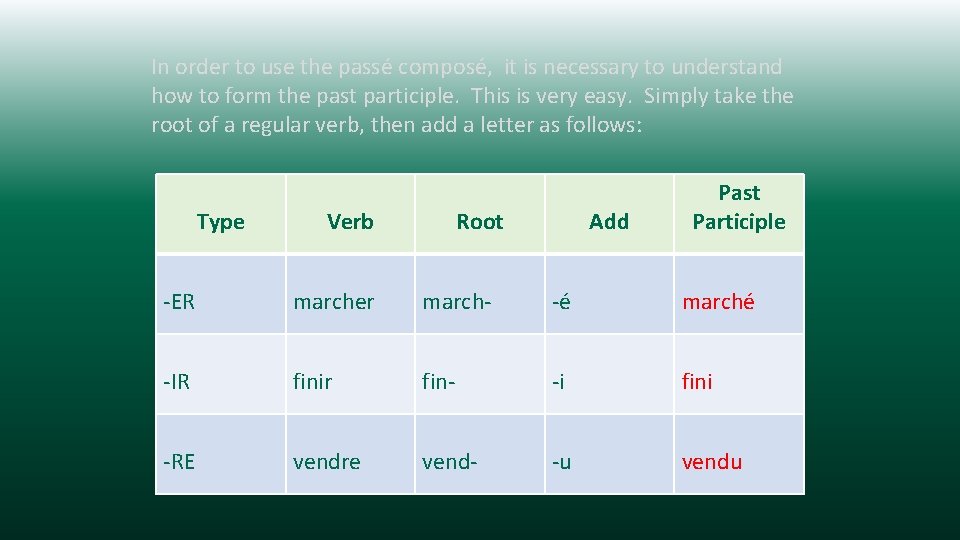
In order to use the passé composé, it is necessary to understand how to form the past participle. This is very easy. Simply take the root of a regular verb, then add a letter as follows: Type Verb Root Add Past Participle -ER marcher march- -é marché -IR finir fin- -i fini -RE vendre vend- -u vendu
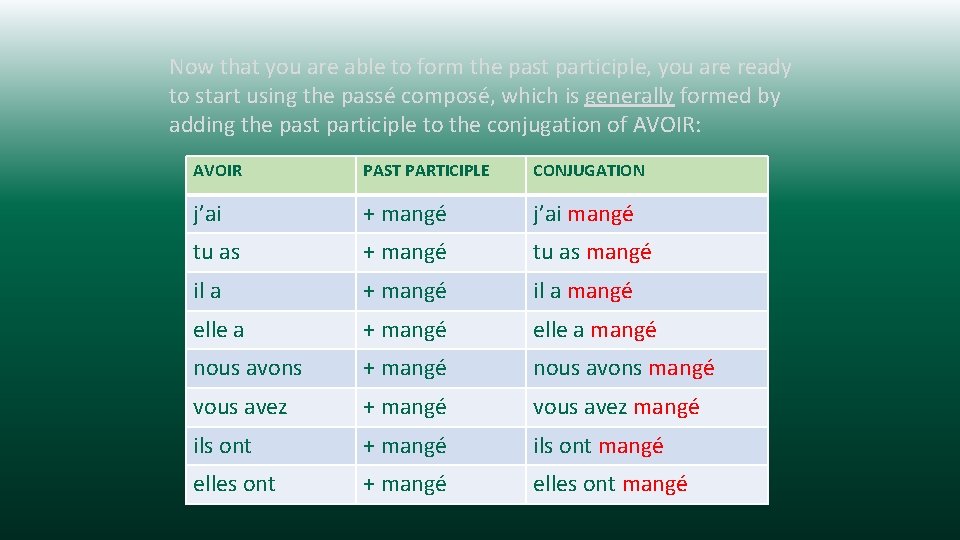
Now that you are able to form the past participle, you are ready to start using the passé composé, which is generally formed by adding the past participle to the conjugation of AVOIR: AVOIR PAST PARTICIPLE CONJUGATION j’ai + mangé j’ai mangé tu as + mangé tu as mangé il a + mangé il a mangé elle a + mangé elle a mangé nous avons + mangé nous avons mangé vous avez + mangé vous avez mangé ils ont + mangé ils ont mangé elles ont + mangé elles ont mangé
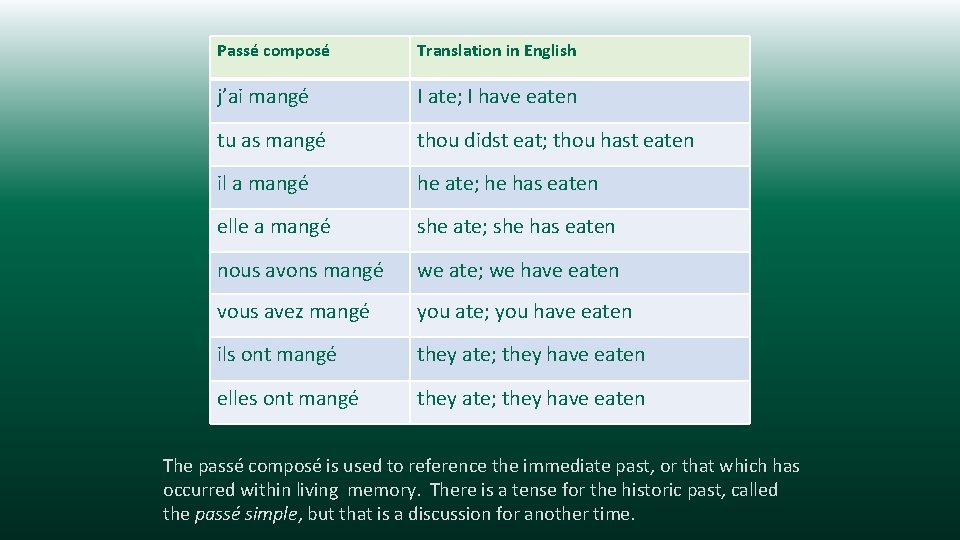
Passé composé Translation in English j’ai mangé I ate; I have eaten tu as mangé thou didst eat; thou hast eaten il a mangé he ate; he has eaten elle a mangé she ate; she has eaten nous avons mangé we ate; we have eaten vous avez mangé you ate; you have eaten ils ont mangé they ate; they have eaten elles ont mangé they ate; they have eaten The passé composé is used to reference the immediate past, or that which has occurred within living memory. There is a tense for the historic past, called the passé simple, but that is a discussion for another time.
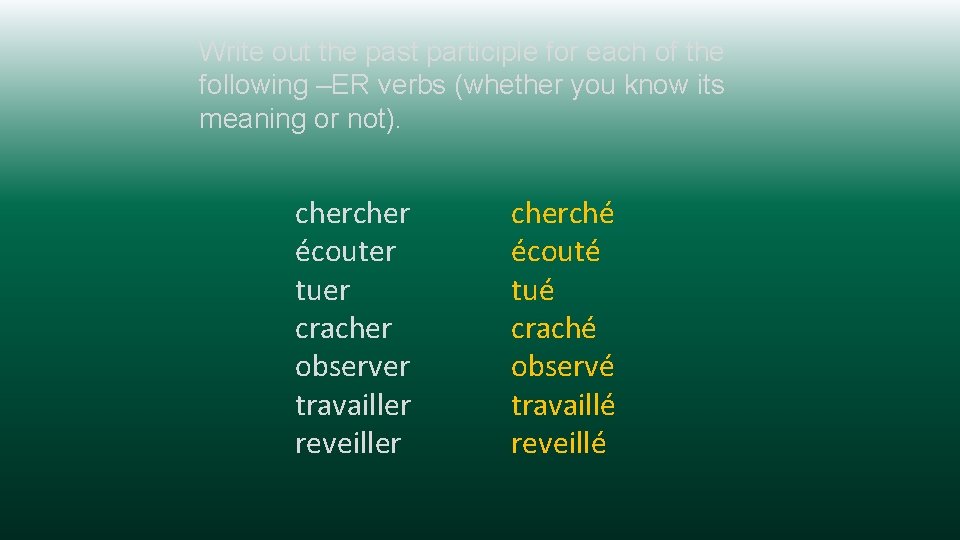
Write out the past participle for each of the following –ER verbs (whether you know its meaning or not). cher écouter tuer cracher observer travailler reveiller cherché écouté tué craché observé travaillé reveillé
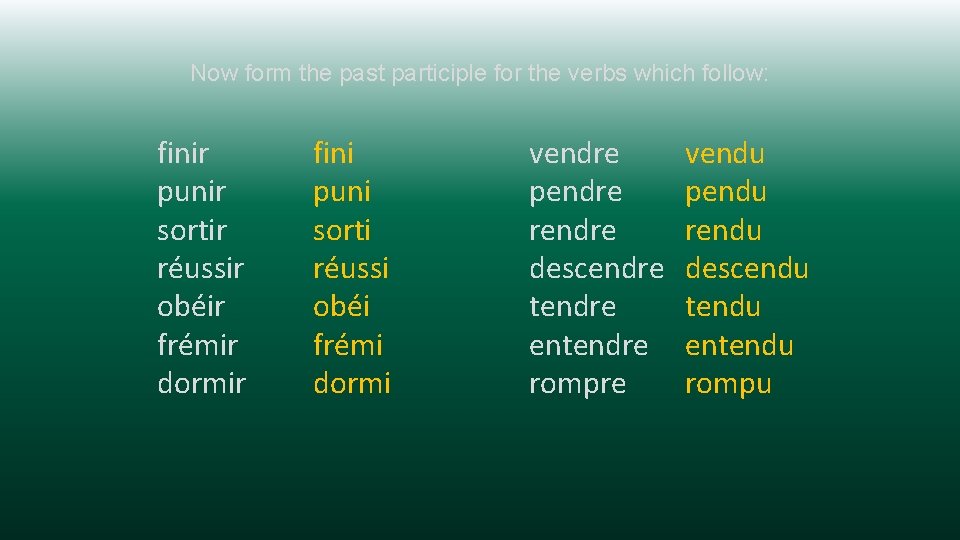
Now form the past participle for the verbs which follow: finir punir sortir réussir obéir frémir dormir fini puni sorti réussi obéi frémi dormi vendre pendre rendre descendre tendre entendre rompre vendu pendu rendu descendu tendu entendu rompu
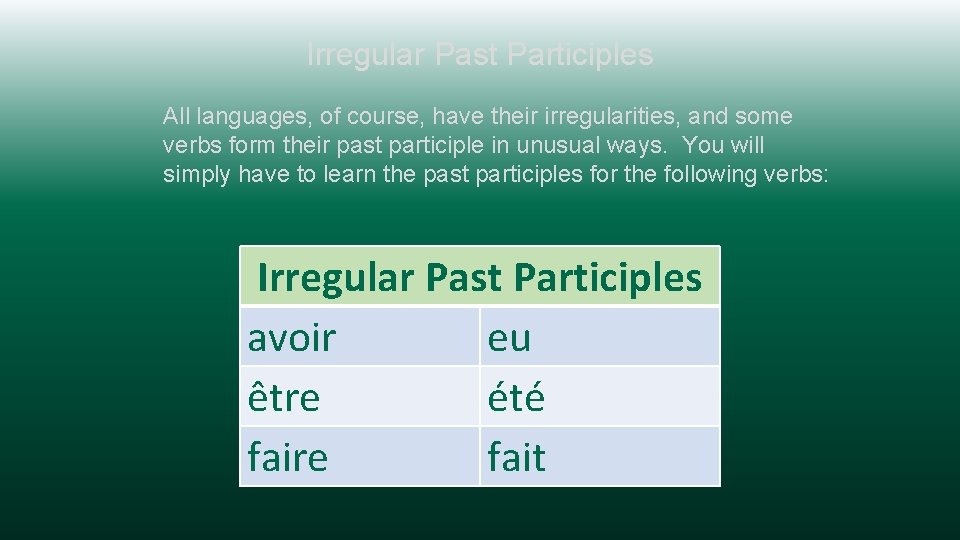
Irregular Past Participles All languages, of course, have their irregularities, and some verbs form their past participle in unusual ways. You will simply have to learn the past participles for the following verbs: Irregular Past Participles avoir eu être été faire fait
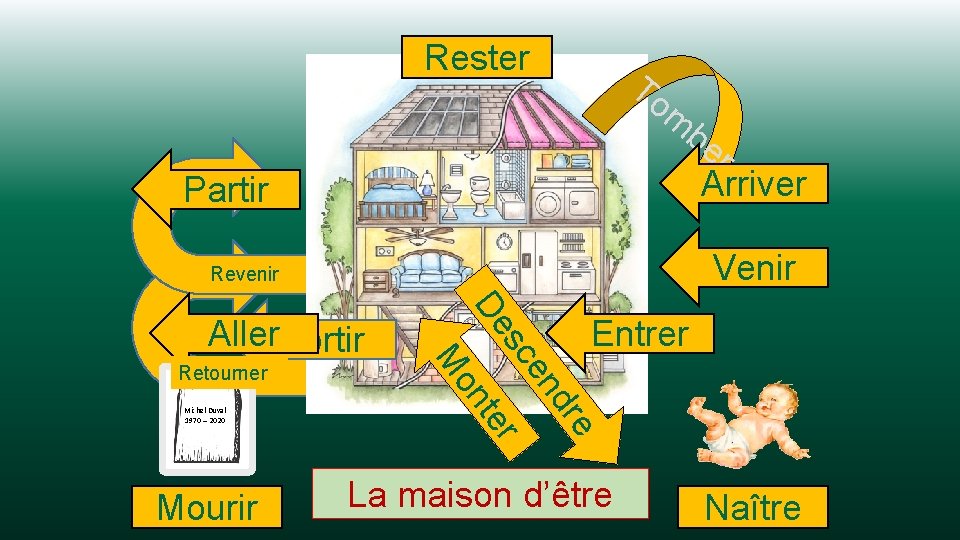
As if the passé composé isn’t already complicated enough, there a number of verbs which are conjugated only with être. These have to be memorized.
Rester To m be r Arriver Partir Venir Revenir Mourir Entrer re nd ce r te Michel Duval 1970 – 2020 s De Retourner on M Aller. Sortir La maison d’être Naître
There are various tricks for remembering which verbs are conjugated with être. All reflexive verbs are conjugated with être. My favorite mnemonic device was Mrs. Van der Tramp. When I came to America, I was introduced to her physician, Dr. V. E. Mantraps. Remember, simply, that all of the verbs from the House of Être are included, as are any verbs containing the same root. In order to conjugate the verbs that go with être, you will need to know their past participles.
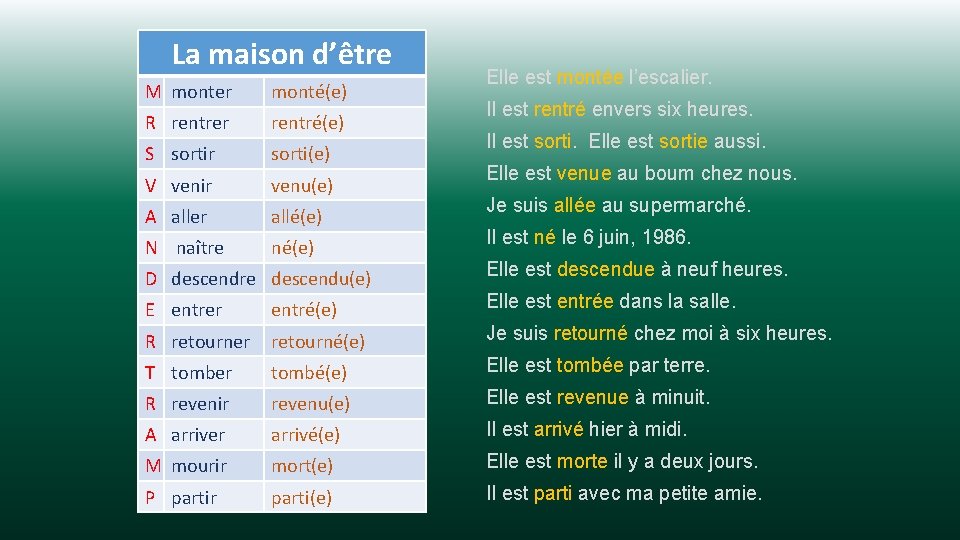
La maison d’être M monter monté(e) R rentrer rentré(e) S sortir sorti(e) V venir venu(e) A aller allé(e) N naître né(e) D descendre descendu(e) Elle est montée l’escalier. Il est rentré envers six heures. Il est sorti. Elle est sortie aussi. Elle est venue au boum chez nous. Je suis allée au supermarché. Il est né le 6 juin, 1986. Elle est descendue à neuf heures. Elle est entrée dans la salle. E entrer entré(e) R retourner retourné(e) Je suis retourné chez moi à six heures. T tomber tombé(e) Elle est tombée par terre. R revenir revenu(e) Elle est revenue à minuit. A arriver arrivé(e) Il est arrivé hier à midi. M mourir mort(e) Elle est morte il y a deux jours. P partir parti(e) Il est parti avec ma petite amie.
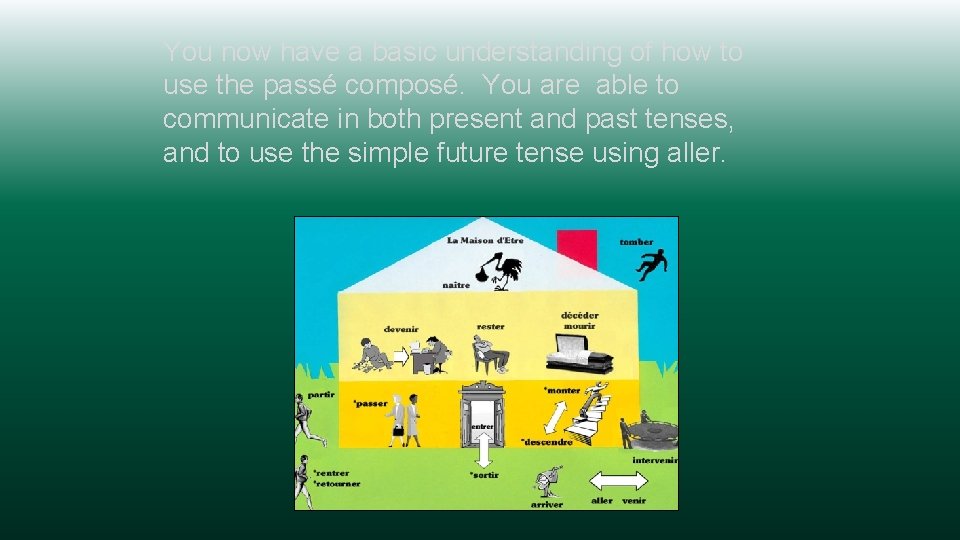
You now have a basic understanding of how to use the passé composé. You are able to communicate in both present and past tenses, and to use the simple future tense using aller.
Power. Point presentation by Mark A. Spalding, BA, MEd, MA (2009). Par Raoul Dufy. Fin
Centre d’Excellence Académique Center for Academic Excellence