
Central Venous Access Devices CVADs Chapter 17 Copyright


- Slides: 26
Central Venous Access Devices (CVADs) Chapter 17 Copyright © 2014 by Mosby, an imprint of Elsevier Inc.
Case Study • R. J. is a 54 -year-old African. American male who is admitted to the hospital with a diagnosis of infective endocarditis. • R. J. will need IV access for extended antibiotic administration. • What type of IV access would be most appropriate for R. J. ? i. Stockphoto/Thinkstock Copyright © 2014 by Mosby, an imprint of Elsevier Inc.
CVADs • Catheters placed in large blood vessels • Subclavian vein, jugular vein • Three main types • Centrally inserted catheters • Peripherally inserted central catheters • Implanted ports Copyright © 2014 by Mosby, an imprint of Elsevier Inc.
CVADs • Permit frequent, continuous, rapid, or intermittent administration of fluids and drugs • Allow for giving drugs that are potentially vesicants • Used to administer blood/blood products and parenteral nutrition Copyright © 2014 by Mosby, an imprint of Elsevier Inc.
CVADs • Used for hemodynamic monitoring • Useful for patients with limited peripheral vascular access or need for long-term vascular access Copyright © 2014 by Mosby, an imprint of Elsevier Inc.
CVADs • Advantages • Immediate access • Reduced venipunctures • Decreased risk of extravasation • Disadvantages • Increased risk of systemic infection • Invasive procedure Copyright © 2014 by Mosby, an imprint of Elsevier Inc.
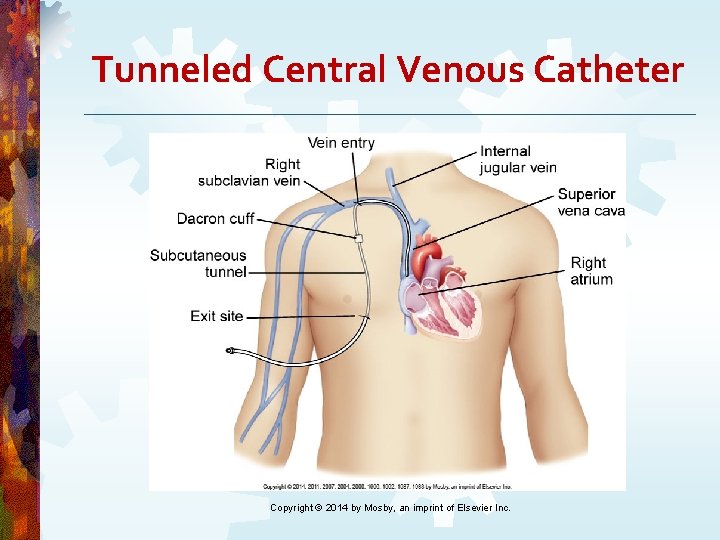
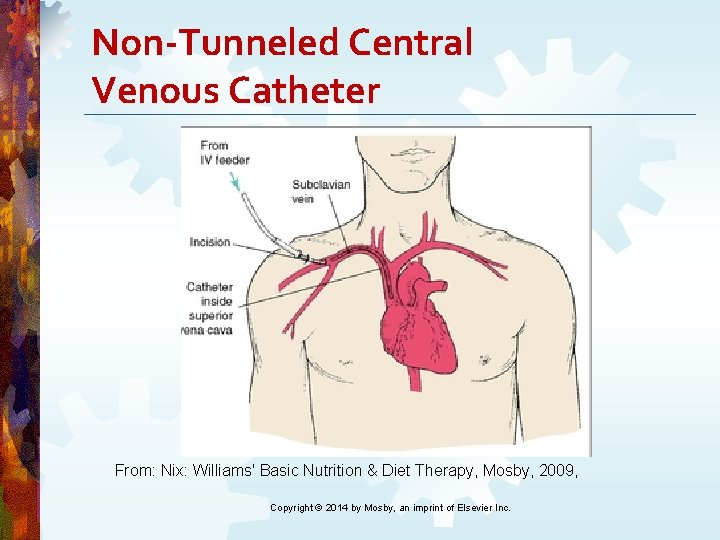
Centrally Inserted Catheter • Inserted into a vein in the neck, chest, or groin with tip resting in the distal end of the superior vena cava • Nontunneled or tunneled • Dacron cuff stabilizes catheter and decreases incidence of infection Copyright © 2014 by Mosby, an imprint of Elsevier Inc.
Centrally Inserted Catheter • Single, double, triple, or quad lumen • Examples of long-term (tunneled) catheters • Hickman • Groshong Copyright © 2014 by Mosby, an imprint of Elsevier Inc.
Tunneled Central Venous Catheter Copyright © 2014 by Mosby, an imprint of Elsevier Inc.
Non-Tunneled Central Venous Catheter From: Nix: Williams' Basic Nutrition & Diet Therapy, Mosby, 2009, Copyright © 2014 by Mosby, an imprint of Elsevier Inc.
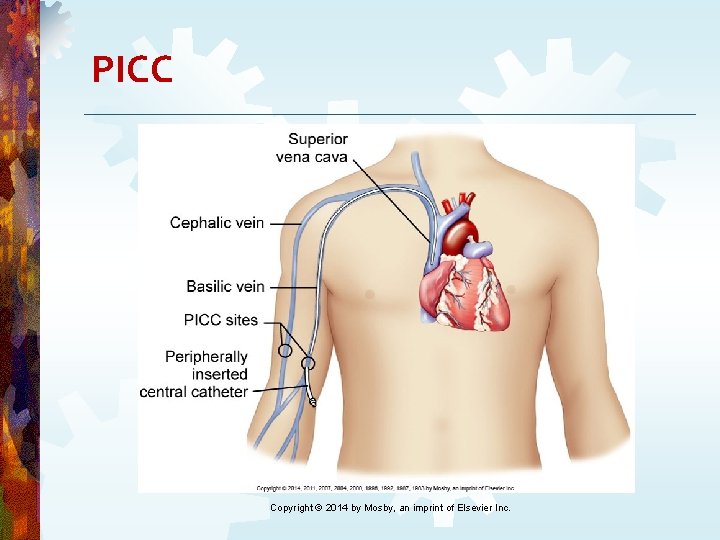
PICC • Central venous catheter inserted into a vein in the arm • Single or multilumen, nontunneled • For patients who need vascular access for 1 week to 6 months • Cannot use arm for BP or blood draw Copyright © 2014 by Mosby, an imprint of Elsevier Inc.
PICC • Advantages • Lower infection rate • Fewer insertion-related complications • Decreased cost • Complications • Catheter occlusion • Phlebitis Copyright © 2014 by Mosby, an imprint of Elsevier Inc.
PICC Copyright © 2014 by Mosby, an imprint of Elsevier Inc.
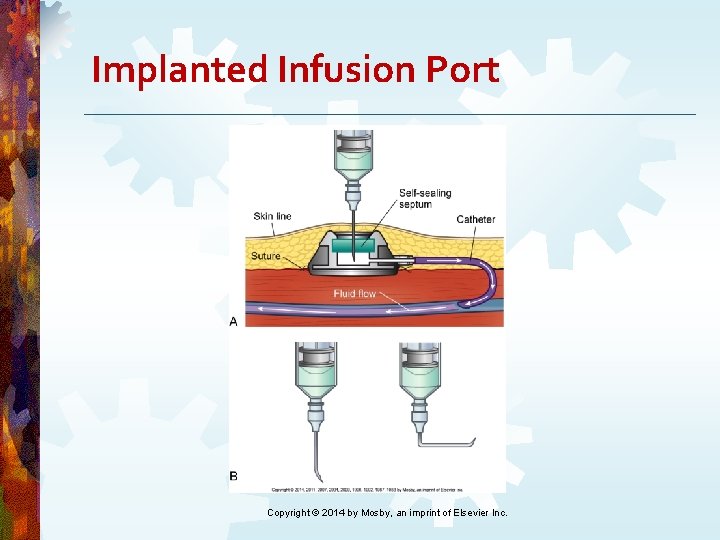
Implanted Infusion Port • Central venous catheter connected to an implanted, single or double subcutaneous injection port • Port is metal sheath with self-sealing silicone septum Copyright © 2014 by Mosby, an imprint of Elsevier Inc.
Implanted Infusion Port Copyright © 2014 by Mosby, an imprint of Elsevier Inc.
Implanted Infusion Port • Drugs are injected through skin into port • Advantages • Good for long-term therapy • Low risk of infection • Cosmetic discretion • Care requires regular flushing Copyright © 2014 by Mosby, an imprint of Elsevier Inc.
Case Study The IV team nurse just completed insertion of a PICC line into R. J. ’s right basilic vein. i. Stockphoto/Thinkstock 1. What must you do before administering the IV antibiotic via the PICC line? 2. For what complications will you monitor R. J. ? Copyright © 2014 by Mosby, an imprint of Elsevier Inc.
Complications • Catheter occlusion • Clamped or kinked catheter • Tip against wall of vessel • Thrombosis • Precipitate buildup in lumen Copyright © 2014 by Mosby, an imprint of Elsevier Inc.
Complications • Embolism • Catheter breaking • Dislodgement of thrombus • Entry of air into circulation Copyright © 2014 by Mosby, an imprint of Elsevier Inc.
Complications • Infection • Contamination during insertion or use • Migration of organisms along catheter • Immunosuppressed patient Copyright © 2014 by Mosby, an imprint of Elsevier Inc.
Complications • Pneumothorax • Perforation of visceral pleura • Catheter migration • Improper suturing • Trauma, forceful flushing • Spontaneous Copyright © 2014 by Mosby, an imprint of Elsevier Inc.
Case Study 1. What can you do to maintain patency of the PICC? i. Stockphoto/Thinkstock 2. What will you teach R. J. about proper care of the PICC line? Copyright © 2014 by Mosby, an imprint of Elsevier Inc.
Nursing Management • Inspect catheter and insertion site • Assess pain • Change dressing and clean according to institution policies • Transparent semipermeable dressing or gauze dressing • Chlorhexidine preferred cleansing agent Copyright © 2014 by Mosby, an imprint of Elsevier Inc.
Nursing Management • Change injection caps • Have patient turn head to opposite side • Valsalva if no clamp • Flushing is important • Normal saline prefilled syringe • Use only 10 ml syringe or larger • Flushing technique important Copyright © 2014 by Mosby, an imprint of Elsevier Inc.
Case Study i. Stockphoto/Thinkstock • R. J. completes his required IV antibiotic regimen and returns to the clinic for removal of his PICC line. • Describe how you will remove the PICC line. Copyright © 2014 by Mosby, an imprint of Elsevier Inc.
Removing CVADs • Should be done according to institution policy • Gently withdraw while patient performs the Valsalva maneuver • Apply pressure • Ensure that catheter tip is intact • Apply antiseptic ointment and dressing Copyright © 2014 by Mosby, an imprint of Elsevier Inc.