
Central Processing Unit CPU CPU is the heart
![Execution for Add Y in an Acc Architecture 1 MAR PC 2 MDR M[MAR]](https://slidetodoc.com/presentation_image_h/16307a3667bdace1d1a6a31937e6bfa6/image-18.jpg "Execution for Add Y in an Acc Architecture 1 MAR PC 2 MDR M[MAR]")
- Slides: 20
Central Processing Unit (CPU) • CPU is the heart and brain • It interprets and executes machine level instructions • Controls data transfer from/to Main Memory (MM) and CPU • Detects any errors • In the following lectures, we will learn: • • • Instruction representation Data transfer mechanism between MM and CPU The internal functional units of two different CPU architectures How these units are interconnected How a processor executes instructions
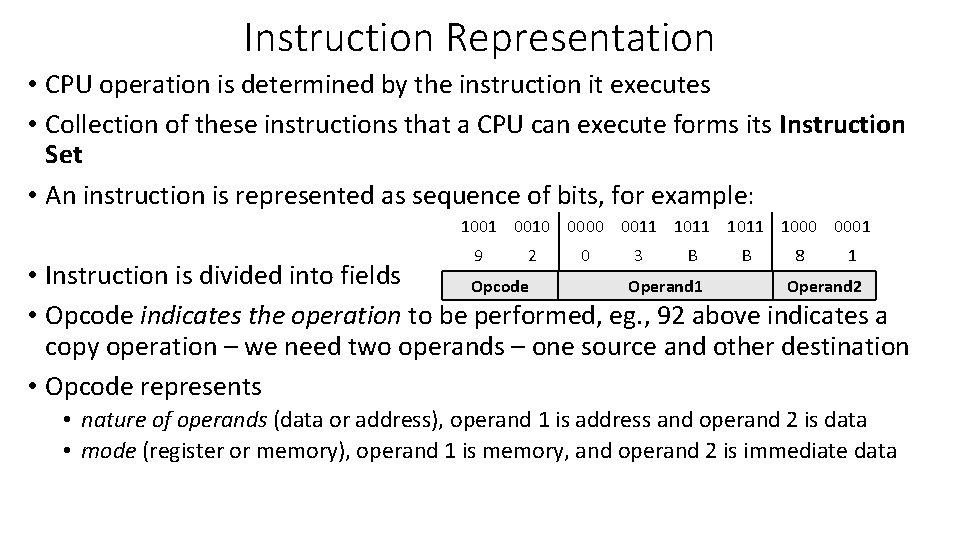
Instruction Representation • CPU operation is determined by the instruction it executes • Collection of these instructions that a CPU can execute forms its Instruction Set • An instruction is represented as sequence of bits, for example: 1001 0010 0000 0011 1011 1000 0001 9 2 0 3 B B 8 1 • Instruction is divided into fields Opcode Operand 1 Operand 2 • Opcode indicates the operation to be performed, eg. , 92 above indicates a copy operation – we need two operands – one source and other destination • Opcode represents • nature of operands (data or address), operand 1 is address and operand 2 is data • mode (register or memory), operand 1 is memory, and operand 2 is immediate data
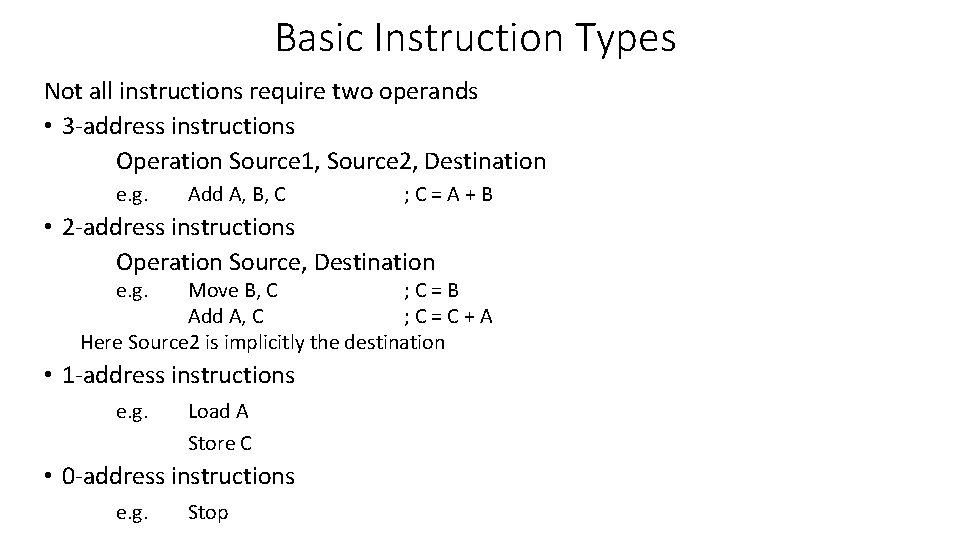
Basic Instruction Types Not all instructions require two operands • 3 -address instructions Operation Source 1, Source 2, Destination e. g. Add A, B, C ; C = A + B • 2 -address instructions Operation Source, Destination e. g. Move B, C ; C = B Add A, C ; C = C + A Here Source 2 is implicitly the destination • 1 -address instructions e. g. Load A Store C • 0 -address instructions e. g. Stop
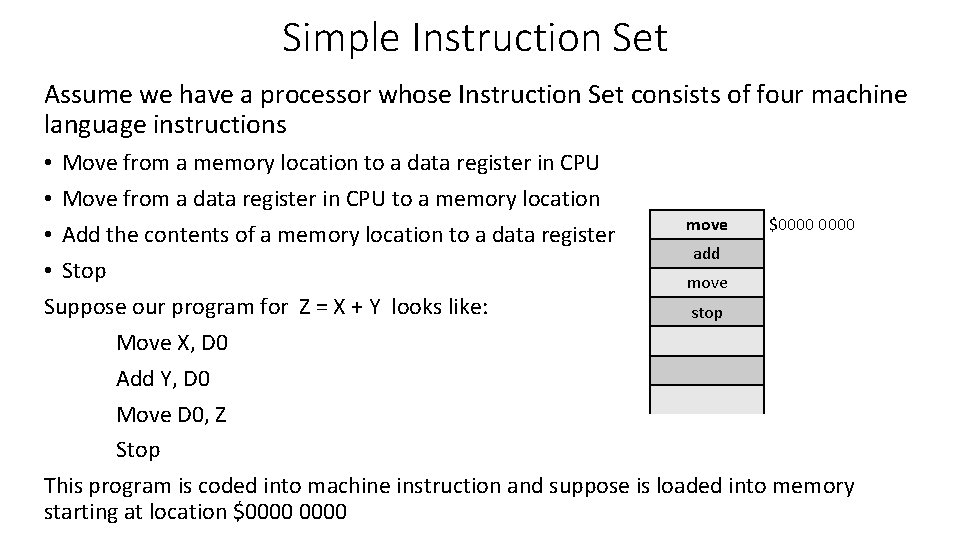
Simple Instruction Set Assume we have a processor whose Instruction Set consists of four machine language instructions • Move from a memory location to a data register in CPU • Move from a data register in CPU to a memory location move $0000 • Add the contents of a memory location to a data register add • Stop move Suppose our program for Z = X + Y looks like: stop Move X, D 0 Add Y, D 0 Move D 0, Z Stop This program is coded into machine instruction and suppose is loaded into memory starting at location $0000
• How does the CPU know which instruction to execute? • There is a dedicated register in CPU called Program Counter (PC) that points to the memory location where next instruction is stored Therefore, at start PC = $0000 • Instruction is in Main Memory – it is to be transferred (fetched) to CPU to be executed • CPU has an Instruction Register (IR) that holds the instruction • What kind of instruction is to be executed? • CPU has its own Instruction Interpreter (Decoder) • Followed by Instruction execution • Next instruction follows. PC is incremented by length of instruction just completed
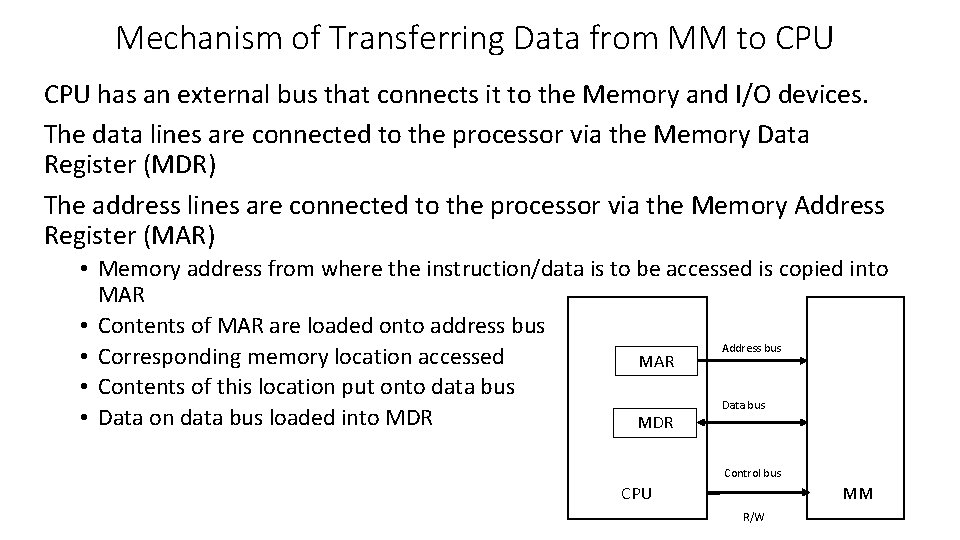
Mechanism of Transferring Data from MM to CPU has an external bus that connects it to the Memory and I/O devices. The data lines are connected to the processor via the Memory Data Register (MDR) The address lines are connected to the processor via the Memory Address Register (MAR) • Memory address from where the instruction/data is to be accessed is copied into MAR • Contents of MAR are loaded onto address bus Address bus • Corresponding memory location accessed MAR • Contents of this location put onto data bus Data bus • Data on data bus loaded into MDR Control bus MM CPU R/W
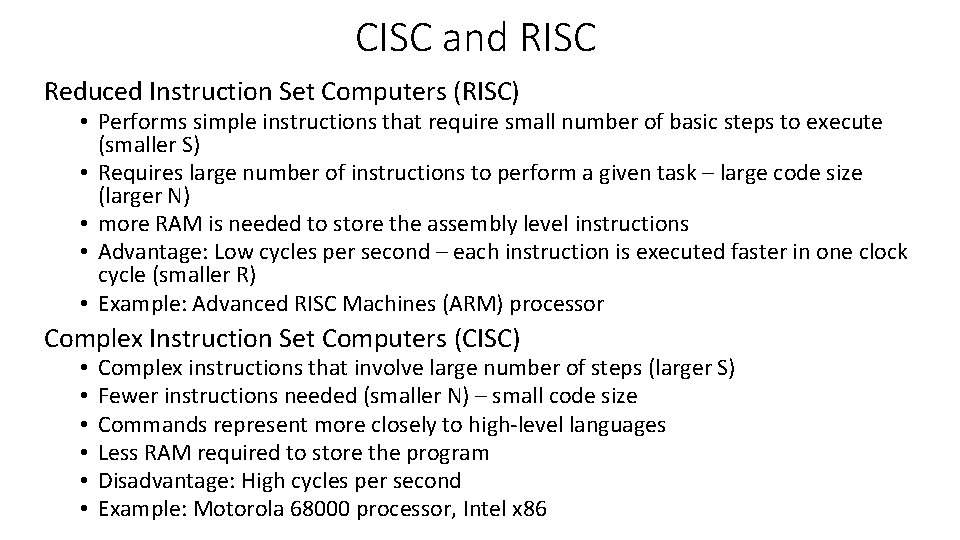
CISC and RISC Reduced Instruction Set Computers (RISC) • Performs simple instructions that require small number of basic steps to execute (smaller S) • Requires large number of instructions to perform a given task – large code size (larger N) • more RAM is needed to store the assembly level instructions • Advantage: Low cycles per second – each instruction is executed faster in one clock cycle (smaller R) • Example: Advanced RISC Machines (ARM) processor Complex Instruction Set Computers (CISC) • • • Complex instructions that involve large number of steps (larger S) Fewer instructions needed (smaller N) – small code size Commands represent more closely to high-level languages Less RAM required to store the program Disadvantage: High cycles per second Example: Motorola 68000 processor, Intel x 86
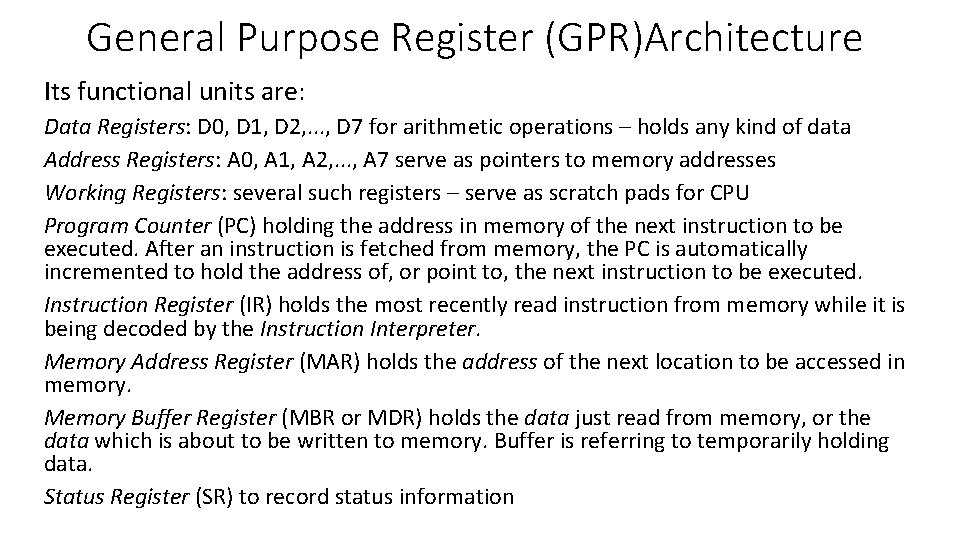
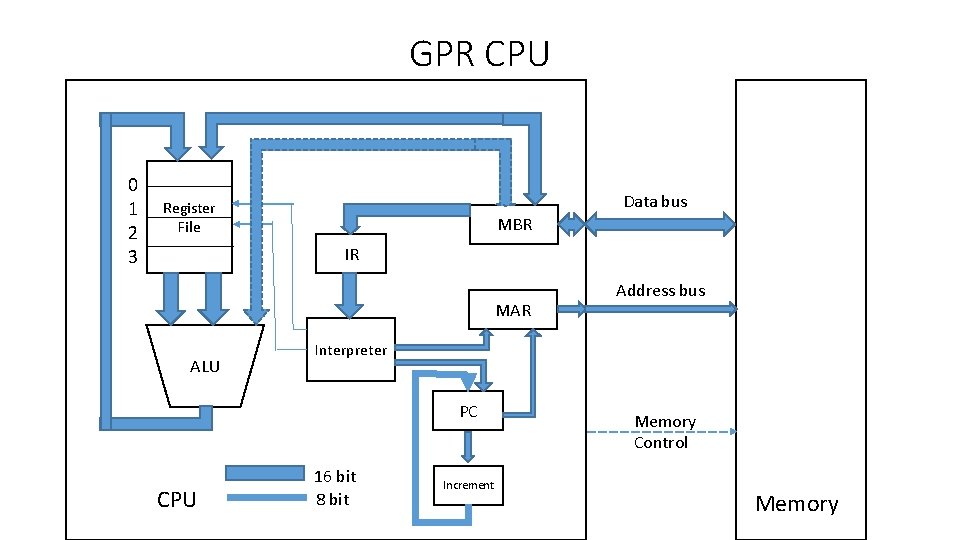
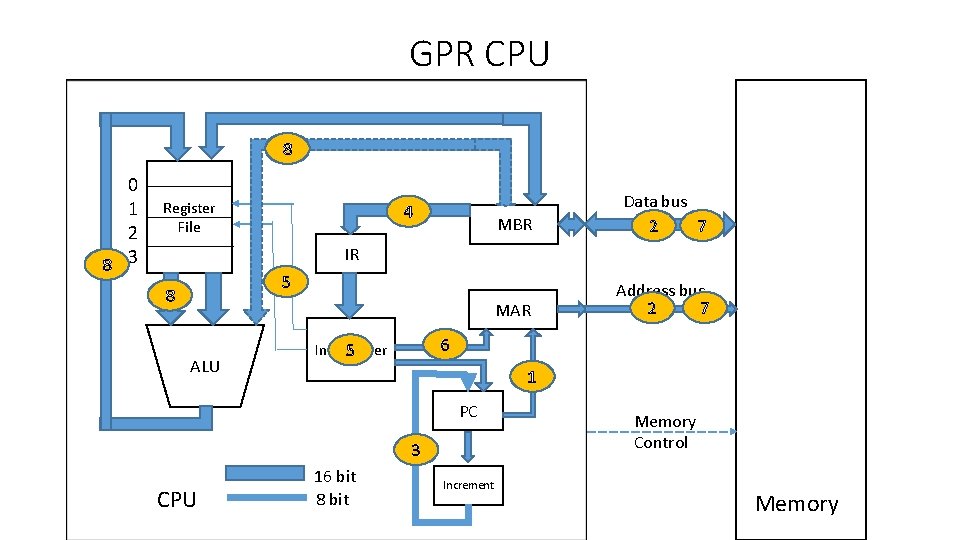
General Purpose Register (GPR)Architecture Its functional units are: Data Registers: D 0, D 1, D 2, . . . , D 7 for arithmetic operations – holds any kind of data Address Registers: A 0, A 1, A 2, . . . , A 7 serve as pointers to memory addresses Working Registers: several such registers – serve as scratch pads for CPU Program Counter (PC) holding the address in memory of the next instruction to be executed. After an instruction is fetched from memory, the PC is automatically incremented to hold the address of, or point to, the next instruction to be executed. Instruction Register (IR) holds the most recently read instruction from memory while it is being decoded by the Instruction Interpreter. Memory Address Register (MAR) holds the address of the next location to be accessed in memory. Memory Buffer Register (MBR or MDR) holds the data just read from memory, or the data which is about to be written to memory. Buffer is referring to temporarily holding data. Status Register (SR) to record status information
GPR CPU 0 1 2 3 Data bus Register File MBR IR MAR ALU Interpreter PC CPU Address bus 16 bit 8 bit Increment Memory Control Memory
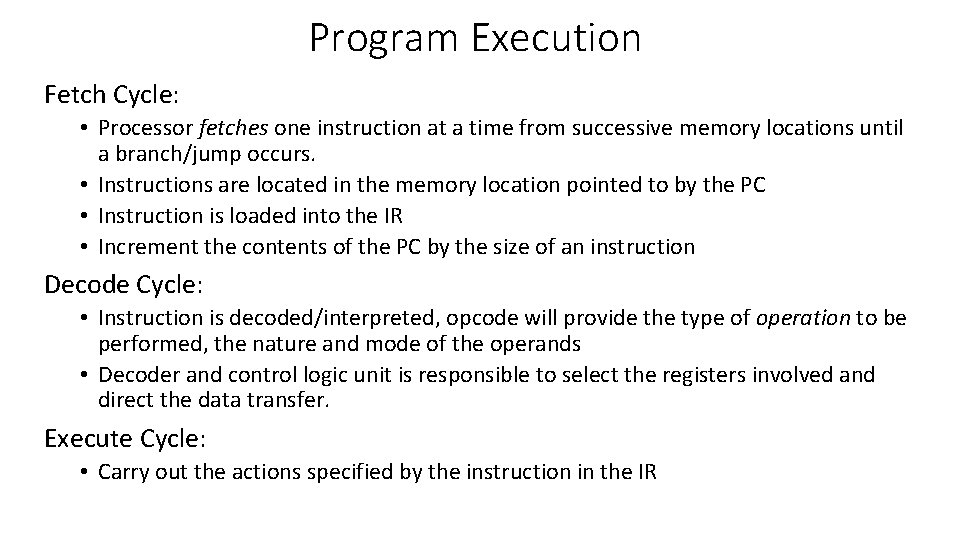
Program Execution Fetch Cycle: • Processor fetches one instruction at a time from successive memory locations until a branch/jump occurs. • Instructions are located in the memory location pointed to by the PC • Instruction is loaded into the IR • Increment the contents of the PC by the size of an instruction Decode Cycle: • Instruction is decoded/interpreted, opcode will provide the type of operation to be performed, the nature and mode of the operands • Decoder and control logic unit is responsible to select the registers involved and direct the data transfer. Execute Cycle: • Carry out the actions specified by the instruction in the IR
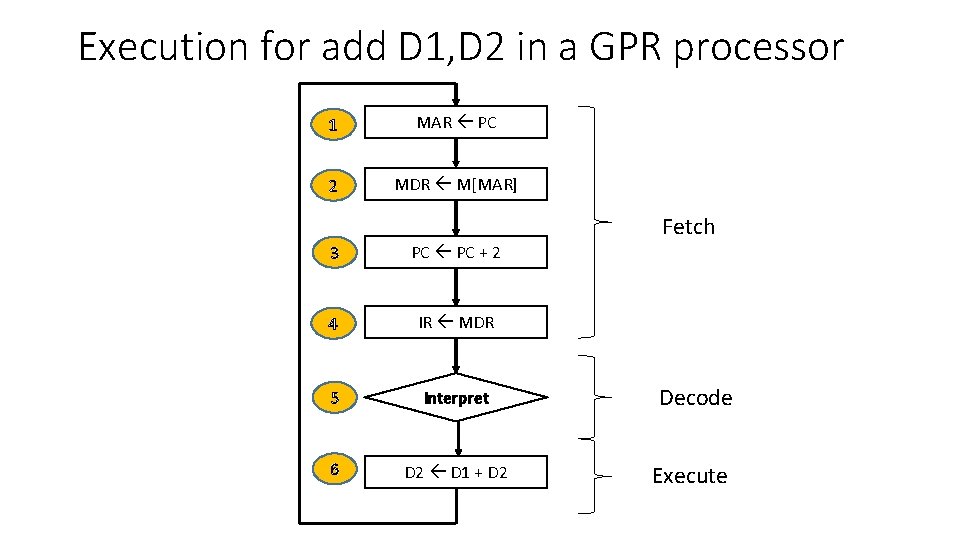
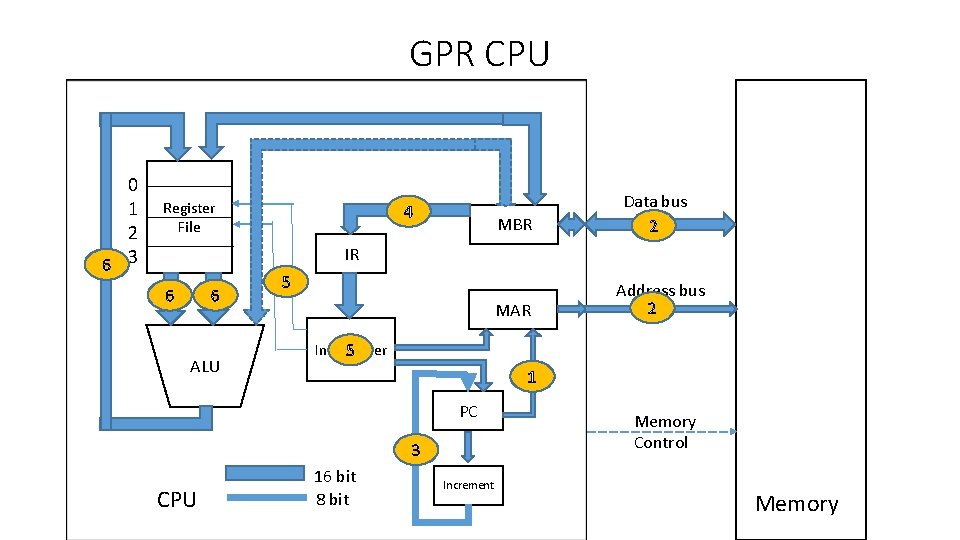
Execution for add D 1, D 2 in a GPR processor 1 MAR PC 2 MDR M[MAR] Fetch 3 PC + 2 4 IR MDR 5 Interpret 6 D 2 D 1 + D 2 Decode Execute
GPR CPU 0 1 2 6 3 Register File 4 MBR Data bus 2 MAR Address bus 2 IR 6 6 ALU 5 Interpreter 5 1 PC 3 CPU 16 bit 8 bit Increment Memory Control Memory
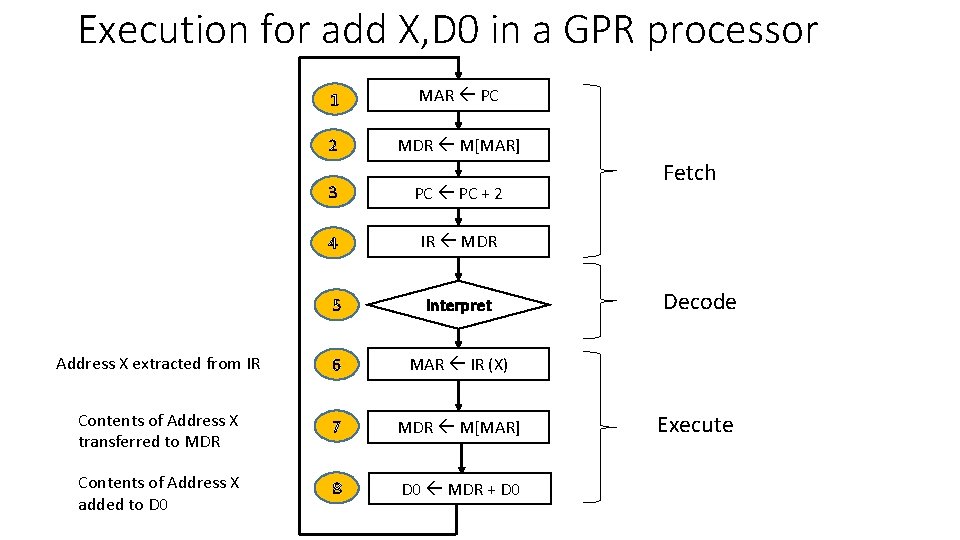
Execution for add X, D 0 in a GPR processor 1 MAR PC 2 MDR M[MAR] 3 PC + 2 4 IR MDR 5 Interpret Address X extracted from IR 6 MAR IR (X) Contents of Address X transferred to MDR 7 MDR M[MAR] Contents of Address X added to D 0 8 D 0 MDR + D 0 Fetch Decode Execute
GPR CPU 8 0 1 2 8 3 Register File 4 MBR Data bus 7 2 MAR Address bus 7 2 IR 5 8 ALU 6 Interpreter 5 1 PC 3 CPU 16 bit 8 bit Increment Memory Control Memory
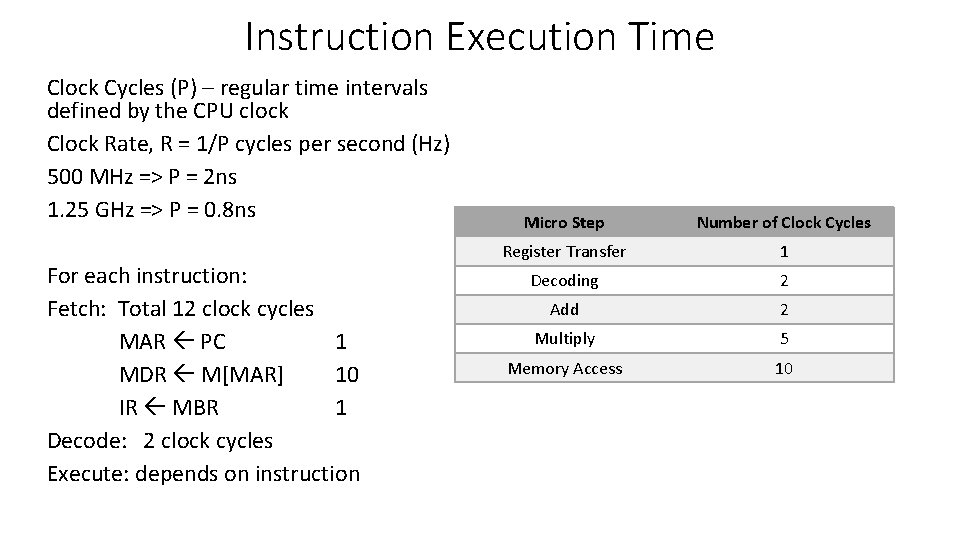
Instruction Execution Time Clock Cycles (P) – regular time intervals defined by the CPU clock Clock Rate, R = 1/P cycles per second (Hz) 500 MHz => P = 2 ns 1. 25 GHz => P = 0. 8 ns For each instruction: Fetch: Total 12 clock cycles MAR PC 1 MDR M[MAR] 10 IR MBR 1 Decode: 2 clock cycles Execute: depends on instruction Micro Step Number of Clock Cycles Register Transfer 1 Decoding 2 Add 2 Multiply 5 Memory Access 10
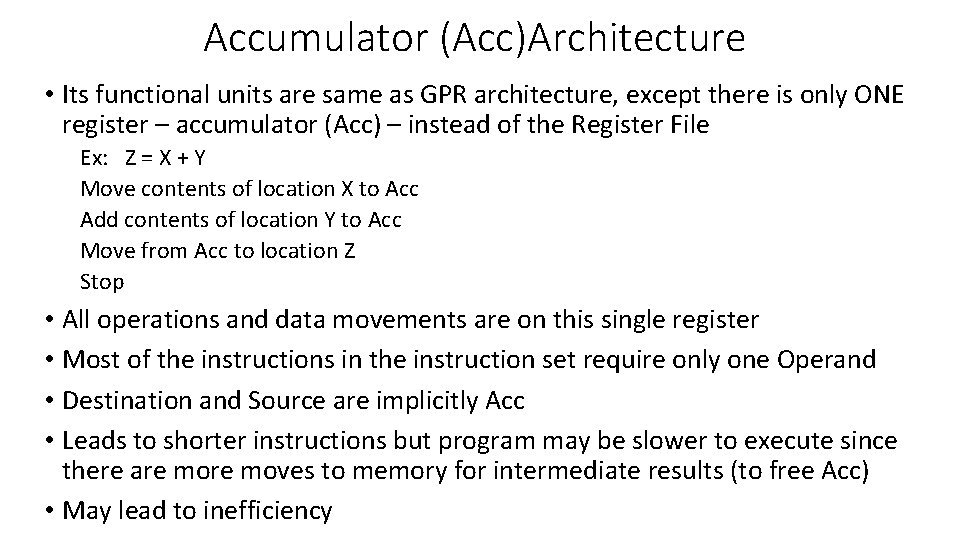
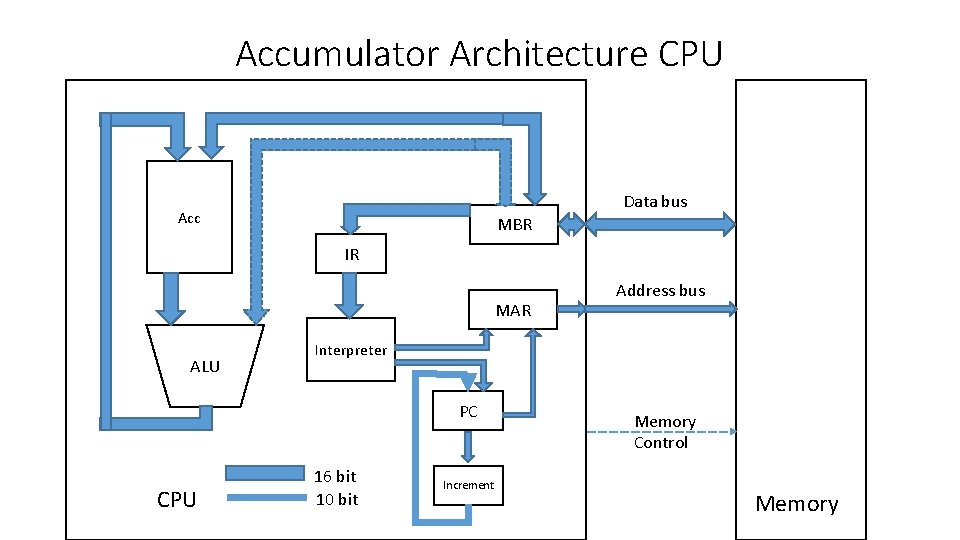
Accumulator (Acc)Architecture • Its functional units are same as GPR architecture, except there is only ONE register – accumulator (Acc) – instead of the Register File Ex: Z = X + Y Move contents of location X to Acc Add contents of location Y to Acc Move from Acc to location Z Stop • All operations and data movements are on this single register • Most of the instructions in the instruction set require only one Operand • Destination and Source are implicitly Acc • Leads to shorter instructions but program may be slower to execute since there are moves to memory for intermediate results (to free Acc) • May lead to inefficiency
Accumulator Architecture CPU Data bus Acc MBR IR MAR ALU Interpreter PC CPU Address bus 16 bit 10 bit Increment Memory Control Memory
Execution for Add Y in an Acc Architecture 1 MAR PC 2 MDR M[MAR] 3 PC + 2 4 IR MDR 5 Interpret Address X extracted from IR 6 MAR IR (X) Contents of Address X transferred to MDR 7 MDR M[MAR] Contents of Address X added to Accumulator 8 Acc MDR + Acc Fetch Decode Execute
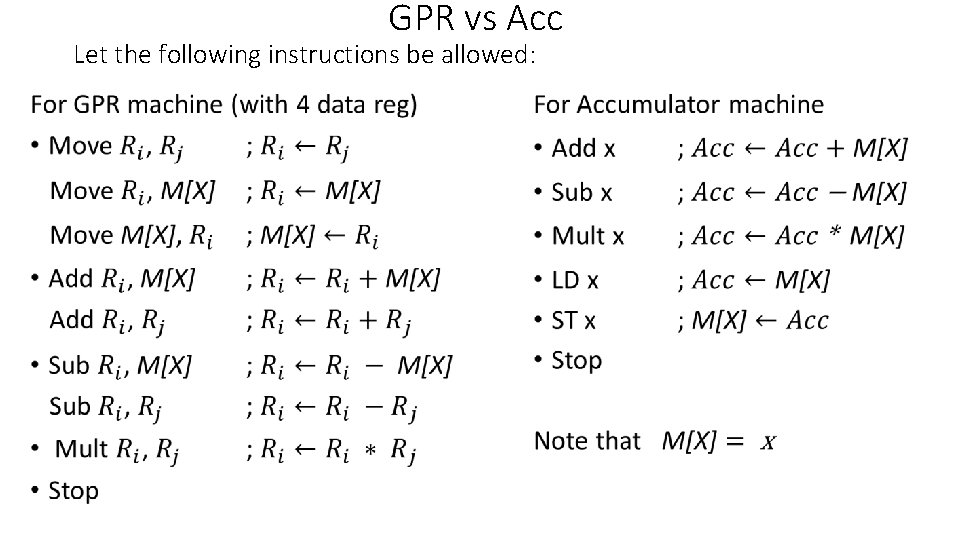
GPR vs Acc Let the following instructions be allowed: • •
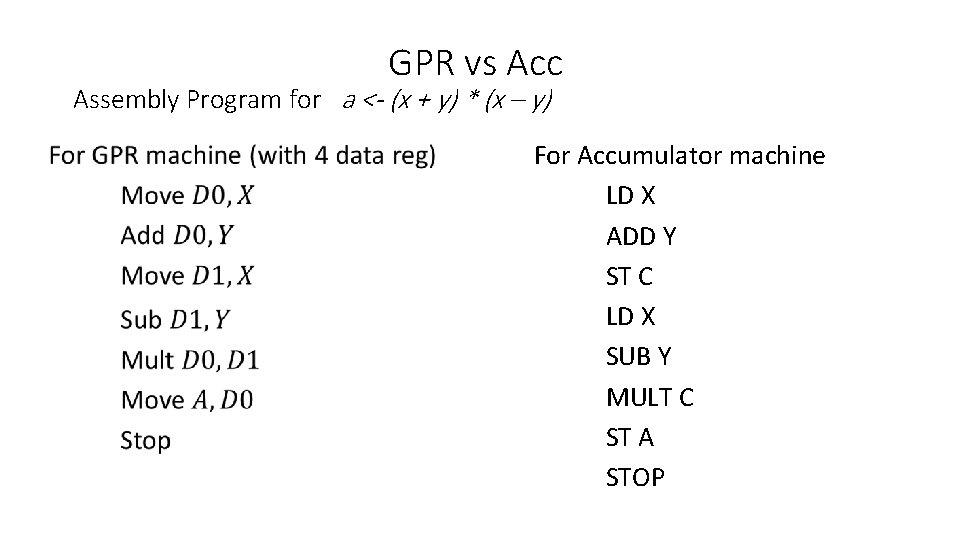
GPR vs Acc Assembly Program for a <- (x + y) * (x – y) • For Accumulator machine LD X ADD Y ST C LD X SUB Y MULT C ST A STOP