
CENTRAL NERVOUS SYSTEM The Ventricular System CSF Circulation
- Slides: 30
CENTRAL NERVOUS SYSTEM The Ventricular System & CSF Circulation Dr. Aiman Q. Afar Surgical Anatomist College of Medicine / University of Mutah 25 November 2019 Dr. Aiman Q. Afar 1
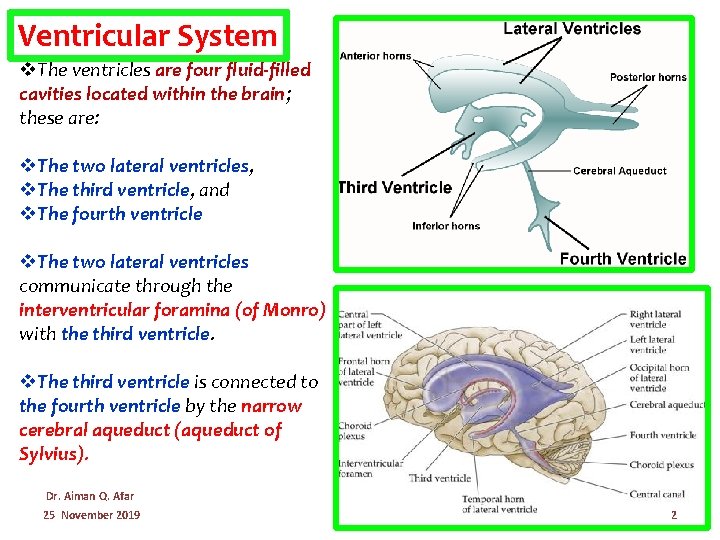
Ventricular System v. The ventricles are four fluid-filled cavities located within the brain; these are: v. The two lateral ventricles, v. The third ventricle, and v. The fourth ventricle v. The two lateral ventricles communicate through the interventricular foramina (of Monro) with the third ventricle. v. The third ventricle is connected to the fourth ventricle by the narrow cerebral aqueduct (aqueduct of Sylvius). Dr. Aiman Q. Afar 25 November 2019 2
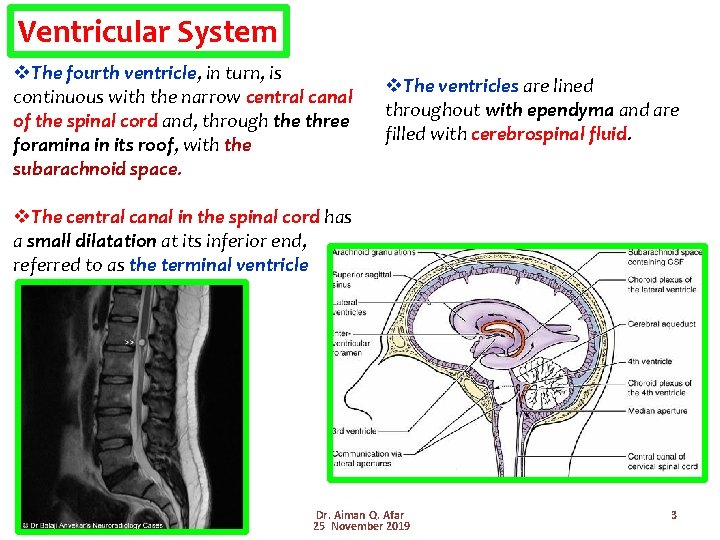
Ventricular System v. The fourth ventricle, in turn, is continuous with the narrow central canal of the spinal cord and, through the three foramina in its roof, with the subarachnoid space. v. The ventricles are lined throughout with ependyma and are filled with cerebrospinal fluid. v. The central canal in the spinal cord has a small dilatation at its inferior end, referred to as the terminal ventricle Dr. Aiman Q. Afar 25 November 2019 3
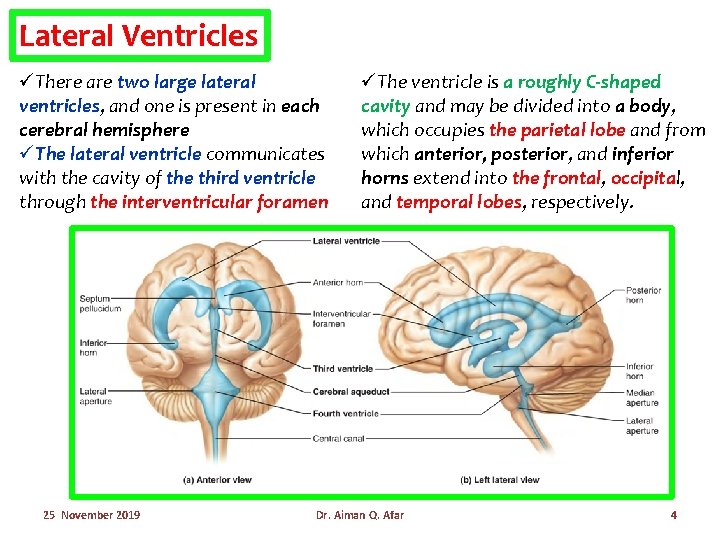
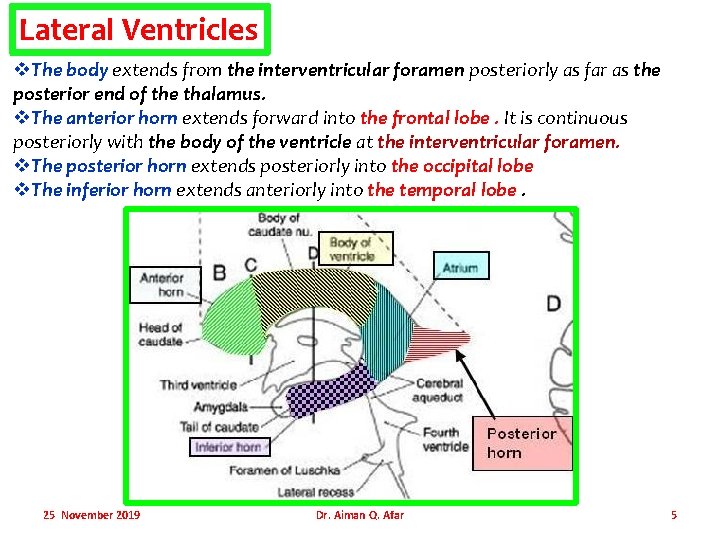
Lateral Ventricles üThere are two large lateral ventricles, and one is present in each cerebral hemisphere üThe lateral ventricle communicates with the cavity of the third ventricle through the interventricular foramen 25 November 2019 üThe ventricle is a roughly C-shaped cavity and may be divided into a body, which occupies the parietal lobe and from which anterior, posterior, and inferior horns extend into the frontal, occipital, and temporal lobes, respectively. Dr. Aiman Q. Afar 4
Lateral Ventricles v. The body extends from the interventricular foramen posteriorly as far as the posterior end of the thalamus. v. The anterior horn extends forward into the frontal lobe. It is continuous posteriorly with the body of the ventricle at the interventricular foramen. v. The posterior horn extends posteriorly into the occipital lobe v. The inferior horn extends anteriorly into the temporal lobe. 25 November 2019 Dr. Aiman Q. Afar 5
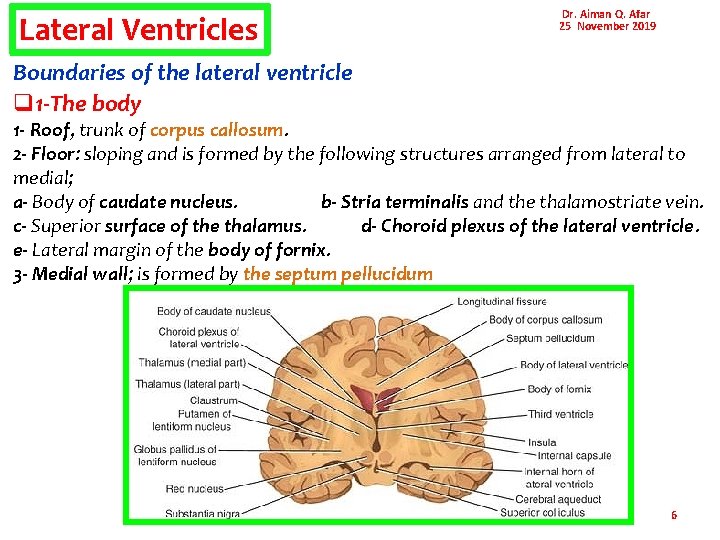
Lateral Ventricles Dr. Aiman Q. Afar 25 November 2019 Boundaries of the lateral ventricle q 1 -The body 1 - Roof, trunk of corpus callosum. 2 - Floor: sloping and is formed by the following structures arranged from lateral to medial; a- Body of caudate nucleus. b- Stria terminalis and the thalamostriate vein. c- Superior surface of the thalamus. d- Choroid plexus of the lateral ventricle. e- Lateral margin of the body of fornix. 3 - Medial wall; is formed by the septum pellucidum 6
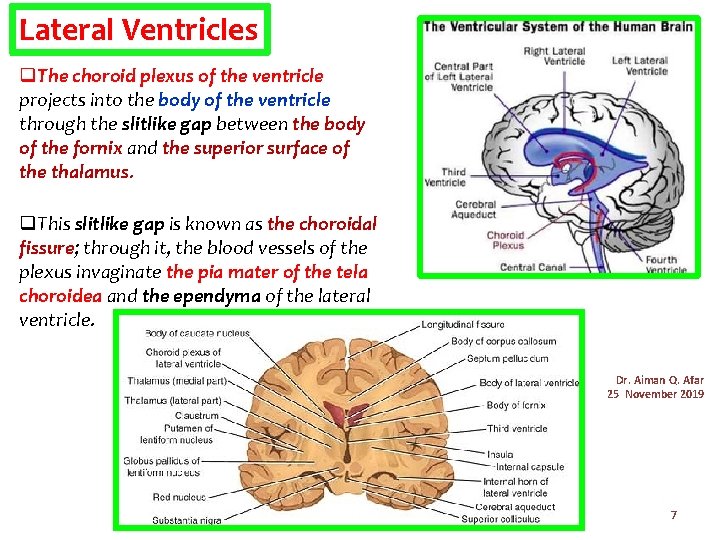
Lateral Ventricles q. The choroid plexus of the ventricle projects into the body of the ventricle through the slitlike gap between the body of the fornix and the superior surface of the thalamus. q. This slitlike gap is known as the choroidal fissure; through it, the blood vessels of the plexus invaginate the pia mater of the tela choroidea and the ependyma of the lateral ventricle. Dr. Aiman Q. Afar 25 November 2019 7
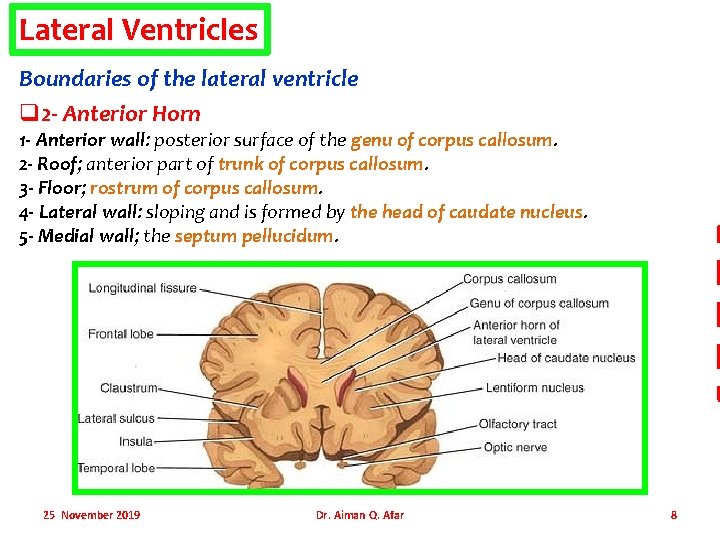
Lateral Ventricles Boundaries of the lateral ventricle q 2 - Anterior Horn 1 - Anterior wall: posterior surface of the genu of corpus callosum. 2 - Roof; anterior part of trunk of corpus callosum. 3 - Floor; rostrum of corpus callosum. 4 - Lateral wall: sloping and is formed by the head of caudate nucleus. 5 - Medial wall; the septum pellucidum. 25 November 2019 Dr. Aiman Q. Afar 8
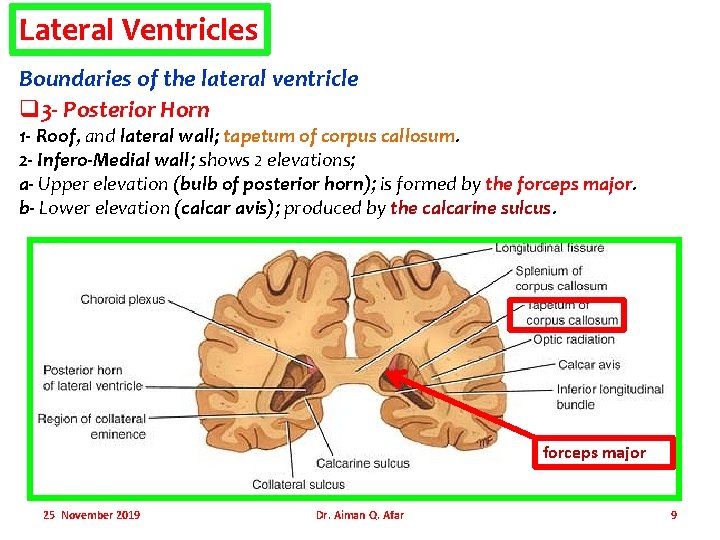
Lateral Ventricles Boundaries of the lateral ventricle q 3 - Posterior Horn 1 - Roof, and lateral wall; tapetum of corpus callosum. 2 - Infero-Medial wall; shows 2 elevations; a- Upper elevation (bulb of posterior horn); is formed by the forceps major. b- Lower elevation (calcar avis); produced by the calcarine sulcus. forceps major 25 November 2019 Dr. Aiman Q. Afar 9
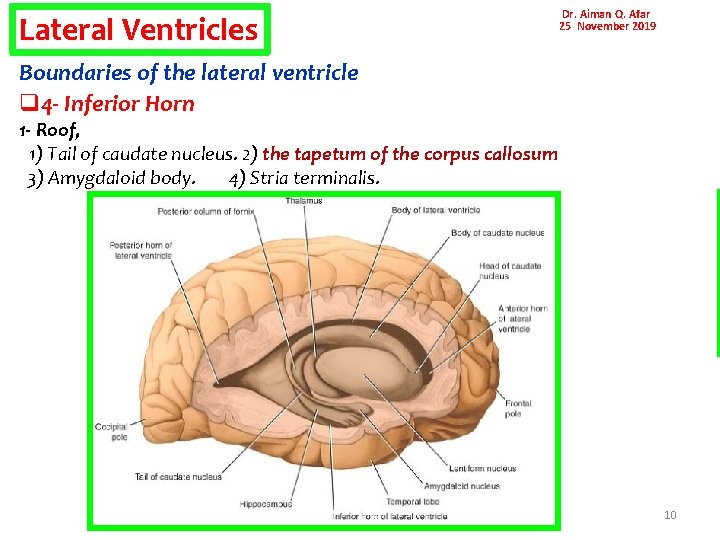
Lateral Ventricles Dr. Aiman Q. Afar 25 November 2019 Boundaries of the lateral ventricle q 4 - Inferior Horn 1 - Roof, 1) Tail of caudate nucleus. 2) the tapetum of the corpus callosum 3) Amygdaloid body. 4) Stria terminalis. 10
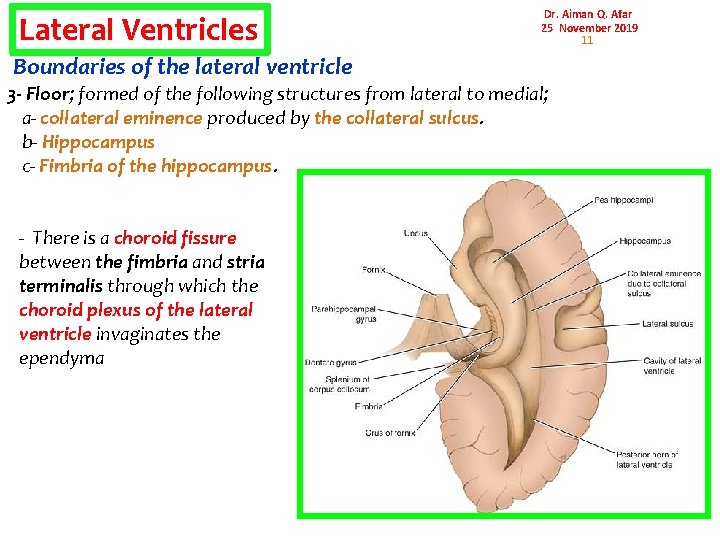
Lateral Ventricles Dr. Aiman Q. Afar 25 November 2019 11 Boundaries of the lateral ventricle 3 - Floor; formed of the following structures from lateral to medial; a- collateral eminence produced by the collateral sulcus. b- Hippocampus c- Fimbria of the hippocampus. - There is a choroid fissure between the fimbria and stria terminalis through which the choroid plexus of the lateral ventricle invaginates the ependyma
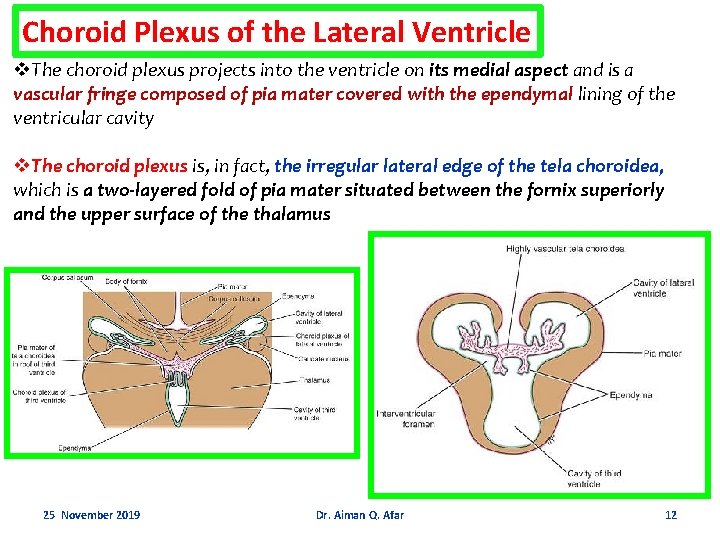
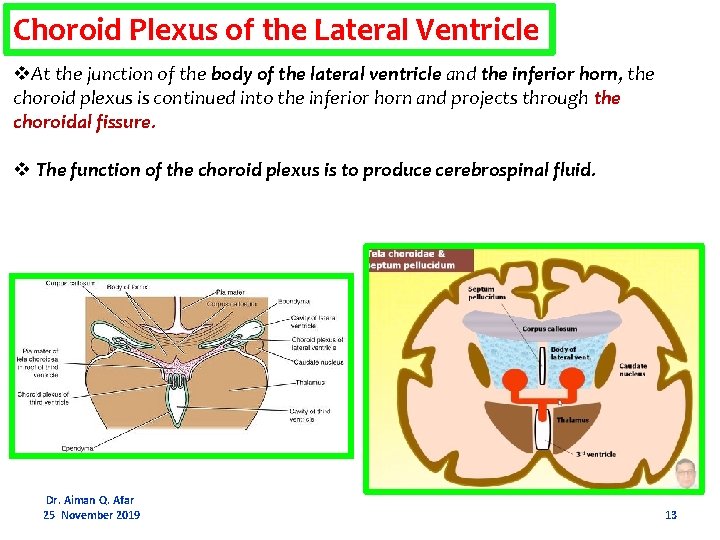
Choroid Plexus of the Lateral Ventricle v. The choroid plexus projects into the ventricle on its medial aspect and is a vascular fringe composed of pia mater covered with the ependymal lining of the ventricular cavity v. The choroid plexus is, in fact, the irregular lateral edge of the tela choroidea, which is a two-layered fold of pia mater situated between the fornix superiorly and the upper surface of the thalamus 25 November 2019 Dr. Aiman Q. Afar 12
Choroid Plexus of the Lateral Ventricle v. At the junction of the body of the lateral ventricle and the inferior horn, the choroid plexus is continued into the inferior horn and projects through the choroidal fissure. v The function of the choroid plexus is to produce cerebrospinal fluid. Dr. Aiman Q. Afar 25 November 2019 13
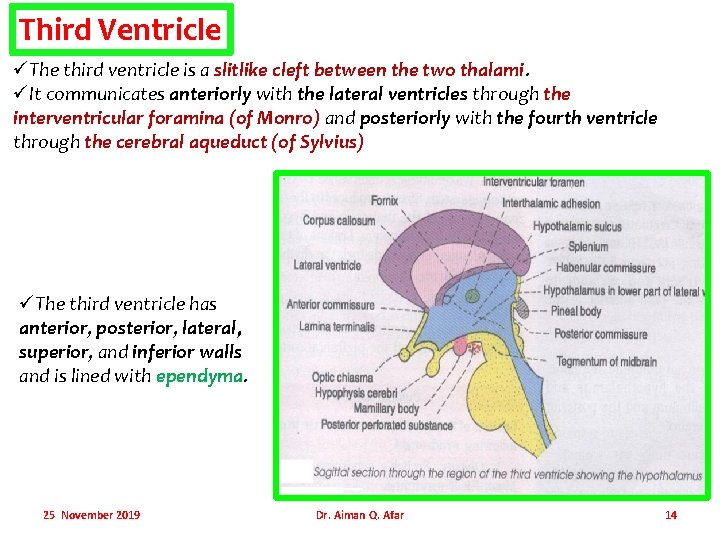
Third Ventricle üThe third ventricle is a slitlike cleft between the two thalami. üIt communicates anteriorly with the lateral ventricles through the interventricular foramina (of Monro) and posteriorly with the fourth ventricle through the cerebral aqueduct (of Sylvius) üThe third ventricle has anterior, posterior, lateral, superior, and inferior walls and is lined with ependyma. 25 November 2019 Dr. Aiman Q. Afar 14
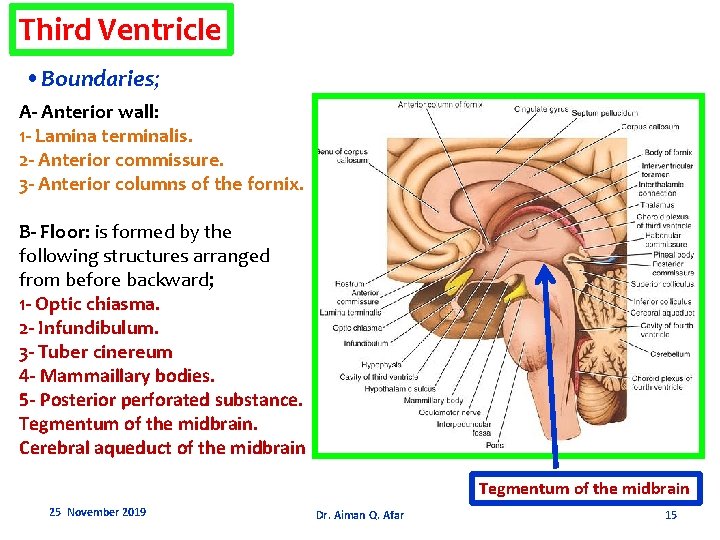
Third Ventricle • Boundaries; A- Anterior wall: 1 - Lamina terminalis. 2 - Anterior commissure. 3 - Anterior columns of the fornix. B- Floor: is formed by the following structures arranged from before backward; 1 - Optic chiasma. 2 - Infundibulum. 3 - Tuber cinereum 4 - Mammaillary bodies. 5 - Posterior perforated substance. Tegmentum of the midbrain. Cerebral aqueduct of the midbrain Tegmentum of the midbrain 25 November 2019 Dr. Aiman Q. Afar 15
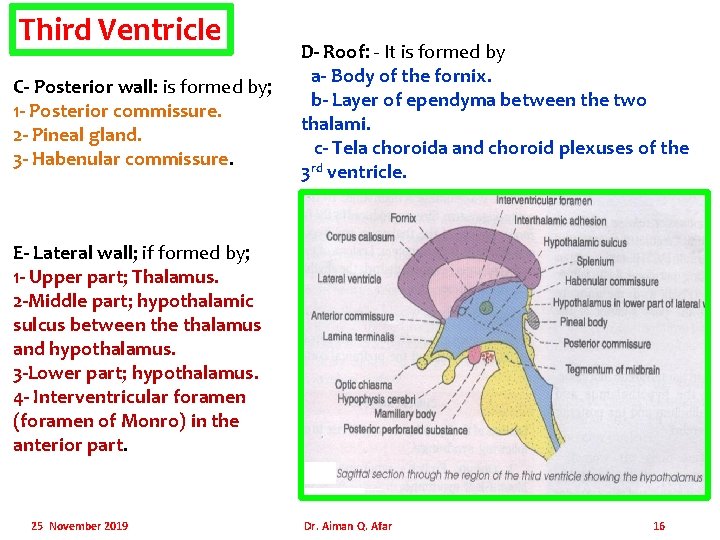
Third Ventricle C- Posterior wall: is formed by; 1 - Posterior commissure. 2 - Pineal gland. 3 - Habenular commissure. D- Roof: - It is formed by a- Body of the fornix. b- Layer of ependyma between the two thalami. c- Tela choroida and choroid plexuses of the 3 rd ventricle. E- Lateral wall; if formed by; 1 - Upper part; Thalamus. 2 -Middle part; hypothalamic sulcus between the thalamus and hypothalamus. 3 -Lower part; hypothalamus. 4 - Interventricular foramen (foramen of Monro) in the anterior part. 25 November 2019 Dr. Aiman Q. Afar 16
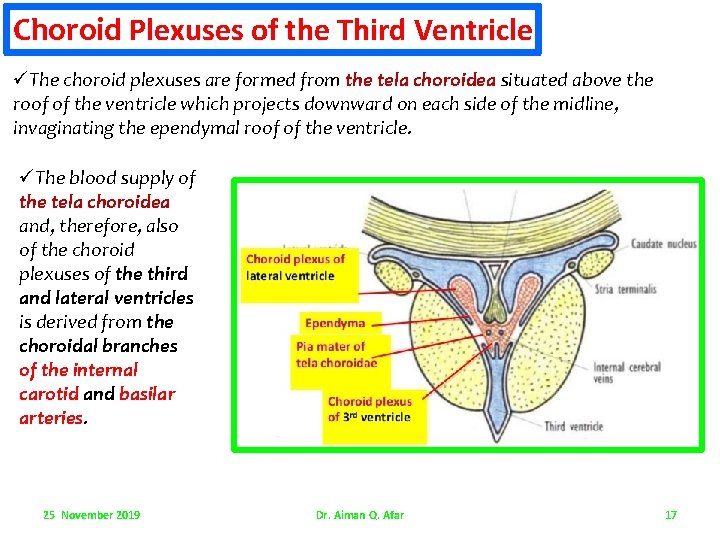
Choroid Plexuses of the Third Ventricle üThe choroid plexuses are formed from the tela choroidea situated above the roof of the ventricle which projects downward on each side of the midline, invaginating the ependymal roof of the ventricle. üThe blood supply of the tela choroidea and, therefore, also of the choroid plexuses of the third and lateral ventricles is derived from the choroidal branches of the internal carotid and basilar arteries. 25 November 2019 Dr. Aiman Q. Afar 17
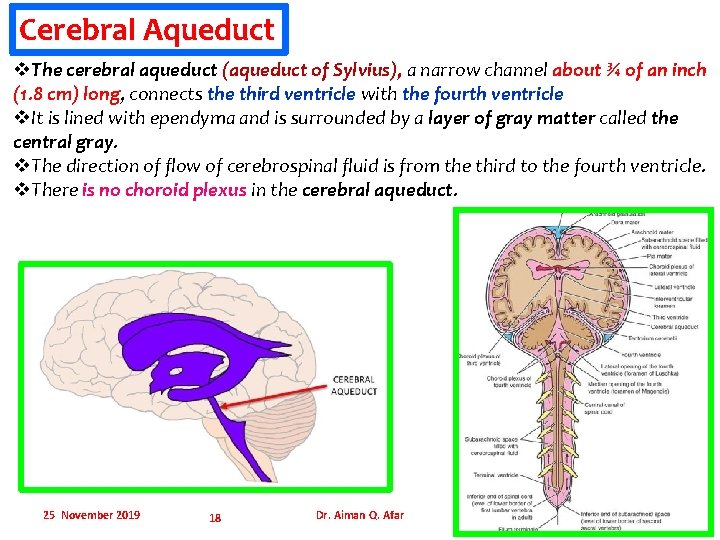
Cerebral Aqueduct v. The cerebral aqueduct (aqueduct of Sylvius), a narrow channel about ¾ of an inch (1. 8 cm) long, connects the third ventricle with the fourth ventricle v. It is lined with ependyma and is surrounded by a layer of gray matter called the central gray. v. The direction of flow of cerebrospinal fluid is from the third to the fourth ventricle. v. There is no choroid plexus in the cerebral aqueduct. 25 November 2019 18 Dr. Aiman Q. Afar
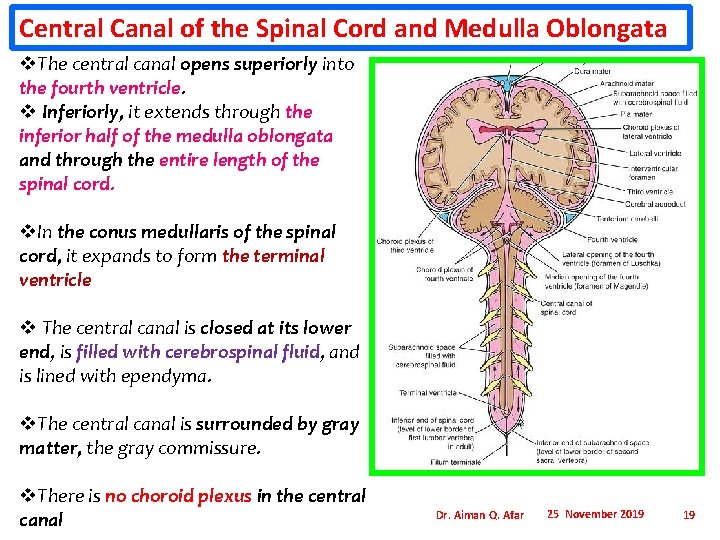
Central Canal of the Spinal Cord and Medulla Oblongata v. The central canal opens superiorly into the fourth ventricle. v Inferiorly, it extends through the inferior half of the medulla oblongata and through the entire length of the spinal cord. v. In the conus medullaris of the spinal cord, it expands to form the terminal ventricle v The central canal is closed at its lower end, is filled with cerebrospinal fluid, and is lined with ependyma. v. The central canal is surrounded by gray matter, the gray commissure. v. There is no choroid plexus in the central canal Dr. Aiman Q. Afar 25 November 2019 19
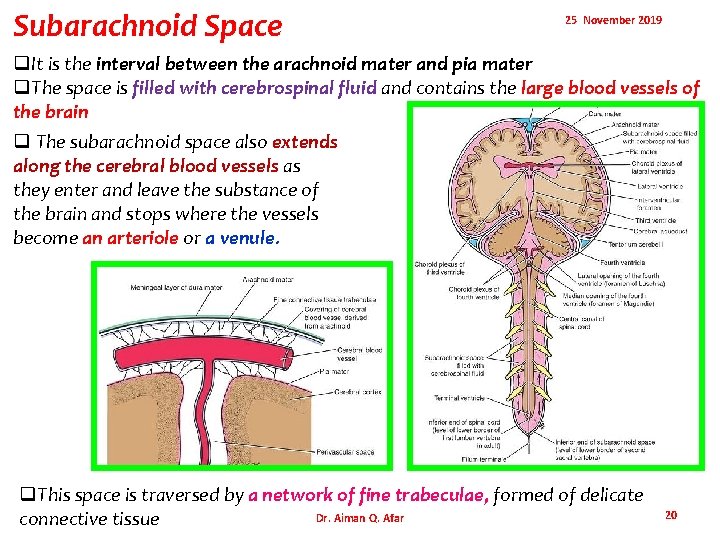
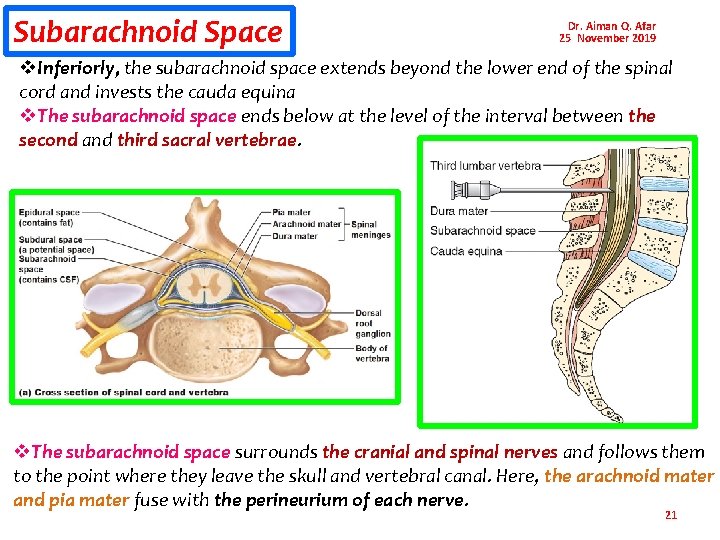
Subarachnoid Space 25 November 2019 q. It is the interval between the arachnoid mater and pia mater q. The space is filled with cerebrospinal fluid and contains the large blood vessels of the brain q The subarachnoid space also extends along the cerebral blood vessels as they enter and leave the substance of the brain and stops where the vessels become an arteriole or a venule. q. This space is traversed by a network of fine trabeculae, formed of delicate Dr. Aiman Q. Afar connective tissue 20
Subarachnoid Space Dr. Aiman Q. Afar 25 November 2019 v. Inferiorly, the subarachnoid space extends beyond the lower end of the spinal cord and invests the cauda equina v. The subarachnoid space ends below at the level of the interval between the second and third sacral vertebrae. v. The subarachnoid space surrounds the cranial and spinal nerves and follows them to the point where they leave the skull and vertebral canal. Here, the arachnoid mater and pia mater fuse with the perineurium of each nerve. 21
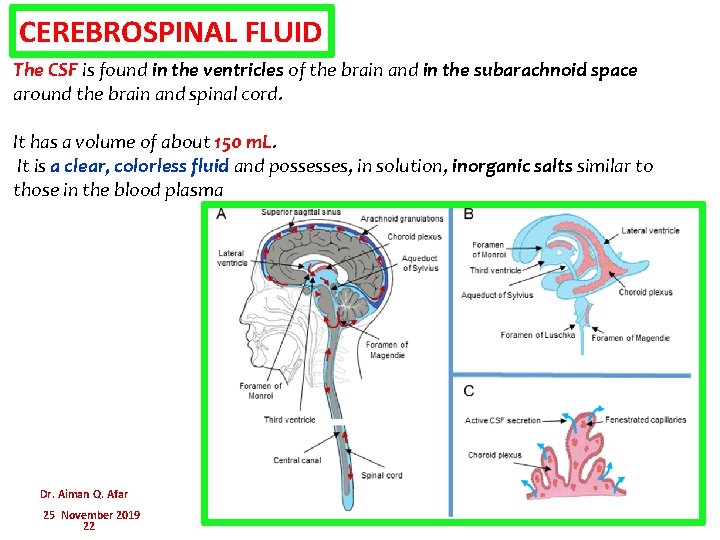
CEREBROSPINAL FLUID The CSF is found in the ventricles of the brain and in the subarachnoid space around the brain and spinal cord. It has a volume of about 150 m. L. It is a clear, colorless fluid and possesses, in solution, inorganic salts similar to those in the blood plasma Dr. Aiman Q. Afar 25 November 2019 22
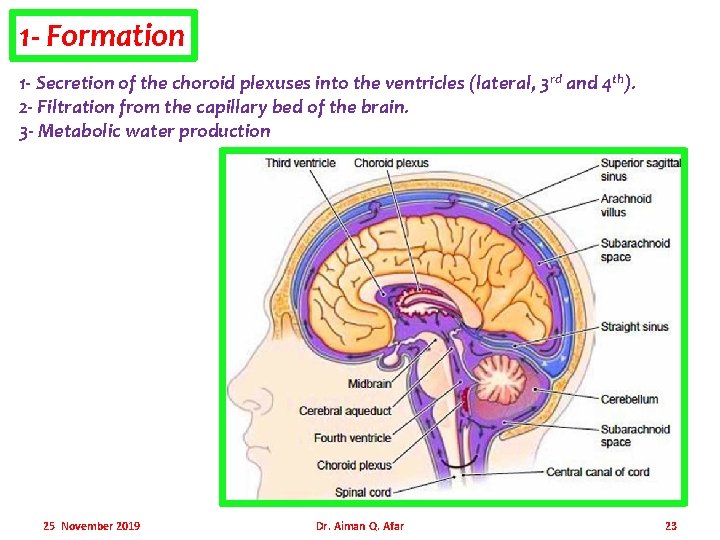
1 - Formation 1 - Secretion of the choroid plexuses into the ventricles (lateral, 3 rd and 4 th). 2 - Filtration from the capillary bed of the brain. 3 - Metabolic water production 25 November 2019 Dr. Aiman Q. Afar 23
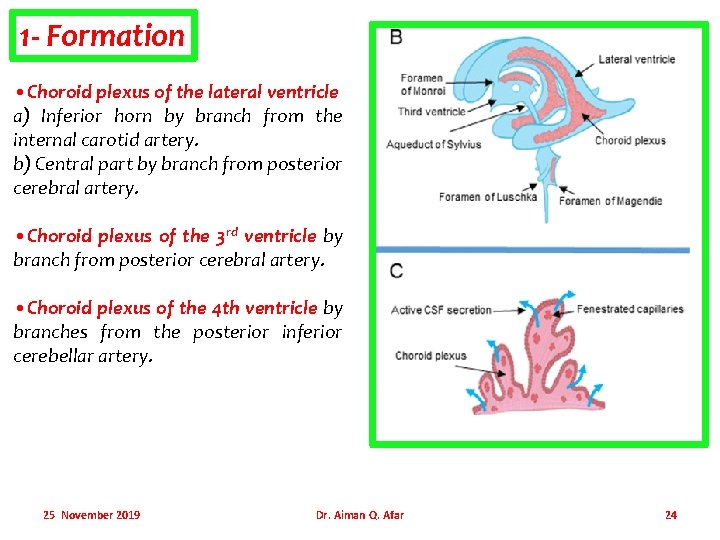
1 - Formation • Choroid plexus of the lateral ventricle a) Inferior horn by branch from the internal carotid artery. b) Central part by branch from posterior cerebral artery. • Choroid plexus of the 3 rd ventricle by branch from posterior cerebral artery. • Choroid plexus of the 4 th ventricle by branches from the posterior inferior cerebellar artery. 25 November 2019 Dr. Aiman Q. Afar 24
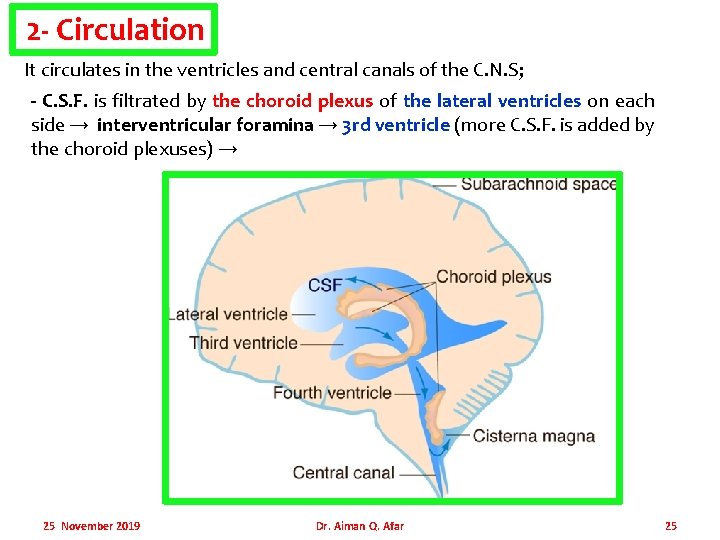
2 - Circulation It circulates in the ventricles and central canals of the C. N. S; - C. S. F. is filtrated by the choroid plexus of the lateral ventricles on each side → interventricular foramina → 3 rd ventricle (more C. S. F. is added by the choroid plexuses) → 25 November 2019 Dr. Aiman Q. Afar 25
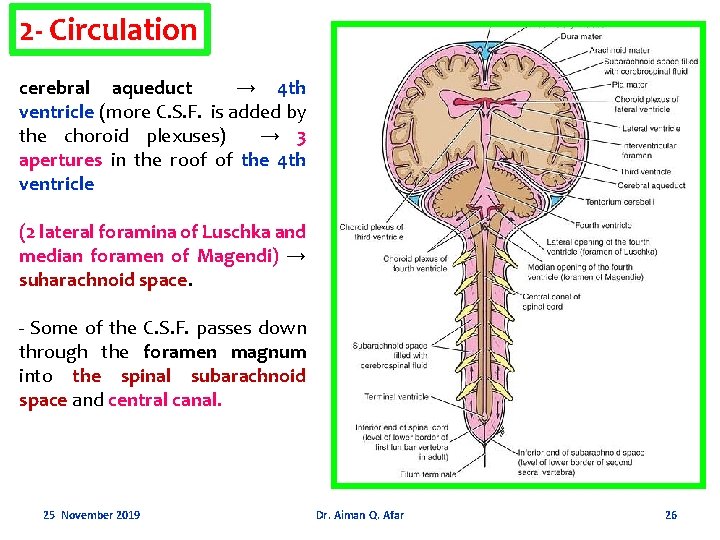
2 - Circulation cerebral aqueduct → 4 th ventricle (more C. S. F. is added by the choroid plexuses) → 3 apertures in the roof of the 4 th ventricle (2 lateral foramina of Luschka and median foramen of Magendi) → suharachnoid space. - Some of the C. S. F. passes down through the foramen magnum into the spinal subarachnoid space and central canal. 25 November 2019 Dr. Aiman Q. Afar 26
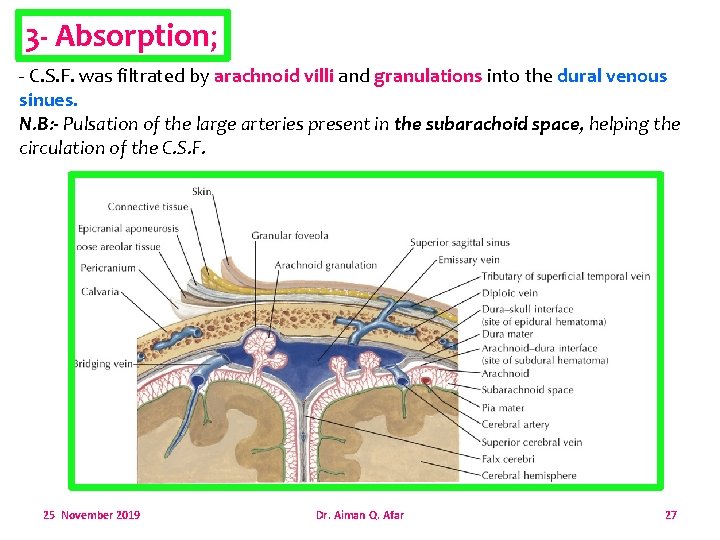
3 - Absorption; - C. S. F. was filtrated by arachnoid villi and granulations into the dural venous sinues. N. B: - Pulsation of the large arteries present in the subarachoid space, helping the circulation of the C. S. F. 25 November 2019 Dr. Aiman Q. Afar 27
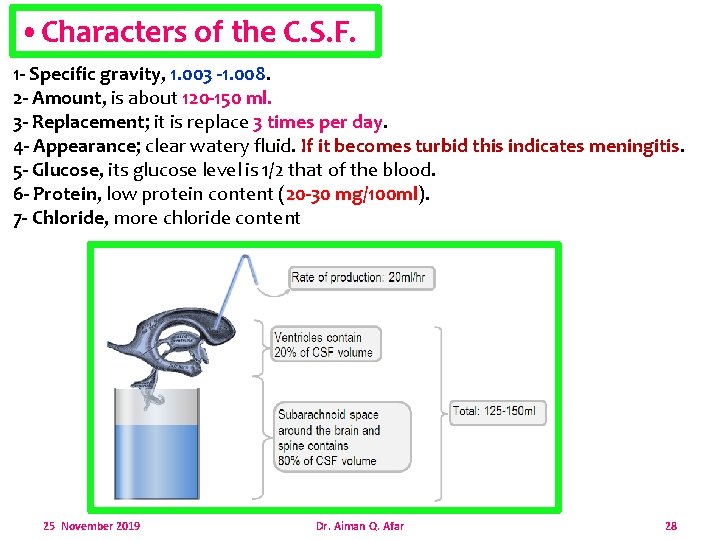
• Characters of the C. S. F. 1 - Specific gravity, 1. 003 -1. 008. 2 - Amount, is about 120 -150 ml. 3 - Replacement; it is replace 3 times per day. 4 - Appearance; clear watery fluid. If it becomes turbid this indicates meningitis. 5 - Glucose, its glucose level is 1/2 that of the blood. 6 - Protein, low protein content (20 -30 mg/100 ml). 7 - Chloride, more chloride content 25 November 2019 Dr. Aiman Q. Afar 28
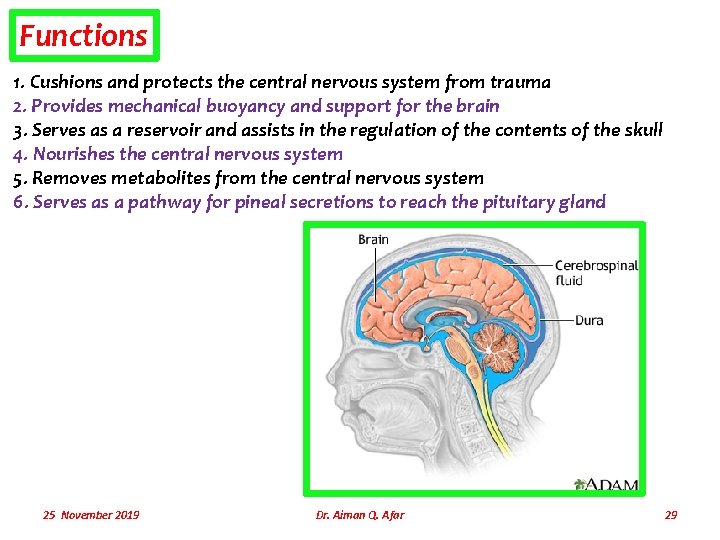
Functions 1. Cushions and protects the central nervous system from trauma 2. Provides mechanical buoyancy and support for the brain 3. Serves as a reservoir and assists in the regulation of the contents of the skull 4. Nourishes the central nervous system 5. Removes metabolites from the central nervous system 6. Serves as a pathway for pineal secretions to reach the pituitary gland 25 November 2019 Dr. Aiman Q. Afar 29
Dr. Aiman Q. Afar 25 November 2019 30