
CENTRAL NERVOUS SYSTEM The Meninges of the Brain
CENTRAL NERVOUS SYSTEM The Meninges of the Brain and Dural Venous Sinuses Dr. Aiman Q. Afar Surgical Anatomist College of Medicine / University of Mutah 25. 11. 2019 Dr. Aiman Q. Afar 1
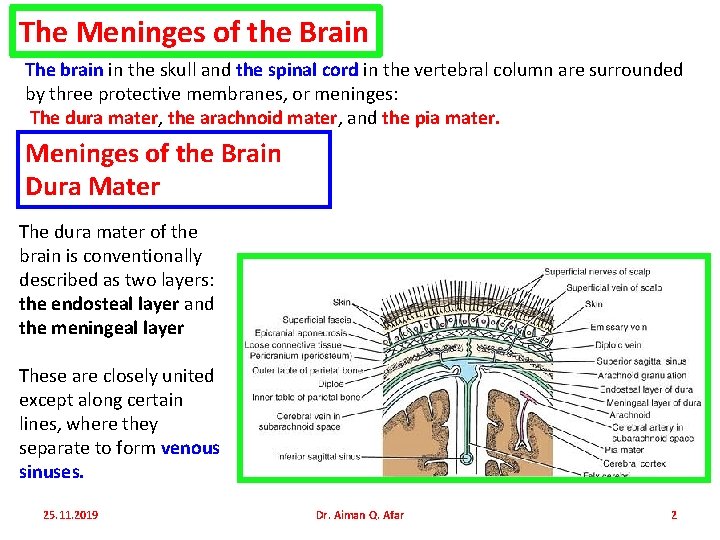
The Meninges of the Brain The brain in the skull and the spinal cord in the vertebral column are surrounded by three protective membranes, or meninges: The dura mater, the arachnoid mater, and the pia mater. Meninges of the Brain Dura Mater The dura mater of the brain is conventionally described as two layers: the endosteal layer and the meningeal layer These are closely united except along certain lines, where they separate to form venous sinuses. 25. 11. 2019 Dr. Aiman Q. Afar 2
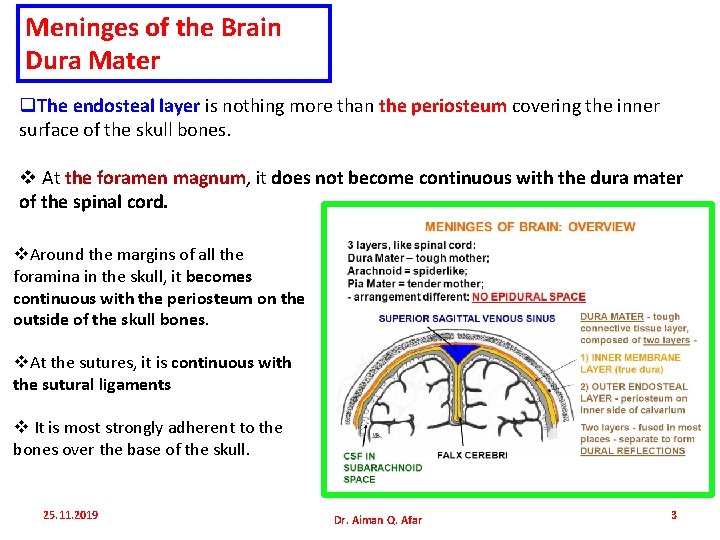
Meninges of the Brain Dura Mater q. The endosteal layer is nothing more than the periosteum covering the inner surface of the skull bones. v At the foramen magnum, it does not become continuous with the dura mater of the spinal cord. v. Around the margins of all the foramina in the skull, it becomes continuous with the periosteum on the outside of the skull bones. v. At the sutures, it is continuous with the sutural ligaments v It is most strongly adherent to the bones over the base of the skull. 25. 11. 2019 Dr. Aiman Q. Afar 3
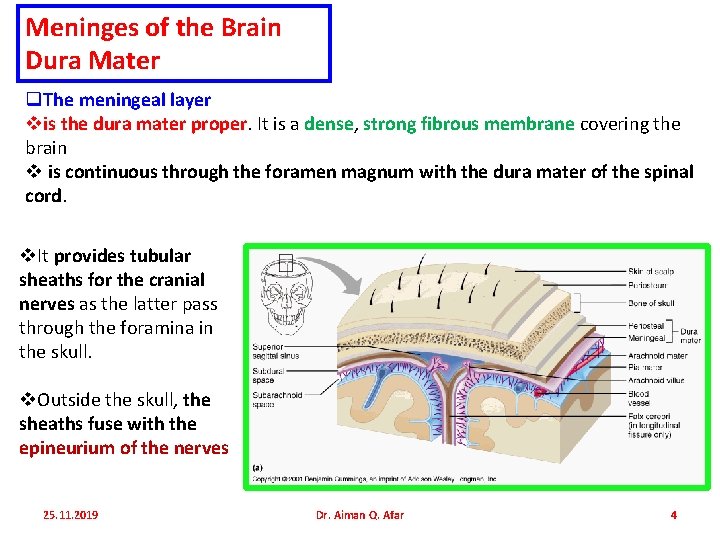
Meninges of the Brain Dura Mater q. The meningeal layer vis the dura mater proper. It is a dense, strong fibrous membrane covering the brain v is continuous through the foramen magnum with the dura mater of the spinal cord. v. It provides tubular sheaths for the cranial nerves as the latter pass through the foramina in the skull. v. Outside the skull, the sheaths fuse with the epineurium of the nerves 25. 11. 2019 Dr. Aiman Q. Afar 4
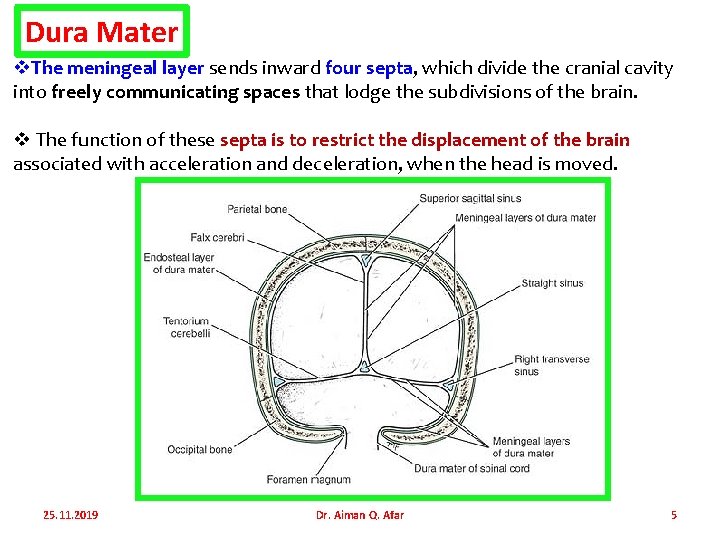
Dura Mater v. The meningeal layer sends inward four septa, which divide the cranial cavity into freely communicating spaces that lodge the subdivisions of the brain. v The function of these septa is to restrict the displacement of the brain associated with acceleration and deceleration, when the head is moved. 25. 11. 2019 Dr. Aiman Q. Afar 5
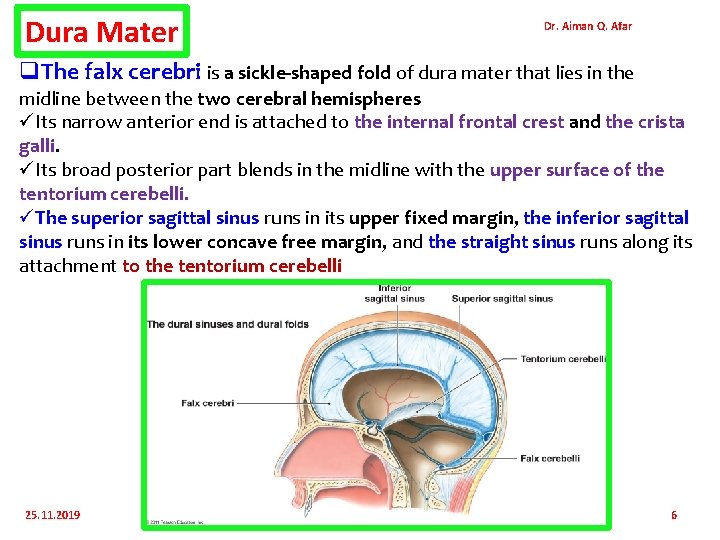
Dura Mater Dr. Aiman Q. Afar q. The falx cerebri is a sickle-shaped fold of dura mater that lies in the midline between the two cerebral hemispheres üIts narrow anterior end is attached to the internal frontal crest and the crista galli. üIts broad posterior part blends in the midline with the upper surface of the tentorium cerebelli. üThe superior sagittal sinus runs in its upper fixed margin, the inferior sagittal sinus runs in its lower concave free margin, and the straight sinus runs along its attachment to the tentorium cerebelli 25. 11. 2019 6
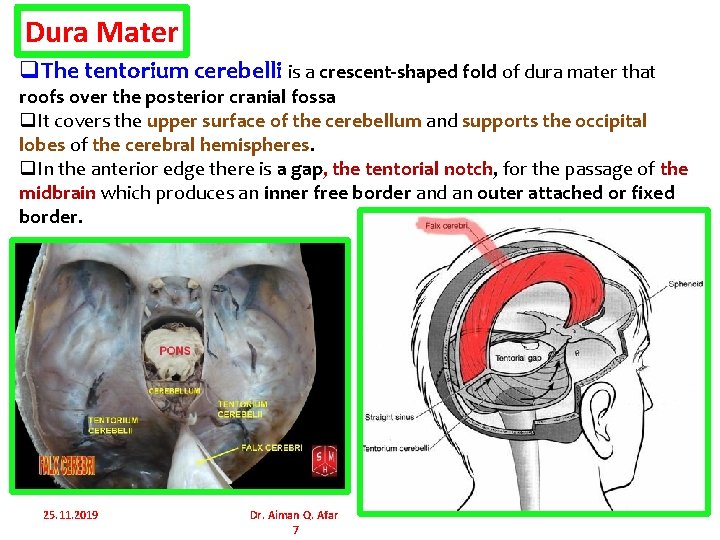
Dura Mater q. The tentorium cerebelli is a crescent-shaped fold of dura mater that roofs over the posterior cranial fossa q. It covers the upper surface of the cerebellum and supports the occipital lobes of the cerebral hemispheres. q. In the anterior edge there is a gap, the tentorial notch, for the passage of the midbrain which produces an inner free border and an outer attached or fixed border. 25. 11. 2019 Dr. Aiman Q. Afar 7
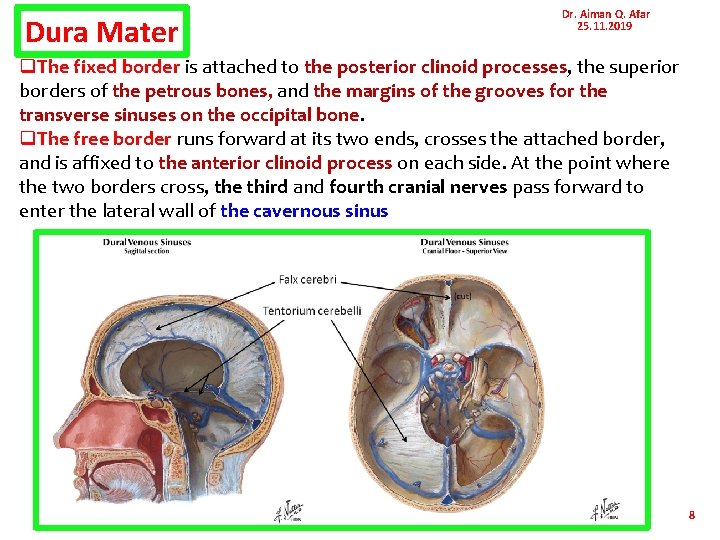
Dura Mater Dr. Aiman Q. Afar 25. 11. 2019 q. The fixed border is attached to the posterior clinoid processes, the superior borders of the petrous bones, and the margins of the grooves for the transverse sinuses on the occipital bone. q. The free border runs forward at its two ends, crosses the attached border, and is affixed to the anterior clinoid process on each side. At the point where the two borders cross, the third and fourth cranial nerves pass forward to enter the lateral wall of the cavernous sinus 8

Dura Mater The falx cerebri and the falx cerebelli are attached to the upper and lower surfaces of the tentorium, respectively. The straight sinus runs along its attachment to the falx cerebri, The superior petrosal sinus runs along its attachment to the petrous bone, and The transverse sinus runs along its attachment to the occipital bone 25. 11. 2019 Dr. Aiman Q. Afar 9

Dura Mater q. The falx cerebelli, a small, sickle-shaped fold of dura mater attached to the internal occipital crest, projects forward between the two cerebellar hemispheres. Its posterior fixed margin contains the occipital sinus. q. The diaphragma sellae is a small, circular fold of dura mater that forms the roof for the sella turcica A small opening in its center allows passage of the stalk of the hypophysis cerebri 25. 11. 2019 Dr. Aiman Q. Afar 10
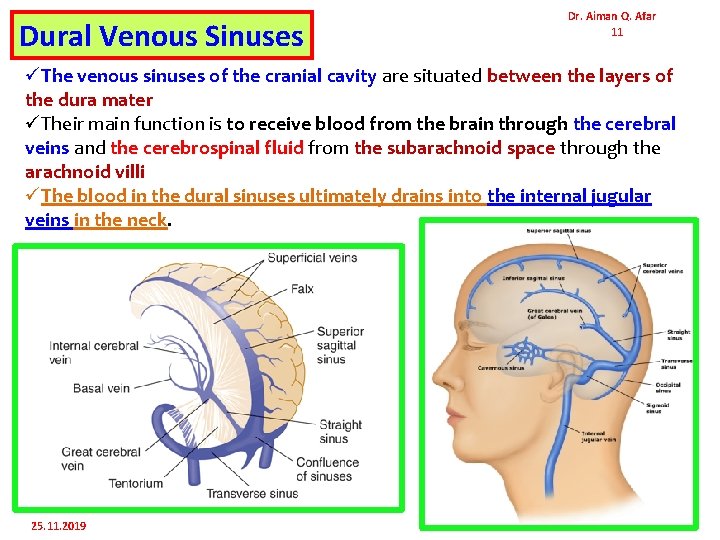
Dural Venous Sinuses Dr. Aiman Q. Afar 11 üThe venous sinuses of the cranial cavity are situated between the layers of the dura mater üTheir main function is to receive blood from the brain through the cerebral veins and the cerebrospinal fluid from the subarachnoid space through the arachnoid villi üThe blood in the dural sinuses ultimately drains into the internal jugular veins in the neck. 25. 11. 2019
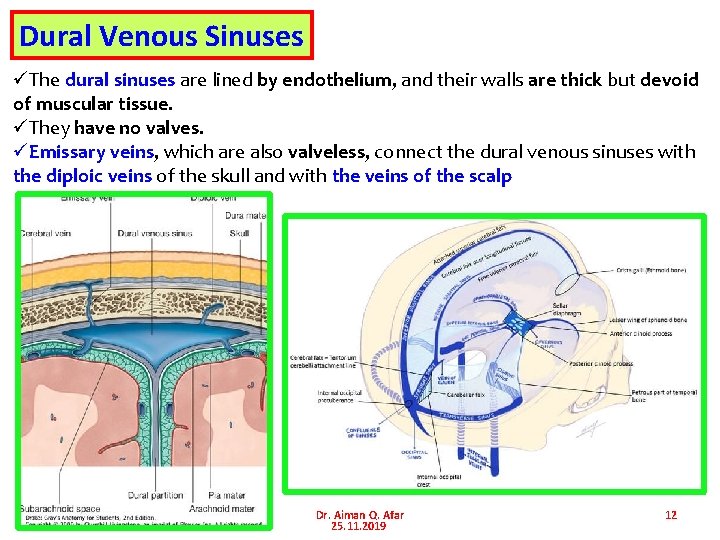
Dural Venous Sinuses üThe dural sinuses are lined by endothelium, and their walls are thick but devoid of muscular tissue. üThey have no valves. üEmissary veins, which are also valveless, connect the dural venous sinuses with the diploic veins of the skull and with the veins of the scalp Dr. Aiman Q. Afar 25. 11. 2019 12
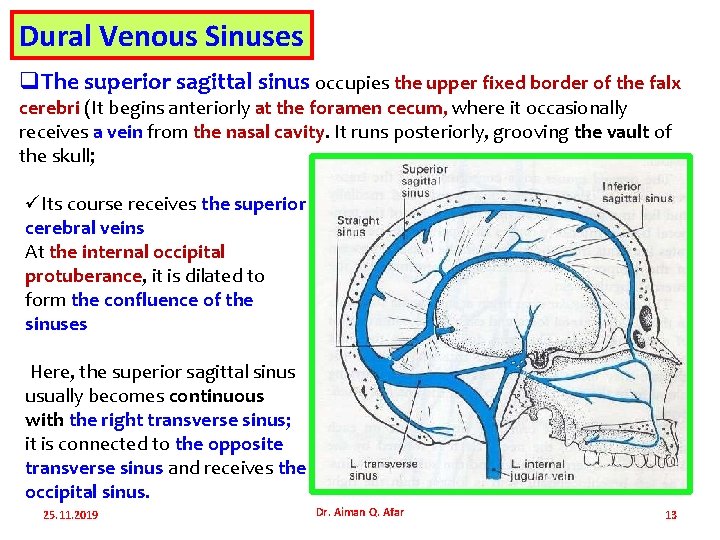
Dural Venous Sinuses q. The superior sagittal sinus occupies the upper fixed border of the falx cerebri (It begins anteriorly at the foramen cecum, where it occasionally receives a vein from the nasal cavity. It runs posteriorly, grooving the vault of the skull; üIts course receives the superior cerebral veins At the internal occipital protuberance, it is dilated to form the confluence of the sinuses Here, the superior sagittal sinus usually becomes continuous with the right transverse sinus; it is connected to the opposite transverse sinus and receives the occipital sinus. 25. 11. 2019 Dr. Aiman Q. Afar 13
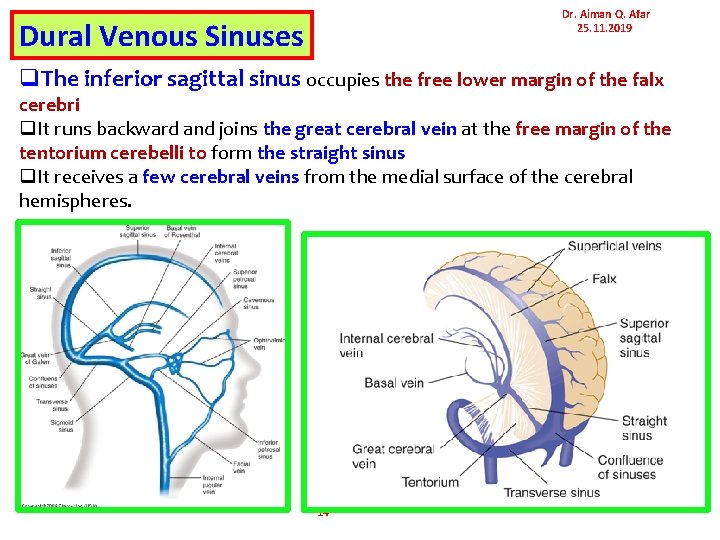
Dr. Aiman Q. Afar 25. 11. 2019 Dural Venous Sinuses q. The inferior sagittal sinus occupies the free lower margin of the falx cerebri q. It runs backward and joins the great cerebral vein at the free margin of the tentorium cerebelli to form the straight sinus q. It receives a few cerebral veins from the medial surface of the cerebral hemispheres. 14
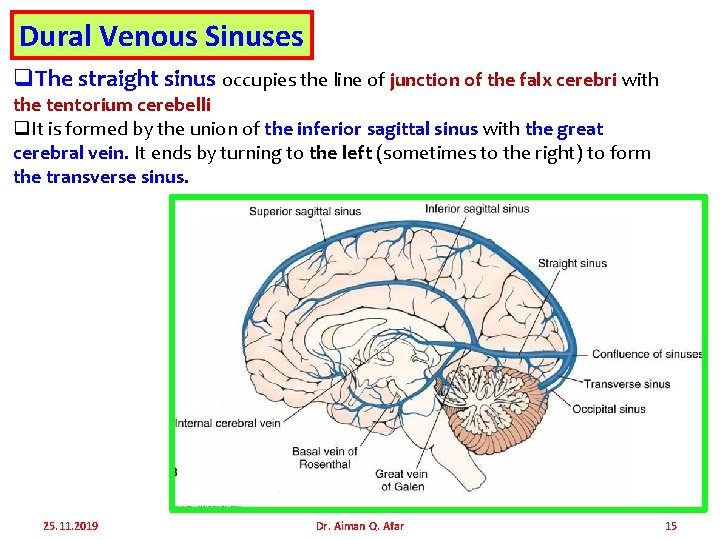
Dural Venous Sinuses q. The straight sinus occupies the line of junction of the falx cerebri with the tentorium cerebelli q. It is formed by the union of the inferior sagittal sinus with the great cerebral vein. It ends by turning to the left (sometimes to the right) to form the transverse sinus. 25. 11. 2019 Dr. Aiman Q. Afar 15
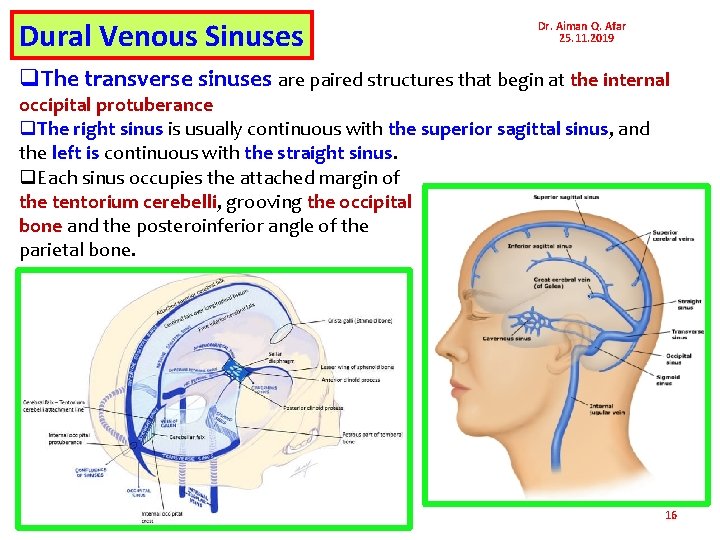
Dural Venous Sinuses Dr. Aiman Q. Afar 25. 11. 2019 q. The transverse sinuses are paired structures that begin at the internal occipital protuberance q. The right sinus is usually continuous with the superior sagittal sinus, and the left is continuous with the straight sinus. q. Each sinus occupies the attached margin of the tentorium cerebelli, grooving the occipital bone and the posteroinferior angle of the parietal bone. 16
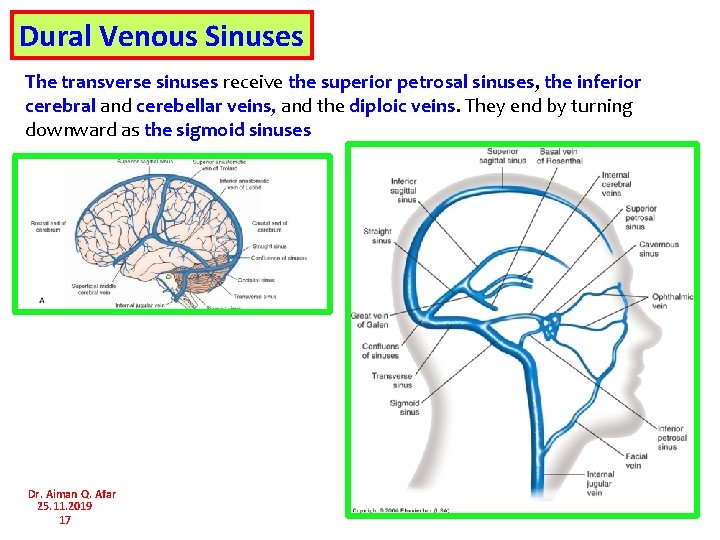
Dural Venous Sinuses The transverse sinuses receive the superior petrosal sinuses, the inferior cerebral and cerebellar veins, and the diploic veins. They end by turning downward as the sigmoid sinuses Dr. Aiman Q. Afar 25. 11. 2019 17
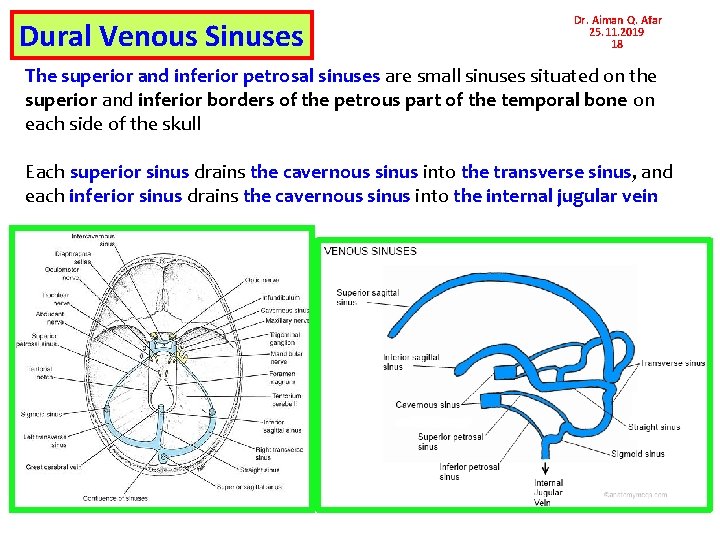
Dural Venous Sinuses Dr. Aiman Q. Afar 25. 11. 2019 18 The superior and inferior petrosal sinuses are small sinuses situated on the superior and inferior borders of the petrous part of the temporal bone on each side of the skull Each superior sinus drains the cavernous sinus into the transverse sinus, and each inferior sinus drains the cavernous sinus into the internal jugular vein
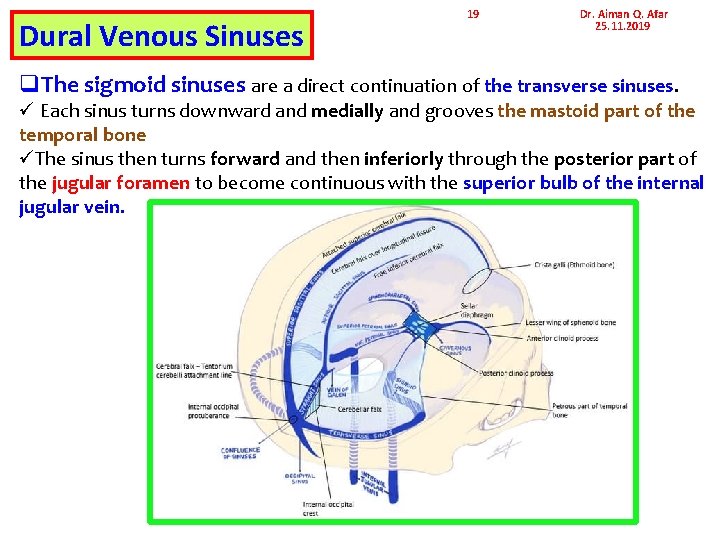
Dural Venous Sinuses 19 Dr. Aiman Q. Afar 25. 11. 2019 q. The sigmoid sinuses are a direct continuation of the transverse sinuses. ü Each sinus turns downward and medially and grooves the mastoid part of the temporal bone üThe sinus then turns forward and then inferiorly through the posterior part of the jugular foramen to become continuous with the superior bulb of the internal jugular vein.
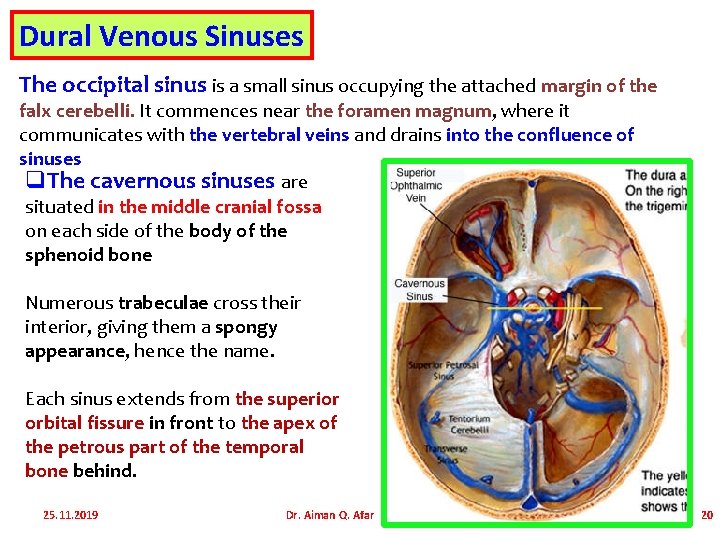
Dural Venous Sinuses The occipital sinus is a small sinus occupying the attached margin of the falx cerebelli. It commences near the foramen magnum, where it communicates with the vertebral veins and drains into the confluence of sinuses q. The cavernous sinuses are situated in the middle cranial fossa on each side of the body of the sphenoid bone Numerous trabeculae cross their interior, giving them a spongy appearance, hence the name. Each sinus extends from the superior orbital fissure in front to the apex of the petrous part of the temporal bone behind. 25. 11. 2019 Dr. Aiman Q. Afar 20
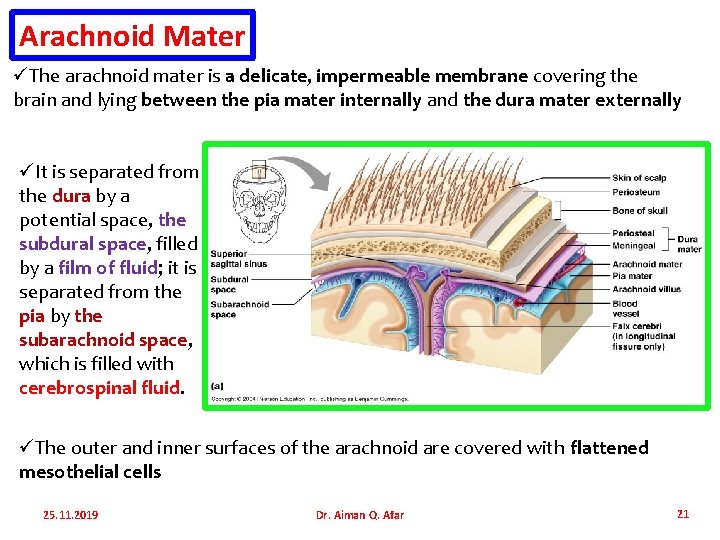
Arachnoid Mater üThe arachnoid mater is a delicate, impermeable membrane covering the brain and lying between the pia mater internally and the dura mater externally üIt is separated from the dura by a potential space, the subdural space, filled by a film of fluid; it is separated from the pia by the subarachnoid space, which is filled with cerebrospinal fluid. üThe outer and inner surfaces of the arachnoid are covered with flattened mesothelial cells 25. 11. 2019 Dr. Aiman Q. Afar 21
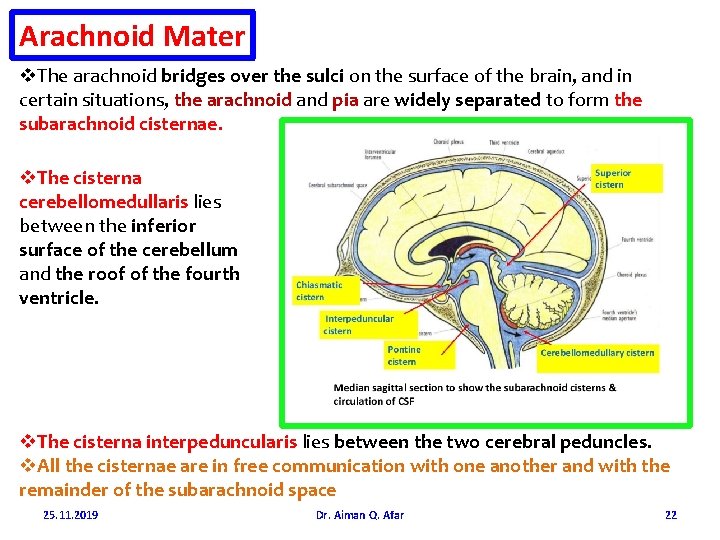
Arachnoid Mater v. The arachnoid bridges over the sulci on the surface of the brain, and in certain situations, the arachnoid and pia are widely separated to form the subarachnoid cisternae. v. The cisterna cerebellomedullaris lies between the inferior surface of the cerebellum and the roof of the fourth ventricle. v. The cisterna interpeduncularis lies between the two cerebral peduncles. v. All the cisternae are in free communication with one another and with the remainder of the subarachnoid space 25. 11. 2019 Dr. Aiman Q. Afar 22
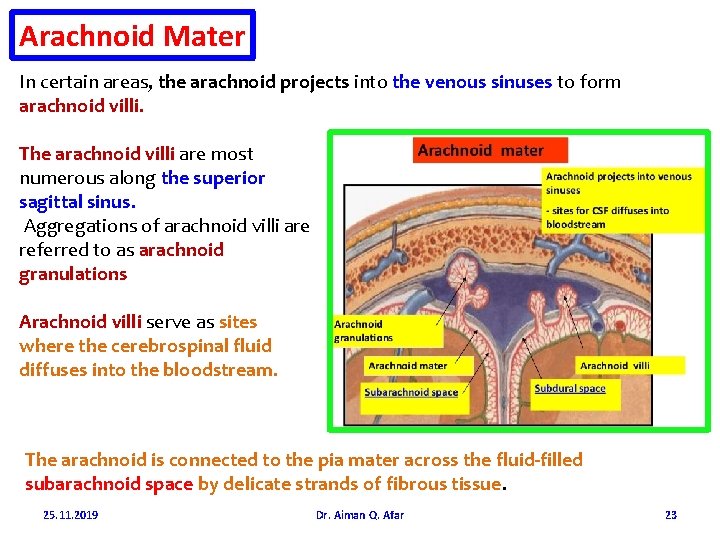
Arachnoid Mater In certain areas, the arachnoid projects into the venous sinuses to form arachnoid villi. The arachnoid villi are most numerous along the superior sagittal sinus. Aggregations of arachnoid villi are referred to as arachnoid granulations Arachnoid villi serve as sites where the cerebrospinal fluid diffuses into the bloodstream. The arachnoid is connected to the pia mater across the fluid-filled subarachnoid space by delicate strands of fibrous tissue. 25. 11. 2019 Dr. Aiman Q. Afar 23
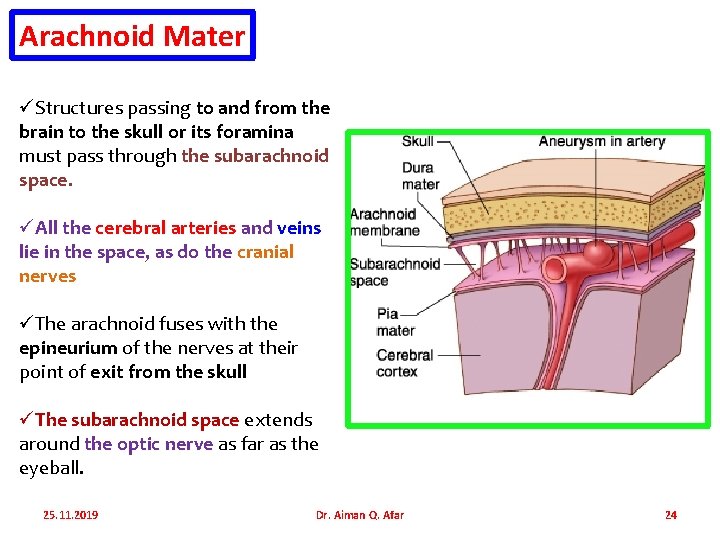
Arachnoid Mater üStructures passing to and from the brain to the skull or its foramina must pass through the subarachnoid space. üAll the cerebral arteries and veins lie in the space, as do the cranial nerves üThe arachnoid fuses with the epineurium of the nerves at their point of exit from the skull üThe subarachnoid space extends around the optic nerve as far as the eyeball. 25. 11. 2019 Dr. Aiman Q. Afar 24
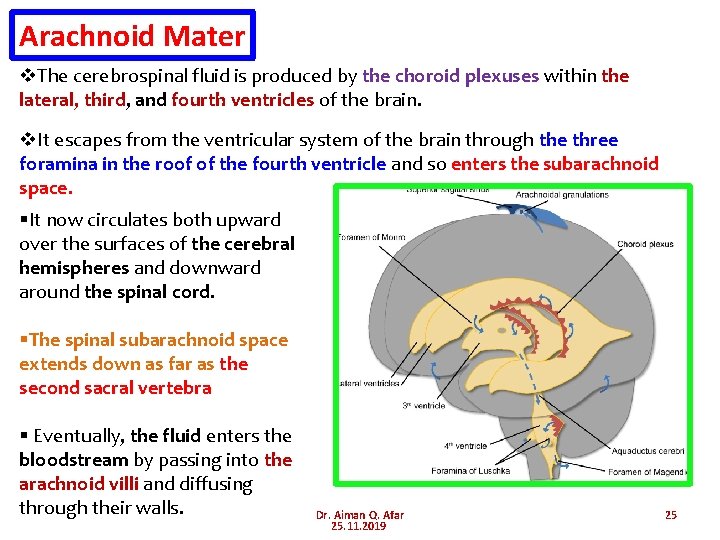
Arachnoid Mater v. The cerebrospinal fluid is produced by the choroid plexuses within the lateral, third, and fourth ventricles of the brain. v. It escapes from the ventricular system of the brain through the three foramina in the roof of the fourth ventricle and so enters the subarachnoid space. §It now circulates both upward over the surfaces of the cerebral hemispheres and downward around the spinal cord. §The spinal subarachnoid space extends down as far as the second sacral vertebra § Eventually, the fluid enters the bloodstream by passing into the arachnoid villi and diffusing through their walls. Dr. Aiman Q. Afar 25. 11. 2019 25
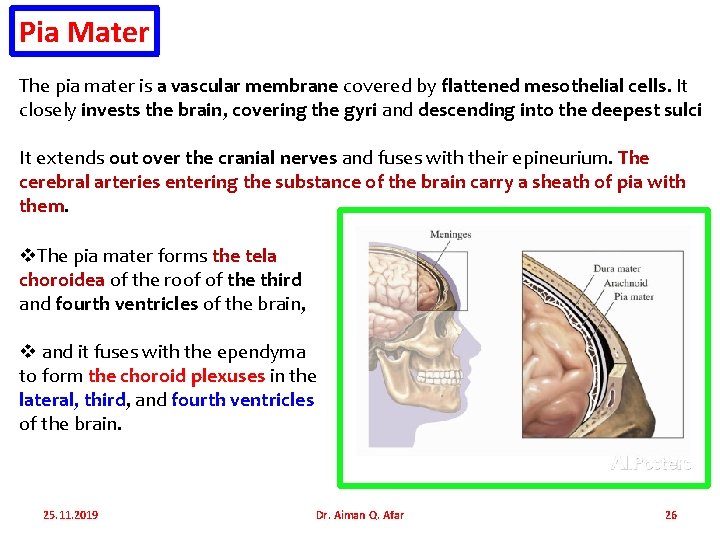
Pia Mater The pia mater is a vascular membrane covered by flattened mesothelial cells. It closely invests the brain, covering the gyri and descending into the deepest sulci It extends out over the cranial nerves and fuses with their epineurium. The cerebral arteries entering the substance of the brain carry a sheath of pia with them. v. The pia mater forms the tela choroidea of the roof of the third and fourth ventricles of the brain, v and it fuses with the ependyma to form the choroid plexuses in the lateral, third, and fourth ventricles of the brain. 25. 11. 2019 Dr. Aiman Q. Afar 26
Dr. Aiman Q. Afar 25. 11. 2019 Dr. Aiman Q. Afar 27
- Slides: 27