
Central Nervous System The CNS is made up
- Slides: 32
Central Nervous System The CNS is made up of the spinal cord and brain
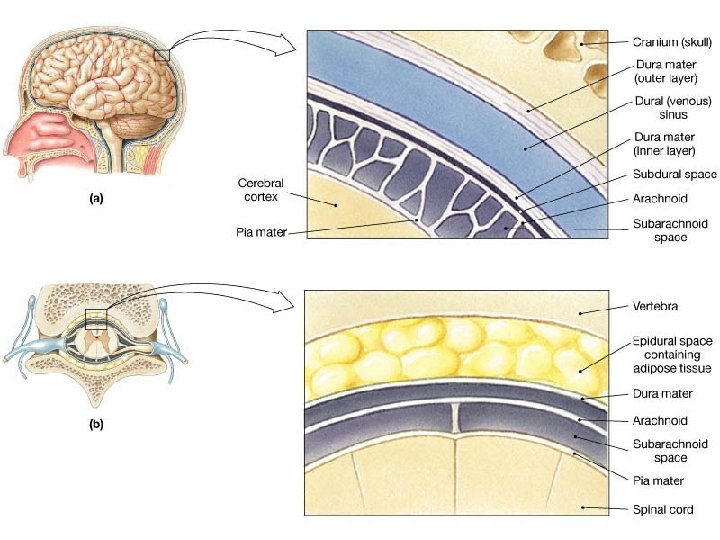
The Meninges s Special covering membranes, the meninges, protect and support the spinal cord and delicate brain s The cranial meninges: the dura mater, arachnoid, pia mater, are continuous with those of the spinal cord.
s 8 -14
s Dura mater: covers the brain and spinal cord s Epidural space separates the spinal dura mater from the walls of the vertebral canal s The subarachnoid space of the arachnoid layer contains cerebrospinal fluid (CSF)
s CSF acts as a shock absorber and a diffusion medium for dissolved gases, nutrients, chemical messages and waste products s Pia mater is bound to the underlying neural tissue.
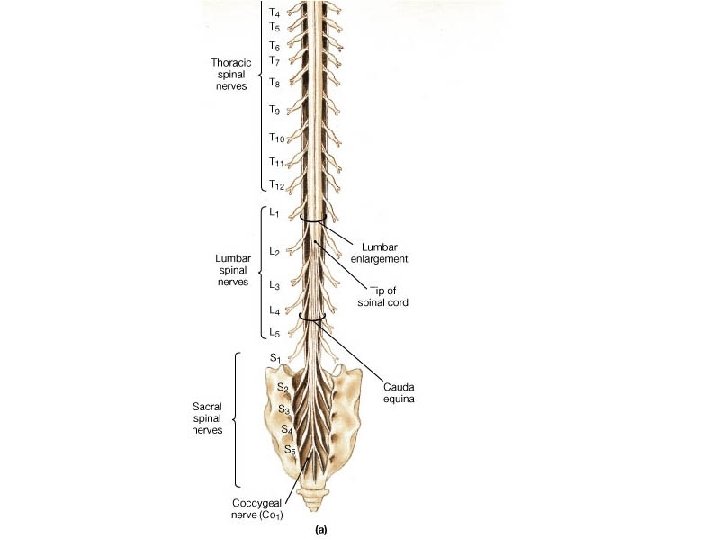
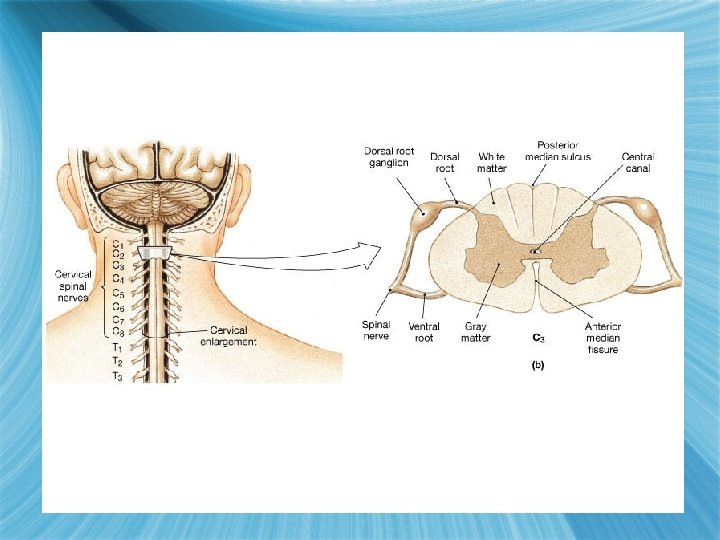
The Spinal Cord s In addition to relaying information to and from the brain, the spinal cord integrates and processes information own its own. s The spinal cord as 31 segments, each associated with a pair of dorsal root ganglia and their dorsal roots and a pair of ventral roots.
s 8 -15
s The white matter contains myelinated and unmyelinated axons s The gray matter contains the cell bodies of neurons and glial cells s The projections of gray matter toward the outer surface of the spinal cord are called horns.
The Brain s There are 6 segments to the adult brain s s s Cerebrum Diencephalon Midbrain Cerebellum Pons Medulla oblongata
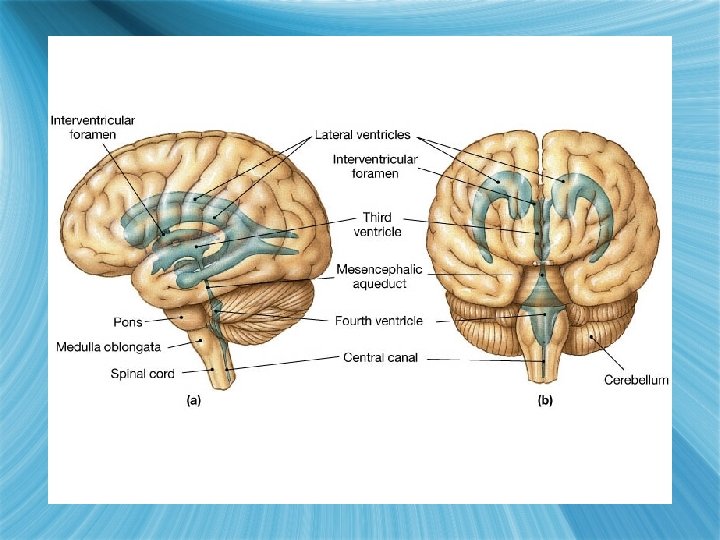
s The central passageway of the brain expands to form four chambers called ventricles. s CSF continuously circulates from the ventricles and central canal of the spinal cord into the subarachnoid space of the meninges that surround the CNS
Cerebrum The cerebrum is responsible for: conscious thought intellectual functions, memory complex involuntary motor patterns
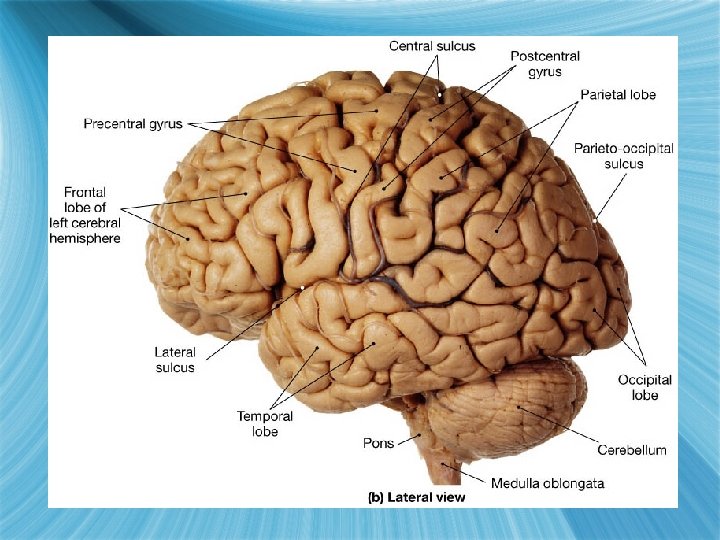
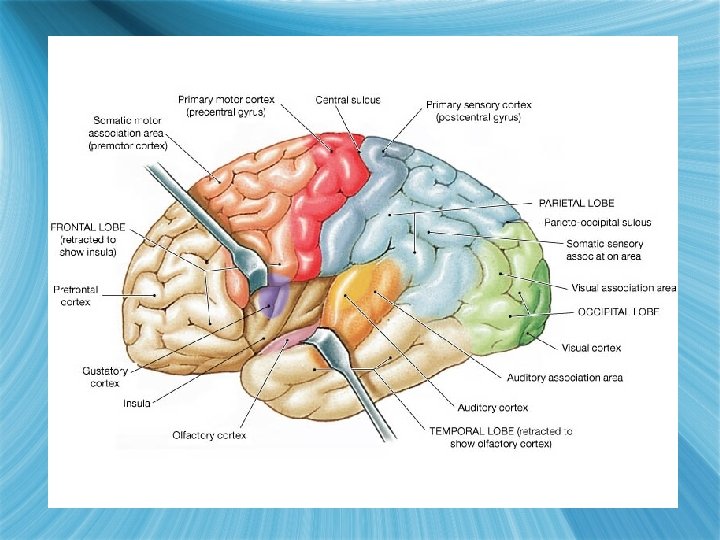
s The surface of the cerebrum contains gyri (elevated ridges) separated by sulci (shallow depressions) or deeper groves (fissures) s The longitudinal fissure separates the two cerebral hemispheres. s The central sulcus marks the boundary between and frontal lobe and the parietal lobe.
s Other sulci form the boundaries of the temporal lobe and the occipital lobe.
s Each cerebral hemisphere receives sensory information and generates motor commands that concern the opposite side of the body. s The primary motor cortex of the precentral gyrus directs voluntary movements.
s The primary sensory cortex receives somatic sensory information from touch, pressure, pain and temperature receptors. s Association areas, control our ability to understand sensory information and coordinate a motor response
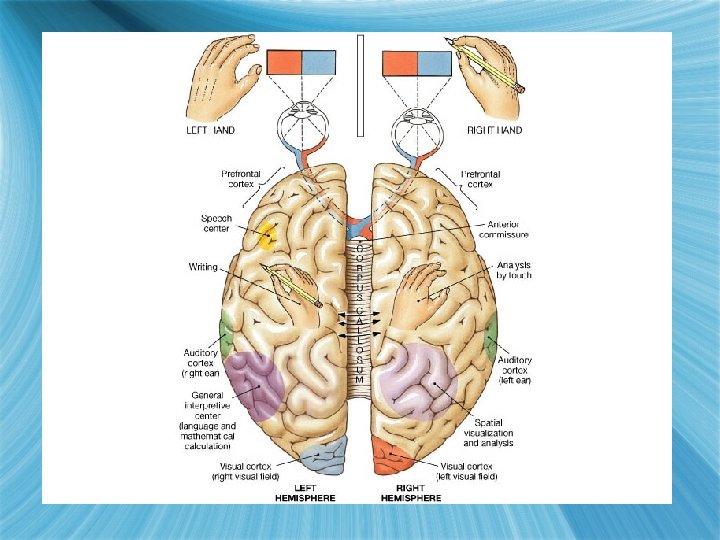
s The left hemisphere is usually the categorical hemisphere which contains the general interpretive and speech centers and is responsible for language based skills.
s The right hemisphere, or representational hemisphere is concerned with spatial relationships and analyses
s
s The basal nuclei lie within the central white matter and aid in the coordination of learned movement patterns and other somatic motor activities. s The limbic system includes the hippocampus, which is involved in memory and learning and the mamillary bodies which control reflex
s The limbic system includes the hippocampus, which is involved in memory and learning and the mamillary bodies which control reflex movements such as eating. s The functions of the limbic system involve emotional states and related behavioral drives.
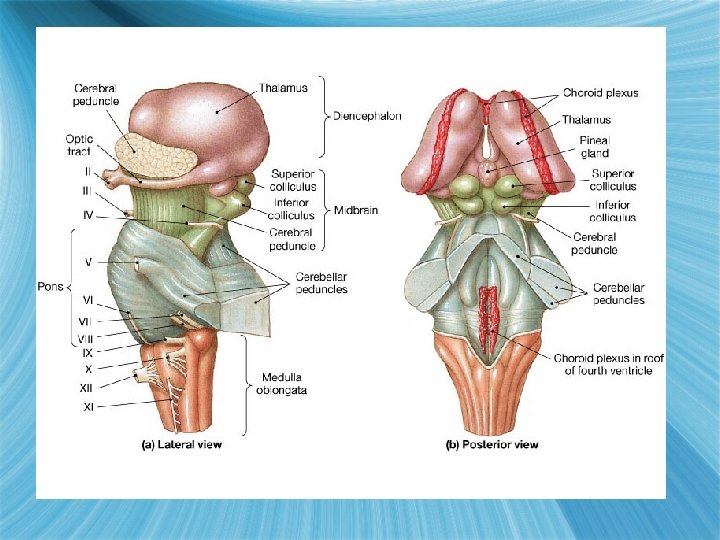
The Diencephalon s Provides the switching and relay centers necessary to integrate the conscious and unconscious sensory and motor pathways. Contains pineal gland choroid plexus thalamus hypothalamus
Thalamus s Final relay point for ascending sensory information s Only a small portion of the arriving sensory information is passed to the cerebral cortex s Rest is passed to the basal nuclei and centers in the brain stem
Hypothalamus s Important control and integrative centers s Produces emotions and behavior drives s Coordinates activities of the nervous and endocrine system s Secretes hormones, s Coordinate voluntary and autonomic functions s Regulates body temperature
The Brain Stem s Three regions s The midbrain processes visual and auditory information and generates involuntary somatic motor responses. s Pons connects the cerebellum to the brain stem and is involved with somatic and visceral motor control s Medulla oblongata: connects to spinal cord relays sensory information and regulates autonomic functions.
Cerebellum s Oversees the body’s postural muscles and programs and tunes voluntary and involuntary movements s Cerebellar peduncles are tracts that link the cerebellum with the brain stem, cerebrum and spinal cord.
More medulla… s Medulla oblongata connects the brain to the spinal cord. s Its nuclei relay information from the spinal cord and brain stem to the cerebral cortex. s Its reflex centers including the cardiovascular centers and the respiratory rhythmicity centers, control or adjust the activities of one or more peripheral systems.