
Central Nervous System Lecture Outline Spinal Cord Design
- Slides: 24
Central Nervous System
Lecture Outline • Spinal Cord Design & Function • Functional Brain Regions – Flow of Information – Learning
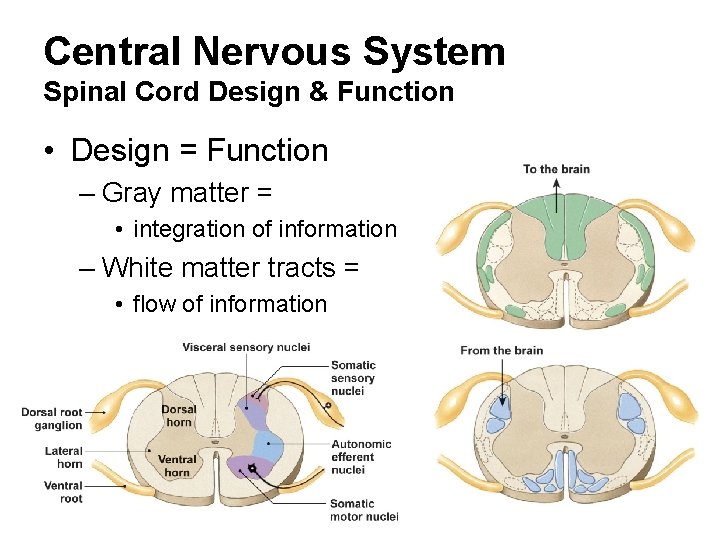
Central Nervous System Spinal Cord Design & Function • Design = Function – Gray matter = • integration of information – White matter tracts = • flow of information
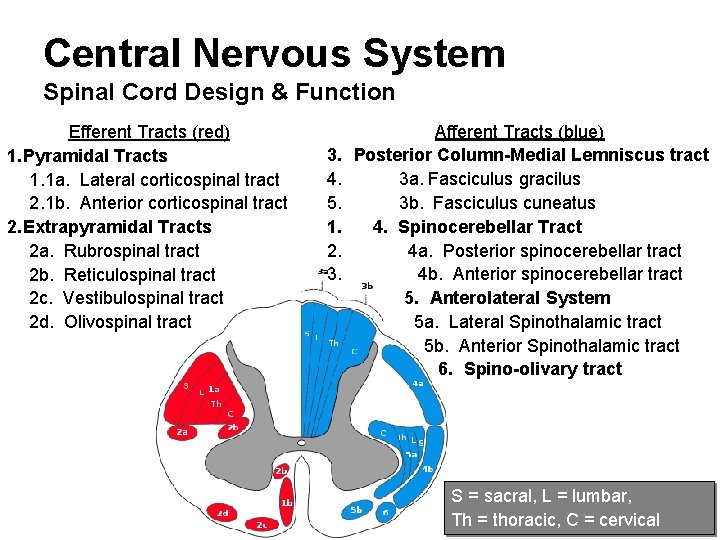
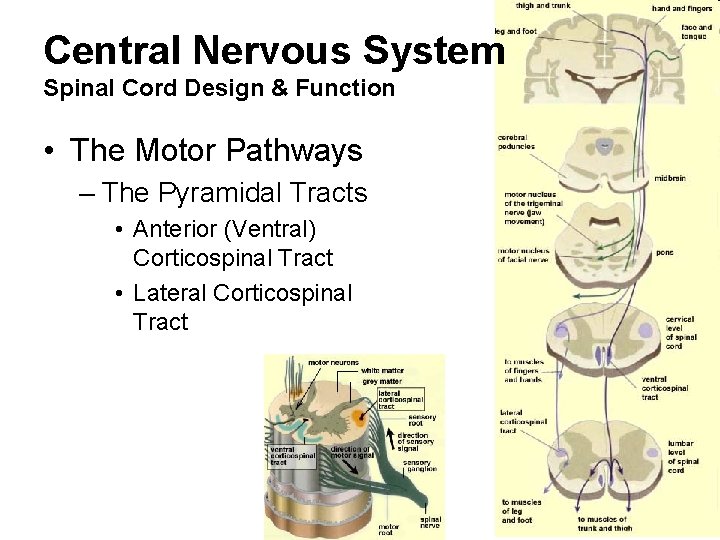
Central Nervous System Spinal Cord Design & Function Efferent Tracts (red) 1. Pyramidal Tracts 1. 1 a. Lateral corticospinal tract 2. 1 b. Anterior corticospinal tract 2. Extrapyramidal Tracts 2 a. Rubrospinal tract 2 b. Reticulospinal tract 2 c. Vestibulospinal tract 2 d. Olivospinal tract 3. 4. 5. 1. 2. 3. Afferent Tracts (blue) Posterior Column-Medial Lemniscus tract 3 a. Fasciculus gracilus 3 b. Fasciculus cuneatus 4. Spinocerebellar Tract 4 a. Posterior spinocerebellar tract 4 b. Anterior spinocerebellar tract 5. Anterolateral System 5 a. Lateral Spinothalamic tract 5 b. Anterior Spinothalamic tract 6. Spino-olivary tract S = sacral, L = lumbar, Th = thoracic, C = cervical
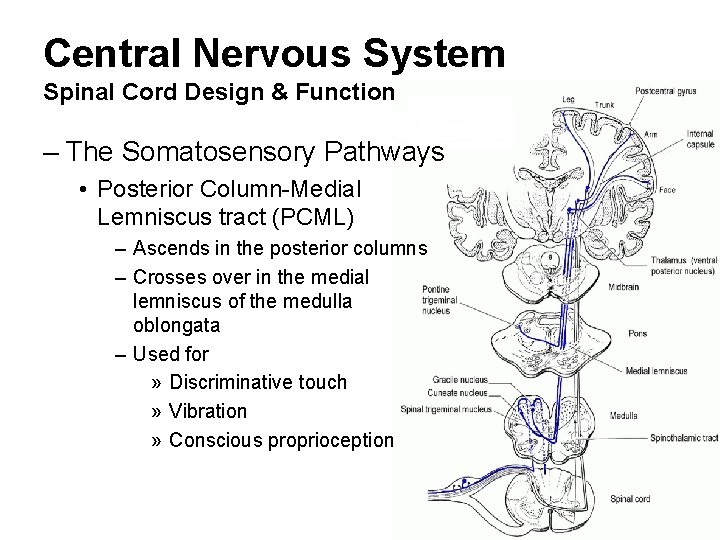
Central Nervous System Spinal Cord Design & Function – The Somatosensory Pathways • Posterior Column-Medial Lemniscus tract (PCML) – Ascends in the posterior columns – Crosses over in the medial lemniscus of the medulla oblongata – Used for » Discriminative touch » Vibration » Conscious proprioception
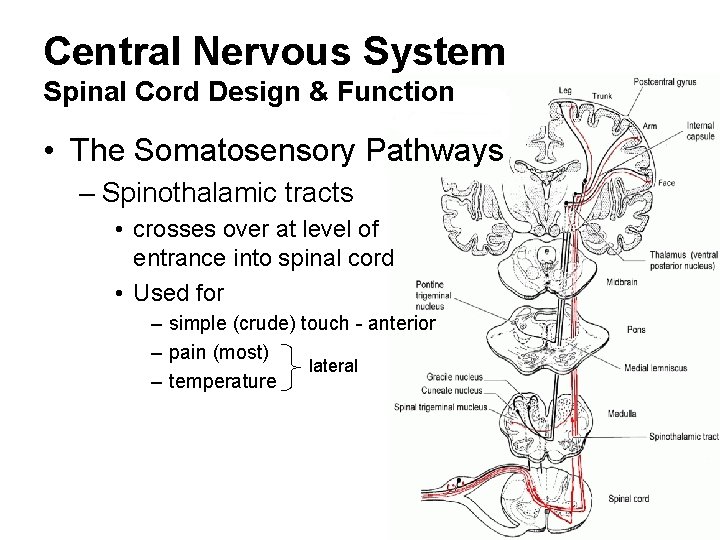
Central Nervous System Spinal Cord Design & Function • The Somatosensory Pathways – Spinothalamic tracts • crosses over at level of entrance into spinal cord • Used for – simple (crude) touch - anterior – pain (most) lateral – temperature
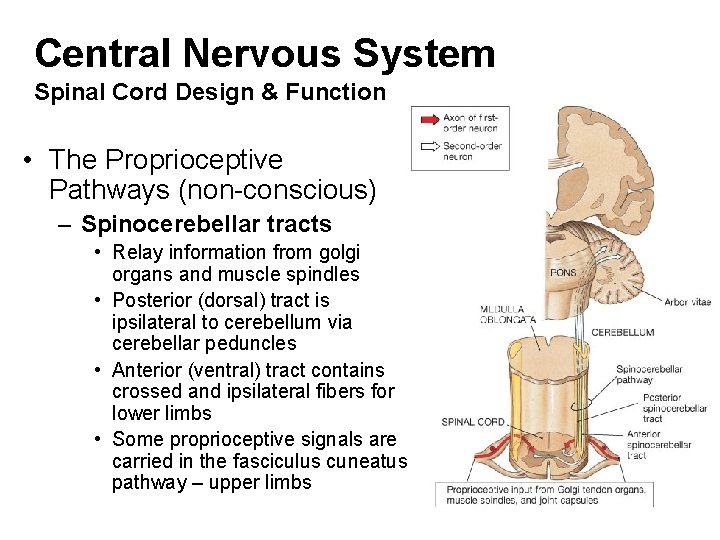
Central Nervous System Spinal Cord Design & Function • The Proprioceptive Pathways (non-conscious) – Spinocerebellar tracts • Relay information from golgi organs and muscle spindles • Posterior (dorsal) tract is ipsilateral to cerebellum via cerebellar peduncles • Anterior (ventral) tract contains crossed and ipsilateral fibers for lower limbs • Some proprioceptive signals are carried in the fasciculus cuneatus pathway – upper limbs
Central Nervous System Spinal Cord Design & Function • Spino-Olivary Tracts – Contains type Ib afferent sensory fibers • Originate from golgi tendon organs • Synapse in the olivary nucleus of medulla • 2 nd order neurons project to the cerebellum
Central Nervous System Spinal Cord Design & Function • The Motor Pathways – The Pyramidal Tracts • Anterior (Ventral) Corticospinal Tract • Lateral Corticospinal Tract
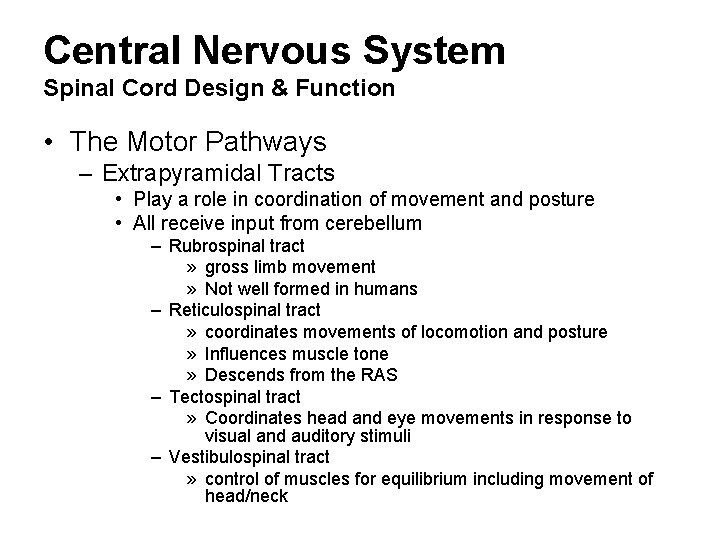
Central Nervous System Spinal Cord Design & Function • The Motor Pathways – Extrapyramidal Tracts • Play a role in coordination of movement and posture • All receive input from cerebellum – Rubrospinal tract » gross limb movement » Not well formed in humans – Reticulospinal tract » coordinates movements of locomotion and posture » Influences muscle tone » Descends from the RAS – Tectospinal tract » Coordinates head and eye movements in response to visual and auditory stimuli – Vestibulospinal tract » control of muscles for equilibrium including movement of head/neck
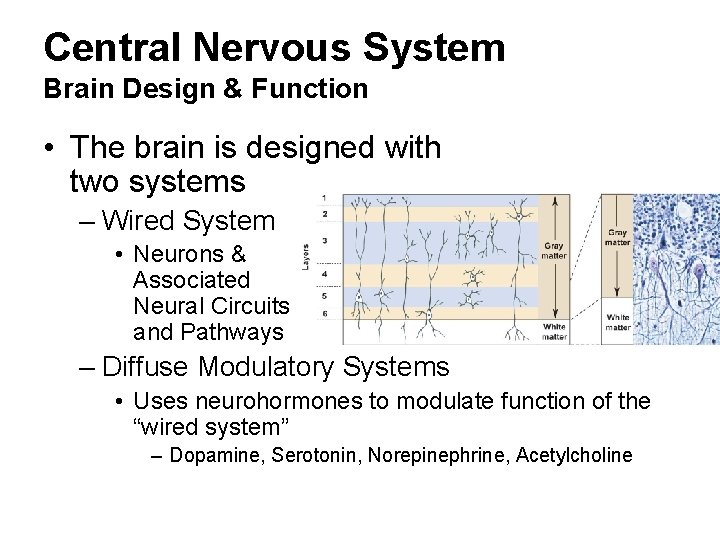
Central Nervous System Brain Design & Function • The brain is designed with two systems – Wired System • Neurons & Associated Neural Circuits and Pathways – Diffuse Modulatory Systems • Uses neurohormones to modulate function of the “wired system” – Dopamine, Serotonin, Norepinephrine, Acetylcholine
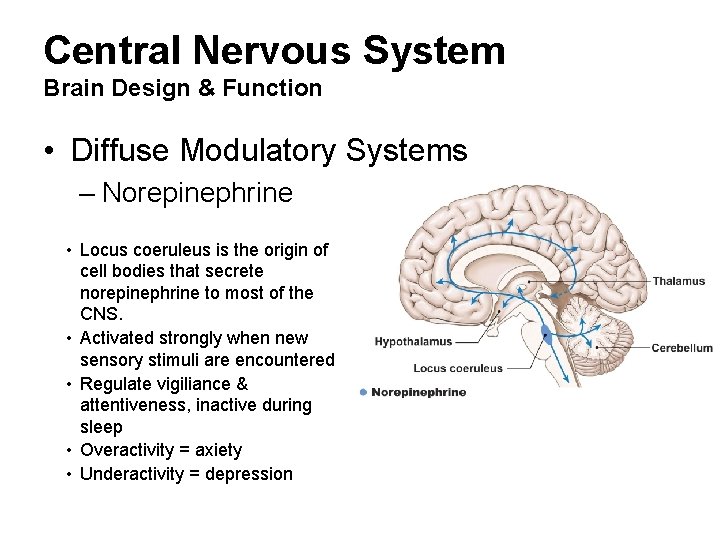
Central Nervous System Brain Design & Function • Diffuse Modulatory Systems – Norepinephrine • Locus coeruleus is the origin of cell bodies that secrete norepinephrine to most of the CNS. • Activated strongly when new sensory stimuli are encountered • Regulate vigiliance & attentiveness, inactive during sleep • Overactivity = axiety • Underactivity = depression
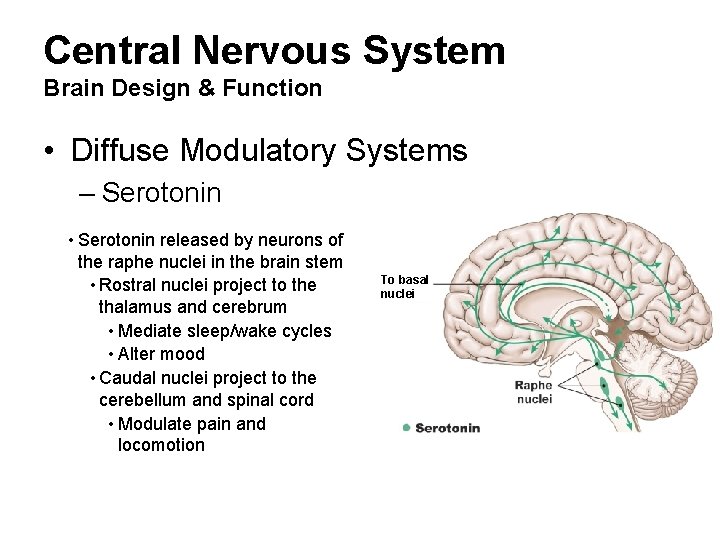
Central Nervous System Brain Design & Function • Diffuse Modulatory Systems – Serotonin • Serotonin released by neurons of the raphe nuclei in the brain stem • Rostral nuclei project to the thalamus and cerebrum • Mediate sleep/wake cycles • Alter mood • Caudal nuclei project to the cerebellum and spinal cord • Modulate pain and locomotion To basal nuclei
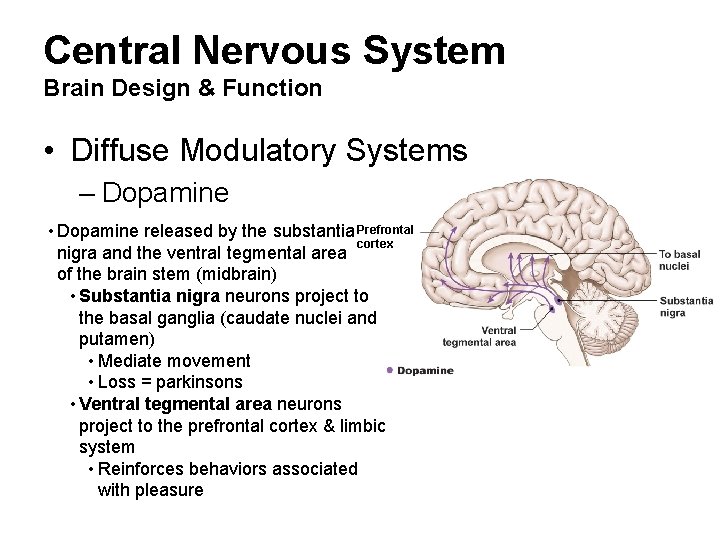
Central Nervous System Brain Design & Function • Diffuse Modulatory Systems – Dopamine • Dopamine released by the substantia Prefrontal cortex nigra and the ventral tegmental area of the brain stem (midbrain) • Substantia nigra neurons project to the basal ganglia (caudate nuclei and putamen) • Mediate movement • Loss = parkinsons • Ventral tegmental area neurons project to the prefrontal cortex & limbic system • Reinforces behaviors associated with pleasure
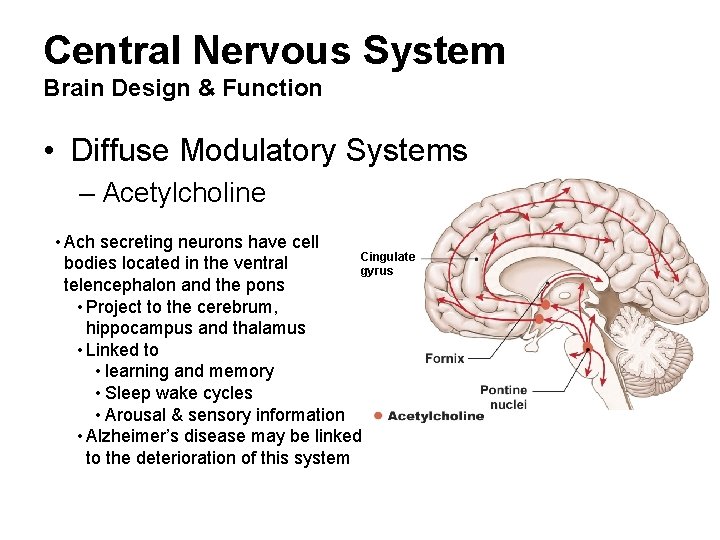
Central Nervous System Brain Design & Function • Diffuse Modulatory Systems – Acetylcholine • Ach secreting neurons have cell Cingulate bodies located in the ventral gyrus telencephalon and the pons • Project to the cerebrum, hippocampus and thalamus • Linked to • learning and memory • Sleep wake cycles • Arousal & sensory information • Alzheimer’s disease may be linked to the deterioration of this system
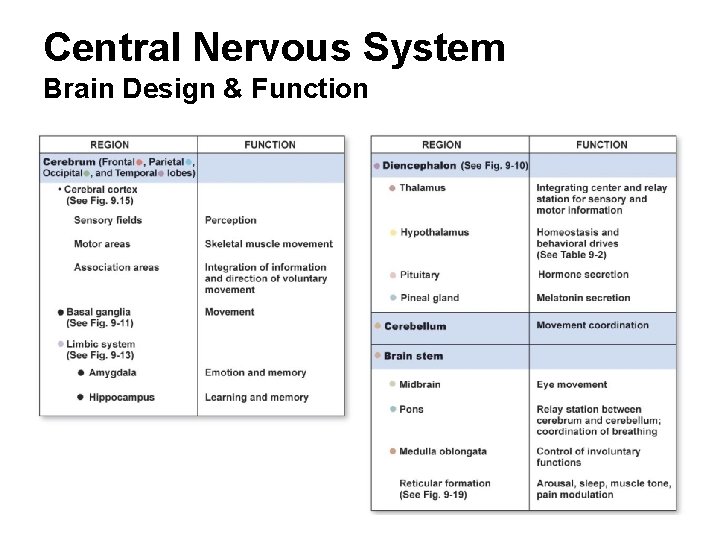
Central Nervous System Brain Design & Function
Central Nervous System Brain Design & Function • So… how does the brain “do” things? – Create voluntary movements – Forming Memories – Communication: thought → expression – Idea of “self” or consciousness – Create emotions – Experience pain & pleasure – Go to sleep & wake up
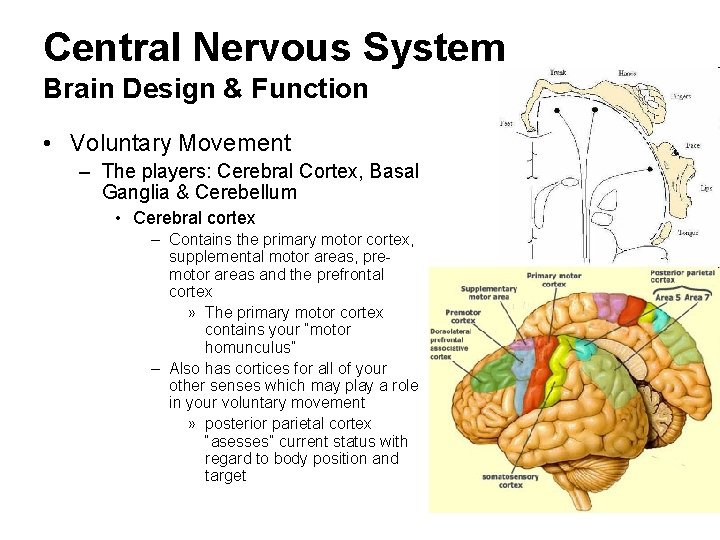
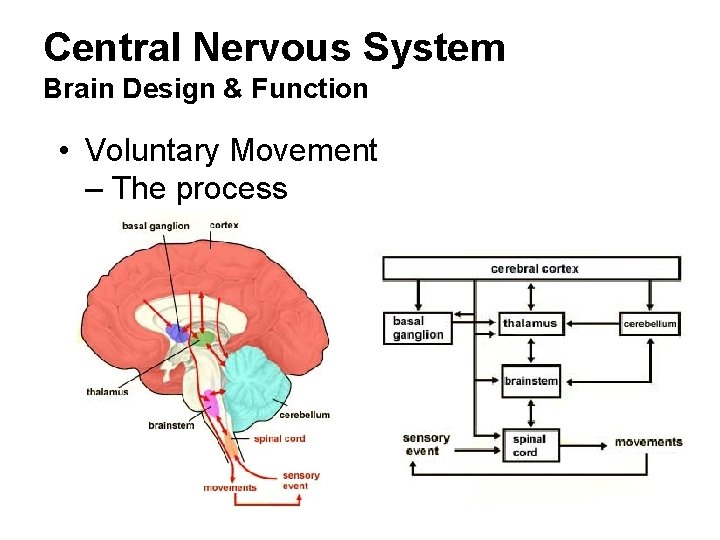
Central Nervous System Brain Design & Function • Voluntary Movement – The players: Cerebral Cortex, Basal Ganglia & Cerebellum • Cerebral cortex – Contains the primary motor cortex, supplemental motor areas, premotor areas and the prefrontal cortex » The primary motor cortex contains your “motor homunculus” – Also has cortices for all of your other senses which may play a role in your voluntary movement » posterior parietal cortex “asesses” current status with regard to body position and target
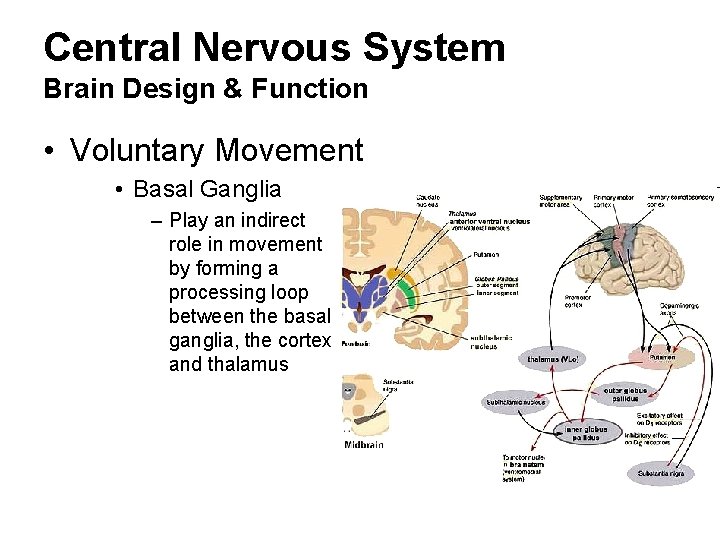
Central Nervous System Brain Design & Function • Voluntary Movement • Basal Ganglia – Play an indirect role in movement by forming a processing loop between the basal ganglia, the cortex and thalamus
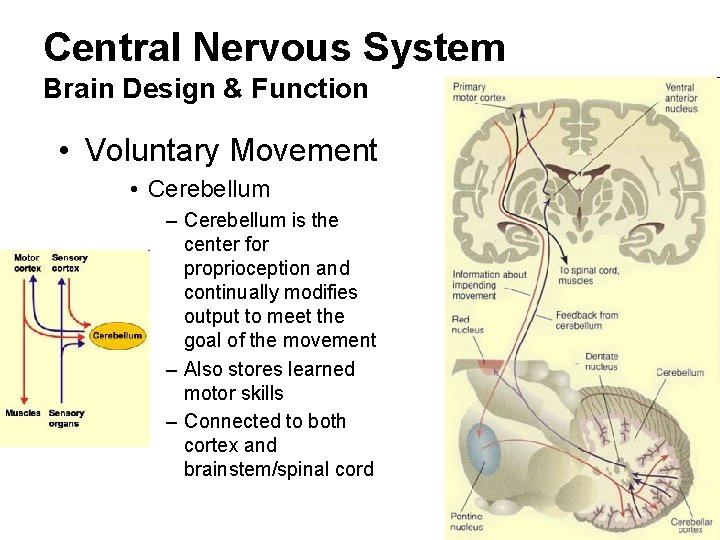
Central Nervous System Brain Design & Function • Voluntary Movement • Cerebellum – Cerebellum is the center for proprioception and continually modifies output to meet the goal of the movement – Also stores learned motor skills – Connected to both cortex and brainstem/spinal cord
Central Nervous System Brain Design & Function • Voluntary Movement – The process
Central Nervous System Brain Design & Function • Learning – Process in the brain differs depending on the type of learning • Episodic memory – Allows you to remember events and occurrences – goes through the hippocampus » Altered by state of mind » Capable of making your own “truth” • Spatial memory – Strictly located on the hippocampus and on the right side – Creates a mental map of space • Procedural memory – processed in the cerebellum • Emotional memory – Involves the amygdala – Often tied to intense emotional events
Central Nervous System Brain Design & Function • Learning – So how does all that occur? • Formation of neural networks/circuits • The more they are used – The more “permanent” they become! • Integration with other events, memories – Consolidation! – How does a person with no sight, or no hearing, or no sense of touch, or…. Learn? – Did Helen Keller's have a different “wiring” of neural circuits?
Next Time… • Peripheral Nervous System