
CENTRAL NERVOUS SYSTEM DIENCEPHALON 1 Dr Aiman Q
- Slides: 26
CENTRAL NERVOUS SYSTEM DIENCEPHALON 1 Dr. Aiman Q. Afar Surgical Anatomist College of Medicine / University of Mutah 5 December 2019 Dr. Aiman Q. Afar 1
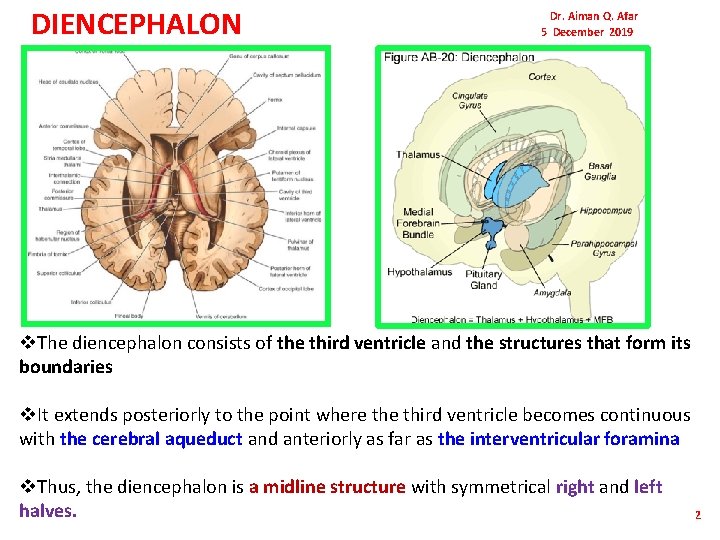
DIENCEPHALON Dr. Aiman Q. Afar 5 December 2019 v. The diencephalon consists of the third ventricle and the structures that form its boundaries v. It extends posteriorly to the point where third ventricle becomes continuous with the cerebral aqueduct and anteriorly as far as the interventricular foramina v. Thus, the diencephalon is a midline structure with symmetrical right and left halves. 2
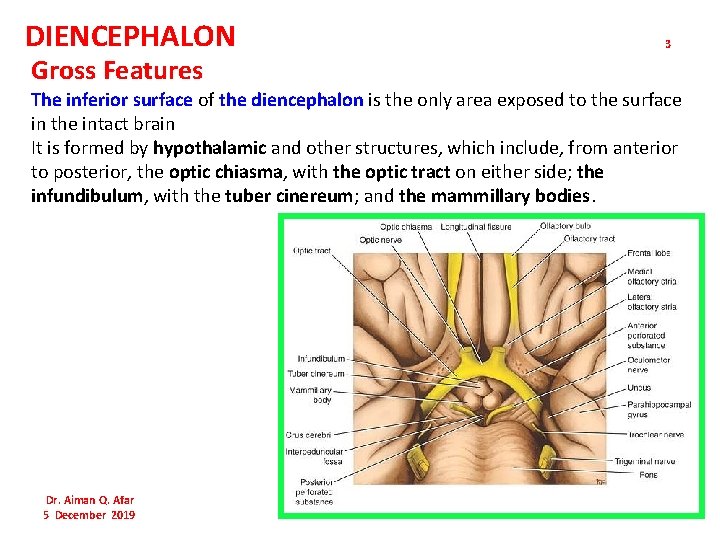
DIENCEPHALON 3 Gross Features The inferior surface of the diencephalon is the only area exposed to the surface in the intact brain It is formed by hypothalamic and other structures, which include, from anterior to posterior, the optic chiasma, with the optic tract on either side; the infundibulum, with the tuber cinereum; and the mammillary bodies. Dr. Aiman Q. Afar 5 December 2019
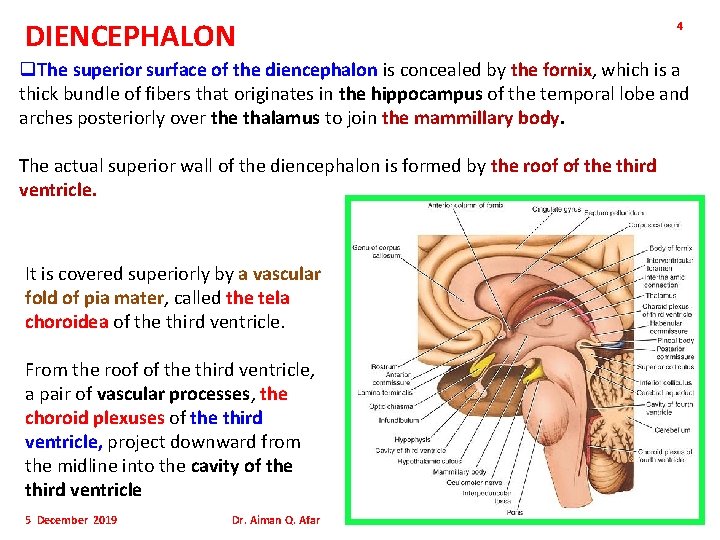
DIENCEPHALON 4 q. The superior surface of the diencephalon is concealed by the fornix, which is a thick bundle of fibers that originates in the hippocampus of the temporal lobe and arches posteriorly over the thalamus to join the mammillary body. The actual superior wall of the diencephalon is formed by the roof of the third ventricle. It is covered superiorly by a vascular fold of pia mater, called the tela choroidea of the third ventricle. From the roof of the third ventricle, a pair of vascular processes, the choroid plexuses of the third ventricle, project downward from the midline into the cavity of the third ventricle 5 December 2019 Dr. Aiman Q. Afar
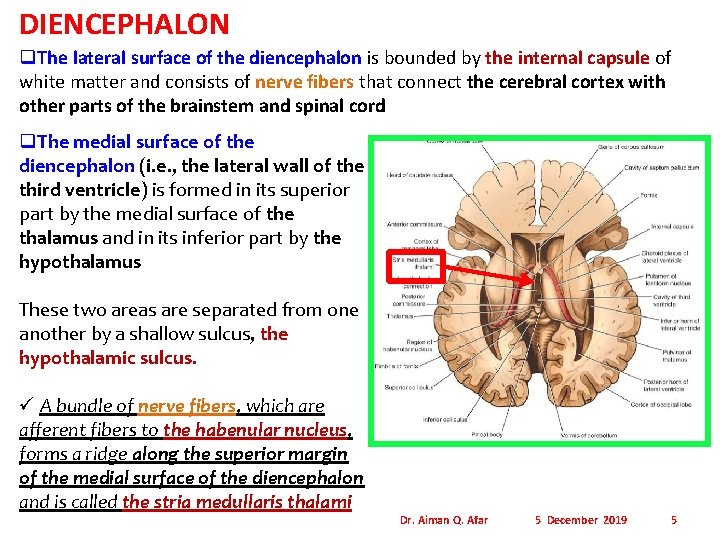
DIENCEPHALON q. The lateral surface of the diencephalon is bounded by the internal capsule of white matter and consists of nerve fibers that connect the cerebral cortex with other parts of the brainstem and spinal cord q. The medial surface of the diencephalon (i. e. , the lateral wall of the third ventricle) is formed in its superior part by the medial surface of the thalamus and in its inferior part by the hypothalamus These two areas are separated from one another by a shallow sulcus, the hypothalamic sulcus. ü A bundle of nerve fibers, which are afferent fibers to the habenular nucleus, forms a ridge along the superior margin of the medial surface of the diencephalon and is called the stria medullaris thalami Dr. Aiman Q. Afar 5 December 2019 5
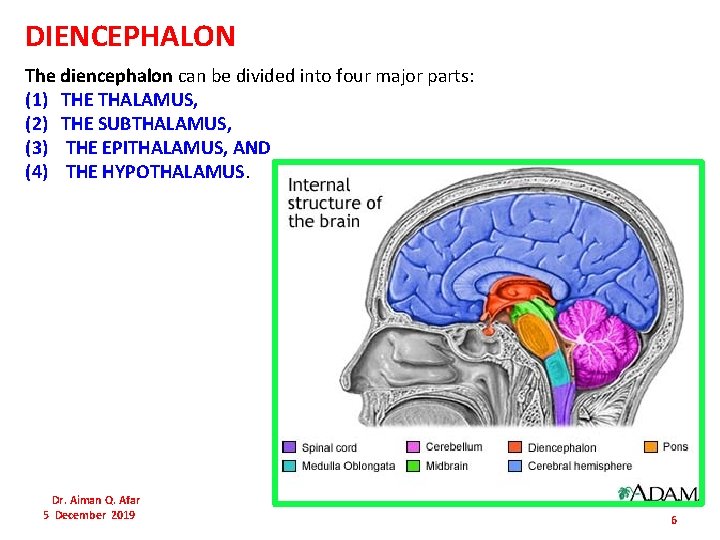
DIENCEPHALON The diencephalon can be divided into four major parts: (1) THE THALAMUS, (2) THE SUBTHALAMUS, (3) THE EPITHALAMUS, AND (4) THE HYPOTHALAMUS. Dr. Aiman Q. Afar 5 December 2019 6
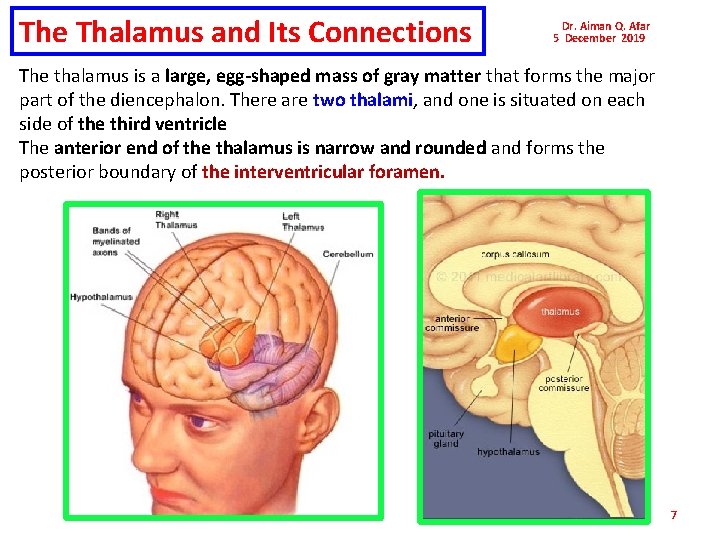
The Thalamus and Its Connections Dr. Aiman Q. Afar 5 December 2019 The thalamus is a large, egg-shaped mass of gray matter that forms the major part of the diencephalon. There are two thalami, and one is situated on each side of the third ventricle The anterior end of the thalamus is narrow and rounded and forms the posterior boundary of the interventricular foramen. 7
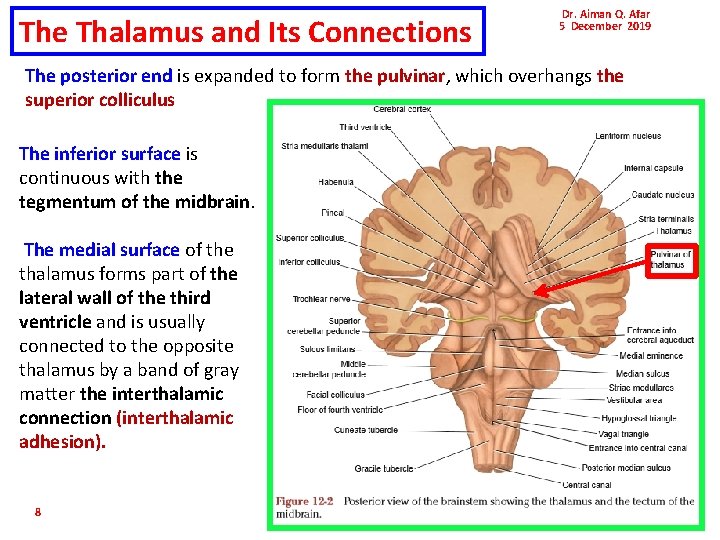
The Thalamus and Its Connections Dr. Aiman Q. Afar 5 December 2019 The posterior end is expanded to form the pulvinar, which overhangs the superior colliculus The inferior surface is continuous with the tegmentum of the midbrain. The medial surface of the thalamus forms part of the lateral wall of the third ventricle and is usually connected to the opposite thalamus by a band of gray matter the interthalamic connection (interthalamic adhesion). 8
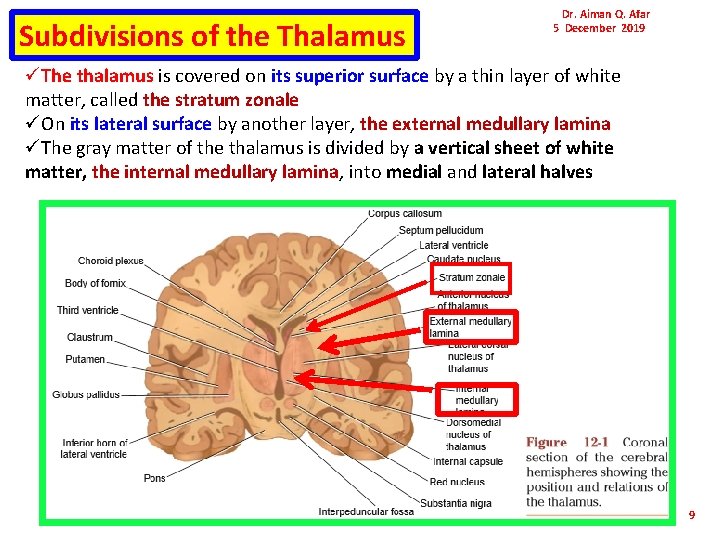
Subdivisions of the Thalamus Dr. Aiman Q. Afar 5 December 2019 üThe thalamus is covered on its superior surface by a thin layer of white matter, called the stratum zonale üOn its lateral surface by another layer, the external medullary lamina üThe gray matter of the thalamus is divided by a vertical sheet of white matter, the internal medullary lamina, into medial and lateral halves 9
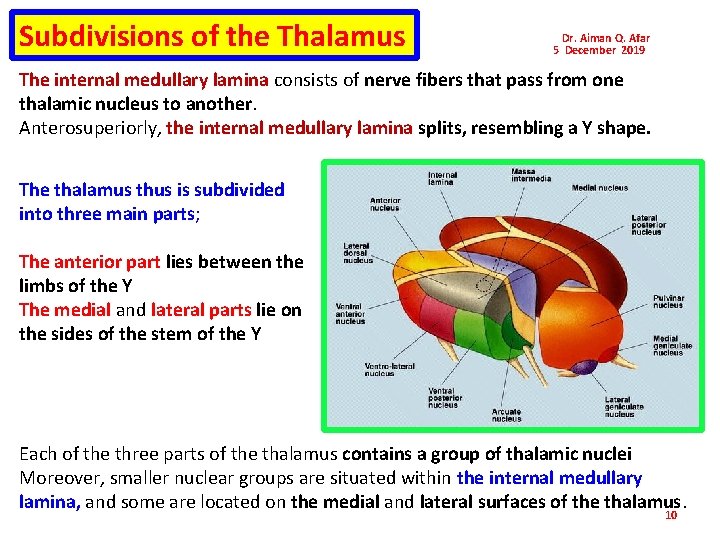
Subdivisions of the Thalamus Dr. Aiman Q. Afar 5 December 2019 The internal medullary lamina consists of nerve fibers that pass from one thalamic nucleus to another. Anterosuperiorly, the internal medullary lamina splits, resembling a Y shape. The thalamus thus is subdivided into three main parts; The anterior part lies between the limbs of the Y The medial and lateral parts lie on the sides of the stem of the Y Each of the three parts of the thalamus contains a group of thalamic nuclei Moreover, smaller nuclear groups are situated within the internal medullary lamina, and some are located on the medial and lateral surfaces of the thalamus. 10
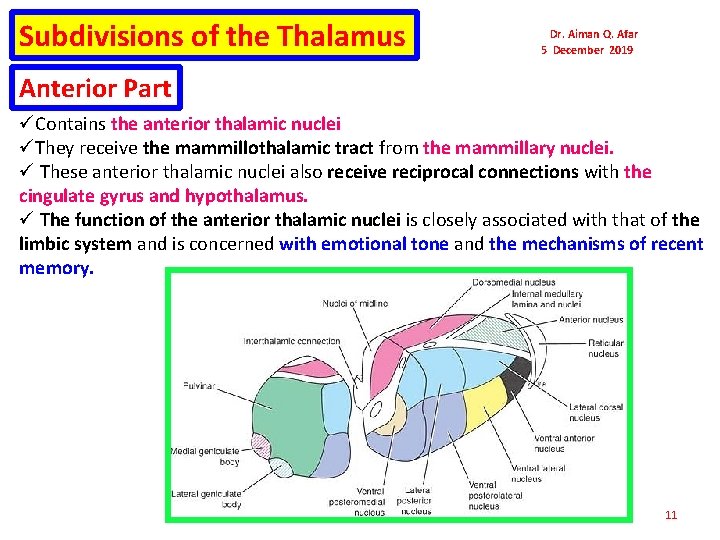
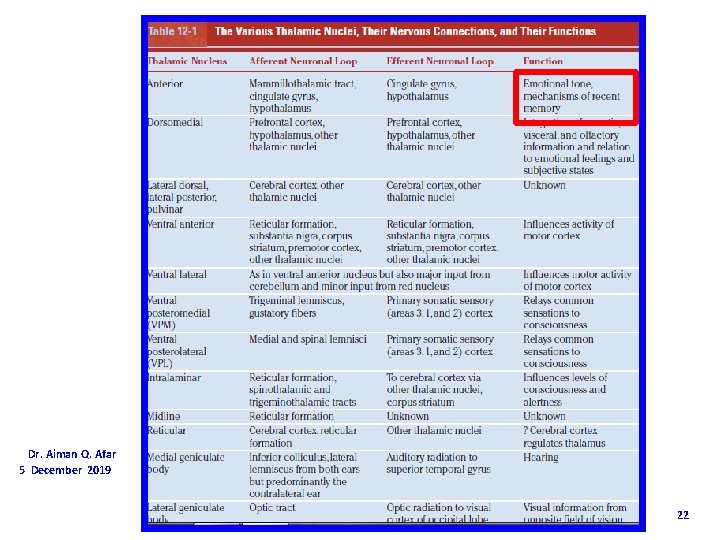
Subdivisions of the Thalamus Dr. Aiman Q. Afar 5 December 2019 Anterior Part üContains the anterior thalamic nuclei üThey receive the mammillothalamic tract from the mammillary nuclei. ü These anterior thalamic nuclei also receive reciprocal connections with the cingulate gyrus and hypothalamus. ü The function of the anterior thalamic nuclei is closely associated with that of the limbic system and is concerned with emotional tone and the mechanisms of recent memory. 11
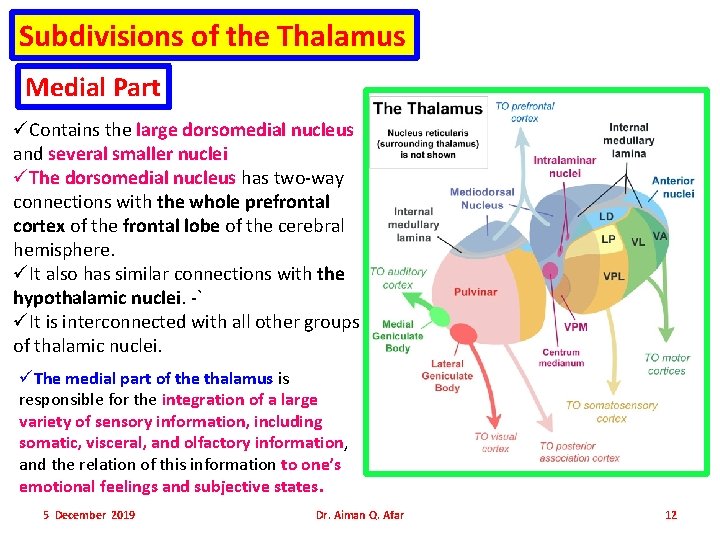
Subdivisions of the Thalamus Medial Part üContains the large dorsomedial nucleus and several smaller nuclei üThe dorsomedial nucleus has two-way connections with the whole prefrontal cortex of the frontal lobe of the cerebral hemisphere. üIt also has similar connections with the hypothalamic nuclei. -` üIt is interconnected with all other groups of thalamic nuclei. üThe medial part of the thalamus is responsible for the integration of a large variety of sensory information, including somatic, visceral, and olfactory information, and the relation of this information to one’s emotional feelings and subjective states. 5 December 2019 Dr. Aiman Q. Afar 12
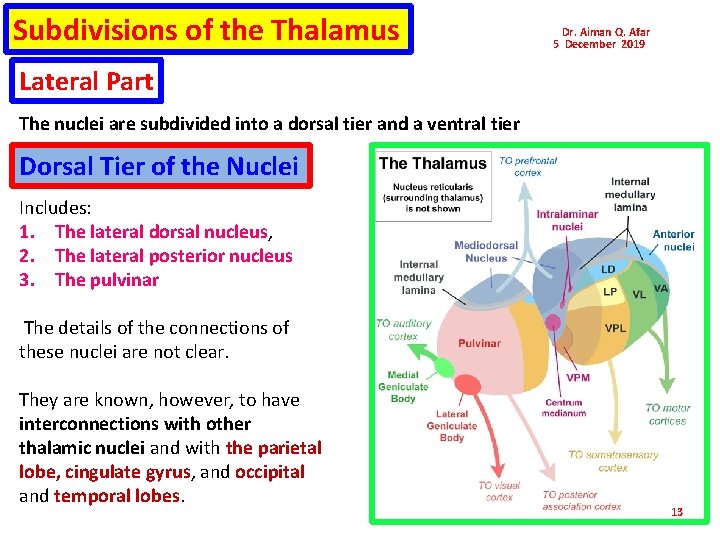
Subdivisions of the Thalamus Dr. Aiman Q. Afar 5 December 2019 Lateral Part The nuclei are subdivided into a dorsal tier and a ventral tier Dorsal Tier of the Nuclei Includes: 1. The lateral dorsal nucleus, 2. The lateral posterior nucleus 3. The pulvinar The details of the connections of these nuclei are not clear. They are known, however, to have interconnections with other thalamic nuclei and with the parietal lobe, cingulate gyrus, and occipital and temporal lobes. 13
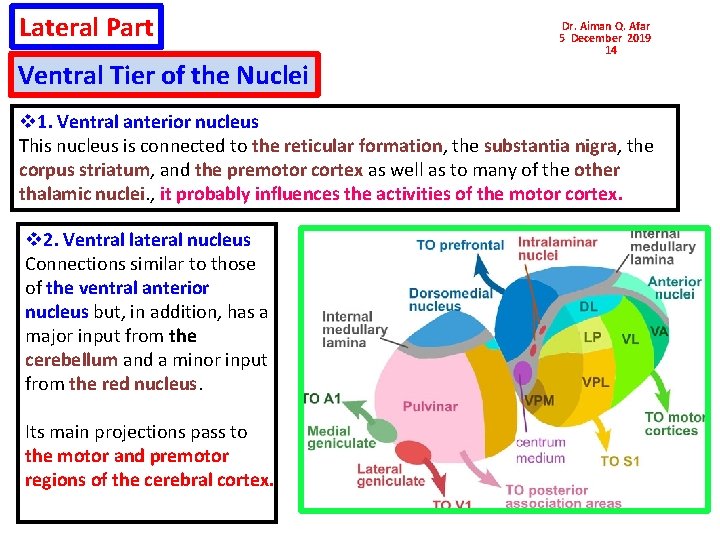
Lateral Part Ventral Tier of the Nuclei Dr. Aiman Q. Afar 5 December 2019 14 v 1. Ventral anterior nucleus This nucleus is connected to the reticular formation, the substantia nigra, the corpus striatum, and the premotor cortex as well as to many of the other thalamic nuclei. , it probably influences the activities of the motor cortex. v 2. Ventral lateral nucleus Connections similar to those of the ventral anterior nucleus but, in addition, has a major input from the cerebellum and a minor input from the red nucleus. Its main projections pass to the motor and premotor regions of the cerebral cortex.
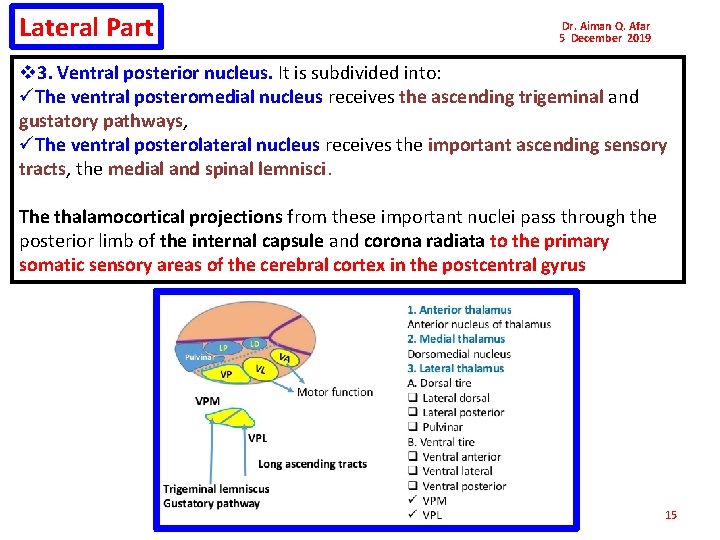
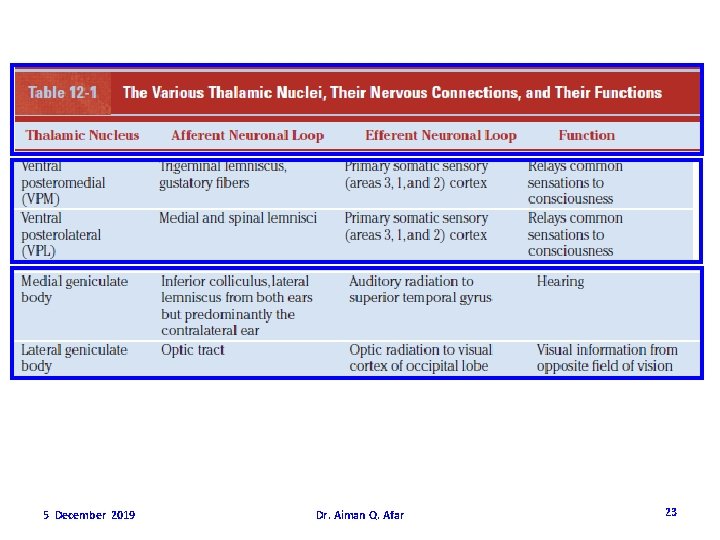
Lateral Part Dr. Aiman Q. Afar 5 December 2019 v 3. Ventral posterior nucleus. It is subdivided into: üThe ventral posteromedial nucleus receives the ascending trigeminal and gustatory pathways, üThe ventral posterolateral nucleus receives the important ascending sensory tracts, the medial and spinal lemnisci. The thalamocortical projections from these important nuclei pass through the posterior limb of the internal capsule and corona radiata to the primary somatic sensory areas of the cerebral cortex in the postcentral gyrus 15
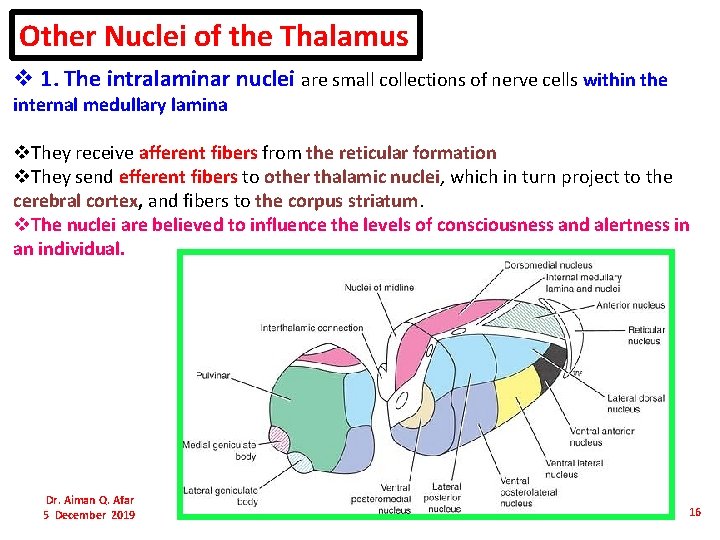
Other Nuclei of the Thalamus v 1. The intralaminar nuclei are small collections of nerve cells within the internal medullary lamina v. They receive afferent fibers from the reticular formation v. They send efferent fibers to other thalamic nuclei, which in turn project to the cerebral cortex, and fibers to the corpus striatum. v. The nuclei are believed to influence the levels of consciousness and alertness in an individual. Dr. Aiman Q. Afar 5 December 2019 16
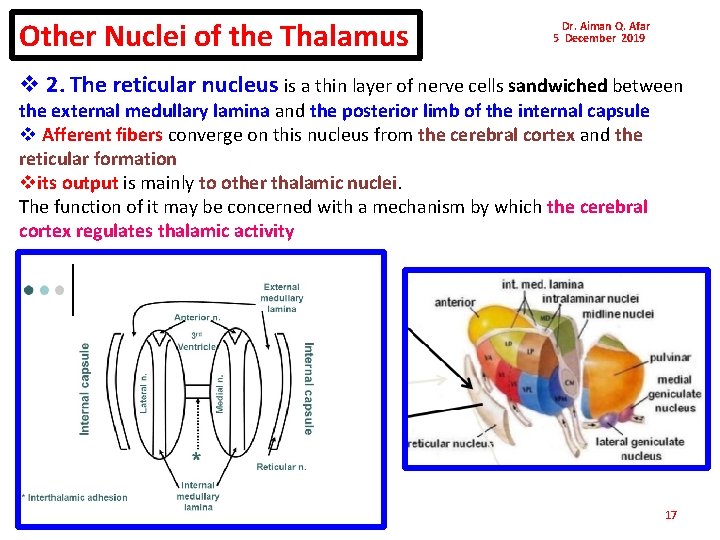
Other Nuclei of the Thalamus Dr. Aiman Q. Afar 5 December 2019 v 2. The reticular nucleus is a thin layer of nerve cells sandwiched between the external medullary lamina and the posterior limb of the internal capsule v Afferent fibers converge on this nucleus from the cerebral cortex and the reticular formation vits output is mainly to other thalamic nuclei. The function of it may be concerned with a mechanism by which the cerebral cortex regulates thalamic activity 17
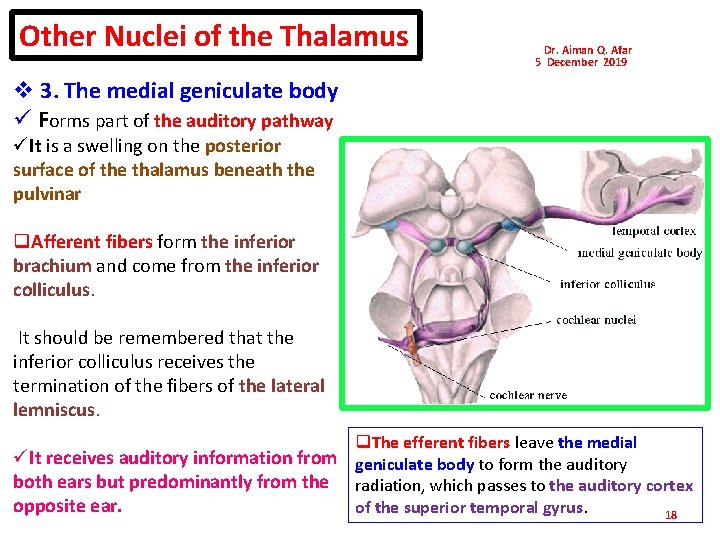
Other Nuclei of the Thalamus Dr. Aiman Q. Afar 5 December 2019 v 3. The medial geniculate body ü Forms part of the auditory pathway üIt is a swelling on the posterior surface of the thalamus beneath the pulvinar q. Afferent fibers form the inferior brachium and come from the inferior colliculus. It should be remembered that the inferior colliculus receives the termination of the fibers of the lateral lemniscus. q. The efferent fibers leave the medial üIt receives auditory information from geniculate body to form the auditory both ears but predominantly from the radiation, which passes to the auditory cortex opposite ear. of the superior temporal gyrus. 18
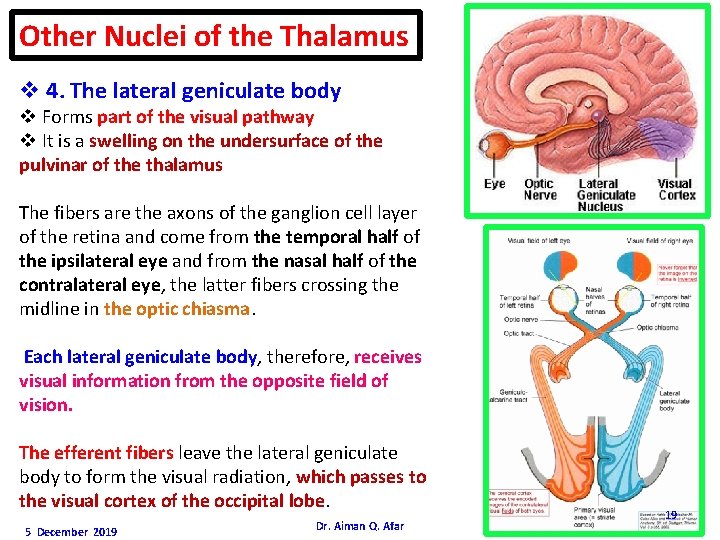
Other Nuclei of the Thalamus v 4. The lateral geniculate body v Forms part of the visual pathway v It is a swelling on the undersurface of the pulvinar of the thalamus The fibers are the axons of the ganglion cell layer of the retina and come from the temporal half of the ipsilateral eye and from the nasal half of the contralateral eye, the latter fibers crossing the midline in the optic chiasma. Each lateral geniculate body, therefore, receives visual information from the opposite field of vision. The efferent fibers leave the lateral geniculate body to form the visual radiation, which passes to the visual cortex of the occipital lobe. 5 December 2019 Dr. Aiman Q. Afar 19
Function of the Thalamus The following basic principles should be committed to memory: q The thalamus is made up of complicated collections of nerve cells that are centrally placed in the brain and are interconnected. q It is the secondary order neuron of all sensation from the body (except smell sensation). converges on the thalamus and presumably is integrated through the interconnections between the nuclei. q It is interposed between the cerebral cortex, cerebellum, hypothalamus and basal ganglia. 5 December 2019 Dr. Aiman Q. Afar 20
Function of the Thalamus q Anatomically and functionally, the thalamus and the cerebral cortex are closely linked. It integrates, spreads and diffuses the impulses to the cortical and subcortical areas. The cerebral cortex is required for the interpretation of sensations based on past experiences. For example, if the sensory cortex is destroyed, one can still appreciate the presence of a hot object in the hand; however, appreciation of the shape, weight, and exact temperature of the object would be impaired. q. The intralaminar nuclei are closely connected with the activities of the reticular formation, and they receive much of their information from this source. Their strategic position enables them to control the level of overall activity of the cerebral cortex. q The intralaminar nuclei are thus able to influence the levels of consciousness and alertness in an individual. 5 December 2019 Dr. Aiman Q. Afar 21
Dr. Aiman Q. Afar 5 December 2019 22
5 December 2019 Dr. Aiman Q. Afar 23
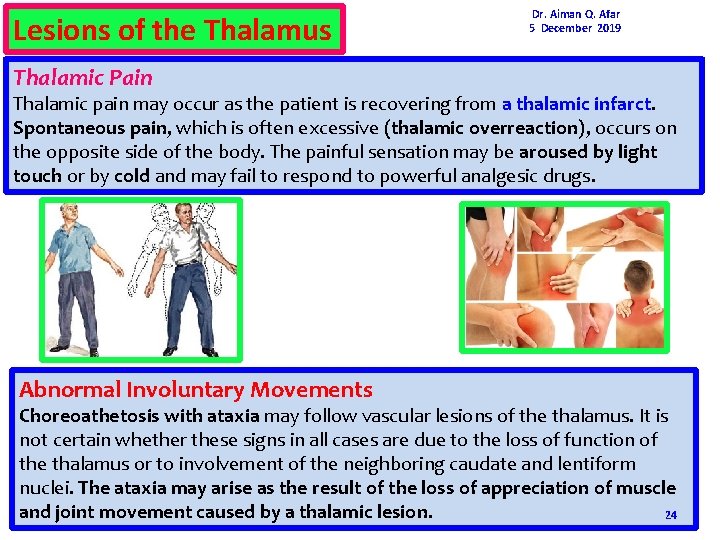
Lesions of the Thalamus Dr. Aiman Q. Afar 5 December 2019 Thalamic Pain Thalamic pain may occur as the patient is recovering from a thalamic infarct. Spontaneous pain, which is often excessive (thalamic overreaction), occurs on the opposite side of the body. The painful sensation may be aroused by light touch or by cold and may fail to respond to powerful analgesic drugs. Abnormal Involuntary Movements Choreoathetosis with ataxia may follow vascular lesions of the thalamus. It is not certain whether these signs in all cases are due to the loss of function of the thalamus or to involvement of the neighboring caudate and lentiform nuclei. The ataxia may arise as the result of the loss of appreciation of muscle and joint movement caused by a thalamic lesion. 24
Lesions of the Thalamus Dr. Aiman Q. Afar 5 December 2019 Sensory Loss These lesions usually result from thrombosis or hemorrhage of one of the arteries supplying the thalamus. Damage to the ventral posteromedial nucleus and the ventral posterolateral nucleus will result in the loss of all forms of sensation, including light touch, tactile localization and discrimination, and muscle joint sense from the opposite side of the body Surgical Relief of Pain by Thalamic Cauterization The intralaminar nuclei of the thalamus are known to take part in the relay of pain to the cerebral cortex. Cauterization of these nuclei has been shown to relieve severe and intractable pain associated with terminal cancer. 25
Dr. Aiman Q. Afar 5 December 2019 26