
Central Johannesburg TVET College Strategic Plan 2020 2024

Central Johannesburg TVET College Strategic Plan 2020 – 2024 Presentation: Focus on Strategies and Interventions Parliament Portfolio Committee on Higher Education, Science and Technology 11 March 2020 Parliament of the Republic of South Africa Committee Room E 249
Contents 1. Background to Central Johannesburg TVET College 2. Names of Campuses 3. Geographical location of Campuses. 4. Status of Central Johannesburg TVET College 5. Governance Structure 6. Management Structure 7. Registration 2020 8. Teaching and Learning 9. Student Accommodation 10. Linkages and Partnerships 11. State of Finances 12. Disbursement of NSFAS 13. Achievements 14. Challenges 15. Staff on Precautionary Transfer / Suspension 16. Conclusion 2
Background to the Central Johannesburg TVET College The Central Johannesburg TVET College was established through the General Notice, 7311 of 2001 which enabled the merger of FIVE former Further Education and Training Colleges. This was implemented with effect from 1 January 2002. 3
Name of Campuses 1. 2. 3. 4. 5. 6. 7. 8. Alexandra Campus Crown Mines Campus Ellispark Campus Langlaagte Campus Parktown Campus Riverlea Campus Smit Street Campus Troyeville Campus All Campuses are within a 15 km radius from the Central Office (5 Ubla Road, Parktown). 4

Geographical Location of Campuses
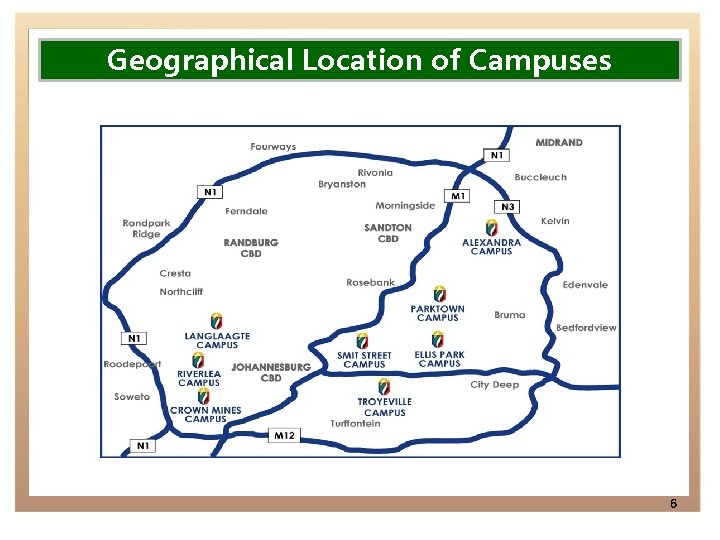
Geographical Location of Campuses 6
Status of Central Johannesburg TVET College (CJC)

Status of CJC The Central Johannesburg TVET College was officially placed under Administration by the former Minister of Higher Education and Training, Dr N Pandor. PE Kedama assumed his responsibility as the Administrator on 06 May 2019. This was done in line with the Continuing Education and Training Act (CET Act 16 of 2006) (as amended) clause 46 (1) – (6). 8

Status of CJC (Cont. ) Some of the reasons that led to the College being placed under administration, after the commissioned phase 1 investigation, amongst other things included: • Poor governance • Lack of internal controls • Qualified audit outcomes • Continuous students and community protests that are disrupting teaching and learning • A number of disruptions emanating from staff members due to various issues, etc. 9

Governance
Governance As per the CET Act (Act 16 of 2006) (Chapter 3 – Clause 9) any Public Technical and Vocational Education and Training College must have the following: 1. College Council (i. e. Administrator in this instance) 2. Academic Board 3. Student Representative Council Academic Board • The established Board had its 1 st meeting on the 29 th of January 2020. • Comprised of external member from Wits University to strengthen academic delivery and forge partnerships • UJ also being approached for participation 11
Governance (Cont. ) Student Representative Council (SRC) • The SRC was established in July 2019, amidst strong resistance, given that previous attempts (before administration) had failed. • Inducted and worked well with management • Improved communication with student population in the college 12
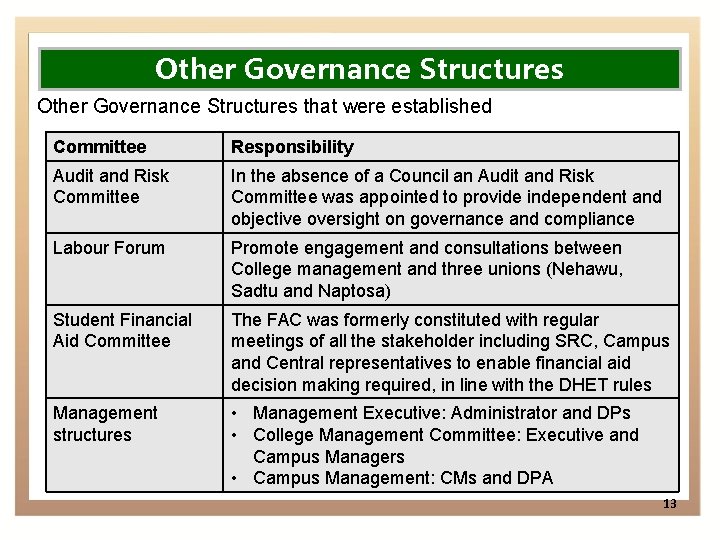
Other Governance Structures that were established Committee Responsibility Audit and Risk Committee In the absence of a Council an Audit and Risk Committee was appointed to provide independent and objective oversight on governance and compliance Labour Forum Promote engagement and consultations between College management and three unions (Nehawu, Sadtu and Naptosa) Student Financial Aid Committee The FAC was formerly constituted with regular meetings of all the stakeholder including SRC, Campus and Central representatives to enable financial aid decision making required, in line with the DHET rules Management structures • Management Executive: Administrator and DPs • College Management Committee: Executive and Campus Managers • Campus Management: CMs and DPA 13
Management Structure

Management Structure Principal Deputy Principal: Corporate Services* Deputy Principal: Finance * The only permanently appointed Deputy Principal at start of Administration. Deputy Principal: Academic Affairs 8 x Campus Managers 15

Registration 2020
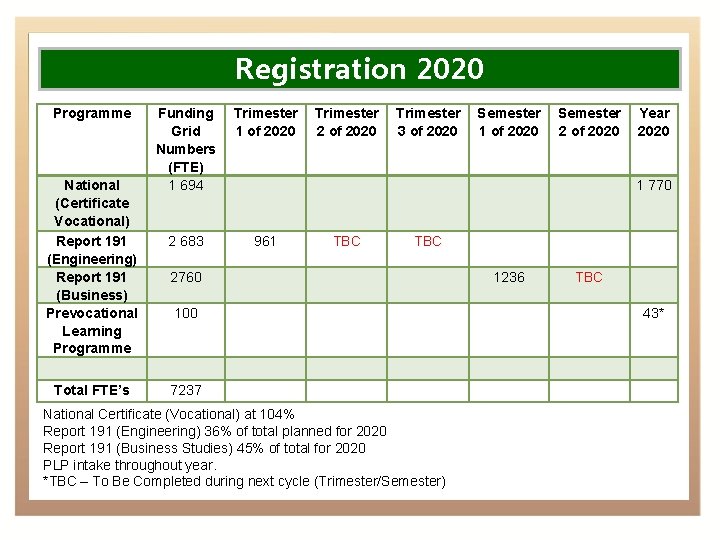
Registration 2020 Programme National (Certificate Vocational) Report 191 (Engineering) Report 191 (Business) Prevocational Learning Programme Total FTE’s Funding Grid Numbers (FTE) 1 694 Trimester 1 of 2020 2 683 961 Trimester 2 of 2020 Trimester 3 of 2020 Semester 1 of 2020 Semester 2 of 2020 Year 2020 1 770 TBC 2760 100 7237 National Certificate (Vocational) at 104% Report 191 (Engineering) 36% of total planned for 2020 Report 191 (Business Studies) 45% of total for 2020 PLP intake throughout year. *TBC – To Be Completed during next cycle (Trimester/Semester) 1236 TBC 43*

Teaching and Learning
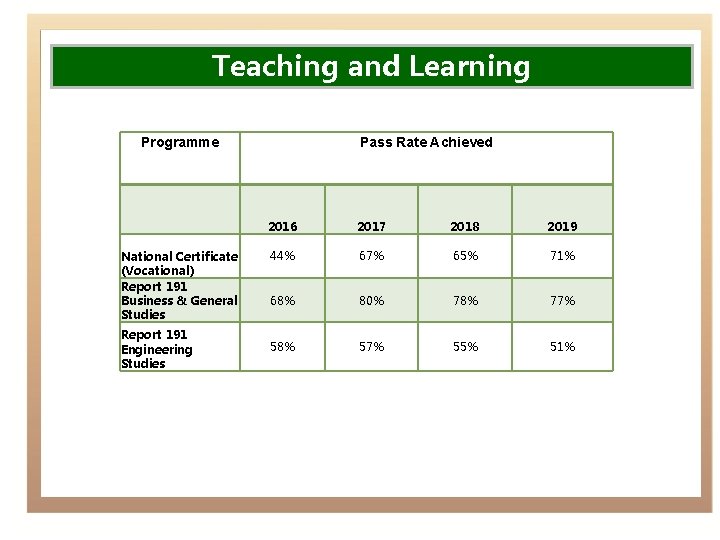
Teaching and Learning Programme National Certificate (Vocational) Report 191 Business & General Studies Report 191 Engineering Studies Pass Rate Achieved 2016 2017 2018 2019 44% 67% 65% 71% 68% 80% 78% 77% 58% 57% 55% 51%

Student Accommodation
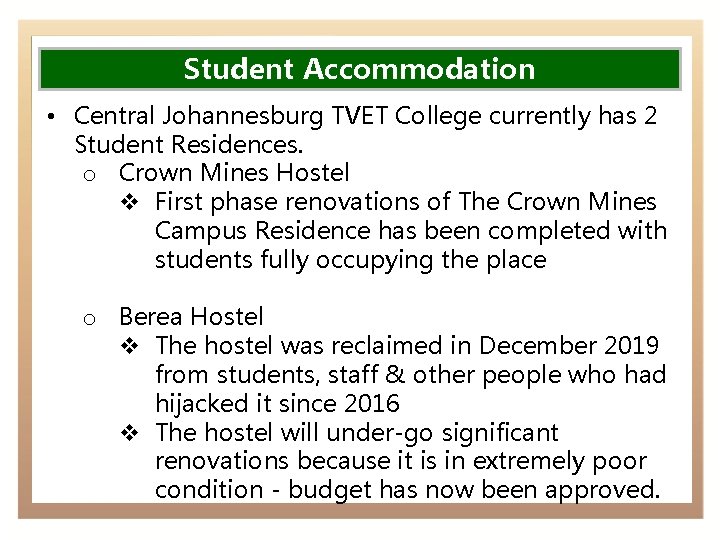
Student Accommodation • Central Johannesburg TVET College currently has 2 Student Residences. o Crown Mines Hostel v First phase renovations of The Crown Mines Campus Residence has been completed with students fully occupying the place o Berea Hostel v The hostel was reclaimed in December 2019 from students, staff & other people who had hijacked it since 2016 v The hostel will under-go significant renovations because it is in extremely poor condition - budget has now been approved.

Linkages & Partnerships
Linkages & Partnerships • Various partnerships have been formed and established with a number of organisations, namely o CATHSSETA o FOODBEV SETA o W&R SETA o NHBRC Note: Employer organisations are being engaged for work integrated learning opportunities, especially for the learners’ practical's and job placements.
State of Finances
Financial Management • Sound financial management of finances in place • Income is generated through Tuition from NSFAS and direct transfers from DHET. • No significant alternative revenue generating streams. Hence, the following was done o Venue hire, o Usage of parking by external stakeholders, etc. • Expenditure management, is now done in line with approved budget, since the budget has been decentralised • Available funds are well managed, and we are also tapping into reserves in 2020 to improve infrastructure, fleet, ICT, etc. • Internal capacity is being built as the finance unit, mainly consists of Interns / junior personnel.

Supply Chain Management • As part of internal capacity build, we insourced the procurement of goods & services (previously outsourced) • Established compliance structures in SCM namely; specifications committee, Bid Evaluation Committee, Bid Adjudication Committee. • Updated policies e. g. Admissions policy, SCM policy (Incl. SOP) etc. • Created economic opportunities for entities within the area of jurisdiction of the campuses especially SMMEs. • Service providers are paid within 30 days.
Major Controls Introduced & Implemented • Approved delegation of authority for payments and procurement introduced • Approval process for ALL spend requirements in place • Monthly reconciliations of all significant balance sheet items, introduced • Payment of suppliers within 30 days • Improved and updated SCM policy
Disbursement of NSFAS
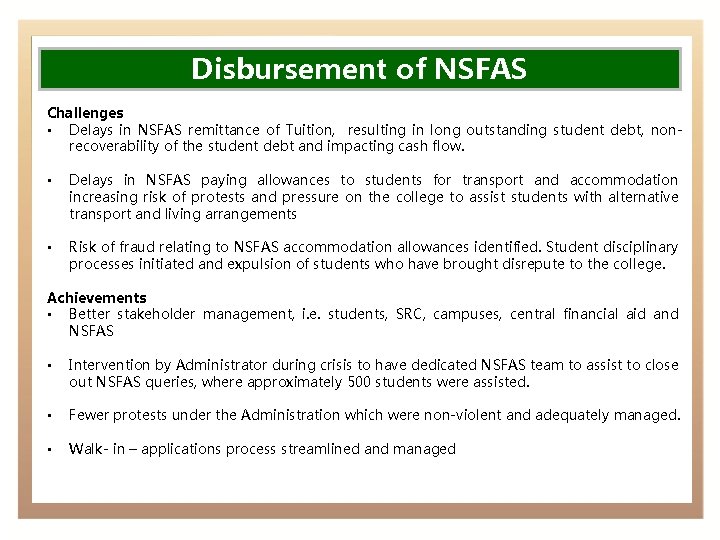
Disbursement of NSFAS Challenges • Delays in NSFAS remittance of Tuition, resulting in long outstanding student debt, nonrecoverability of the student debt and impacting cash flow. • Delays in NSFAS paying allowances to students for transport and accommodation increasing risk of protests and pressure on the college to assist students with alternative transport and living arrangements • Risk of fraud relating to NSFAS accommodation allowances identified. Student disciplinary processes initiated and expulsion of students who have brought disrepute to the college. Achievements • Better stakeholder management, i. e. students, SRC, campuses, central financial aid and NSFAS • Intervention by Administrator during crisis to have dedicated NSFAS team to assist to close out NSFAS queries, where approximately 500 students were assisted. • Fewer protests under the Administration which were non-violent and adequately managed. • Walk- in – applications process streamlined and managed

Achievements
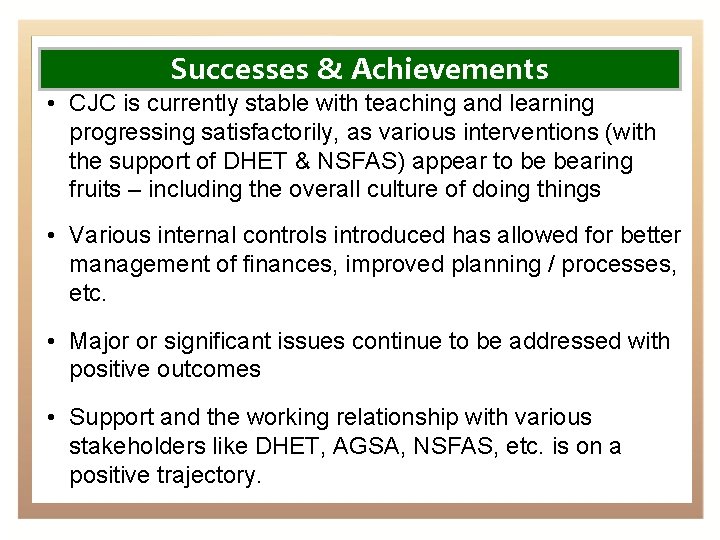
Successes & Achievements • CJC is currently stable with teaching and learning progressing satisfactorily, as various interventions (with the support of DHET & NSFAS) appear to be bearing fruits – including the overall culture of doing things • Various internal controls introduced has allowed for better management of finances, improved planning / processes, etc. • Major or significant issues continue to be addressed with positive outcomes • Support and the working relationship with various stakeholders like DHET, AGSA, NSFAS, etc. is on a positive trajectory.

Challenges
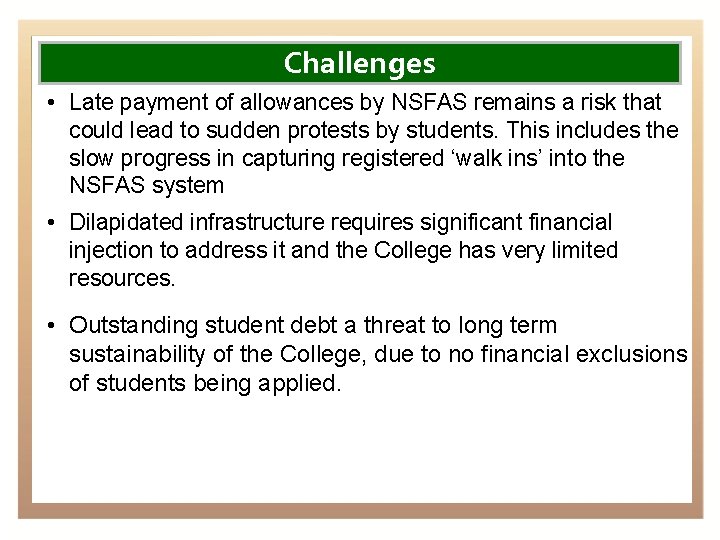
Challenges • Late payment of allowances by NSFAS remains a risk that could lead to sudden protests by students. This includes the slow progress in capturing registered ‘walk ins’ into the NSFAS system • Dilapidated infrastructure requires significant financial injection to address it and the College has very limited resources. • Outstanding student debt a threat to long term sustainability of the College, due to no financial exclusions of students being applied.
Staff on Precautionary Transfer/Suspension
Status of Central Johannesburg TVET College On inception of administration the following management positions were vacant owing to staff suspensions and transfers • Principal – Precautionary Transferred • Deputy Principal: Finance – Precautionary Suspended • Human Resources Manager – Precautionary Suspended • Campus Manager: Ellispark Campus - Precautionary Suspended • Student Financial Aid Manager – Precautionary Suspended Many of these cases are concluded if not about to be concluded 35
Status of Central Johannesburg TVET During Administration a. College number of staff were placed under precautionary suspension: • Campus Manager: Crown Mines - Precautionary Suspended • IT Manager: Central Office: - Precautionary Suspended • Lecturers (PL 1) : Alexandra Campus x 4 Precautionary Suspended • Lecturer (PL 1): Parktown Campus x 1 - Precautionary Suspended • General Assistant: Alexandra Campus x 1 Precautionary Suspended Cases ranged from neglect of duties, abuse of property, disrepute, etc. 36
Conclusion
Conclusion • Notwithstanding resistance, significant progress has been made since the start of the administration and there has not been a students or labour unrest since June 2019. • The College is in a stable state, which has resulted in huge interest from students during the recent 2020 registration process (i. e. walk ins) • The academic performance is gradually improving due to various interventions aimed at assisting students who are struggling particularly in maths, engineering related subjects, etc. • The spend on infrastructure has improved and refurbishments of selected areas in all campuses are currently underway • A new culture of compliance has been embraced by staff
Conclusion (Cont. ) • Finances are in stable condition and supply chain management measures introduced are heading in the right direction – obviously, capacity & skills challenges are still an issue • Notwithstanding progress to date, much more still needs to be done to address some of the persistent challenges, which can be resolved, as follows: o The move into an integrated management system, is already underway o Skilling and capacitating support staff & lecturers o Improved support for students so that we produce employable students and/or entrepreneurs o Introduction and utilisation of smart boards to infuse 21 st century teaching & learning, etc.

Thank You
- Slides: 40