
Central Information Commission Annual Convention 2018 RTI Implementation



- Slides: 18
Central Information Commission Annual Convention – 2018 RTI Implementation Presented by: P. JANAKIRAM, Sr. KM By Dr. MCR HRD Institute Campus, Road No. 25, Jubilee Hills, Hyderabad Ph. 040 -23686131, Mob. 9989334048 E-mail: janakiram. p@cgg. gov. in
About CGG • A Government of TELANGANA Organisation, established in 2002 • Board Chairman is Chief Minister, Head of the Organisation Is IAS officer • Have varied experience of working in the field of promoting Good Governance • Worked on projects such as preparation of Citizen Charters • Conducted Online Certificate Course on Right to Information (RTI-OCC) – English, Hindi, Telugu - Sponsored by Do. PT • Has Knowledge Consulting as well as IT Divisions • Has experience of working with various State Government, Central Government and International Development Organisations
When is RTI Implementation successful • Information is freely available and provided to Citizen • All the PAs registered and submit Annual Reports • PIOs are trained and competent to handle the queries • Suo Moto disclosure is carried out as prescribed • Minimal complaints regarding non adherence to Provisions of RTI Act • Awareness regarding RTI to the last mile citizen • Everyone in the Value chain has sufficient Resources & Functional freedom
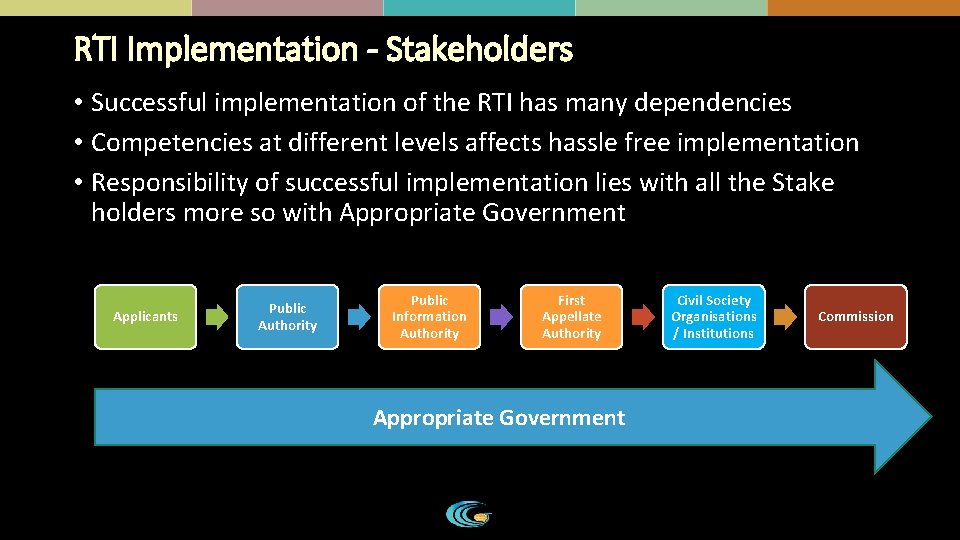
RTI Implementation - Stakeholders • Successful implementation of the RTI has many dependencies • Competencies at different levels affects hassle free implementation • Responsibility of successful implementation lies with all the Stake holders more so with Appropriate Government Applicants Public Authority Public Information Authority First Appellate Authority Appropriate Government Civil Society Organisations / Institutions Commission
Observations of a Common Man on effect of RTI General Benefits that include • Practical Regime • Transparency • Accountability • Other Benefits observed due to RTI • • Streamlining of Processes Documentation of Every Activity Clear defining of Responsibilities A sense of Turn Around Time and Repercussions of not adhering to it
Challenges
Challenges faced by PA • Huge number of Applications • Seeking same information, inspite of Voluntary Disclosure • Queries pertaining to subjects dated back even to 2 decades • Investment in Cost Centre, due to the statutory requirements • Unwilling PIOs due to the responsibility attached • Higher level of Documentation required better competencies • Some RTI applications result in denting the Trust among employees • Applications with non-existent address
Challenges faced by PIO • Usually PIOs are Junior officers in Middle Management • PIO role is usually an additional responsibility • Have the burden to meet the Turn Around Time of the application • Collection of the information from the respective departments within the Public Authority • Non maintenance of records in proper formats • Challenges pertaining to infrastructure – Physical as well as intellectual • Lack of Competencies and preparedness
Challenges faced by Applicant • Lack of Awareness regarding the provisions of the ACT and Amendments • PIOs not adhering to the prescribed regulations and rules • Insufficient information provided by the PIOs • Access to Commission at rural areas – Cost involved • Long pendency of petitions at Commission level • Persistent applications with ill intentions, scuttle the efforts of genuine applicants
Perceived Challenges of Information commission • Lack of adequate infrastructure and manpower • Huge number of pending cases • PAs not adhering to Suo-moto Disclosure • No process for Monitoring & Evaluation of suo-moto disclosures • Non submission of Annual Report by PAs • Increasing number of appeals by organisations to be declared as “NOT PUBLIC AUTHORITY” under the Act • Limited authority to enforce the orders on Public Authorities
POSSIBLE OF SOLUTIONS
Possible Solutions What is not recorded cannot be measured and What is not measured cannot be improved • Conduct of Appraisal of the PAs on the key indicators of RTI implementation • Quantitative as well as Quantitative analysis of the Gaps and defining the Measures • Sharing of the Common issues and solutions for the same with all the PAs
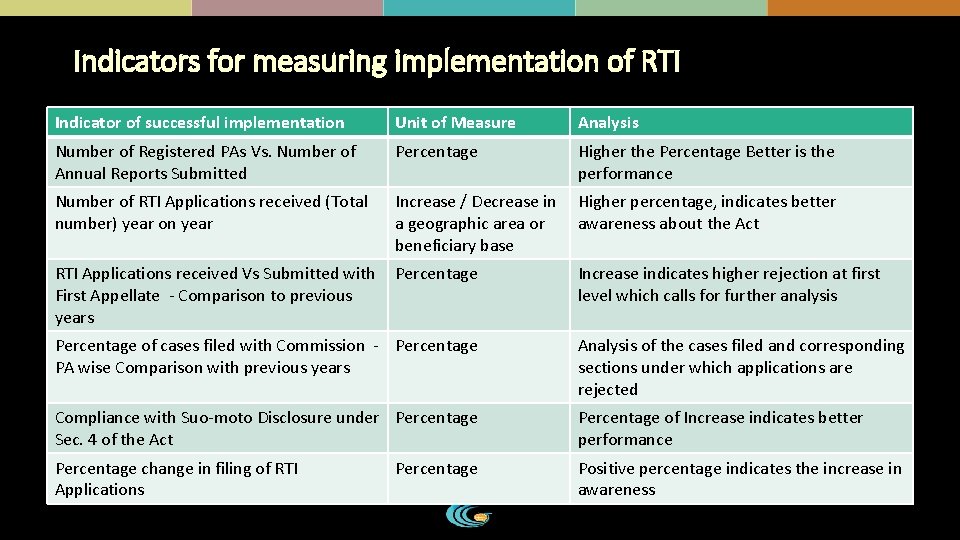
Indicators for measuring implementation of RTI Indicator of successful implementation Unit of Measure Analysis Number of Registered PAs Vs. Number of Annual Reports Submitted Percentage Higher the Percentage Better is the performance Number of RTI Applications received (Total number) year on year Increase / Decrease in a geographic area or beneficiary base Higher percentage, indicates better awareness about the Act RTI Applications received Vs Submitted with First Appellate - Comparison to previous years Percentage Increase indicates higher rejection at first level which calls for further analysis Percentage of cases filed with Commission - Percentage PA wise Comparison with previous years Analysis of the cases filed and corresponding sections under which applications are rejected Compliance with Suo-moto Disclosure under Percentage Sec. 4 of the Act Percentage of Increase indicates better performance Percentage change in filing of RTI Applications Positive percentage indicates the increase in awareness Percentage
Competency Based Training • Competency based Training for all stake holders (In lines with NTP 2012) • • • Defining Job Description of PIOs, FAA Identifying Competencies Required for PIOs, FAA Designing of training Capsules to orient PIOs & FAA Developing and Deploying training capsule through GAMING Model Updating the module on regular basis • Development of Orientation module for the Top management of PAs defining requirements under the Act
Possible Solutions • Defining of the Organisation structure and filling up of all sanctioned positions at Commissions • • Designing Organisation Structure Provide connectivity of Commission to rural areas Not only defining cadre strength but also filling the positions Where RTIs are high in number, dedicating a Section to address the issue defining a norm • Instructing all the PAs and providing required knowledge support to PAs in adhering to provisions • Ensuring only trained personnel are PIOs with fixed tenure in the role • Appropriate Government taking measures in this regard
Possible Solutions • Periodic Survey, Analysis & providing support • Suo-moto disclosure tool • Annual Report preparation • Rejection percentage etc. • Provision of Facilitation and procedural support • Support in form of suggesting Templates • Periodic reminding of the Tasks and Activities to be completed • Periodic Communication among stakeholders • Circulation of important developments regarding RTI • Updating Training modules with latest changes
Measures to publicize • Conducting Orientation on RTI Act at all the Colleges in Rural Areas • Using the services of Self Help Group system to orient women regarding the Act • Widely publicising the success stories ex. Villagers getting required infrastructure using RTI as tool • Conducting RTI awareness weeks at all levels of the Government
Thank You