
Central Exclusive Production at the STAR experiment May
![d /d( ) [nb/rad] d /d [nb] d /d. M [nb/Ge. V] Phase I](https://slidetodoc.com/presentation_image_h/1b19b73bfc17477bb7f2c55400c1b99d/image-10.jpg "d /d( ) [nb/rad] d /d [nb] d /d. M [nb/Ge. V] Phase I")
- Slides: 21
Central Exclusive Production at the STAR experiment May 30, 2016 1
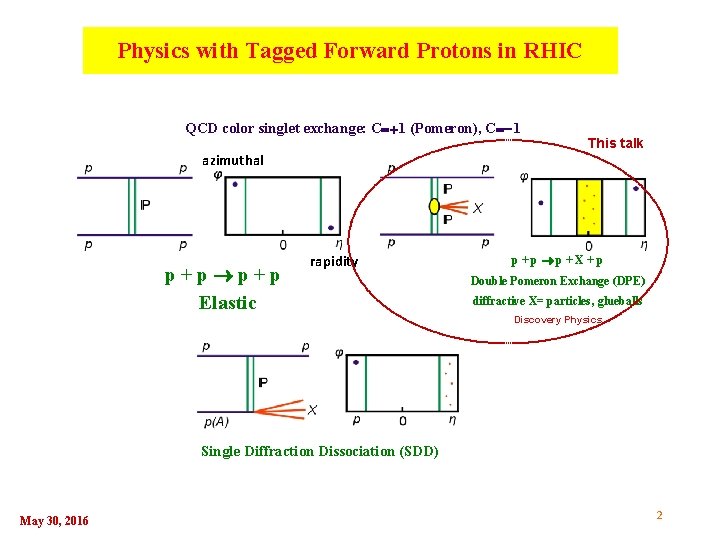
Physics with Tagged Forward Protons in RHIC QCD color singlet exchange: C 1 (Pomeron), C 1 azimuthal p+p Elastic rapidity This talk p+p p+X+p Double Pomeron Exchange (DPE) diffractive X= particles, glueballs Discovery Physics Single Diffraction Dissociation (SDD) May 30, 2016 2
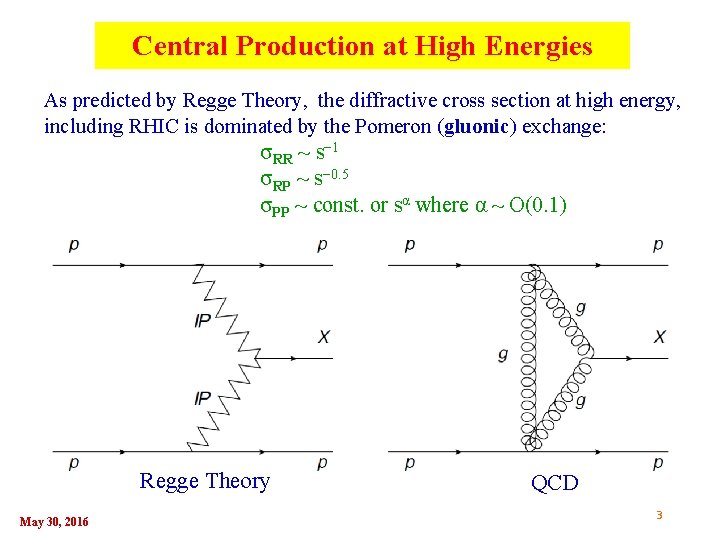
Central Production at High Energies As predicted by Regge Theory, the diffractive cross section at high energy, including RHIC is dominated by the Pomeron (gluonic) exchange: σRR ~ s 1 σRP ~ s 0. 5 σPP ~ const. or sα where α ~ O(0. 1) Regge Theory May 30, 2016 QCD 3
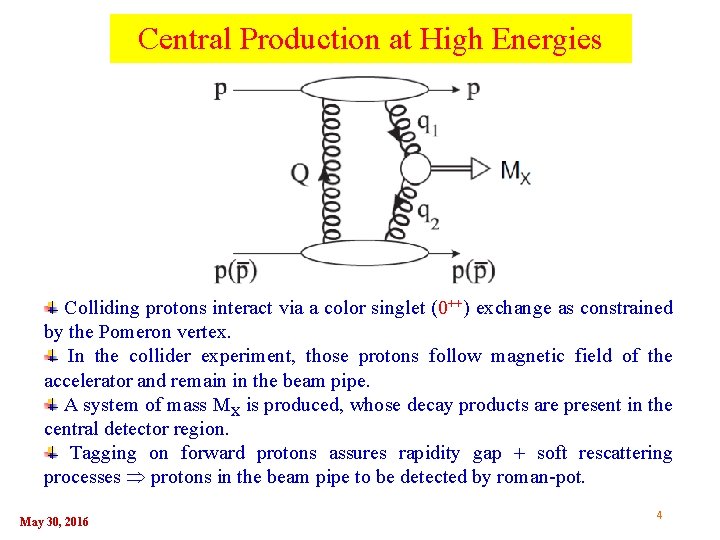
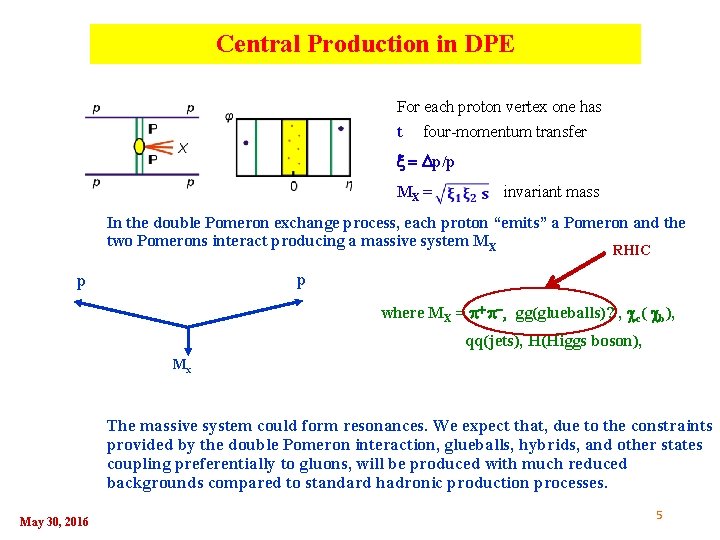
Central Production at High Energies Colliding protons interact via a color singlet (0++) exchange as constrained by the Pomeron vertex. In the collider experiment, those protons follow magnetic field of the accelerator and remain in the beam pipe. A system of mass MX is produced, whose decay products are present in the central detector region. Tagging on forward protons assures rapidity gap soft rescattering processes protons in the beam pipe to be detected by roman-pot. May 30, 2016 4
Central Production in DPE For each proton vertex one has t four-momentum transfer p/p MX = invariant mass In the double Pomeron exchange process, each proton “emits” a Pomeron and the two Pomerons interact producing a massive system MX RHIC p p where MX = gg(glueballs)? , c( b), qq(jets), H(Higgs boson), Mx The massive system could form resonances. We expect that, due to the constraints provided by the double Pomeron interaction, glueballs, hybrids, and other states coupling preferentially to gluons, will be produced with much reduced backgrounds compared to standard hadronic production processes. May 30, 2016 5
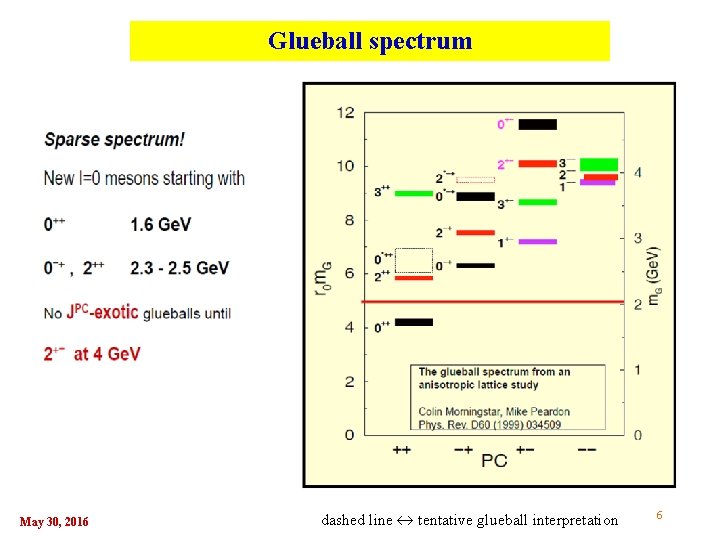
Glueball spectrum May 30, 2016 dashed line tentative glueball interpretation 6
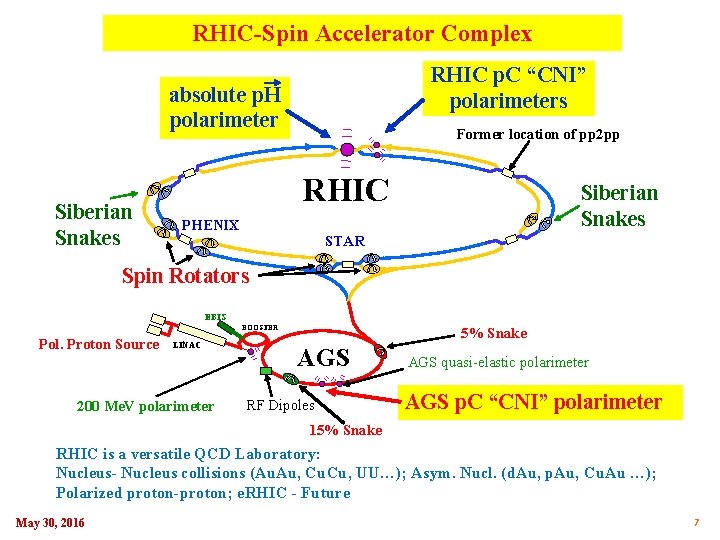
RHIC-Spin Accelerator Complex RHIC p. C “CNI” polarimeters absolute p. H polarimeter Siberian Snakes Former location of pp 2 pp RHIC PHENIX Siberian Snakes STAR Spin Rotators EBIS BOOSTER Pol. Proton Source LINAC 200 Me. V polarimeter 5% Snake AGS RF Dipoles AGS quasi-elastic polarimeter AGS p. C “CNI” polarimeter 15% Snake RHIC is a versatile QCD Laboratory: Nucleus- Nucleus collisions (Au. Au, Cu. Cu, UU…); Asym. Nucl. (d. Au, p. Au, Cu. Au …); Polarized proton-proton; e. RHIC - Future May 30, 2016 7
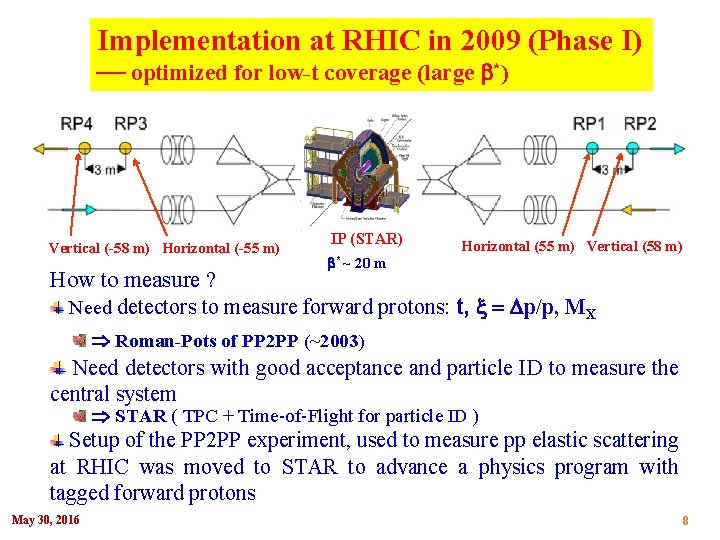
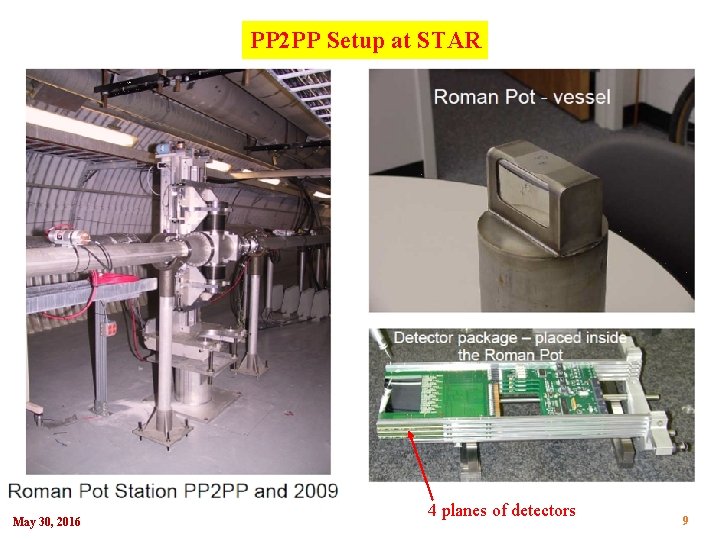
Implementation at RHIC in 2009 (Phase I) optimized for low-t coverage (large *) Vertical (-58 m) Horizontal (-55 m) IP (STAR) * ~ Horizontal (55 m) Vertical (58 m) 20 m How to measure ? Need detectors to measure forward protons: t, p/p, MX Roman-Pots of PP 2 PP (~2003) Need detectors with good acceptance and particle ID to measure the central system STAR ( TPC + Time-of-Flight for particle ID ) Setup of the PP 2 PP experiment, used to measure pp elastic scattering at RHIC was moved to STAR to advance a physics program with tagged forward protons May 30, 2016 8
PP 2 PP Setup at STAR May 30, 2016 4 planes of detectors 9
d /d( ) [nb/rad] d /d [nb] d /d. M [nb/Ge. V] Phase I preliminary results in CEP M (Ge. V) (rad) Details can be found in Int. J. Mod. Phys. A 29 (2014) no. 28, 1446010 May 30, 2016 10
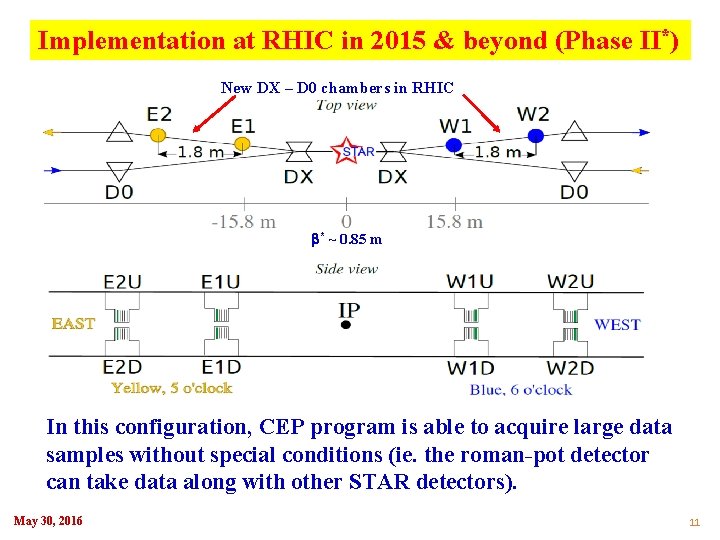
Implementation at RHIC in 2015 & beyond (Phase II*) New DX – D 0 chambers in RHIC * ~ 0. 85 m In this configuration, CEP program is able to acquire large data samples without special conditions (ie. the roman-pot detector can take data along with other STAR detectors). May 30, 2016 11
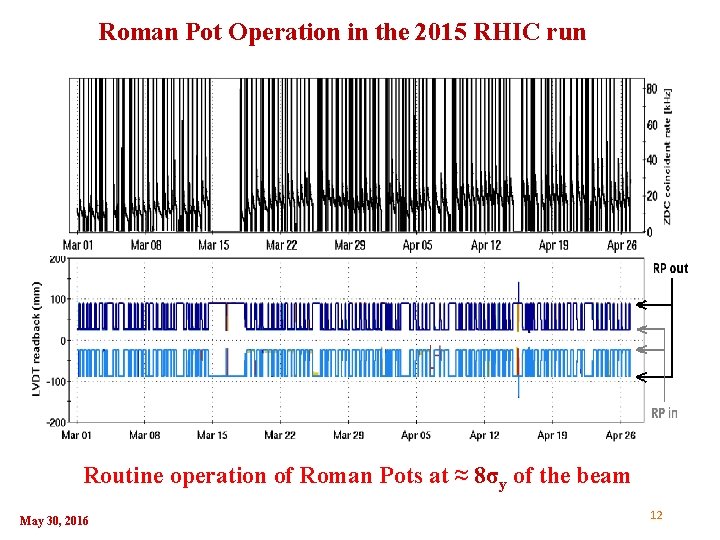
Roman Pot Operation in the 2015 RHIC run Routine operation of Roman Pots at ≈ 8σy of the beam May 30, 2016 12
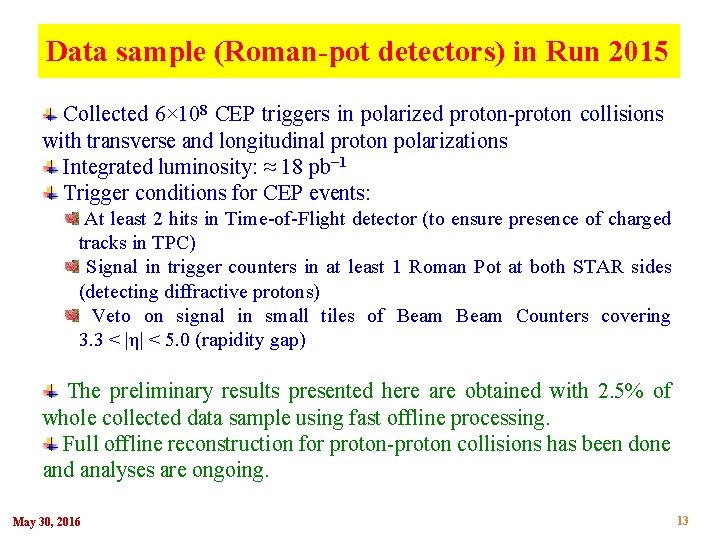
Data sample (Roman-pot detectors) in Run 2015 Collected 6× 10⁸ CEP triggers in polarized proton-proton collisions with transverse and longitudinal proton polarizations Integrated luminosity: ≈ 18 pb− 1 Trigger conditions for CEP events: At least 2 hits in Time-of-Flight detector (to ensure presence of charged tracks in TPC) Signal in trigger counters in at least 1 Roman Pot at both STAR sides (detecting diffractive protons) Veto on signal in small tiles of Beam Counters covering 3. 3 < |η| < 5. 0 (rapidity gap) The preliminary results presented here are obtained with 2. 5% of whole collected data sample using fast offline processing. Full offline reconstruction for proton-proton collisions has been done and analyses are ongoing. May 30, 2016 13
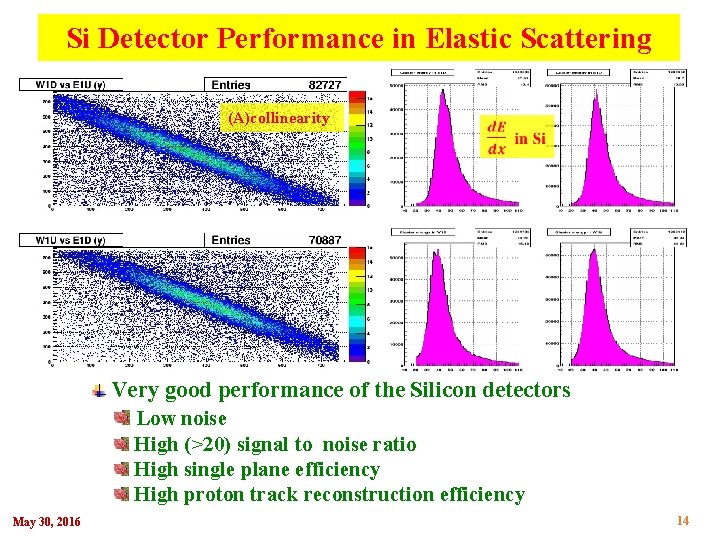
Si Detector Performance in Elastic Scattering (A)collinearity Very good performance of the Silicon detectors Low noise High (>20) signal to noise ratio High single plane efficiency High proton track reconstruction efficiency May 30, 2016 14
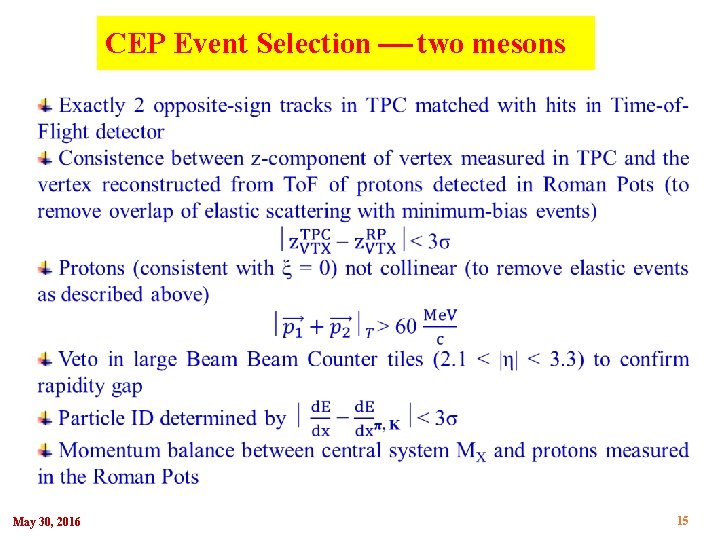
CEP Event Selection two mesons May 30, 2016 15
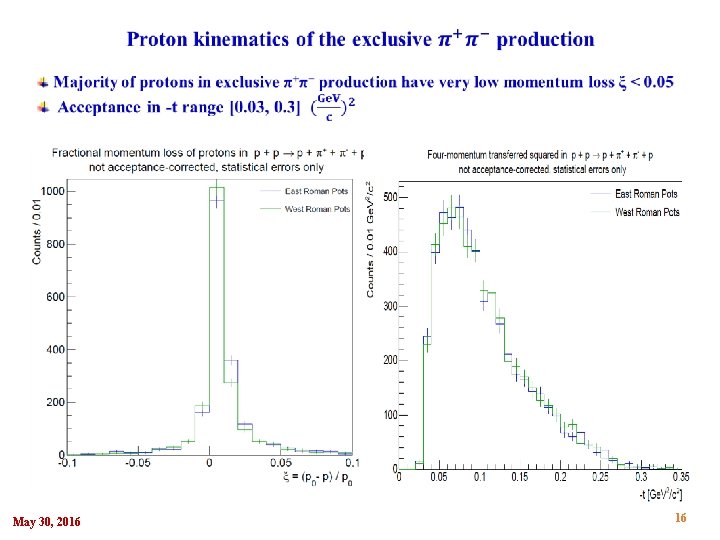
May 30, 2016 16
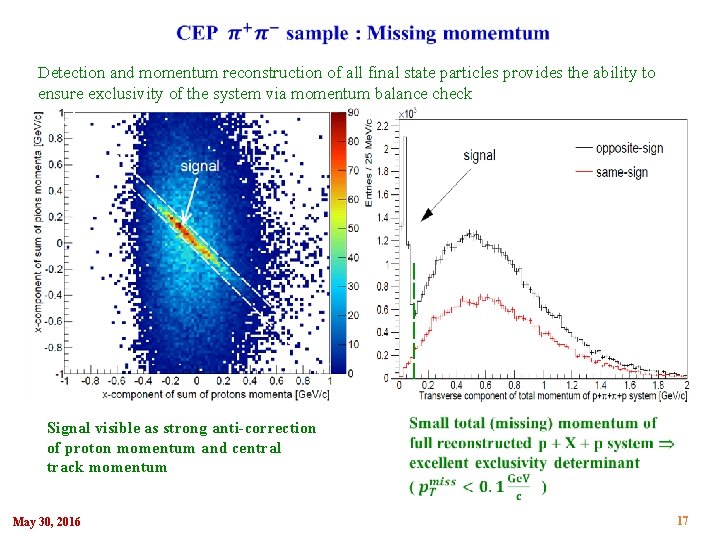
Detection and momentum reconstruction of all final state particles provides the ability to ensure exclusivity of the system via momentum balance check Signal visible as strong anti-correction of proton momentum and central track momentum May 30, 2016 17
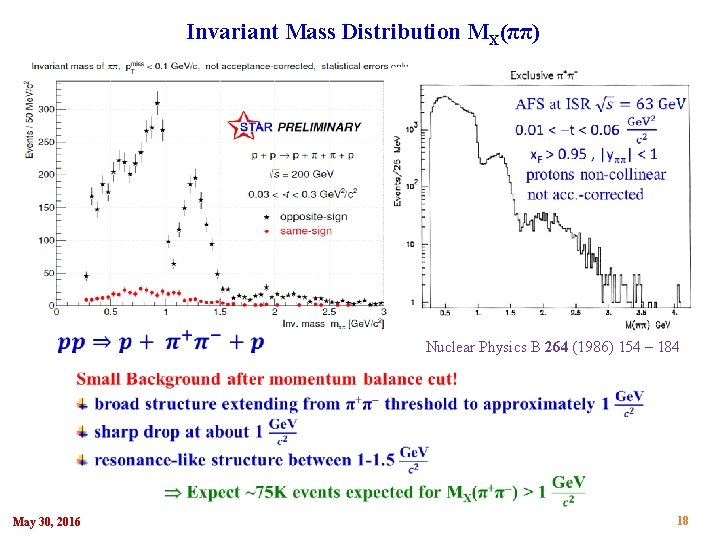
Invariant Mass Distribution MX(ππ) Nuclear Physics B 264 (1986) 154 – 184 May 30, 2016 18
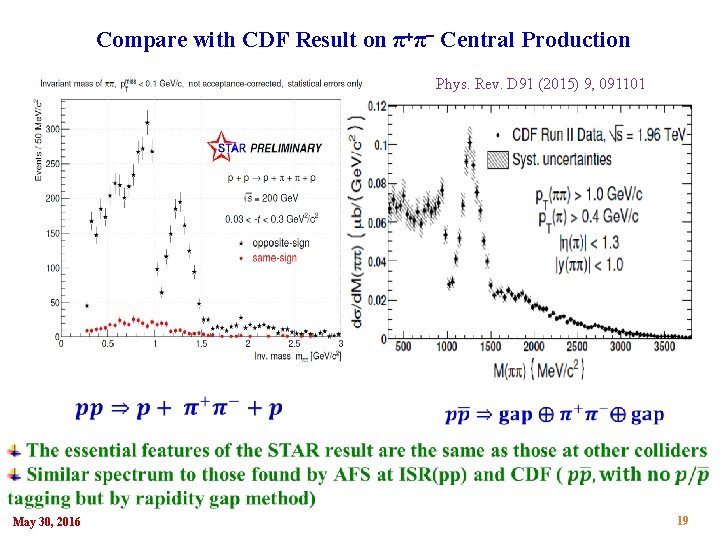
Compare with CDF Result on π π Central Production Phys. Rev. D 91 (2015) 9, 091101 Nuclear Physics B 264 (1986) 154 – 184 May 30, 2016 19
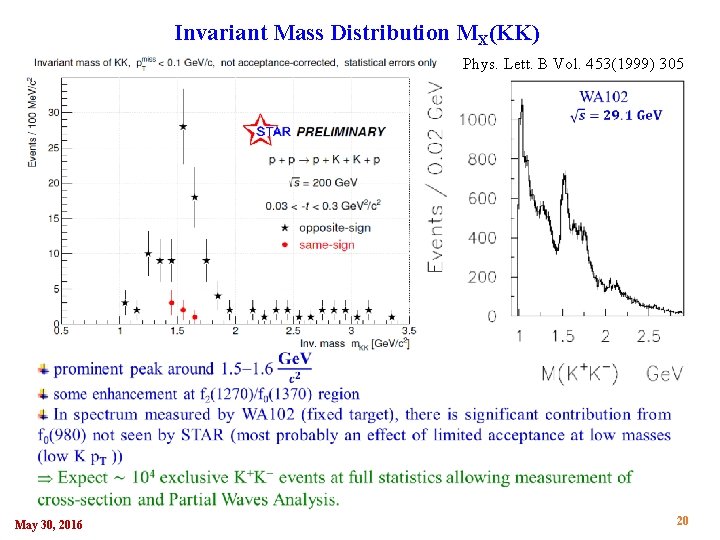
Invariant Mass Distribution MX(ΚΚ) Phys. Lett. B Vol. 453(1999) 305 May 30, 2016 20
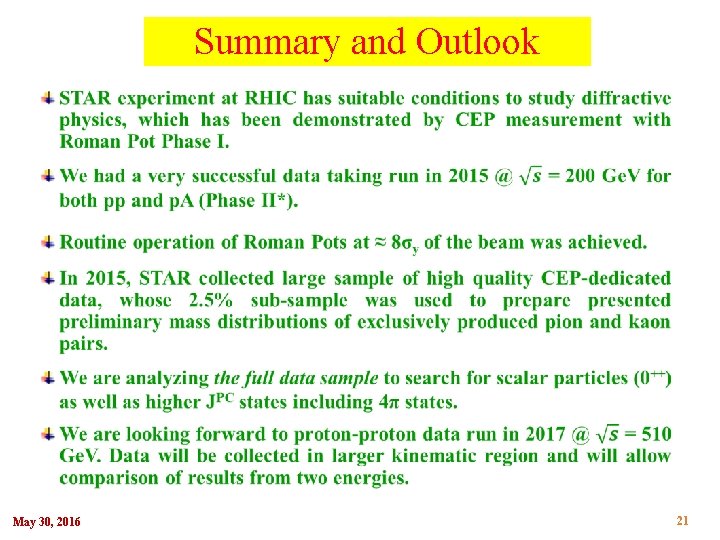
Summary and Outlook • May 30, 2016 21