
Central Europe towards Sustainable Building CESB 19 July
Central Europe towards Sustainable Building CESB 19 July 2 – 4, 2019, Prague ENERGY. FUTURE. ZAE. PERFORMANCE ANALYSIS OF ROOM INTEGRATED PCM WALLBOARDS Author - Bharat Chhugani Presenter - Dr. Michaela Reim … Central Europe towards Sustainable Building CESB 19 © Bavarian Center for Applied Energy Research e. V. © ZAE Bayern All rights reserved, also regarding any disposal, exploitation, reproduction, editing, and dissemination as well as in the case of industrial property rights. . July 2 – 4, 2019, Prague 1
Outline 1. Motivation and Objective 2. Phase Change Materials (PCM) 3. Experimental Scenario and Results 4. Simulation Model and Results 5. Conclusion Central Europe towards Sustainable Building CESB 19 July 2 – 4, 2019, Prague © ZAE Bayern 2
Outline 1. Motivation and Objective 2. Phase Change Materials (PCM) 3. Experimental Scenario and Results 4. Simulation Model and Results 5. Conclusion Central Europe towards Sustainable Building CESB 19 July 2 – 4, 2019, Prague © ZAE Bayern 3
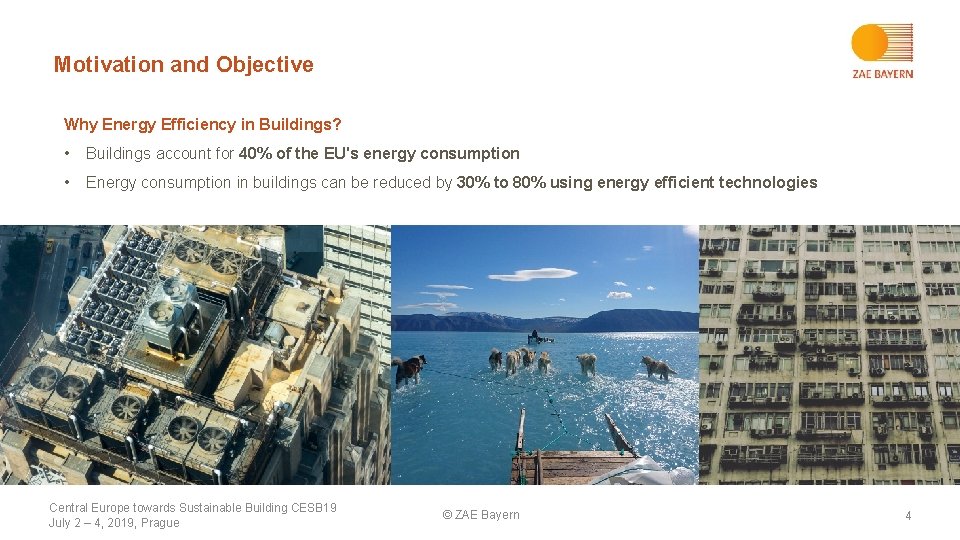
Motivation and Objective Why Energy Efficiency in Buildings? • Buildings account for 40% of the EU's energy consumption • Energy consumption in buildings can be reduced by 30% to 80% using energy efficient technologies Central Europe towards Sustainable Building CESB 19 July 2 – 4, 2019, Prague © ZAE Bayern 4
Outline 1. Motivation and Objective 2. Phase Change Materials (PCM) 3. Experimental Scenario and Results 4. Simulation Model and Results 5. Conclusion Central Europe towards Sustainable Building CESB 19 July 2 – 4, 2019, Prague © ZAE Bayern 5
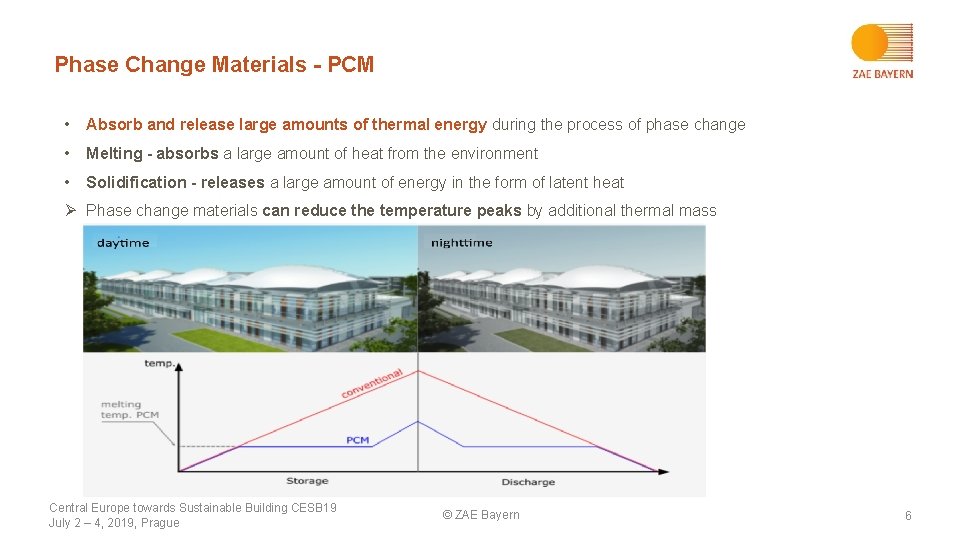
Phase Change Materials - PCM • Absorb and release large amounts of thermal energy during the process of phase change • Melting - absorbs a large amount of heat from the environment • Solidification - releases a large amount of energy in the form of latent heat Ø Phase change materials can reduce the temperature peaks by additional thermal mass Central Europe towards Sustainable Building CESB 19 July 2 – 4, 2019, Prague © ZAE Bayern 6
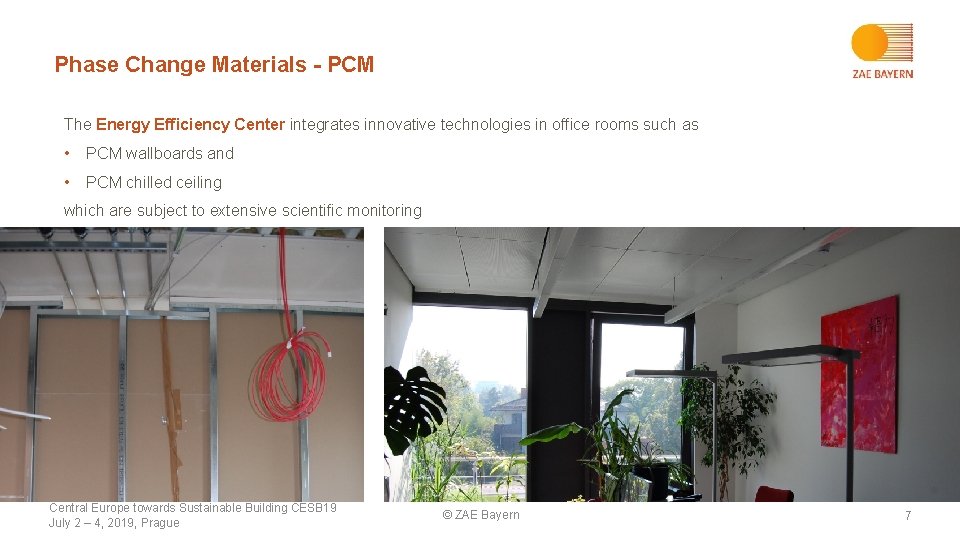
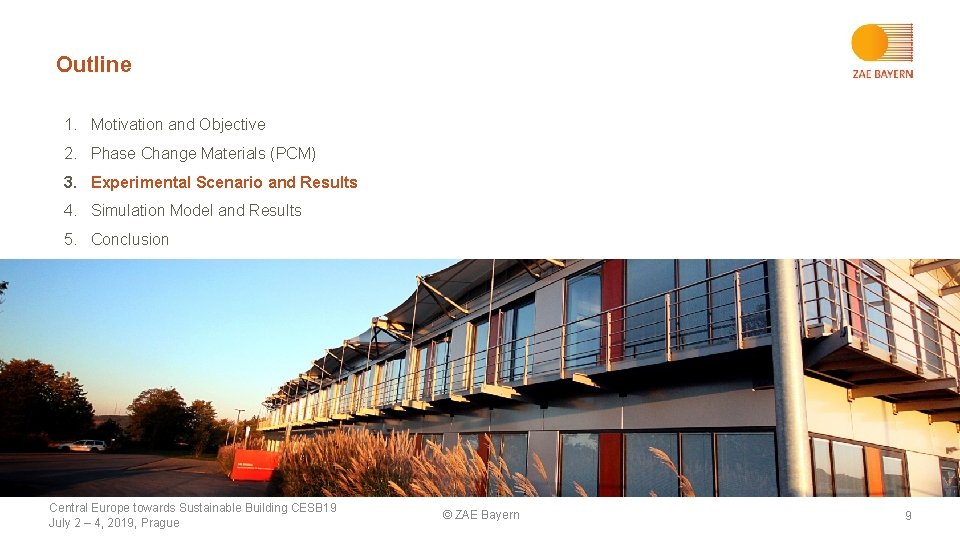
Phase Change Materials - PCM The Energy Efficiency Center integrates innovative technologies in office rooms such as • PCM wallboards and • PCM chilled ceiling which are subject to extensive scientific monitoring Central Europe towards Sustainable Building CESB 19 July 2 – 4, 2019, Prague © ZAE Bayern 7
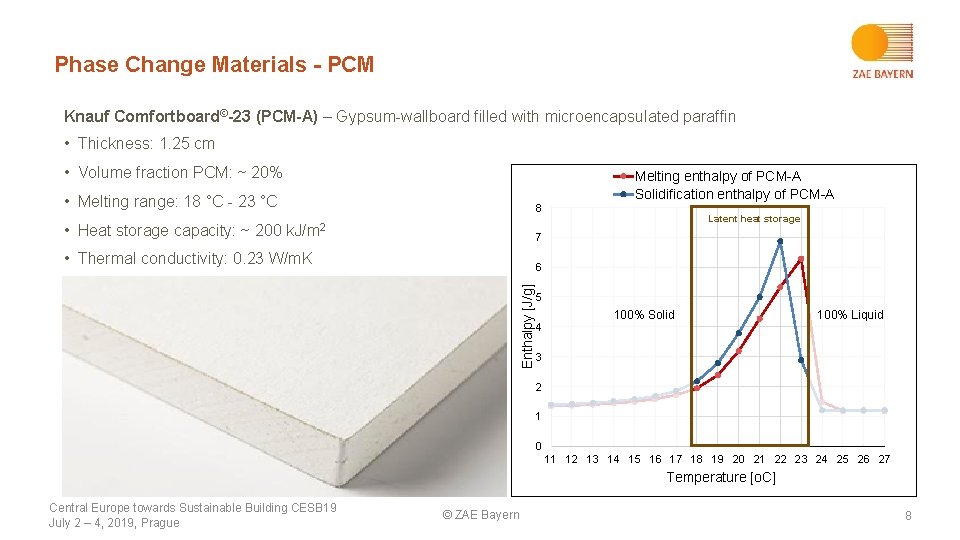
Phase Change Materials - PCM Knauf Comfortboard©-23 (PCM-A) – Gypsum-wallboard filled with microencapsulated paraffin • Thickness: 1. 25 cm • Volume fraction PCM: ~ 20% • Melting range: 18 °C - 23 °C 8 • Heat storage capacity: ~ 200 k. J/m 2 Melting enthalpy of PCM-A Solidification enthalpy of PCM-A Latent heat storage 7 • Thermal conductivity: 0. 23 W/m. K Enthalpy [J/g] 6 5 4 100% Solid 100% Liquid 3 2 1 0 11 12 13 14 15 16 17 18 19 20 21 22 23 24 25 26 27 Temperature [o. C] Central Europe towards Sustainable Building CESB 19 July 2 – 4, 2019, Prague © ZAE Bayern 8
Outline 1. Motivation and Objective 2. Phase Change Materials (PCM) 3. Experimental Scenario and Results 4. Simulation Model and Results 5. Conclusion Central Europe towards Sustainable Building CESB 19 July 2 – 4, 2019, Prague © ZAE Bayern 9
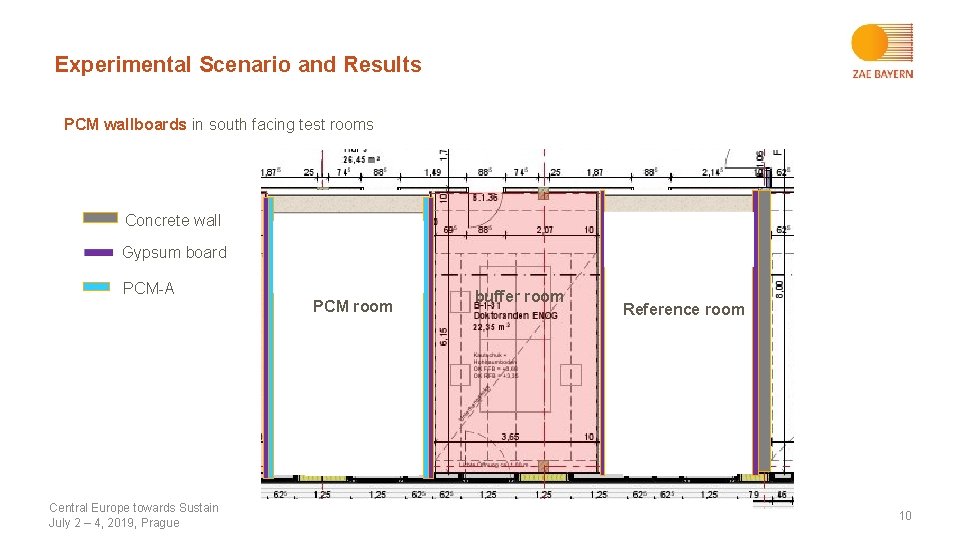
Experimental Scenario and Results PCM wallboards in south facing test rooms Concrete wall Gypsum board PCM-A PCM room Central Europe towards Sustainable Building CESB 19 July 2 – 4, 2019, Prague buffer room © ZAE Bayern Reference room 10
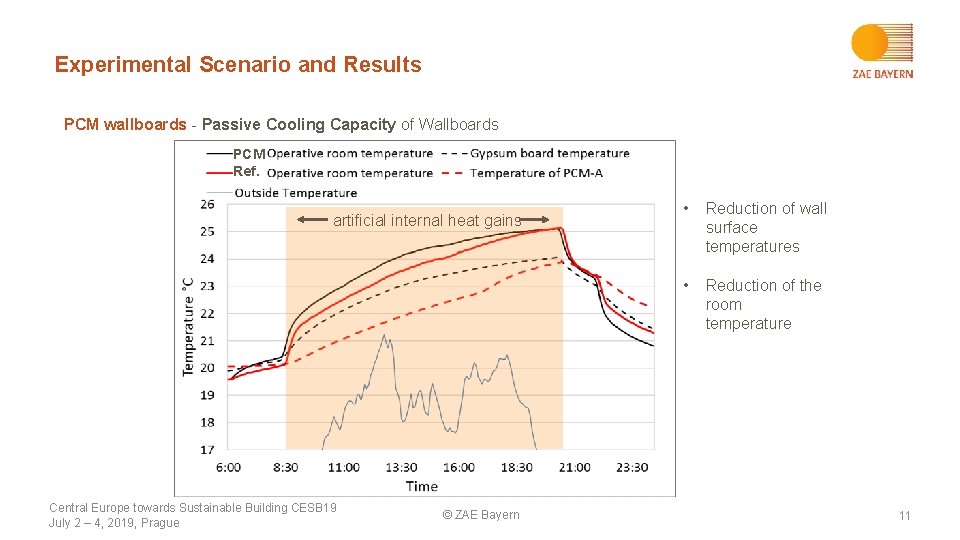
Experimental Scenario and Results PCM wallboards - Passive Cooling Capacity of Wallboards PCM Ref. artificial internal heat gains Central Europe towards Sustainable Building CESB 19 July 2 – 4, 2019, Prague © ZAE Bayern • Reduction of wall surface temperatures • Reduction of the room temperature 11
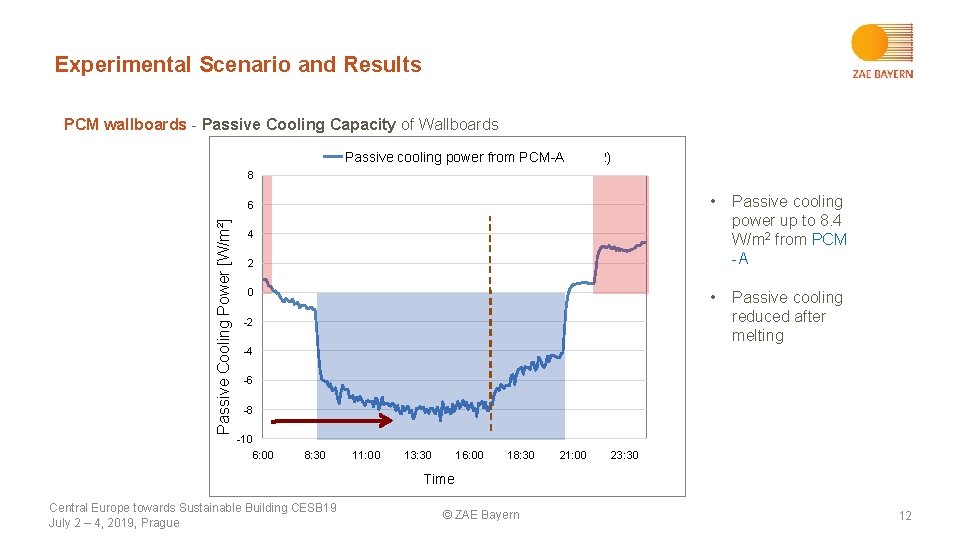
Experimental Scenario and Results PCM wallboards - Passive Cooling Capacity of Wallboards Passive cooling power from PCM-A (R 112) 8 Passive Cooling Power [W/m²] 6 • Passive cooling power up to 8. 4 W/m 2 from PCM -A • Passive cooling reduced after melting 4 2 0 -2 -4 -6 -8 -10 6: 00 8: 30 11: 00 13: 30 16: 00 18: 30 21: 00 23: 30 Time Central Europe towards Sustainable Building CESB 19 July 2 – 4, 2019, Prague © ZAE Bayern 12
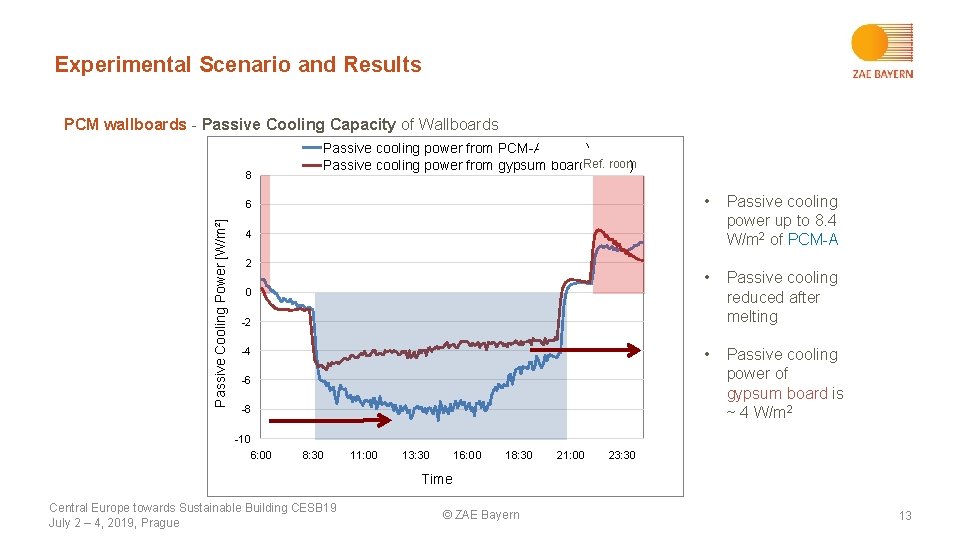
Experimental Scenario and Results PCM wallboards - Passive Cooling Capacity of Wallboards Passive Cooling Power [W/m²] 8 Passive cooling power from PCM-A (R 112) Ref. room Passive cooling power from gypsum board (R 110) 8 6 6 4 4 2 2 0 0 -2 -2 -4 -4 -6 -6 -8 -8 -10 6: 00 • Passive cooling power up to 8. 4 W/m 2 of PCM-A • Passive cooling reduced after melting • Passive cooling power of gypsum board is ~ 4 W/m 2 -10 8: 30 11: 00 13: 30 16: 00 18: 30 21: 00 23: 30 Time Central Europe towards Sustainable Building CESB 19 July 2 – 4, 2019, Prague © ZAE Bayern 13
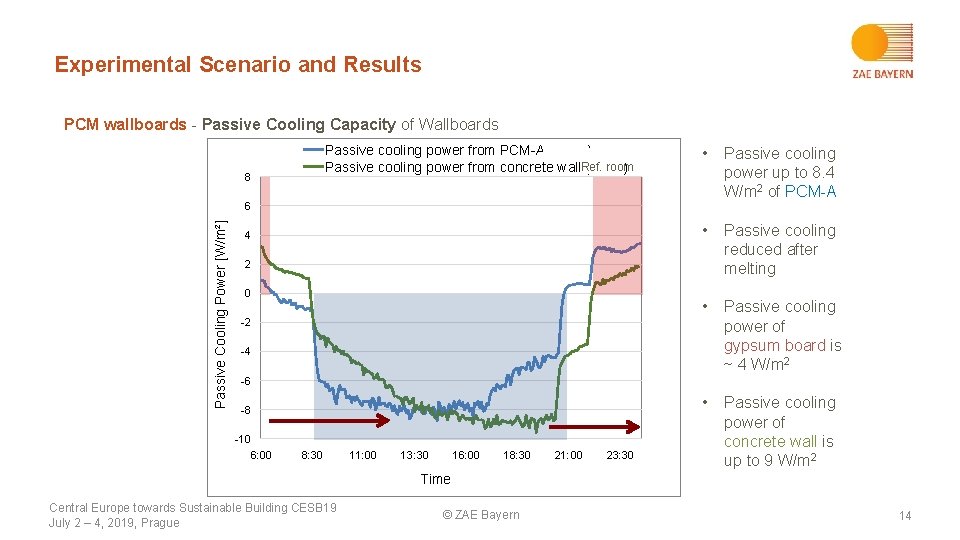
Experimental Scenario and Results PCM wallboards - Passive Cooling Capacity of Wallboards Passive cooling power from PCM-A (R 112) Ref. room Passive cooling power from concrete wall (R 110) Passive Cooling Power [W/m²] 8 6 4 4 2 2 0 0 -2 -2 -4 -4 -6 -6 -8 -8 -10 8: 30 11: 00 13: 30 16: 00 18: 30 21: 00 23: 30 Passive cooling power up to 8. 4 W/m 2 of PCM-A • Passive cooling reduced after melting • Passive cooling power of gypsum board is ~ 4 W/m 2 • Passive cooling power of concrete wall is up to 9 W/m 2 8 6 -10 6: 00 • Time Central Europe towards Sustainable Building CESB 19 July 2 – 4, 2019, Prague © ZAE Bayern 14
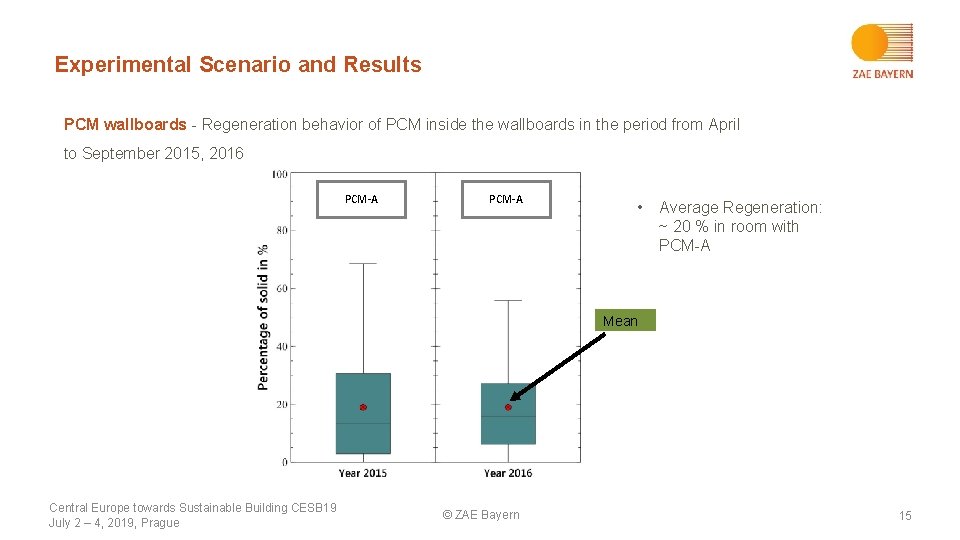
Experimental Scenario and Results PCM wallboards - Regeneration behavior of PCM inside the wallboards in the period from April to September 2015, 2016 PCM-A • Average Regeneration: ~ 20 % in room with PCM-A Mean Central Europe towards Sustainable Building CESB 19 July 2 – 4, 2019, Prague © ZAE Bayern 15
Experimental Scenario and Results Experimental Conclusion: • PCM-A shows visible latent heat storage effect with passive cooling power of up to 8. 4 W/m 2 (at a thickness of 1. 25 cm) when regenerated properly. This is nearly the same cooling power as a concrete wall of 15 cm. • PCM-A shows almost double passive cooling power compared to a conventional gypsum board. • Regeneration is problematic in PCM wallboards: PCM-A shows latent heat storage with average regeneration of only 20 %. Central Europe towards Sustainable Building CESB 19 July 2 – 4, 2019, Prague © ZAE Bayern 16
Outline 1. Motivation and Objective 2. Phase Change Materials (PCM) 3. Experimental Scenario and Results 4. Simulation Model and Results 5. Conclusion Central Europe towards Sustainable Building CESB 19 July 2 – 4, 2019, Prague © ZAE Bayern 17
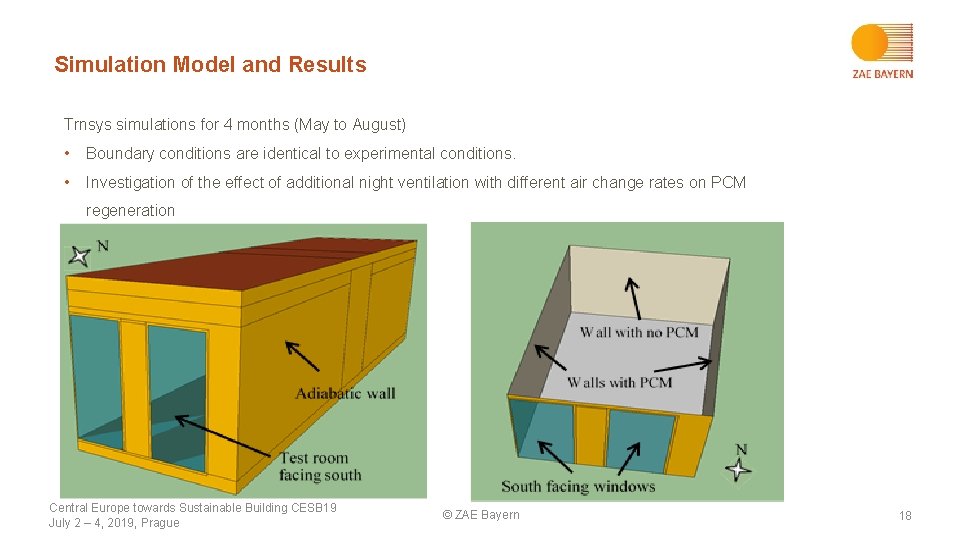
Simulation Model and Results Trnsys simulations for 4 months (May to August) • Boundary conditions are identical to experimental conditions. • Investigation of the effect of additional night ventilation with different air change rates on PCM regeneration Central Europe towards Sustainable Building CESB 19 July 2 – 4, 2019, Prague © ZAE Bayern 18
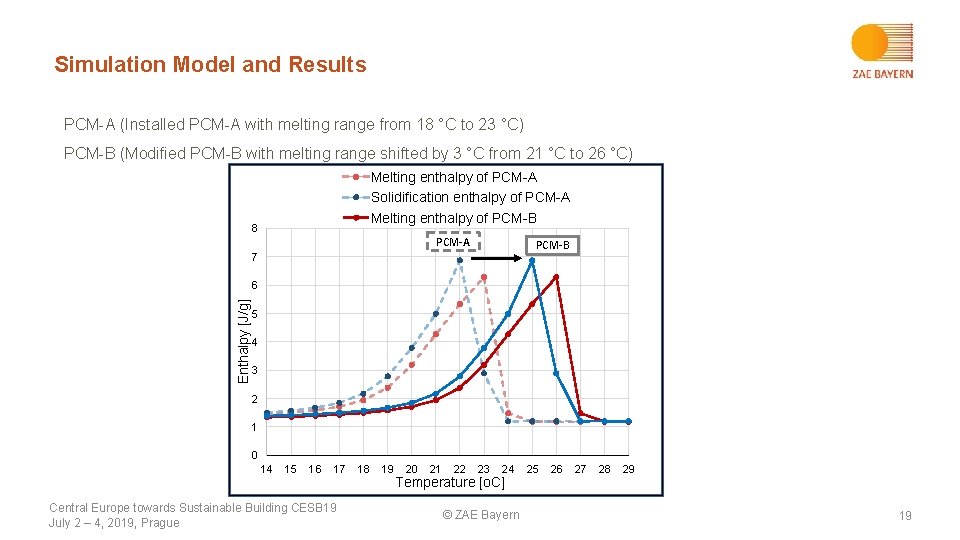
Simulation Model and Results PCM-A (Installed PCM-A with melting range from 18 °C to 23 °C) PCM-B (Modified PCM-B with melting range shifted by 3 °C from 21 °C to 26 °C) Melting enthalpy of PCM-A Solidification enthalpy of PCM-A Melting enthalpy of PCM-B 8 PCM-A PCM-B 7 Enthalpy [J/g] 6 5 4 3 2 1 0 14 15 16 17 Central Europe towards Sustainable Building CESB 19 July 2 – 4, 2019, Prague 18 19 20 21 22 23 24 Temperature [o. C] © ZAE Bayern 25 26 27 28 29 19
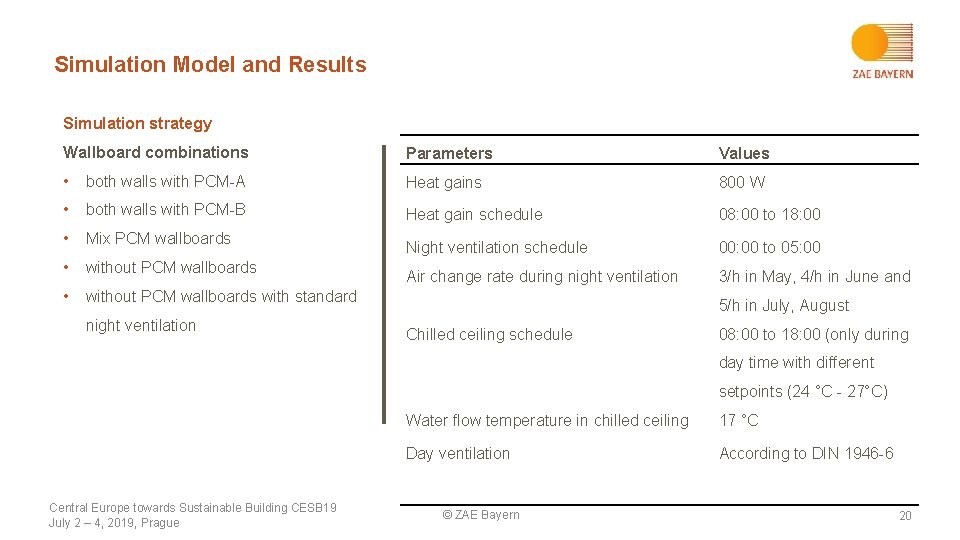
Simulation Model and Results Simulation strategy Wallboard combinations Parameters Values • both walls with PCM-A Heat gains 800 W • both walls with PCM-B Heat gain schedule 08: 00 to 18: 00 • Mix PCM wallboards Night ventilation schedule 00: 00 to 05: 00 • without PCM wallboards Air change rate during night ventilation 3/h in May, 4/h in June and • without PCM wallboards with standard night ventilation 5/h in July, August Chilled ceiling schedule 08: 00 to 18: 00 (only during day time with different setpoints (24 °C - 27°C) Central Europe towards Sustainable Building CESB 19 July 2 – 4, 2019, Prague Water flow temperature in chilled ceiling 17 °C Day ventilation According to DIN 1946 -6 © ZAE Bayern 20
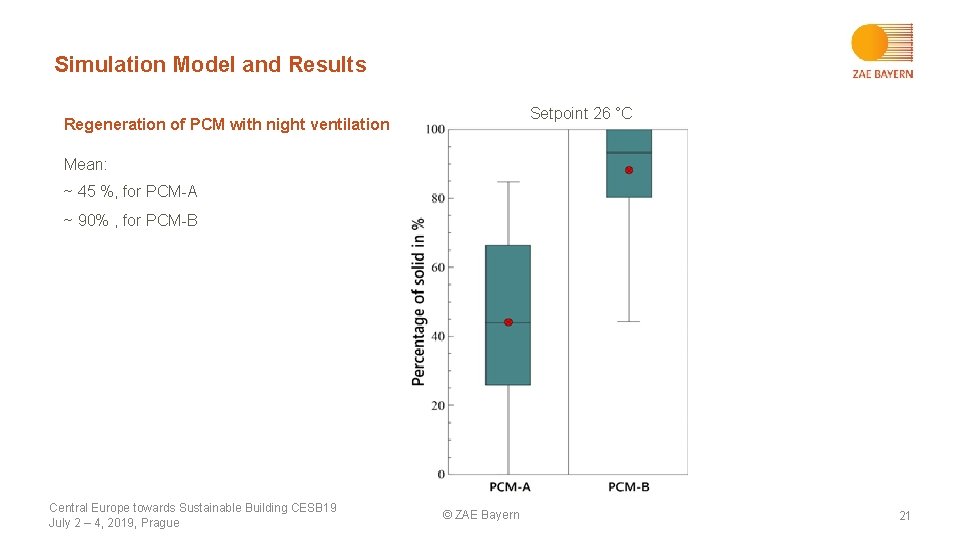
Simulation Model and Results Setpoint 26 °C Regeneration of PCM with night ventilation Mean: ~ 45 %, for PCM-A ~ 90% , for PCM-B Central Europe towards Sustainable Building CESB 19 July 2 – 4, 2019, Prague © ZAE Bayern 21
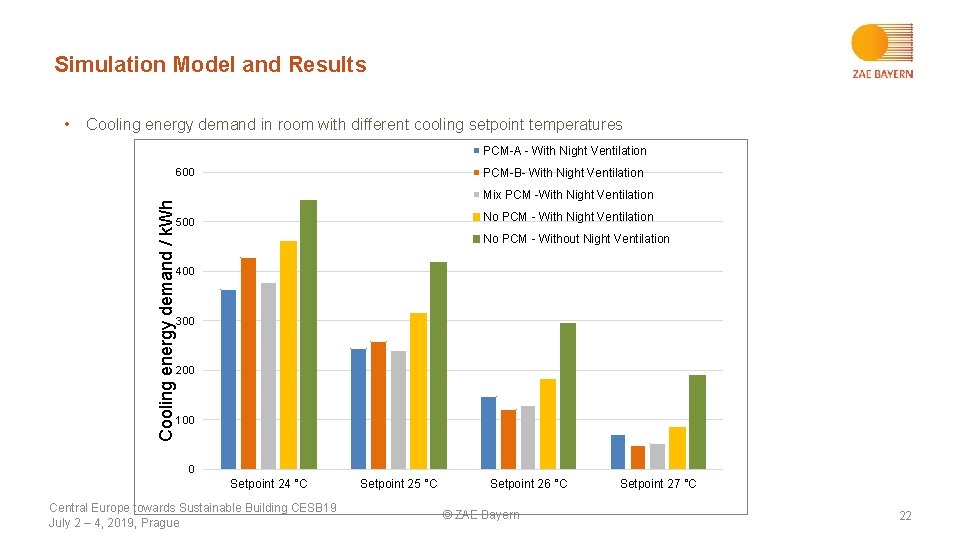
Simulation Model and Results • Cooling energy demand in room with different cooling setpoint temperatures PCM-A - With Night Ventilation PCM-B- With Night Ventilation Cooling energy demand / k. Wh 600 Mix PCM -With Night Ventilation No PCM - With Night Ventilation 500 No PCM - Without Night Ventilation 400 300 200 100 0 Setpoint 24 °C Central Europe towards Sustainable Building CESB 19 July 2 – 4, 2019, Prague Setpoint 25 °C Setpoint 26 °C © ZAE Bayern Setpoint 27 °C 22
Simulation Model and Results Simulation conclusion • Simulation results show that by using proper night ventilation, average regeneration values can achieve approx. 45% for PCM-A. • PCM-B wallboard with regeneration of approx. 90% could be an interesting option in the future concerning the climate change in Europe. • The simulations also show that PCM in rooms can reduce cooling energy demand compared to the room without PCM. • Further effects on the electrical energy demand is shown in the paper. Central Europe towards Sustainable Building CESB 19 July 2 – 4, 2019, Prague © ZAE Bayern 25
Thank you for your attention! Dr. Michaela Reim ZAE Bayern Bavarian Center for Applied Energy Research e. V. Division: Energy Efficiency Magdalene-Schoch-Straße 3 D-97074 Würzburg Tel. : +49 931 70564 -354 Fax: +49 931 70564 -600 michaela. reim@zae-bayern. de http: //www. zae-bayern. de Central Europe towards Sustainable Building CESB 19 © Bavarian Center for Applied Energy Research e. V. © ZAE Bayern All rights reserved, also regarding any disposal, exploitation, reproduction, editing, and dissemination as well as in the case of industrial property rights. . July 2 – 4, 2019, Prague 26
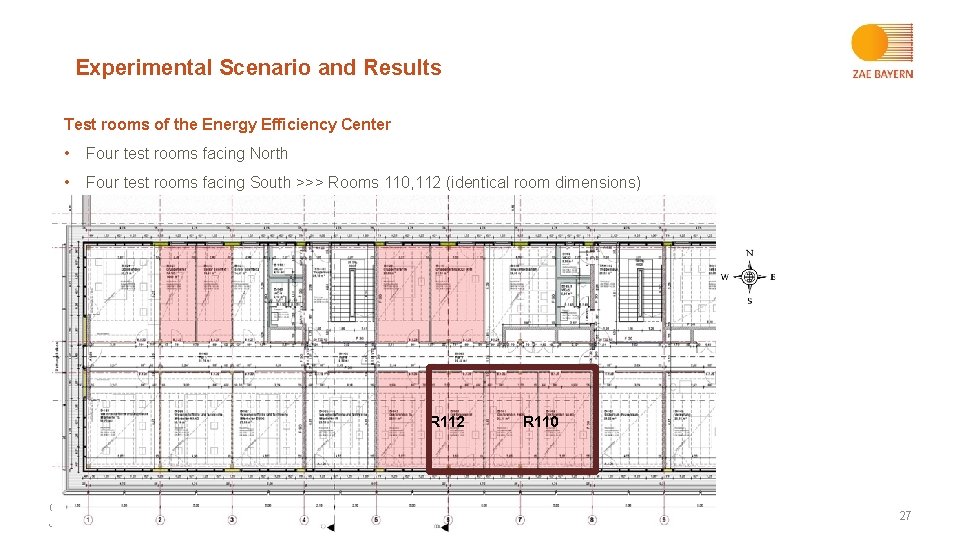
Experimental Scenario and Results Test rooms of the Energy Efficiency Center • Four test rooms facing North • Four test rooms facing South >>> Rooms 110, 112 (identical room dimensions) R 112 Central Europe towards Sustainable Building CESB 19 July 2 – 4, 2019, Prague © ZAE Bayern R 110 27
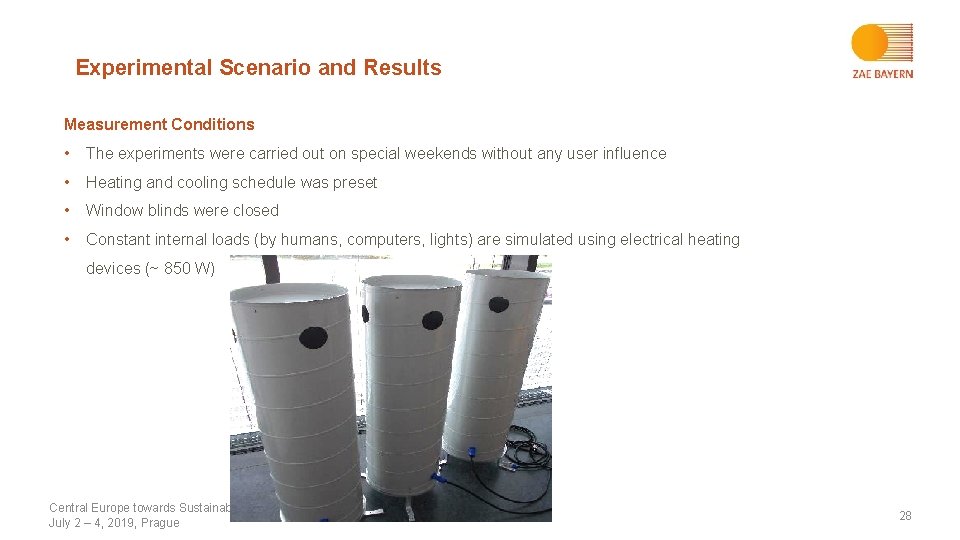
Experimental Scenario and Results Measurement Conditions • The experiments were carried out on special weekends without any user influence • Heating and cooling schedule was preset • Window blinds were closed • Constant internal loads (by humans, computers, lights) are simulated using electrical heating devices (~ 850 W) Central Europe towards Sustainable Building CESB 19 July 2 – 4, 2019, Prague © ZAE Bayern 28
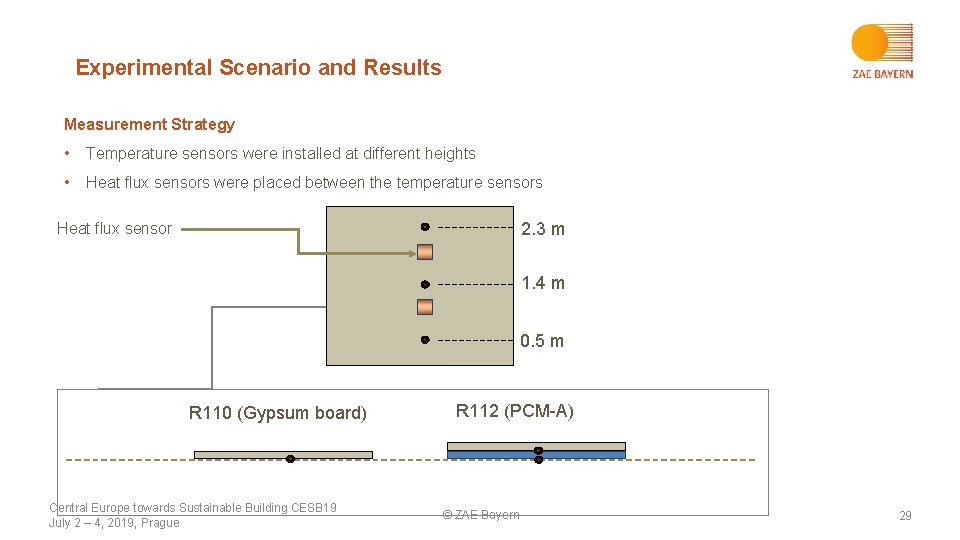
Experimental Scenario and Results Measurement Strategy • Temperature sensors were installed at different heights • Heat flux sensors were placed between the temperature sensors 2. 3 m Heat flux sensor 1. 4 m 0. 5 m R 110 (Gypsum board) Central Europe towards Sustainable Building CESB 19 July 2 – 4, 2019, Prague R 112 (PCM-A) © ZAE Bayern 29
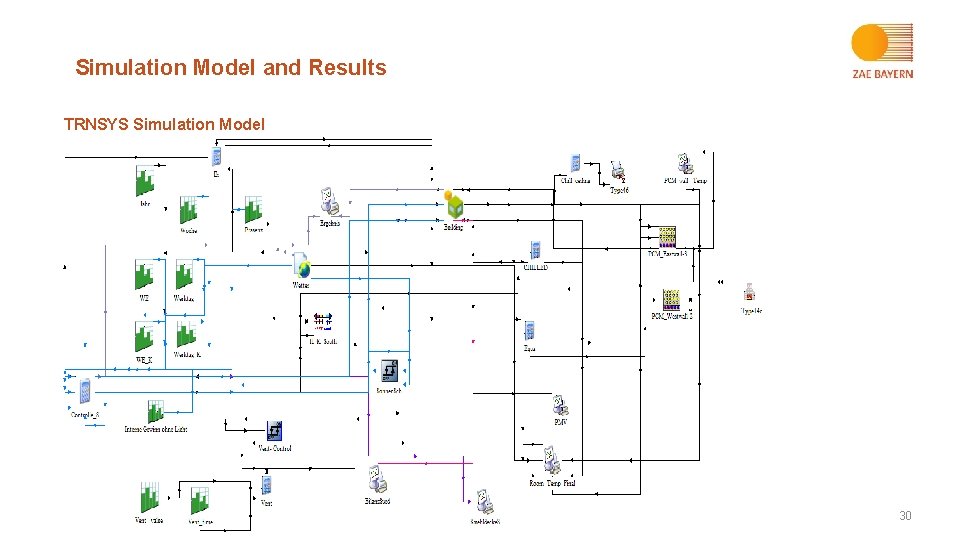
Simulation Model and Results TRNSYS Simulation Model Central Europe towards Sustainable Building CESB 19 July 2 – 4, 2019, Prague © ZAE Bayern 30
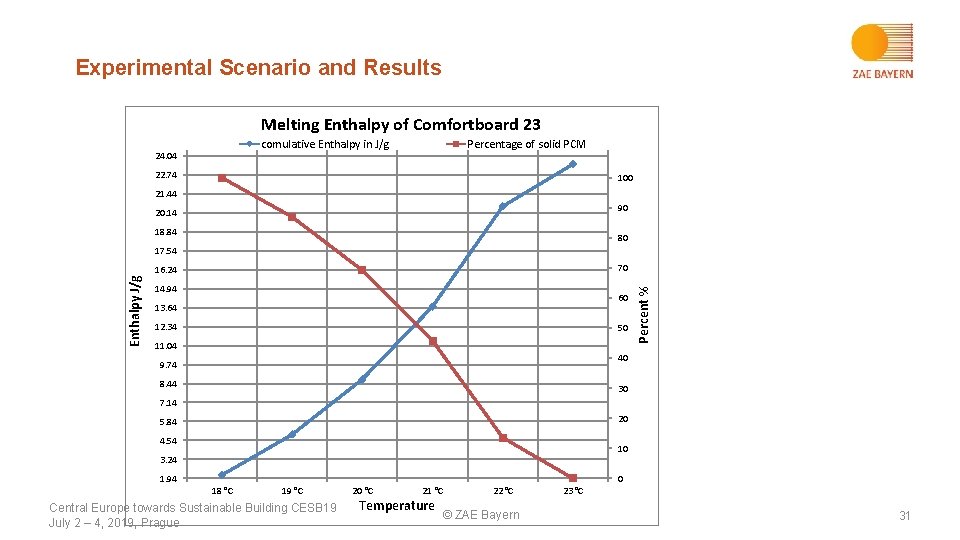
Experimental Scenario and Results Melting Enthalpy of Comfortboard 23 comulative Enthalpy in J/g 24. 04 Percentage of solid PCM 22. 74 100 21. 44 90 20. 14 18. 84 80 70 16. 24 14. 94 60 13. 64 12. 34 50 11. 04 Percent % Enthalpy J/g 17. 54 40 9. 74 8. 44 30 7. 14 20 5. 84 4. 54 10 3. 24 1. 94 0 18 °C 19 °C Central Europe towards Sustainable Building CESB 19 July 2 – 4, 2019, Prague 20 °C 21 °C Temperature 22 °C © ZAE Bayern 23 °C 31
Central Europe towards Sustainable Building CESB 19 © Bavarian Center for Applied Energy Research e. V. © ZAE Bayern All rights reserved, also regarding any disposal, exploitation, reproduction, editing, and dissemination as well as in the case of industrial property rights. July 2 – 4, 2019, Prague 32
- Slides: 30