
Central Commissioning Facility CCF Supplier Information Event February
Central Commissioning Facility (CCF) Supplier Information Event February 11 th 2015
Agenda Welcome and purpose of the event The tendering process The Central Commissioning Function Questions from Potential Suppliers Lunch and networking (12. 30 pm) One-2 -Ones 2 Nursery Milk Procurement Rick Webb Kay Pattison All present
Purpose of the day • • 3 Seeking the views of the market Transparency, accountability Understanding deliverability of key requirements Identification and understanding of risk Creating an environment of collaboration Remove barriers to participating (actual or perceptions) Improve the quality of the process documents DH – Leading the nation’s health and care
CCF Procurement Route Rick Webb MCIPS, Procurement Specialist DH Procurement Services Procurement, Investment and Commercial Division (PICD)
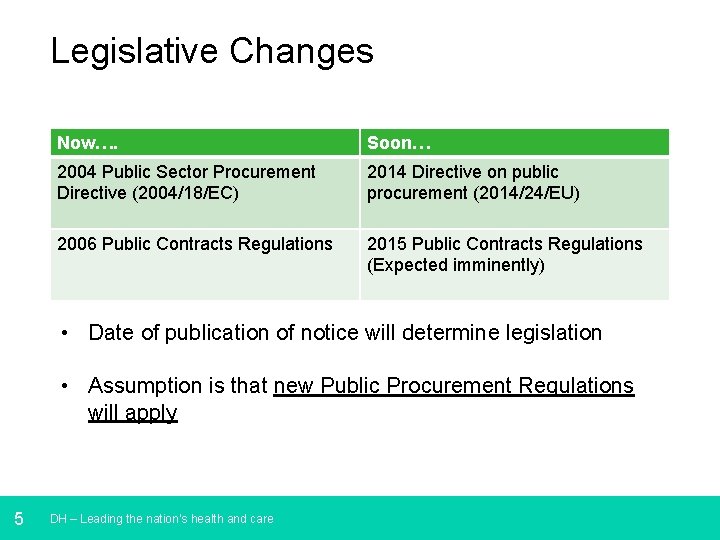
Legislative Changes Now…. Soon… 2004 Public Sector Procurement Directive (2004/18/EC) 2014 Directive on public procurement (2014/24/EU) 2006 Public Contracts Regulations 2015 Public Contracts Regulations (Expected imminently) • Date of publication of notice will determine legislation • Assumption is that new Public Procurement Regulations will apply 5 DH – Leading the nation’s health and care
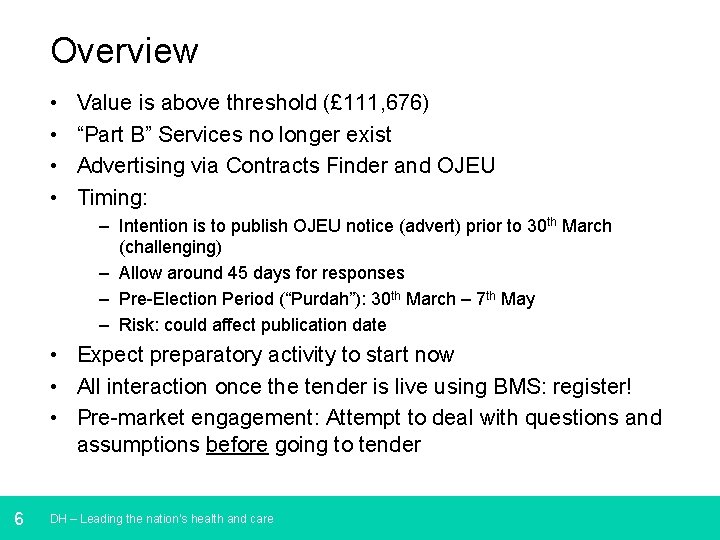
Overview • • Value is above threshold (£ 111, 676) “Part B” Services no longer exist Advertising via Contracts Finder and OJEU Timing: – Intention is to publish OJEU notice (advert) prior to 30 th March (challenging) – Allow around 45 days for responses – Pre-Election Period (“Purdah”): 30 th March – 7 th May – Risk: could affect publication date • Expect preparatory activity to start now • All interaction once the tender is live using BMS: register! • Pre-market engagement: Attempt to deal with questions and assumptions before going to tender 6 DH – Leading the nation’s health and care
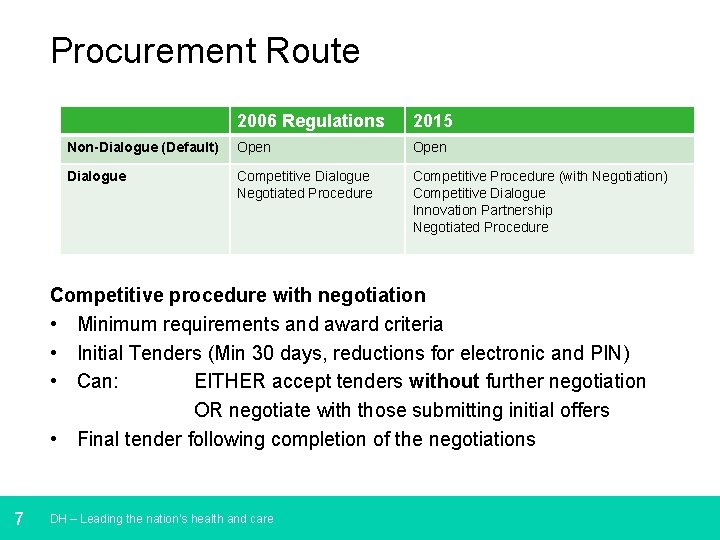
Procurement Route 2006 Regulations 2015 Non-Dialogue (Default) Open Dialogue Competitive Dialogue Negotiated Procedure Competitive Procedure (with Negotiation) Competitive Dialogue Innovation Partnership Negotiated Procedure Competitive procedure with negotiation • Minimum requirements and award criteria • Initial Tenders (Min 30 days, reductions for electronic and PIN) • Can: EITHER accept tenders without further negotiation OR negotiate with those submitting initial offers • Final tender following completion of the negotiations 7 DH – Leading the nation’s health and care
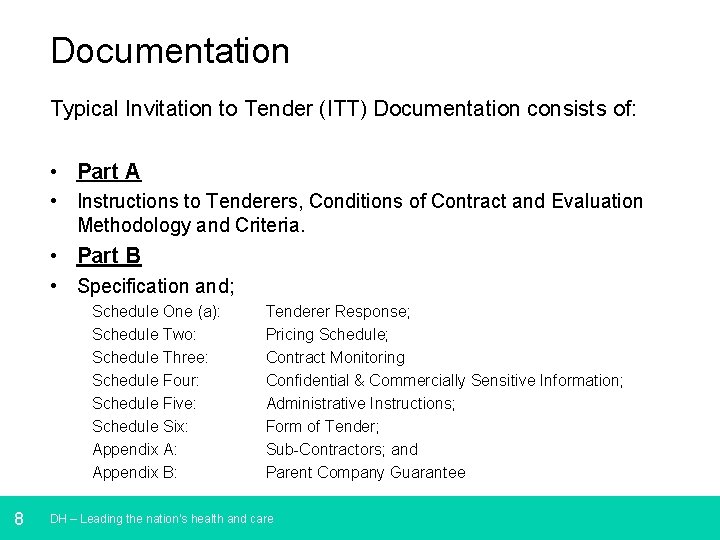
Documentation Typical Invitation to Tender (ITT) Documentation consists of: • Part A • Instructions to Tenderers, Conditions of Contract and Evaluation Methodology and Criteria. • Part B • Specification and; Schedule One (a): Schedule Two: Schedule Three: Schedule Four: Schedule Five: Schedule Six: Appendix A: Appendix B: 8 Tenderer Response; Pricing Schedule; Contract Monitoring Confidential & Commercially Sensitive Information; Administrative Instructions; Form of Tender; Sub-Contractors; and Parent Company Guarantee DH – Leading the nation’s health and care
Evaluation • Gate A – Administrative compliance, completeness • Gate B – Mandatory and discretionary exclusions • Gate C – Backwards facing, historic, selection, suitability, capacity, capability and track record • Section D – Proposal, solution, innovation, documentary support 9 DH – Leading the nation’s health and care
Hints and Tips • • 10 Respond to every question Check document signed and dated as required Provide all the information requested Assume the evaluation panel know nothing about your organisation or the subject matter Make sure the numbers add-up Link each response to the specification and to the evaluation criteria Self-evaluate against the evaluation criteria Submit tender well before the deadline (familiarise with BMS functionality) DH – Leading the nation’s health and care
NIHR Coordinating Centres (CCs) and the Central Commissioning Facility (CCF) Dr. Kay Pattison, Research and Development Directorate
The main work strands of the NIHR are managed by the following NIHR Coordinating Centres (CCs): • research is managed by the Central Commissioning Facility (CCF) and the NIHR Evaluation, Studies and Trials Coordinating Centre (NETSCC) • infrastructure is managed by the Clinical Research Network Coordinating Centre (CRNCC) and the (CCF) • information management and research management systems are managed by the CRNCC and through a cooperative venture between the work strands and the Department of Health • training and career development of our faculty is managed by the NIHR Trainees Coordinating Centre (TCC) 12 NIHR Commissioning Centres (CCs) and the Central Commissioning Facility (CCF)
CCF Research funding programmes: • Invention for Innovation (i 4 i) • Programme Grants for Applied Research (PGf. AR) • Programme Development Grants (PDG) • Research for Patient Benefit (Rf. PB) • Health Innovation Challenge Fund 13 NIHR Commissioning Centres (CCs) and the Central Commissioning Facility (CCF)
Research Design Service (RDS) To support applicants applying for research Programme funding • Remit • Methodology • Patient and public involvement 14 NIHR Commissioning Centres (CCs) and the Central Commissioning Facility (CCF)
Research schools, centre and units: • • • 15 Blood and Transplant Research Units (BTRUs) Health Protection Research Units (HPRUs) School for Primary Care Research (SPRC) School for Public Health Research (SPHR) School for Social Care Research (SSCR) Surgical Reconstruction and Microbiology Research Centre (SRMRC). NIHR Commissioning Centres (CCs) and the Central Commissioning Facility (CCF)
Policy Research Programme (PRP) The CCF manages the Department of Health's Policy Research Programme (PRP) which involves commissioning research projects and units. 16 NIHR Commissioning Centres (CCs) and the Central Commissioning Facility (CCF)
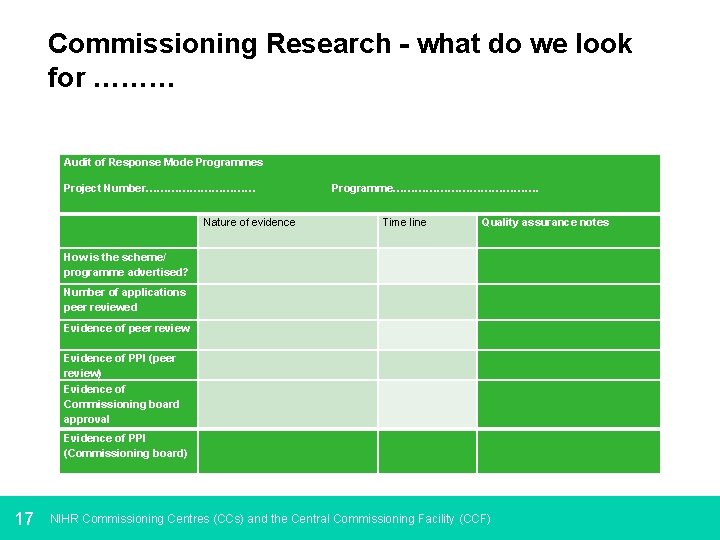
Commissioning Research - what do we look for ……… Audit of Response Mode Programmes Project Number…………… Programme…………………. 17 Nature of evidence Time line Quality assurance notes How is the scheme/ programme advertised? Number of applications peer reviewed Evidence of peer review Evidence of PPI (peer review) Evidence of Commissioning board approval Evidence of PPI (Commissioning board) NIHR Commissioning Centres (CCs) and the Central Commissioning Facility (CCF)
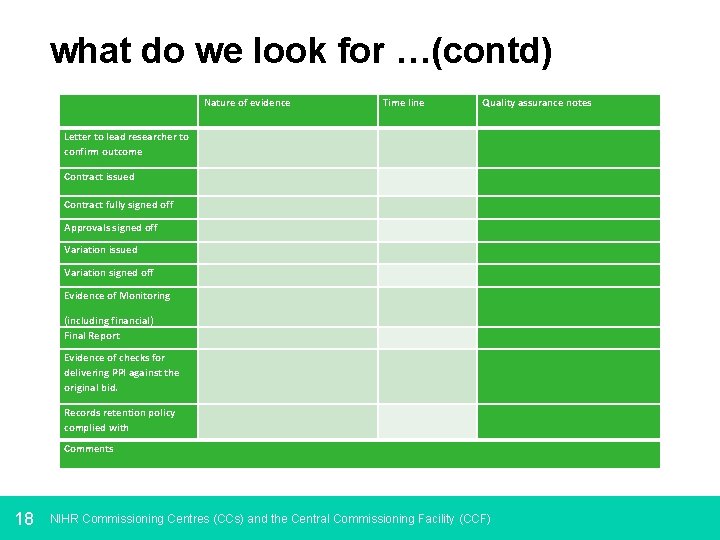
what do we look for …(contd) Nature of evidence Time line Quality assurance notes Letter to lead researcher to confirm outcome Contract issued Contract fully signed off Approvals signed off Variation issued Variation signed off Evidence of Monitoring (including financial) Final Report Evidence of checks for delivering PPI against the original bid. Records retention policy complied with Comments 18 NIHR Commissioning Centres (CCs) and the Central Commissioning Facility (CCF)
Infrastructure NIHR Infrastructure is as follows: • Biomedical Research Centres (BRCs) • Biomedical Research Units (BRUs) • Clinical Research Facilities (CRFs) for Experimental Medicine • Collaborations for Leadership in Applied Health Research and Care (CLAHRCs) • Diagnostic Evidence Co-operative (DECs) • Healthcare Technology Co-operative (HTCs) • Patient Safety Translational Research Centre (PSTRCs) 19 NIHR Commissioning Centres (CCs) and the Central Commissioning Facility (CCF)
Support for Clinical Trials • The CCF will support the NIHR in providing information on recruitment to clinical trials, including commercial trials. NOCRI • The NIHR Office for Clinical Research Infrastructure (NOCRI) is hosted by CCF and based in London. NOCRI works closely with the NIHR infrastructure managed by CCF. 20 NIHR Commissioning Centres (CCs) and the Central Commissioning Facility (CCF)
Faculty The CCF will support NIHR Faculty which brings together and supports the growing NIHR community of health research professionals, including clinical and support staff from all relevant fields and professional backgrounds. Senior Investigators are the NIHR’s pre-eminent researchers. The NIHR maintains a college of over 200 Senior Investigators. 21 NIHR Commissioning Centres (CCs) and the Central Commissioning Facility (CCF)
Patient and Public Involvement (PPI) • PPI is core to CCF’s review and commissioning process. • Engaging patients and members of the public in research leads to treatments that meet their needs, is more reliable and more likely to be put into practice. 22 NIHR Commissioning Centres (CCs) and the Central Commissioning Facility (CCF)
NIHR Coordinating Centres (CCs) and the Central Commissioning Facility (CCF) Dr Kay Pattison, Research and Development Directorate
1: 1 Interviews with Suppliers Purpose of 1 -2 -1 sessions Opportunity to provide input and ideas and ask further questions about the requirements. Can either be based on what you’ve seen and heard today or on any other related topic. A summary of the discussions will be publisehed 24
Q&A Session • Please state your name and organisation when asking questions • All Questions and Answers will be noted and published 25
- Slides: 25