
Centers for Disease Control and Prevention Overview of
- Slides: 36
Centers for Disease Control and Prevention Overview of the Center for State, Tribal, Local, and Territorial Support (proposed) Steven L. Reynolds, MPH Deputy Director, Center for State, Tribal, Local and Territorial Support Centers for Disease Control and Prevention
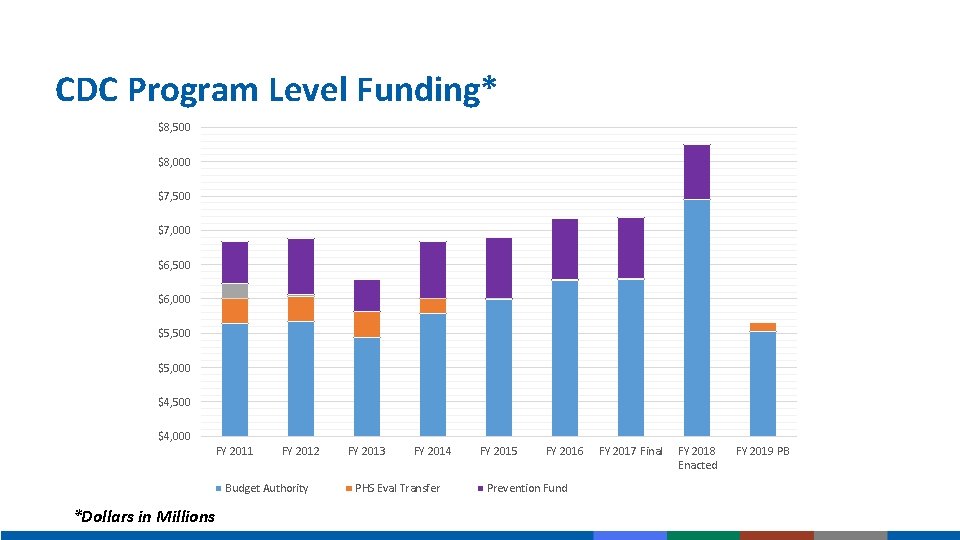
CDC Program Level Funding* $8, 500 $8, 000 $7, 500 $7, 000 $6, 500 $6, 000 $5, 500 $5, 000 $4, 500 $4, 000 FY 2011 FY 2012 Budget Authority *Dollars in Millions FY 2013 FY 2014 PHS Eval Transfer FY 2015 FY 2016 FY 2017 Final Prevention Fund FY 2018 Enacted FY 2019 PB
CSTLTS Mission Advance US public health agency and system performance, capacity, agility, and resilience
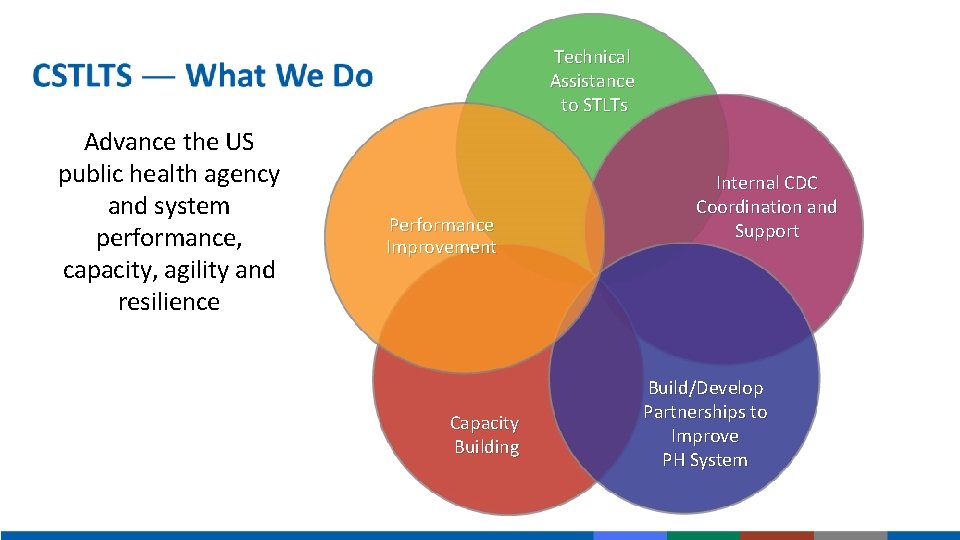
Technical Assistance to STLTs Advance the US public health agency and system performance, capacity, agility and resilience Performance Improvement Capacity Building Internal CDC Coordination and Support Build/Develop Partnerships to Improve PH System
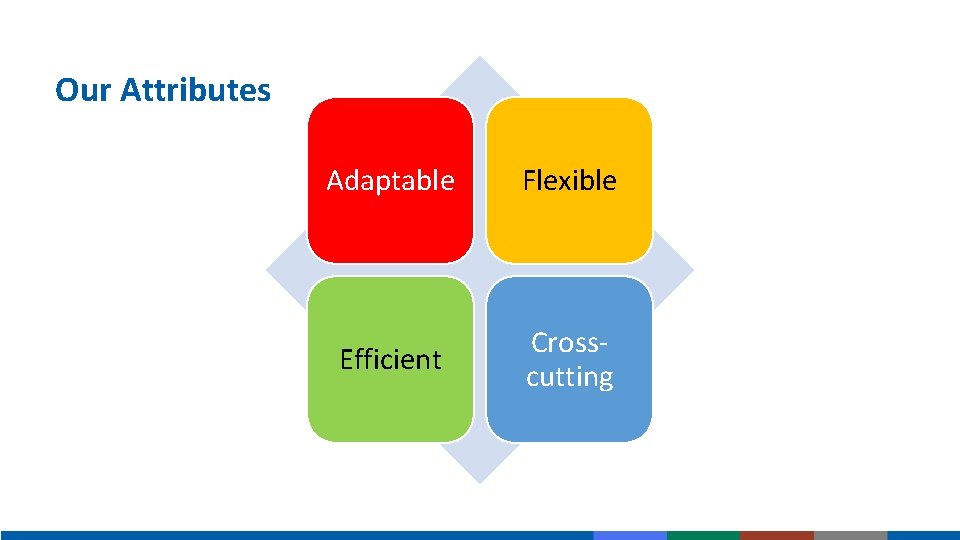
Our Attributes Adaptable Flexible Efficient Crosscutting
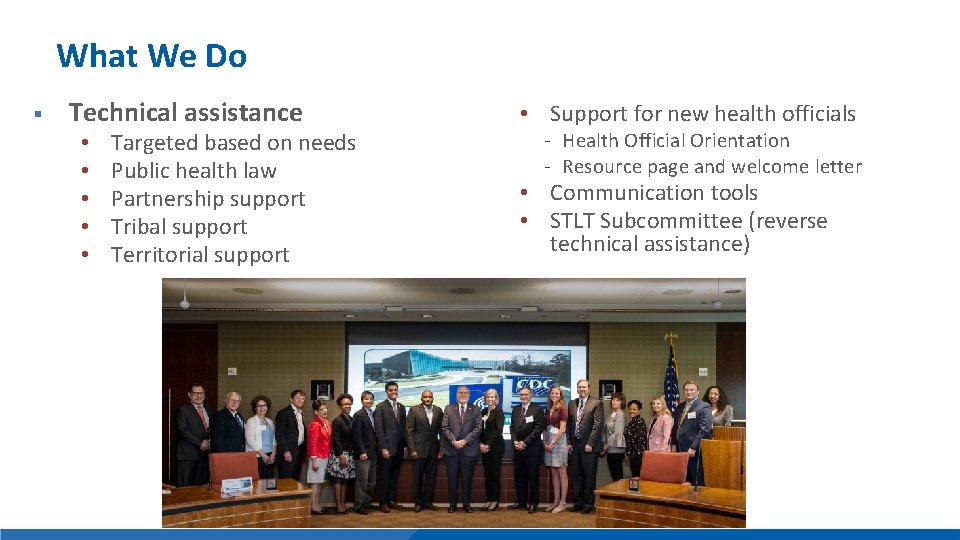
What We Do § Technical assistance • • • Targeted based on needs Public health law Partnership support Tribal support Territorial support • Support for new health officials - Health Official Orientation - Resource page and welcome letter • Communication tools • STLT Subcommittee (reverse technical assistance)
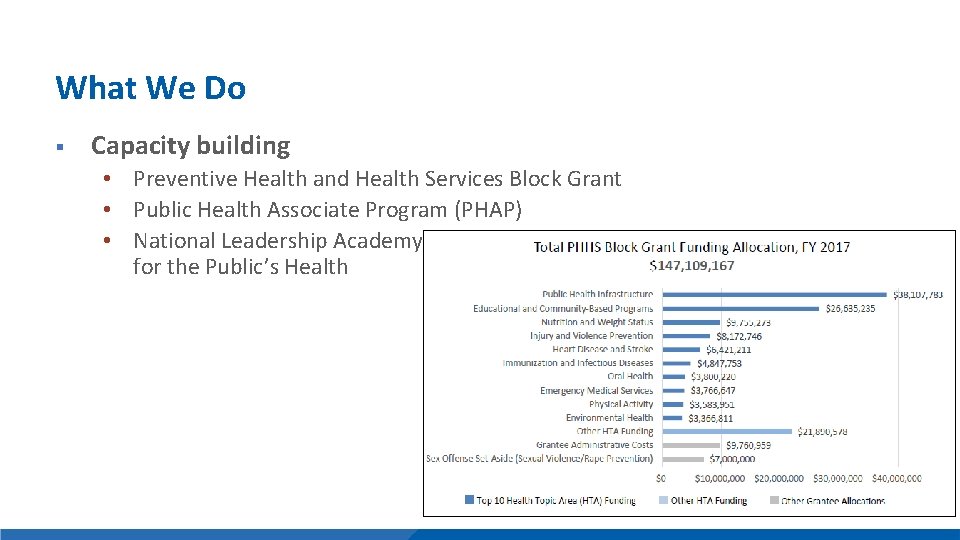
What We Do § Capacity building • Preventive Health and Health Services Block Grant • Public Health Associate Program (PHAP) • National Leadership Academy for the Public’s Health
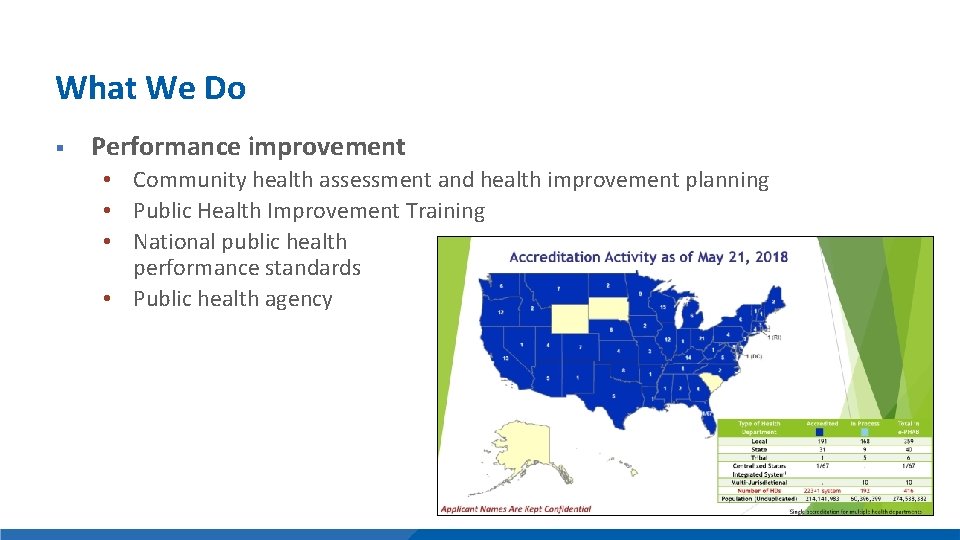
What We Do § Performance improvement • Community health assessment and health improvement planning • Public Health Improvement Training • National public health performance standards • Public health agency accreditation
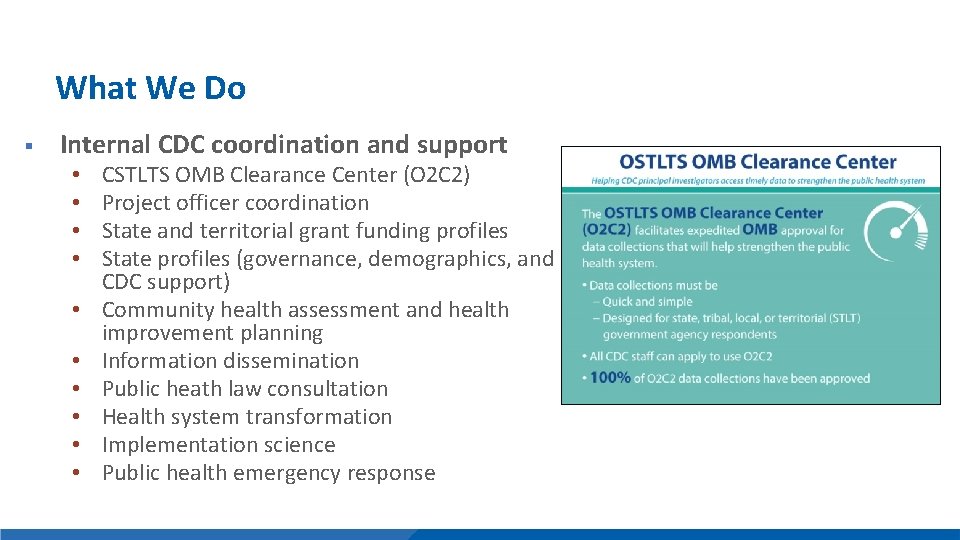
What We Do § Internal CDC coordination and support • • • CSTLTS OMB Clearance Center (O 2 C 2) Project officer coordination State and territorial grant funding profiles State profiles (governance, demographics, and CDC support) Community health assessment and health improvement planning Information dissemination Public heath law consultation Health system transformation Implementation science Public health emergency response
CSTLTS Networks and Relationships § External • • State health officials State deputies Public health attorneys Performance improvement and quality improvement managers PHAP host site supervisors Territorial health officials Big Cities health officials National partners § Internal • • CIO leaders CDC field staff Project officers PHAP mentors
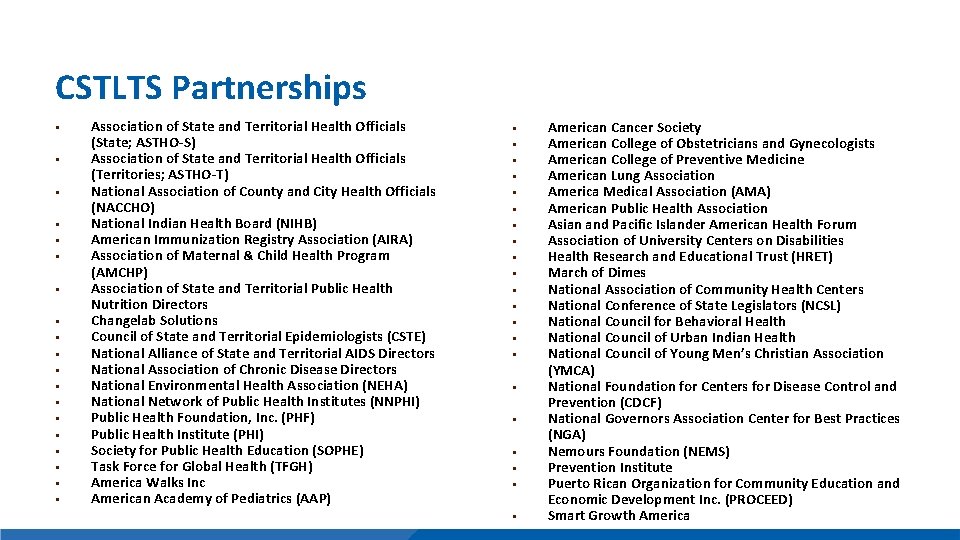
CSTLTS Partnerships § § § § § Association of State and Territorial Health Officials (State; ASTHO-S) Association of State and Territorial Health Officials (Territories; ASTHO-T) National Association of County and City Health Officials (NACCHO) National Indian Health Board (NIHB) American Immunization Registry Association (AIRA) Association of Maternal & Child Health Program (AMCHP) Association of State and Territorial Public Health Nutrition Directors Changelab Solutions Council of State and Territorial Epidemiologists (CSTE) National Alliance of State and Territorial AIDS Directors National Association of Chronic Disease Directors National Environmental Health Association (NEHA) National Network of Public Health Institutes (NNPHI) Public Health Foundation, Inc. (PHF) Public Health Institute (PHI) Society for Public Health Education (SOPHE) Task Force for Global Health (TFGH) America Walks Inc American Academy of Pediatrics (AAP) § § § § § § American Cancer Society American College of Obstetricians and Gynecologists American College of Preventive Medicine American Lung Association America Medical Association (AMA) American Public Health Association Asian and Pacific Islander American Health Forum Association of University Centers on Disabilities Health Research and Educational Trust (HRET) March of Dimes National Association of Community Health Centers National Conference of State Legislators (NCSL) National Council for Behavioral Health National Council of Urban Indian Health National Council of Young Men’s Christian Association (YMCA) National Foundation for Centers for Disease Control and Prevention (CDCF) National Governors Association Center for Best Practices (NGA) Nemours Foundation (NEMS) Prevention Institute Puerto Rican Organization for Community Education and Economic Development Inc. (PROCEED) Smart Growth America
Public Health System § Complex § Underfunded § Sometimes Mislead - “Politics man, Politics”
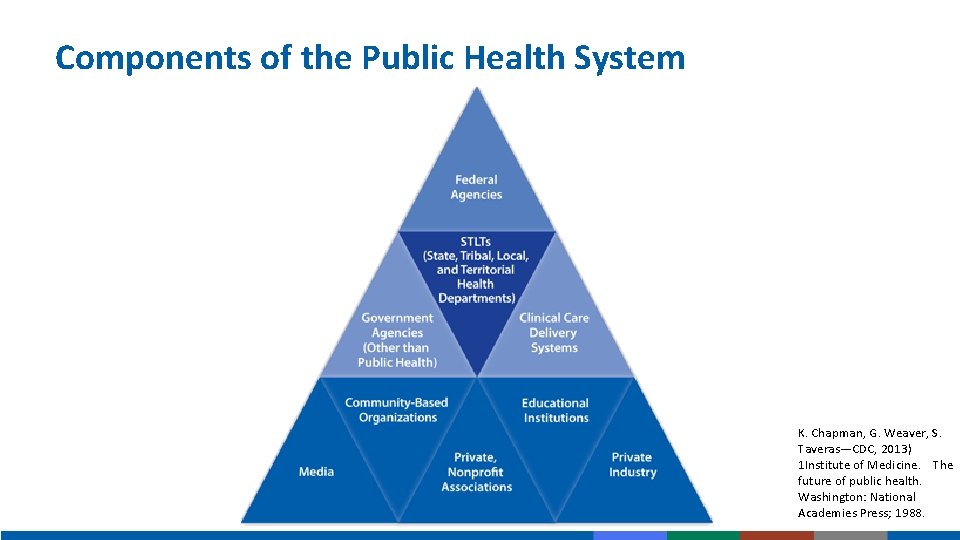
Components of the Public Health System K. Chapman, G. Weaver, S. Taveras—CDC, 2013) 1 Institute of Medicine. The future of public health. Washington: National Academies Press; 1988.
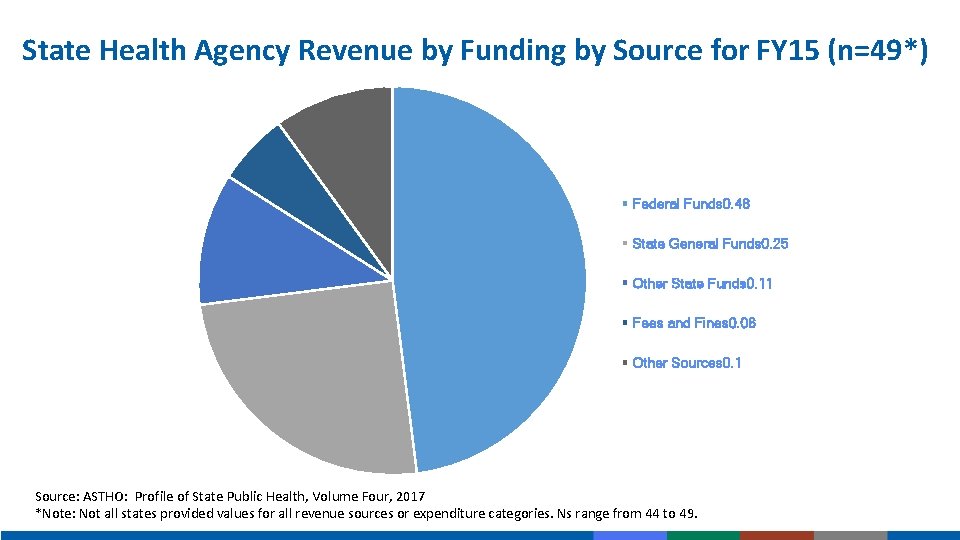
State Health Agency Revenue by Funding by Source for FY 15 (n=49*) Federal Funds 0. 48 State General Funds 0. 25 Other State Funds 0. 11 Fees and Fines 0. 06 Other Sources 0. 1 Source: ASTHO: Profile of State Public Health, Volume Four, 2017 Source: ASTHO: Profile of State Public Health, Volume Two, 2011 *Note: Not all states provided values for all revenue sources or expenditure categories. Ns range from 44 to 49.
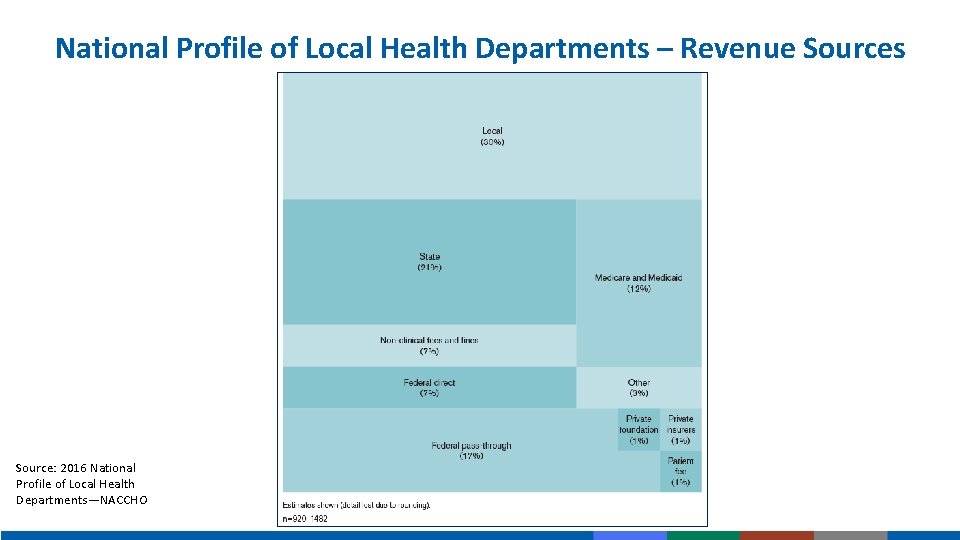
National Profile of Local Health Departments – Revenue Sources Source: 2016 National Profile of Local Health Departments—NACCHO
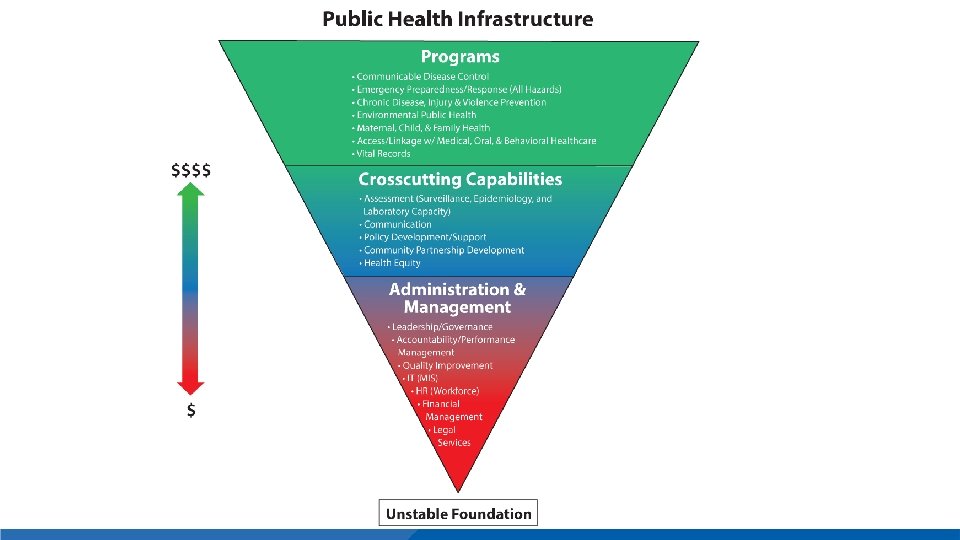
Public Health Funding Challenge § Traditionally, federal public health grant awards to state and local health departments have been narrowly segmented in focus, despite pursuing many common goals and serving overlapping populations 1 § This often leads to organizational silos, fragmented funding vehicles and governance, and limited external partnerships, and has contributed to the unstable foundation for public health infrastructure 1, 2 1. The High Achieving Governmental Health Department in 2020 as the Community Chief Health Strategist. Public Health Leadership Forum. RESOLVE; 2014 2. Blending, Braiding, and Block-Granting Funds for Public Health and Prevention: Implications for States. The National Academy for State Health Policy. December; 2017
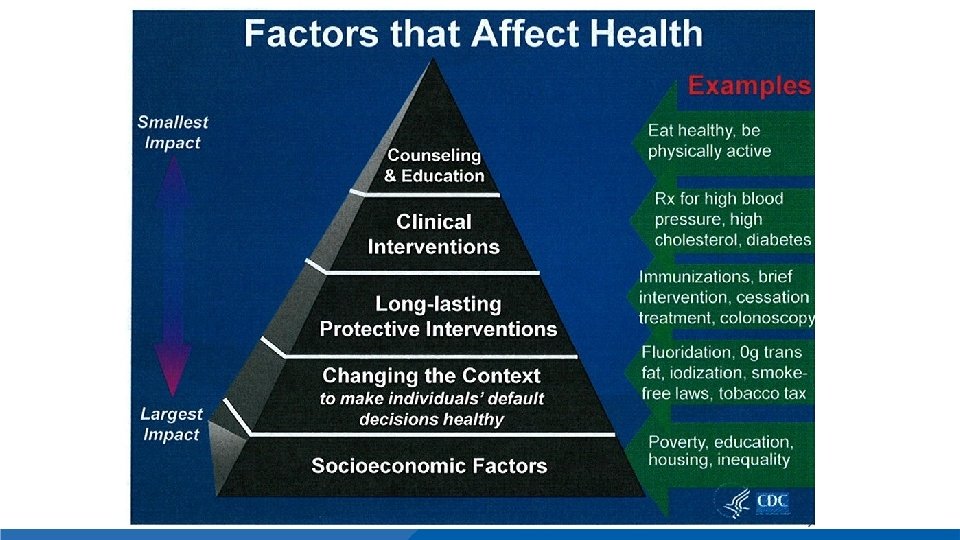
Upstream Determinants of Health § § How do we operate, fund and function upstream? How do we provide quick gains while making a generational change?
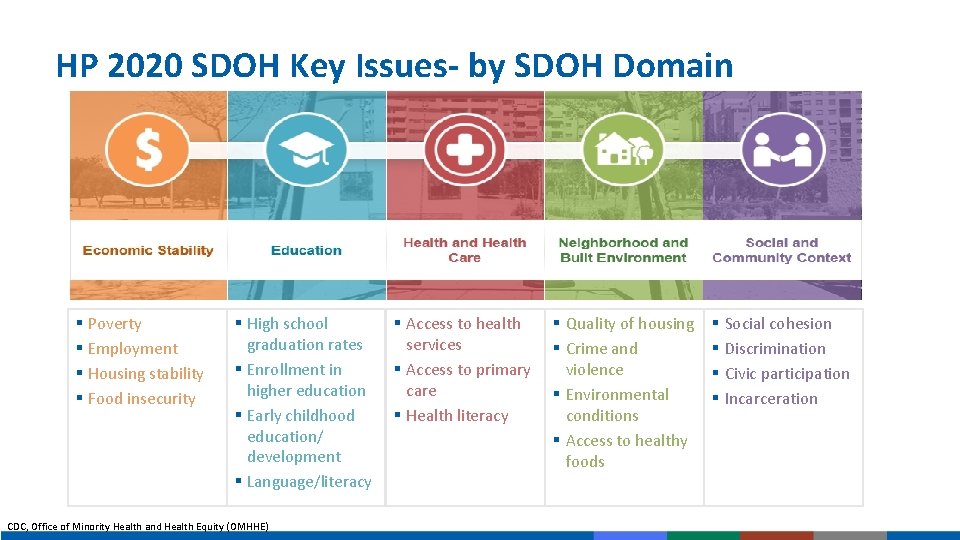
HP 2020 SDOH Key Issues- by SDOH Domain § Poverty § Employment § Housing stability § Food insecurity § High school graduation rates § Enrollment in higher education § Early childhood education/ development § Language/literacy CDC, Office of Minority Health and Health Equity (OMHHE) § Access to health § Quality of housing services § Crime and § Access to primary violence care § Environmental § Health literacy conditions § Access to healthy foods § Social cohesion § Discrimination § Civic participation § Incarceration
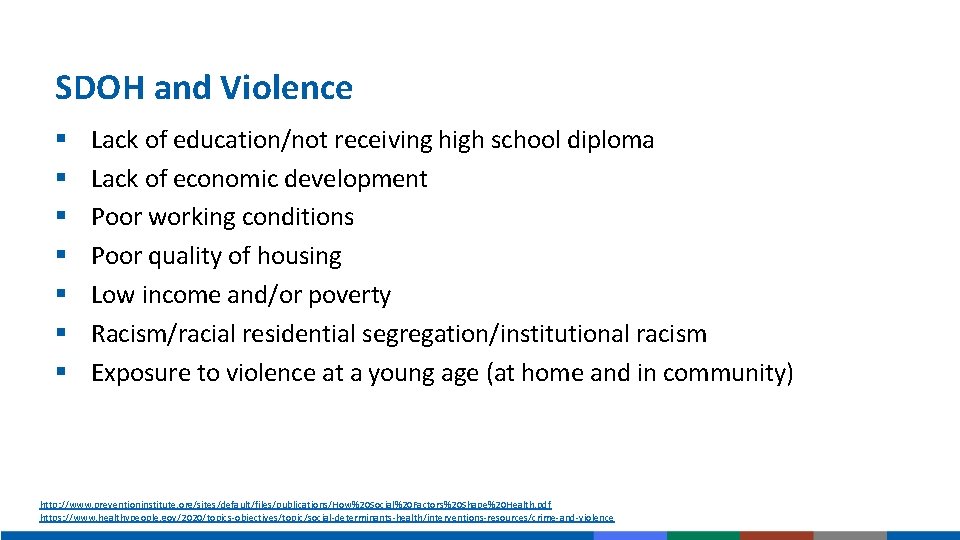
SDOH and Violence § § § § Lack of education/not receiving high school diploma Lack of economic development Poor working conditions Poor quality of housing Low income and/or poverty Racism/racial residential segregation/institutional racism Exposure to violence at a young age (at home and in community) http: //www. preventioninstitute. org/sites/default/files/publications/How%20 Social%20 Factors%20 Shape%20 Health. pdf https: //www. healthypeople. gov/2020/topics-objectives/topic/social-determinants-health/interventions-resources/crime-and-violence
SDOH and Opioids § § § § Lack of access to health care (substance abuse treatment) Cultural norms (within the community) Social environment (family, social networks, peer pressure) Poverty Substandard working conditions Poor living conditions/homelessness Social stigmatization with regards to seeking treatment (when available) https: //www. ncbi. nlm. nih. gov/pmc/articles/PMC 5846593/
SDOH and Adverse Childhood Experiences (ACEs) § Exposure to violence § Incarcerations § High poverty, low-resource neighborhoods https: //www. ncbi. nlm. nih. gov/pmc/articles/PMC 4991352/
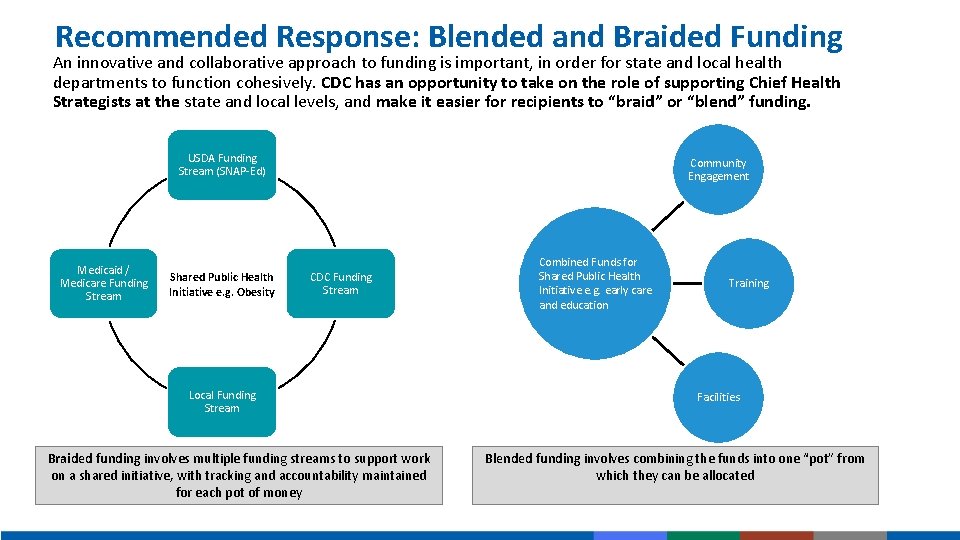
Recommended Response: Blended and Braided Funding An innovative and collaborative approach to funding is important, in order for state and local health departments to function cohesively. CDC has an opportunity to take on the role of supporting Chief Health Strategists at the state and local levels, and make it easier for recipients to “braid” or “blend” funding. USDA Funding Stream (SNAP-Ed) Medicaid / Medicare Funding Stream Shared Public Health Initiative e. g. Obesity Community Engagement CDC Funding Stream Local Funding Stream Braided funding involves multiple funding streams to support work on a shared initiative, with tracking and accountability maintained for each pot of money Combined Funds for Shared Public Health Initiative e. g. early care and education Training Facilities Blended funding involves combining the funds into one “pot” from which they can be allocated
Needed Policy/Systems Changes § Authority: need for NOFOs to give local flexibility on the use of funding § Capacity Building: financial systems, mechanisms, skills, and tools in place to take advantage of the flexibility in funding; adoption of proven blended/braided methods that lead to greater efficiencies § Accountability: funders need to be assured the funded organization/health department is using the money to accomplish what was intended for it to accomplish
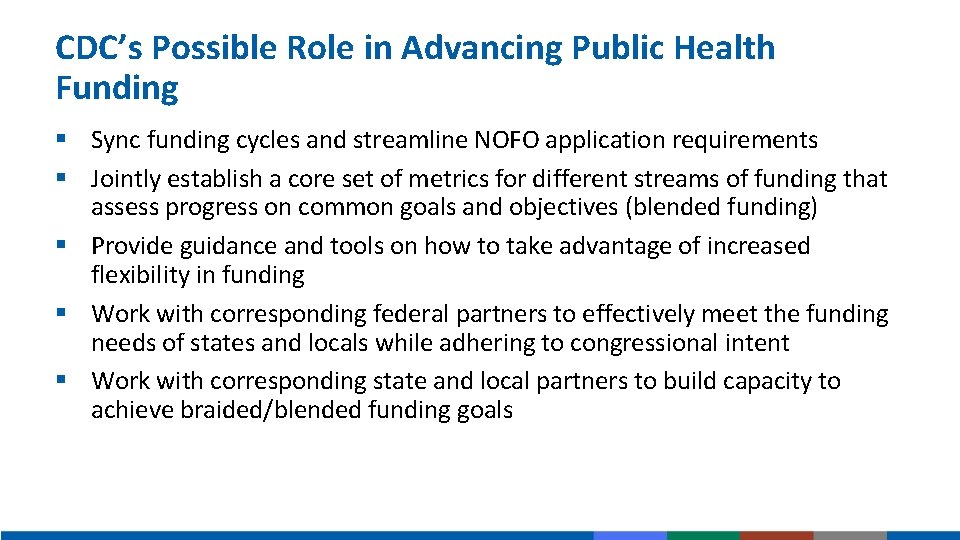
CDC’s Possible Role in Advancing Public Health Funding § Sync funding cycles and streamline NOFO application requirements § Jointly establish a core set of metrics for different streams of funding that assess progress on common goals and objectives (blended funding) § Provide guidance and tools on how to take advantage of increased flexibility in funding § Work with corresponding federal partners to effectively meet the funding needs of states and locals while adhering to congressional intent § Work with corresponding state and local partners to build capacity to achieve braided/blended funding goals
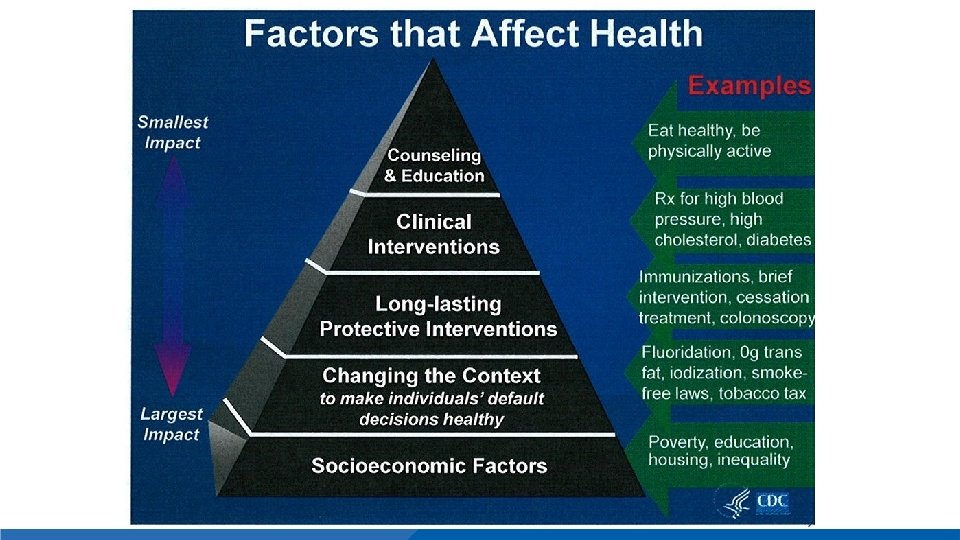
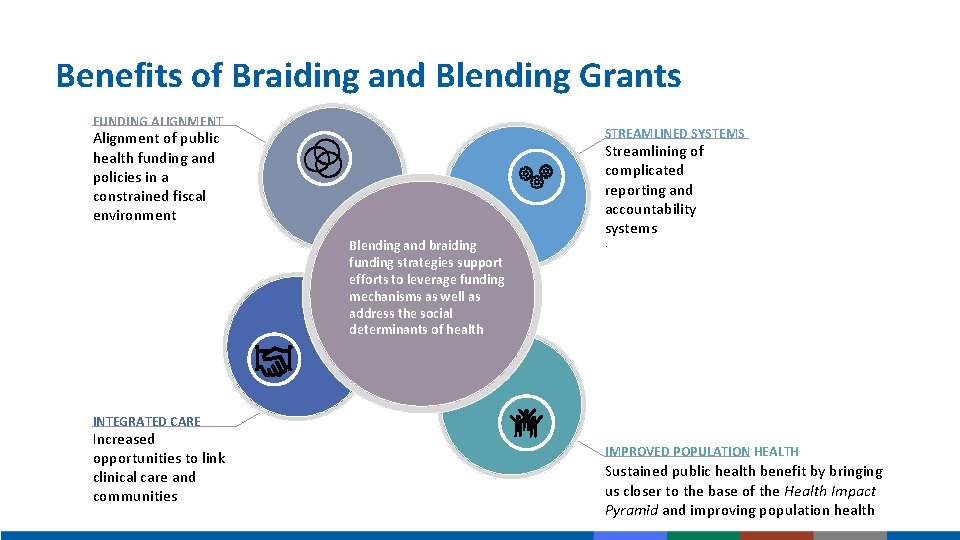
Benefits of Braiding and Blending Grants FUNDING ALIGNMENT STREAMLINED SYSTEMS Alignment of public health funding and policies in a constrained fiscal environment Blending and braiding funding strategies support efforts to leverage funding mechanisms as well as address the social determinants of health Streamlining of complicated reporting and accountability systems. INTEGRATED CARE Increased opportunities to link clinical care and communities IMPROVED POPULATION HEALTH Sustained public health benefit by bringing us closer to the base of the Health Impact Pyramid and improving population health
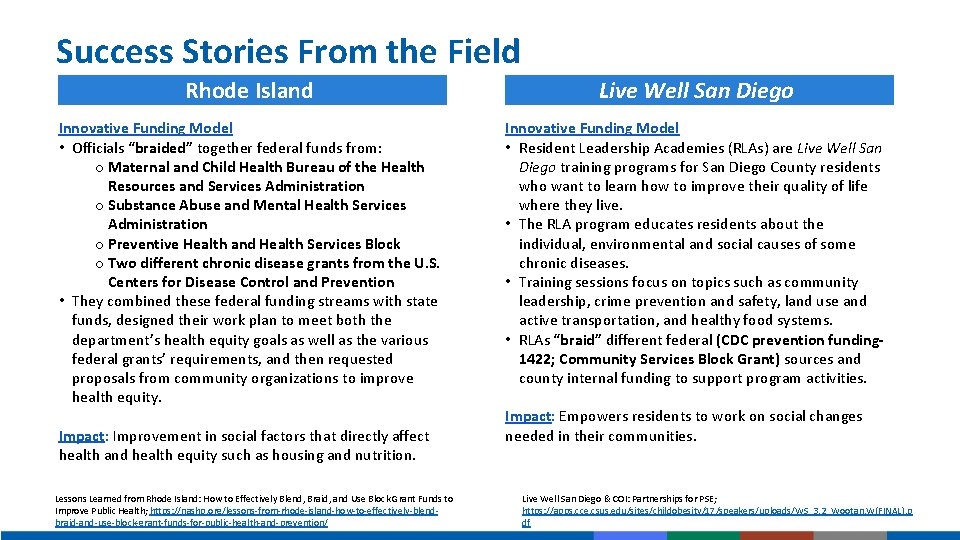
Success Stories From the Field Rhode Island Live Well San Diego Innovative Funding Model • Officials “braided” together federal funds from: o Maternal and Child Health Bureau of the Health Resources and Services Administration o Substance Abuse and Mental Health Services Administration o Preventive Health and Health Services Block o Two different chronic disease grants from the U. S. Centers for Disease Control and Prevention • They combined these federal funding streams with state funds, designed their work plan to meet both the department’s health equity goals as well as the various federal grants’ requirements, and then requested proposals from community organizations to improve health equity. Innovative Funding Model • Resident Leadership Academies (RLAs) are Live Well San Diego training programs for San Diego County residents who want to learn how to improve their quality of life where they live. • The RLA program educates residents about the individual, environmental and social causes of some chronic diseases. • Training sessions focus on topics such as community leadership, crime prevention and safety, land use and active transportation, and healthy food systems. • RLAs “braid” different federal (CDC prevention funding- 1422; Community Services Block Grant) sources and county internal funding to support program activities. Impact: Improvement in social factors that directly affect health and health equity such as housing and nutrition. Lessons Learned from Rhode Island: How to Effectively Blend, Braid, and Use Block Grant Funds to Improve Public Health; https: //nashp. org/lessons-from-rhode-island-how-to-effectively-blendbraid-and-use-block-grant-funds-for-public-health-and-prevention/ Impact: Empowers residents to work on social changes needed in their communities. Live Well San Diego & COI: Partnerships for PSE; https: //apps. cce. csus. edu/sites/childobesity/17/speakers/uploads/WS_3. 2_Wootan, W(FINAL). p df
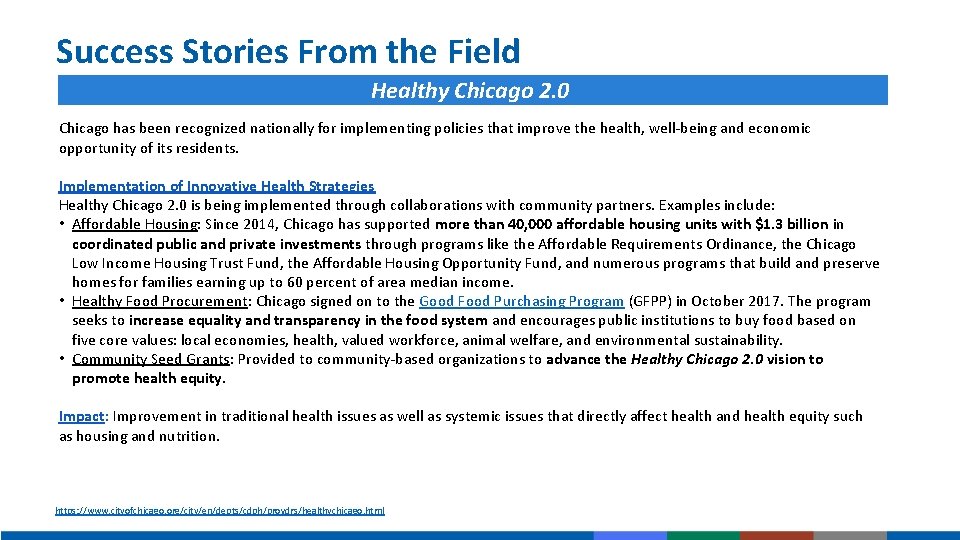
Success Stories From the Field Healthy Chicago 2. 0 Chicago has been recognized nationally for implementing policies that improve the health, well-being and economic opportunity of its residents. Implementation of Innovative Health Strategies Healthy Chicago 2. 0 is being implemented through collaborations with community partners. Examples include: • Affordable Housing: Since 2014, Chicago has supported more than 40, 000 affordable housing units with $1. 3 billion in coordinated public and private investments through programs like the Affordable Requirements Ordinance, the Chicago Low Income Housing Trust Fund, the Affordable Housing Opportunity Fund, and numerous programs that build and preserve homes for families earning up to 60 percent of area median income. • Healthy Food Procurement: Chicago signed on to the Good Food Purchasing Program (GFPP) in October 2017. The program seeks to increase equality and transparency in the food system and encourages public institutions to buy food based on five core values: local economies, health, valued workforce, animal welfare, and environmental sustainability. • Community Seed Grants: Provided to community-based organizations to advance the Healthy Chicago 2. 0 vision to promote health equity. Impact: Improvement in traditional health issues as well as systemic issues that directly affect health and health equity such as housing and nutrition. https: //www. cityofchicago. org/city/en/depts/cdph/provdrs/healthychicago. html
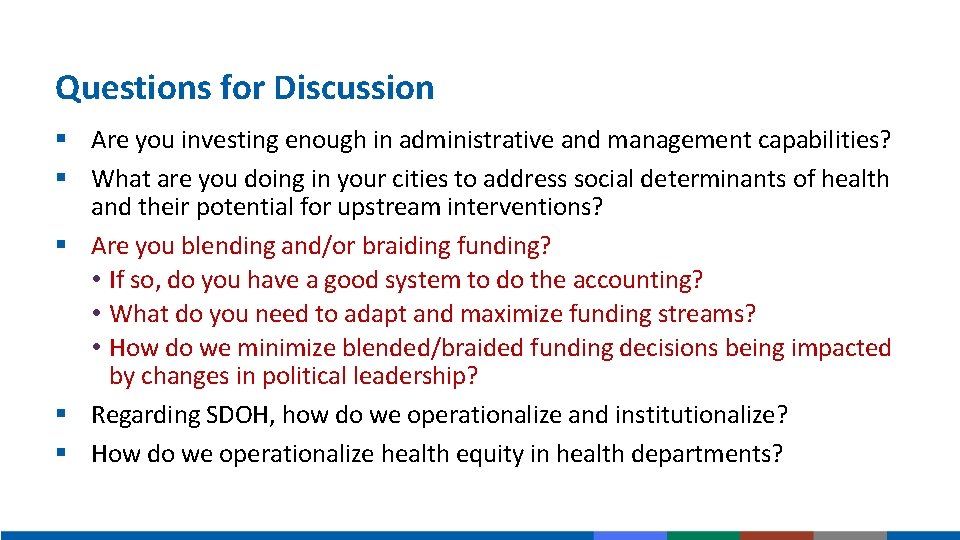
Questions for Discussion § Are you investing enough in administrative and management capabilities? § What are you doing in your cities to address social determinants of health and their potential for upstream interventions? § Are you blending and/or braiding funding? • If so, do you have a good system to do the accounting? • What do you need to adapt and maximize funding streams? • How do we minimize blended/braided funding decisions being impacted by changes in political leadership? § Regarding SDOH, how do we operationalize and institutionalize? § How do we operationalize health equity in health departments?
Thank you! CSTLTS Contact Information: (404) 698 -9246 For more information, contact CDC 1 -800 -CDC-INFO (232 -4636) TTY: 1 -888 -232 -6348 www. cdc. gov The findings and conclusions in this report are those of the authors and do not necessarily represent the official position of the Centers for Disease Control and Prevention.
Resources § § § § CSTLTS Website (www. cdc. gov/stltpublichealth) Vital Signs Town Hall Have You Heard? Did You Know? Health Official Orientation Public Health Law News Public Health Practice Stories from the Field