
Centers for Disease Control and Prevention Center for

- Slides: 46
Centers for Disease Control and Prevention Center for Preparedness and Response Capability Update Initiative Briefing Public Health Emergency Preparedness and Response Capabilities: National Standards for State, Local, Tribal, and Territorial Public Health De. Andrea Martinez, MPH Public Health Analyst Program Planning and Development Unit Division of State and Local Readiness (DSLR) National Indian Health Board March 2019
Session Objectives The purpose of this session is to provide the National Indian Health Board with an overview of the capability update initiative. Specific objectives include: § Provide a description of the capability standards § Describe the purpose and approach for the capability update initiative § Explain the capability definitions
Agenda § § Introduction: Revisiting the “Premise” of the Capabilities Capability Update Initiative Overview Capability Definitions Questions and Answers
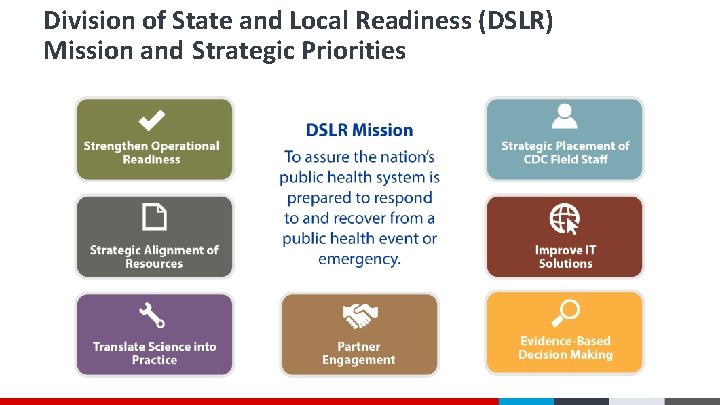
Division of State and Local Readiness (DSLR) Mission and Strategic Priorities
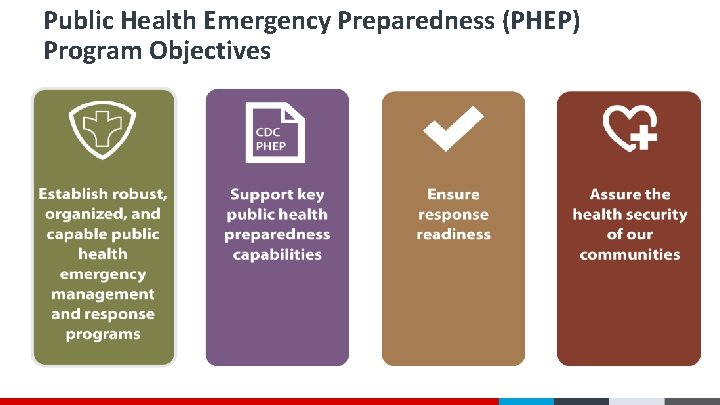
Public Health Emergency Preparedness (PHEP) Program Objectives
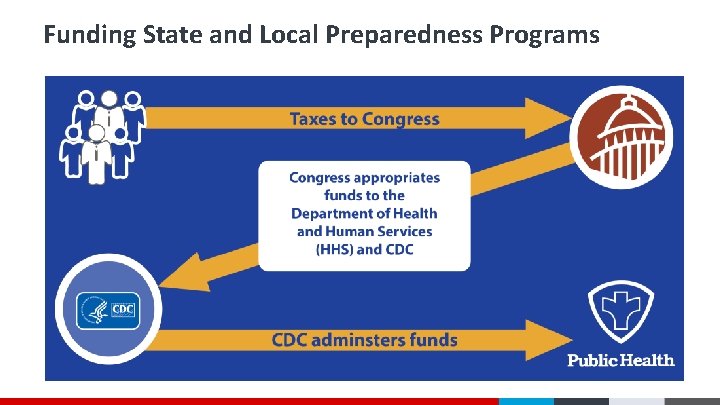
Funding State and Local Preparedness Programs
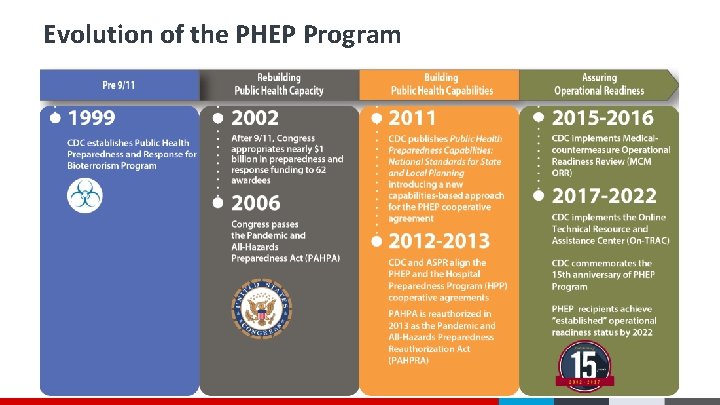
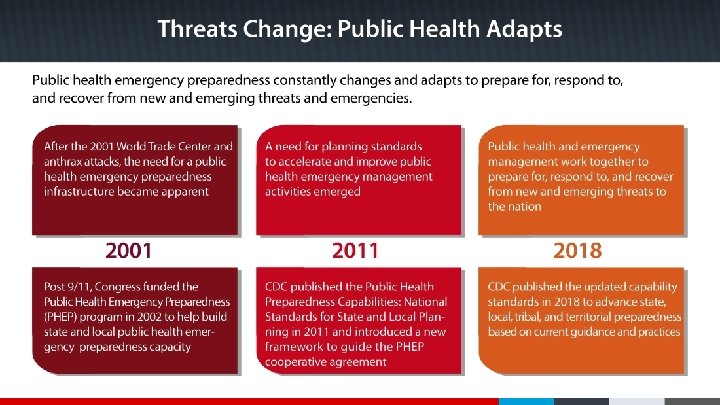
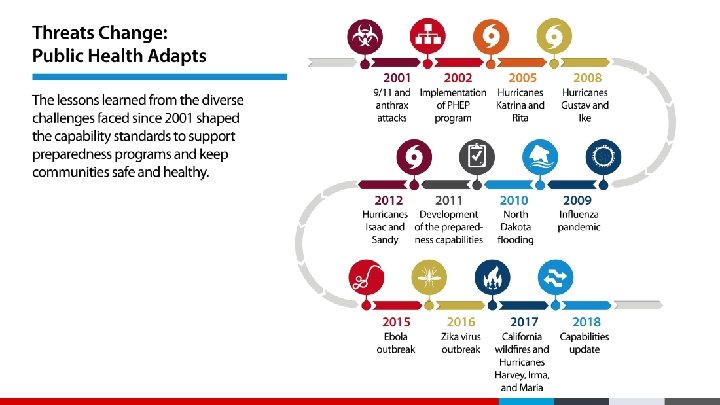
Evolution of the PHEP Program
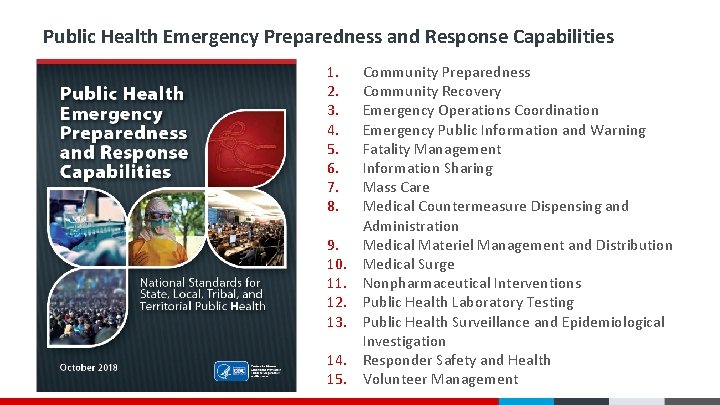
Public Health Emergency Preparedness and Response Capabilities 1. 2. 3. 4. 5. 6. 7. 8. 9. 10. 11. 12. 13. 14. 15. Community Preparedness Community Recovery Emergency Operations Coordination Emergency Public Information and Warning Fatality Management Information Sharing Mass Care Medical Countermeasure Dispensing and Administration Medical Materiel Management and Distribution Medical Surge Nonpharmaceutical Interventions Public Health Laboratory Testing Public Health Surveillance and Epidemiological Investigation Responder Safety and Health Volunteer Management
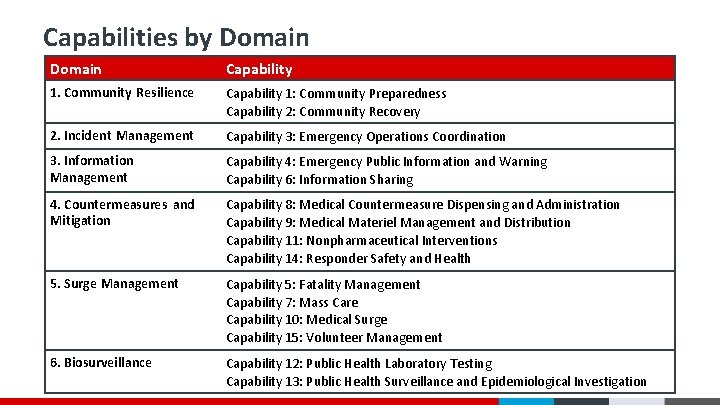
Capabilities by Domain Capability 1. Community Resilience Capability 1: Community Preparedness Capability 2: Community Recovery 2. Incident Management Capability 3: Emergency Operations Coordination 3. Information Management Capability 4: Emergency Public Information and Warning Capability 6: Information Sharing 4. Countermeasures and Mitigation Capability 8: Medical Countermeasure Dispensing and Administration Capability 9: Medical Materiel Management and Distribution Capability 11: Nonpharmaceutical Interventions Capability 14: Responder Safety and Health 5. Surge Management Capability 5: Fatality Management Capability 7: Mass Care Capability 10: Medical Surge Capability 15: Volunteer Management 6. Biosurveillance Capability 12: Public Health Laboratory Testing Capability 13: Public Health Surveillance and Epidemiological Investigation
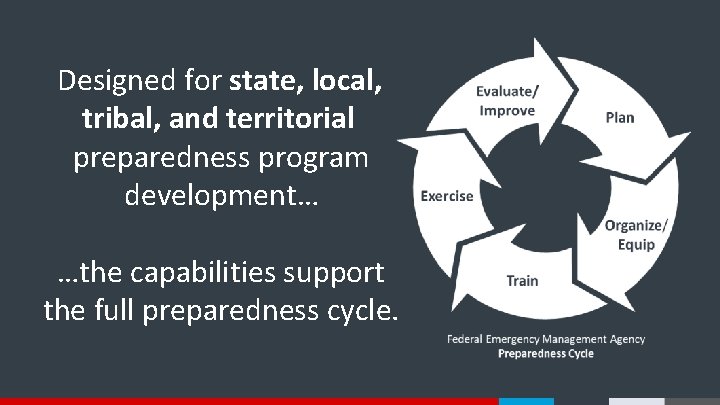
Designed for state, local, tribal, and territorial preparedness program development… …the capabilities support the full preparedness cycle.
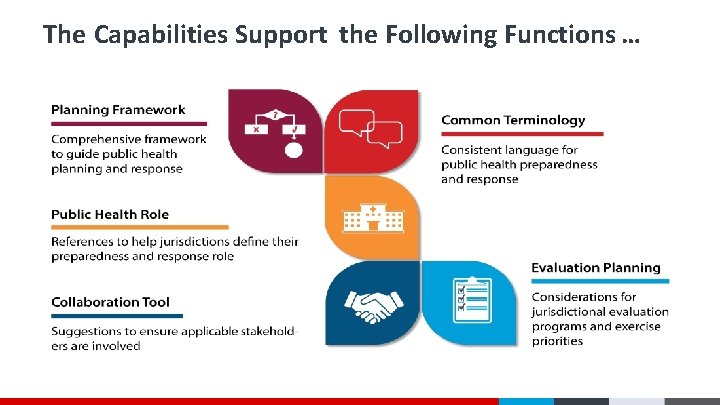
The Capabilities Support the Following Functions …
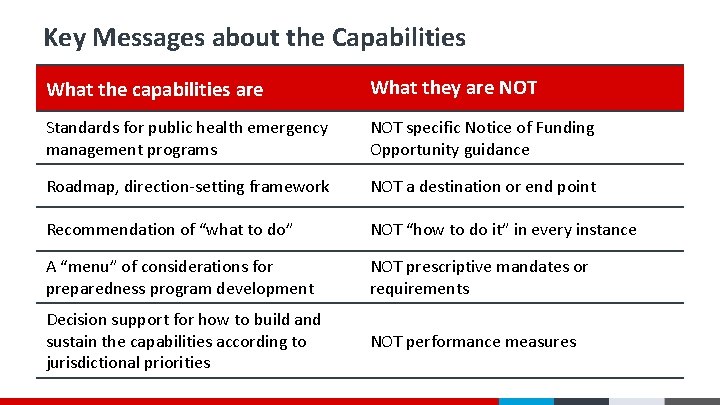
Key Messages about the Capabilities What the capabilities are What they are NOT Standards for public health emergency management programs NOT specific Notice of Funding Opportunity guidance Roadmap, direction-setting framework NOT a destination or end point Recommendation of “what to do” NOT “how to do it” in every instance A “menu” of considerations for preparedness program development NOT prescriptive mandates or requirements Decision support for how to build and sustain the capabilities according to jurisdictional priorities NOT performance measures
Capability Update Initiative Overview
Capability Update Purpose Reasons for Update § § § Lessons learned from recent incidents and events Evolution of guidance, standards, and practices Feedback indicating a need to update – PHEP program review – 2017 National Association of County and City Health Officials (NACCHO) Preparedness Summit (feedback from the practice community) – Assessment of Public Health Preparedness Capabilities report – DSLR staff survey (internal staff feedback)
Capability Update Purpose (Cont. ) Update Objectives – State, Local , Tribal, and Territorial Utility § § § Strengthen cross-cutting and intersecting program areas Simplify and streamline language without loss of meaning Emphasize planning and operational readiness Update content in resource elements, tasks and definitions, as needed Update preface to set the context of capabilities and their use
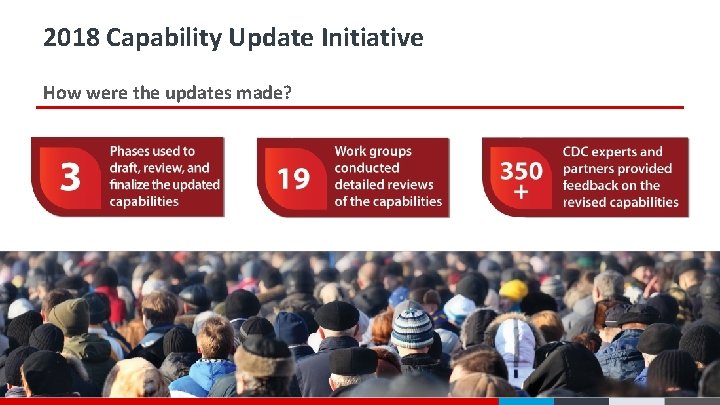
2018 Capability Update Initiative How were the updates made?
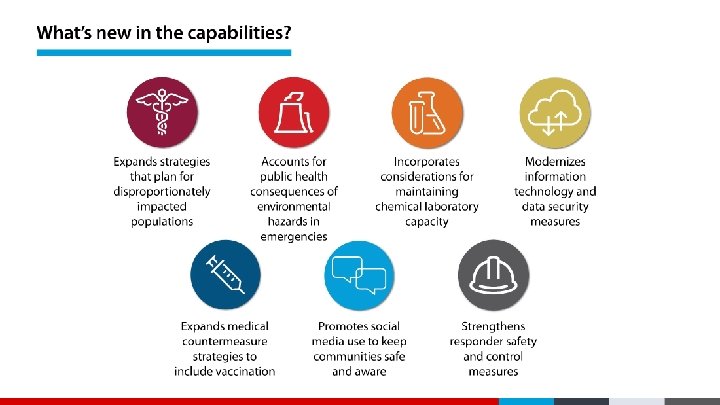
What’s New in the Capabilities
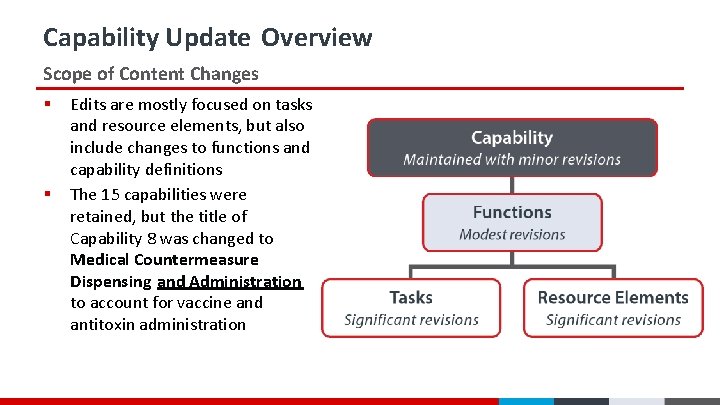
Capability Update Overview Scope of Content Changes § § Edits are mostly focused on tasks and resource elements, but also include changes to functions and capability definitions The 15 capabilities were retained, but the title of Capability 8 was changed to Medical Countermeasure Dispensing and Administration to account for vaccine and antitoxin administration
Capability Update Overview (Cont. ) Document-Level Changes § § Updated the introduction to the capabilities document Removed performance measures (measurement will be done with the Operational Readiness Review [ORR]) Reordered Resource Elements to align with task sequencing Used active voice to transition focus of document from planning to execution and demonstration – Renamed “Planning” Resource Elements to “Preparedness” Resource Elements – Communicate “Procedures in place…”, rather than “Written Plans should include…” § Updated considerations for tribal populations, at-risk populations, environmental health, and pandemic influenza throughout each capability
What has Not Changed § § § 15 original capabilities and their original structure were retained Tier 1 capabilities maintained their Tier 1 categorization Capabilities remained aligned to the original 6 domains: 1. 2. 3. 4. 5. 6. § § Community Resilience Incident Management Information Management Countermeasures and Mitigation Surge Management Biosurveillance Capabilities are informed by current preparedness guidance, science, practice, and subject matter expert input Capabilities will support “everyday use” – sustainability
Alignment with Other Standards The updated capabilities continue to align well with related emergency preparedness and response program standards FEMA Core Capabilities § § The Public Health Emergency Preparedness and Response Capabilities operationalize the public health components of FEMA’s 32 core capabilities Interdisciplinary coordination between public health, health care, and emergency management is critical to effective emergency preparedness and response Public Health Accreditation Board (PHAB) § § The capability standards support PHAB accreditation efforts as the two have been developed with input and consideration for each other Guidance on how PHAB and capability standards align has been developed to support state, local, and territorial program planning and accreditation efforts
Alignment with Other Standards (Cont. ) The updated capabilities continue to align well with related emergency preparedness and response program standards NACCHO Project Public Health Ready (PPHR) § There is a strong connection between the capability standards and PPHR criteria § Both programs are focused on establishing and promoting national standards for local public health preparedness and all-hazards preparedness
Suggested Resources to Support the Capability Standards § Added nationally recognized guidance, trainings, and tools to suggested resources § Updated and expanded the list of suggested resources and used them to inform capabilities content § Migrated suggested resources to CDC’s Online Technical Resource and Assistance Center (On-TRAC) (https: //ontrac. cdc. gov) and CDC’s State and Local Readiness website (https: //www. cdc. gov/cpr/readiness)
Public Health Preparedness Resources CDC offers resources to assist health departments with their strategic planning to strengthen their public health preparedness capabilities: – On-TRAC https: //www. cdc. gov/cpr/readiness/on-trac. htm – Public Health Emergency Preparedness and Response Capabilities https: //www. cdc. gov/cpr/readiness/capabilities. htm – Infographics https: //www. cdc. gov/cpr/readiness/graphics. htm – Additional Preparedness Resources www. cdc. gov/cpr/readiness/resources. htm
Example of Tribal Updates § Community Preparedness (Capability 1) : Highlights the importance of partnerships with tribal organizations in public health preparedness and response activities § Medical Countermeasure Dispensing and Administration (Capability 8): Alternate approaches for reaching tribal populations, including crossjurisdictional agreements § Nonpharmaceutical Interventions (Capability 11): Information sharing between CDC and state, local, tribal, territorial public health authorities, including protection of sensitive information, such as protected health information
Questions and Answers
Thank you! For more information, contact CDC 1 -800 -CDC-INFO (232 -4636) TTY: 1 -888 -232 -6348 www. cdc. gov The findings and conclusions in this report are those of the authors and do not necessarily represent the official position of the Centers for Disease Control and Prevention.
Appendix: Capability Definitions
Domain 1: Community Resilience (slide 1 of 2) Definition Capability 1: Community Preparedness § Community preparedness is the ability of communities to prepare for, withstand, and recover from public health incidents in both the short and long term.
Domain 1: Community Resilience (slide 2 of 2) Definition Capability 2: Community Recovery § Community recovery is the ability of communities to identify critical assets, facilities, and other services within public health, emergency management, health care, human services, mental/behavioral health, and environmental health sectors that can guide and prioritize recovery operations.
Domain 2: Incident Management Definition Capability 3: Emergency Operations Coordination § Emergency operations coordination is the ability to coordinate with emergency management and to direct and support an incident or event with public health or health care implications by establishing a standardized, scalable system of oversight, organization, and supervision that is consistent with jurisdictional standards and practices and the National Incident Management System (NIMS).
Domain 3: Information Management (slide 1 of 2) Definition Capability 4: Emergency Public Information and Warning § Emergency public information and warning is the ability to develop, coordinate, and disseminate information, alerts, warnings, and notifications to the public and incident management personnel.
Domain 3: Information Management (slide 2 of 2) Definition Capability 6: Information Sharing § § Information sharing is the ability to conduct multijurisdictional and multidisciplinary exchange of health-related information and situational awareness data among federal, state, local, tribal, and territorial levels of government and the private sector. This capability includes the routine sharing of information as well as issuing of public health alerts to all levels of government and the private sector in preparation for and in response to events or incidents of public health significance.
Domain 4: Countermeasures and Mitigation (slide 1 of 4) Definition Capability 8: Medical Countermeasure Dispensing and Administration § § Medical countermeasure dispensing and administration is the ability to provide medical countermeasures to targeted population(s) to prevent, mitigate, or treat the adverse health effects of a public health incident, according to public health guidelines. This capability focuses on dispensing and administering medical countermeasures, such as vaccines, antiviral drugs, antibiotics, and antitoxins.
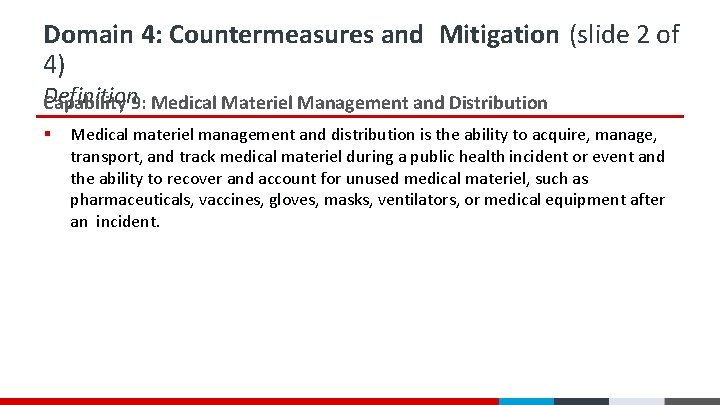
Domain 4: Countermeasures and Mitigation (slide 2 of 4) Definition 9: Medical Materiel Management and Distribution Capability § Medical materiel management and distribution is the ability to acquire, manage, transport, and track medical materiel during a public health incident or event and the ability to recover and account for unused medical materiel, such as pharmaceuticals, vaccines, gloves, masks, ventilators, or medical equipment after an incident.
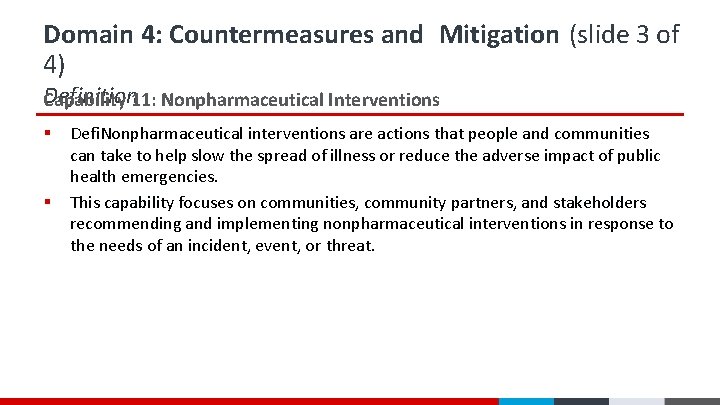
Domain 4: Countermeasures and Mitigation (slide 3 of 4) Definition 11: Nonpharmaceutical Interventions Capability § § Defi. Nonpharmaceutical interventions are actions that people and communities can take to help slow the spread of illness or reduce the adverse impact of public health emergencies. This capability focuses on communities, community partners, and stakeholders recommending and implementing nonpharmaceutical interventions in response to the needs of an incident, event, or threat.
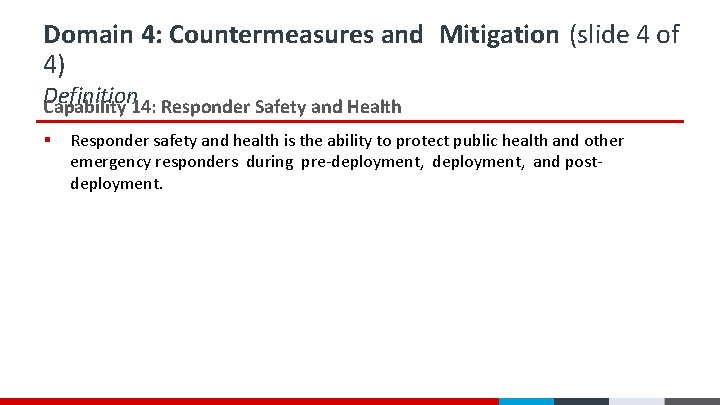
Domain 4: Countermeasures and Mitigation (slide 4 of 4) Definition 14: Responder Safety and Health Capability § Responder safety and health is the ability to protect public health and other emergency responders during pre-deployment, and postdeployment.
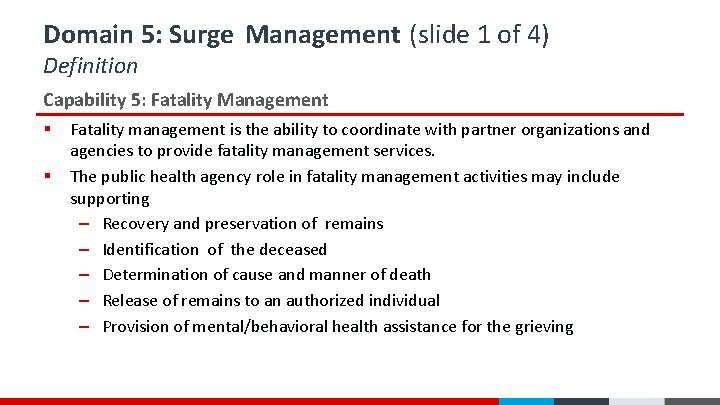
Domain 5: Surge Management (slide 1 of 4) Definition Capability 5: Fatality Management § § Fatality management is the ability to coordinate with partner organizations and agencies to provide fatality management services. The public health agency role in fatality management activities may include supporting – Recovery and preservation of remains – Identification of the deceased – Determination of cause and manner of death – Release of remains to an authorized individual – Provision of mental/behavioral health assistance for the grieving
Domain 5: Surge Management (slide 2 of 4) Definition Capability 7: Mass Care § § Mass care is the ability of public health agencies to coordinate with and support partner agencies to address, within a congregate location (excluding shelter-inplace locations), the public health, health care, mental/behavioral health, and human services needs of those impacted by an incident. This capability includes coordinating ongoing surveillance and public health assessments to ensure that health needs continue to be met as the incident evolves.
Domain 5: Surge Management (slide 3 of 4) Definition Capability 10: Medical Surge § § Medical surge is the ability to provide adequate medical evaluation and care during events that exceed the limits of the normal medical infrastructure of an affected community. It encompasses the ability of the health care system to endure a hazard impact, maintain or rapidly recover operations that were compromised, and support the delivery of medical care and associated public health services, including disease surveillance, epidemiological inquiry, laboratory diagnostic services, and environmental health assessments.
Domain 5: Surge Management (slide 4 of 4) Definition Capability 15: Volunteer Management § Volunteer management is the ability to coordinate with emergency management and partner agencies to identify, recruit, register, verify, train, and engage volunteers to support the jurisdictional public health agency’s preparedness, response, and recovery activities during pre-deployment, and postdeployment.
Domain 6: Biosurveillance (slide 1 of 2) Definition Capability 12: Public Health Laboratory Testing § § Public health laboratory testing is the ability to implement and perform methods to detect, characterize, and confirm public health threats. It also includes the ability to report timely data, provide investigative support, and use partnerships to address actual or potential exposure to threat agents in multiple matrices, including clinical specimens and food, water, and other environmental samples.
Domain 6: Biosurveillance (slide 2 of 2) Definition Capability 13: Public Health Surveillance and Epidemiological Investigation § § Public health surveillance and epidemiological investigation is the ability to create, maintain, support, and strengthen routine surveillance and detection systems and epidemiological investigation processes. It also includes the ability to expand these systems and processes in response to incidents of public health significance.