
Center Point Energy Street Light Luminaire Replacement LED

- Slides: 21
Center. Point Energy Street Light Luminaire Replacement LED Street Light Conversion Program August 27, 2015
Center. Point Energy LED Street Light Replacement The purpose of this presentation is to provide a brief description of Center. Point Energy’s LED Street Light Conversion Program • Introduce LED street lighting technology • Provide information on the conversion project with City of Houston. • Explain the future financial impact of an LED conversion 2
What is LED? Light-Emitting Diode: a semiconductor device that emits visible light when an electric current passes through it 3
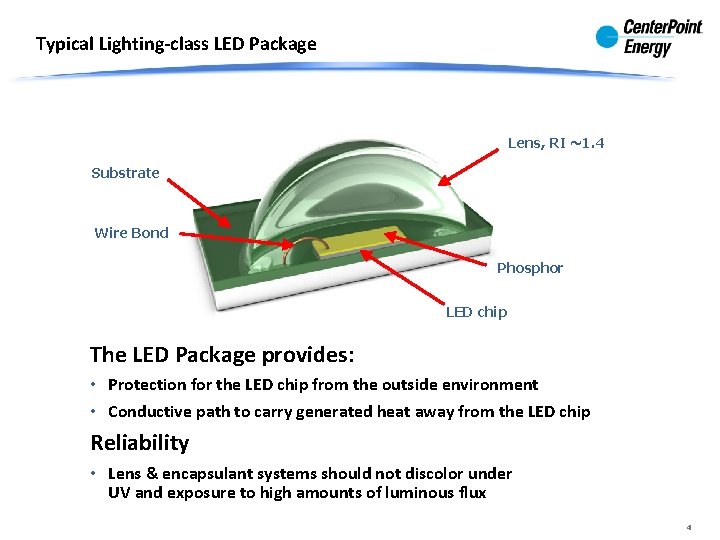
Typical Lighting-class LED Package Lens, RI ~1. 4 Substrate Wire Bond Phosphor LED chip The LED Package provides: • Protection for the LED chip from the outside environment • Conductive path to carry generated heat away from the LED chip Reliability • Lens & encapsulant systems should not discolor under UV and exposure to high amounts of luminous flux 4
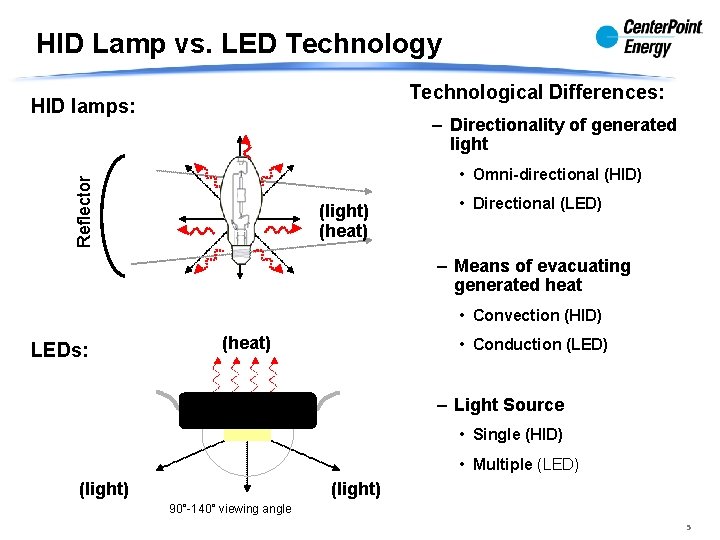
HID Lamp vs. LED Technology Technological Differences: HID lamps: – Directionality of generated light Reflector • Omni-directional (HID) (light) (heat) • Directional (LED) – Means of evacuating generated heat • Convection (HID) LEDs: (heat) • Conduction (LED) – Light Source • Single (HID) • Multiple (LED) (light) 90°-140° viewing angle 5
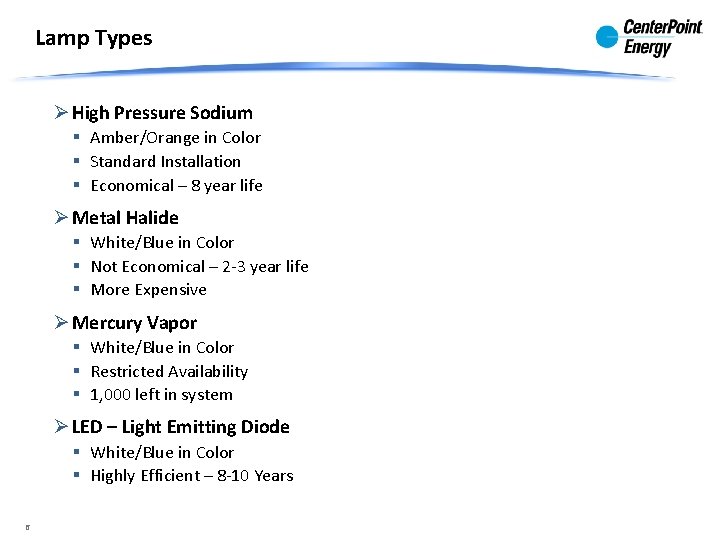
Lamp Types Ø High Pressure Sodium § Amber/Orange in Color § Standard Installation § Economical – 8 year life Ø Metal Halide § White/Blue in Color § Not Economical – 2 -3 year life § More Expensive Ø Mercury Vapor § White/Blue in Color § Restricted Availability § 1, 000 left in system Ø LED – Light Emitting Diode § White/Blue in Color § Highly Efficient – 8 -10 Years 6
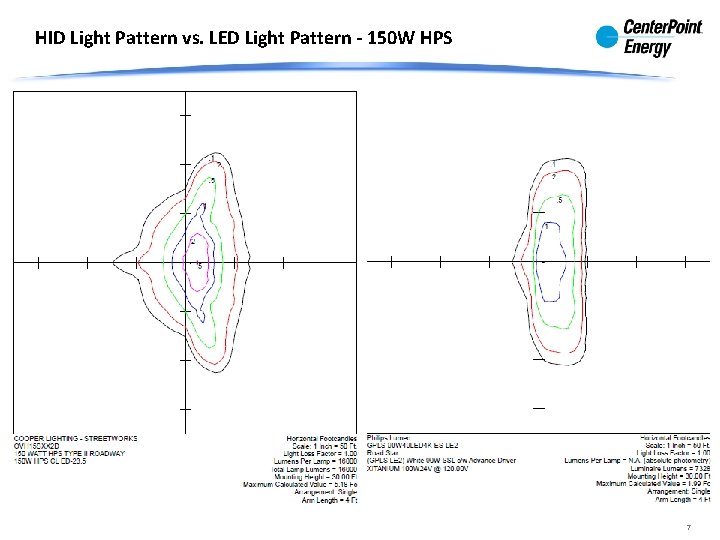
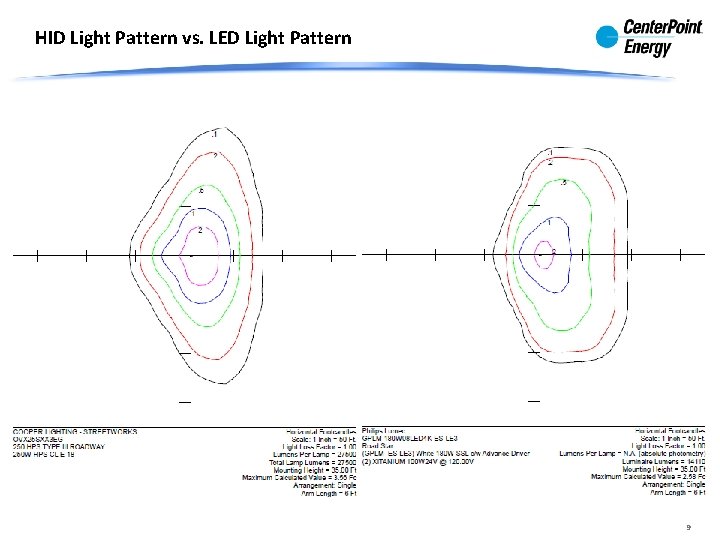
HID Light Pattern vs. LED Light Pattern - 150 W HPS 7
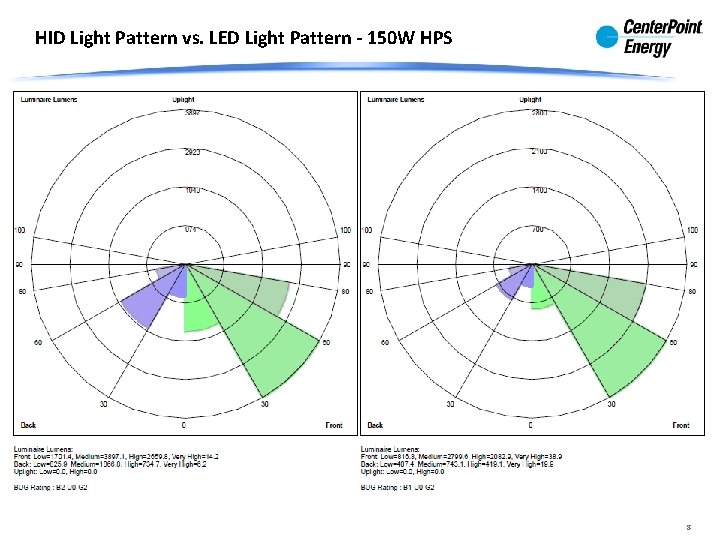
HID Light Pattern vs. LED Light Pattern - 150 W HPS 8
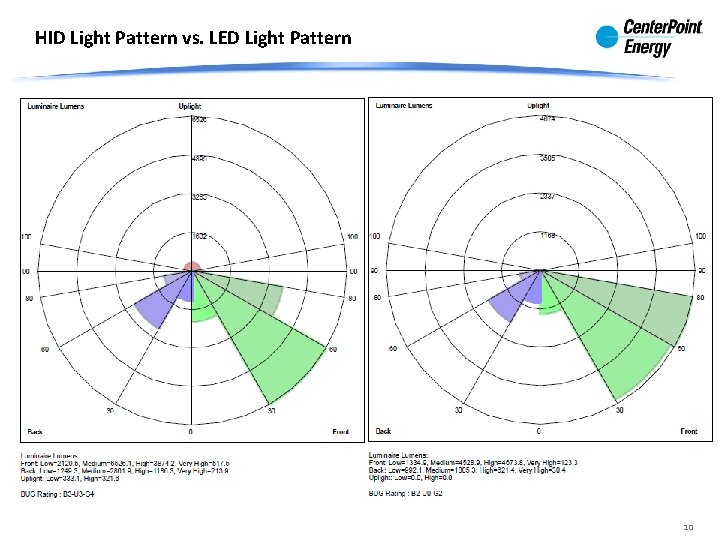
HID Light Pattern vs. LED Light Pattern 9
HID Light Pattern vs. LED Light Pattern 10
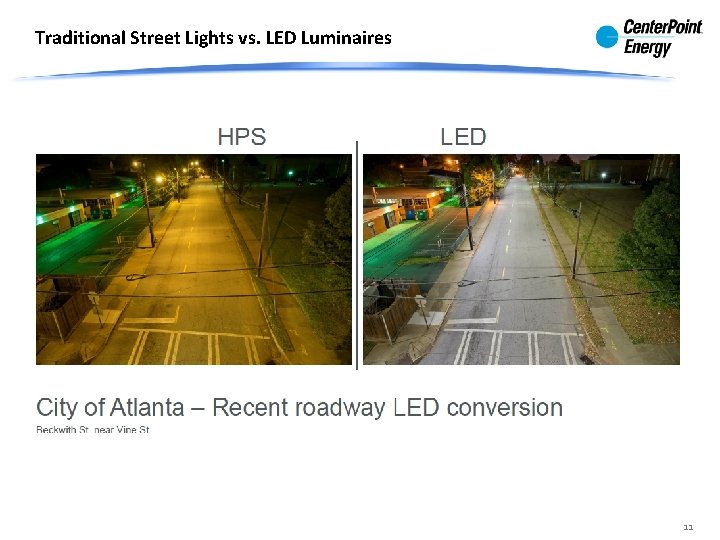
Traditional Street Lights vs. LED Luminaires 11
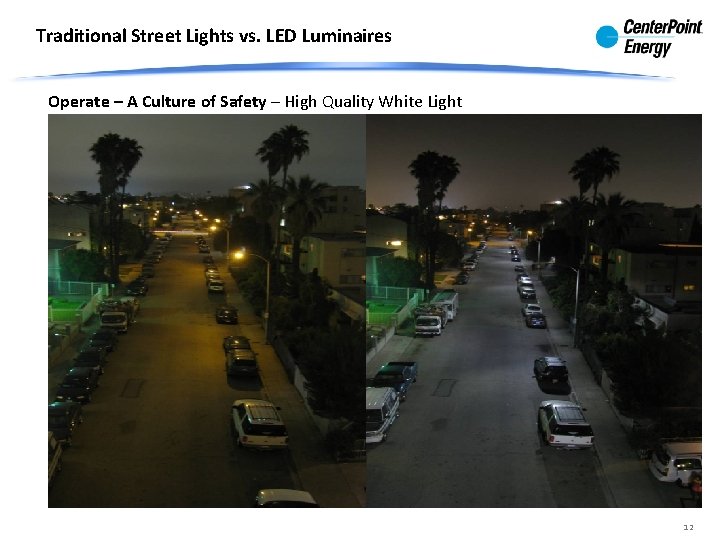
Traditional Street Lights vs. LED Luminaires Operate – A Culture of Safety – High Quality White Light 12
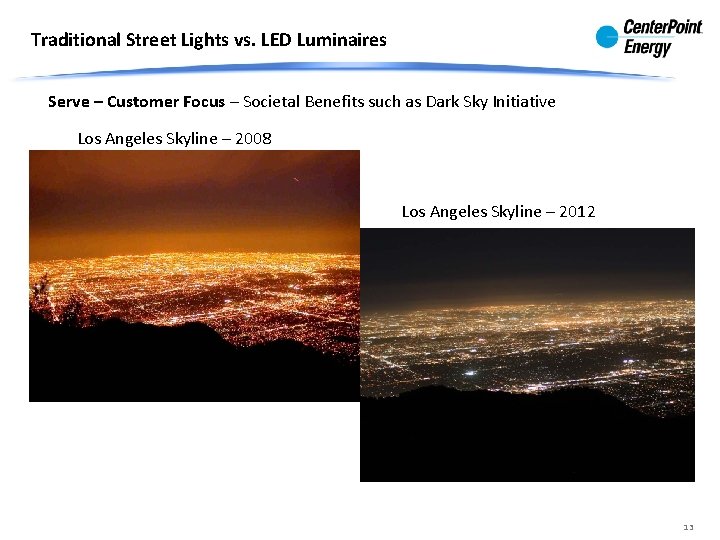
Traditional Street Lights vs. LED Luminaires Serve – Customer Focus – Societal Benefits such as Dark Sky Initiative Los Angeles Skyline – 2008 Los Angeles Skyline – 2012 13
LED: Advantages and Disadvantages Center. Point Energy has been conducting pilot testing of the technology for the previous six years ADVANTAGES • Energy efficient: 80% of the electricity used by an LED is converted to light, compared to just 10% for incandescent bulbs. • Long and predictable life: LEDs last up to 100, 000 hours or more; substantially longer than High Pressure Sodium and Metal Halide lamps • Excellent CRI (color rendering index): LEDs can produce a high quality of white light that allows the eye to detect colors more effectively. • Environmentally friendly: LEDs emit very little infrared radiation and contain no mercury. • Directional lighting: LEDs focus light in a particular direction, making them useful for spotlight and other applications. • Quick turn on and off: LEDs come on with full brightness instantly. Unlike mercury vapor, metal halide and sodium vapor lamps (commonly used in street lighting), LEDs do not have a problem restarting immediately (hot ignition) following a brief power failure or inadvertent turn off. LED luminaires may provide up to approximately 60% k. Wh energy savings for the end-use customer DISADVANTAGES • Cost: LEDs are currently more expensive than other conventional HID sources. • Heat: LEDs are very heat sensitive. Correct dissipation of heat is necessary to light output and lifespan of the fixture. 14
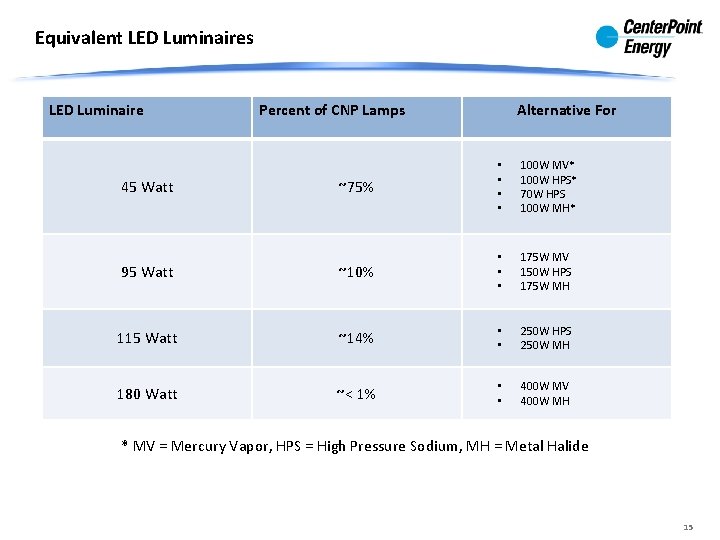
Equivalent LED Luminaires LED Luminaire Percent of CNP Lamps Alternative For ~75% • • 100 W MV* 100 W HPS* 70 W HPS 100 W MH* 95 Watt ~10% • • • 175 W MV 150 W HPS 175 W MH 115 Watt ~14% • • 250 W HPS 250 W MH 180 Watt ~< 1% • • 400 W MV 400 W MH 45 Watt * MV = Mercury Vapor, HPS = High Pressure Sodium, MH = Metal Halide 15
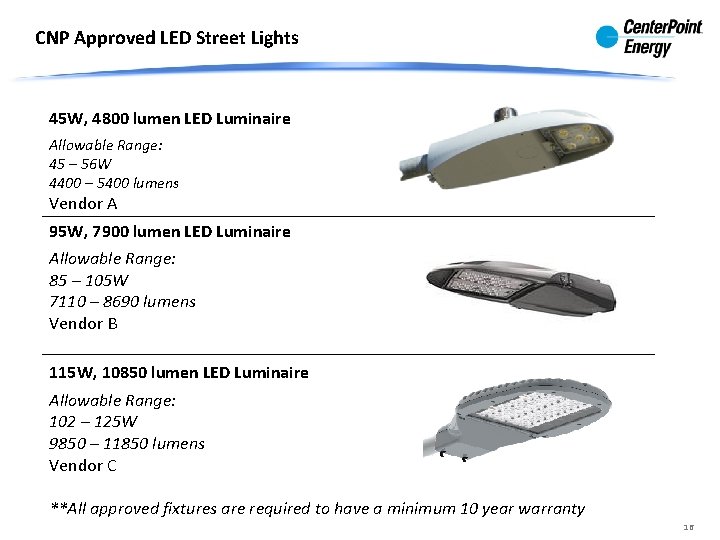
CNP Approved LED Street Lights 45 W, 4800 lumen LED Luminaire Allowable Range: 45 – 56 W 4400 – 5400 lumens Vendor A 95 W, 7900 lumen LED Luminaire Allowable Range: 85 – 105 W 7110 – 8690 lumens Vendor B 115 W, 10850 lumen LED Luminaire Allowable Range: 102 – 125 W 9850 – 11850 lumens Vendor C **All approved fixtures are required to have a minimum 10 year warranty 16
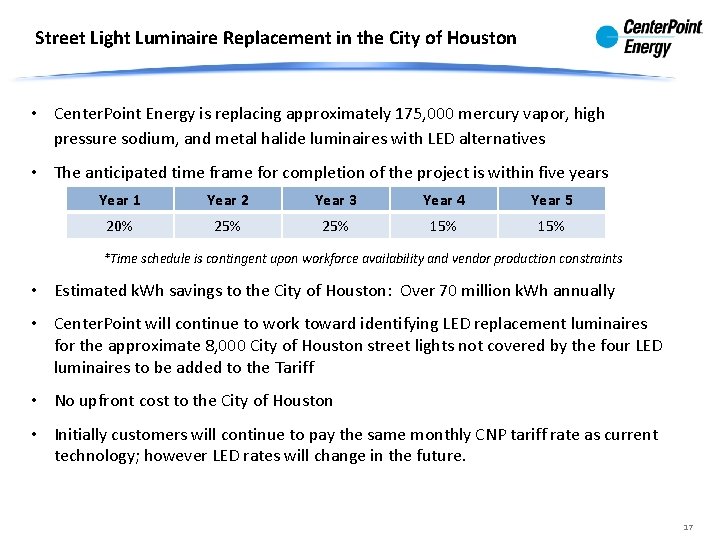
Street Light Luminaire Replacement in the City of Houston • Center. Point Energy is replacing approximately 175, 000 mercury vapor, high pressure sodium, and metal halide luminaires with LED alternatives • The anticipated time frame for completion of the project is within five years Year 1 Year 2 Year 3 Year 4 Year 5 20% 25% 15% *Time schedule is contingent upon workforce availability and vendor production constraints • Estimated k. Wh savings to the City of Houston: Over 70 million k. Wh annually • Center. Point will continue to work toward identifying LED replacement luminaires for the approximate 8, 000 City of Houston street lights not covered by the four LED luminaires to be added to the Tariff • No upfront cost to the City of Houston • Initially customers will continue to pay the same monthly CNP tariff rate as current technology; however LED rates will change in the future. 17
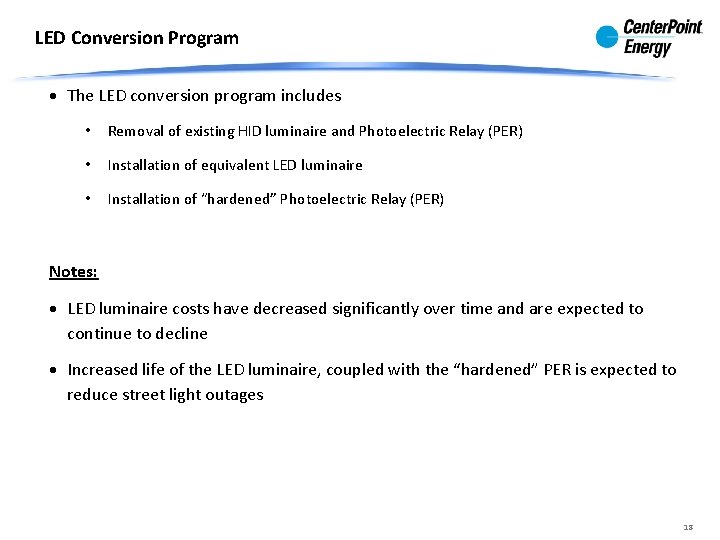
LED Conversion Program The LED conversion program includes • Removal of existing HID luminaire and Photoelectric Relay (PER) • Installation of equivalent LED luminaire • Installation of “hardened” Photoelectric Relay (PER) Notes: LED luminaire costs have decreased significantly over time and are expected to continue to decline Increased life of the LED luminaire, coupled with the “hardened” PER is expected to reduce street light outages 18
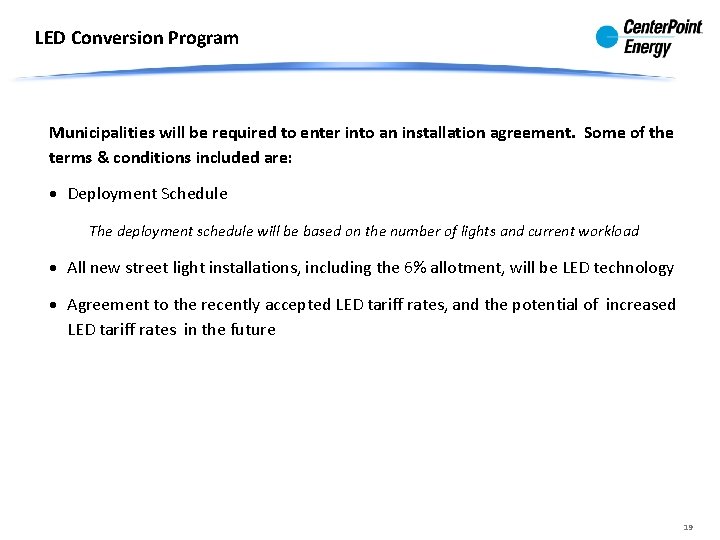
LED Conversion Program Municipalities will be required to enter into an installation agreement. Some of the terms & conditions included are: Deployment Schedule The deployment schedule will be based on the number of lights and current workload All new street light installations, including the 6% allotment, will be LED technology Agreement to the recently accepted LED tariff rates, and the potential of increased LED tariff rates in the future 19
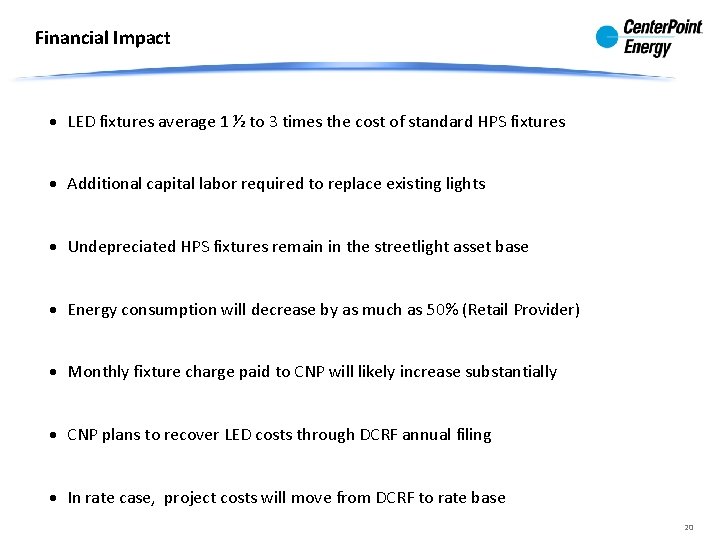
Financial Impact LED fixtures average 1 ½ to 3 times the cost of standard HPS fixtures Additional capital labor required to replace existing lights Undepreciated HPS fixtures remain in the streetlight asset base Energy consumption will decrease by as much as 50% (Retail Provider) Monthly fixture charge paid to CNP will likely increase substantially CNP plans to recover LED costs through DCRF annual filing In rate case, project costs will move from DCRF to rate base 20
Questions? 21