
Center of Gravity Plus stability and why things
Center of Gravity Plus stability and why things don’t fall over, or “weebles wobble but they don’t fall down”.
Center of gravity • For our purposes, “center of gravity” and “center of mass” are basically the same thing. • They both refer to a special point in an object that is the average position of the weight or mass of the object. • Ah, yes, the students, say, but what does that actually mean?
Co. G continued • Think about throwing two objects: a baseball and a baseball bat. • When you throw the ball, it follows a parabolic path. • When you throw the bat, it wobbles and rotates around as it flies through the air.
Co. G continued • The complicated motion of the baseball bat can be broken down into two separate motions – Rotation of the bat around the center of gravity – The parabolic motion of the Co. G as it moves through the air • Refer to the picture at the bottom of page 136
Everything has a Co. G! • The center of gravity of an object may not be at the actual center of the object. • It may not even be inside the object at all. • Here are some general hints involving uniform mass distributions – What does that mean? It means that the density of the object is uniform. There are no areas where the density is higher than any other area inside.
Co. G hints • For a uniform sphere, the Co. G will be at the center • For a uniform cylinder, the Co. G will be along the central axis • In fact, if there is any object with an axis of symmetry (i. e. on side is a mirror image of the other side), then the Co. G will be along that axis of symmetry.
Fun with Co. G • Remember, the Co. G is the point upon which all the weight acts (effectively). • So how would you find the Co. G of an regularly shaped object? • So how would you find the Co. G of an irregularly shaped object? • Let’s try!
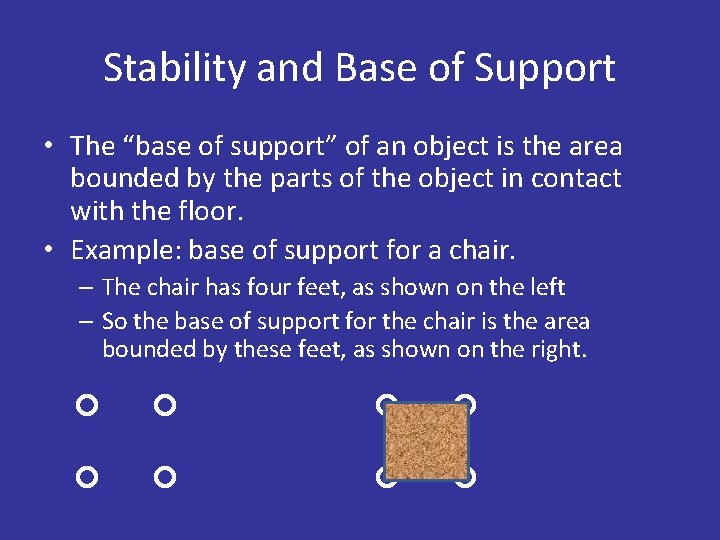
Stability and Base of Support • The “base of support” of an object is the area bounded by the parts of the object in contact with the floor. • Example: base of support for a chair. – The chair has four feet, as shown on the left – So the base of support for the chair is the area bounded by these feet, as shown on the right.
Stability and Base of Support • So, if the Co. G is generally going to be vertically above the floor. • But think about a line going straight down from the Co. G • If that line lands inside the base of support, the object won’t fall over. • If that line lands outside the base of support, the object will fall over.
Stable vs. unstable equilibrium • An object is stable if its Co. G is BELOW the point of support – Example: pendulum • An object is unstable if its Co. G is ABOVE its point of support – Example: an upright meter stick • Some buildings are stable because their Co. G is actually below the ground – Space needle, etc.
Toppling over and how to avoid it • We now understand that an object falls over if it’s Co. G falls outside its base of support. • Many of you go through your daily lives, performing various activities, and manage not to fall over onto the floor. • What tricks have you (subconsciously) developed to do this? Consider the following situations:
Situations in which you don’t fall over • What do you do to avoid falling over in these situations? • You are carrying a heavy bucket in one hand • You are Charles Constantino in a wrestling match and someone is trying to knock you down • You have a stack of boxes you have to carry ranging from light to heavy. How do you stack them?
Demonstrations! • • Find Co. G of irregular piece of cardboard Find Co. G of L-shaped piece of cardboard Find Co. G of United States of cardboard Wobble toy Weight on a basketball. Find Co. G of meter stick Magic Co. G box
Even more Demonstrations! • • Pendulum versus upright stick balance Pencil with potatoes Boys vs. girls chair lift thing Stand from chair without moving feet Toe touch with butt against wall Stand on toes against wall And with door
- Slides: 14