
Center for Smart Agriculture Protected cultivation of vegetable
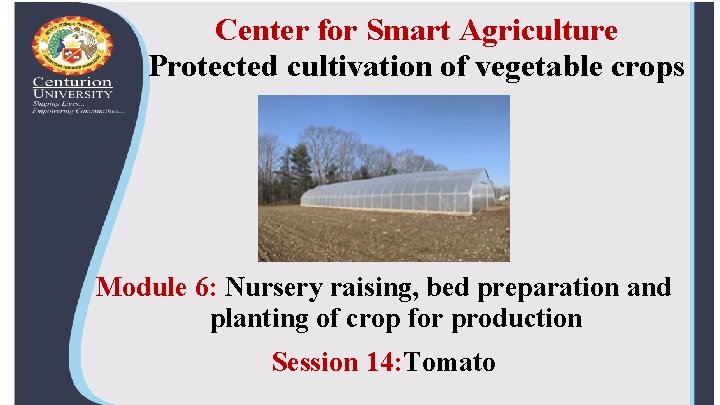
Center for Smart Agriculture Protected cultivation of vegetable crops Module 6: Nursery raising, bed preparation and planting of crop for production Session 14: Tomato
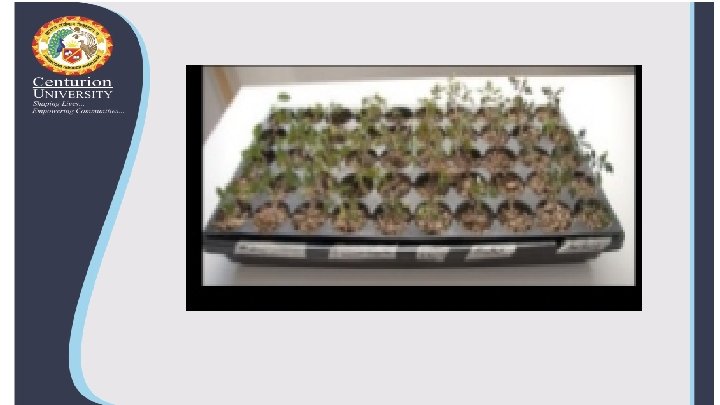
Nursery raising & Soil preparation • Seedling of tomato are raised in 98 cell pro trays having drainage holes at the bottom. • The growing media includes vermicompost + sand + sterilized cocopeat (1: 1: 1). • Shallow depressions of 5 mm depth are made in each cell and seed treated with Captan are sown one per cell • Filled trays are staked one above the other and covered with plastic sheet.
• The emerging seedlings are drenched with Copper-oxychloride solution (@ 3 g/ lit), covered with a plastic sheet immediately after germination. • The seedlings are provided nutrition by drenching them with 0. 2 per cent, 19: 19 (N: P: K) plus trace elements at 15 days after germination
• To prevent thrips infestation, the seedlings are sprayed using Acephate (0. 75 g/lit). • The seedlings are hardened by gradually reducing the frequency of irrigation and exposing them to sunlight. • The seedling are sprayed Imidacloprid (0. 03 ml/lit) with
• Drenching the seedlings with Carbendazim (0. 1%) • The seedlings are ready for planting within 20 to 25 days of sowing when they attain a height of 25 cm. • To plant tomato in 1000 m 2 of greenhouse area 20 g seed is required.
Growing Bed preparation: • Soil clods are broken & soil is brought to fine tilth by digging. • In heavy soils mixing sand or decomposed rice husk up to 25% of volume is required
Disinfecting the growing beds • Disinfection of growing beds helps in killing of weeds, harmful organisms, fungal spores, bacteria and nematodes. • During the process the temperature rises up to 60 -70 o. C. • In June – July the beds drenched using 4 per cent formaldehyde (@ 4 liters/sqm) and the beds are covered with polyethylene (400 gauge) sheet. • All the doors and ventilators are closed.
• After four days of formaldehyde treatment, the polyethylene cover is removed and the ventilators and the doors are opened. • The beds are hoed repeatedly everyday to remove the trapped formaldehyde fumes completely before transplanting. • After fumigation the beds are prepared as per requirement. • Beds of 100 cm width and 40 cm height are prepared leaving 50 cm footpath between the beds.
Laying of drip line • After bed preparation two drip lines of 20: 2: 50 size are laid on each bed at 60 cm spacing. • The distance of the drip lines is adjusted according to the planting distance. • The emmiters in the adjacent rows in a bed should be adjusted so that they are not in front of each other (in triangular fashion). • Before planting, the drip system is run to check uniform discharge of water from the emitters.
Mulching • Mulching Black / silver polyethylene mulch film 100 micron (400 gauge) thickness having 1. 2 m width is used to cover the planting beds. • 5 cm diameter holes are made on the mulch film using a sharp pipe at recommended crop spacing • Cover the planting beds with the mulch film be securing the edges of the sheet by burying in the soil.
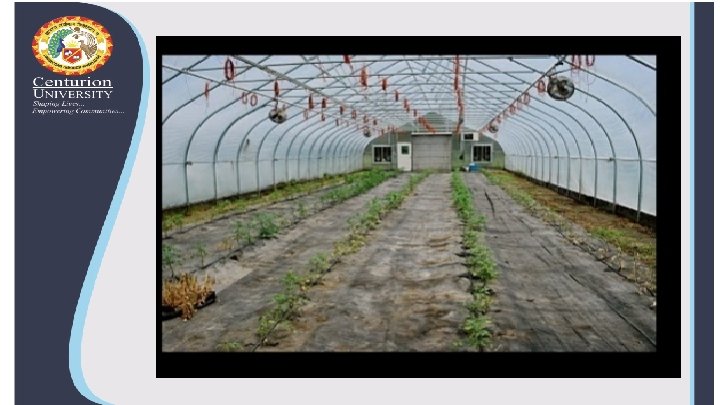
Transplanting • For better establishment of seedlings, irrigating the beds to field capacity is required before transplanting. • 20 -25 days old, vigorous & uniform in size 25 -30 cm in height seedlings are selected for planting. • The seedlings are removed from the trays by applying slight pressure on the bottom of the individual cells.
• Seedlings are planted in the centre of the holes made in the polythene mulch film so that the seedlings do not touch the mulch film. • Beds are irrigated daily with a rose-can till the seedling establishment. If the humidity is low, the foggers are run to increase the RH level. • The beds are drenched with copper oxy chloride (@ 3 g/lit) if seedling mortality due to damping off is observed.
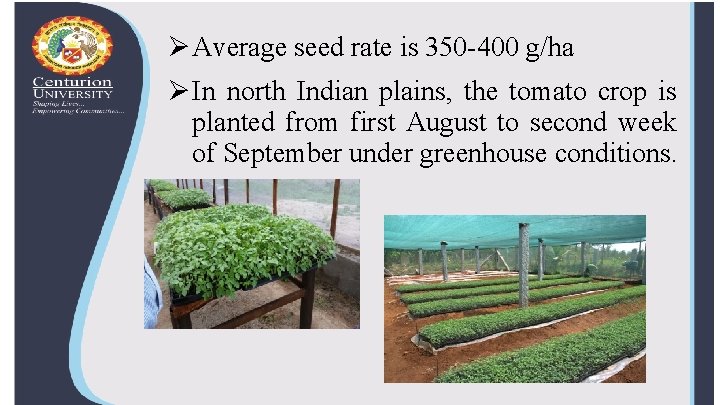
Ø Average seed rate is 350 -400 g/ha Ø In north Indian plains, the tomato crop is planted from first August to second week of September under greenhouse conditions.
• The approximate seeding dates for two crops are: Ø Spring crop: Late December through early January Ø Fall crop: Late June through early July Ø Transplanting into the greenhouse should occur about 4 to 7 weeks from the seeding date, or about February 25 to March 5 for a spring crop, and mid August for a fall crop.
Ø For the 60 x 60 cm, two strong leading shoots are left to bear the fruits. All other shoots are removed as early as possible by snapping them off carefully by hand. Selected branches are vertically supported by trellises or staking Ø For the 60 x 45 cm, only one strong and dominant shoot is left to grow and bear fruits. All other shoots are desuckered in time.

Thank You ….
- Slides: 18