
Center for Public Health Practice Collette Young Ph
Center for Public Health Practice Collette Young, Ph. D Administrator Center for Public Health Practice PUBLIC CENTER FORHEALTH PUBLICDIVISION HEALTH PRACTICE New Employee Orientation Public Health Division
Center for Public Health Practice: Mission & Goals Develop and sustain: • high quality, efficient, core public health programs that promote and protect a healthy population, • a strong, well-trained and competent public health workforce, and • a sound Public Health System essential to successful Health Services Transformation and to achieving its triple aim. 2

3
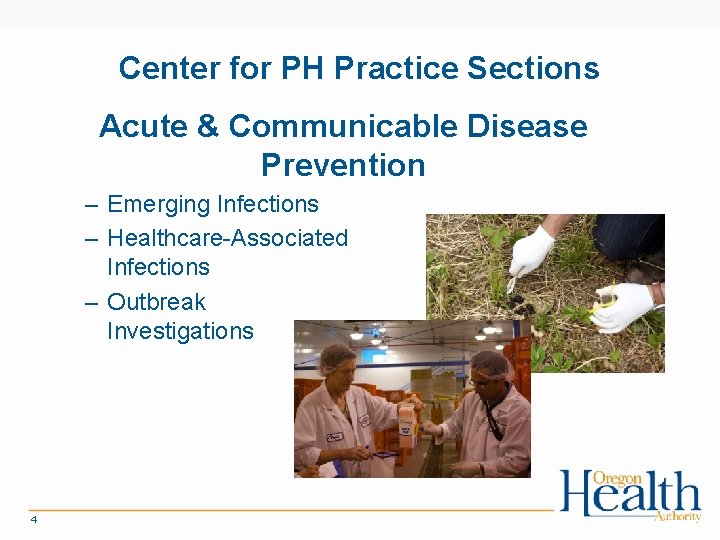
Center for PH Practice Sections Acute & Communicable Disease Prevention – Emerging Infections – Healthcare-Associated Infections – Outbreak Investigations 4
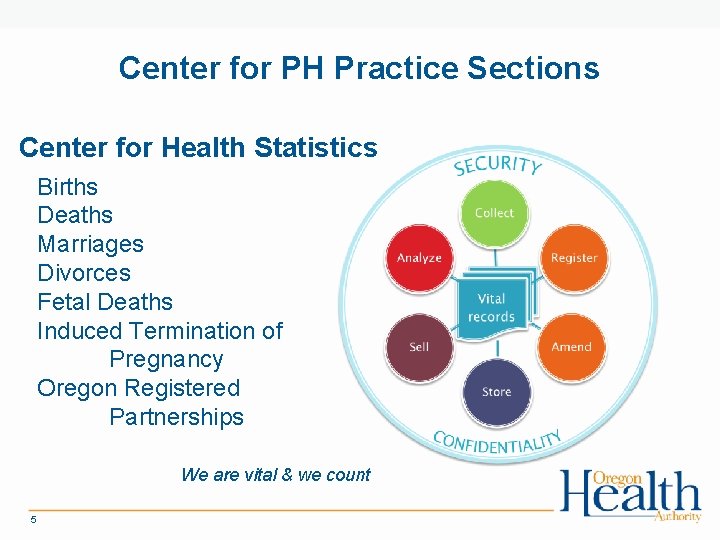
Center for PH Practice Sections Center for Health Statistics Births Deaths Marriages Divorces Fetal Deaths Induced Termination of Pregnancy Oregon Registered Partnerships We are vital & we count 5
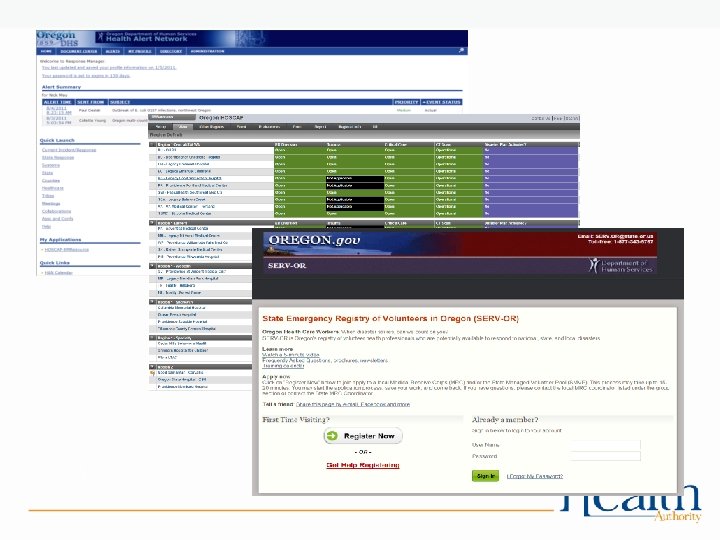
Center for PH Practice Sections Health Securities, Preparedness & Response (HSPR) – – – – 6 All Hazards Planning PH Emergency Preparedness Medical Counter Measures Ameri. Corps VISTA State Emergency Registry of Volunteers in Oregon Tribal and Local Public Health Liaison program Hospital Preparedness Program
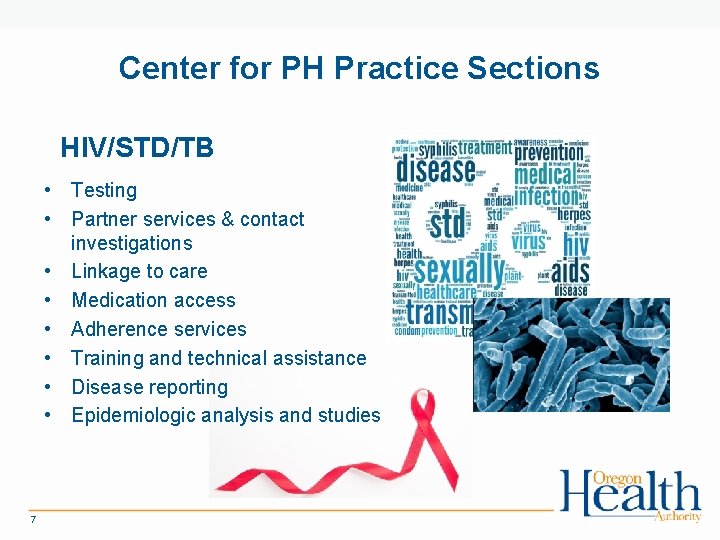
Center for PH Practice Sections HIV/STD/TB • Testing • Partner services & contact investigations • Linkage to care • Medication access • Adherence services • Training and technical assistance • Disease reporting • Epidemiologic analysis and studies 7
Center for PH Practice Sections Immunizations – – – – – 8 Vaccines for Children ALERT Immunization Information System School Law Assessment, Feedback, Incentives, Exchange (AFIX) Immunize Oregon Coalition Epidemiology, Research & Evaluation Pandemic Preparedness Vaccine Preventable Disease Surveillance CDC Sentinel Site Participant
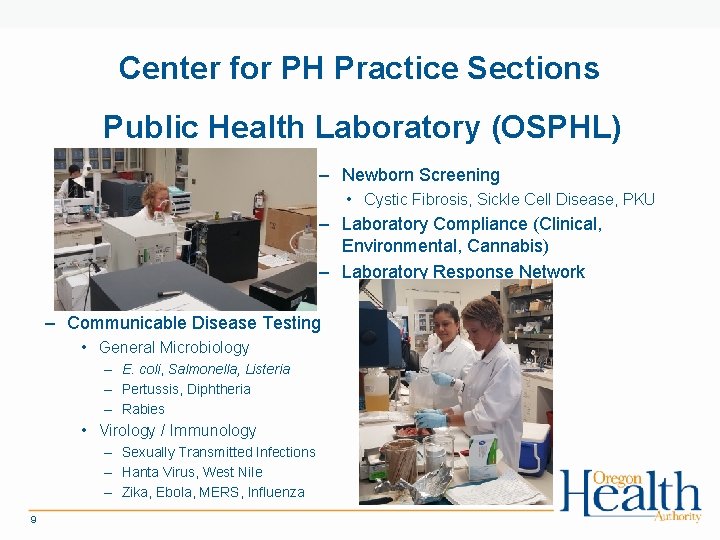
Center for PH Practice Sections Public Health Laboratory (OSPHL) – Newborn Screening • Cystic Fibrosis, Sickle Cell Disease, PKU – Laboratory Compliance (Clinical, Environmental, Cannabis) – Laboratory Response Network – Communicable Disease Testing • General Microbiology – E. coli, Salmonella, Listeria – Pertussis, Diphtheria – Rabies • Virology / Immunology – Sexually Transmitted Infections – Hanta Virus, West Nile – Zika, Ebola, MERS, Influenza 9
Contact information Collette Young, Ph. D 971 -673 -1707 Collette. m. young@state. or. us 10
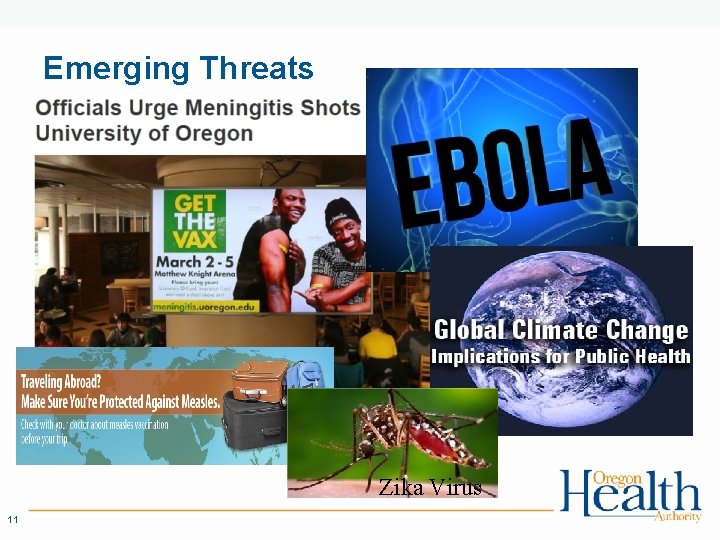
Emerging Threats Zika Virus 11
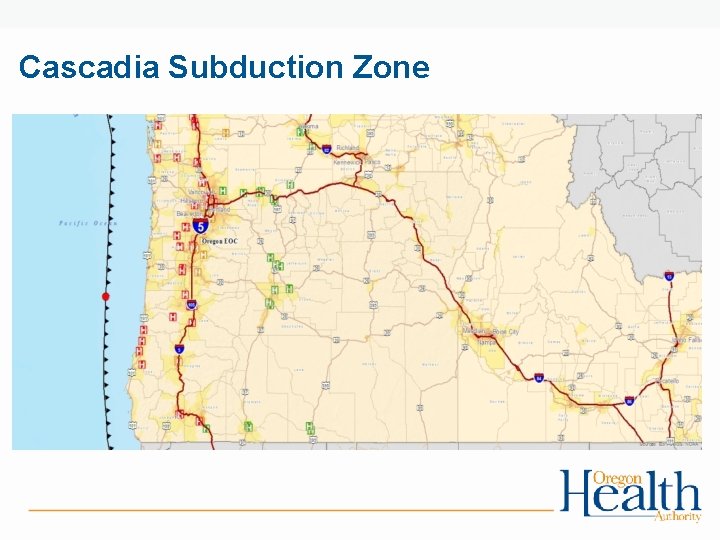
Cascadia Subduction Zone
14
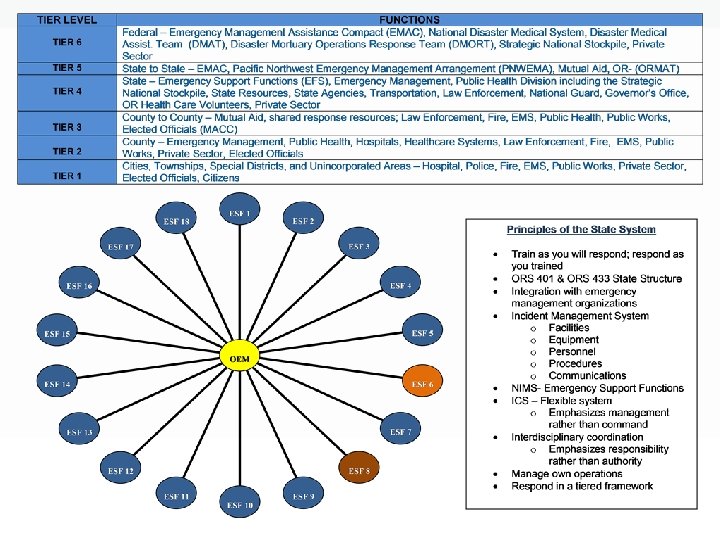
So what can you do? • • • Have a family plan – pets – meds – communication – cash Can your supervisor get a hold of you other than at work? 72 -hour kit to new 2 -week supplies Volunteering Interested in helping here at PSOB?
Resources • • Healthoregon. org/preparedness Ready. gov Redcross. org/prepare FEMA //www. training. fema. gov/is/crslist. aspx
Contact information Akiko Saito 971 -673 -1363 Akiko. saito@state. or. us 17
Health Equity, Cultural Competence and a Diverse and Inclusive Work Environment Leann Johnson, MS Director Office of Equity and Inclusion Division PUBLIC HEALTH DIVISION New Employee Orientation 18
Equity and Inclusion Division
20
• Vision: All people, communities and cultures co-creating and enjoying a healthy Oregon. • Mission: To engage and align diverse community voices and the Oregon Health Authority to ensure the elimination of avoidable health gaps and promote optimal health in Oregon.
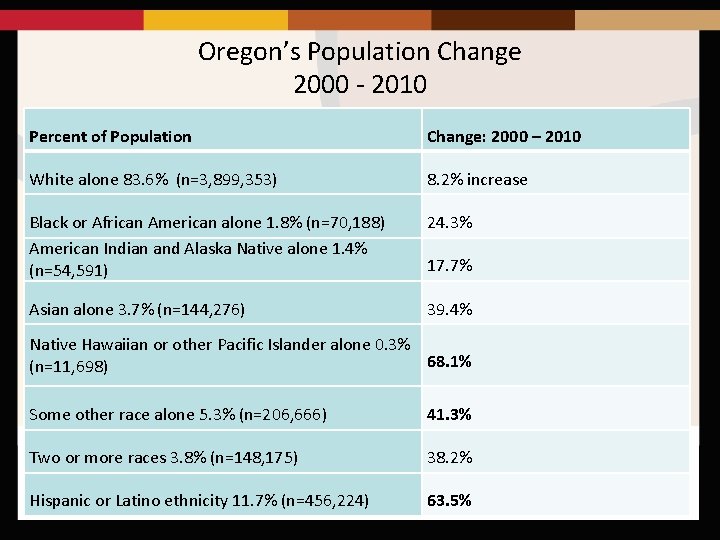
Oregon’s Population Change 2000 - 2010 Percent of Population Change: 2000 – 2010 White alone 83. 6% (n=3, 899, 353) 8. 2% increase Black or African American alone 1. 8% (n=70, 188) American Indian and Alaska Native alone 1. 4% (n=54, 591) 24. 3% Asian alone 3. 7% (n=144, 276) 39. 4% 17. 7% Native Hawaiian or other Pacific Islander alone 0. 3% 68. 1% (n=11, 698) Some other race alone 5. 3% (n=206, 666) 41. 3% Two or more races 3. 8% (n=148, 175) 38. 2% Hispanic or Latino ethnicity 11. 7% (n=456, 224) 63. 5%
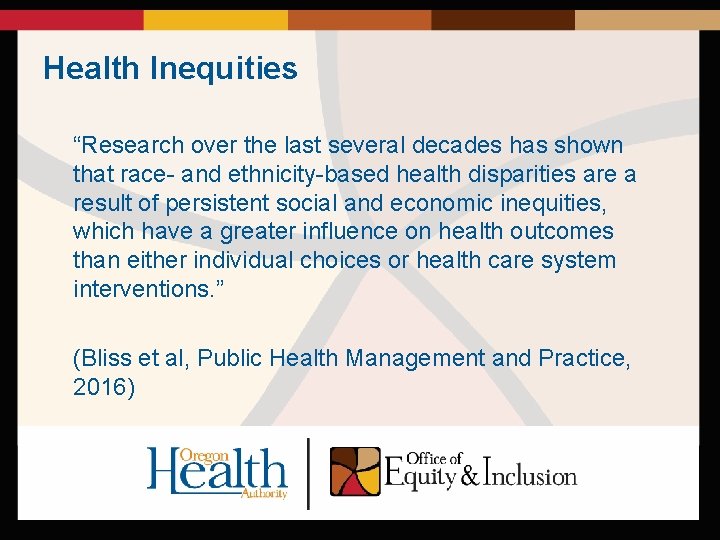
Health Inequities “Research over the last several decades has shown that race- and ethnicity-based health disparities are a result of persistent social and economic inequities, which have a greater influence on health outcomes than either individual choices or health care system interventions. ” (Bliss et al, Public Health Management and Practice, 2016)
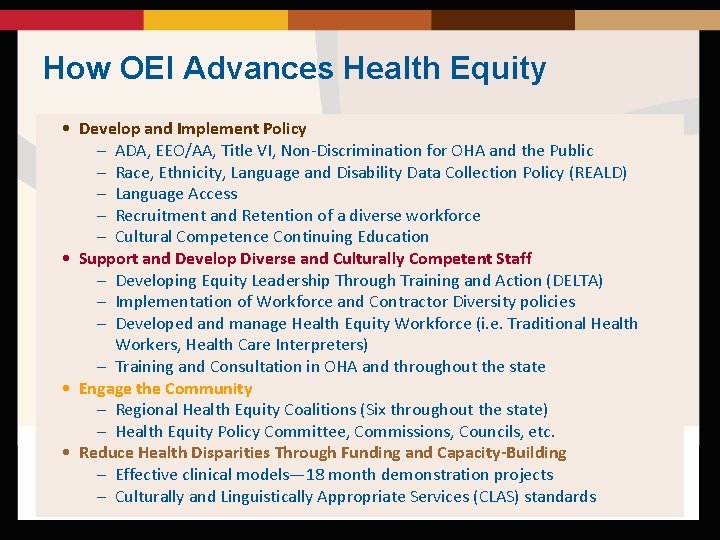
How OEI Advances Health Equity • Develop and Implement Policy – ADA, EEO/AA, Title VI, Non-Discrimination for OHA and the Public – Race, Ethnicity, Language and Disability Data Collection Policy (REALD) – Language Access – Recruitment and Retention of a diverse workforce – Cultural Competence Continuing Education • Support and Develop Diverse and Culturally Competent Staff – Developing Equity Leadership Through Training and Action (DELTA) – Implementation of Workforce and Contractor Diversity policies – Developed and manage Health Equity Workforce (i. e. Traditional Health Workers, Health Care Interpreters) – Training and Consultation in OHA and throughout the state • Engage the Community – Regional Health Equity Coalitions (Six throughout the state) – Health Equity Policy Committee, Commissions, Councils, etc. • Reduce Health Disparities Through Funding and Capacity-Building – Effective clinical models— 18 month demonstration projects – Culturally and Linguistically Appropriate Services (CLAS) standards
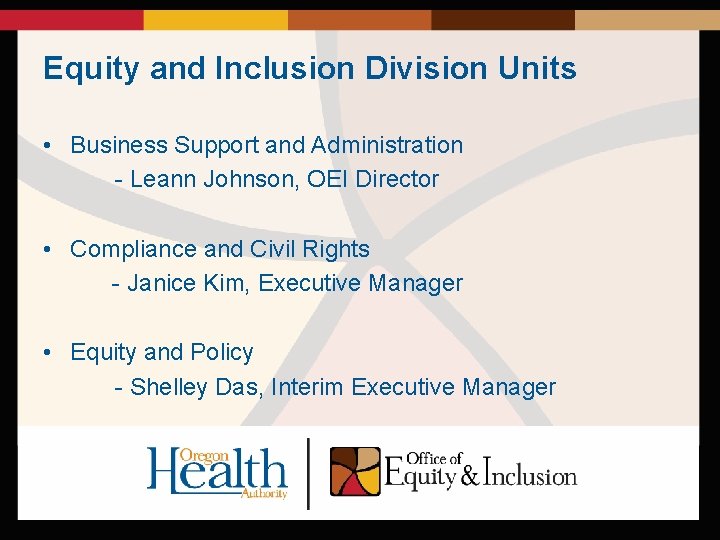
Equity and Inclusion Division Units • Business Support and Administration - Leann Johnson, OEI Director • Compliance and Civil Rights - Janice Kim, Executive Manager • Equity and Policy - Shelley Das, Interim Executive Manager
Questions? Leann R Johnson, MS Director, Equity and Inclusion Division Oregon Health Authority leann. r. johnson@state. or. us Desk: 971 -673 -1285
See you in an hour! 27
Public Health Policy, Administrative Rules, Ordinances and State Legislature Cara Biddlecom Interim Policy Officer Office of the State Public Health Director PUBLIC HEALTH DIVISION New Employee Orientation 28
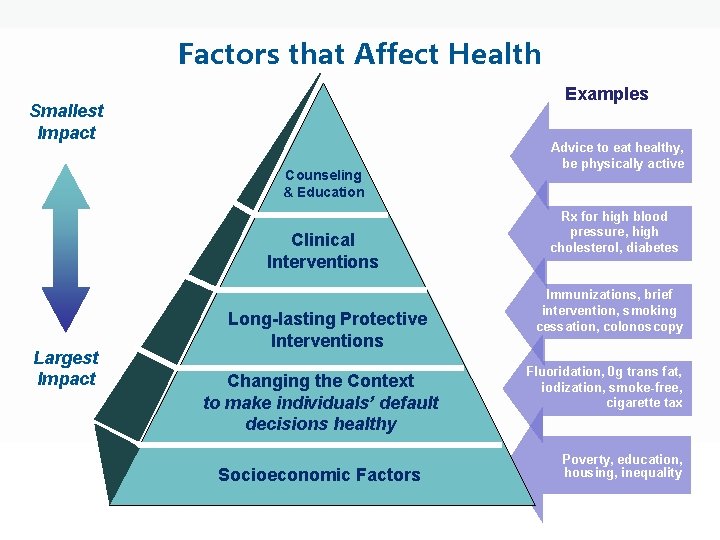
Factors that Affect Health Examples Smallest Impact Counseling & Education Clinical Interventions Largest Impact Long-lasting Protective Interventions Changing the Context to make individuals’ default decisions healthy Socioeconomic Factors Advice to eat healthy, be physically active Rx for high blood pressure, high cholesterol, diabetes Immunizations, brief intervention, smoking cessation, colonoscopy Fluoridation, 0 g trans fat, iodization, smoke-free, cigarette tax Poverty, education, housing, inequality
Oregon’s State Health Improvement Plan, 2015 -2019 • • Reduce tobacco use Slow the increase of obesity Improve oral health Reduce harms associated with alcohol and substance use • Prevent deaths from suicide • Improve immunization rates • Prevent the population from communicable diseases
What you need to know • • Respectful workplace Training needs Ergo assessments Safety issues at PSOB Remember your ID Learning Center to i. Learn. Oregon Resources for Employees Questions?
Contact information Cara Biddlecom 971 -673 -2284 Cara. m. biddlecom@state. or. us 33

The Return of the Workday

See you in 15 minutes 35
Union Presentation for Represented Employees Managers are welcome too Ray Wikle SEIU PUBLIC HEALTH DIVISION New Employee Orientation 36
OHA Tribal Affairs Karol Dixon Tribal Affairs Director Oregon Health Authority PUBLIC HEALTH DIVISION New Employee Orientation
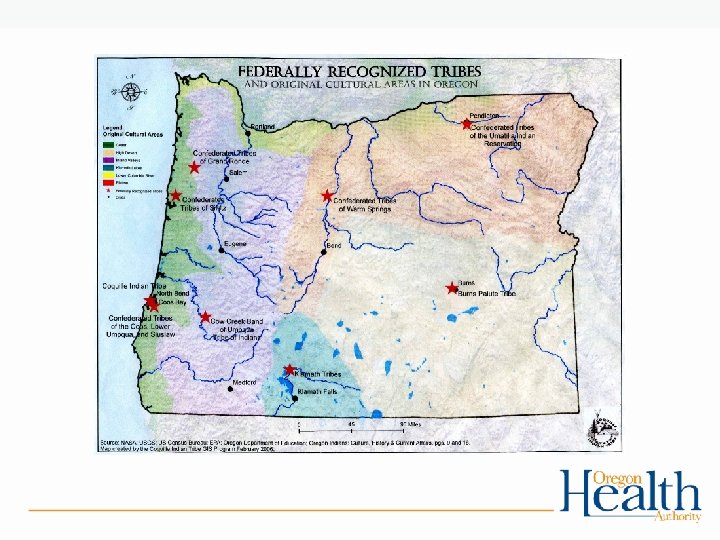
Oregon Tribal Governments • • • Burns Paiute Tribe Confederated Tribes of Coos, Lower Umpqua and Siuslaw Coquille Indian Tribe Cow Creek Band of Umpqua Tribe of Indians Confederated Tribes of The Grand Ronde Community Klamath Tribes Confederated Tribes of Siletz Indians Confederated Tribes of the Umatilla Indian Reservation Confederated Tribes of Warm Springs Reservation
Oregon Indian Tribes Tribal governments are separate sovereign nations with powers to protect the health, safety and welfare of their members and to govern their lands. This tribal sovereignty predates the existence of the U. S. government and the state of Oregon. The members residing in Oregon are citizens of their tribes, of Oregon and, since 1924, of the United States of America. All Oregon tribal governments have reservation or trust lands created by treaties or federal acts. Tribal governments have regulatory authority over these lands unless that authority has been removed by Congress.
Supreme Law of the Land This Constitution, and the Laws of the United States which shall be made in Pursuance thereof; and all Treaties made, or which shall be made, under the Authority of the United States, shall be the supreme Law of the Land; and the Judges in every State shall be bound thereby, any Thing in the Constitution or Laws of any State to the Contrary notwithstanding. US Constitution, Article VI 1855 Coquelle - unratified Treaty of 1855 - Cayuse, Umatilla, and Walla Tribes Treaty with the Tribes of Middle Oregon, 1855 Treaty of 1864, Klamath
Termination & Relocation • The Klamath Termination Act (PL 587) enacted in 1954 and terminated Federal supervision over land members • The Western Oregon Indian Termination Act (PL 588) was passed in August 1954 as part of the United States Indian termination policy and affected ~60 Oregon Tribes (Siletz, Grand Ronde, Coquille, Coos, Lower Umpqua, Siuslaw, and other Oregon tribes) effective immediately • The Indian Relocation Act of 1956 encouraged Native Americans to leave Indian reservations, acquire vocational skills, and assimilate into the general population
Restoration 1977 -1989 • 1977, the Siletz Tribe was recognized and restored • 1982, the Cow Creek Band of the Umpqua Tribe was restored • 1983, Grand Ronde Restoration Act (PL 98– 165), creating the Confederated Tribes of Grand Ronde • 1984, Coos, Lower Umpqua, and Siuslaw had trust status restored • 1986, Klamath had their trust status restored • 1989, Coquille Restoration Act to restore federal trust relationship
Oregon Indian Population • 126, 944 AI/AN (alone or in combination, ACS 2014) • 48, 107 in Portland – 37. 8% (Census, 2010) • 35, 937 on OHP – 28. 3% Portland is 9 th largest Native American population in USA
A note on Service Areas Each tribe’s area of interest may extend far beyond its tribal governmental center or reservation location. The federal government acknowledges that many tribal members do not live on tribal lands and, therefore, allows for tribes to provide governmental programs in specified service areas. For example, the Confederated Tribes of Siletz service area includes 11 Oregon counties: Benton, Clackamas, Lane, Lincoln, Linn, Marion, Multnomah, Polk, Tillamook, Washington and Yamhill.
SB 770 • Oregon 1 st state to adopt formal legal G 2 G through EO and legislation • Direct state agencies in G 2 G with Oregon tribes • Framework is model of excellent state tribal relations
What is Tribal Consultation? To establish and maintain a positive government-to-government relationship, communication and consultation must occur on an ongoing basis so that Tribes have an opportunity to provide meaningful and timely input on issues that may have a substantial direct effect on them.
Meeting or Consultation? • Tribal Consultation refers to a formal meeting with elected Tribal government officials and our agency director. Decision makers present. • Tribal meetings are less formal and happen frequently. Updates, program reports, etc. Decision makers may or may not be present. – Examples: OHA Tribal Monthly Meeting, 770 Quarterly Health Cluster meeting • Small “c” consultation – according to our state plan, written notification of changes with opportunity to call for large “C”.
OHA Tribal Affairs Karol Dixon & Julie Johnson karol. l. dixon@state. or. us 971 -283 -1822 julie. a. johnson@state. or. us 503 -569 -5802
TRIVIA 50
51
Thank you! And welcome aboard! 52
- Slides: 52