
Center for Devices and Radiological Health A Perspective

- Slides: 10
Center for Devices and Radiological Health A Perspective On Medical Device Risk Management William Midgette Heart Rhythm Society Washington, D. C. September 16, 2005
Two Common Approaches to Analyzing Risk u Bottom-up Center for Devices and Radiological Health (inductive, e. g. , Failure Mode and Effects Analysis) versus top-down (deductive, e. g. Fault Tree Analysis) u Bottom-up – induce a failure and determine the harm it can cause u Top-down – select an undesired top-level event and identify the faults that can cause it
Fault-Tree Analysis Center for Devices and Radiological Health u Requires the selection of an undesired toplevel event, e. g, life-saving shock not delivered for an ICD u The analysis should identify all faults that can cause the event u Risk control measures should be included in the analysis
Risk Control Measures u Protective Center for Devices and Radiological Health measures, e. g. default operating modes u Information for safety, e. g. , warnings in labeling u Many measures require intervention – The correct response for the circumstances, e. g. a patient-specific response – Timeliness
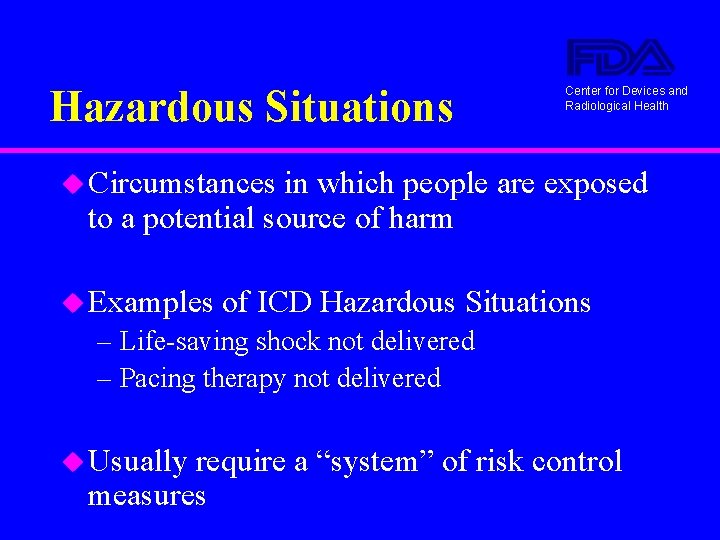
Hazardous Situations Center for Devices and Radiological Health u Circumstances in which people are exposed to a potential source of harm u Examples of ICD Hazardous Situations – Life-saving shock not delivered – Pacing therapy not delivered u Usually require a “system” of risk control measures
Hazardous Situation and Causes Center for Devices and Radiological Health Hazardous Situation OR Cause #1 Cause #2 Cause #3 Cause #4
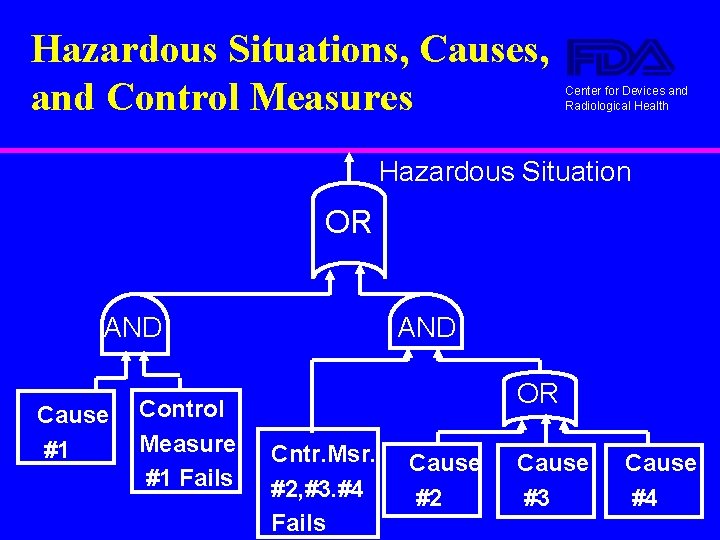
Hazardous Situations, Causes, and Control Measures Center for Devices and Radiological Health Hazardous Situation OR AND Cause #1 Control Measure #1 Fails AND OR Cntr. Msr. #2, #3. #4 Fails Cause #2 Cause #3 Cause #4
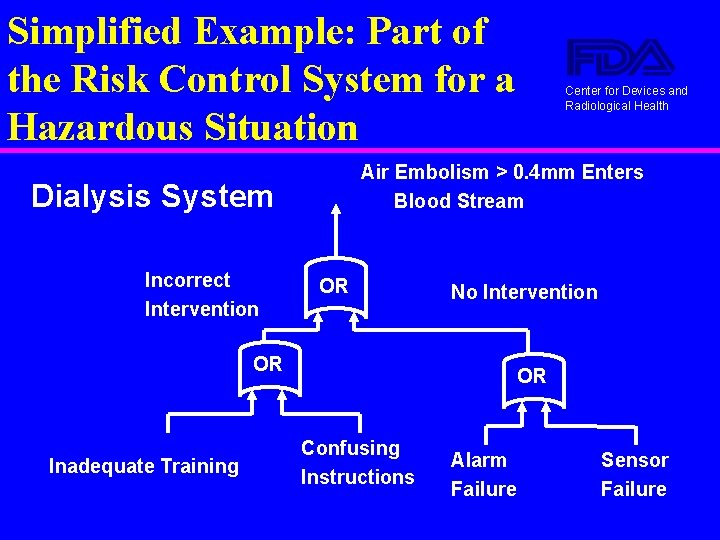
Simplified Example: Part of the Risk Control System for a Hazardous Situation Air Embolism > 0. 4 mm Enters Blood Stream Dialysis System Incorrect Intervention OR No Intervention OR Inadequate Training Center for Devices and Radiological Health OR Confusing Instructions Alarm Failure Sensor Failure
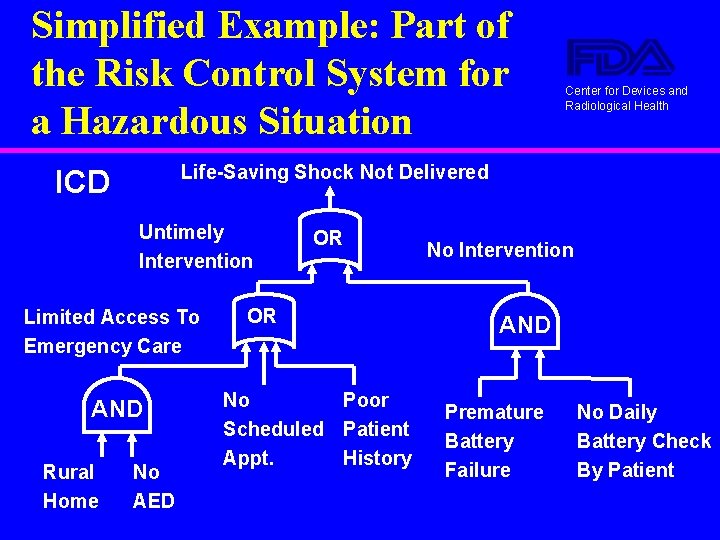
Simplified Example: Part of the Risk Control System for a Hazardous Situation Life-Saving Shock Not Delivered ICD Untimely Intervention Limited Access To Emergency Care AND Rural Home Center for Devices and Radiological Health No AED OR OR No Poor Scheduled Patient Appt. History No Intervention AND Premature Battery Failure No Daily Battery Check By Patient
Center for Devices and Radiological Health Conclusions