
Center for Biofilm Engineering Using equivalence testing in

Center for Biofilm Engineering Using equivalence testing in microbiology Albert Parker Biostatistician and Research Engineer Center for Biofilm Engineering, MSU July 2011

Standardized Biofilm Methods Laboratory Diane Walker Paul Sturman Lindsey Lorenz Marty Hamilton Kelli Buckingham-Meyer Darla Goeres
Outline § What is an equivalence test? § Equivalence vs. significance § How to perform an equivalence test? § Example: Neutralization tests
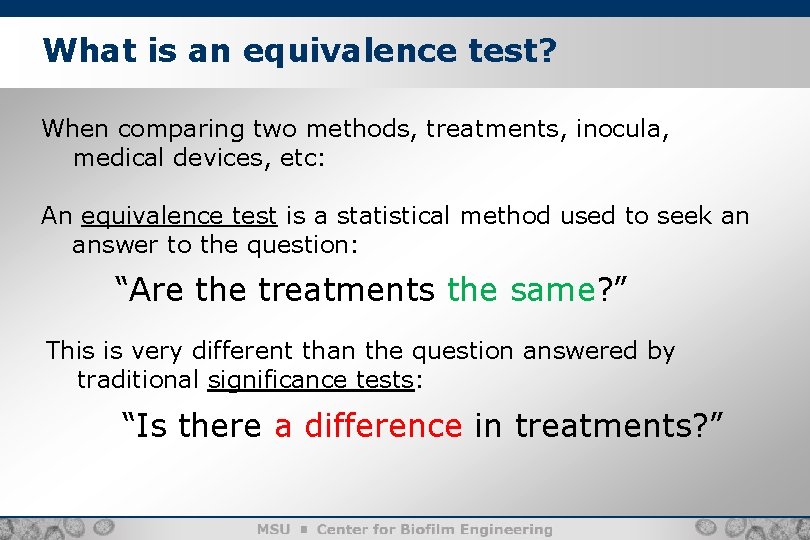
What is an equivalence test? 4 When comparing two methods, treatments, inocula, medical devices, etc: An equivalence test is a statistical method used to seek an answer to the question: “Are the treatments the same? ” This is very different than the question answered by traditional significance tests: “Is there a difference in treatments? ”
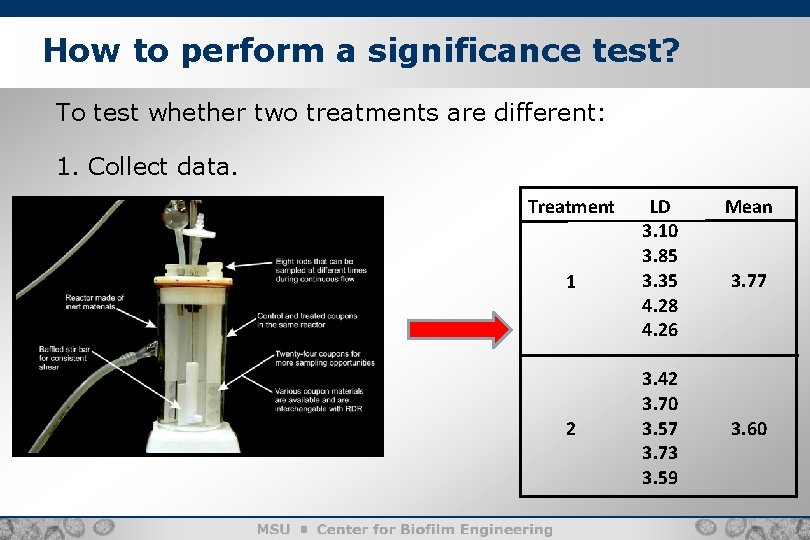
How to perform a significance test? 5 To test whether two treatments are different: 1. Collect data. Treatment 1 2 LD 3. 10 3. 85 3. 35 4. 28 4. 26 3. 42 3. 70 3. 57 3. 73 3. 59 Mean 3. 77 3. 60

How to perform a significance test? To test whether two treatments are different: 2. Calculate a p-value for the difference in means. Treatment 1 2 LD 3. 10 3. 85 3. 35 4. 28 4. 26 3. 42 3. 70 3. 57 3. 73 3. 59 Mean 3. 77 t-test p-value 0. 442 3. 60 6
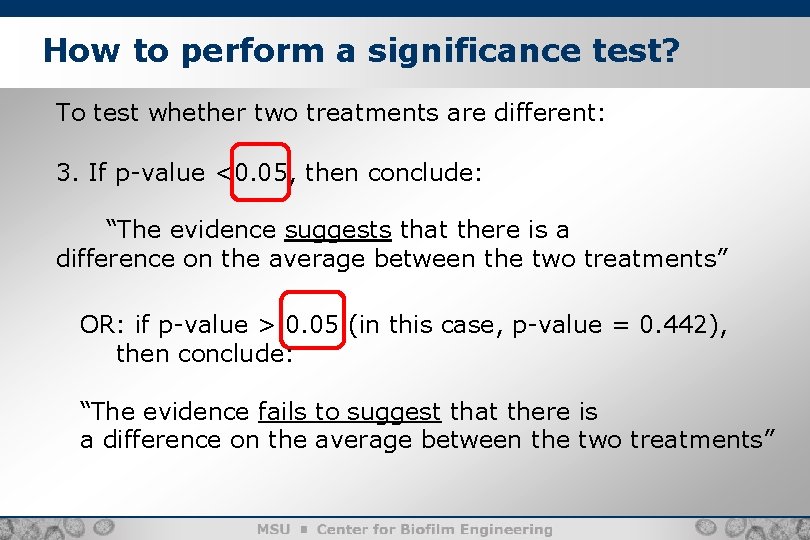
How to perform a significance test? 7 To test whether two treatments are different: 3. If p-value <0. 05, then conclude: “The evidence suggests that there is a difference on the average between the two treatments” OR: if p-value > 0. 05 (in this case, p-value = 0. 442), then conclude: “The evidence fails to suggest that there is a difference on the average between the two treatments”
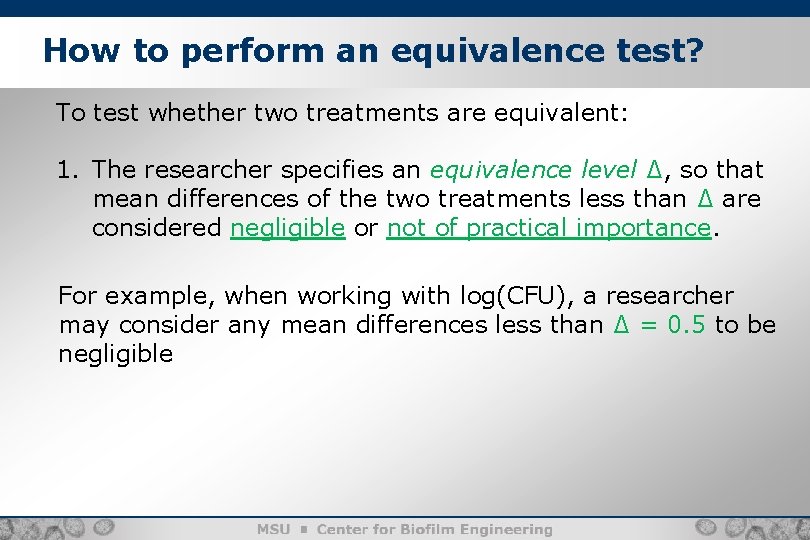
How to perform an equivalence test? 8 To test whether two treatments are equivalent: 1. The researcher specifies an equivalence level ∆, so that mean differences of the two treatments less than ∆ are considered negligible or not of practical importance. For example, when working with log(CFU), a researcher may consider any mean differences less than ∆ = 0. 5 to be negligible

How to perform an equivalence test? 9 To test whether two treatments are equivalent: 2. Collect data. Treatment 1 2 LD 3. 10 3. 85 3. 35 4. 28 4. 26 3. 42 3. 70 3. 57 3. 73 3. 59 Mean 3. 77 3. 60
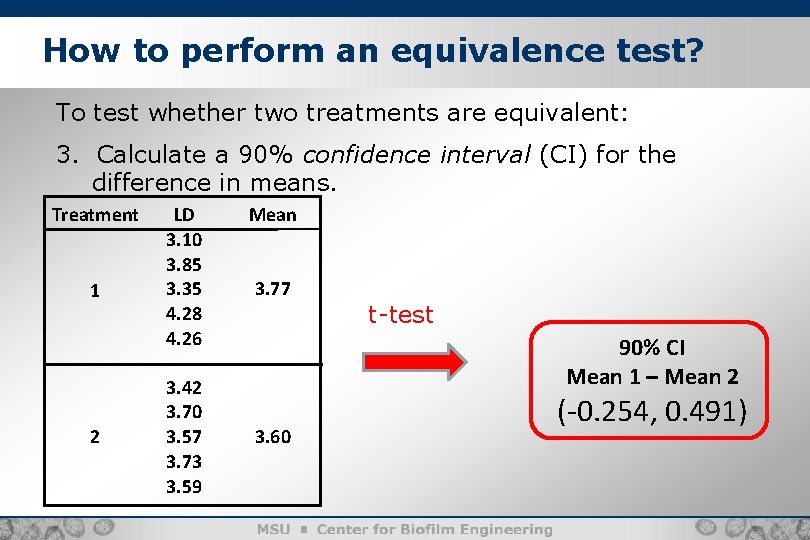
How to perform an equivalence test? 10 To test whether two treatments are equivalent: 3. Calculate a 90% confidence interval (CI) for the difference in means. Treatment 1 2 LD 3. 10 3. 85 3. 35 4. 28 4. 26 3. 42 3. 70 3. 57 3. 73 3. 59 Mean 3. 77 t-test 90% CI Mean 1 – Mean 2 3. 60 (-0. 254, 0. 491)

How to perform an equivalence test? 11 To test whether two treatments are equivalent: 4. If the 90% CI falls entirely within the equivalence zone [-∆, ∆] 90% CI Mean 1 – Mean 2 (-0. 254, 0. 491) -0. 50 -0. 25 0. 00 0. 25 then conclude: “The evidence suggests that the two treatments are statistically equivalent on the average” 0. 50
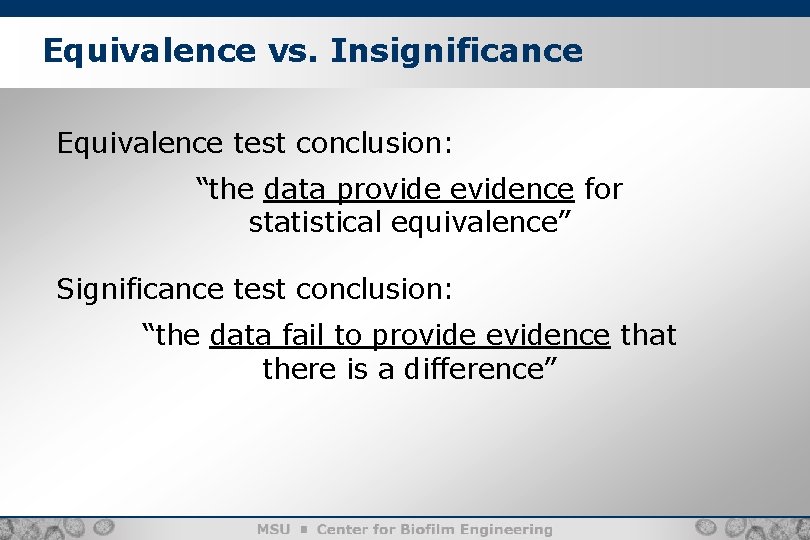
Equivalence vs. Insignificance Equivalence test conclusion: “the data provide evidence for statistical equivalence” Significance test conclusion: “the data fail to provide evidence that there is a difference”
Applications in Microbiology § FDA submissions claiming equivalence between drugs or medical devices. § Verification of an equivalent inoculum or bio-challenge among different experiments § Neutralization tests
Example: Neutralization Testing Questions: § Is a purported neutralizer inhibitory or toxic to the bacterial cells? § Does a purported neutralizer inactivate the anti-microbial activity of a disinfectant?

Example: Neutralization Testing ASTM E 1054 -08 “Standard Test Methods for Evaluation of Inactivators of Antimicrobial Agents”: Add a neutralizer or DI water, bacterial cells, and disinfectant to 4 test flasks: • • A: neutralizer + cells + disinfectant B: neutralizer + cells C: DI water + cells D: disinfectant + cells
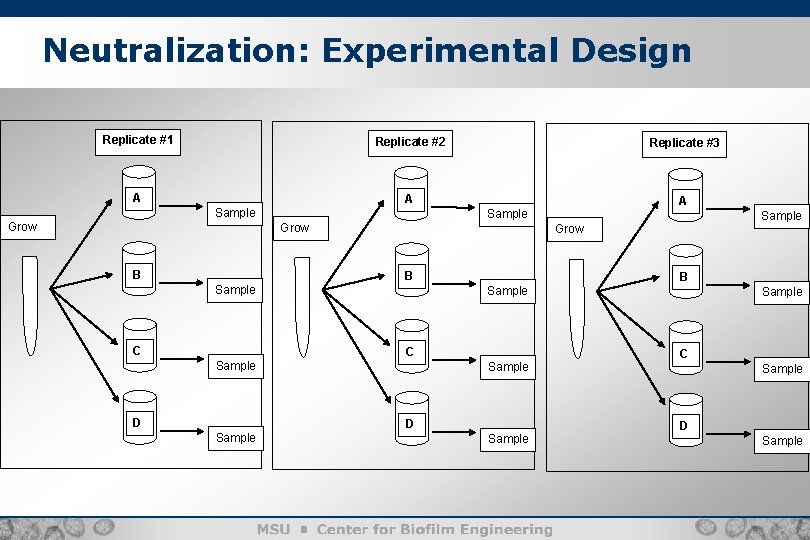
Neutralization: Experimental Design Replicate #1 Replicate #2 A A Sample Grow B Replicate #3 Grow B Sample C Sample D Sample
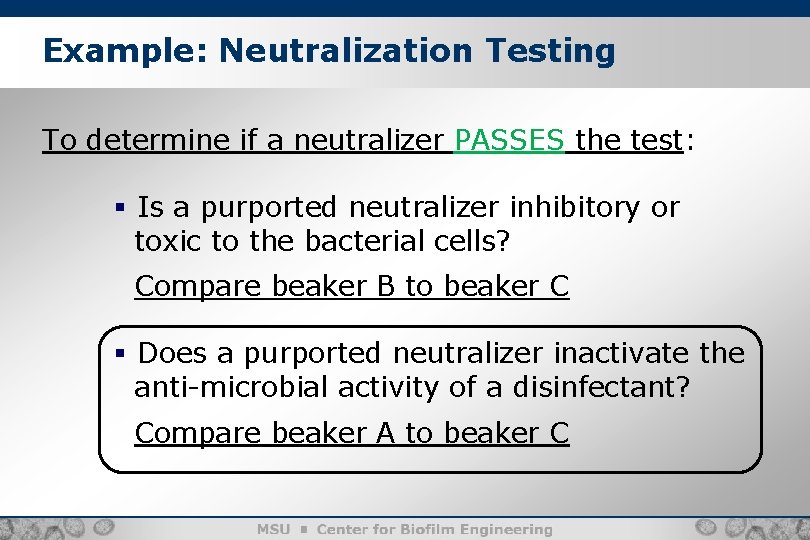
Example: Neutralization Testing To determine if a neutralizer PASSES the test: § Is a purported neutralizer inhibitory or toxic to the bacterial cells? Compare beaker B to beaker C § Does a purported neutralizer inactivate the anti-microbial activity of a disinfectant? Compare beaker A to beaker C
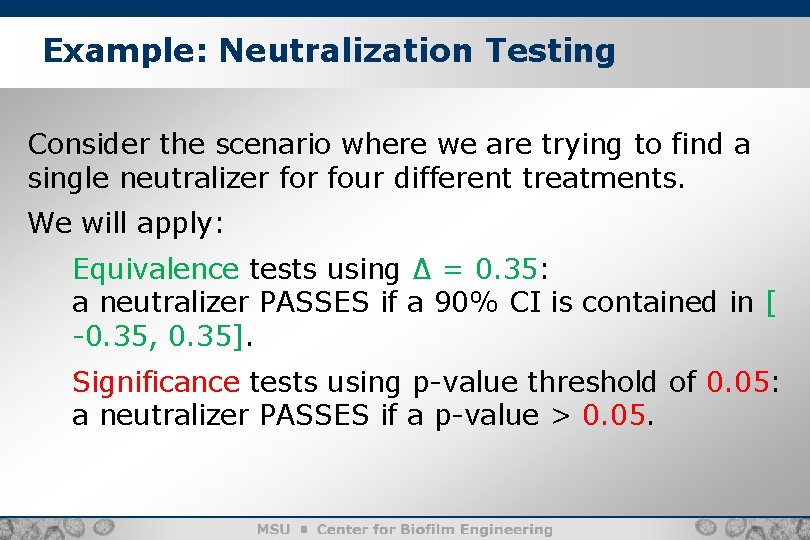
Example: Neutralization Testing Consider the scenario where we are trying to find a single neutralizer four different treatments. We will apply: Equivalence tests using ∆ = 0. 35: a neutralizer PASSES if a 90% CI is contained in [ -0. 35, 0. 35]. Significance tests using p-value threshold of 0. 05: a neutralizer PASSES if a p-value > 0. 05.
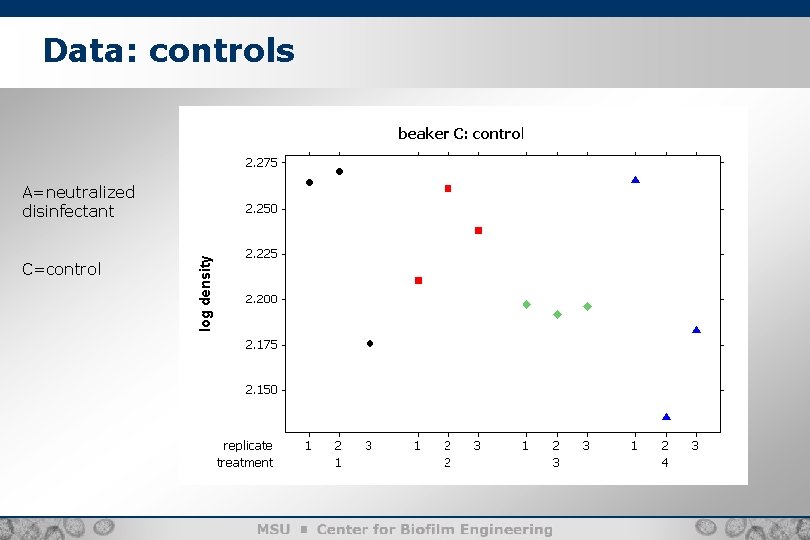
Data: controls A=neutralized disinfectant C=control
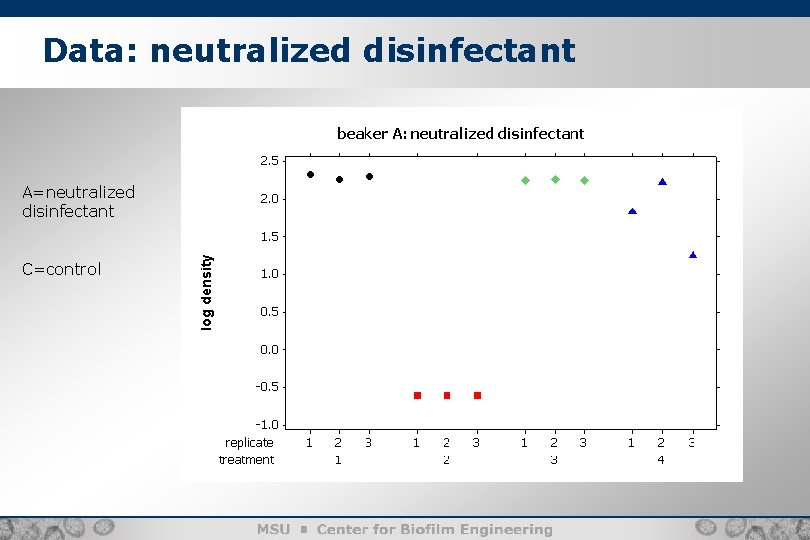
Data: neutralized disinfectant A=neutralized disinfectant C=control

Does the neutralizer neutralize? Calculate: a log reduction LR = log(C) LR = – log(A) -
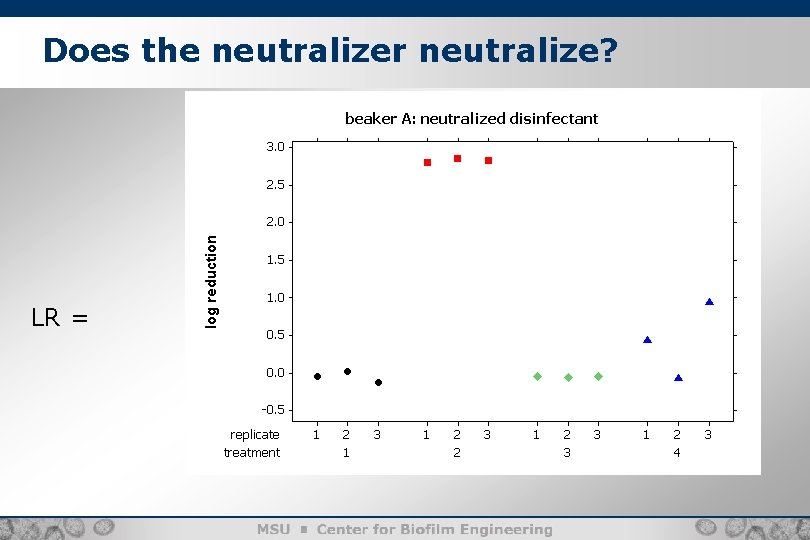
Does the neutralizer neutralize? LR =
![Does the neutralizer neutralize? Equivalence zone [-0. 35, 0. 35] 90% CIs I 0.](http://slidetodoc.com/presentation_image_h/0db815adfe1d9b831134b55c31759077/image-23.jpg "Does the neutralizer neutralize? Equivalence zone [-0. 35, 0. 35] 90% CIs I 0.")
Does the neutralizer neutralize? Equivalence zone [-0. 35, 0. 35] 90% CIs I 0. 297 0. 000 0. 006 and p-values The equivalence tests and significance tests agree for the first two scenarios … I P I F ? 0. 281 I ?
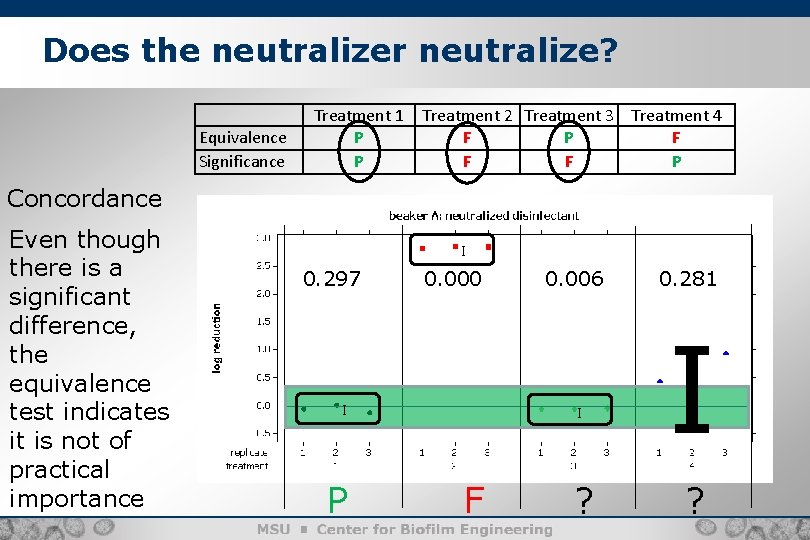
Does the neutralizer neutralize? Equivalence Significance Treatment 1 P P Treatment 2 Treatment 3 Treatment 4 F P F F F P Concordance Even though there is a significant difference, the equivalence test indicates it is not of practical importance I 0. 297 0. 000 I P 0. 006 I F ? 0. 281 I ?
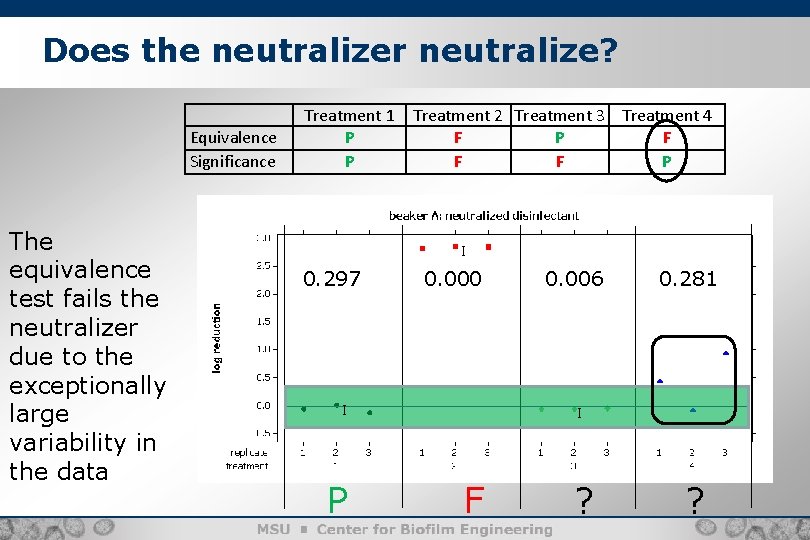
Does the neutralizer neutralize? Equivalence Significance The equivalence test fails the neutralizer due to the exceptionally large variability in the data Treatment 1 P P Treatment 2 Treatment 3 Treatment 4 F P F F F P I 0. 297 0. 000 I P 0. 006 0. 281 I F ? ?
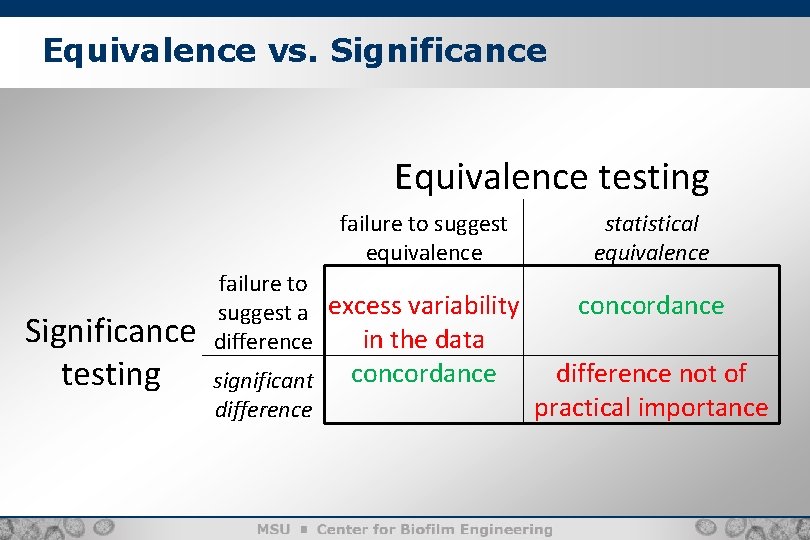
Equivalence vs. Significance Equivalence testing failure to suggest equivalence failure to suggest a excess variability in the data difference Significance testing significant difference concordance statistical equivalence concordance difference not of practical importance
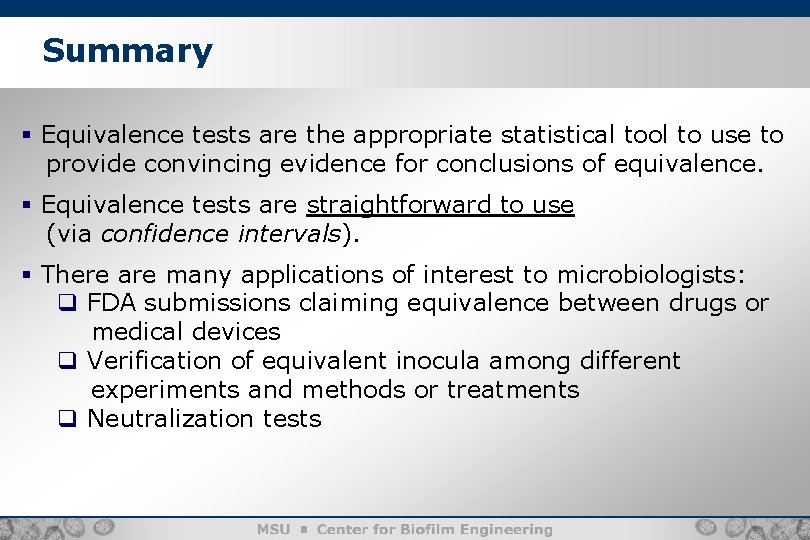
Summary § Equivalence tests are the appropriate statistical tool to use to provide convincing evidence for conclusions of equivalence. § Equivalence tests are straightforward to use (via confidence intervals). § There are many applications of interest to microbiologists: q FDA submissions claiming equivalence between drugs or medical devices q Verification of equivalent inocula among different experiments and methods or treatments q Neutralization tests
Reference How to: Richter, S. J. , and Richter, C. (2002) A method for determining equivalence in industrial applications. Quality Engineering 14, 375– 380. Application to a microbiological data: Tomasino, S. F. , & Hamilton, M. A. (2006) Modification to the AOAC Sporicidal Activity of Disinfectants Test (Method 966. 04): Collaborative Study. JAOAC Int. 89, 1373– 1397.

equivalence testing
- Slides: 29