
Center Computational CCV Visualization Mannheim Summer School 2002

- Slides: 75
Center Computational CCV Visualization Mannheim Summer School 2002 Computational Visualization 1. Sources, characteristics, representation 2. Mesh Processing 3. Contouring 4. Volume Rendering 5. Flow, Vector, Tensor Field Visualization 6. Application Case Studies Copyright: Chandrajit Bajaj, CCV, University of Texas at Austin
Center Computational CCV Visualization Computational Visualization: Contouring Lecture 3 Copyright: Chandrajit Bajaj, CCV, University of Texas at Austin
Center Computational CCV Outline Visualization • • • Primal vs Dual Topology Look Up Table Seed Sets Spectrum for Isovalue Selection Progressive Time Varying Copyright: Chandrajit Bajaj, CCV, University of Texas at Austin
Center Computational CCV Contouring in Visualization Copyright: Chandrajit Bajaj, CCV, University of Texas at Austin
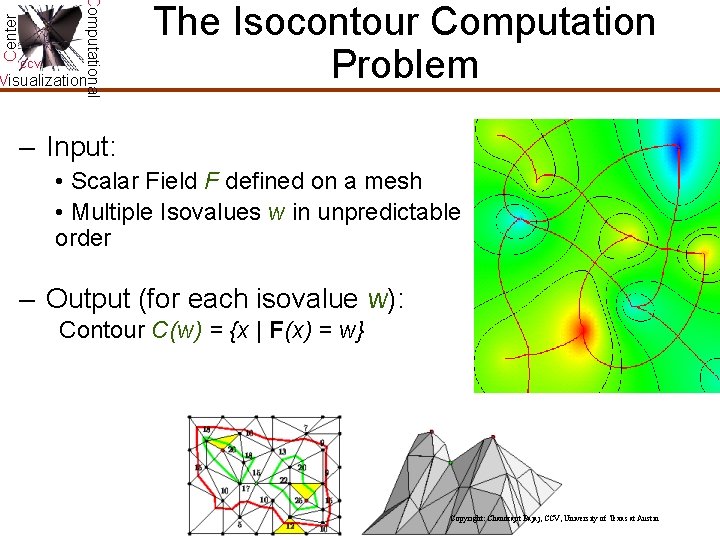
Center Computational CCV Visualization The Isocontour Computation Problem – Input: • Scalar Field F defined on a mesh • Multiple Isovalues w in unpredictable order – Output (for each isovalue w): Contour C(w) = {x | F(x) = w} Copyright: Chandrajit Bajaj, CCV, University of Texas at Austin
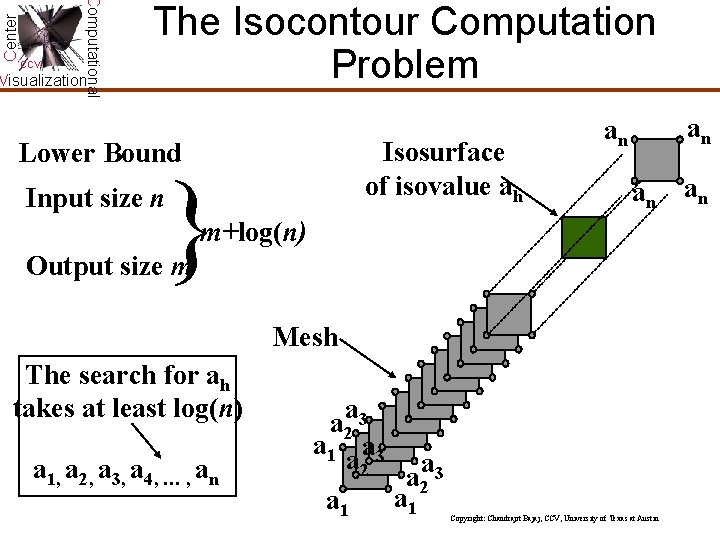
Center Computational CCV Visualization The Isocontour Computation Problem Isosurface of isovalue ah Lower Bound } Input size n an an an m+log(n) Output size m Mesh The search for ah takes at least log(n) a 1, a 2, a 3, a 4, … , an a a 2 3 a 1 a 3 a 2 a 1 a 2 a 3 a 1 Copyright: Chandrajit Bajaj, CCV, University of Texas at Austin an
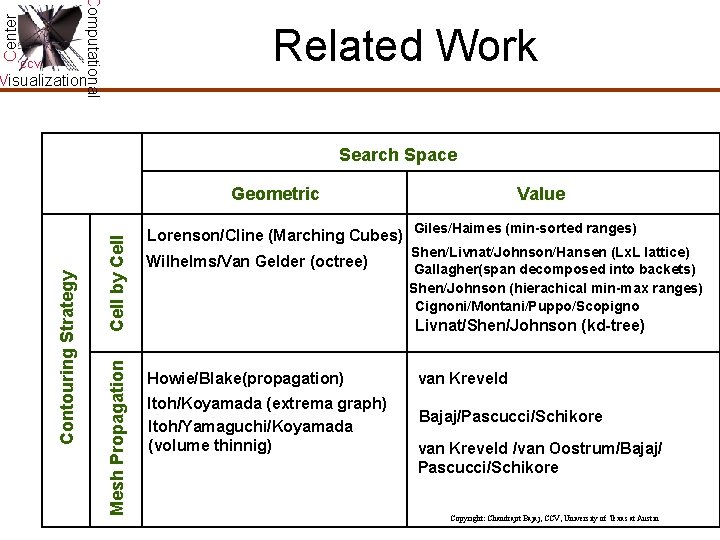
Center Computational CCV Related Work Visualization Search Space Cell by Cell Mesh Propagation Contouring Strategy Geometric Lorenson/Cline (Marching Cubes) Wilhelms/Van Gelder (octree) Value Giles/Haimes (min-sorted ranges) Shen/Livnat/Johnson/Hansen (Lx. L lattice) Gallagher(span decomposed into backets) Shen/Johnson (hierachical min-max ranges) Cignoni/Montani/Puppo/Scopigno Livnat/Shen/Johnson (kd-tree) Howie/Blake(propagation) van Kreveld Itoh/Koyamada (extrema graph) Itoh/Yamaguchi/Koyamada (volume thinnig) Bajaj/Pascucci/Schikore van Kreveld /van Oostrum/Bajaj/ Pascucci/Schikore Copyright: Chandrajit Bajaj, CCV, University of Texas at Austin
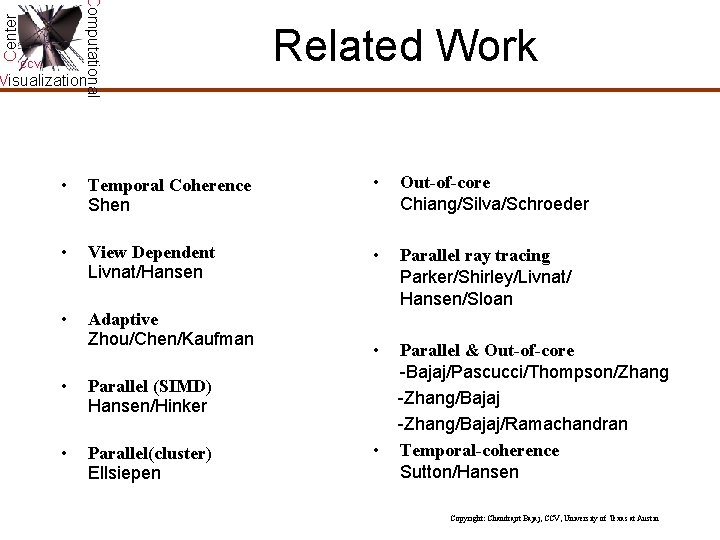
Center Computational CCV Related Work Visualization • Temporal Coherence Shen • Out-of-core Chiang/Silva/Schroeder • View Dependent Livnat/Hansen • Parallel ray tracing Parker/Shirley/Livnat/ Hansen/Sloan • Adaptive Zhou/Chen/Kaufman • Parallel & Out-of-core -Bajaj/Pascucci/Thompson/Zhang -Zhang/Bajaj/Ramachandran Temporal-coherence Sutton/Hansen • Parallel (SIMD) Hansen/Hinker • Parallel(cluster) Ellsiepen • Copyright: Chandrajit Bajaj, CCV, University of Texas at Austin
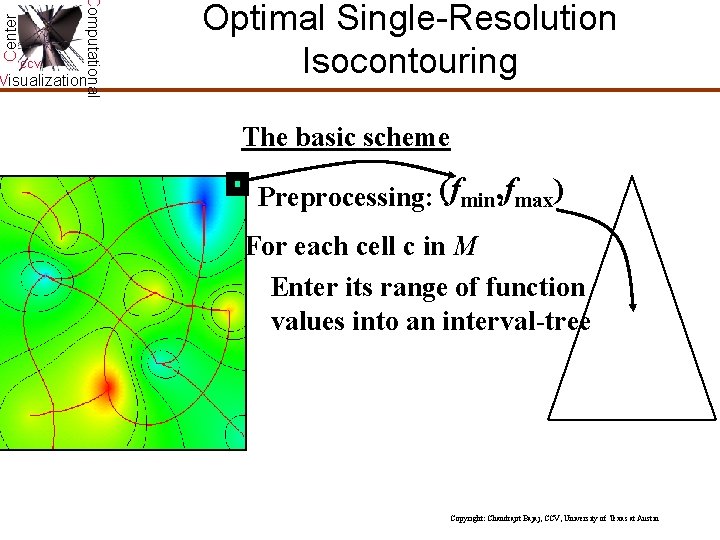
Center Computational CCV Visualization Optimal Single-Resolution Isocontouring The basic scheme Preprocessing: (fmin, fmax) For each cell c in M Enter its range of function values into an interval-tree Copyright: Chandrajit Bajaj, CCV, University of Texas at Austin
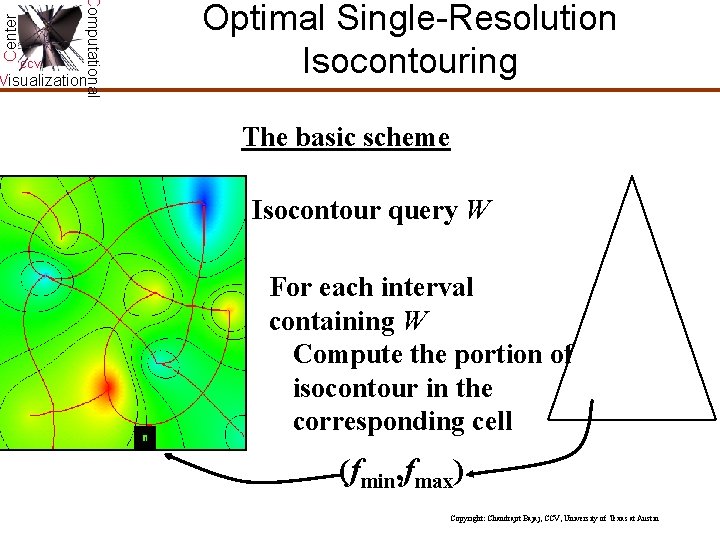
Center Computational CCV Visualization Optimal Single-Resolution Isocontouring The basic scheme Isocontour query W For each interval containing W Compute the portion of isocontour in the corresponding cell (fmin, fmax) Copyright: Chandrajit Bajaj, CCV, University of Texas at Austin
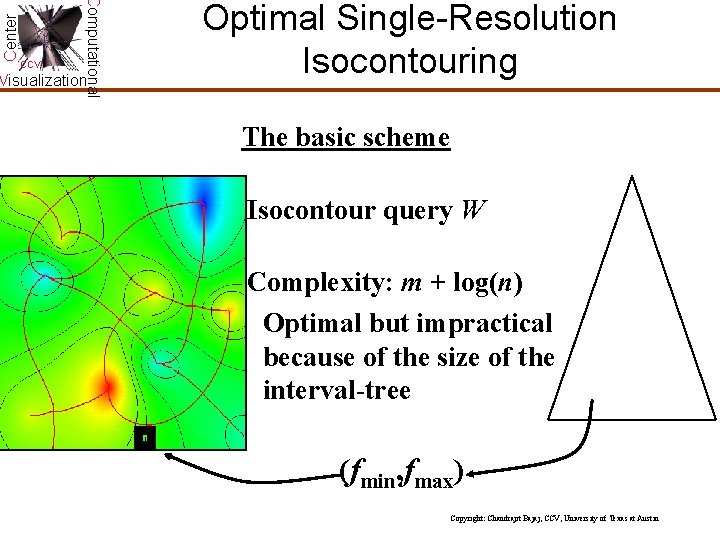
Center Computational CCV Visualization Optimal Single-Resolution Isocontouring The basic scheme Isocontour query W Complexity: m + log(n) Optimal but impractical because of the size of the interval-tree (fmin, fmax) Copyright: Chandrajit Bajaj, CCV, University of Texas at Austin
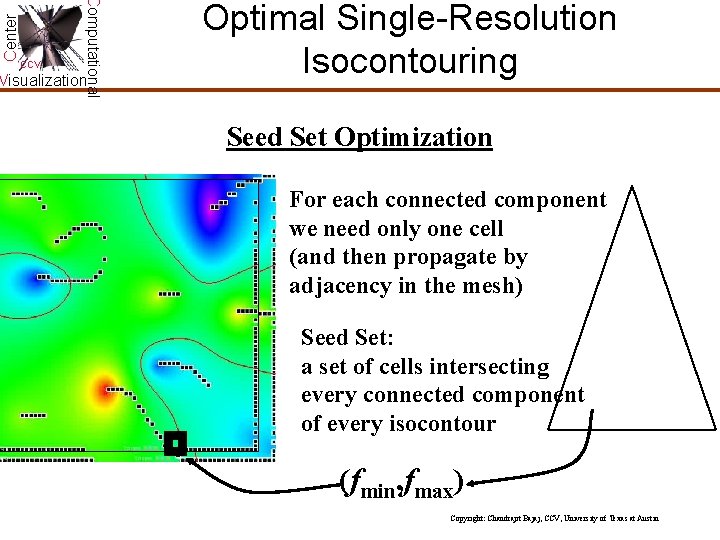
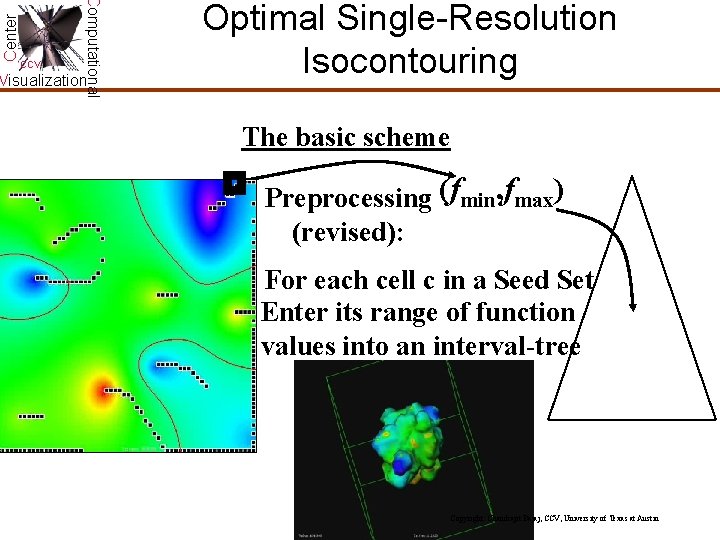
Center Computational CCV Visualization Optimal Single-Resolution Isocontouring Seed Set Optimization For each connected component we need only one cell (and then propagate by adjacency in the mesh) Seed Set: a set of cells intersecting every connected component of every isocontour (fmin, fmax) Copyright: Chandrajit Bajaj, CCV, University of Texas at Austin
Center Computational CCV Visualization Optimal Single-Resolution Isocontouring The basic scheme Preprocessing (fmin, fmax) (revised): For each cell c in a Seed Set Enter its range of function values into an interval-tree Copyright: Chandrajit Bajaj, CCV, University of Texas at Austin
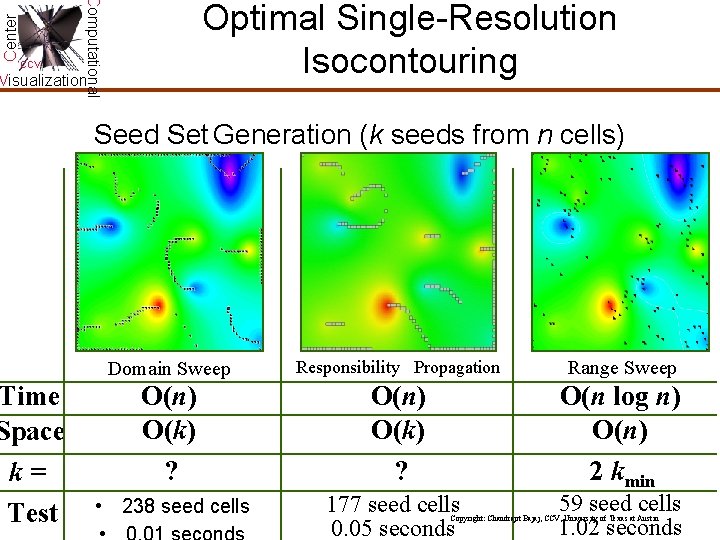
Center Computational CCV Optimal Single-Resolution Isocontouring Visualization Time Space k= Test Seed Set Generation (k seeds from n cells) Domain Sweep Responsibility Propagation Range Sweep O(n) O(k) ? O(n log n) O(n) 2 kmin • 238 seed cells 177 seed cells 0. 05 seconds 59 seed cells 1. 02 seconds Copyright: Chandrajit Bajaj, CCV, University of Texas at Austin
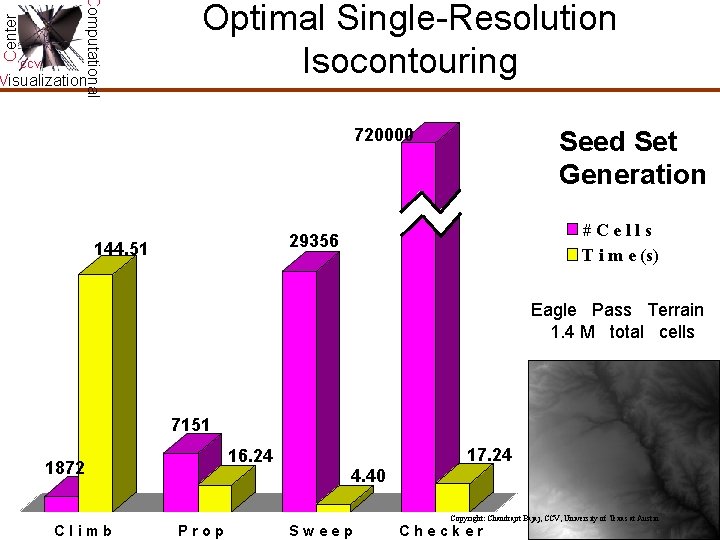
Center Computational CCV Visualization Optimal Single-Resolution Isocontouring 720000 Seed Set Generation #Cells T i m e (s) 29356 144. 51 Eagle Pass Terrain 1. 4 M total cells 7151 16. 24 1872 Climb Prop 17. 24 4. 40 Sweep Copyright: Chandrajit Bajaj, CCV, University of Texas at Austin Checker
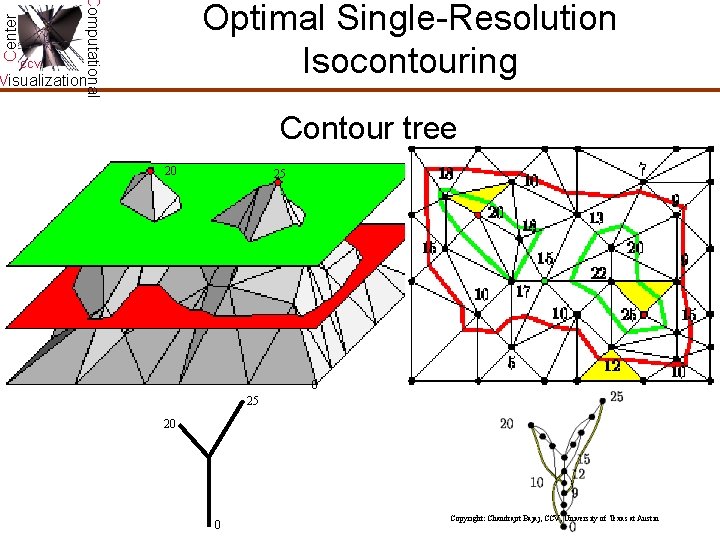
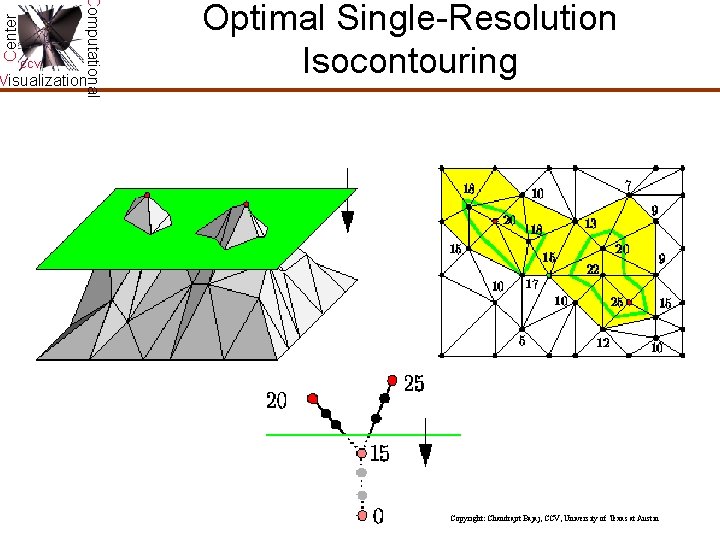
Center Computational CCV Optimal Single-Resolution Isocontouring Visualization Contour tree 20 25 20 0 Copyright: Chandrajit Bajaj, CCV, University of Texas at Austin
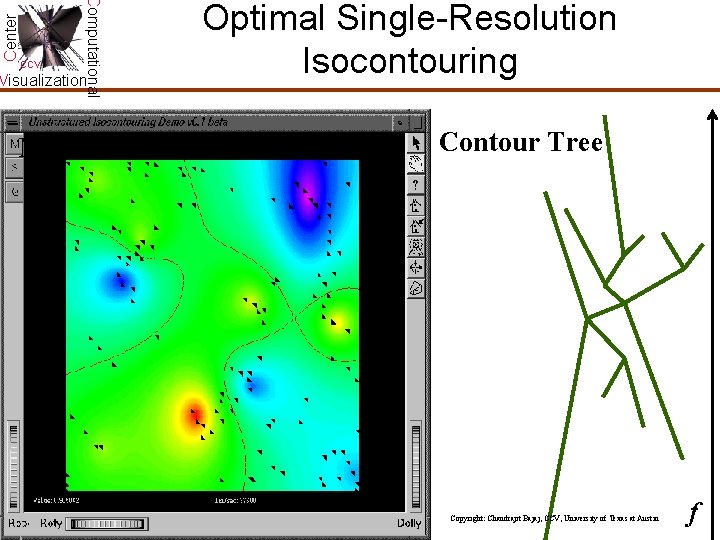
Center Computational CCV Visualization Optimal Single-Resolution Isocontouring Minimal Seed Set Contour Tree Copyright: Chandrajit Bajaj, CCV, University of Texas at Austin f
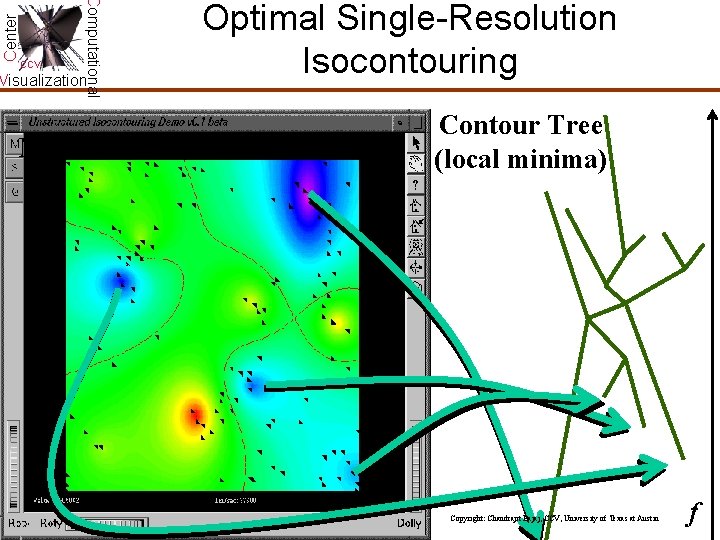
Center Computational CCV Visualization Optimal Single-Resolution Isocontouring Minimal Seed Set Contour Tree (local minima) Copyright: Chandrajit Bajaj, CCV, University of Texas at Austin f
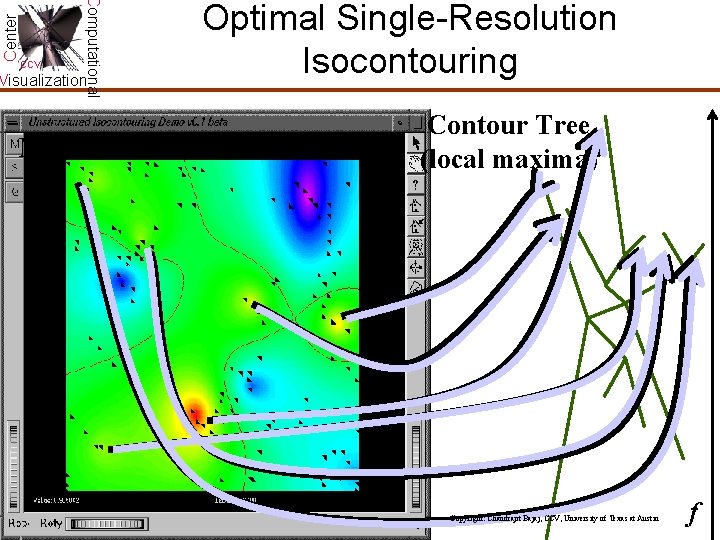
Center Computational CCV Visualization Optimal Single-Resolution Isocontouring Minimal Seed Set Contour Tree (local maxima) Copyright: Chandrajit Bajaj, CCV, University of Texas at Austin f
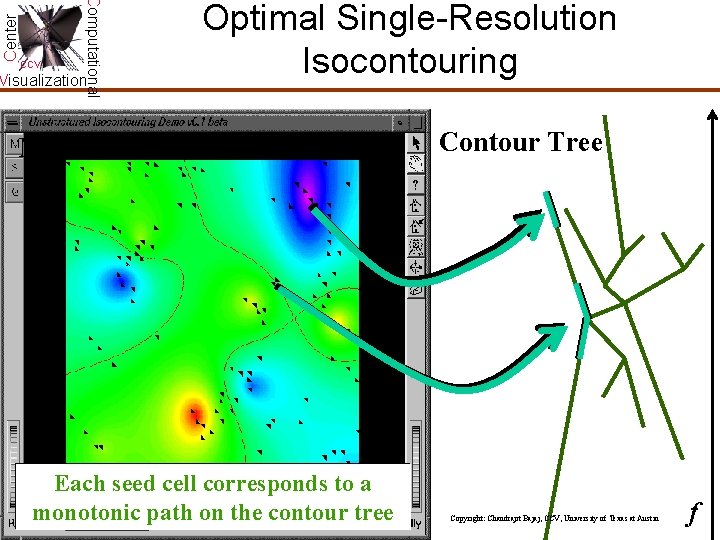
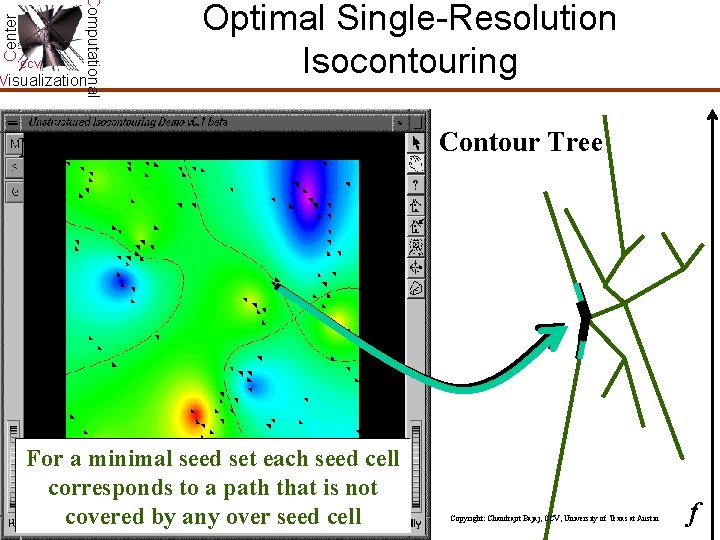
Center Computational CCV Visualization Optimal Single-Resolution Isocontouring Minimal Seed Set Each seed cell corresponds to a monotonic path on the contour tree Contour Tree Copyright: Chandrajit Bajaj, CCV, University of Texas at Austin f
Center Computational CCV Visualization Optimal Single-Resolution Isocontouring Minimal Seed Set For a minimal seed set each seed cell corresponds to a path that is not covered by any over seed cell Contour Tree Copyright: Chandrajit Bajaj, CCV, University of Texas at Austin f
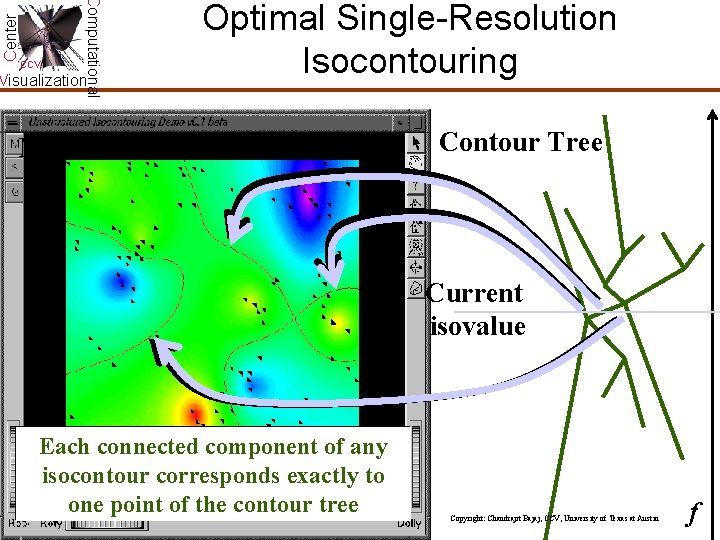
Center Computational CCV Visualization Optimal Single-Resolution Isocontouring Minimal Seed Set Contour Tree Current isovalue Each connected component of any isocontour corresponds exactly to one point of the contour tree Copyright: Chandrajit Bajaj, CCV, University of Texas at Austin f
Center Computational CCV Visualization Optimal Single-Resolution Isocontouring Range sweep Copyright: Chandrajit Bajaj, CCV, University of Texas at Austin
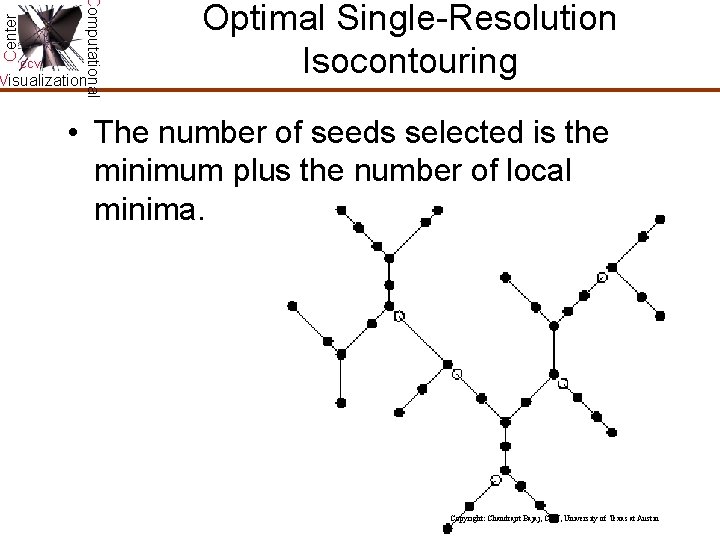
Center Computational CCV Visualization Optimal Single-Resolution Isocontouring • The number of seeds selected is the minimum plus the number of local minima. Copyright: Chandrajit Bajaj, CCV, University of Texas at Austin
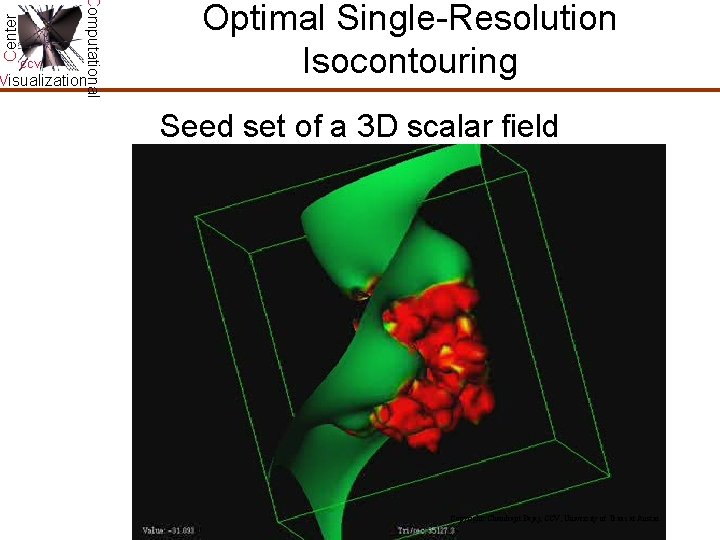
Center Computational CCV Visualization Optimal Single-Resolution Isocontouring Seed set of a 3 D scalar field Copyright: Chandrajit Bajaj, CCV, University of Texas at Austin
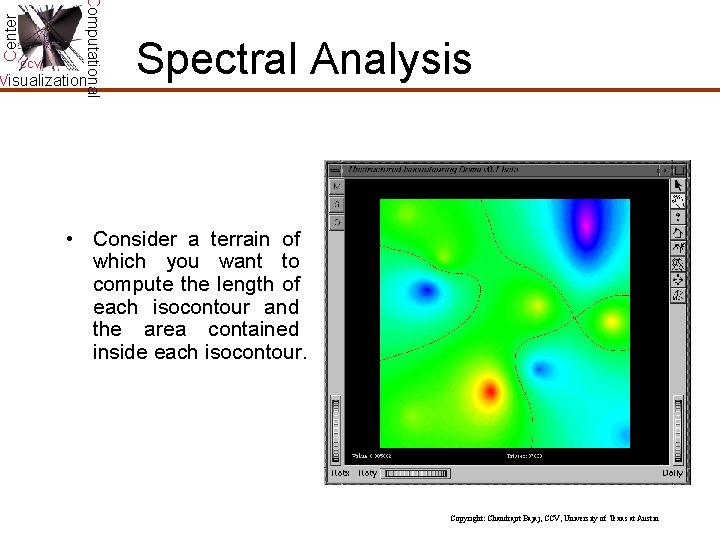
Center Computational CCV Visualization Spectral Analysis • Consider a terrain of which you want to compute the length of each isocontour and the area contained inside each isocontour. Copyright: Chandrajit Bajaj, CCV, University of Texas at Austin
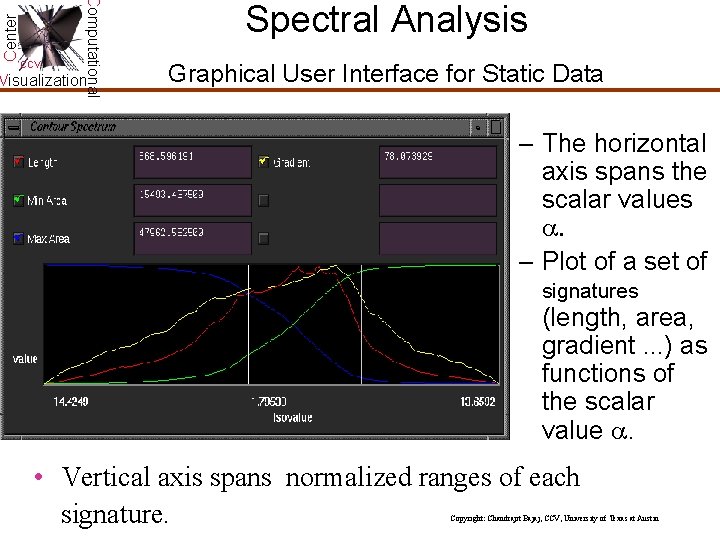
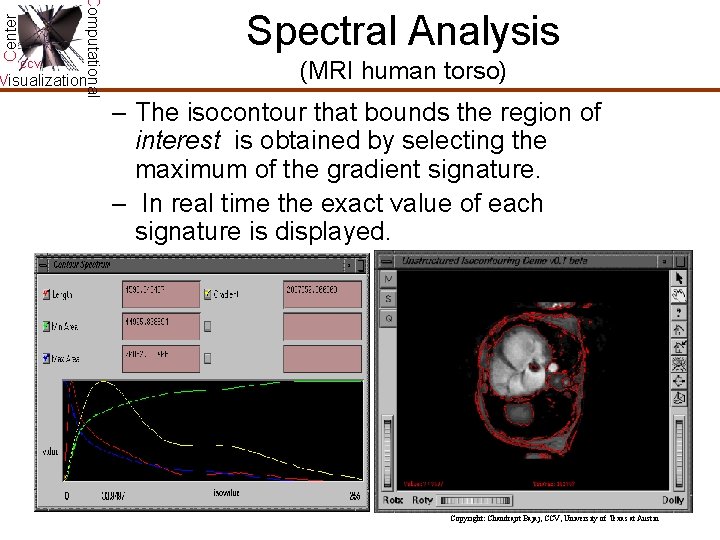
Center Computational CCV Visualization Spectral Analysis Graphical User Interface for Static Data – The horizontal axis spans the scalar values – Plot of a set of signatures (length, area, gradient. . . ) as functions of the scalar value . • Vertical axis spans normalized ranges of each signature. Copyright: Chandrajit Bajaj, CCV, University of Texas at Austin
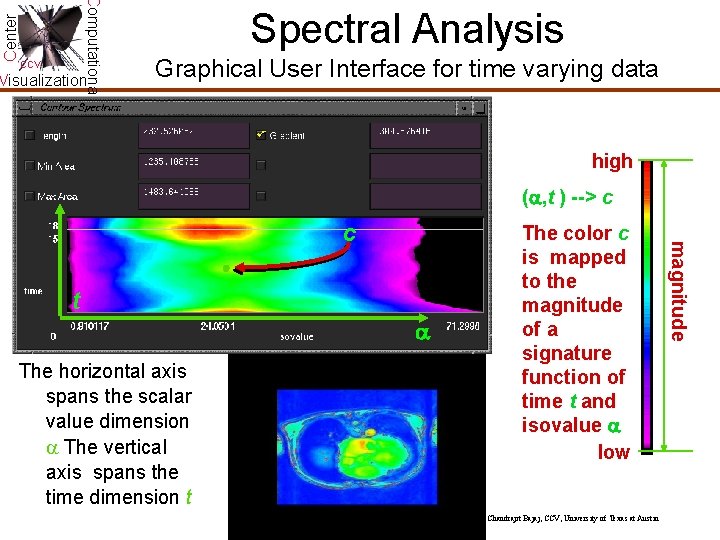
Center Computational CCV Visualization Spectral Analysis Graphical User Interface for time varying data high ( , t ) --> c t The horizontal axis spans the scalar value dimension The vertical axis spans the time dimension t The color c is mapped to the magnitude of a signature function of time t and isovalue low Copyright: Chandrajit Bajaj, CCV, University of Texas at Austin magnitude c
Center Computational CCV Visualization Spectral Analysis (MRI human torso) – The isocontour that bounds the region of interest is obtained by selecting the maximum of the gradient signature. – In real time the exact value of each signature is displayed. Copyright: Chandrajit Bajaj, CCV, University of Texas at Austin
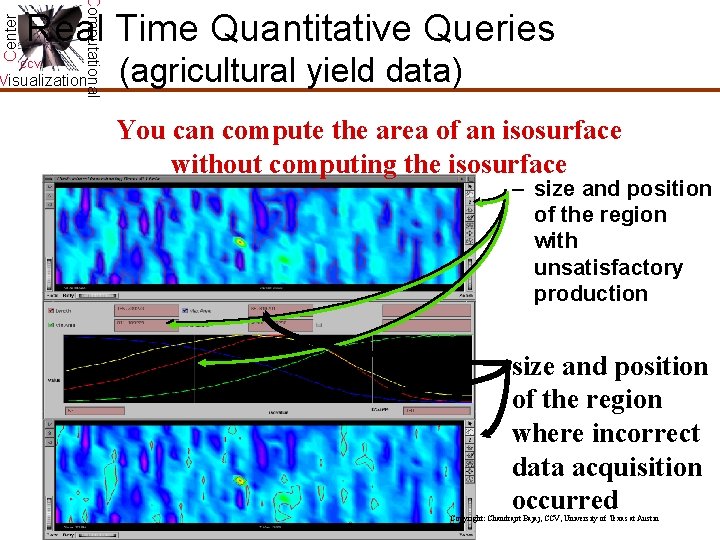
Center Computational Real Time Quantitative Queries CCV Visualization (agricultural yield data) You can compute the area of an isosurface without computing the isosurface – size and position of the region with unsatisfactory production size and position of the region where incorrect data acquisition occurred Copyright: Chandrajit Bajaj, CCV, University of Texas at Austin
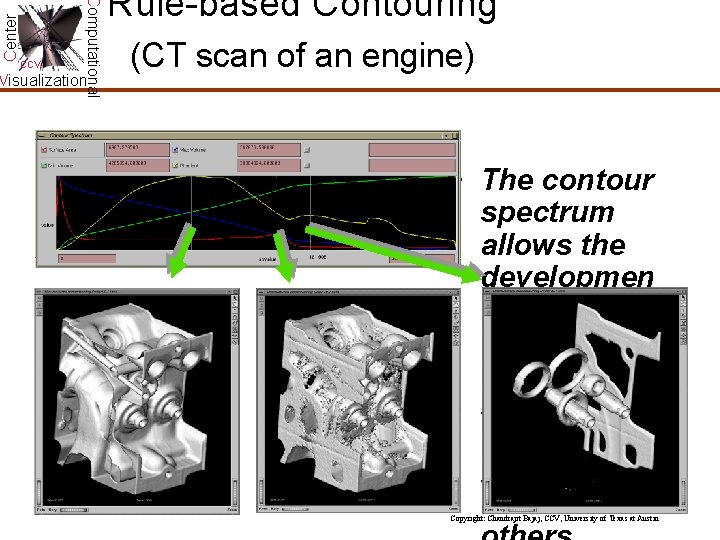
Center Computational CCV Visualization Rule-based Contouring (CT scan of an engine) • The contour spectrum allows the developmen t of an adaptive ability to separate interesting isovalues from the Copyright: Chandrajit Bajaj, CCV, University of Texas at Austin
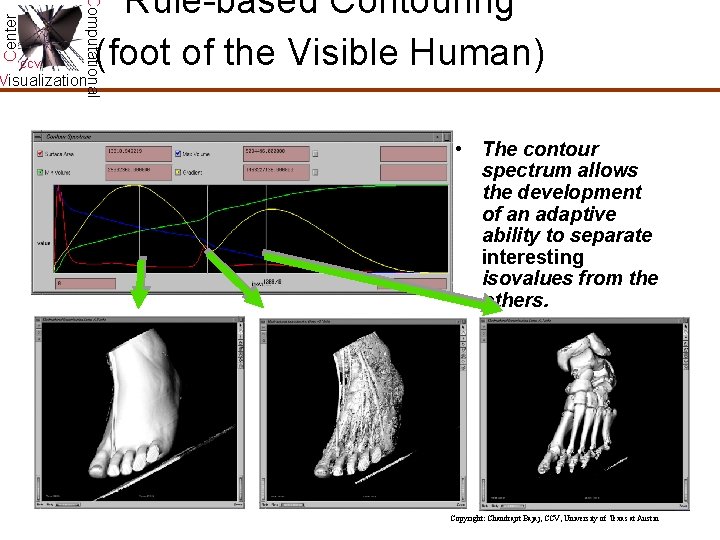
Center Computational CCV Rule-based Contouring (foot of the Visible Human) Visualization • The contour spectrum allows the development of an adaptive ability to separate interesting isovalues from the others. Copyright: Chandrajit Bajaj, CCV, University of Texas at Austin
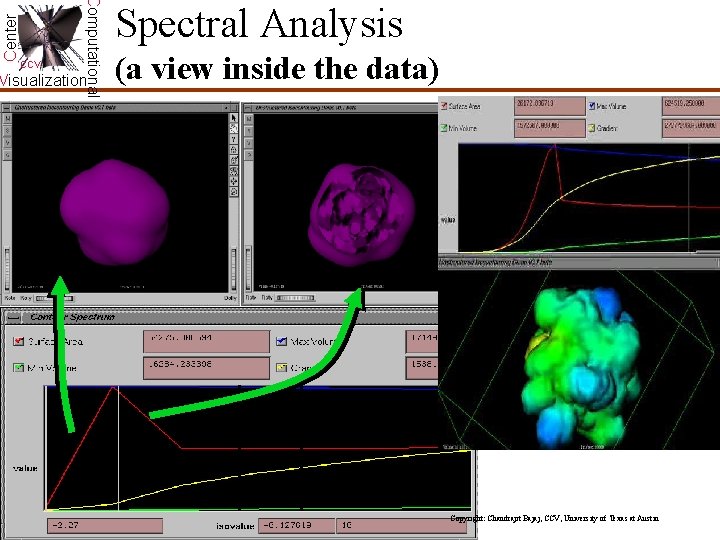
Center Computational CCV Visualization Spectral Analysis (a view inside the data) Copyright: Chandrajit Bajaj, CCV, University of Texas at Austin
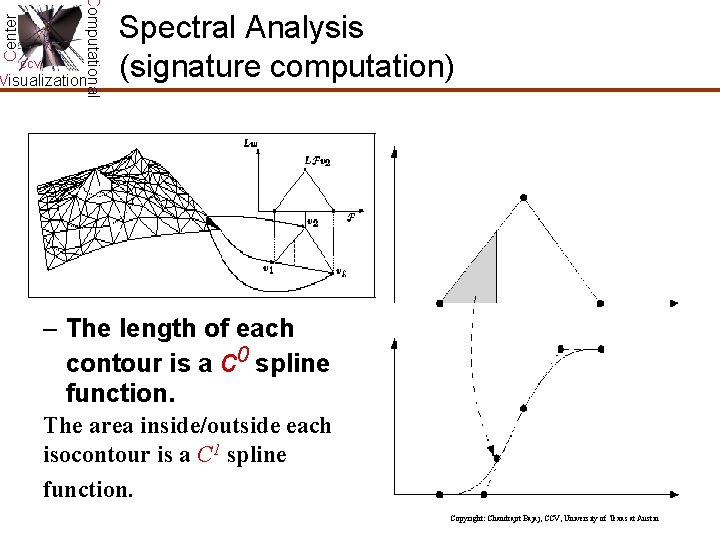
Center Computational CCV Visualization Spectral Analysis (signature computation) – The length of each contour is a c 0 spline function. The area inside/outside each isocontour is a C 1 spline function. Copyright: Chandrajit Bajaj, CCV, University of Texas at Austin
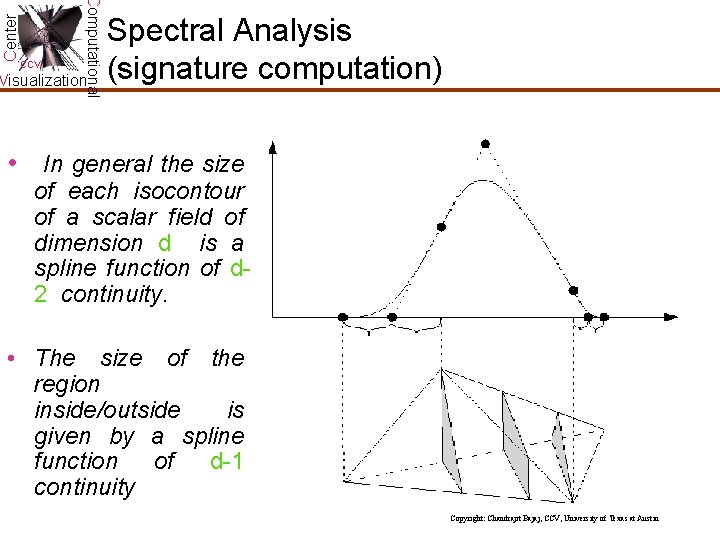
Center Computational CCV Visualization Spectral Analysis (signature computation) • In general the size of each isocontour of a scalar field of dimension d is a spline function of d 2 continuity. • The size of the region inside/outside is given by a spline function of d-1 continuity Copyright: Chandrajit Bajaj, CCV, University of Texas at Austin
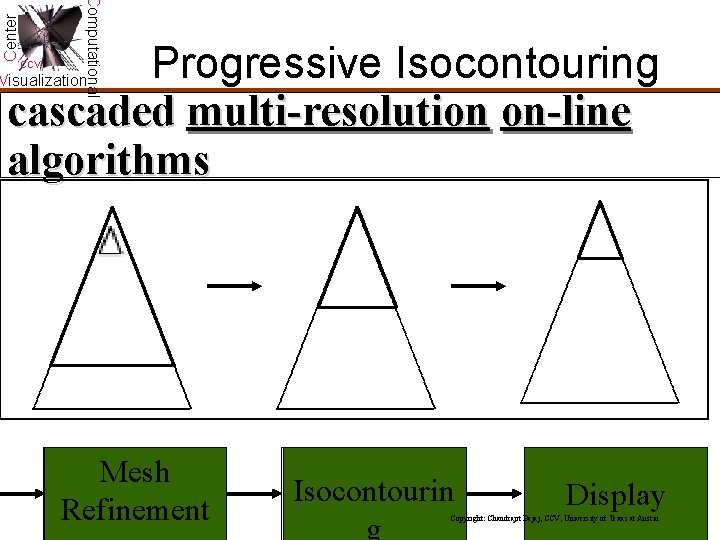
Center Computational CCV Visualization Progressive Isocontouring We have an optimal isocontouring algorithm with minimal storage requirements What more? A Progressive Algorithm N. B. not just a progressive data-structure but a progressive algorithm Copyright: Chandrajit Bajaj, CCV, University of Texas at Austin
Center Computational CCV Visualization Bring on the coffee! Or Mineral Wasser !! Copyright: Chandrajit Bajaj, CCV, University of Texas at Austin
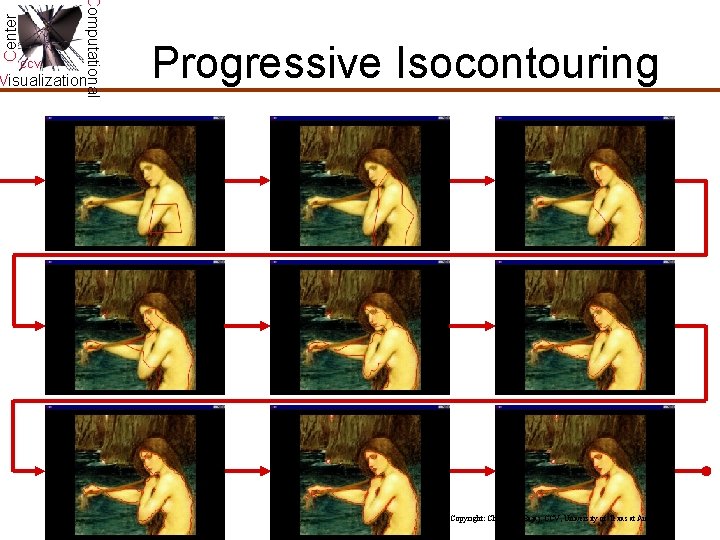
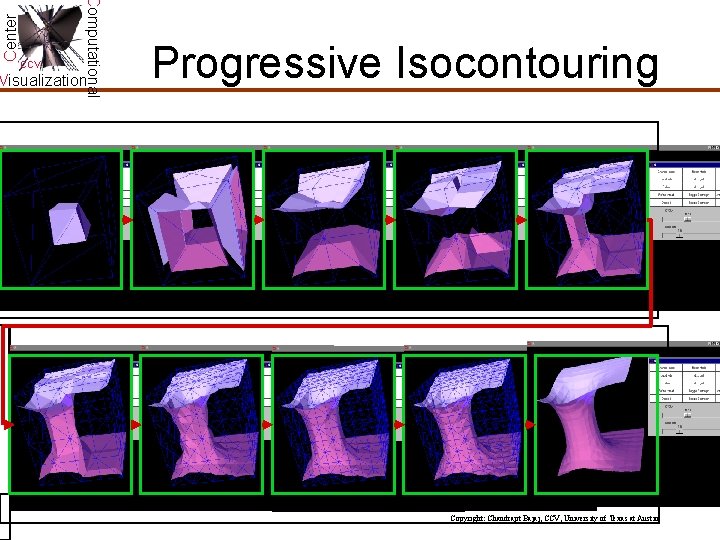
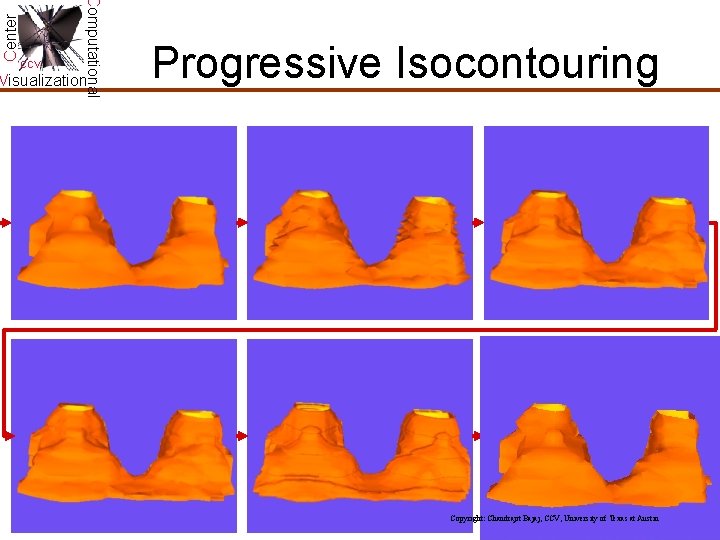
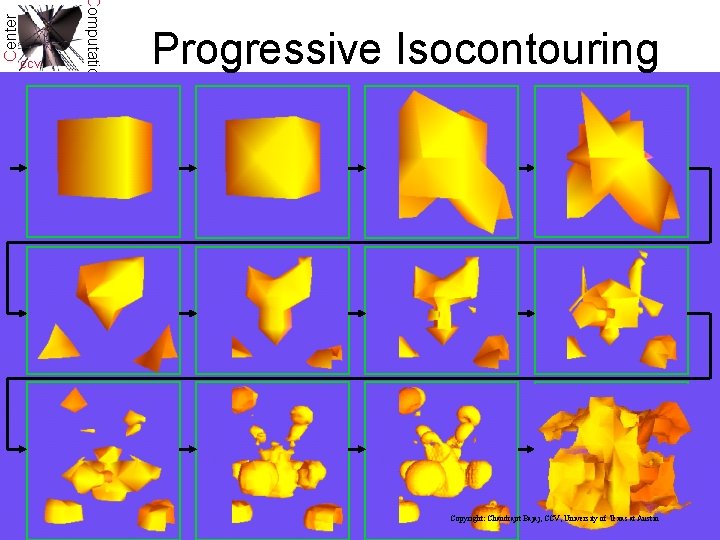
Center Computational Progressive Isocontouring cascaded multi-resolution on-line algorithms CCV Visualization Mesh Refinement Isocontourin g Display Copyright: Chandrajit Bajaj, CCV, University of Texas at Austin
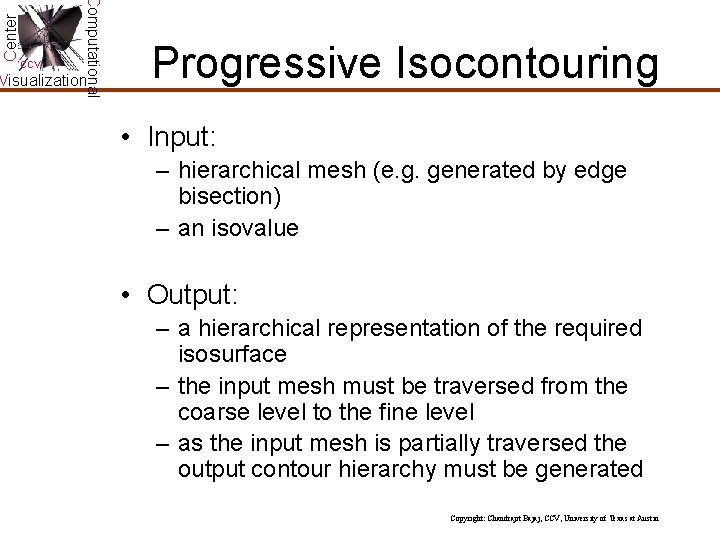
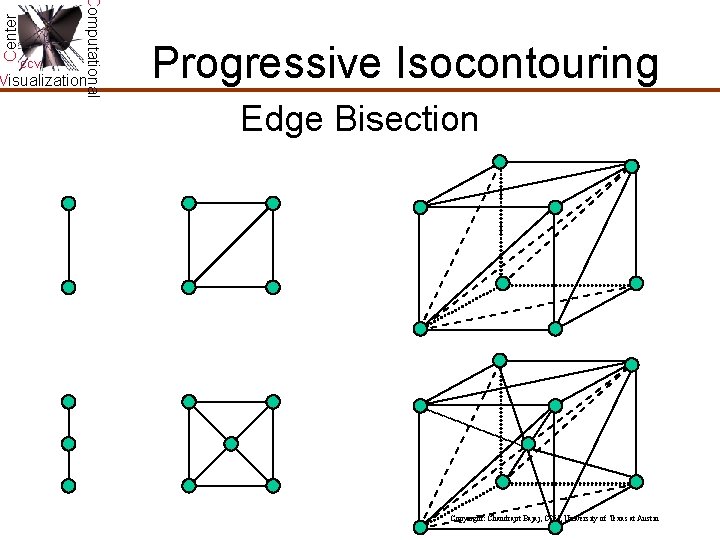
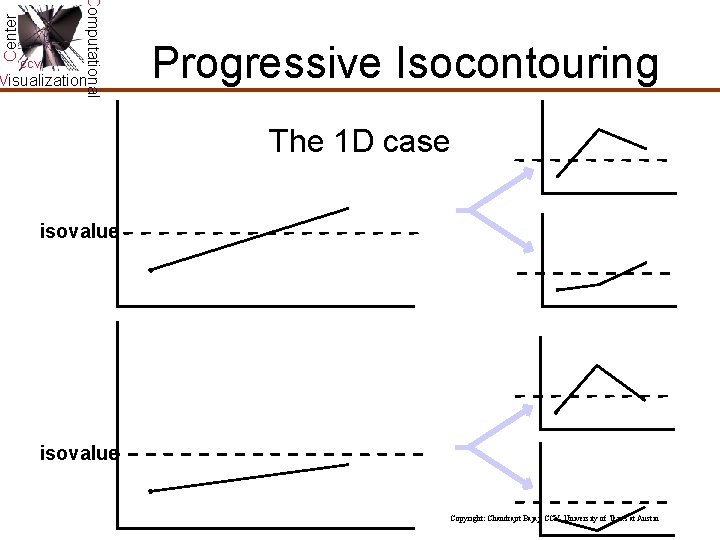
Center Computational CCV Visualization Progressive Isocontouring • Input: – hierarchical mesh (e. g. generated by edge bisection) – an isovalue • Output: – a hierarchical representation of the required isosurface – the input mesh must be traversed from the coarse level to the fine level – as the input mesh is partially traversed the output contour hierarchy must be generated Copyright: Chandrajit Bajaj, CCV, University of Texas at Austin
Center Computational CCV Visualization Progressive Isocontouring Edge Bisection Copyright: Chandrajit Bajaj, CCV, University of Texas at Austin
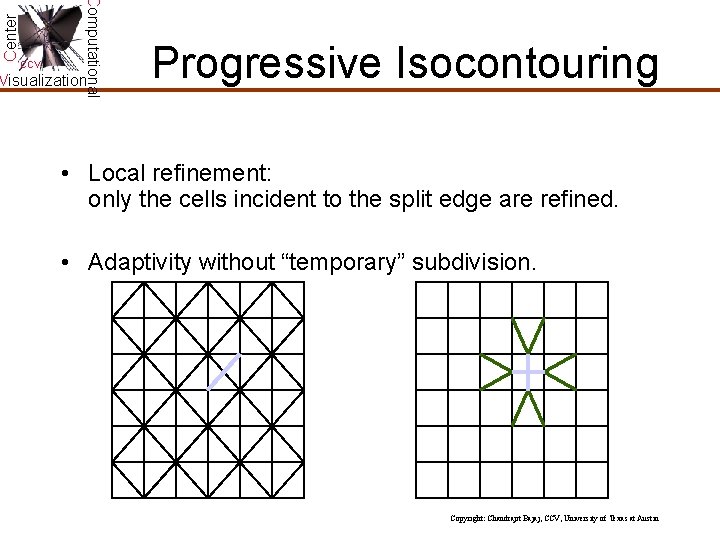
Center Computational CCV Visualization Progressive Isocontouring • Local refinement: only the cells incident to the split edge are refined. • Adaptivity without “temporary” subdivision. Copyright: Chandrajit Bajaj, CCV, University of Texas at Austin
Center Computational CCV Visualization Progressive Isocontouring The 1 D case isovalue Copyright: Chandrajit Bajaj, CCV, University of Texas at Austin
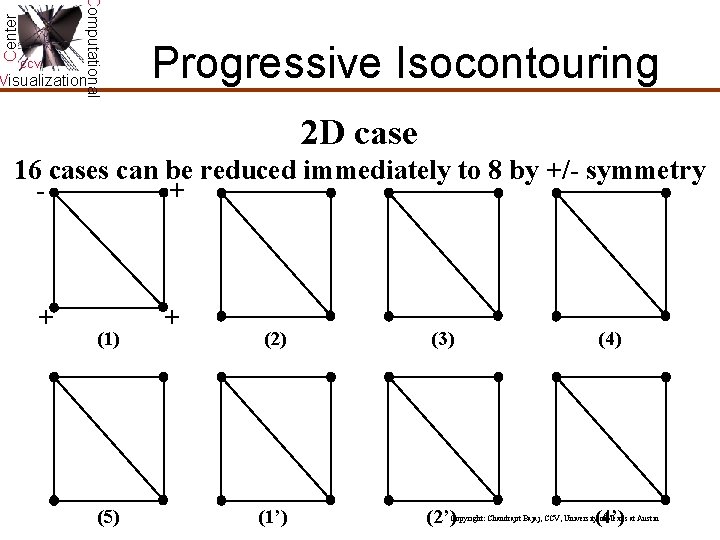
Center Computational CCV Visualization Progressive Isocontouring 2 D case 16 cases can be reduced immediately to 8 by +/- symmetry + + (1) (5) + (2) (3) (4) (1’) (2’) (4’) Copyright: Chandrajit Bajaj, CCV, University of Texas at Austin
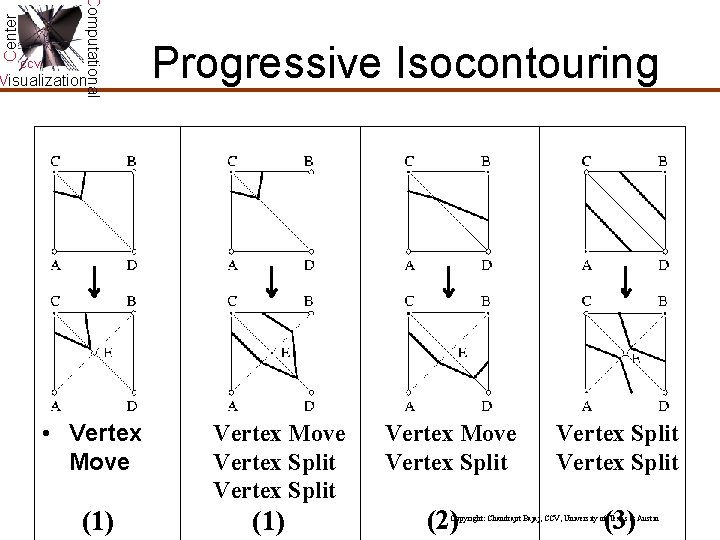
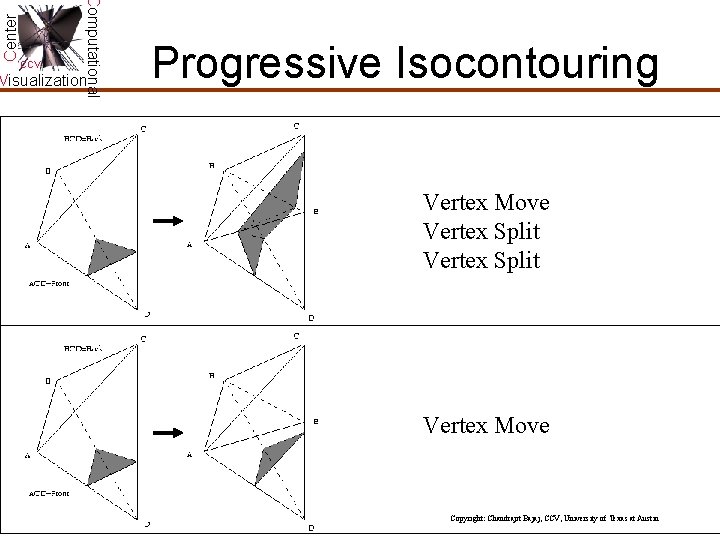
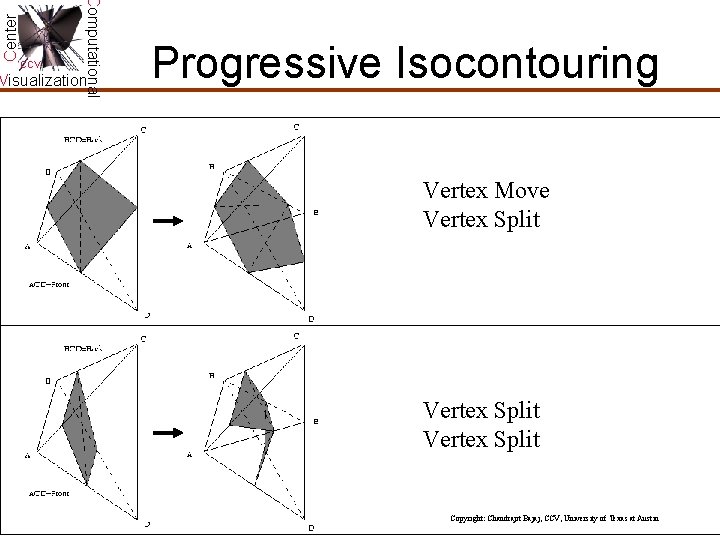
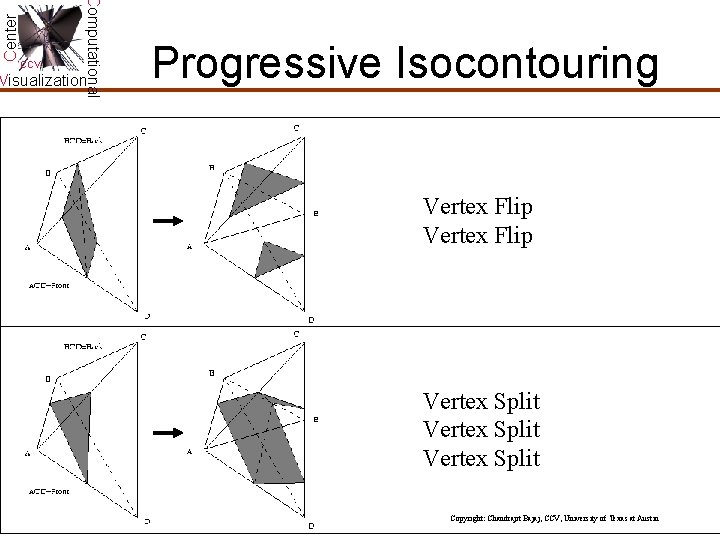
Center Computational CCV Visualization • Vertex Move (1) Progressive Isocontouring Vertex Move Vertex Split (1) Vertex Move Vertex Split (2) Vertex Split (3) Copyright: Chandrajit Bajaj, CCV, University of Texas at Austin
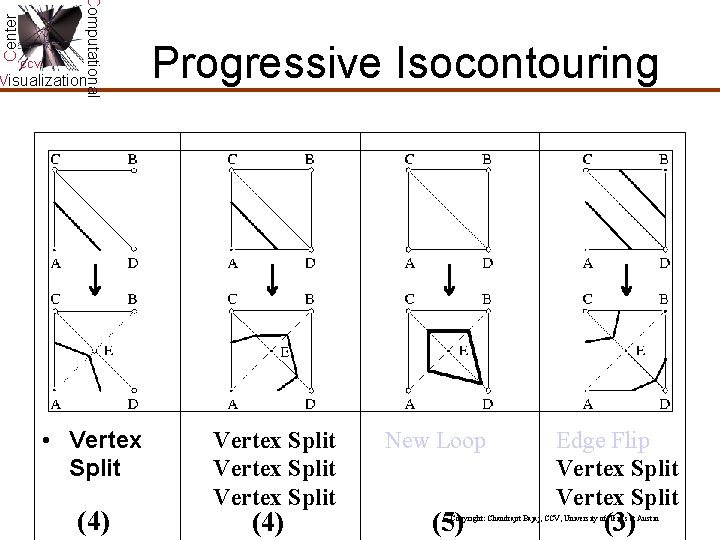
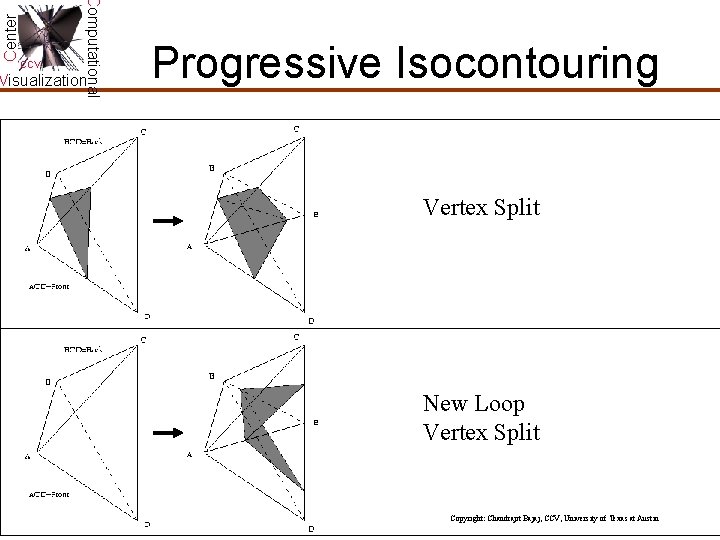
Center Computational CCV Visualization • Vertex Split (4) Progressive Isocontouring Vertex Split (4) New Loop (5) Edge Flip Vertex Split (3) Copyright: Chandrajit Bajaj, CCV, University of Texas at Austin
Center Computational CCV Visualization Progressive Isocontouring Copyright: Chandrajit Bajaj, CCV, University of Texas at Austin
Center Computational CCV Visualization Progressive Isocontouring Vertex Move Vertex Split Vertex Move Copyright: Chandrajit Bajaj, CCV, University of Texas at Austin
Center Computational CCV Visualization Progressive Isocontouring Vertex Move Vertex Split Copyright: Chandrajit Bajaj, CCV, University of Texas at Austin
Center Computational CCV Visualization Progressive Isocontouring Vertex Split New Loop Vertex Split Copyright: Chandrajit Bajaj, CCV, University of Texas at Austin
Center Computational CCV Visualization Progressive Isocontouring Vertex Flip Vertex Split Copyright: Chandrajit Bajaj, CCV, University of Texas at Austin
Center Computational CCV Visualization Progressive Isocontouring Copyright: Chandrajit Bajaj, CCV, University of Texas at Austin
Center Computational CCV Visualization Progressive Isocontouring Copyright: Chandrajit Bajaj, CCV, University of Texas at Austin
Center Computational CCV Visualization Progressive Isocontouring Copyright: Chandrajit Bajaj, CCV, University of Texas at Austin
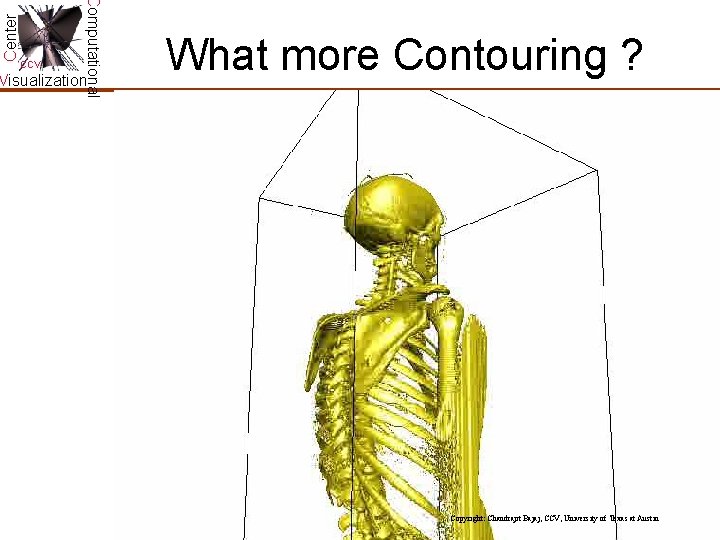
Center Computational CCV Visualization What more Contouring ? Copyright: Chandrajit Bajaj, CCV, University of Texas at Austin
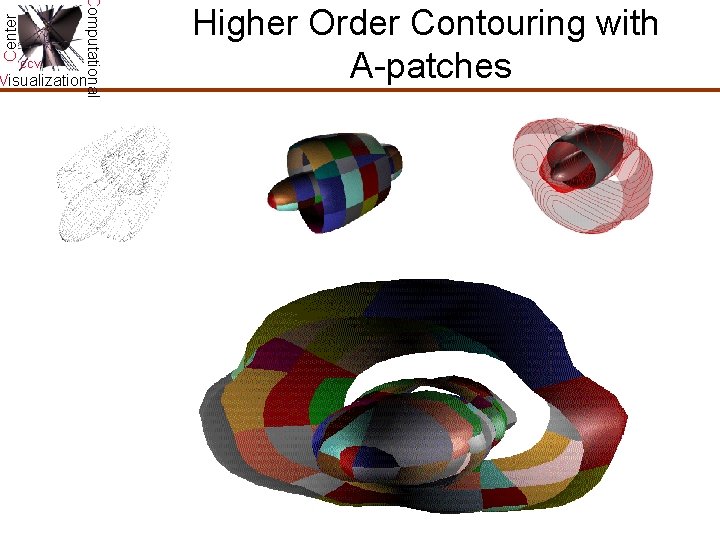
Center Computational CCV Visualization Higher Order Contouring with A-patches
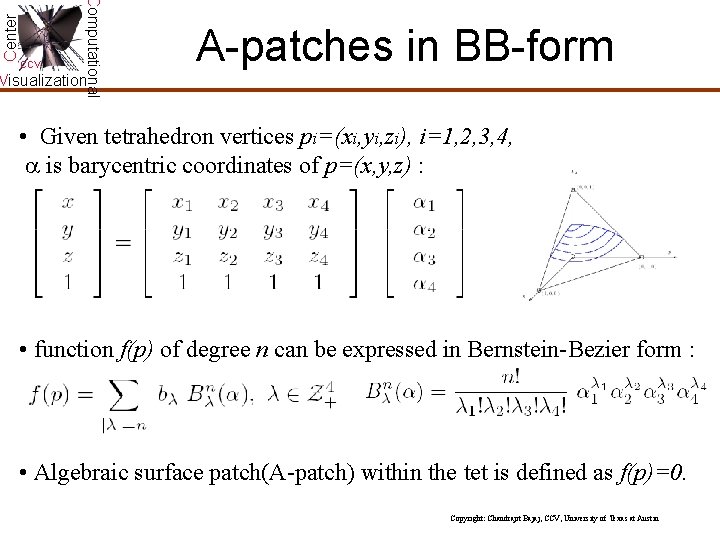
Center Computational CCV A-patches in BB-form Visualization • Given tetrahedron vertices pi=(xi, yi, zi), i=1, 2, 3, 4, is barycentric coordinates of p=(x, y, z) : • function f(p) of degree n can be expressed in Bernstein-Bezier form : • Algebraic surface patch(A-patch) within the tet is defined as f(p)=0. Copyright: Chandrajit Bajaj, CCV, University of Texas at Austin
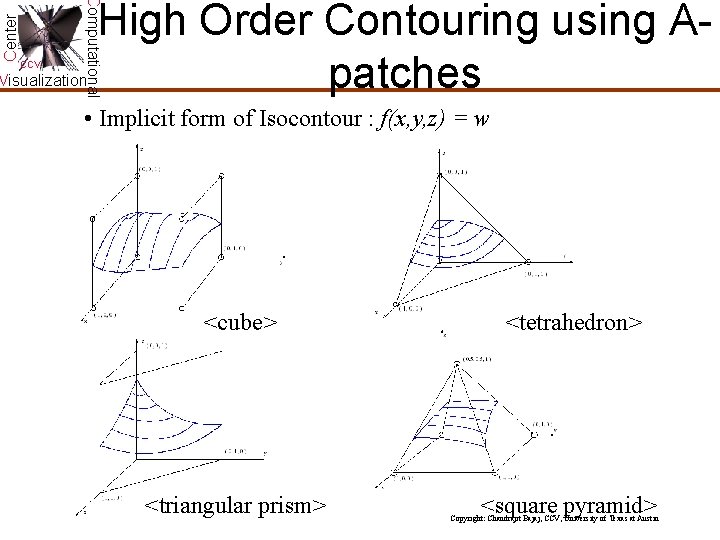
Center Computational CCV Visualization High Order Contouring using Apatches • Implicit form of Isocontour : f(x, y, z) = w <cube> <triangular prism> <tetrahedron> <square pyramid> Copyright: Chandrajit Bajaj, CCV, University of Texas at Austin
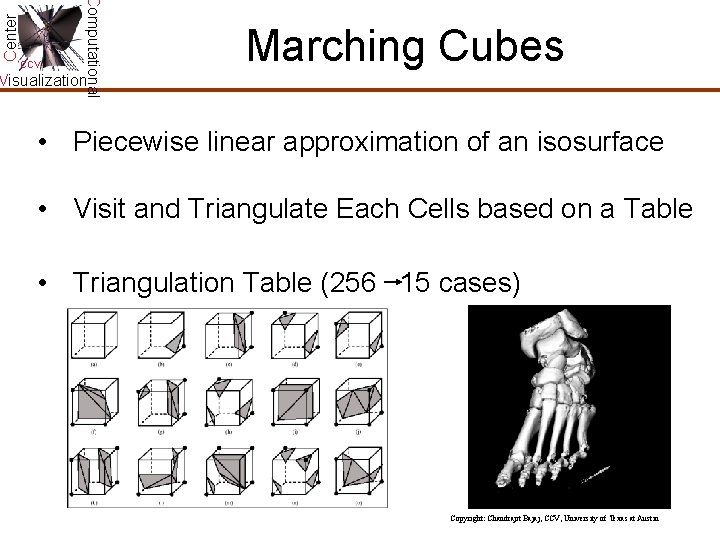
Center Computational CCV Marching Cubes Visualization • Piecewise linear approximation of an isosurface • Visit and Triangulate Each Cells based on a Table • Triangulation Table (256 15 cases) Copyright: Chandrajit Bajaj, CCV, University of Texas at Austin
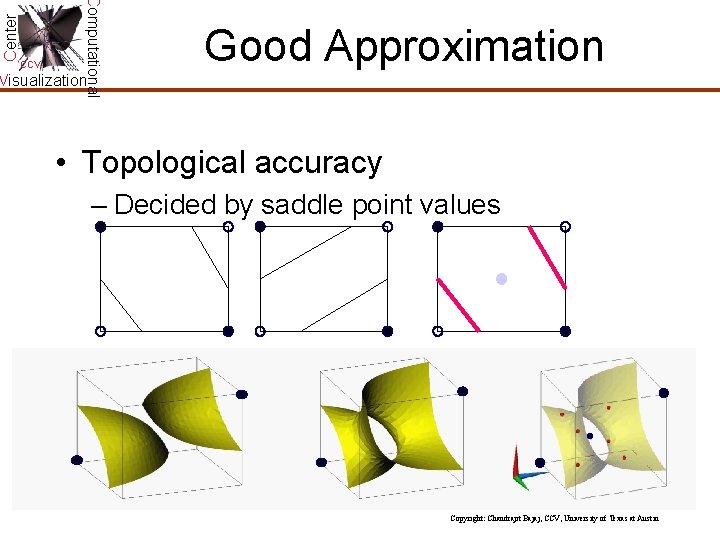
Center Computational CCV Good Approximation Visualization • Topological accuracy – Decided by saddle point values Copyright: Chandrajit Bajaj, CCV, University of Texas at Austin
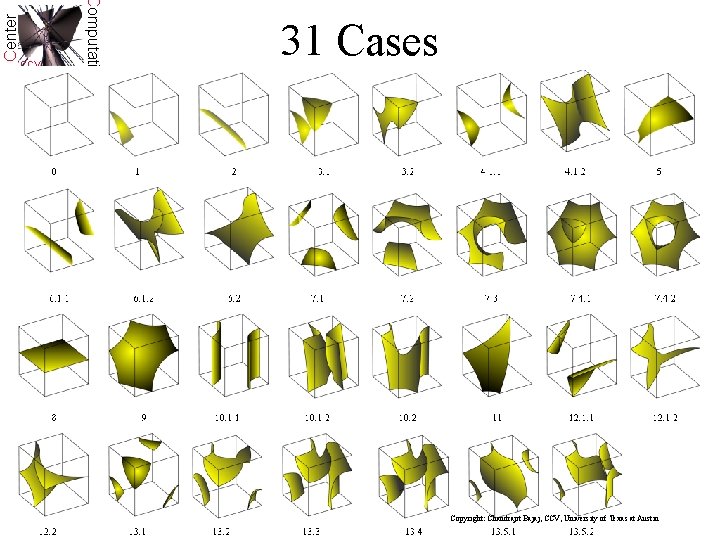
Center Computational CCV 31 Cases Visualization Copyright: Chandrajit Bajaj, CCV, University of Texas at Austin
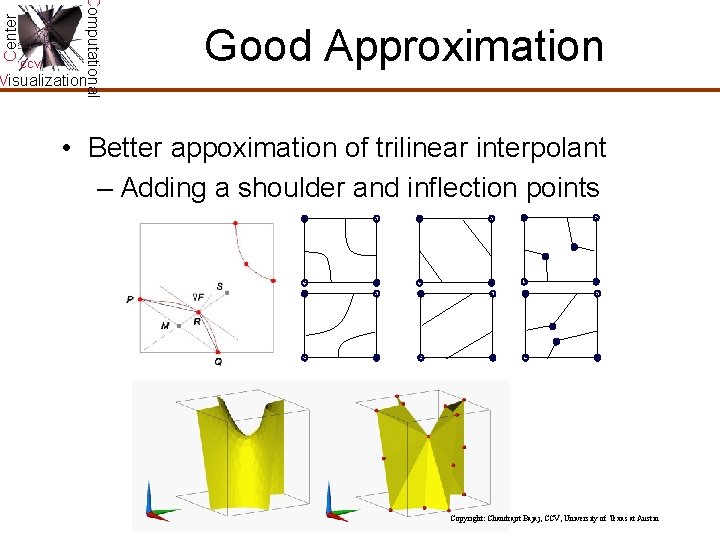
Center Computational CCV Good Approximation Visualization • Better appoximation of trilinear interpolant – Adding a shoulder and inflection points Copyright: Chandrajit Bajaj, CCV, University of Texas at Austin
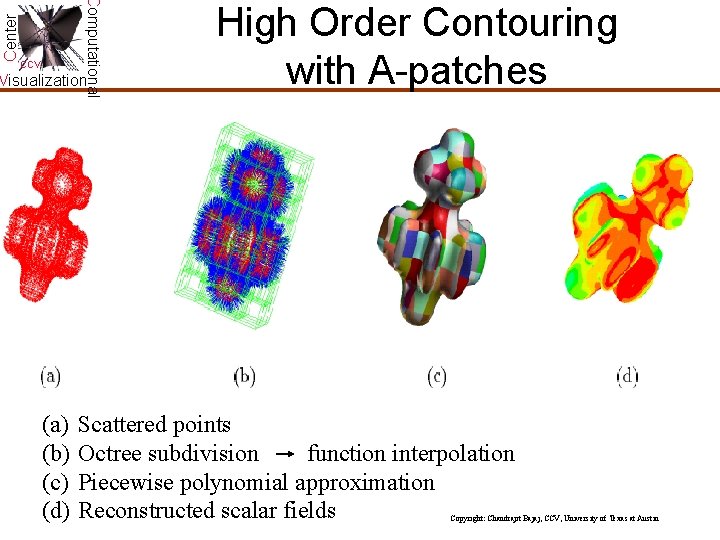
Center Computational CCV Visualization (a) (b) (c) (d) High Order Contouring with A-patches Scattered points Octree subdivision function interpolation Piecewise polynomial approximation Reconstructed scalar fields Copyright: Chandrajit Bajaj, CCV, University of Texas at Austin
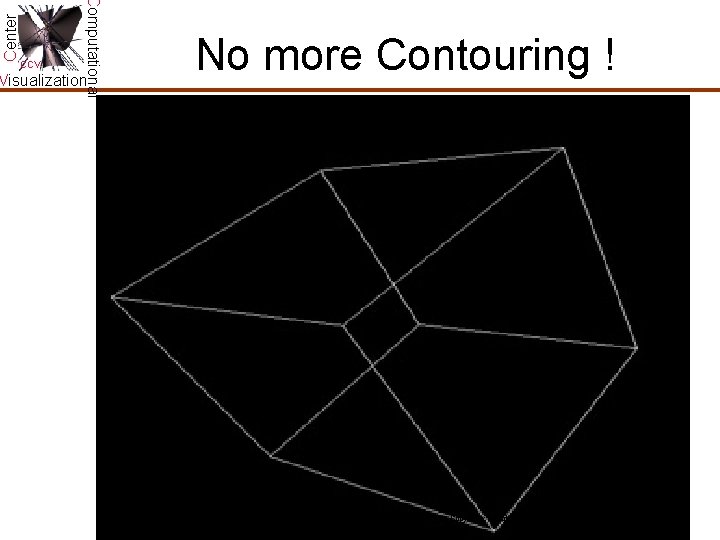
Center Computational CCV Visualization No more Contouring ! Copyright: Chandrajit Bajaj, CCV, University of Texas at Austin
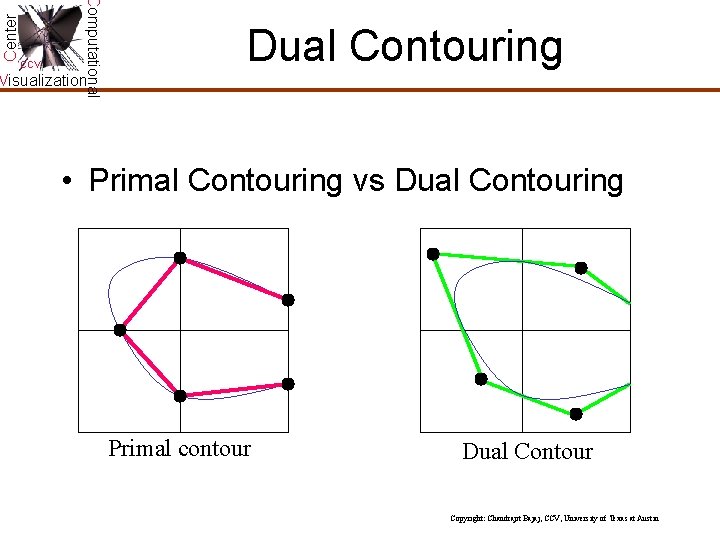
Center Computational CCV Dual Contouring Visualization • Primal Contouring vs Dual Contouring Primal contour Dual Contour Copyright: Chandrajit Bajaj, CCV, University of Texas at Austin
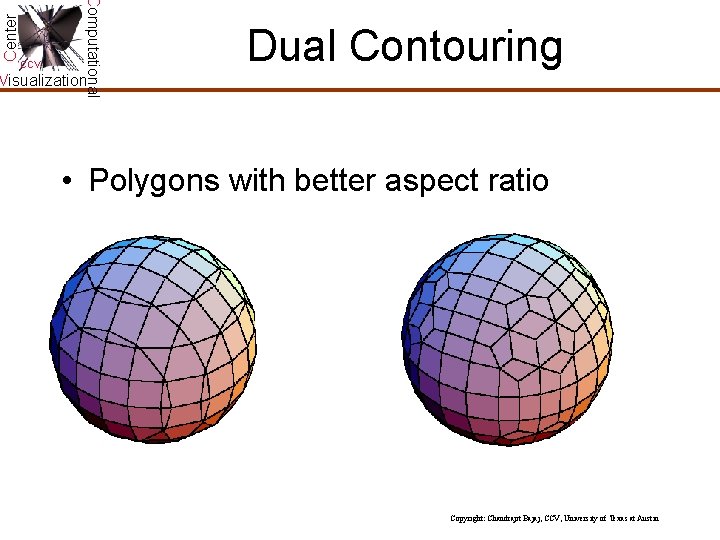
Center Computational CCV Dual Contouring Visualization • Polygons with better aspect ratio Copyright: Chandrajit Bajaj, CCV, University of Texas at Austin
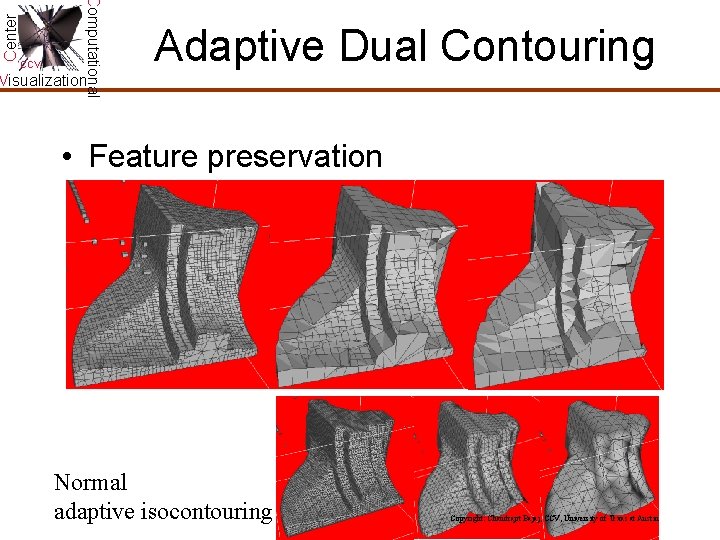
Center Computational CCV Adaptive Dual Contouring Visualization • Feature preservation Normal adaptive isocontouring Copyright: Chandrajit Bajaj, CCV, University of Texas at Austin
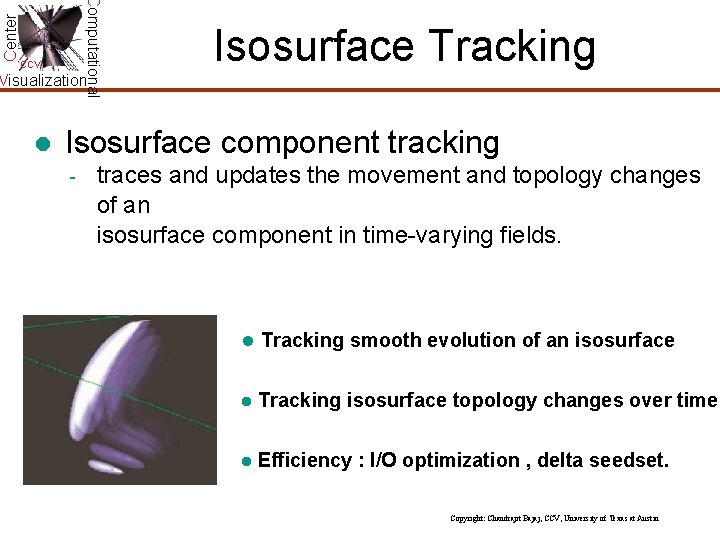
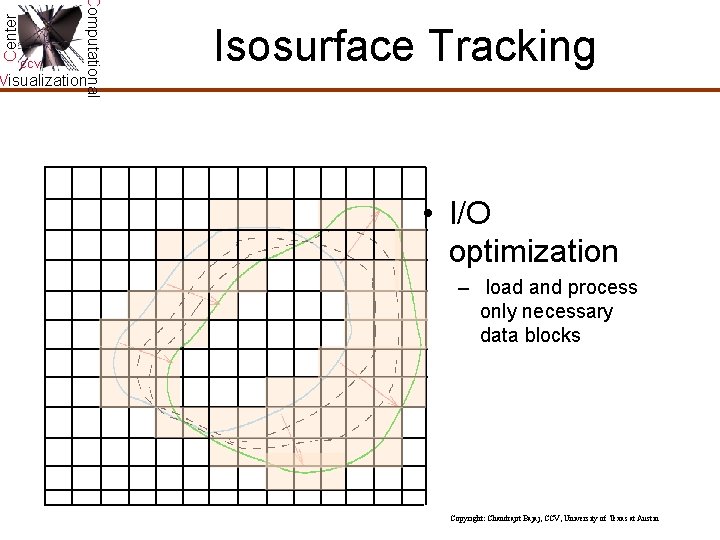
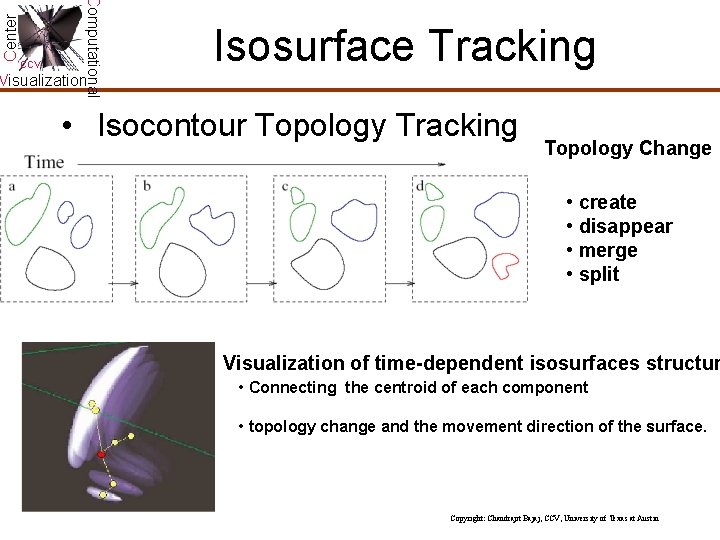
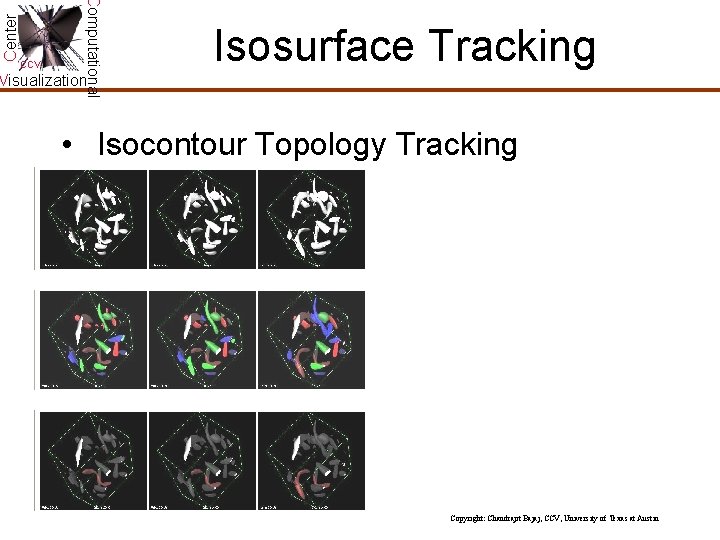
Center Computational CCV Isosurface Tracking Visualization l Isosurface component tracking - traces and updates the movement and topology changes of an isosurface component in time-varying fields. l Tracking smooth evolution of an isosurface l Tracking isosurface topology changes over time l Efficiency : I/O optimization , delta seedset. Copyright: Chandrajit Bajaj, CCV, University of Texas at Austin
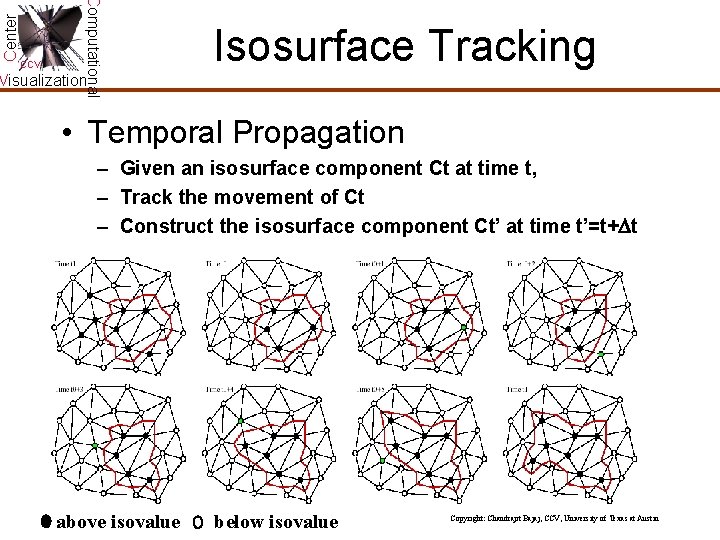
Center Computational CCV Isosurface Tracking Visualization • Temporal Propagation – Given an isosurface component Ct at time t, – Track the movement of Ct – Construct the isosurface component Ct’ at time t’=t+Dt above isovalue below isovalue Copyright: Chandrajit Bajaj, CCV, University of Texas at Austin
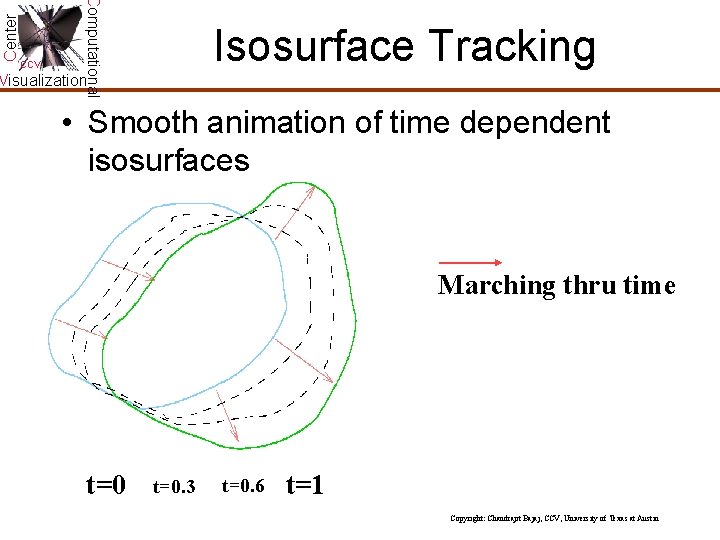
Center Computational CCV Isosurface Tracking Visualization • Smooth animation of time dependent isosurfaces Marching thru time t=0. 3 t=0. 6 t=1 Copyright: Chandrajit Bajaj, CCV, University of Texas at Austin
Center Computational CCV Isosurface Tracking Visualization • I/O optimization – load and process only necessary data blocks Copyright: Chandrajit Bajaj, CCV, University of Texas at Austin
Center Computational CCV Isosurface Tracking Visualization • Isocontour Topology Tracking Topology Change • create • disappear • merge • split Visualization of time-dependent isosurfaces structur • Connecting the centroid of each component • topology change and the movement direction of the surface. Copyright: Chandrajit Bajaj, CCV, University of Texas at Austin
Center Computational CCV Isosurface Tracking Visualization • Isocontour Topology Tracking Copyright: Chandrajit Bajaj, CCV, University of Texas at Austin
Center Computational CCV Visualization Mannheim Summer School 2002 Computational Visualization 1. Sources, characteristics, representation 2. Mesh Processing 3. Contouring 4. Volume Rendering 5. Flow, Vector, Tensor Field Visualization 6. Application Case Studies Copyright: Chandrajit Bajaj, CCV, University of Texas at Austin
Center Computational CCV Further Reading Visualization • Fast Isocontouring for Improved Interactivity Proceedings: ACM Siggraph/IEEE Symposium on Volume Visualization, ACM Press, (1996), San Francisco, CA • A. Lopes, K. Brodlie, “Improving the Robustness and Accuracy of the Marching Cubes Algorithm for Isosurfacing”, TVCG • Tao Ju, Frank Losasso, Scott Schaefer, Joe Warren , “Dual Contouring of Hermite Data”, SIGGRAPH 2002 • Leif P. Kobbelt, Mario Botsch, Ulrich Schwanecke, Hans-Peter Seidel, “Feature Sensitive Surface Extraction from Volume Data”, SIGGRAPH 2001 • Z. Wood, M. Desbrun, P. Schröder and D. E. Breen, “Semi. Regular Mesh Extraction from Volumes”, IEEE Visualization 2000 Copyright: Chandrajit Bajaj, CCV, University of Texas at Austin
Center Computational CCV Further Reading (contd) Visualization • The Contour Spectrum Proceedings of the 1997 IEEE Visualization Conference, 167173, October 1997 Phoeniz, Arizona. • Contour Trees and Small Seed Sets for Isosurface Traversal, In Proceedings Thirtheen ACM Symposium on Computational Geometry (Theory Track), (Nice, France, June 46, (1997), ACM Press, pp. 212 -219 • C. Bajaj, “Modeling Physical Fields for Interrogative Data Visualization”, 7 th IMA Conference on the Mathematics of Surfaces, The Mathematics of Surfaces VII, edited by T. N. T. Goodman and R. Martin, Oxford University Press, (1997). • Parallel and Out-of-core View-dependent Isocontour Visualization Using Random Data Distribution Joint Eurographics-IEEE TCVG Symposium on Visualization 2002, pages 9 -18 Copyright: Chandrajit Bajaj, CCV, University of Texas at Austin