
Census 2020 Online Questionnaire Assistance Guide Overview Census

- Slides: 44
Census 2020 Online Questionnaire Assistance Guide
Overview ● Census 2020 Impact and Timeline ● Guidelines for Online Census Support ● Assisting with Responses ● How to Access the Online 2020 Census ● 2020 Census Questions ● Tracking Your Community’s Progress ● SLC Counts Resources
Introduction Stakeholders can support the census in new ways by making electronic devices available to the public to respond. ● Guidelines are in place for stakeholders to support a safe and inclusive census. ○ Only the Census Bureau can offer confidentiality protected by law. ● Stakeholders are discouraged from conducting surveys during the 2020 Census so your surveys aren’t confused with the census. ● Partners can provide incentives to respondents for attending a census event and self-responding to the census.
Impact! ● Addressing the digital divide. ● Supporting non-English speakers by accessing the 2020 Census in 12 different languages. ● Providing access to a computer in a familiar and trusted space. ● Fair and Inclusive Count ○ Avoiding door-to-door enumeration which isn’t as accurate and is expensive.
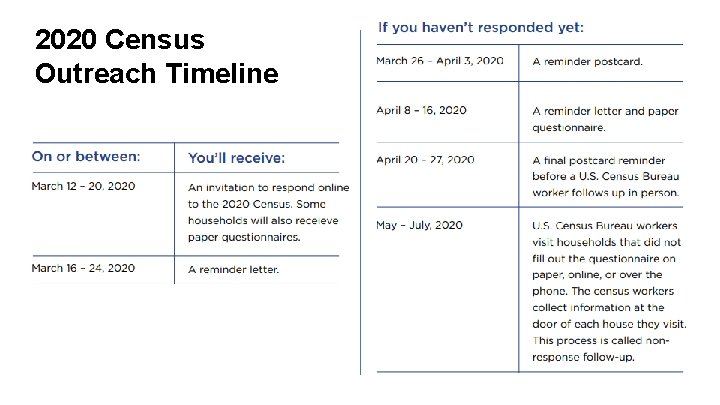
2020 Census Outreach Timeline
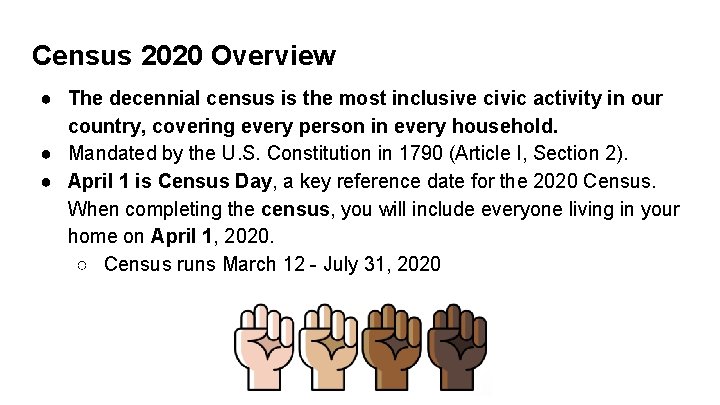
Census 2020 Overview ● The decennial census is the most inclusive civic activity in our country, covering every person in every household. ● Mandated by the U. S. Constitution in 1790 (Article I, Section 2). ● April 1 is Census Day, a key reference date for the 2020 Census. When completing the census, you will include everyone living in your home on April 1, 2020. ○ Census runs March 12 - July 31, 2020
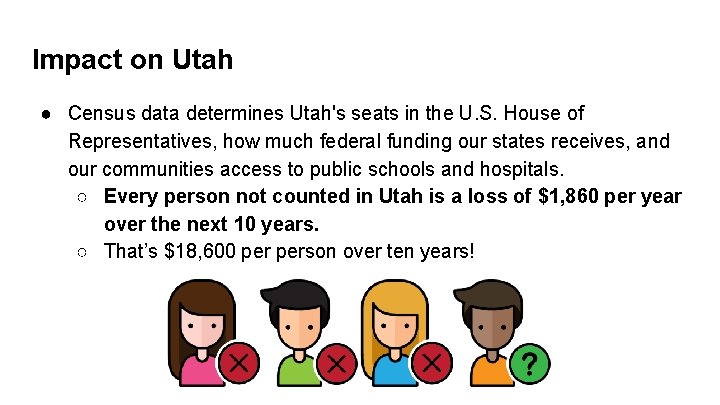
Impact on Utah ● Census data determines Utah's seats in the U. S. House of Representatives, how much federal funding our states receives, and our communities access to public schools and hospitals. ○ Every person not counted in Utah is a loss of $1, 860 per year over the next 10 years. ○ That’s $18, 600 person over ten years!
Undercounted Populations ● ● ● ● ● Racial and ethnic minorities Persons who do not speak English fluently Lower income persons/renters Homeless persons Undocumented immigrants Young mobile persons Children (ages 0 -4) Persons who are angry at and/or distrust the government LGBTQ persons College students
Call to Action! ● Provide access to computers and tablets for on-the-spot access to the 2020 Census website. ■ my 2020 census. gov ● Talk about the 2020 Census! Distribute content on your social media accounts, in your newsletters, on your website or hang up a poster. ● Please report misinformation and disinformation to rumors@census. gov.
Guidelines Online Census Support
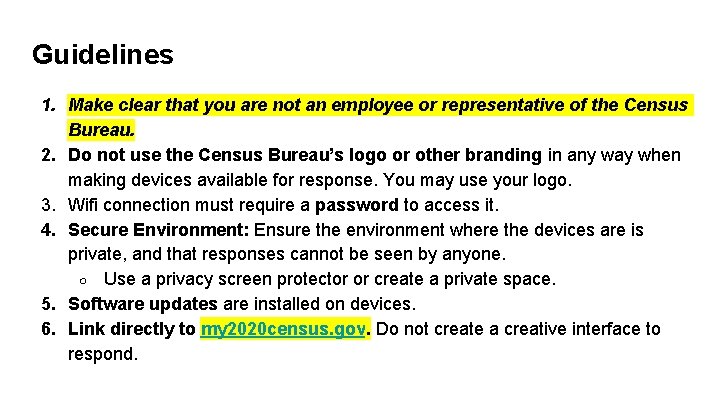
Guidelines 1. Make clear that you are not an employee or representative of the Census Bureau. 2. Do not use the Census Bureau’s logo or other branding in any way when making devices available for response. You may use your logo. 3. Wifi connection must require a password to access it. 4. Secure Environment: Ensure the environment where the devices are is private, and that responses cannot be seen by anyone. ○ Use a privacy screen protector or create a private space. 5. Software updates are installed on devices. 6. Link directly to my 2020 census. gov. Do not create a creative interface to respond.
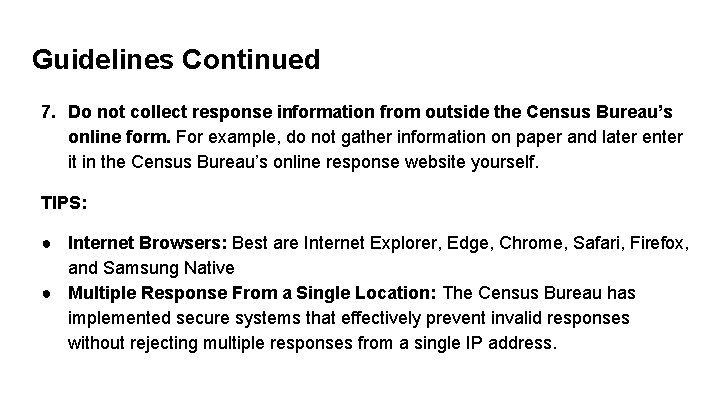
Guidelines Continued 7. Do not collect response information from outside the Census Bureau’s online form. For example, do not gather information on paper and later enter it in the Census Bureau’s online response website yourself. TIPS: ● Internet Browsers: Best are Internet Explorer, Edge, Chrome, Safari, Firefox, and Samsung Native ● Multiple Response From a Single Location: The Census Bureau has implemented secure systems that effectively prevent invalid responses without rejecting multiple responses from a single IP address.
And now… a word from the Census Bureau: The Census Bureau cannot and does not protect any devices that you make available to the public for response. The Census Bureau has no responsibility for the operation, maintenance, or security of any such device or any systems or networks supporting the device. The Census Bureau is not responsible for providing device, systems or network support, and is not responsible for any failures of those devices, systems, or networks. Therefore, any entity making devices available to the public should follow best practices for securing devices and networks. The Department of Homeland Security’s Cybersecurity and Infrastructure Security Agency’s Web site provides steps to secure devices.
Assisting with Responses
Assisting People with Their Responses: ● If a member of the public requests assistance in completing their questionnaire, direct them to the response option (online, phone, mail/paper, census taker visit to the home) that best suits their needs. ○ For example, if an individual is responding online and needs language assistance, or if a person who is blind requests help with the online response website, encourage them to respond through the phone response option.
Exception ● If a respondent insists that you help them, inform them that you are not a employee or representative of the Census Bureau and therefore their answers are not protected by law with you. ● Do not encourage anyone to respond to the census on behalf of a household in which they do not live.
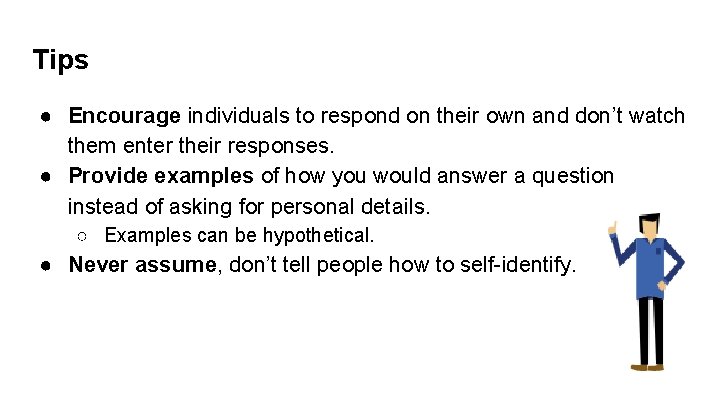
Tips ● Encourage individuals to respond on their own and don’t watch them enter their responses. ● Provide examples of how you would answer a question instead of asking for personal details. ○ Examples can be hypothetical. ● Never assume, don’t tell people how to self-identify.
Contact Info Census Bureau ● Questionnaire Assistance Phone Numbers: ○ ○ English: 844 -330 -2020 Spanish: 844 -468 -2020 TDD: 844 -467 -2020 TTY: For people who are deaf or hard of hearing call 1 -800 -877 -8339 to use the Federal Relay Service. NALEO Bilingual Census Information Hotline ● Monday - Friday: 8: 30 am - 8: 30 pm ET ● 877 -EL-CENSO (877 -352 -3676) ● Text “Census” to 97779
Safe Census ● Emphasize that the 2020 Census is safe and secure. ● From the moment responses are submitted, they are protected by sophisticated security measures that meet federal government cyber security standards. ● Personal information is confidential. It can never be shared with law enforcement agencies, ICE or a landlord.
How To Access The Online Census ID Requirements & Language Support
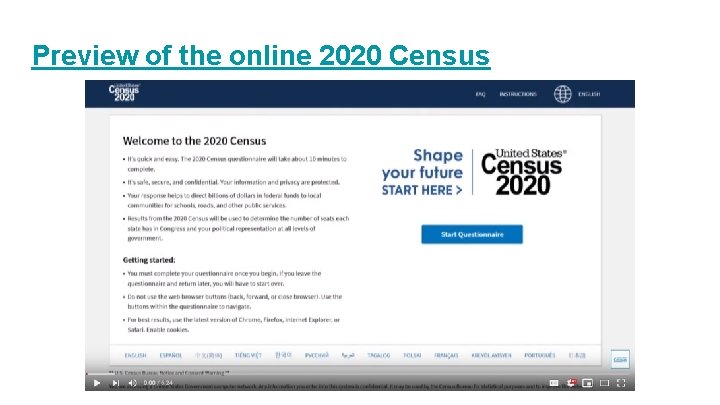
Preview of the online 2020 Census https: //www. youtube. com/watch? v=f. Xg 1_1 HHKz. A&feature=youtu. be
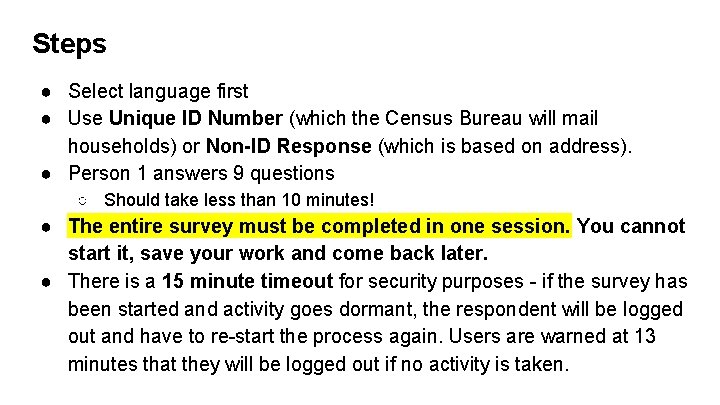
Steps ● Select language first ● Use Unique ID Number (which the Census Bureau will mail households) or Non-ID Response (which is based on address). ● Person 1 answers 9 questions ○ Should take less than 10 minutes! ● The entire survey must be completed in one session. You cannot start it, save your work and come back later. ● There is a 15 minute timeout for security purposes - if the survey has been started and activity goes dormant, the respondent will be logged out and have to re-start the process again. Users are warned at 13 minutes that they will be logged out if no activity is taken.
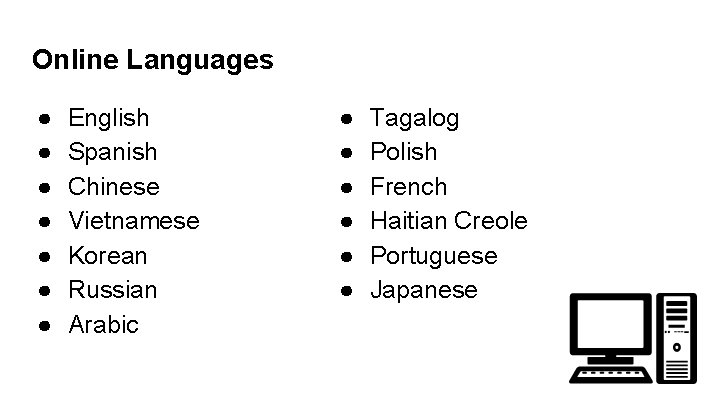
Online Languages ● ● ● ● English Spanish Chinese Vietnamese Korean Russian Arabic ● ● ● Tagalog Polish French Haitian Creole Portuguese Japanese
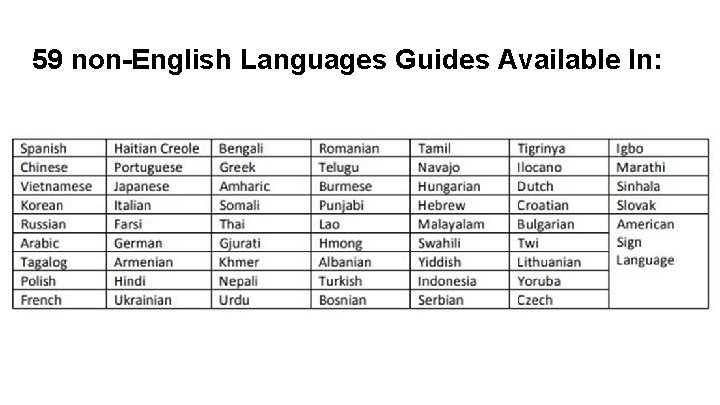
Accessing Language Guide If a respondent requires a language that is not available on the online Census, there are video and printed guides offered in 59 other languages. ● Video language guides will help respondents complete the 2020 Census online. ● Print language guides will help respondents complete the 2020 Census paper questionnaire. Access the Language Video and Printer Guides HERE
59 non-English Languages Guides Available In:
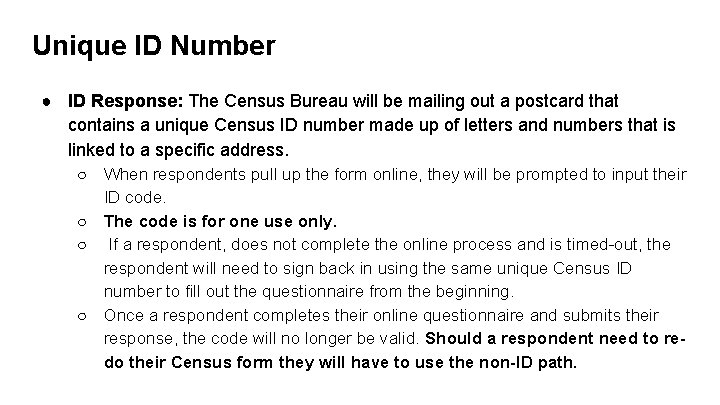
Unique ID Number ● ID Response: The Census Bureau will be mailing out a postcard that contains a unique Census ID number made up of letters and numbers that is linked to a specific address. ○ When respondents pull up the form online, they will be prompted to input their ID code. ○ The code is for one use only. ○ If a respondent, does not complete the online process and is timed-out, the respondent will need to sign back in using the same unique Census ID number to fill out the questionnaire from the beginning. ○ Once a respondent completes their online questionnaire and submits their response, the code will no longer be valid. Should a respondent need to redo their Census form they will have to use the non-ID path.
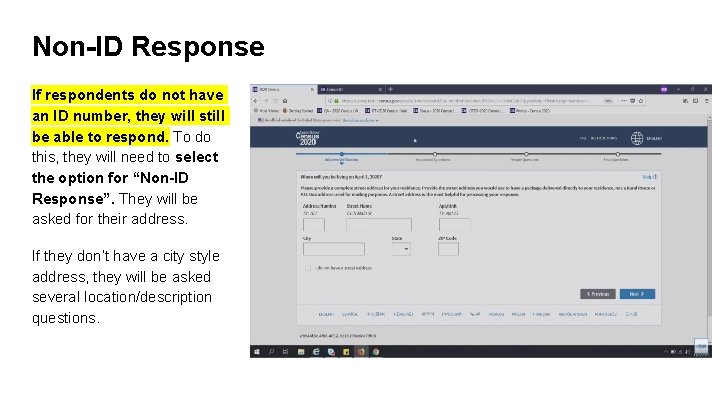
Non-ID Response If respondents do not have an ID number, they will still be able to respond. To do this, they will need to select the option for “Non-ID Response”. They will be asked for their address. If they don’t have a city style address, they will be asked several location/description questions.
Unsure If You Have Been Counted? ● If people express to you that they are unsure if others in their home completed the 2020 Census and included them, you should advise them to complete the 2020 Census on their own and include everyone living in their household (children, non-relatives, and other families). ○ The Census Bureau has processes in place to resolve duplicate submissions.
2020 Census Questions
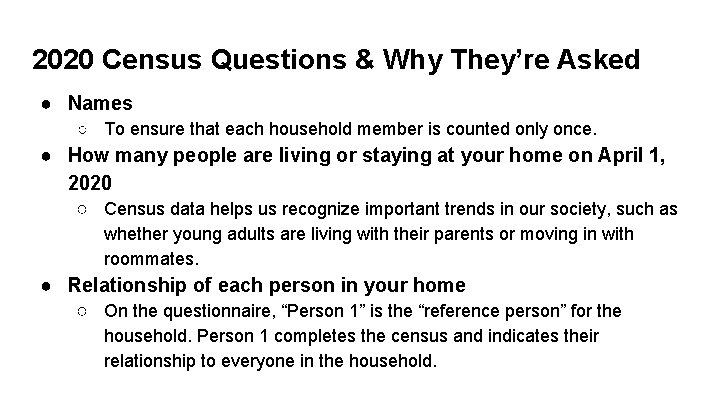
2020 Census Questions & Why They’re Asked ● Names ○ To ensure that each household member is counted only once. ● How many people are living or staying at your home on April 1, 2020 ○ Census data helps us recognize important trends in our society, such as whether young adults are living with their parents or moving in with roommates. ● Relationship of each person in your home ○ On the questionnaire, “Person 1” is the “reference person” for the household. Person 1 completes the census and indicates their relationship to everyone in the household.
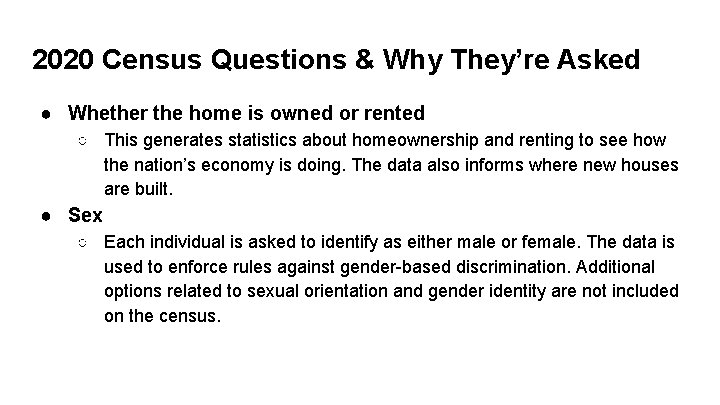
2020 Census Questions & Why They’re Asked ● Whether the home is owned or rented ○ This generates statistics about homeownership and renting to see how the nation’s economy is doing. The data also informs where new houses are built. ● Sex ○ Each individual is asked to identify as either male or female. The data is used to enforce rules against gender-based discrimination. Additional options related to sexual orientation and gender identity are not included on the census.
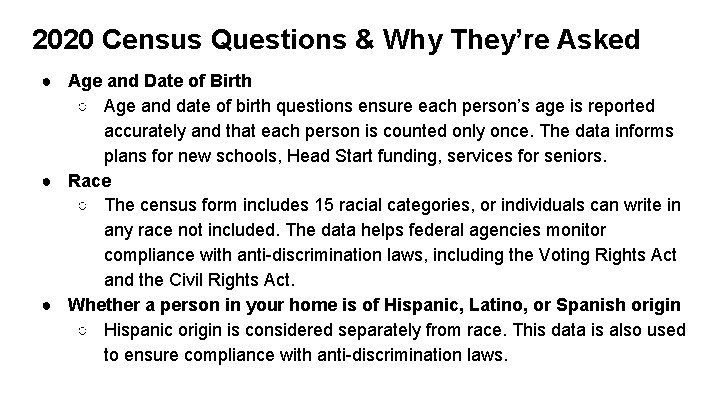
2020 Census Questions & Why They’re Asked ● Age and Date of Birth ○ Age and date of birth questions ensure each person’s age is reported accurately and that each person is counted only once. The data informs plans for new schools, Head Start funding, services for seniors. ● Race ○ The census form includes 15 racial categories, or individuals can write in any race not included. The data helps federal agencies monitor compliance with anti-discrimination laws, including the Voting Rights Act and the Civil Rights Act. ● Whether a person in your home is of Hispanic, Latino, or Spanish origin ○ Hispanic origin is considered separately from race. This data is also used to ensure compliance with anti-discrimination laws.
How is this person related to Person 1? ● The 2020 form says “Person 1” should be someone who pays the rent or owns the home. If nobody meets that description, start by listing any adult living in the household as “Person 1. ” ○ Any adult living in the household can be Person 1, work with your household to figure that out. ● Options: Mark ONE box; opposite-sex husband/wife/spouse; oppositesex unmarried partner; same-sex husband/wife/spouse; same-sex unmarried partner; biological son or daughter; adopted son or daughter; stepson or stepdaughter; brother or sister; father or mother; grandchild; parent-in-law; son-in-law or daughter-in-law; other relative; roommate or housemate; foster child; other non relative.
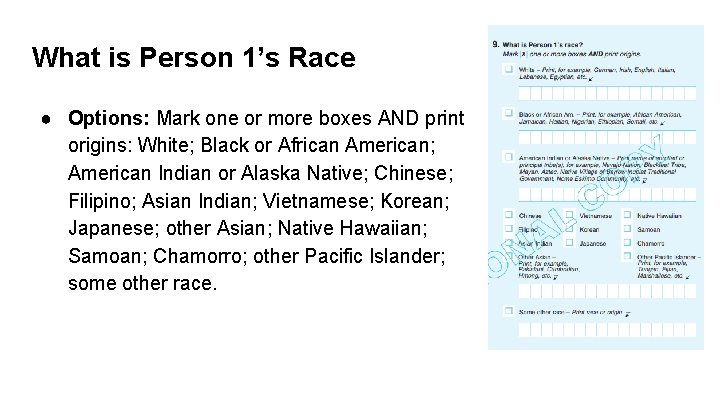
What is Person 1’s Race ● Options: Mark one or more boxes AND print origins: White; Black or African American; American Indian or Alaska Native; Chinese; Filipino; Asian Indian; Vietnamese; Korean; Japanese; other Asian; Native Hawaiian; Samoan; Chamorro; other Pacific Islander; some other race.
Is Person 1 of Hispanic, Latino, or Spanish origin? ● Hispanic origins are not races. ● Hispanic origin can be viewed as the heritage, nationality, lineage, or country of birth of the person or the person’s parents or ancestors before arriving in the United States. People who identify as Hispanic, Latino, or Spanish may be any race. ● Options: ○ ○ ○ No, not of Hispanic, Latino, or Spanish origin Yes, Mexican Am. , Chicano Yes, Puerto Rican Yes, Cuban Yes, another Hispanic, Latino, or Spanish origin - Print, for example, Salvadoran, Dominican, Colombian, Guatemala, Spaniard, Ecuadorian, etc.
Is a person required to answer all of the census questions? ● No. If you don’t answer all the questions, your form can still be submitted. ● An enumerator may come to your house to collect the missing information.
There is NO citizenship question on the 2020 Census!
Track Your Community’s Progress! The Benefits of An Online Census
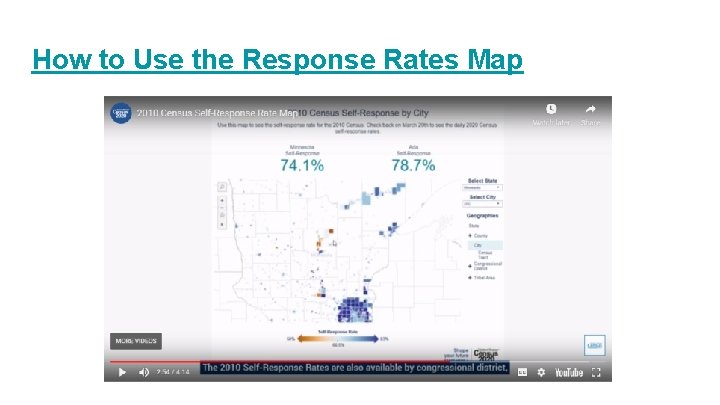
2020 Census Self-Response Rate Map ● Beginning on March 20, 2020 Census response rates will be available online in near real-time to help communities track their response rates. ○ When partners/Complete Count Committees find self-response is lagging on the map, they can plan events or social media posts to encourage participation. ● The Response Rate Map will be updated between 3 pm and 4 pm (EST) daily to reflect response rates from the prior day. ● Response rates will be updated daily, 7 days per week, until the end of May 2020. ○ From May to the end of July 2020, the map will be updated Monday – Friday only.
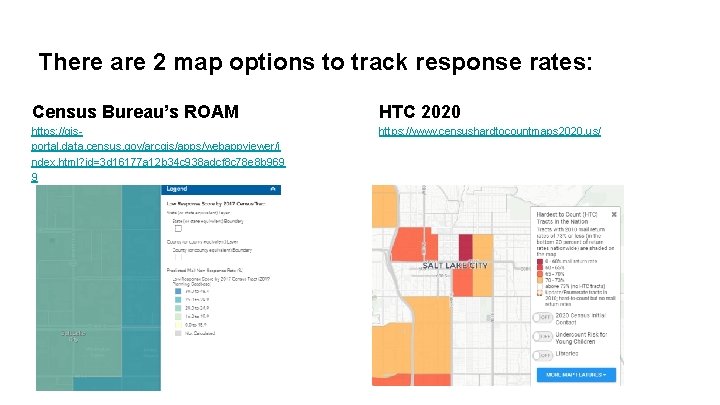
Hard-To-Count “Census Tracts” ● Hard-to-count populations are identified through looking at census tracts. ○ Hardest to Count (HTC) Tracts areas that had low response rates in 2010. So areas where mail return rates were 73% or less. ● Census Tract are equivalent to a neighborhood established by the Bureau of Census for analyzing populations. ● Tracts encompass a population between 2, 500 to 8, 000 people
How to Use the Response Rates Map
There are 2 map options to track response rates: Census Bureau’s ROAM HTC 2020 https: //gisportal. data. census. gov/arcgis/apps/webappviewer/i ndex. html? id=3 d 16177 a 12 b 34 c 938 adcf 8 c 78 e 8 b 969 9 https: //www. censushardtocountmaps 2020. us/
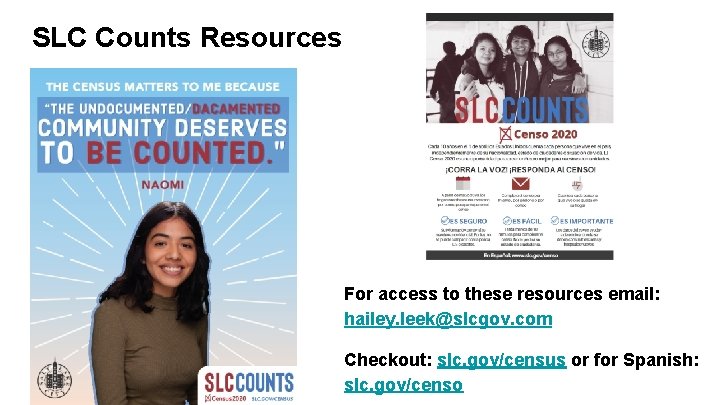
SLC Counts Resources For access to these resources email: hailey. leek@slcgov. com Checkout: slc. gov/census or for Spanish: slc. gov/censo
Join us!