
CENGAGE Learning Principles of economics 6 th Edition
- Slides: 52
CENGAGE Learning Principles of economics 6 th Edition N. Gregory Mankiw Copyright © 2004 South-Western/Thomson Learning
CHAPTER - 1 Ten Principles of Economics N. Gregory Mankiw 11/2/2020 3: 23 AM 2 Copyright © 2004 South-Western/Thomson Learning
WHAT IS ECONOMICS v. A household an economy face many decisions: v Who will work? v What goods and how many of them should be produced? v What resources should be used in production? v At what price should the goods be sold?
WHAT IS ECONOMICS Society and Scarce Resources: • The management of society’s resources is important because resources are scarce. • Scarcity. . . means that society has limited resources and therefore cannot produce all the goods and services people wish to have.
WHAT IS ECONOMICS • Economics is the science of scarcity. • Scarcity is the condition in which our wants are greater than our limited resources. • Since we are unable to have everything we desire, we must make choices on how we will use our limited resources. • In economics we will study the choices of individuals, firms, and governments. • Economics is the study of Choices.
WHAT IS ECONOMICS Economics is the study of how society manages its scarce resources. Economics, as a social science concerned with the efficient use of limited resources to achieve maximum satisfaction of economic wants.
Microeconomics and Macroeconomics • Microeconomics focuses on the individual parts of the economy. • How households and firms make decisions and how they interact in specific markets • Macroeconomics looks at the economy as a whole. • Economy-wide phenomena, including inflation, unemployment, and economic growth • These two branches of economics are closely intertwined, yet distinct – they address different questions.
MICROECONOMICS v Study of the economic actions of individuals and small groups of individuals v The study of particular firms, particular households, individual prices, wages, incomes, individual industry, particular commodities. v In its approach, microeconomics proceeds to examine how output and employment are allocated among individual industries and individual firms operating under industry and how the prices of various products of these individual firms are established assuming the total output, total employment and spending for all goods and services as given.
MACROECONOMICS v Essentially the study of the behaviour and performance of the economy as a whole v Deals with the functioning of the economy as a cluding whole, output of goods and services, the price level of goods and services and the total employment of resources are determined and what causes these magnitudes to fluctuate. v Studies the relationship and interaction between the factors and forces that determine the level and growth of output and employment, general price level and balance of payment position of an economy.
Concept of Utility Meaning of Utility v Utility refers to want satisfying power of a commodity. v It is the satisfaction, actual or expected, derived from the consumption of a commodity. v Utility differs from person- to-person, place-to-place and time-to-time. v In short, when a commodity is capable of satisfying human wants, we can conclude that the commodity has utility.
Concept of Utility How to measure utility v Several economists including Marshall, suggested the measurement of utility in monetary terms. v According to them, utility can be measured in terms of money or price, which the consumer is willing to pay not the price he is actually paying. v For example, if consumer is willing to pay Rs. 20 from consuming a cup of ice-cream, then he is deriving utility worth Rs. 20 from that cup of ice-cream. This utility of Rs. 20 from the ice-cream is termed as value of utility in terms of money. v It must be noted that it is impossible to measure satisfaction of a person as it is inherent to the individual and differs greatly from person-to-person. Still, the concept of utility is very useful in explaining and understanding the behaviour of consumer.
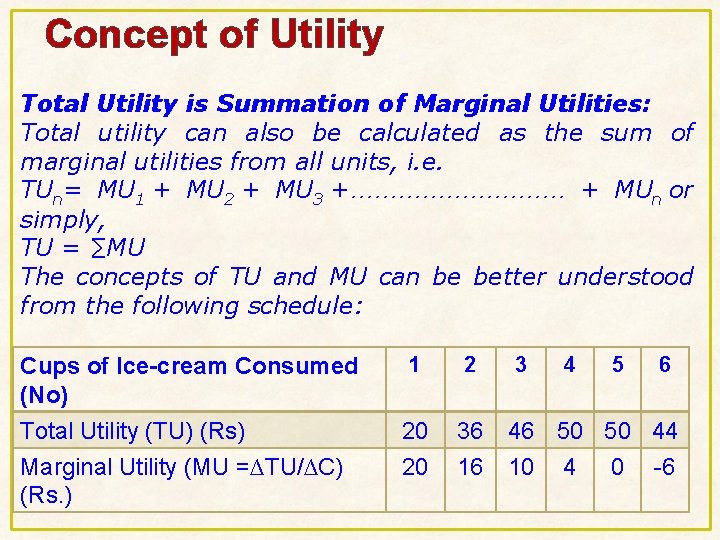
Concept of Utility v Total Utility (TU) refers to the total satisfaction obtained from the consumption of all possible units of a commodity. v It measures the total satisfaction obtained from consumption of all the units of that good. v For example, if the 1 st cup of ice-cream gives you a satisfaction of 20 and 2 nd one gives 16, then TU from 2 cups of ice-cream is 20 + 16 = 36. If the 3 rd cup of ice-cream generates satisfaction of 10, then TU from 3 cups of icecream will be 20+ 16 + 10 = 46. Note that the utility is measured by money you are willing to pay. TU can be calculated as: TUn = U 1 + U 2 + U 3 +…………. + Un, where: TUn = Total utility from n units of a given commodity U 1, U 2, U 3, ……………. Un = Utility from the 1 st, 2 nd, 3 rd nth unit n = Number of units consumed
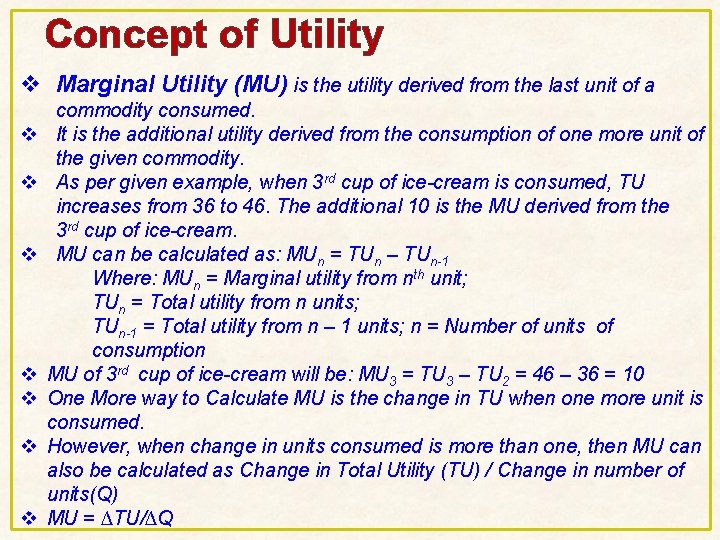
Concept of Utility v Marginal Utility (MU) is the utility derived from the last unit of a v v v v commodity consumed. It is the additional utility derived from the consumption of one more unit of the given commodity. As per given example, when 3 rd cup of ice-cream is consumed, TU increases from 36 to 46. The additional 10 is the MU derived from the 3 rd cup of ice-cream. MU can be calculated as: MUn = TUn – TUn-1 Where: MUn = Marginal utility from nth unit; TUn = Total utility from n units; TUn-1 = Total utility from n – 1 units; n = Number of units of consumption MU of 3 rd cup of ice-cream will be: MU 3 = TU 3 – TU 2 = 46 – 36 = 10 One More way to Calculate MU is the change in TU when one more unit is consumed. However, when change in units consumed is more than one, then MU can also be calculated as Change in Total Utility (TU) / Change in number of units(Q) MU = ∆TU/∆Q
Concept of Utility Total Utility is Summation of Marginal Utilities: Total utility can also be calculated as the sum of marginal utilities from all units, i. e. TUn= MU 1 + MU 2 + MU 3 +…………… + MUn or simply, TU = ∑MU The concepts of TU and MU can be better understood from the following schedule: Cups of Ice-cream Consumed (No) Total Utility (TU) (Rs) Marginal Utility (MU =∆TU/∆C) (Rs. ) 1 2 20 20 36 16 3 4 5 6 46 50 50 44 10 4 0 -6
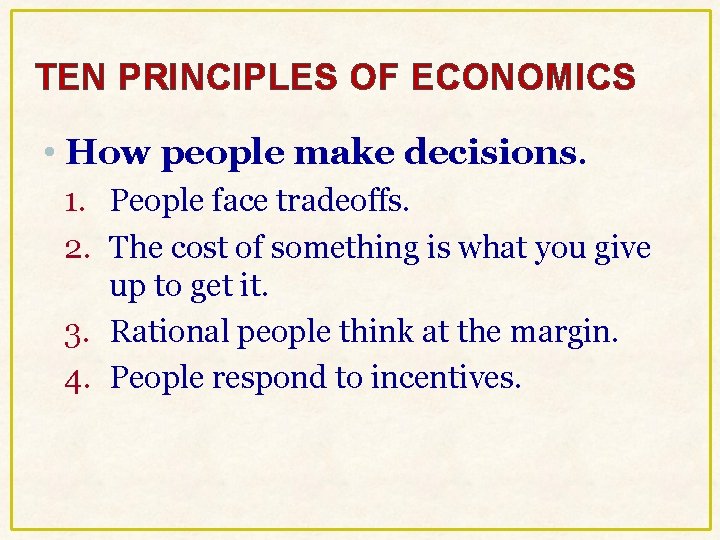
TEN PRINCIPLES OF ECONOMICS • How people make decisions. 1. People face tradeoffs. 2. The cost of something is what you give up to get it. 3. Rational people think at the margin. 4. People respond to incentives.
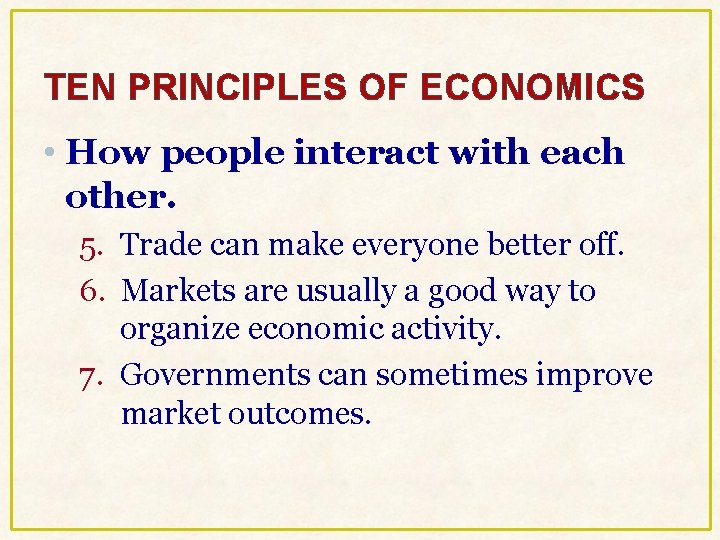
TEN PRINCIPLES OF ECONOMICS • How people interact with each other. 5. Trade can make everyone better off. 6. Markets are usually a good way to organize economic activity. 7. Governments can sometimes improve market outcomes.
TEN PRINCIPLES OF ECONOMICS • The forces and trends that affect how the economy as a whole works. 8. The standard of living depends on a country’s production. 9. Prices rise when the government prints too much money. 10. Society faces a short-run tradeoff between inflation and unemployment.
Principle No 1: People Face Tradeoffs. This means that there always trade-offs -- to get more of something we like, we have to give up something else that we like. For example, if you spend money on dinner and a movie, you won't be able to spend it on new clothes. “There is no such thing as a free lunch!”
Principle No 1: People Face Tradeoffs. To get one thing, we usually have to give up another thing since resources to satisfy wants are scarce. Trade-offs are all the alternatives that we give up whenever we choose one course of action over others. • Guns v. butter • Food v. clothing • Leisure time v. work • Efficiency v. equity Making decisions requires trading off one goal against another.
Principle No 1: People Face Tradeoffs • Efficiency v. Equity • Efficiency means society gets the most that it can from its scarce resources. • Equity means the benefits of those resources are distributed fairly among the members of society. • Tradeoff: • To achieve greater equality, Government could redistribute income from wealthy to poor. • But this reduces incentive to work and produce, shrinks the size of the economic “pie. ”
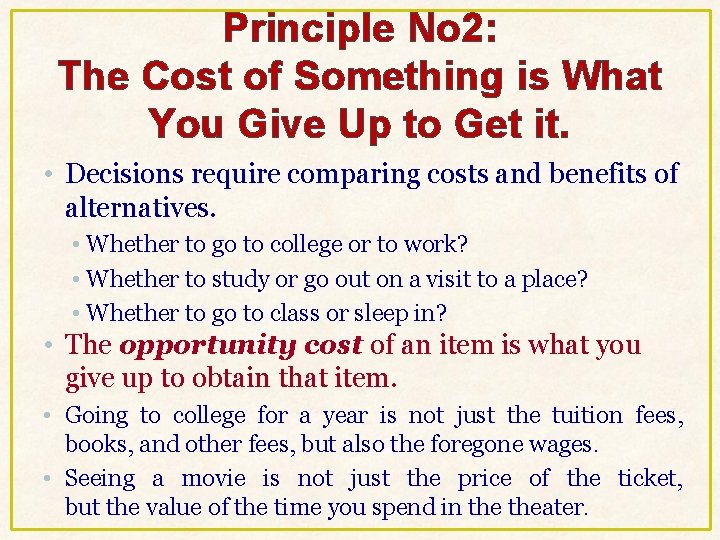
Principle No 2: The Cost of Something is What You Give Up to Get it. • Decisions require comparing costs and benefits of alternatives. • Whether to go to college or to work? • Whether to study or go out on a visit to a place? • Whether to go to class or sleep in? • The opportunity cost of an item is what you give up to obtain that item. • Going to college for a year is not just the tuition fees, books, and other fees, but also the foregone wages. • Seeing a movie is not just the price of the ticket, but the value of the time you spend in theater.
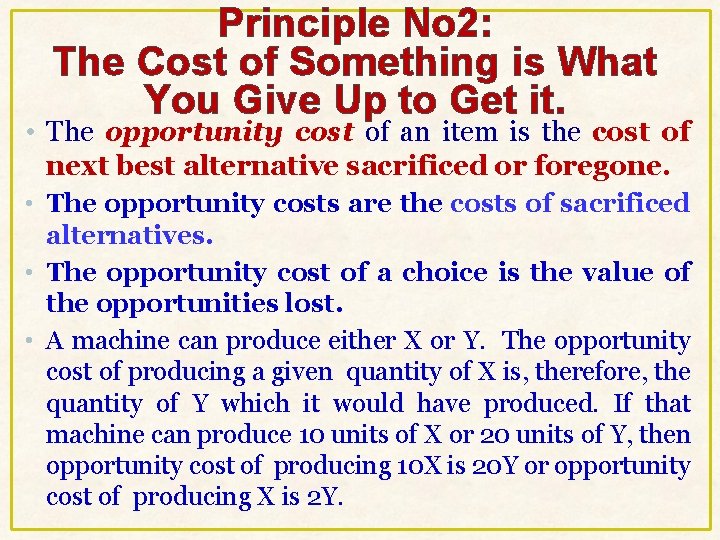
Principle No 2: The Cost of Something is What You Give Up to Get it. • The opportunity cost of an item is the cost of next best alternative sacrificed or foregone. • The opportunity costs are the costs of sacrificed alternatives. • The opportunity cost of a choice is the value of the opportunities lost. • A machine can produce either X or Y. The opportunity cost of producing a given quantity of X is, therefore, the quantity of Y which it would have produced. If that machine can produce 10 units of X or 20 units of Y, then opportunity cost of producing 10 X is 20 Y or opportunity cost of producing X is 2 Y.
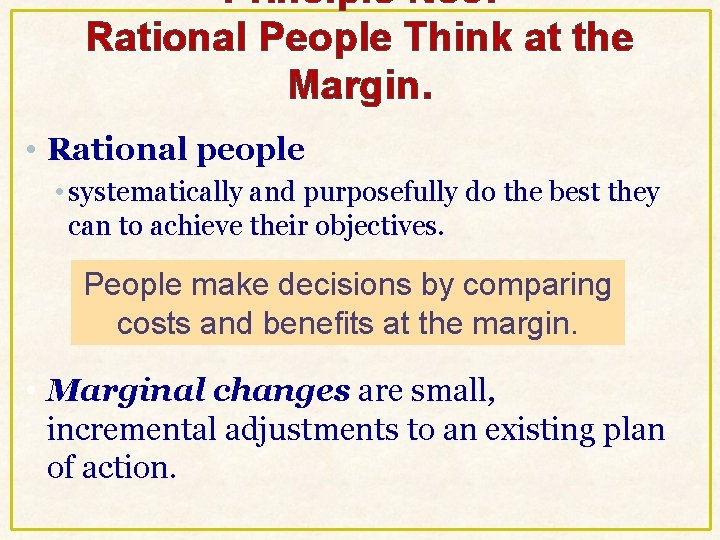
Principle No 3: Rational People Think at the Margin. • Rational people • systematically and purposefully do the best they can to achieve their objectives. People make decisions by comparing costs and benefits at the margin. • Marginal changes are small, incremental adjustments to an existing plan of action.
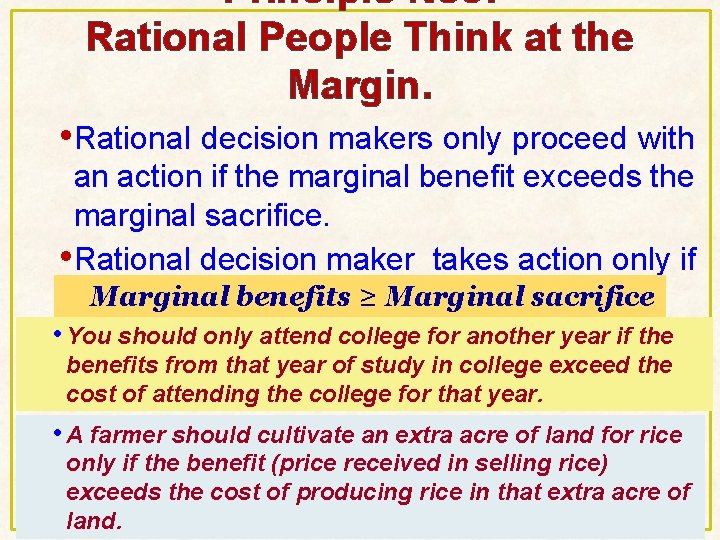
Principle No 3: Rational People Think at the Margin. • Rational decision makers only proceed with an action if the marginal benefit exceeds the marginal sacrifice. • Rational decision maker takes action only if Marginal benefits ≥ Marginal sacrifice • You should only attend college for another year if the benefits from that year of study in college exceed the cost of attending the college for that year. • A farmer should cultivate an extra acre of land for rice only if the benefit (price received in selling rice) exceeds the cost of producing rice in that extra acre of land.
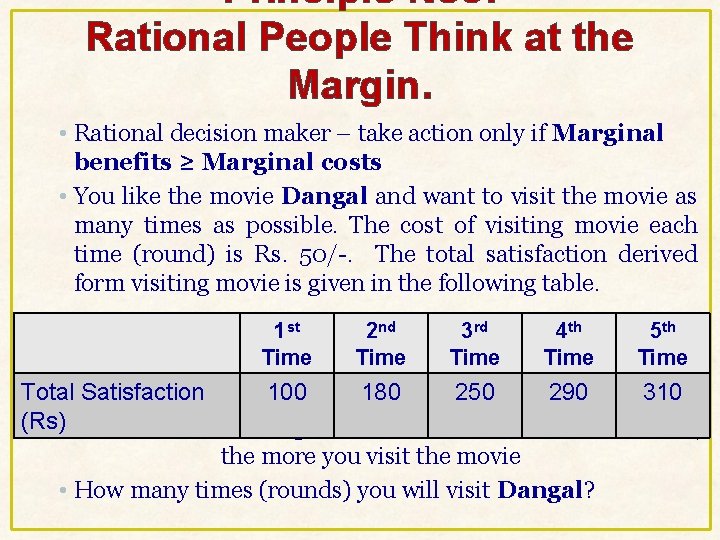
Principle No 3: Rational People Think at the Margin. • Rational decision maker – take action only if Marginal benefits ≥ Marginal costs • You like the movie Dangal and want to visit the movie as many times as possible. The cost of visiting movie each time (round) is Rs. 50/-. The total satisfaction derived form visiting movie is given in the following table. 1 st Time 2 nd Time 3 rd Time 4 th Time 5 th Time Total Satisfaction 100 180 250 290 310 (Rs)Please note- You will get less and less satisfaction each time, the more you visit the movie • How many times (rounds) you will visit Dangal?
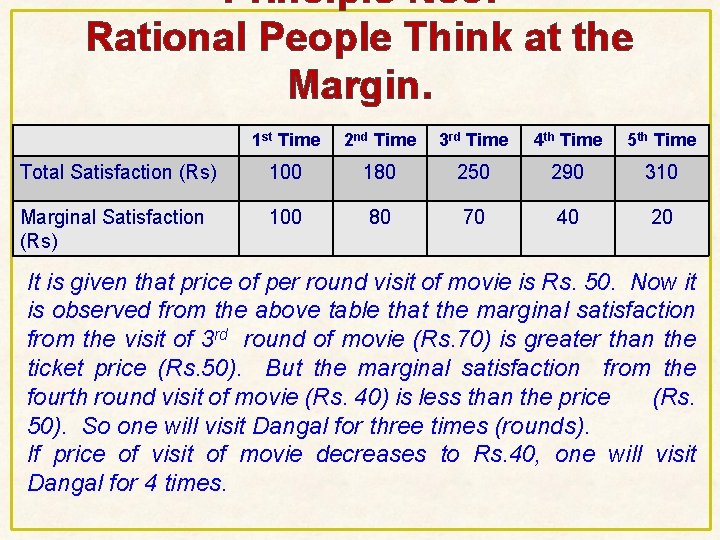
Principle No 3: Rational People Think at the Margin. In determining how many time one will visit movie Dangal, one will utilize the economic principle, i. e. , ‘Rational People think at margin’. This principle implies that a consumer always goes on consuming a commodity till marginal benefit (marginal satisfaction in this case) is greater than or equal to marginal sacrifice (price per unit of movie ticket in this case). The moment the consumer feels that the marginal benefit is less than marginal sacrifice, he stopped his consumption. Given total satisfaction from different rounds of visit of movie, it is required to calculate marginal satisfaction from various rounds of visit of movie which is given below. Marginal satisfaction is the addition to the total satisfaction when one visit movie by one additional round.
Principle No 3: Rational People Think at the Margin. 1 st Time 2 nd Time 3 rd Time 4 th Time 5 th Time Total Satisfaction (Rs) 100 180 250 290 310 Marginal Satisfaction (Rs) 100 80 70 40 20 It is given that price of per round visit of movie is Rs. 50. Now it is observed from the above table that the marginal satisfaction from the visit of 3 rd round of movie (Rs. 70) is greater than the ticket price (Rs. 50). But the marginal satisfaction from the fourth round visit of movie (Rs. 40) is less than the price (Rs. 50). So one will visit Dangal for three times (rounds). If price of visit of movie decreases to Rs. 40, one will visit Dangal for 4 times.
Principle No 3: Rational People Think at the Margin. • Other Examples: • When a student considers whether to go to college for an additional year, he compares the fees & foregone wages to the extra income he could earn with the extra year of education. • When a manager considers whether to increase output, he compares the cost of the needed labor and materials to the extra revenue.
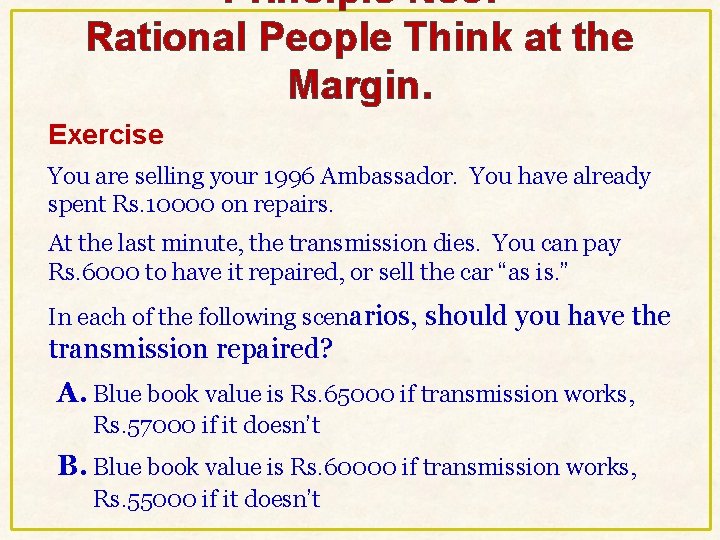
Principle No 3: Rational People Think at the Margin. Exercise You are selling your 1996 Ambassador. You have already spent Rs. 10000 on repairs. At the last minute, the transmission dies. You can pay Rs. 6000 to have it repaired, or sell the car “as is. ” In each of the following scenarios, should you have the transmission repaired? A. Blue book value is Rs. 65000 if transmission works, Rs. 57000 if it doesn’t B. Blue book value is Rs. 60000 if transmission works, Rs. 55000 if it doesn’t
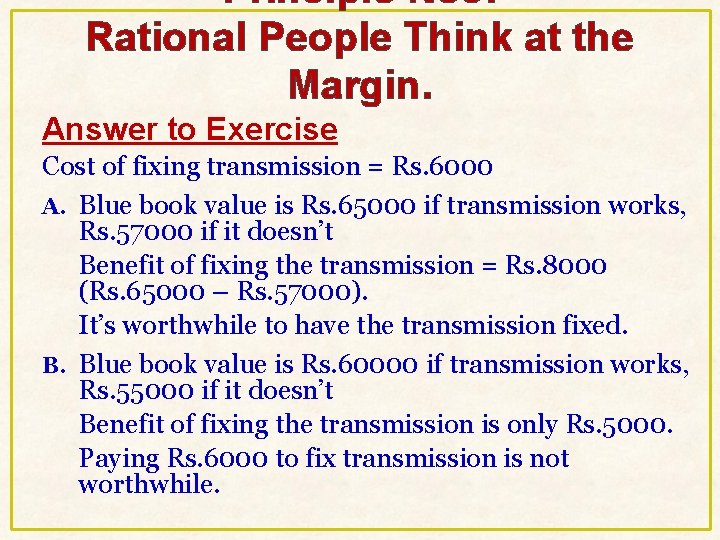
Principle No 3: Rational People Think at the Margin. Answer to Exercise Cost of fixing transmission = Rs. 6000 A. Blue book value is Rs. 65000 if transmission works, Rs. 57000 if it doesn’t Benefit of fixing the transmission = Rs. 8000 (Rs. 65000 – Rs. 57000). It’s worthwhile to have the transmission fixed. B. Blue book value is Rs. 60000 if transmission works, Rs. 55000 if it doesn’t Benefit of fixing the transmission is only Rs. 5000. Paying Rs. 6000 to fix transmission is not worthwhile.
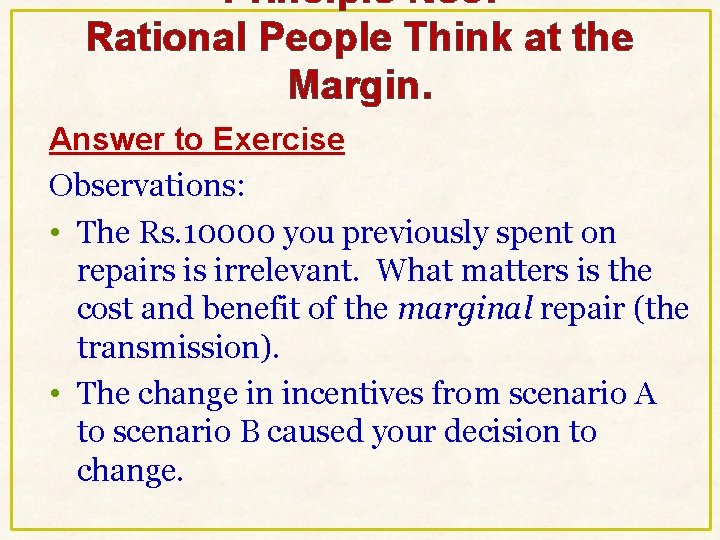
Principle No 3: Rational People Think at the Margin. Answer to Exercise Observations: • The Rs. 10000 you previously spent on repairs is irrelevant. What matters is the cost and benefit of the marginal repair (the transmission). • The change in incentives from scenario A to scenario B caused your decision to change.
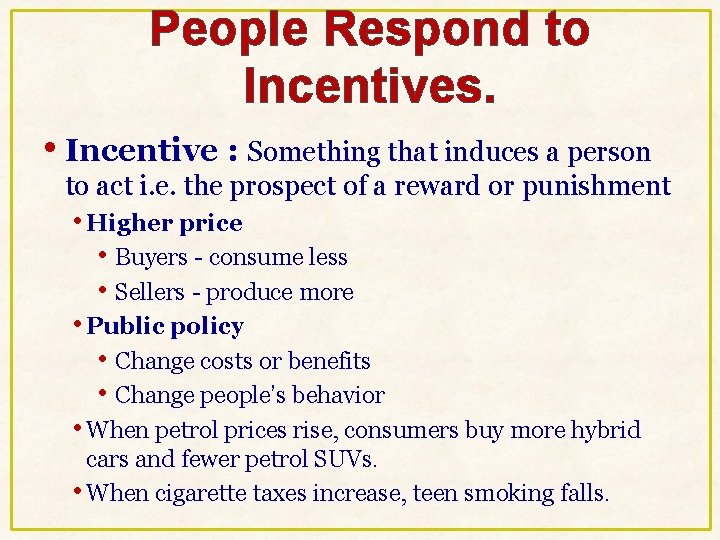
People Respond to Incentives. • Incentive : Something that induces a person to act i. e. the prospect of a reward or punishment • Higher price • Buyers - consume less • Sellers - produce more • Public policy • Change costs or benefits • Change people’s behavior • When petrol prices rise, consumers buy more hybrid cars and fewer petrol SUVs. • When cigarette taxes increase, teen smoking falls.
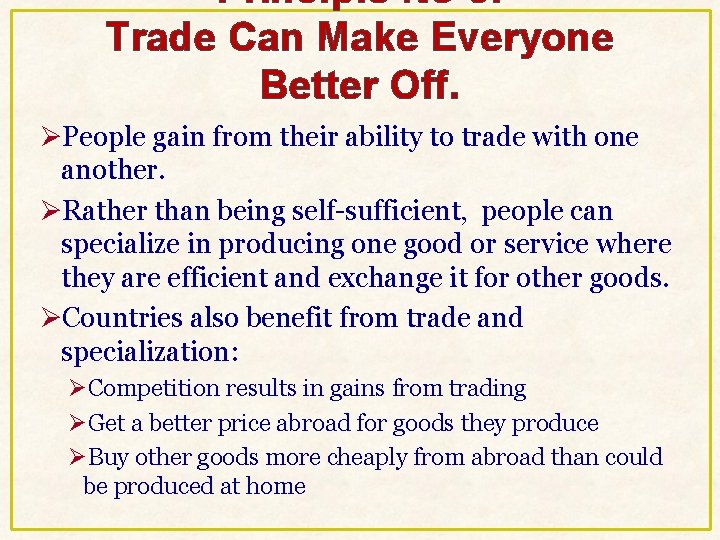
Principle No 5: Trade Can Make Everyone Better Off. ØPeople gain from their ability to trade with one another. ØRather than being self-sufficient, people can specialize in producing one good or service where they are efficient and exchange it for other goods. ØCountries also benefit from trade and specialization: ØCompetition results in gains from trading ØGet a better price abroad for goods they produce ØBuy other goods more cheaply from abroad than could be produced at home
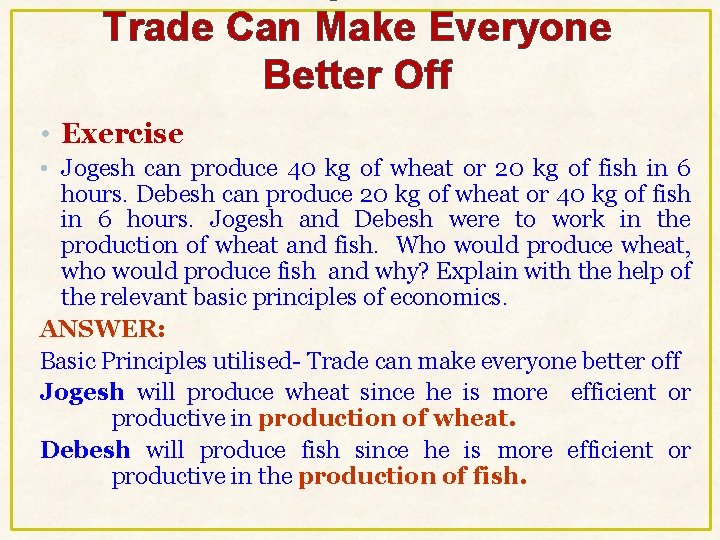
Trade Can Make Everyone Better Off • Exercise • Jogesh can produce 40 kg of wheat or 20 kg of fish in 6 hours. Debesh can produce 20 kg of wheat or 40 kg of fish in 6 hours. Jogesh and Debesh were to work in the production of wheat and fish. Who would produce wheat, who would produce fish and why? Explain with the help of the relevant basic principles of economics. ANSWER: Basic Principles utilised- Trade can make everyone better off Jogesh will produce wheat since he is more efficient or productive in production of wheat. Debesh will produce fish since he is more efficient or productive in the production of fish.
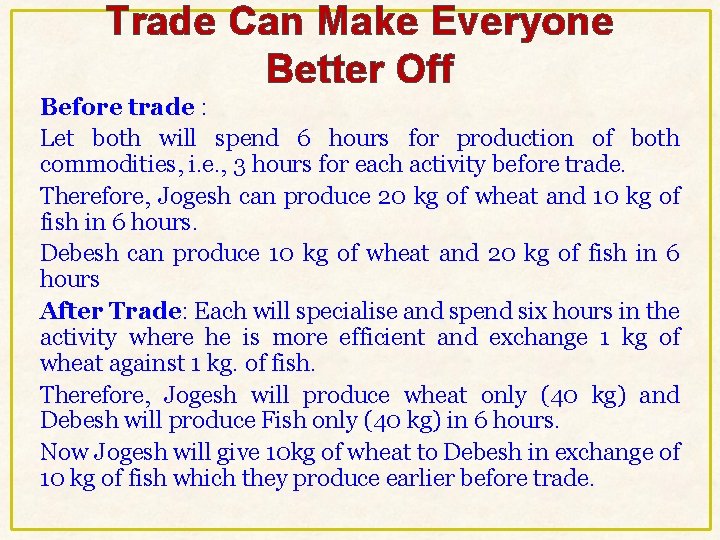
Trade Can Make Everyone Better Off Before trade : Let both will spend 6 hours for production of both commodities, i. e. , 3 hours for each activity before trade. Therefore, Jogesh can produce 20 kg of wheat and 10 kg of fish in 6 hours. Debesh can produce 10 kg of wheat and 20 kg of fish in 6 hours After Trade: Each will specialise and spend six hours in the activity where he is more efficient and exchange 1 kg of wheat against 1 kg. of fish. Therefore, Jogesh will produce wheat only (40 kg) and Debesh will produce Fish only (40 kg) in 6 hours. Now Jogesh will give 10 kg of wheat to Debesh in exchange of 10 kg of fish which they produce earlier before trade.
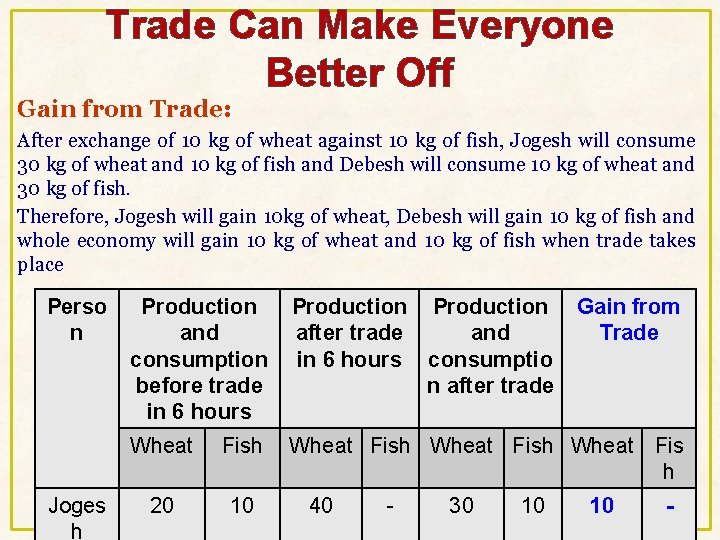
Trade Can Make Everyone Better Off Gain from Trade: After exchange of 10 kg of wheat against 10 kg of fish, Jogesh will consume 30 kg of wheat and 10 kg of fish and Debesh will consume 10 kg of wheat and 30 kg of fish. Therefore, Jogesh will gain 10 kg of wheat, Debesh will gain 10 kg of fish and whole economy will gain 10 kg of wheat and 10 kg of fish when trade takes place Perso n Joges h Production and consumption before trade in 6 hours Production after trade and in 6 hours consumptio n after trade Wheat Fish Wheat Fis h 20 10 40 - 30 10 Gain from Trade 10 -
Principle No 6: Markets Are Usually a Good Way to Organize Economic Activity. • A market economy is an economy that allocates resources through the decentralized decisions of many firms and households as they interact in markets for goods and services. • Households decide what to buy and who to work for. • Firms decide whom to hire and what to produce.
Principle No 6: Markets Are Usually a Good Way to Organize Economic Activity. • Adam Smith made the observation that households and firms interacting in markets act as if guided by an “invisible hand. ” • Because households and firms look at prices when deciding what to buy and sell, they unknowingly take into account the social costs of their actions. • As a result, prices guide decision makers to reach outcomes that tend to maximize the welfare of society as a whole.
Principle No 7: Governments Can Sometimes Improve Market Outcomes. v. We need government v. Enforce the rules v. Enforce property rights (Ability of an individual to own and exercise control over scarce resources) v. Market failure occurs when the market fails to allocate resources efficiently. v. Market failure may be caused by van externality, which is the impact of one person or firm’s actions on the well-being of a bystander. vmarket power, which is the ability of a single person or firm to unduly influence market prices.
Principle No 7: Governments Can Sometimes Improve Market Outcomes. v. When the market fails (breaks down) government can intervene to promote efficiency and equity. v. To promote efficiency : Avoid market failure v. To promote equality : Avoid disparities in economic wellbeing v. If the market’s distribution of economic wellbeing is not desirable, tax or welfare policies can change how the economic “pie” is divided.
Principle No 8: The Standard of Living Depends on a Country’s Production. v. Standard of living may be measured in different ways: v. By comparing personal incomes. v By comparing the total market value of a nation’s production.
Principle No 8: The Standard of Living Depends on a Country’s Production. v. Almost all variations in living standards are explained by differences in countries’ productivities. v. Productivity is the amount of goods and services produced from each unit of labor input.
Principle No 9: Prices Rise When the Government Prints Too Much Money. v. Inflation is an increase in the overall level of prices in the economy. v. One cause of inflation is the growth in the quantity of money. v. When the government creates large quantities of money, the value of the money falls.
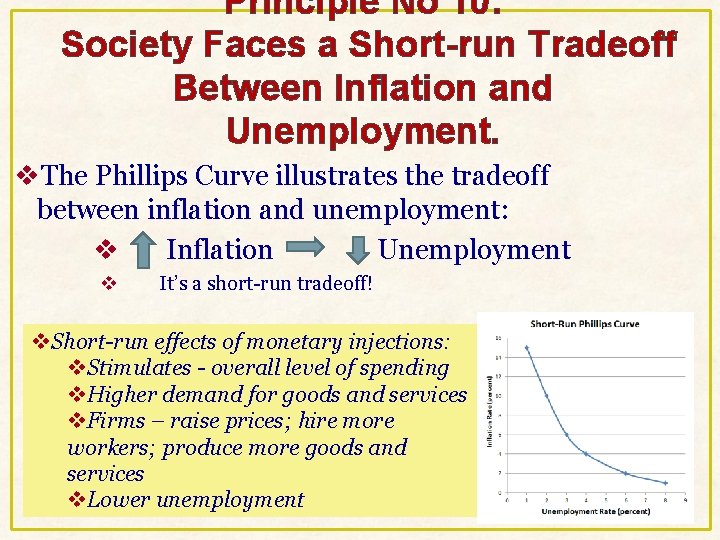
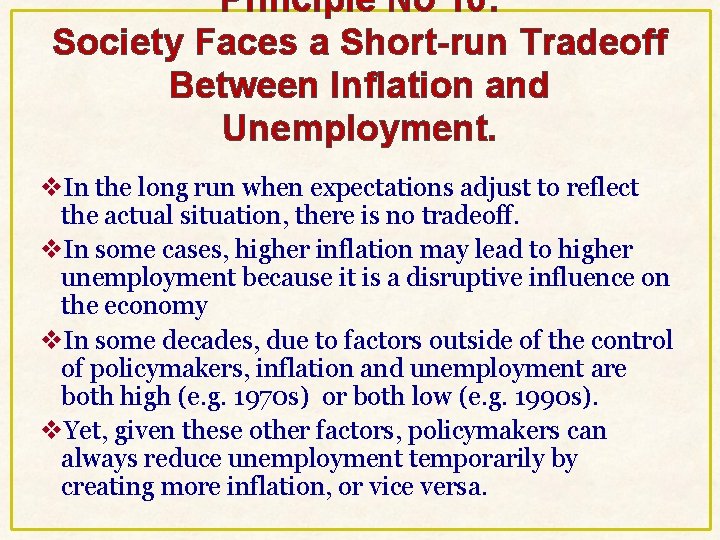
Principle No 10: Society Faces a Short-run Tradeoff Between Inflation and Unemployment. v. The Phillips Curve illustrates the tradeoff between inflation and unemployment: Unemployment v Inflation v It’s a short-run tradeoff! v. Short-run effects of monetary injections: v. Stimulates - overall level of spending v. Higher demand for goods and services v. Firms – raise prices; hire more workers; produce more goods and services v. Lower unemployment
Principle No 10: Society Faces a Short-run Tradeoff Between Inflation and Unemployment. v. In the long run when expectations adjust to reflect the actual situation, there is no tradeoff. v. In some cases, higher inflation may lead to higher unemployment because it is a disruptive influence on the economy v. In some decades, due to factors outside of the control of policymakers, inflation and unemployment are both high (e. g. 1970 s) or both low (e. g. 1990 s). v. Yet, given these other factors, policymakers can always reduce unemployment temporarily by creating more inflation, or vice versa.
Summary • When individuals make decisions, they face tradeoffs among alternative goals. • The cost of any action is measured in terms of foregone opportunities. • Rational people make decisions by comparing marginal costs and marginal benefits. • People change their behavior in response to the incentives they face.
Summary • Trade can be mutually beneficial. • Markets are usually a good way of coordinating trade among people. • Government can potentially improve market outcomes if there is some market failure or if the market outcome is inequitable.
Summary • Productivity is the ultimate source of living standards. • Money growth is the ultimate source of inflation. • Society faces a short-run tradeoff between inflation and unemployment.
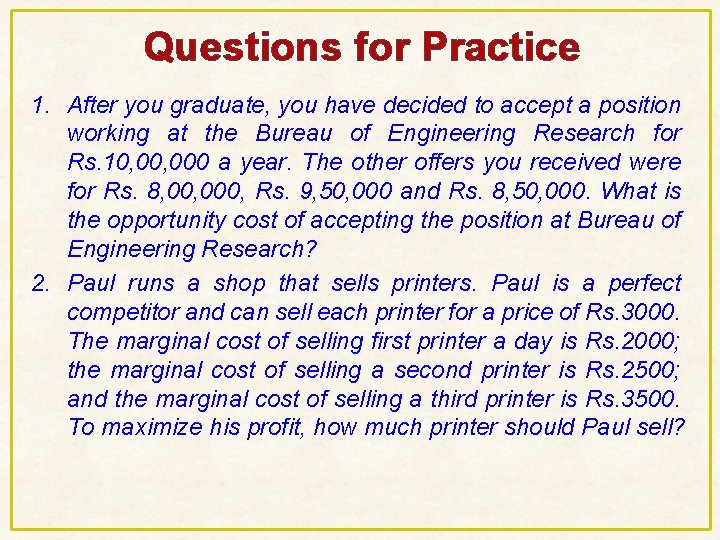
Questions for Practice 1. After you graduate, you have decided to accept a position working at the Bureau of Engineering Research for Rs. 10, 000 a year. The other offers you received were for Rs. 8, 000, Rs. 9, 50, 000 and Rs. 8, 50, 000. What is the opportunity cost of accepting the position at Bureau of Engineering Research? 2. Paul runs a shop that sells printers. Paul is a perfect competitor and can sell each printer for a price of Rs. 3000. The marginal cost of selling first printer a day is Rs. 2000; the marginal cost of selling a second printer is Rs. 2500; and the marginal cost of selling a third printer is Rs. 3500. To maximize his profit, how much printer should Paul sell?
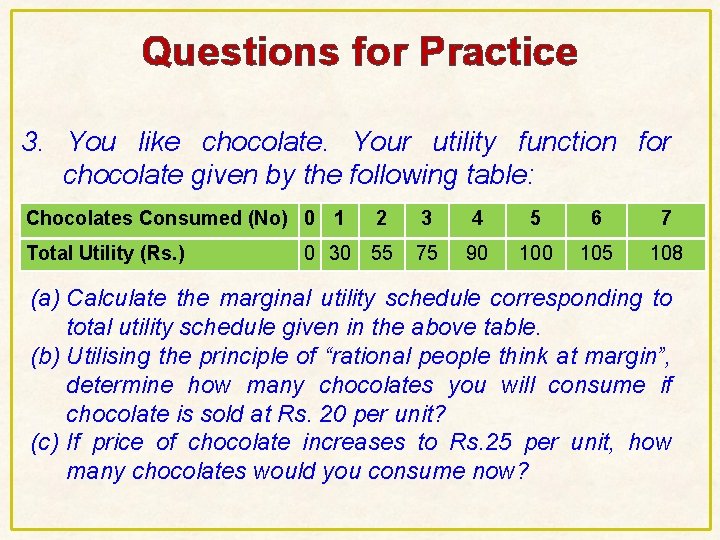
Questions for Practice 3. You like chocolate. Your utility function for chocolate given by the following table: Chocolates Consumed (No) 0 1 Total Utility (Rs. ) 2 3 4 5 6 7 0 30 55 75 90 105 108 (a) Calculate the marginal utility schedule corresponding to total utility schedule given in the above table. (b) Utilising the principle of “rational people think at margin”, determine how many chocolates you will consume if chocolate is sold at Rs. 20 per unit? (c) If price of chocolate increases to Rs. 25 per unit, how many chocolates would you consume now?
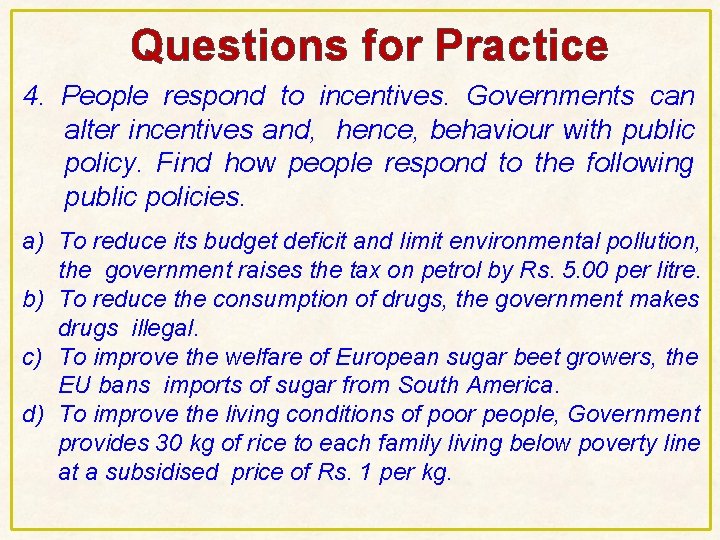
Questions for Practice 4. People respond to incentives. Governments can alter incentives and, hence, behaviour with public policy. Find how people respond to the following public policies. a) To reduce its budget deficit and limit environmental pollution, the government raises the tax on petrol by Rs. 5. 00 per litre. b) To reduce the consumption of drugs, the government makes drugs illegal. c) To improve the welfare of European sugar beet growers, the EU bans imports of sugar from South America. d) To improve the living conditions of poor people, Government provides 30 kg of rice to each family living below poverty line at a subsidised price of Rs. 1 per kg.
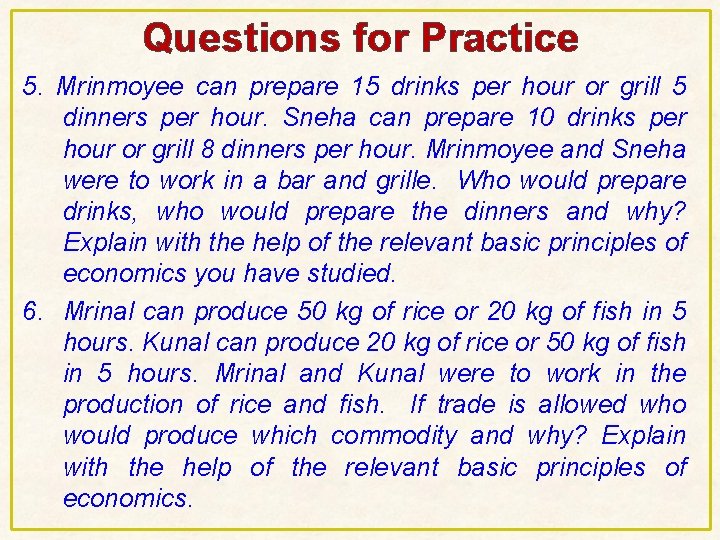
Questions for Practice 5. Mrinmoyee can prepare 15 drinks per hour or grill 5 dinners per hour. Sneha can prepare 10 drinks per hour or grill 8 dinners per hour. Mrinmoyee and Sneha were to work in a bar and grille. Who would prepare drinks, who would prepare the dinners and why? Explain with the help of the relevant basic principles of economics you have studied. 6. Mrinal can produce 50 kg of rice or 20 kg of fish in 5 hours. Kunal can produce 20 kg of rice or 50 kg of fish in 5 hours. Mrinal and Kunal were to work in the production of rice and fish. If trade is allowed who would produce which commodity and why? Explain with the help of the relevant basic principles of economics.