
CENG 477 Introduction to Computer Graphics Data Structures
- Slides: 87
CENG 477 Introduction to Computer Graphics Data Structures for Graphics
Until Now • We rendered virtual objects – – Ray tracing Ray are easy: r(t) = o + dt Mathematical objects also easy: x 2 + y 2 + z 2 = R 2 How about arbitrary objects embedded in 2 D/3 D scenes? • Today we will learn how to – explicitly represent those objects • triangle meshes – implicitly represent those objects as well as organize them • spatial structures CENG 477 – Computer Graphics 2
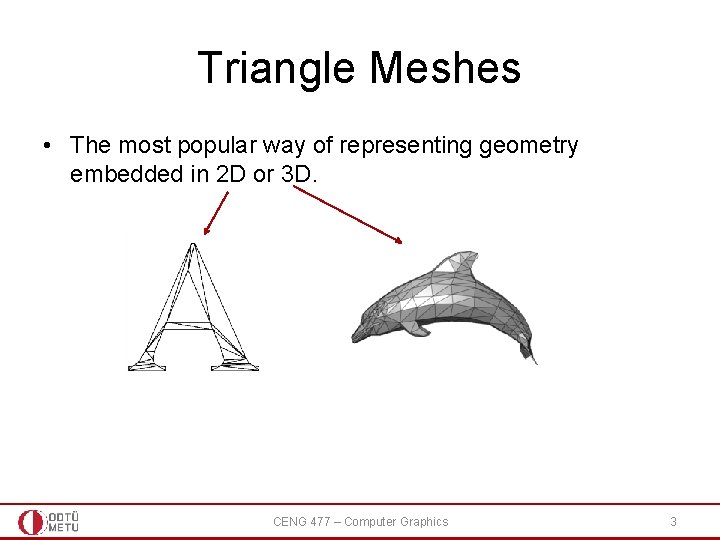
Triangle Meshes • The most popular way of representing geometry embedded in 2 D or 3 D. CENG 477 – Computer Graphics 3
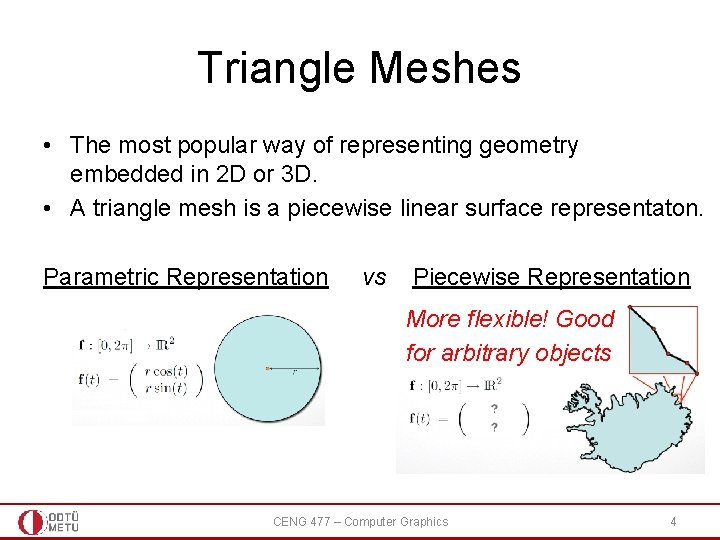
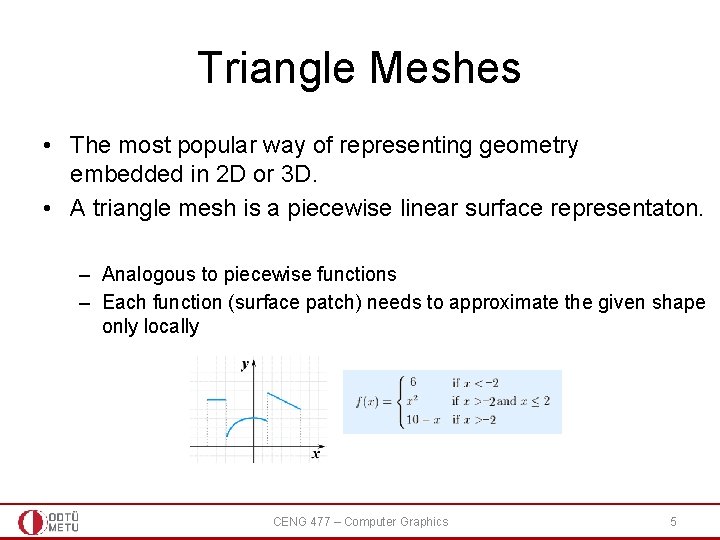
Triangle Meshes • The most popular way of representing geometry embedded in 2 D or 3 D. • A triangle mesh is a piecewise linear surface representaton. Parametric Representation vs Piecewise Representation More flexible! Good for arbitrary objects CENG 477 – Computer Graphics 4
Triangle Meshes • The most popular way of representing geometry embedded in 2 D or 3 D. • A triangle mesh is a piecewise linear surface representaton. – Analogous to piecewise functions – Each function (surface patch) needs to approximate the given shape only locally CENG 477 – Computer Graphics 5
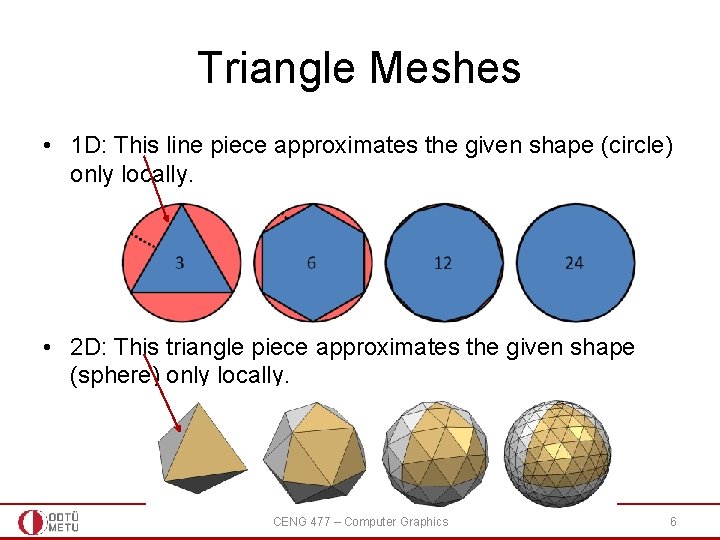
Triangle Meshes • 1 D: This line piece approximates the given shape (circle) only locally. • 2 D: This triangle piece approximates the given shape (sphere) only locally. CENG 477 – Computer Graphics 6
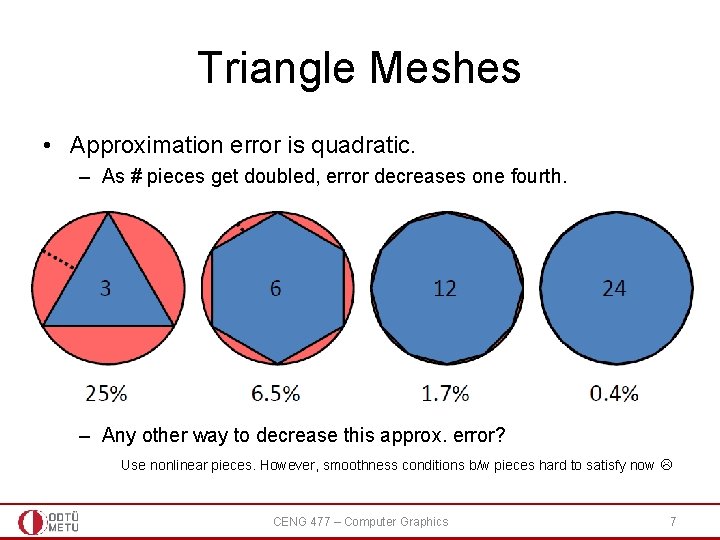
Triangle Meshes • Approximation error is quadratic. – As # pieces get doubled, error decreases one fourth. – Any other way to decrease this approx. error? Use nonlinear pieces. However, smoothness conditions b/w pieces hard to satisfy now CENG 477 – Computer Graphics 7
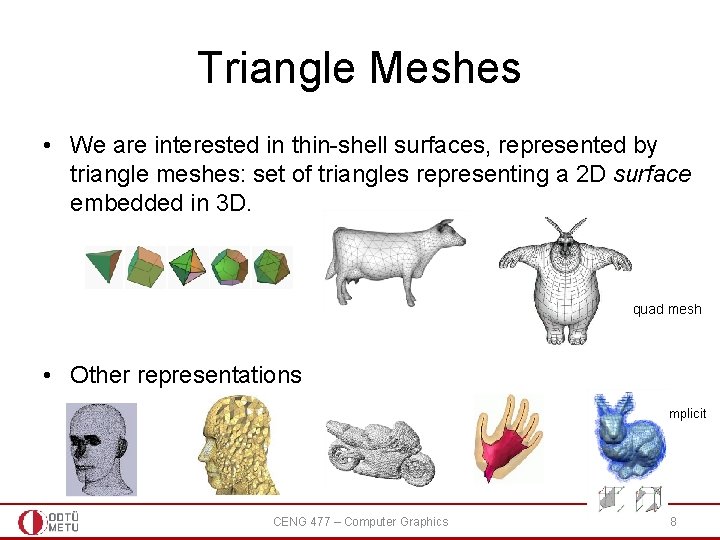
Triangle Meshes • We are interested in thin-shell surfaces, represented by triangle meshes: set of triangles representing a 2 D surface embedded in 3 D. quad mesh • Other representations implicit CENG 477 – Computer Graphics 8
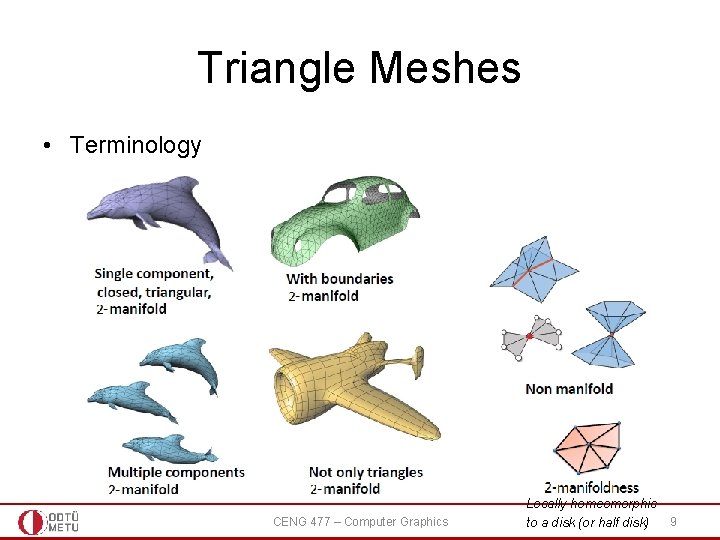
Triangle Meshes • Terminology CENG 477 – Computer Graphics Locally homeomorphic to a disk (or half disk) 9
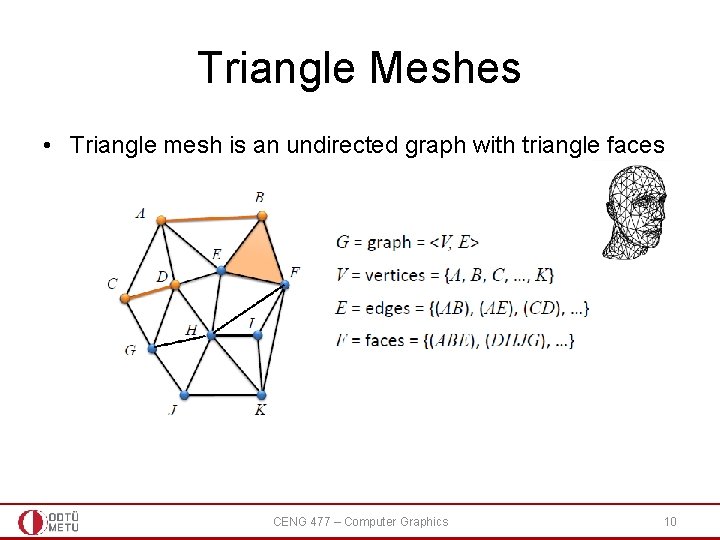
Triangle Meshes • Triangle mesh is an undirected graph with triangle faces CENG 477 – Computer Graphics 10
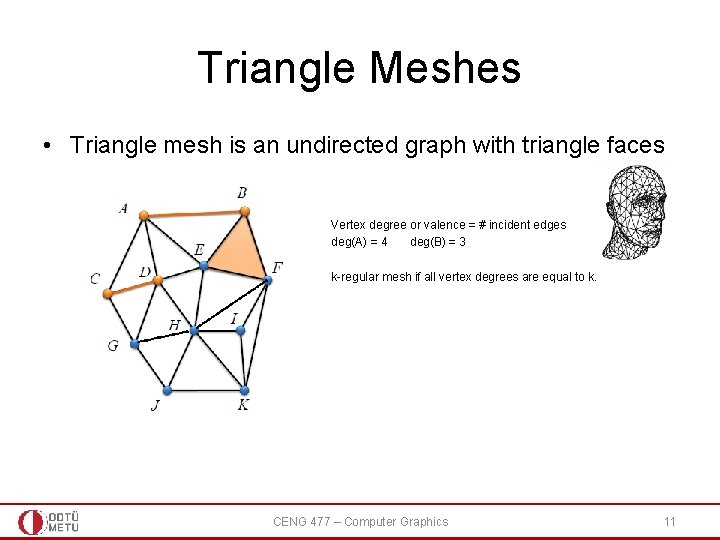
Triangle Meshes • Triangle mesh is an undirected graph with triangle faces Vertex degree or valence = # incident edges deg(A) = 4 deg(B) = 3 k-regular mesh if all vertex degrees are equal to k. CENG 477 – Computer Graphics 11
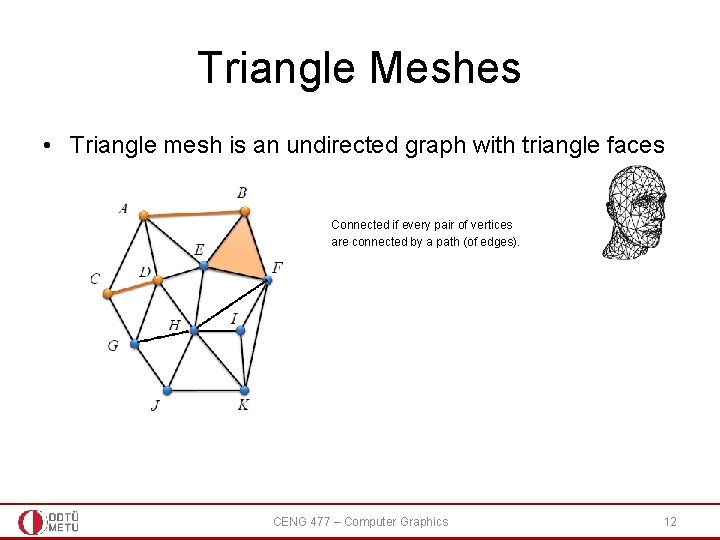
Triangle Meshes • Triangle mesh is an undirected graph with triangle faces Connected if every pair of vertices are connected by a path (of edges). CENG 477 – Computer Graphics 12
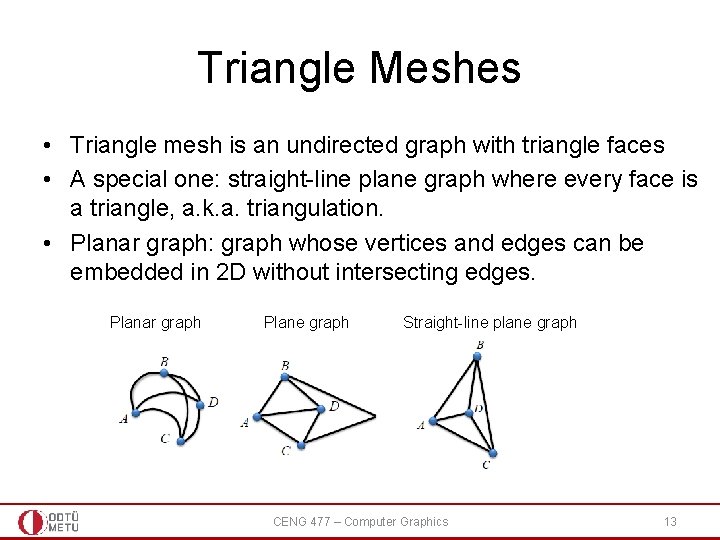
Triangle Meshes • Triangle mesh is an undirected graph with triangle faces • A special one: straight-line plane graph where every face is a triangle, a. k. a. triangulation. • Planar graph: graph whose vertices and edges can be embedded in 2 D without intersecting edges. Planar graph Plane graph Straight-line plane graph CENG 477 – Computer Graphics 13
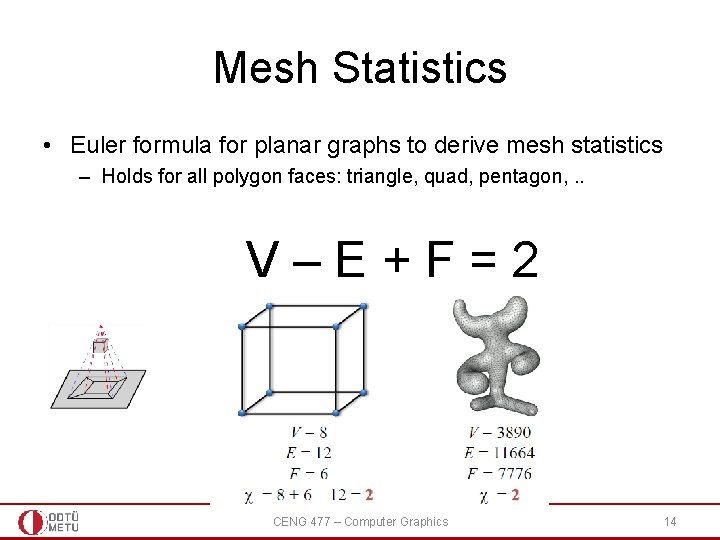
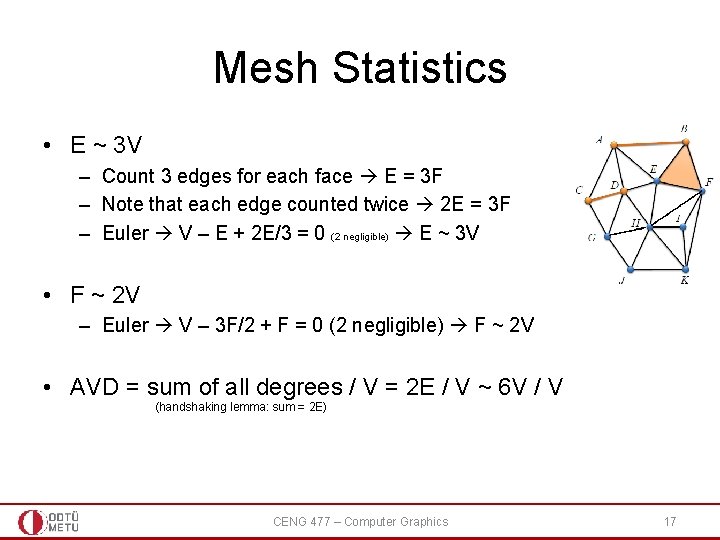
Mesh Statistics • Euler formula for planar graphs to derive mesh statistics – Holds for all polygon faces: triangle, quad, pentagon, . . V–E+F=2 CENG 477 – Computer Graphics 14
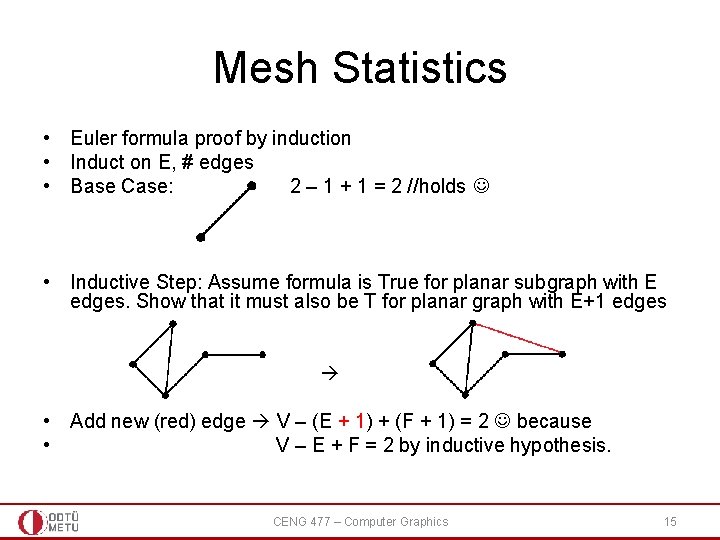
Mesh Statistics • Euler formula proof by induction • Induct on E, # edges • Base Case: 2 – 1 + 1 = 2 //holds • Inductive Step: Assume formula is True for planar subgraph with E edges. Show that it must also be T for planar graph with E+1 edges • Add new (red) edge V – (E + 1) + (F + 1) = 2 because • V – E + F = 2 by inductive hypothesis. CENG 477 – Computer Graphics 15
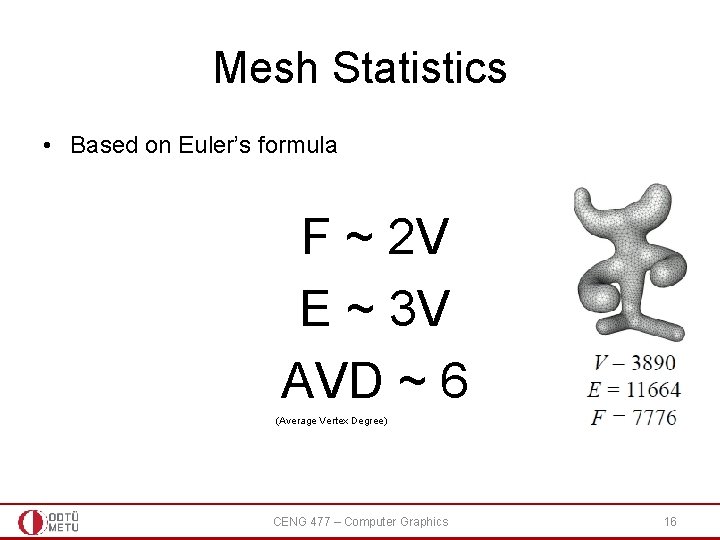
Mesh Statistics • Based on Euler’s formula F ~ 2 V E ~ 3 V AVD ~ 6 (Average Vertex Degree) CENG 477 – Computer Graphics 16
Mesh Statistics • E ~ 3 V – Count 3 edges for each face E = 3 F – Note that each edge counted twice 2 E = 3 F – Euler V – E + 2 E/3 = 0 (2 negligible) E ~ 3 V • F ~ 2 V – Euler V – 3 F/2 + F = 0 (2 negligible) F ~ 2 V • AVD = sum of all degrees / V = 2 E / V ~ 6 V / V (handshaking lemma: sum = 2 E) CENG 477 – Computer Graphics 17
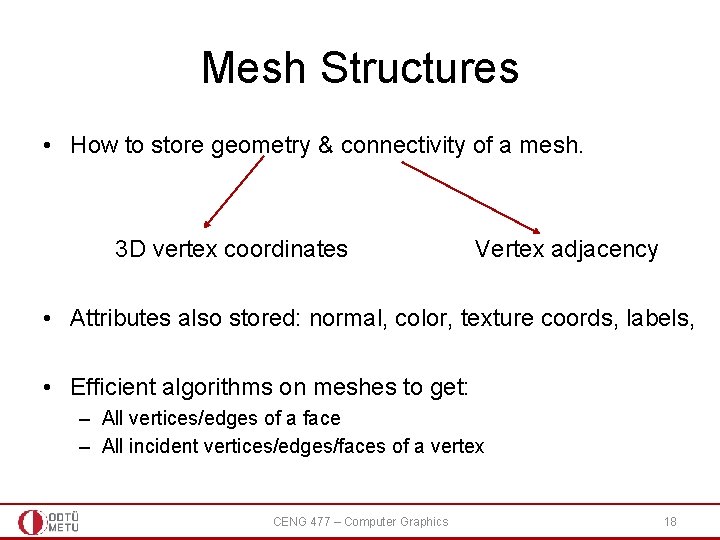
Mesh Structures • How to store geometry & connectivity of a mesh. 3 D vertex coordinates Vertex adjacency • Attributes also stored: normal, color, texture coords, labels, • Efficient algorithms on meshes to get: – All vertices/edges of a face – All incident vertices/edges/faces of a vertex CENG 477 – Computer Graphics 18
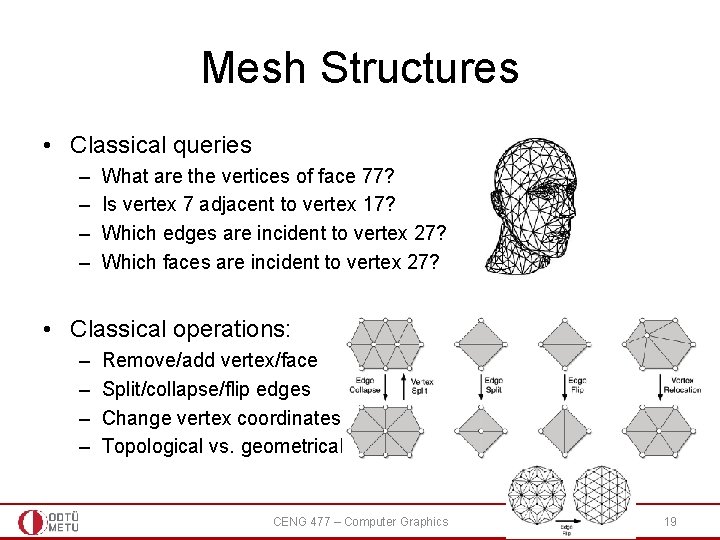
Mesh Structures • Classical queries – – What are the vertices of face 77? Is vertex 7 adjacent to vertex 17? Which edges are incident to vertex 27? Which faces are incident to vertex 27? • Classical operations: – – Remove/add vertex/face Split/collapse/flip edges Change vertex coordinates Topological vs. geometrical CENG 477 – Computer Graphics 19
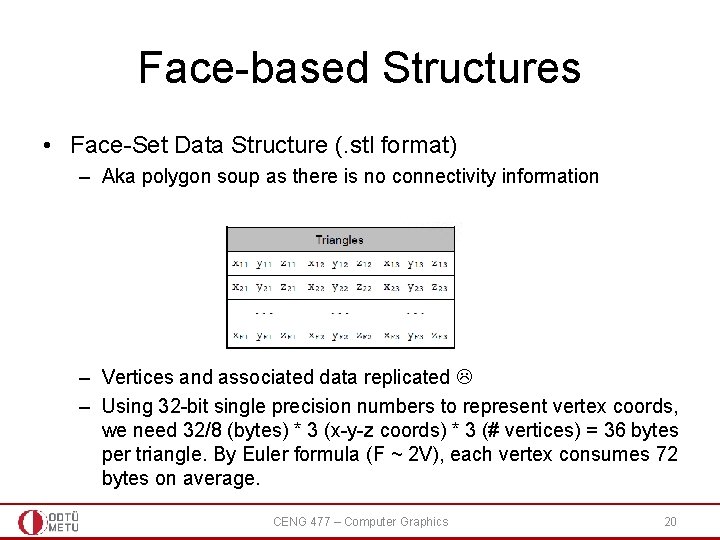
Face-based Structures • Face-Set Data Structure (. stl format) – Aka polygon soup as there is no connectivity information – Vertices and associated data replicated – Using 32 -bit single precision numbers to represent vertex coords, we need 32/8 (bytes) * 3 (x-y-z coords) * 3 (# vertices) = 36 bytes per triangle. By Euler formula (F ~ 2 V), each vertex consumes 72 bytes on average. CENG 477 – Computer Graphics 20
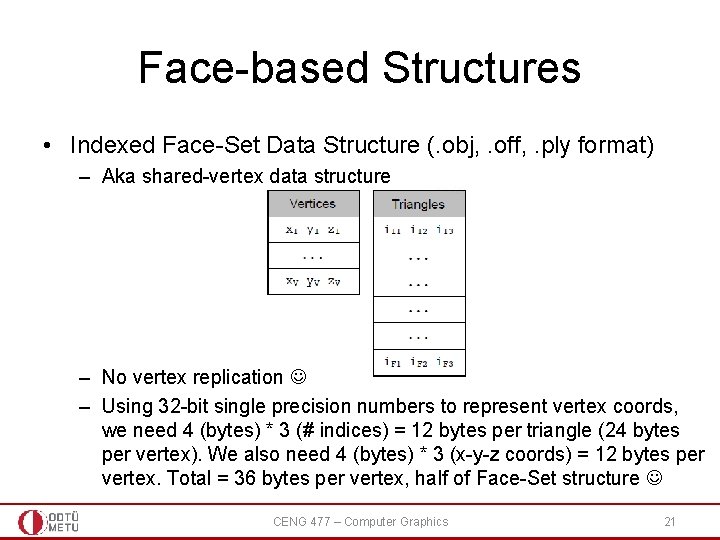
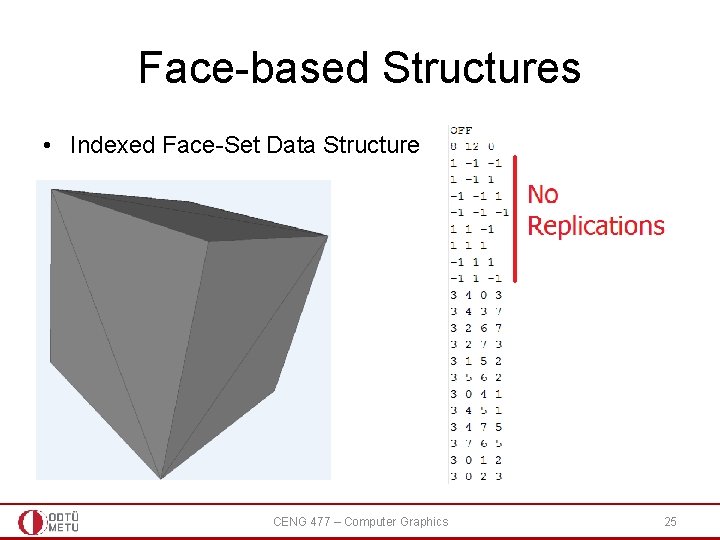
Face-based Structures • Indexed Face-Set Data Structure (. obj, . off, . ply format) – Aka shared-vertex data structure – No vertex replication – Using 32 -bit single precision numbers to represent vertex coords, we need 4 (bytes) * 3 (# indices) = 12 bytes per triangle (24 bytes per vertex). We also need 4 (bytes) * 3 (x-y-z coords) = 12 bytes per vertex. Total = 36 bytes per vertex, half of Face-Set structure CENG 477 – Computer Graphics 21
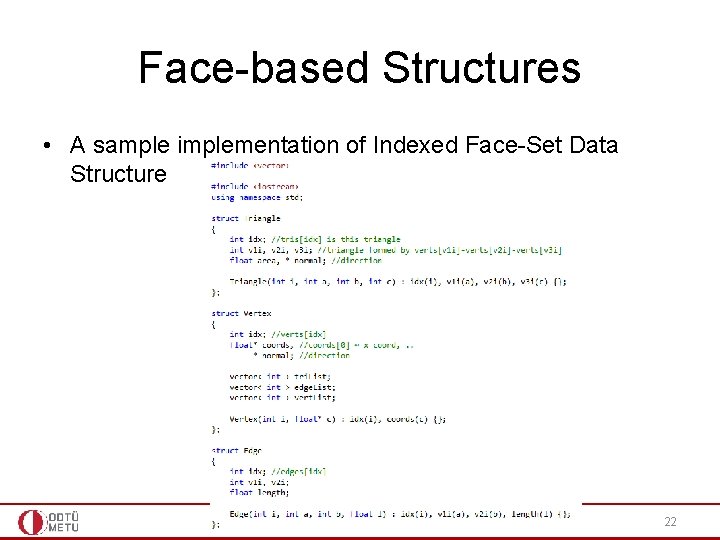
Face-based Structures • A sample implementation of Indexed Face-Set Data Structure CENG 477 – Computer Graphics 22
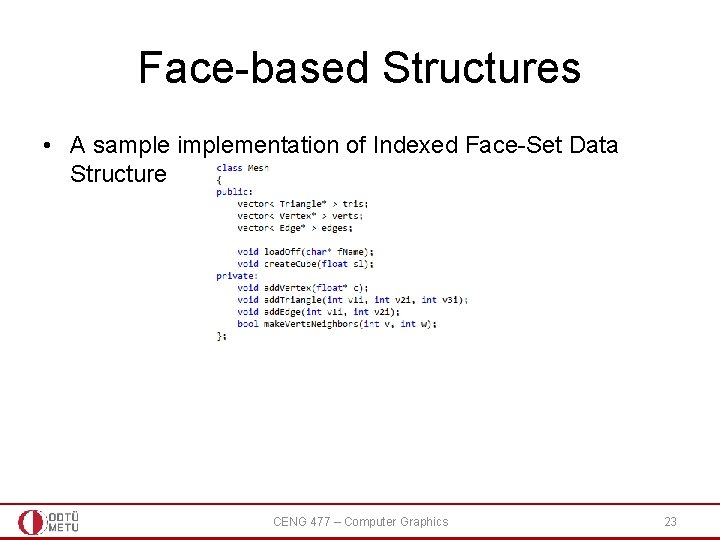
Face-based Structures • A sample implementation of Indexed Face-Set Data Structure CENG 477 – Computer Graphics 23
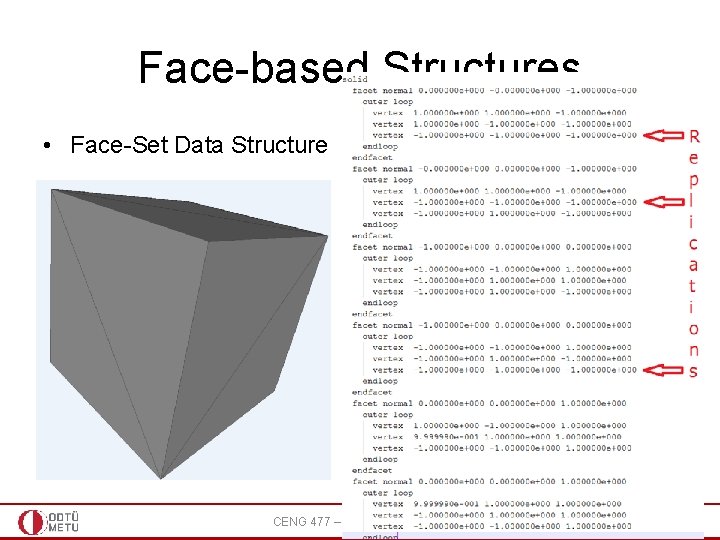
Face-based Structures • Face-Set Data Structure CENG 477 – Computer Graphics 24
Face-based Structures • Indexed Face-Set Data Structure CENG 477 – Computer Graphics 25
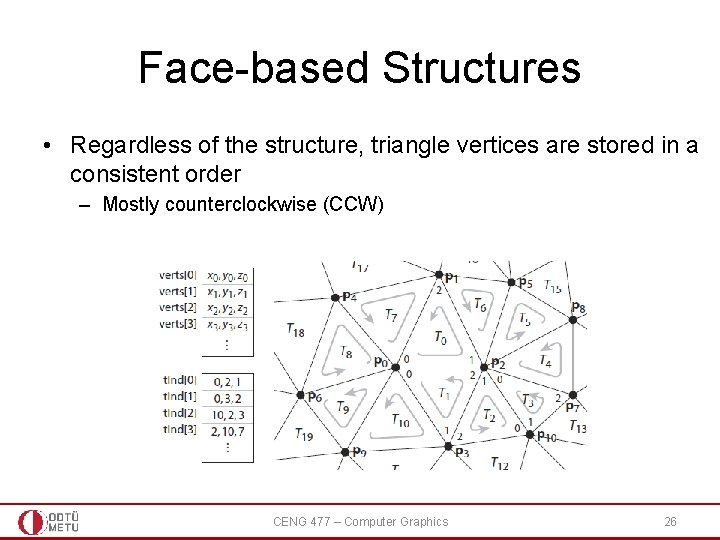
Face-based Structures • Regardless of the structure, triangle vertices are stored in a consistent order – Mostly counterclockwise (CCW) CENG 477 – Computer Graphics 26
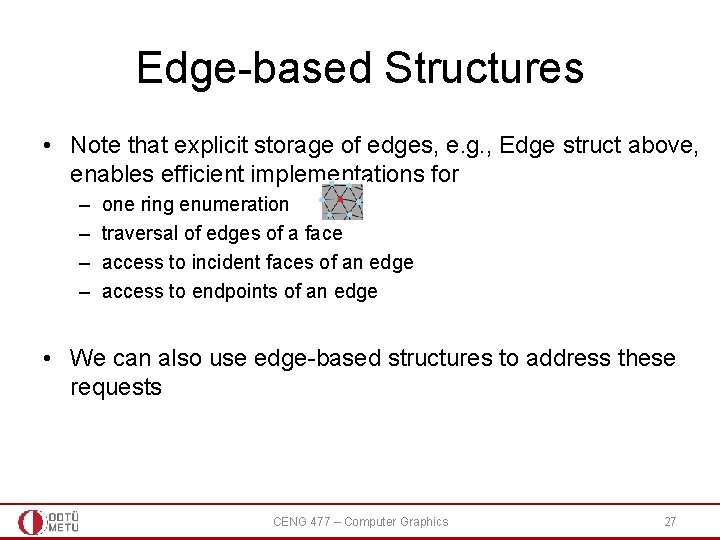
Edge-based Structures • Note that explicit storage of edges, e. g. , Edge struct above, enables efficient implementations for – – one ring enumeration traversal of edges of a face access to incident faces of an edge access to endpoints of an edge • We can also use edge-based structures to address these requests CENG 477 – Computer Graphics 27
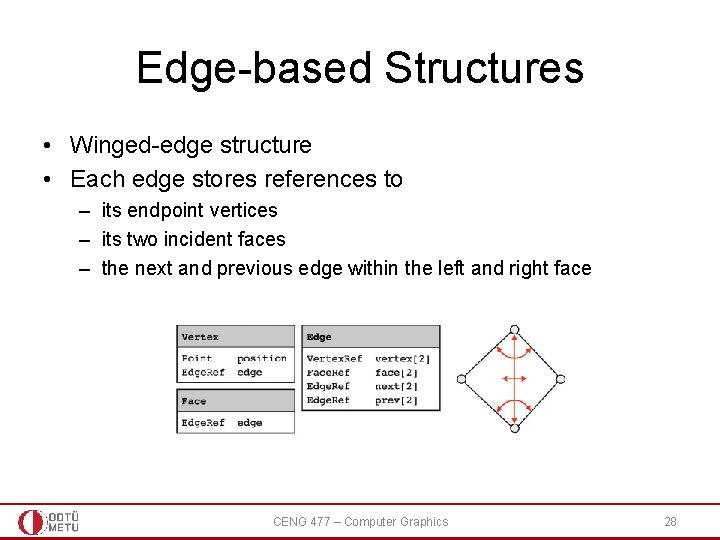
Edge-based Structures • Winged-edge structure • Each edge stores references to – its endpoint vertices – its two incident faces – the next and previous edge within the left and right face CENG 477 – Computer Graphics 28
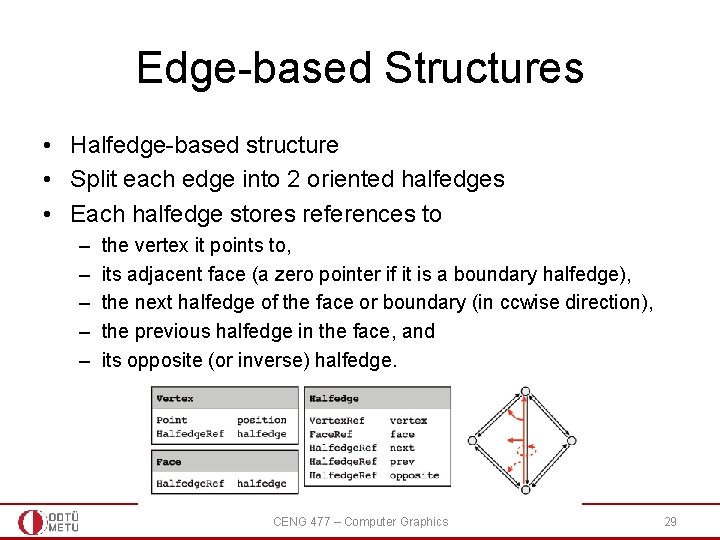
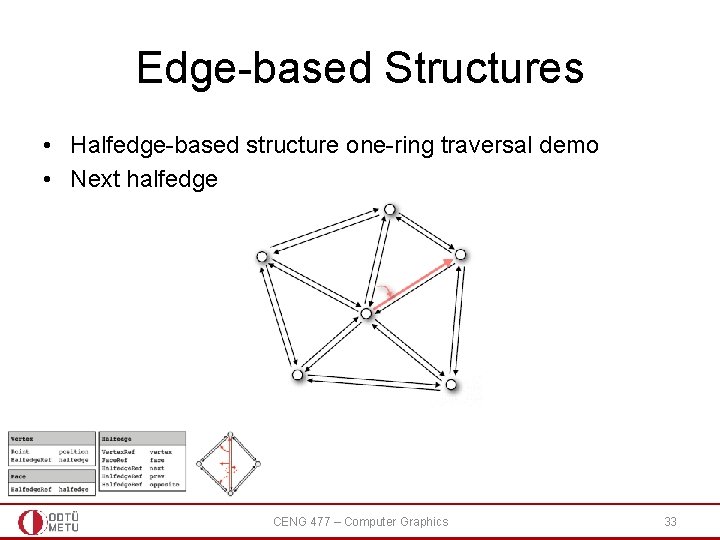
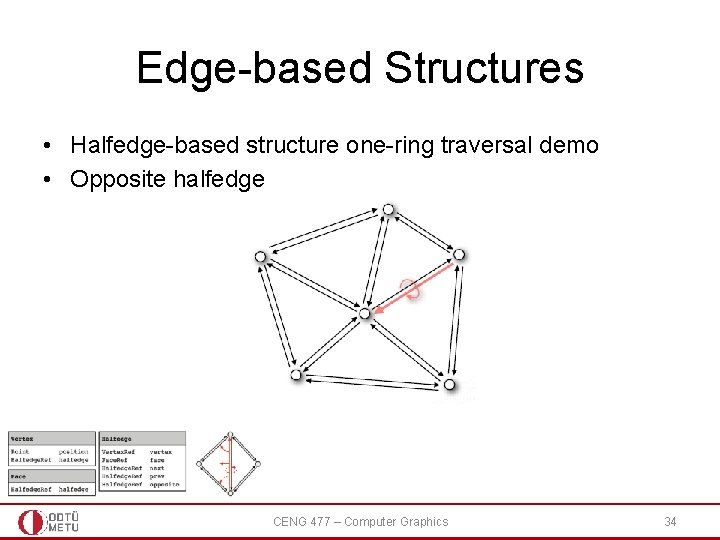
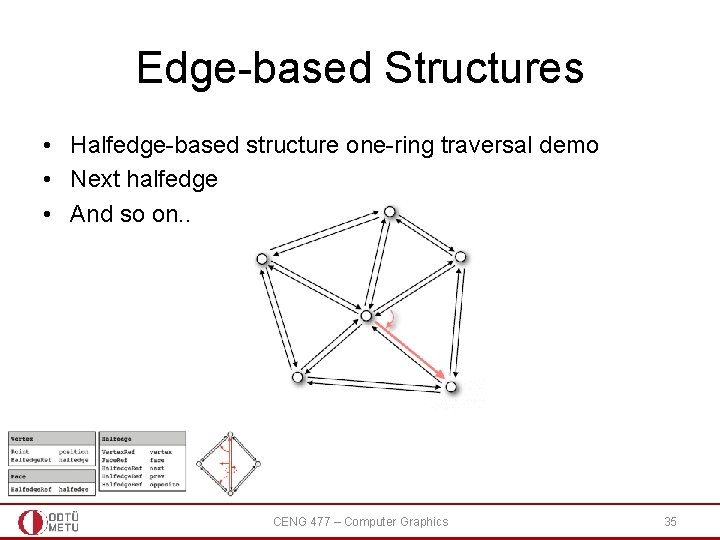
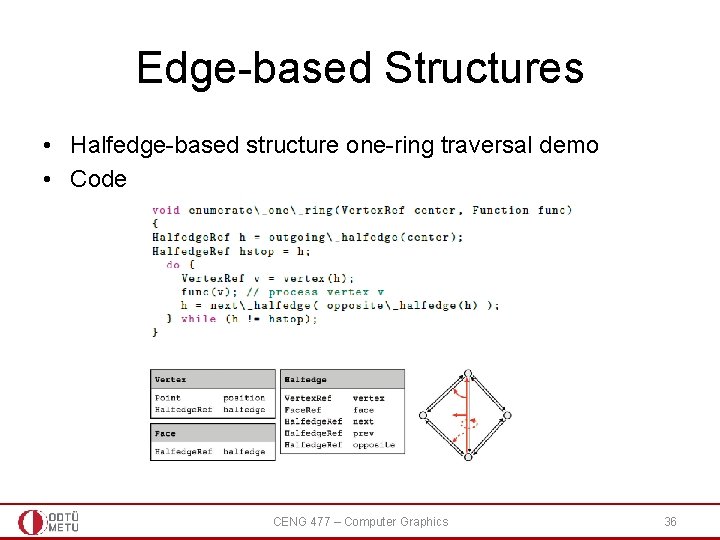
Edge-based Structures • Halfedge-based structure • Split each edge into 2 oriented halfedges • Each halfedge stores references to – – – the vertex it points to, its adjacent face (a zero pointer if it is a boundary halfedge), the next halfedge of the face or boundary (in ccwise direction), the previous halfedge in the face, and its opposite (or inverse) halfedge. CENG 477 – Computer Graphics 29
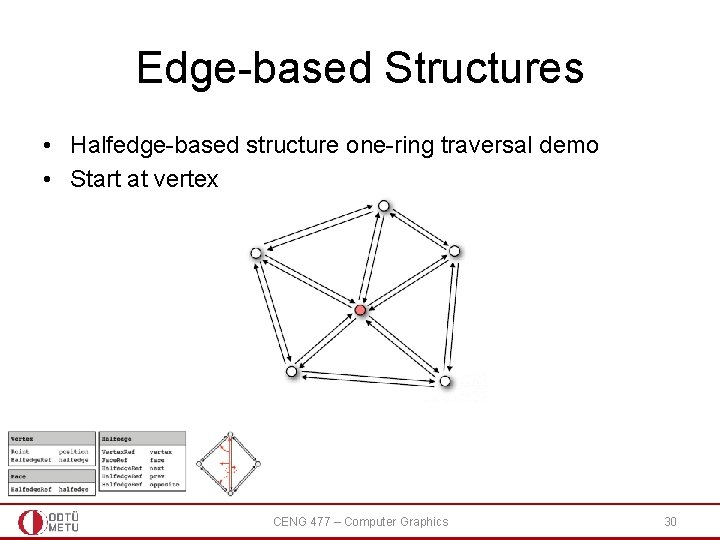
Edge-based Structures • Halfedge-based structure one-ring traversal demo • Start at vertex CENG 477 – Computer Graphics 30
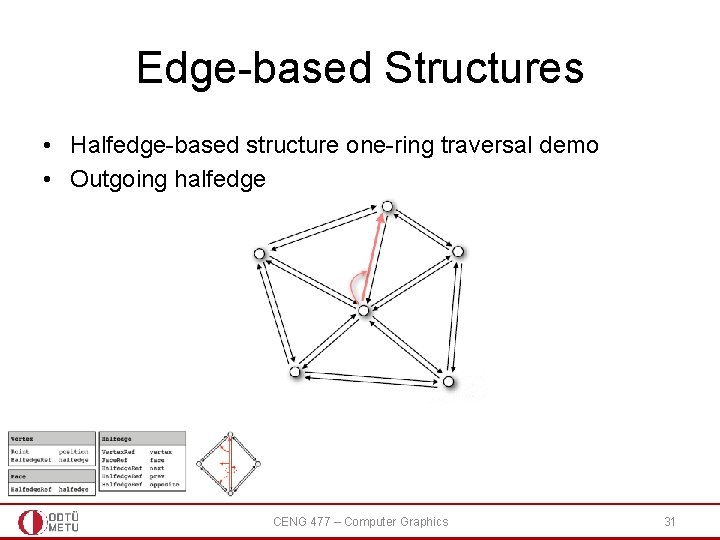
Edge-based Structures • Halfedge-based structure one-ring traversal demo • Outgoing halfedge CENG 477 – Computer Graphics 31
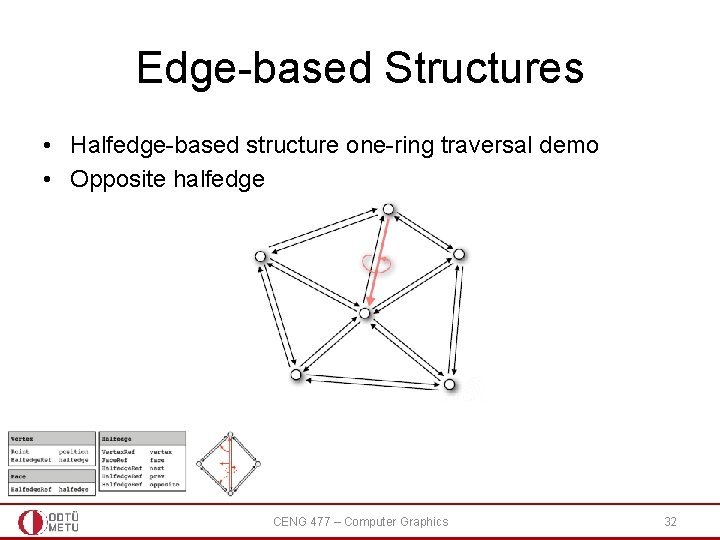
Edge-based Structures • Halfedge-based structure one-ring traversal demo • Opposite halfedge CENG 477 – Computer Graphics 32
Edge-based Structures • Halfedge-based structure one-ring traversal demo • Next halfedge CENG 477 – Computer Graphics 33
Edge-based Structures • Halfedge-based structure one-ring traversal demo • Opposite halfedge CENG 477 – Computer Graphics 34
Edge-based Structures • Halfedge-based structure one-ring traversal demo • Next halfedge • And so on. . CENG 477 – Computer Graphics 35
Edge-based Structures • Halfedge-based structure one-ring traversal demo • Code CENG 477 – Computer Graphics 36
Mesh Structure Libraries • CGAL • Open. Mesh CENG 477 – Computer Graphics 37
Spatial Structures • So far we learnt how to represent shapes explicitly using efficient mesh structures • Now we learn how to represent shapes implicitly using spatial structures • Also we learn how to organize/index shapes in a scene using spatial structures CENG 477 – Computer Graphics 38
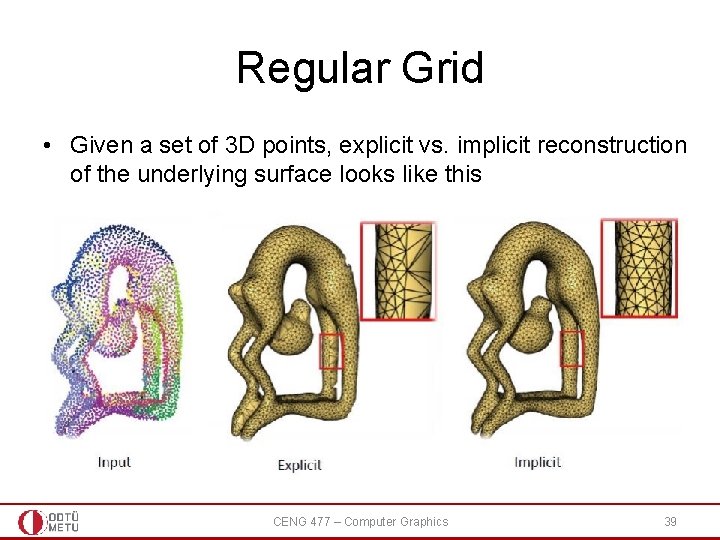
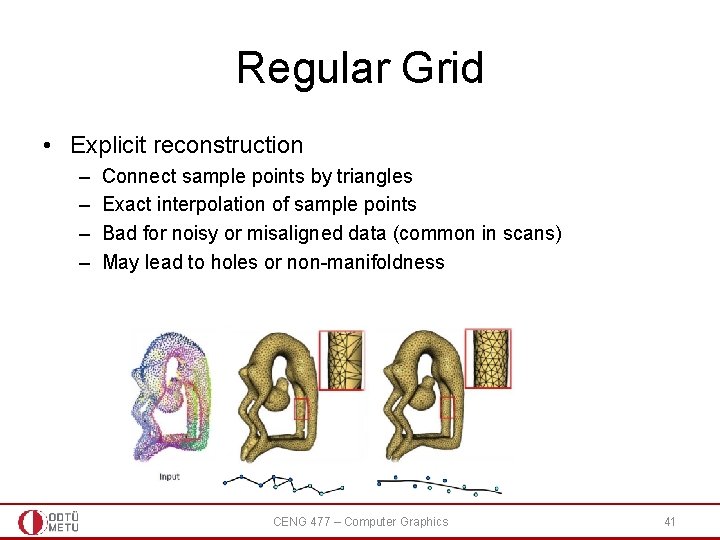
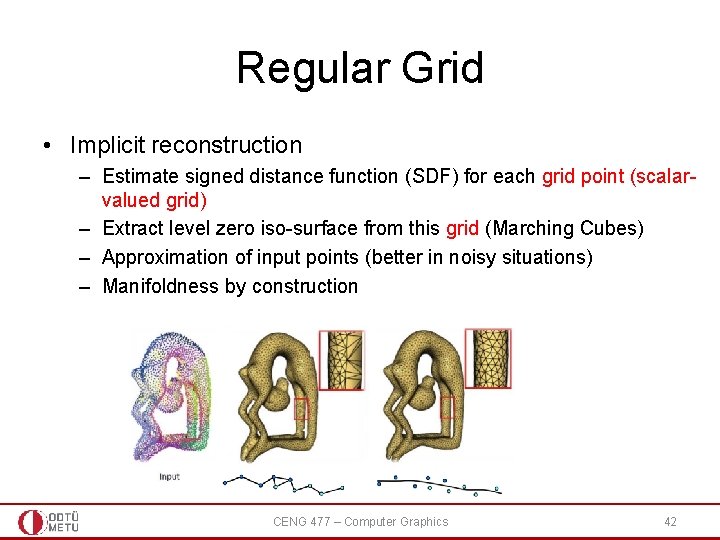
Regular Grid • Given a set of 3 D points, explicit vs. implicit reconstruction of the underlying surface looks like this CENG 477 – Computer Graphics 39
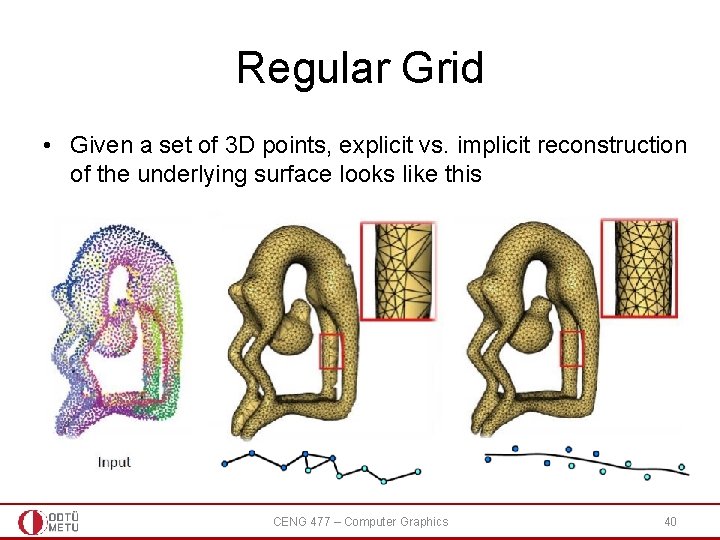
Regular Grid • Given a set of 3 D points, explicit vs. implicit reconstruction of the underlying surface looks like this CENG 477 – Computer Graphics 40
Regular Grid • Explicit reconstruction – – Connect sample points by triangles Exact interpolation of sample points Bad for noisy or misaligned data (common in scans) May lead to holes or non-manifoldness CENG 477 – Computer Graphics 41
Regular Grid • Implicit reconstruction – Estimate signed distance function (SDF) for each grid point (scalarvalued grid) – Extract level zero iso-surface from this grid (Marching Cubes) – Approximation of input points (better in noisy situations) – Manifoldness by construction CENG 477 – Computer Graphics 42
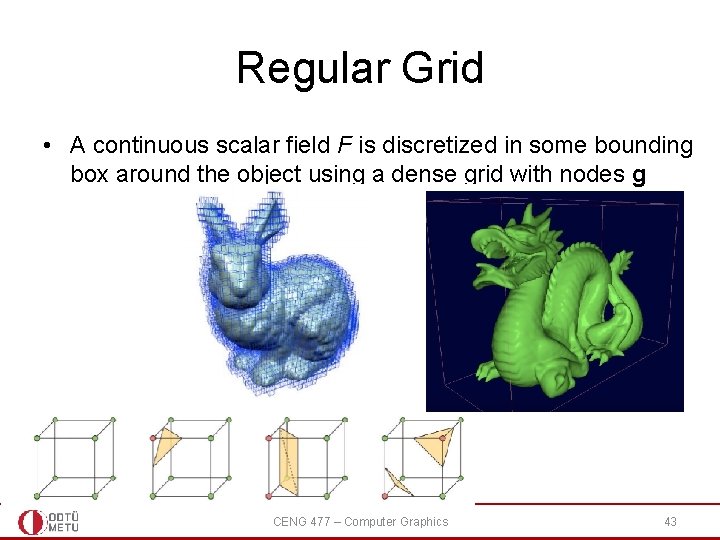
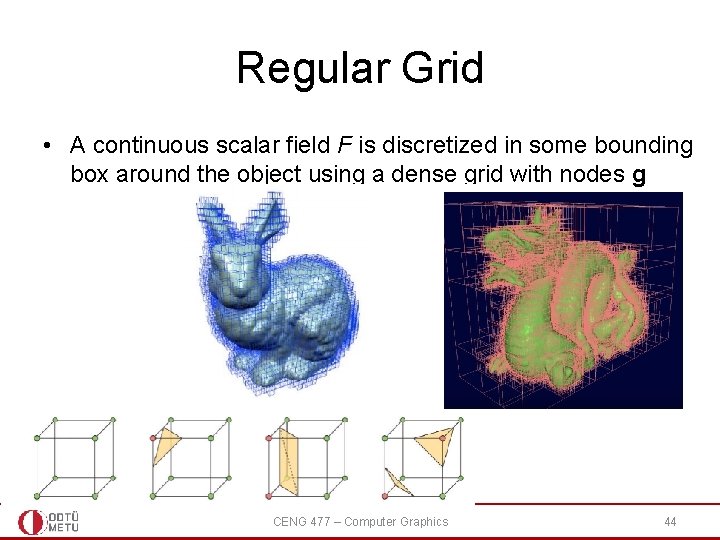
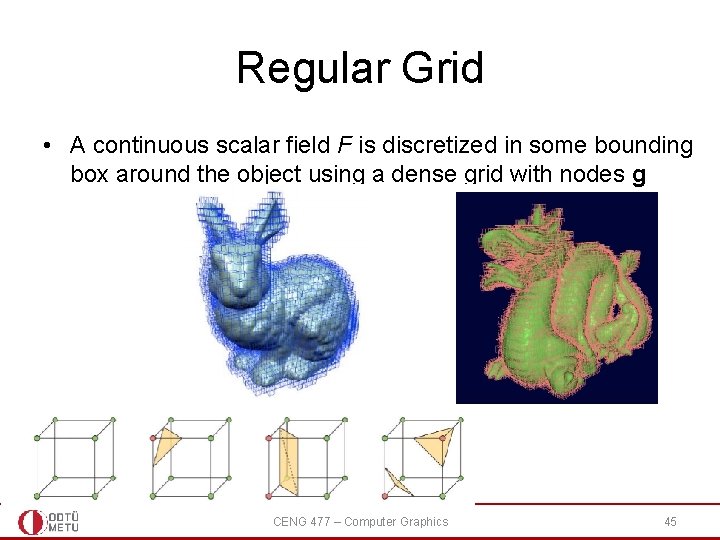
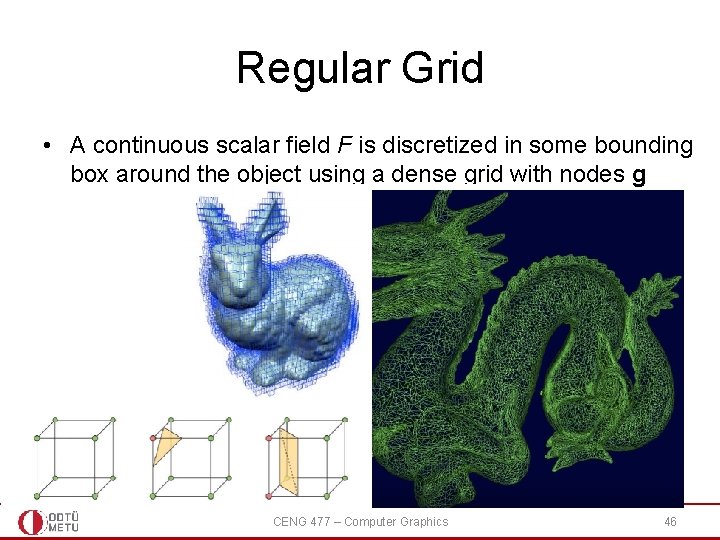
Regular Grid • A continuous scalar field F is discretized in some bounding box around the object using a dense grid with nodes g CENG 477 – Computer Graphics 43
Regular Grid • A continuous scalar field F is discretized in some bounding box around the object using a dense grid with nodes g CENG 477 – Computer Graphics 44
Regular Grid • A continuous scalar field F is discretized in some bounding box around the object using a dense grid with nodes g CENG 477 – Computer Graphics 45
Regular Grid • A continuous scalar field F is discretized in some bounding box around the object using a dense grid with nodes g CENG 477 – Computer Graphics 46
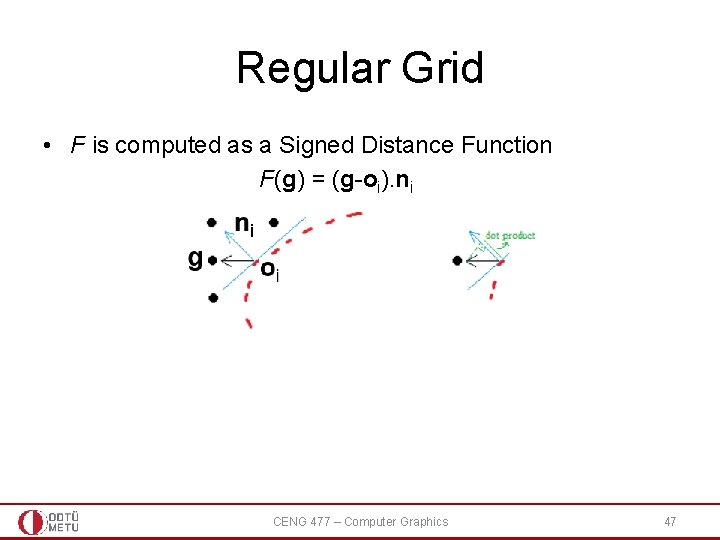
Regular Grid • F is computed as a Signed Distance Function F(g) = (g-oi). ni CENG 477 – Computer Graphics 47
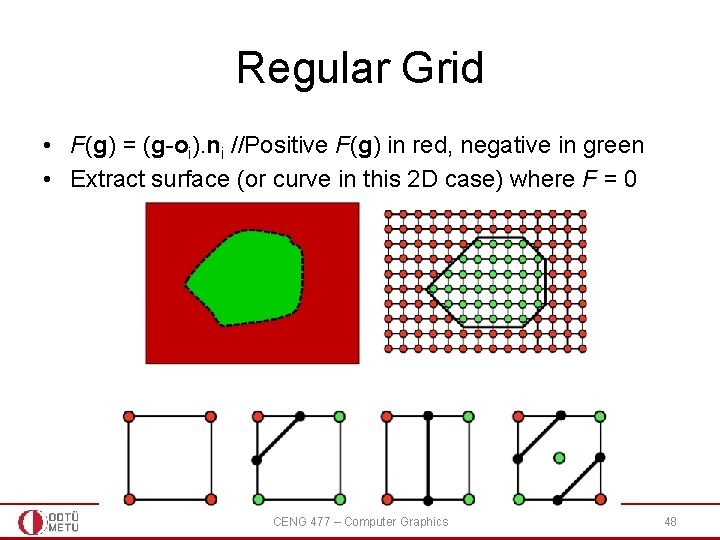
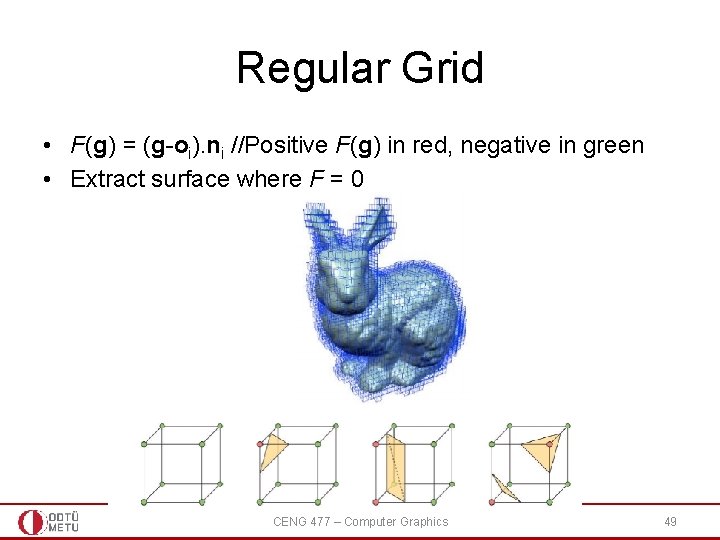
Regular Grid • F(g) = (g-oi). ni //Positive F(g) in red, negative in green • Extract surface (or curve in this 2 D case) where F = 0 CENG 477 – Computer Graphics 48
Regular Grid • F(g) = (g-oi). ni //Positive F(g) in red, negative in green • Extract surface where F = 0 CENG 477 – Computer Graphics 49
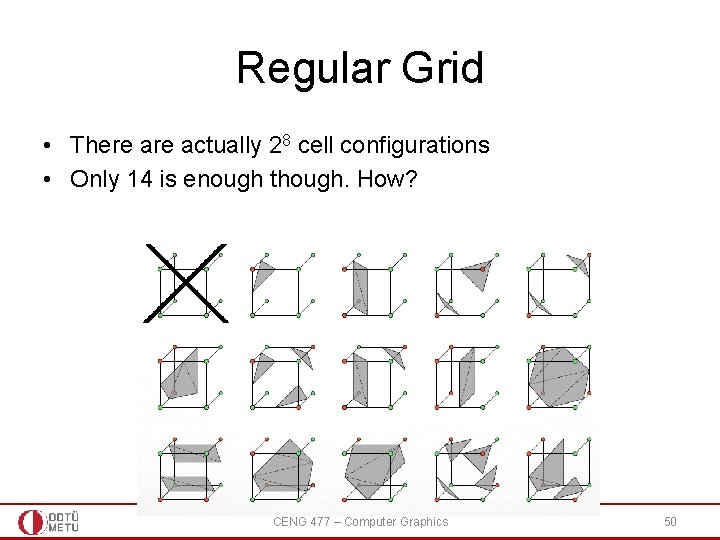
Regular Grid • There actually 28 cell configurations • Only 14 is enough though. How? CENG 477 – Computer Graphics 50
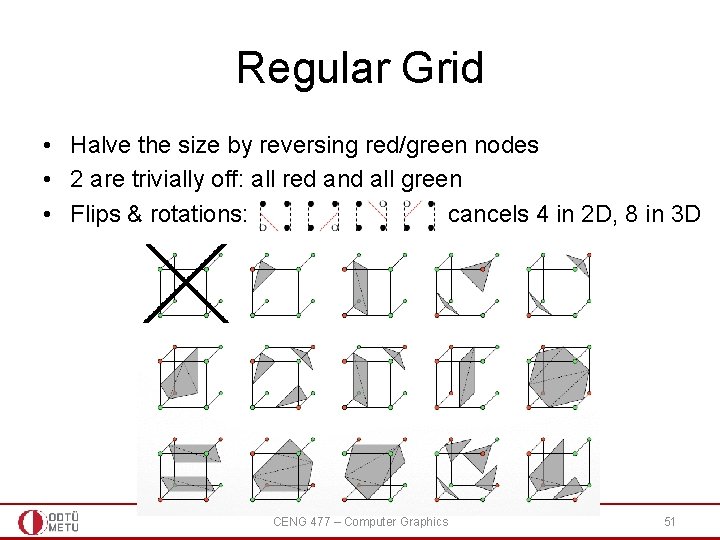
Regular Grid • Halve the size by reversing red/green nodes • 2 are trivially off: all red and all green • Flips & rotations: cancels 4 in 2 D, 8 in 3 D CENG 477 – Computer Graphics 51
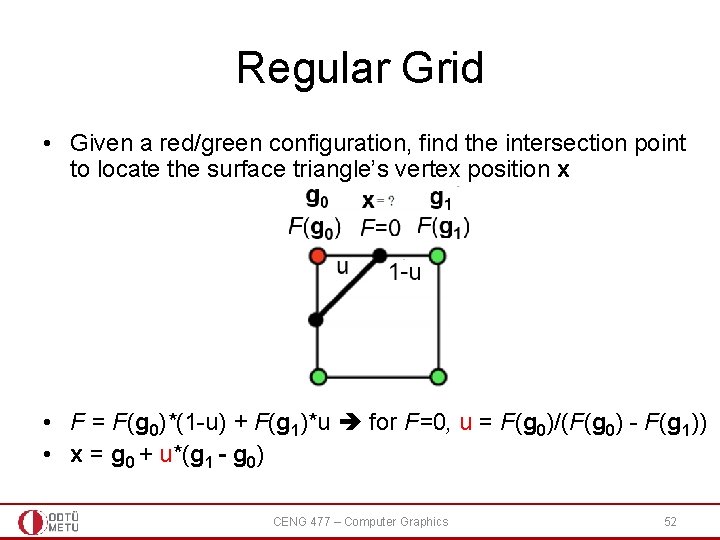
Regular Grid • Given a red/green configuration, find the intersection point to locate the surface triangle’s vertex position x • F = F(g 0)*(1 -u) + F(g 1)*u for F=0, u = F(g 0)/(F(g 0) - F(g 1)) • x = g 0 + u*(g 1 - g 0) CENG 477 – Computer Graphics 52
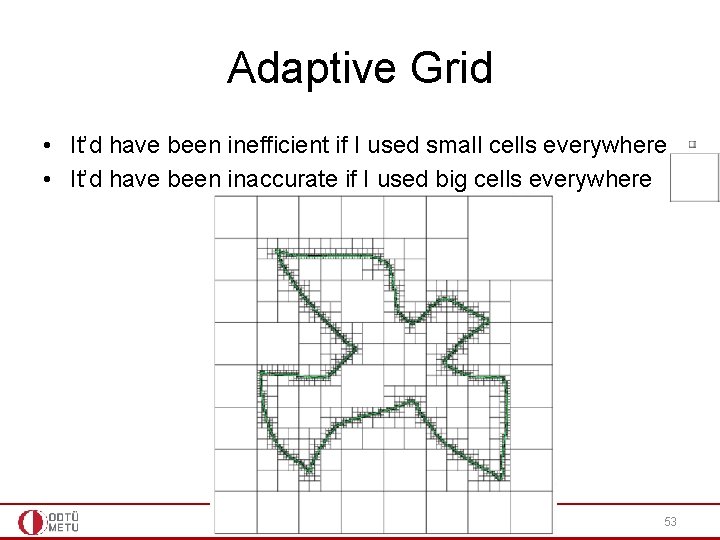
Adaptive Grid • It’d have been inefficient if I used small cells everywhere • It’d have been inaccurate if I used big cells everywhere CENG 477 – Computer Graphics 53
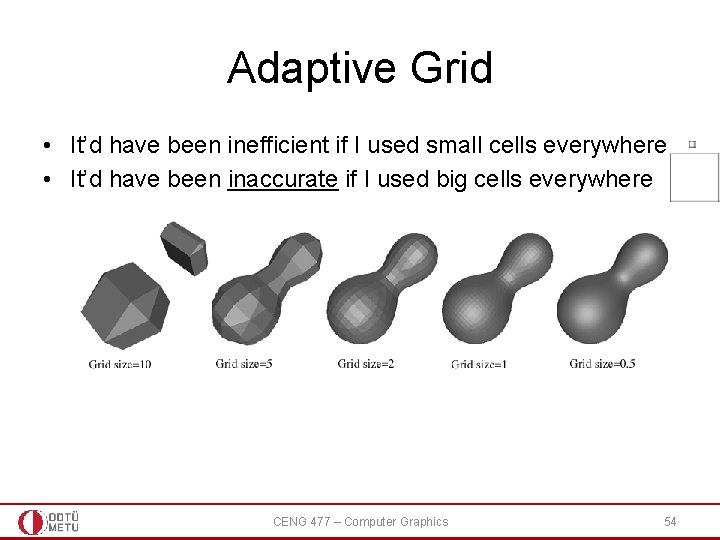
Adaptive Grid • It’d have been inefficient if I used small cells everywhere • It’d have been inaccurate if I used big cells everywhere CENG 477 – Computer Graphics 54
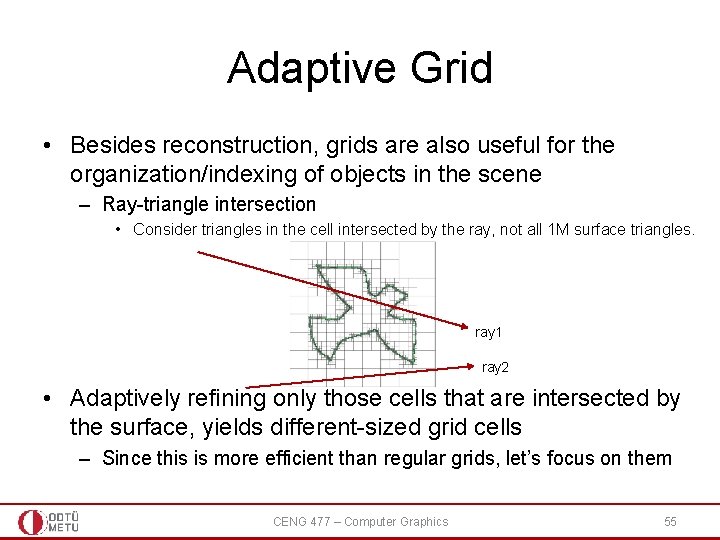
Adaptive Grid • Besides reconstruction, grids are also useful for the organization/indexing of objects in the scene – Ray-triangle intersection • Consider triangles in the cell intersected by the ray, not all 1 M surface triangles. ray 1 ray 2 • Adaptively refining only those cells that are intersected by the surface, yields different-sized grid cells – Since this is more efficient than regular grids, let’s focus on them CENG 477 – Computer Graphics 55
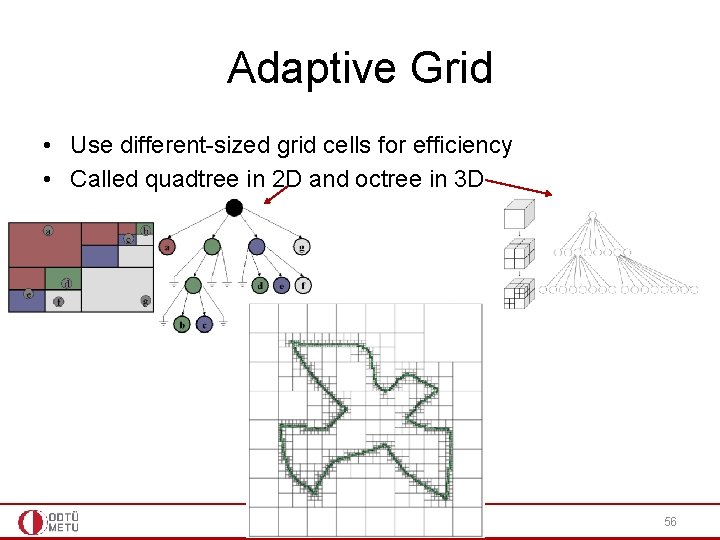
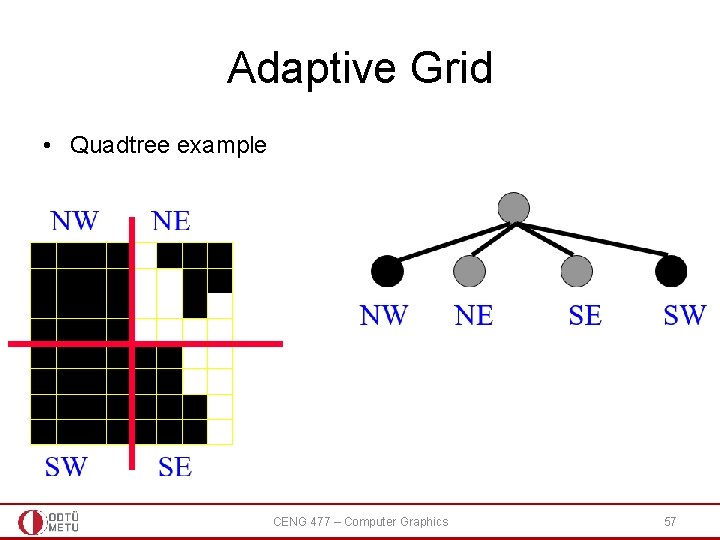
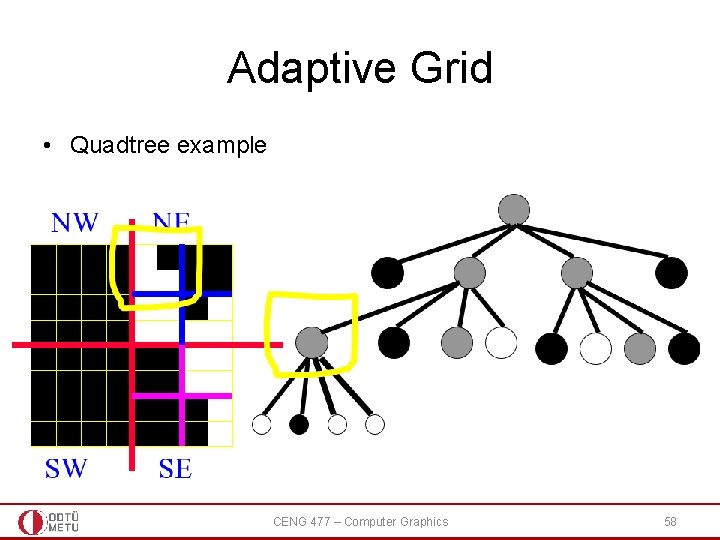
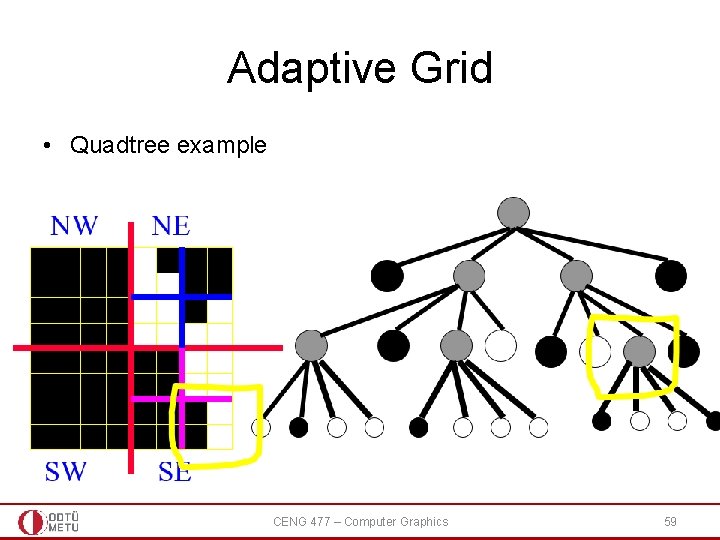
Adaptive Grid • Use different-sized grid cells for efficiency • Called quadtree in 2 D and octree in 3 D CENG 477 – Computer Graphics 56
Adaptive Grid • Quadtree example CENG 477 – Computer Graphics 57
Adaptive Grid • Quadtree example CENG 477 – Computer Graphics 58
Adaptive Grid • Quadtree example CENG 477 – Computer Graphics 59
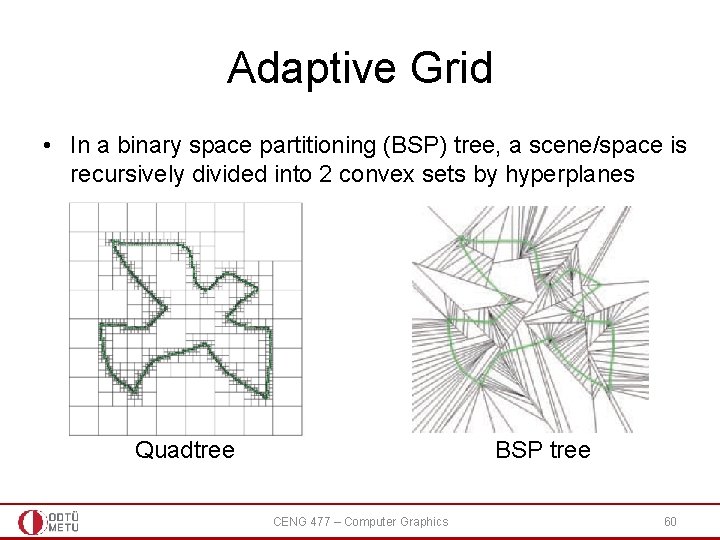
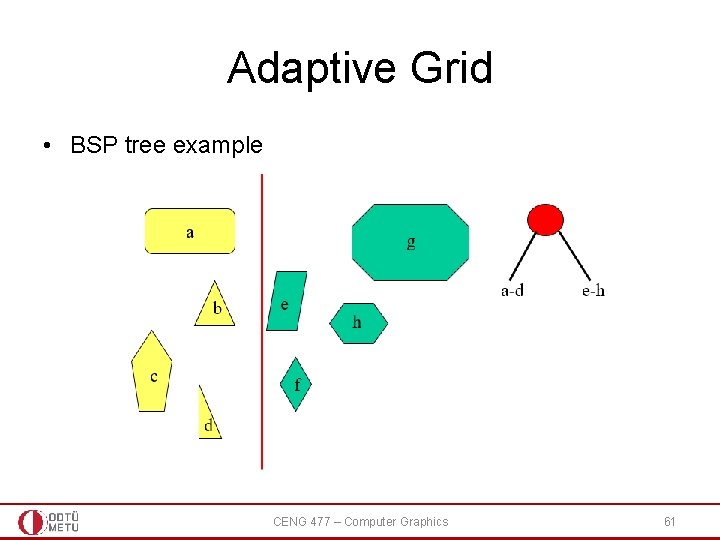
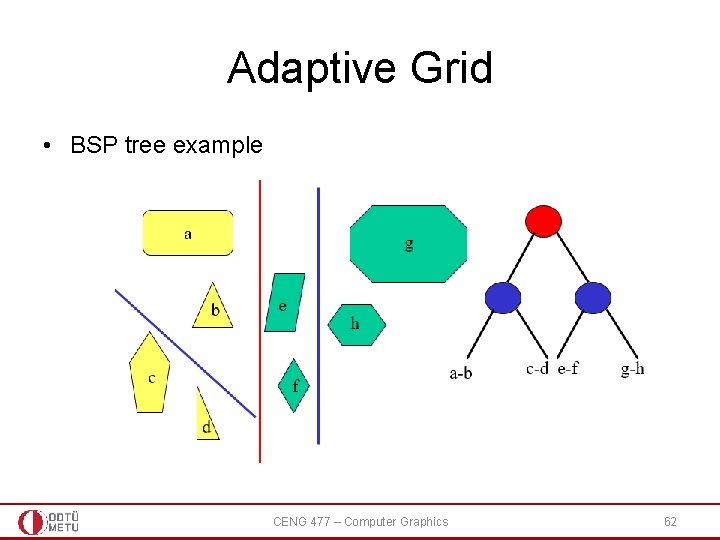
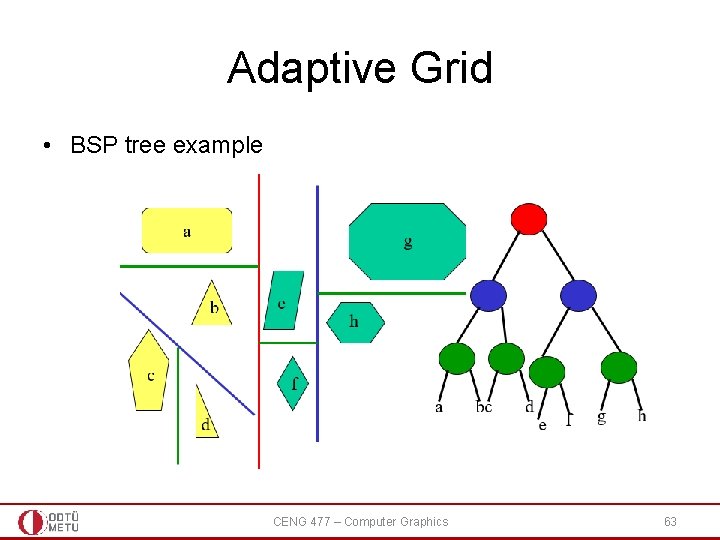
Adaptive Grid • In a binary space partitioning (BSP) tree, a scene/space is recursively divided into 2 convex sets by hyperplanes Quadtree BSP tree CENG 477 – Computer Graphics 60
Adaptive Grid • BSP tree example CENG 477 – Computer Graphics 61
Adaptive Grid • BSP tree example CENG 477 – Computer Graphics 62
Adaptive Grid • BSP tree example CENG 477 – Computer Graphics 63
Adaptive Grid • In a k-d tree, a scene/space is recursively divided into 2 convex sets by axis-aligned hyperplanes, a special case of BSP tree CENG 477 – Computer Graphics 64
Adaptive Grid • In a k-d tree, each node has 2 children – Unlike quadtree (up to 4 children) and octree (up to 8 children) CENG 477 – Computer Graphics 65
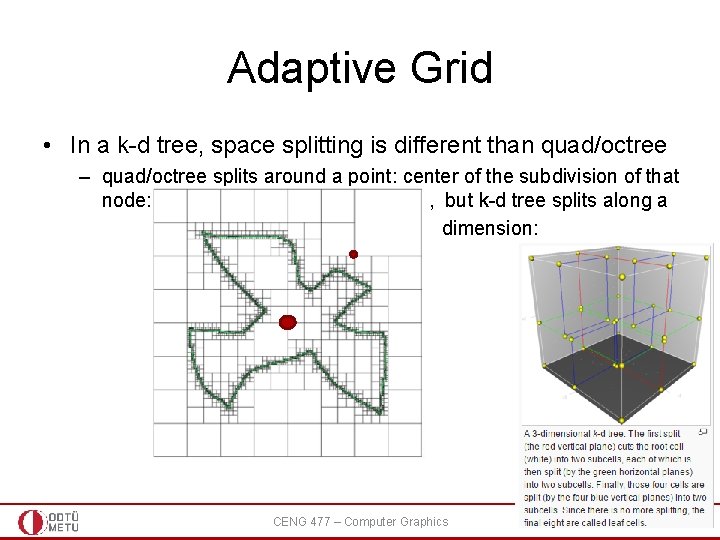
Adaptive Grid • In a k-d tree, space splitting is different than quad/octree – quad/octree splits around a point: center of the subdivision of that node: , but k-d tree splits along a dimension: CENG 477 – Computer Graphics 66
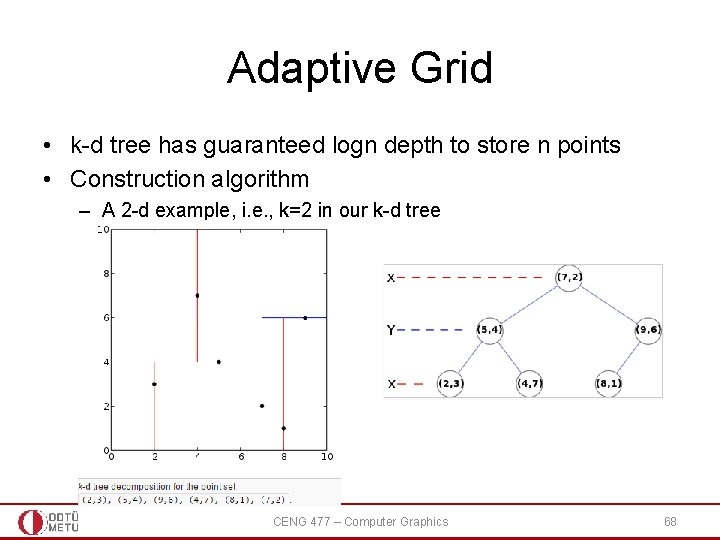
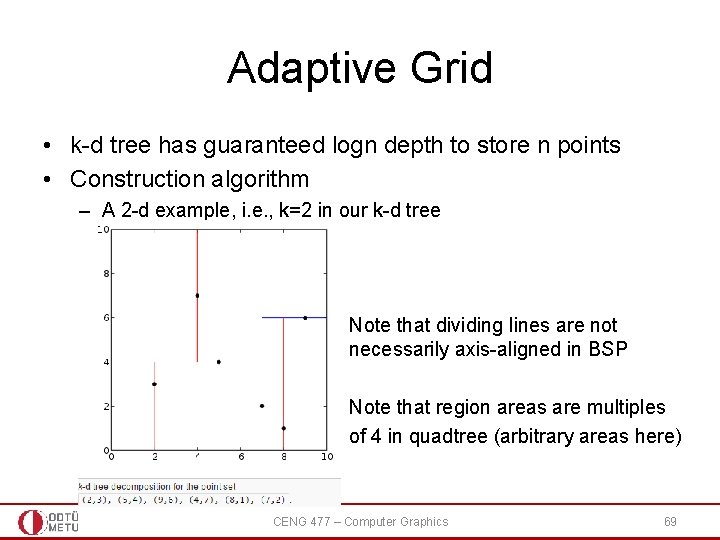
Adaptive Grid • k-d tree has guaranteed logn depth to store n points • Construction algorithm – If there is just one point/object, form a leaf with that point – Else, divide the points by a line perpendicular to one of the axes; dividing line passes through the median of the region points • Every time you go down in tree, change decision-making dimension to the next CENG 477 – Computer Graphics 67
Adaptive Grid • k-d tree has guaranteed logn depth to store n points • Construction algorithm – A 2 -d example, i. e. , k=2 in our k-d tree CENG 477 – Computer Graphics 68
Adaptive Grid • k-d tree has guaranteed logn depth to store n points • Construction algorithm – A 2 -d example, i. e. , k=2 in our k-d tree • Note that dividing lines are not necessarily axis-aligned in BSP • Note that region areas are multiples • of 4 in quadtree (arbitrary areas here) CENG 477 – Computer Graphics 69
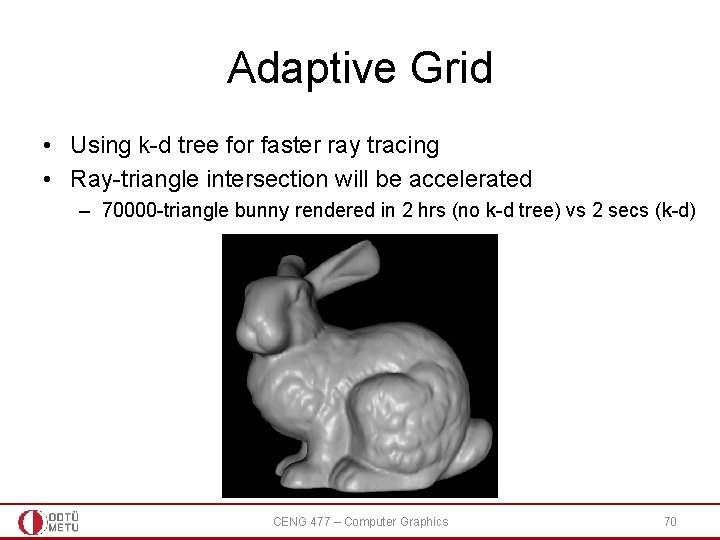
Adaptive Grid • Using k-d tree for faster ray tracing • Ray-triangle intersection will be accelerated – 70000 -triangle bunny rendered in 2 hrs (no k-d tree) vs 2 secs (k-d) CENG 477 – Computer Graphics 70
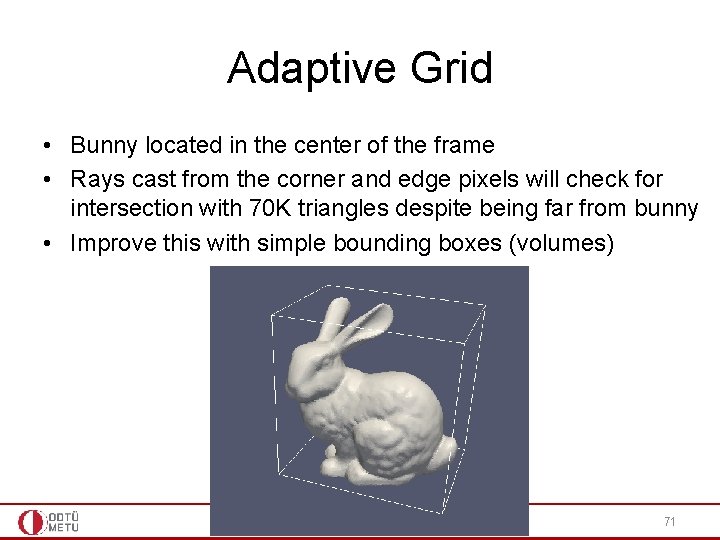
Adaptive Grid • Bunny located in the center of the frame • Rays cast from the corner and edge pixels will check for intersection with 70 K triangles despite being far from bunny • Improve this with simple bounding boxes (volumes) CENG 477 – Computer Graphics 71
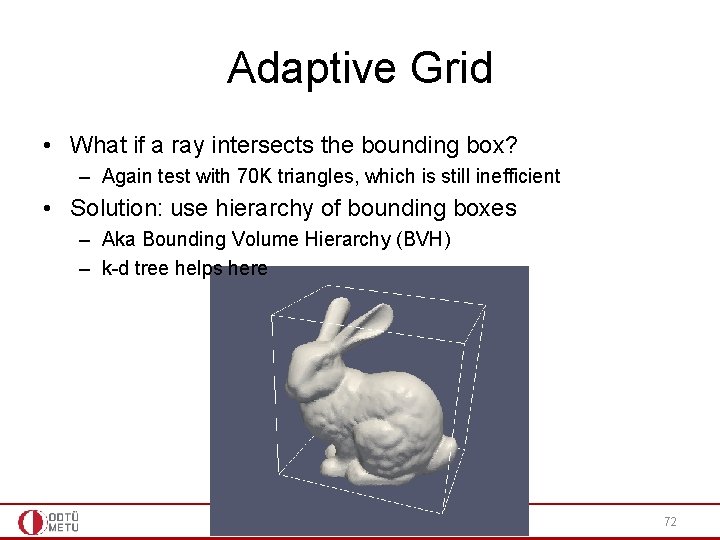
Adaptive Grid • What if a ray intersects the bounding box? – Again test with 70 K triangles, which is still inefficient • Solution: use hierarchy of bounding boxes – Aka Bounding Volume Hierarchy (BVH) – k-d tree helps here 72
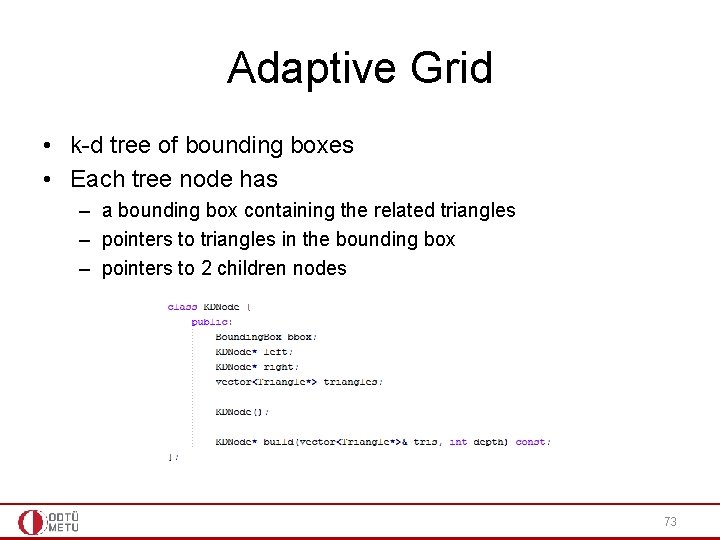
Adaptive Grid • k-d tree of bounding boxes • Each tree node has – a bounding box containing the related triangles – pointers to triangles in the bounding box – pointers to 2 children nodes 73
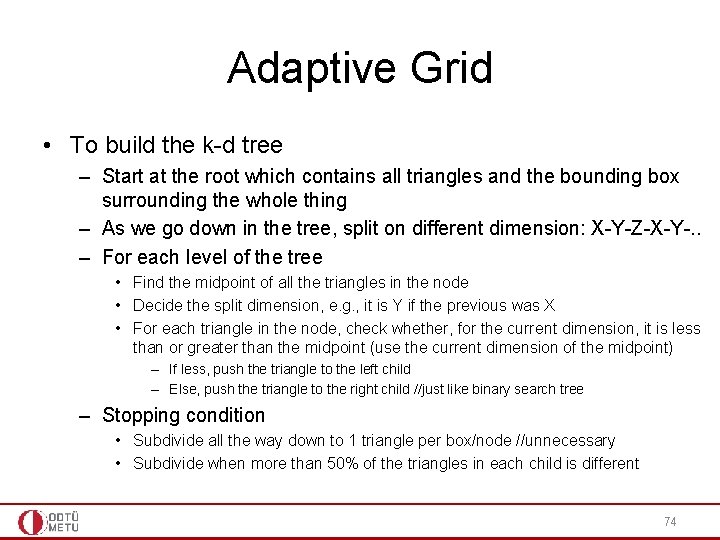
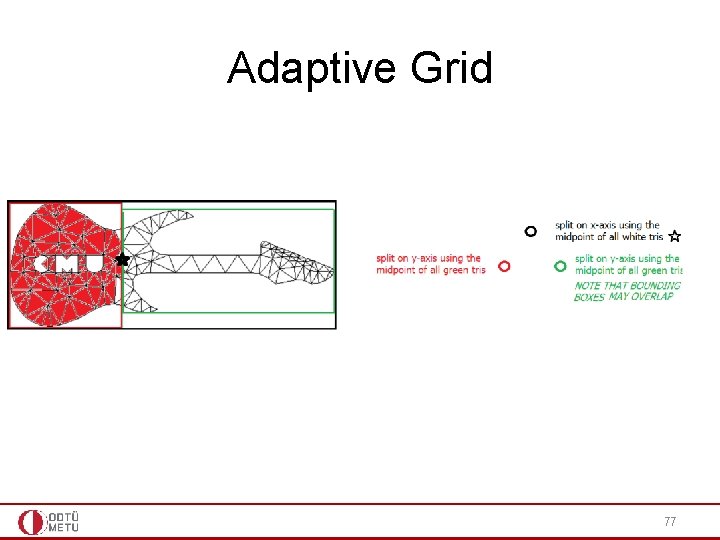
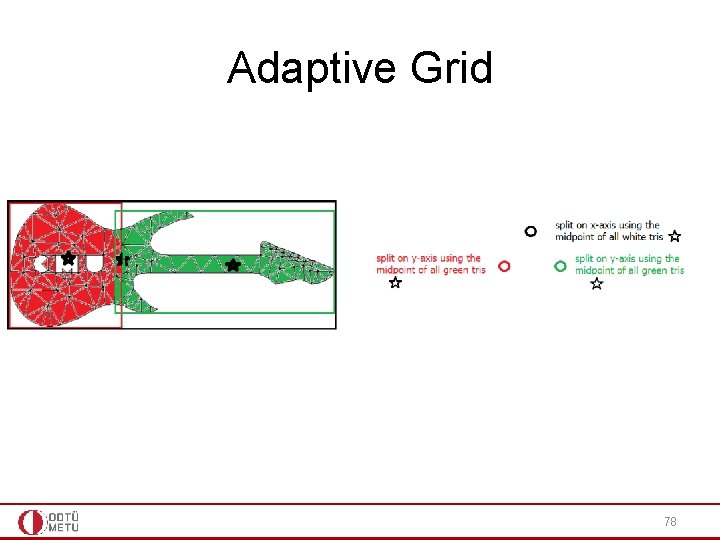
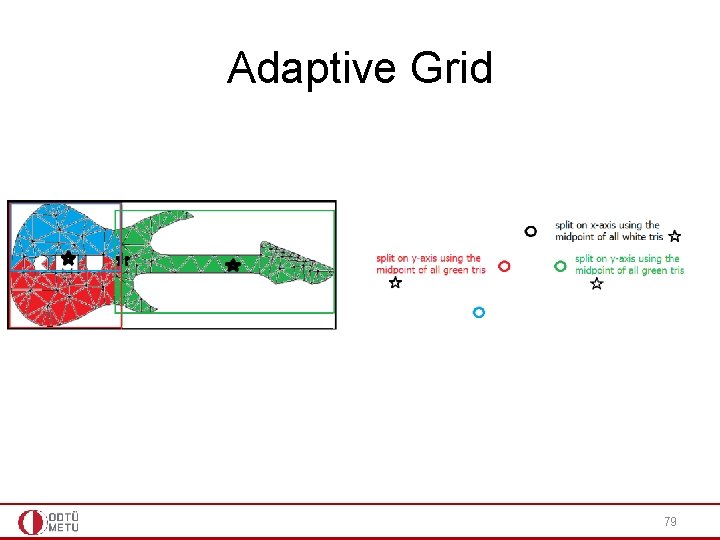
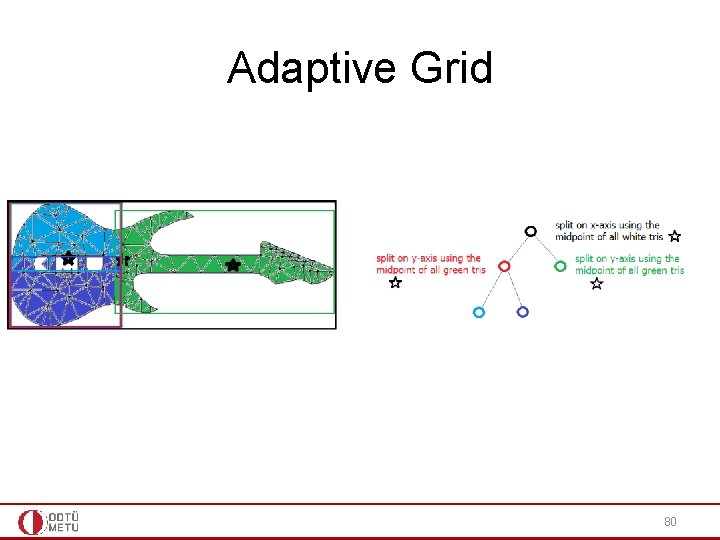
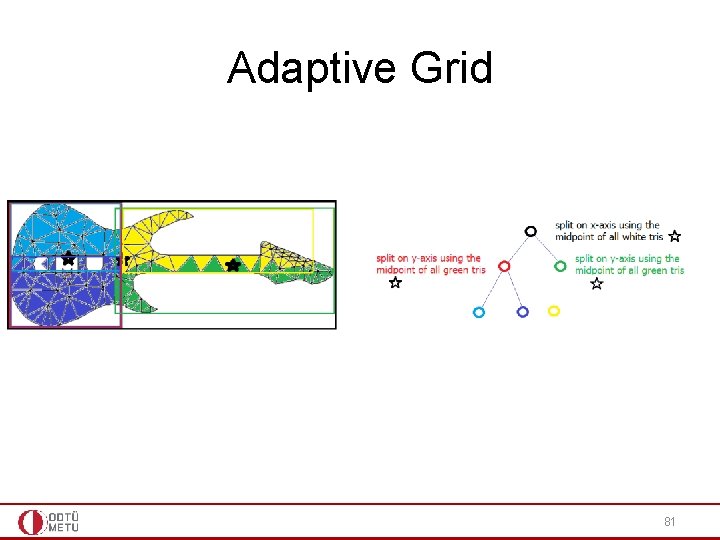
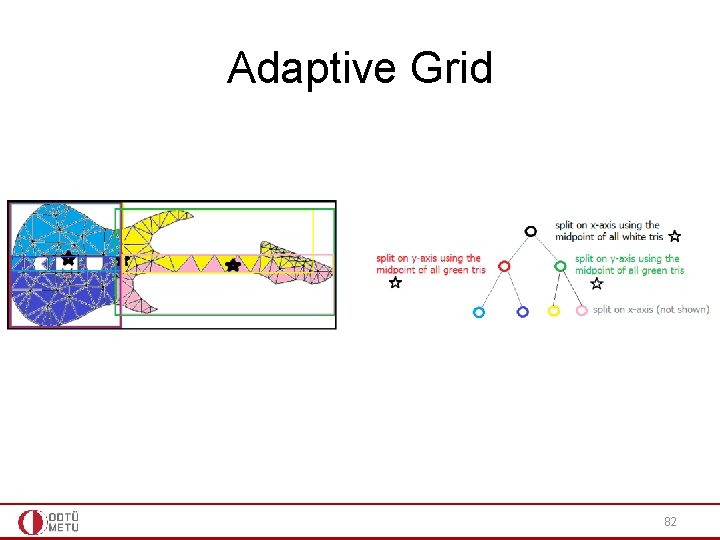
Adaptive Grid • To build the k-d tree – Start at the root which contains all triangles and the bounding box surrounding the whole thing – As we go down in the tree, split on different dimension: X-Y-Z-X-Y-. . – For each level of the tree • Find the midpoint of all the triangles in the node • Decide the split dimension, e. g. , it is Y if the previous was X • For each triangle in the node, check whether, for the current dimension, it is less than or greater than the midpoint (use the current dimension of the midpoint) – If less, push the triangle to the left child – Else, push the triangle to the right child //just like binary search tree – Stopping condition • Subdivide all the way down to 1 triangle per box/node //unnecessary • Subdivide when more than 50% of the triangles in each child is different 74
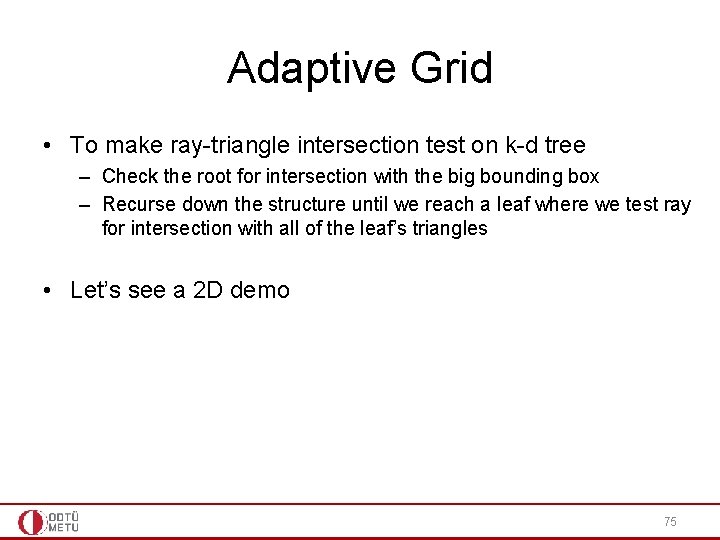
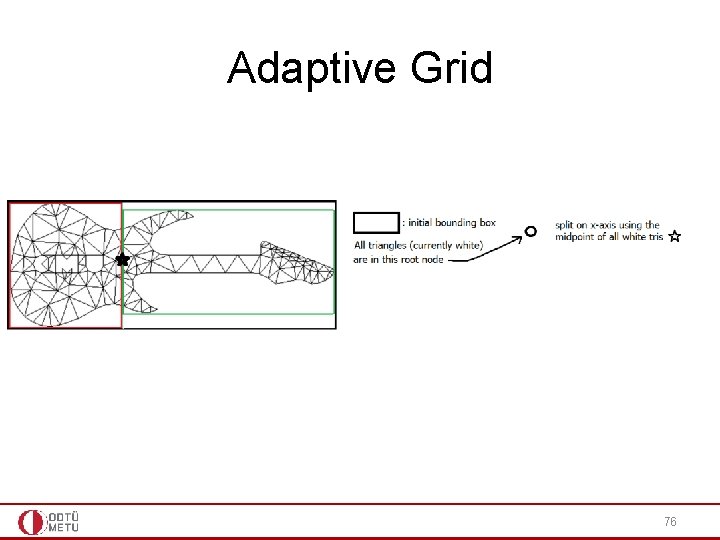
Adaptive Grid • To make ray-triangle intersection test on k-d tree – Check the root for intersection with the big bounding box – Recurse down the structure until we reach a leaf where we test ray for intersection with all of the leaf’s triangles • Let’s see a 2 D demo 75
Adaptive Grid 76
Adaptive Grid 77
Adaptive Grid 78
Adaptive Grid 79
Adaptive Grid 80
Adaptive Grid 81
Adaptive Grid 82
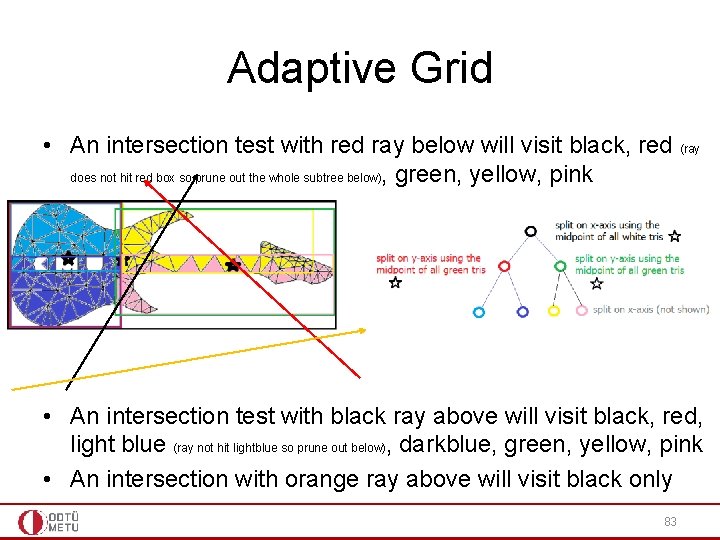
Adaptive Grid • An intersection test with red ray below will visit black, red (ray does not hit red box so prune out the whole subtree below), green, yellow, pink • An intersection test with black ray above will visit black, red, light blue (ray not hit lightblue so prune out below), darkblue, green, yellow, pink • An intersection with orange ray above will visit black only 83
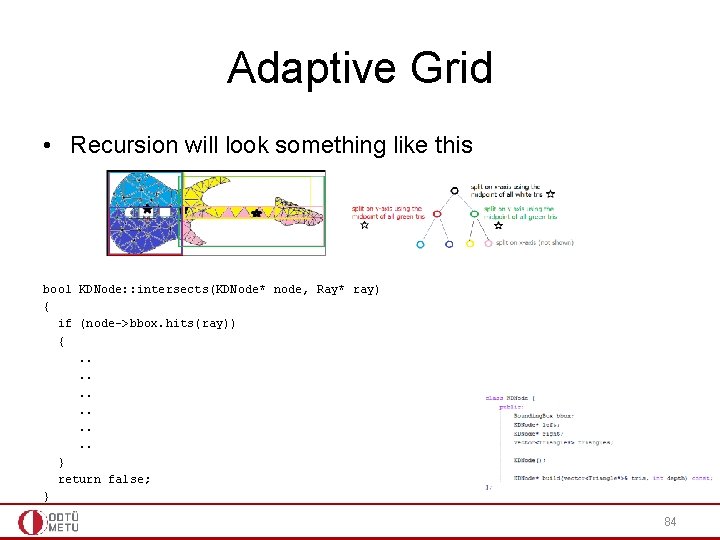
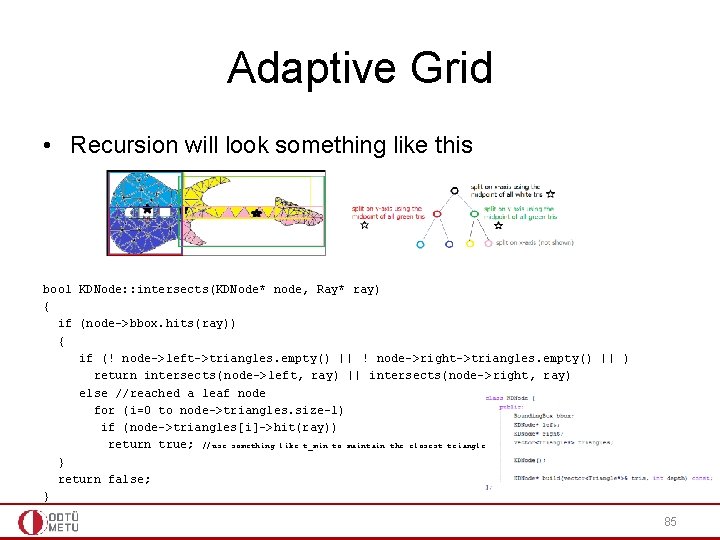
Adaptive Grid • Recursion will look something like this bool KDNode: : intersects(KDNode* node, Ray* ray) { if (node->bbox. hits(ray)) {. . . } return false; } 84
Adaptive Grid • Recursion will look something like this bool KDNode: : intersects(KDNode* node, Ray* ray) { if (node->bbox. hits(ray)) { if (! node->left->triangles. empty() || ! node->right->triangles. empty() || ) return intersects( node->left, ray) || intersects(node->right, ray) else //reached a leaf node for (i=0 to node->triangles. size-1) if (node->triangles[i]->hit(ray)) return true; //use something like t_min to maintain the closest triangle } return false; } 85
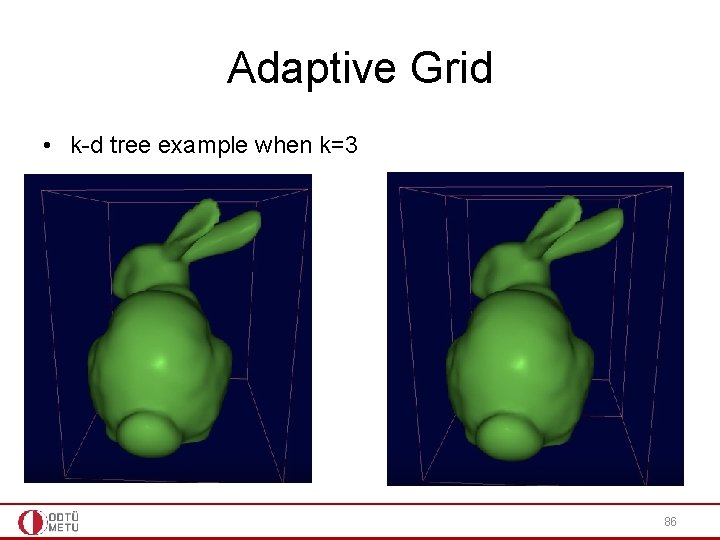
Adaptive Grid • k-d tree example when k=3 86
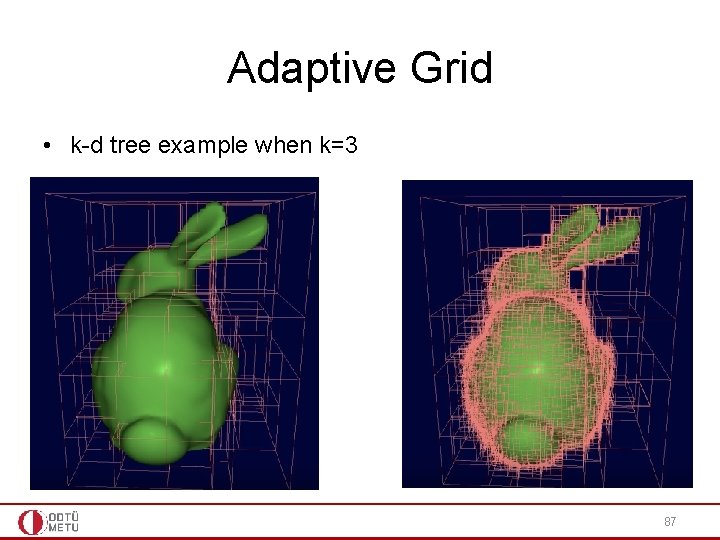
Adaptive Grid • k-d tree example when k=3 87