
CEN 352 Digital Signal Processing BY DR ANWAR
CEN 352 Digital Signal Processing BY DR. ANWAR M. MIRZA ﺍﻧﻮﺭ ﻣﺠﻴﺪ ﻣﻴﺮﺯﺍ / ﺍﻟﺪﻛﺘﻮﺭ Office No. 2185 Phone: 4697362 anwar. m. mirza@gmail. com or ammirza@ksu. edu. sa Lecture No. 6 Department of Computer Engineering, College of Computer and Information Sciences, King Saud University, Riyadh, Kingdom of Saudi Arabia September 24 th, 2012
Quantization �A digital signal is a sequence of numbers (samples) in which each number is represented by a finite number of digits (finite precision i. e. finite number of digits). � The process of converting a discrete-time continuous-amplitude signal into a digital signal by expressing each sample value as a finite (instead of an infinite) number of digits is called quantization � The error introduced in representing the continuous -valued signal by a finite set of discrete value levels is called quantization error or quantization noise 2
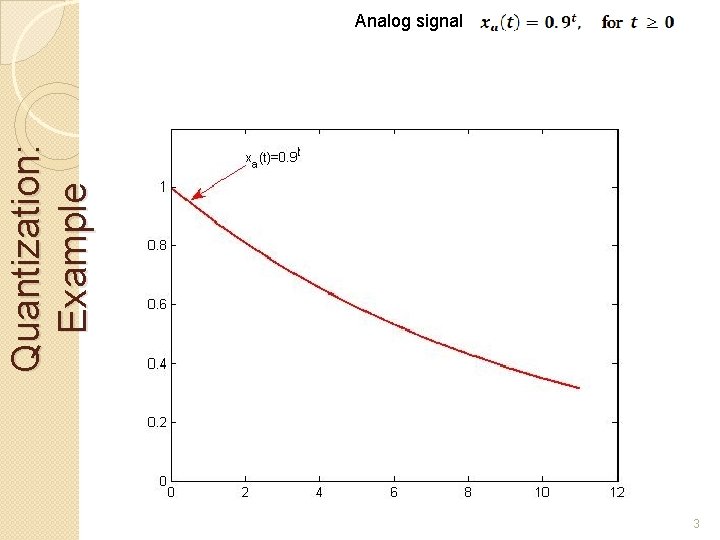
Quantization: Example Analog signal 3
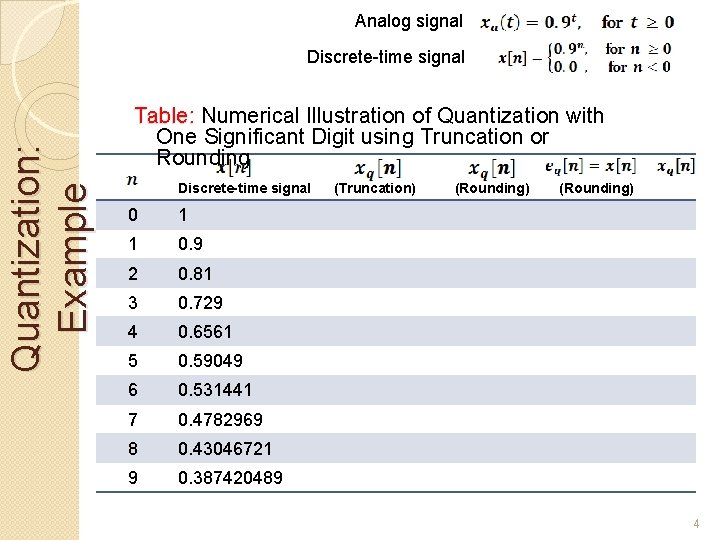
Analog signal Quantization: Example Discrete-time signal Table: Numerical Illustration of Quantization with One Significant Digit using Truncation or Rounding Discrete-time signal 0 1 1 0. 9 2 0. 81 3 0. 729 4 0. 6561 5 0. 59049 6 0. 531441 7 0. 4782969 8 0. 43046721 9 0. 387420489 (Truncation) (Rounding) 4
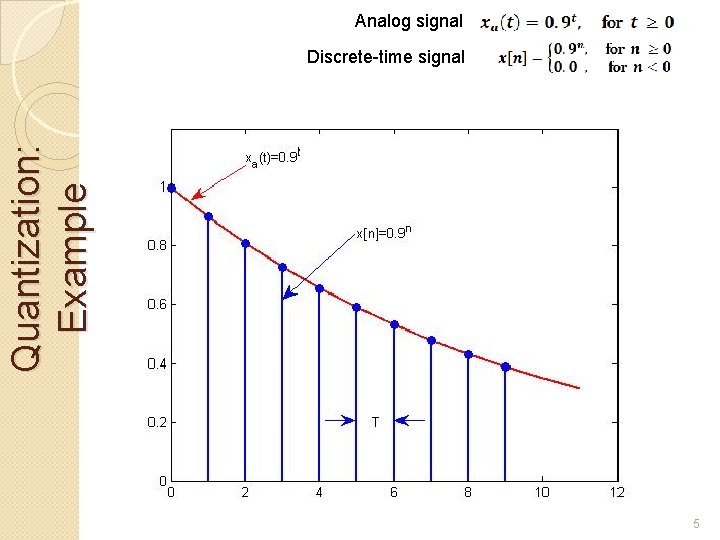
Analog signal Quantization: Example Discrete-time signal 5
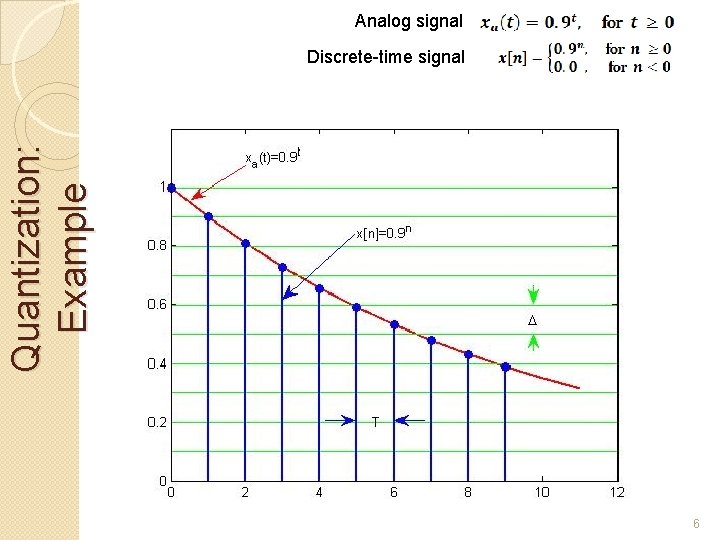
Analog signal Quantization: Example Discrete-time signal 6
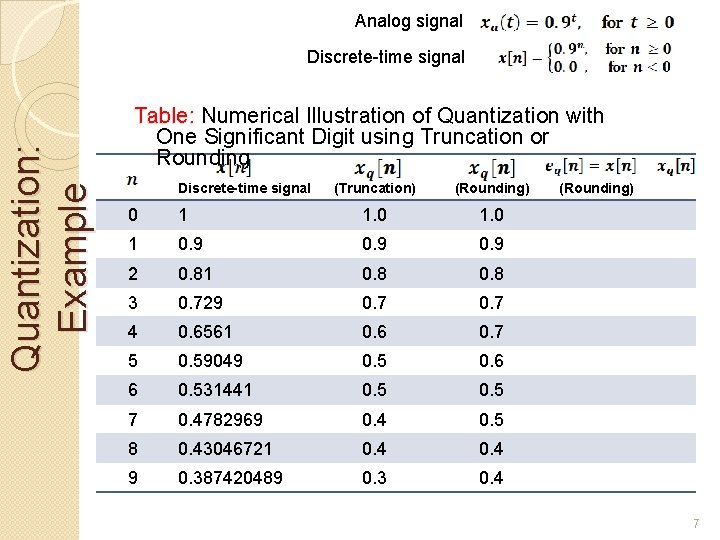
Analog signal Quantization: Example Discrete-time signal Table: Numerical Illustration of Quantization with One Significant Digit using Truncation or Rounding Discrete-time signal (Truncation) (Rounding) 0 1 1. 0 1 0. 9 2 0. 81 0. 8 3 0. 729 0. 7 4 0. 6561 0. 6 0. 7 5 0. 59049 0. 5 0. 6 6 0. 531441 0. 5 7 0. 4782969 0. 4 0. 5 8 0. 43046721 0. 4 9 0. 387420489 0. 3 0. 4 (Rounding) 7
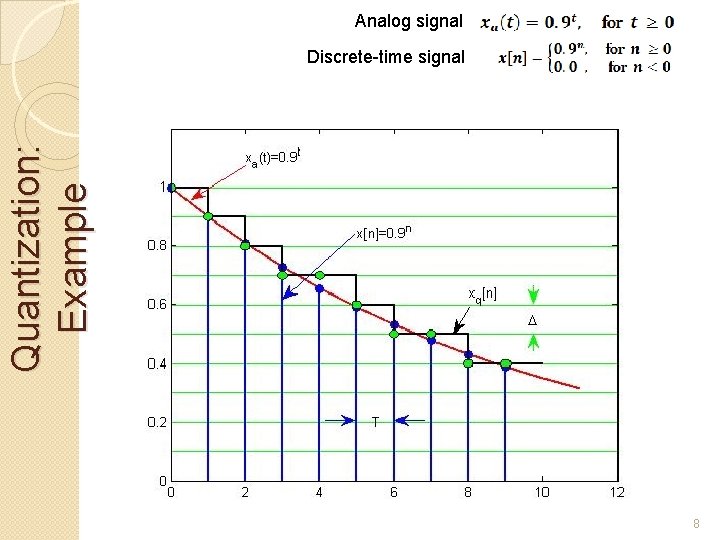
Analog signal Quantization: Example Discrete-time signal 8
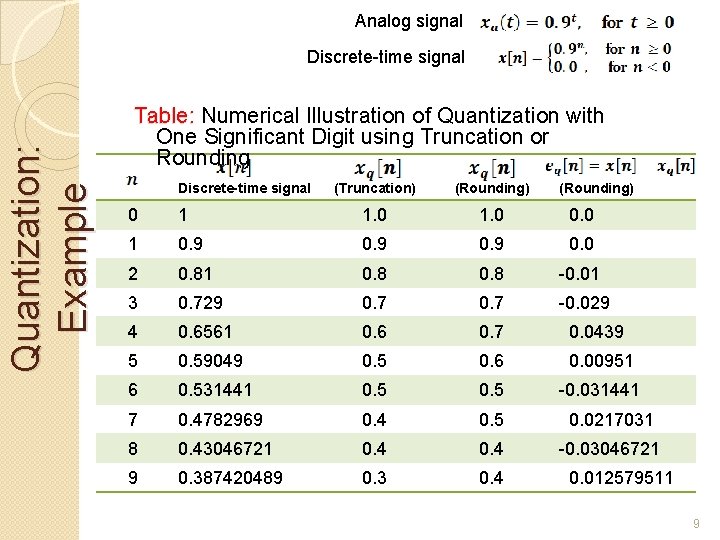
Analog signal Quantization: Example Discrete-time signal Table: Numerical Illustration of Quantization with One Significant Digit using Truncation or Rounding Discrete-time signal (Truncation) (Rounding) 0 1 1. 0 0. 0 1 0. 9 0. 0 2 0. 81 0. 8 -0. 01 3 0. 729 0. 7 -0. 029 4 0. 6561 0. 6 0. 7 0. 0439 5 0. 59049 0. 5 0. 6 0. 00951 6 0. 531441 0. 5 -0. 031441 7 0. 4782969 0. 4 0. 5 0. 0217031 8 0. 43046721 0. 4 -0. 03046721 9 0. 387420489 0. 3 0. 4 0. 012579511 9
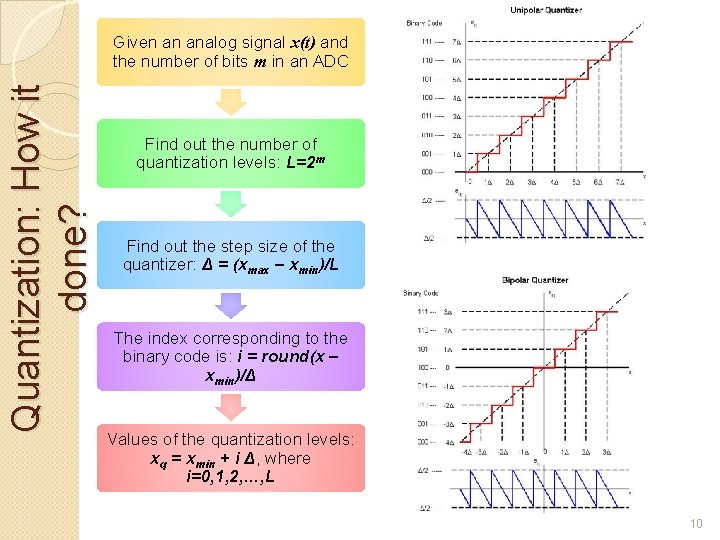
Quantization: How it done? Given an analog signal x(t) and the number of bits m in an ADC Find out the number of quantization levels: L=2 m Find out the step size of the quantizer: Δ = (xmax ‒ xmin)/L The index corresponding to the binary code is: i = round(x ‒ xmin)/Δ Values of the quantization levels: xq = xmin + i Δ, where i=0, 1, 2, …, L 10
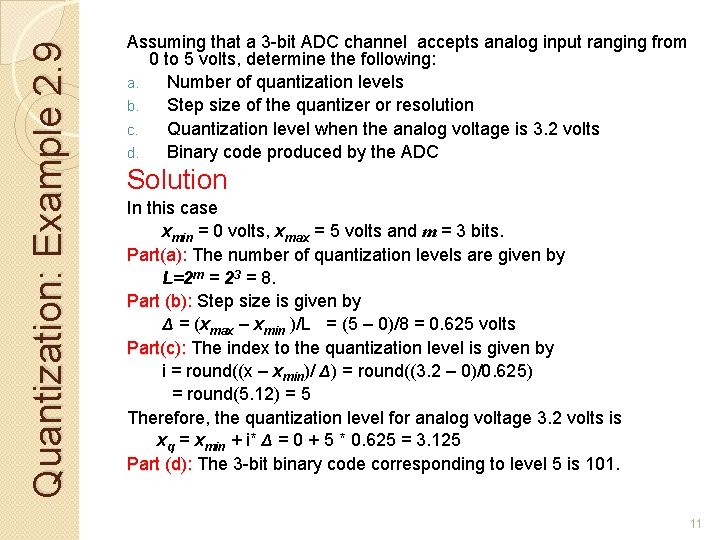
Quantization: Example 2. 9 Assuming that a 3 -bit ADC channel accepts analog input ranging from 0 to 5 volts, determine the following: a. Number of quantization levels b. Step size of the quantizer or resolution c. Quantization level when the analog voltage is 3. 2 volts d. Binary code produced by the ADC Solution In this case xmin = 0 volts, xmax = 5 volts and m = 3 bits. Part(a): The number of quantization levels are given by L=2 m = 23 = 8. Part (b): Step size is given by Δ = (xmax – xmin )/L = (5 – 0)/8 = 0. 625 volts Part(c): The index to the quantization level is given by i = round((x – xmin)/ Δ) = round((3. 2 – 0)/0. 625) = round(5. 12) = 5 Therefore, the quantization level for analog voltage 3. 2 volts is xq = xmin + i* Δ = 0 + 5 * 0. 625 = 3. 125 Part (d): The 3 -bit binary code corresponding to level 5 is 101. 11
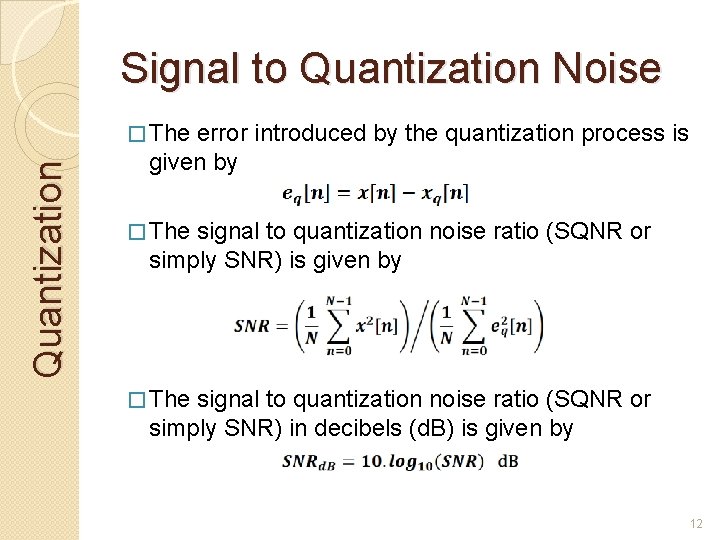
Signal to Quantization Noise Quantization � The error introduced by the quantization process is given by � The signal to quantization noise ratio (SQNR or simply SNR) in decibels (d. B) is given by 12

13
- Slides: 13