
Cement Outlook Fall Committee Meetings August 2012 Ed









- Slides: 49
Cement Outlook Fall Committee Meetings August 2012 Ed Sullivan, Chief Economist PCA
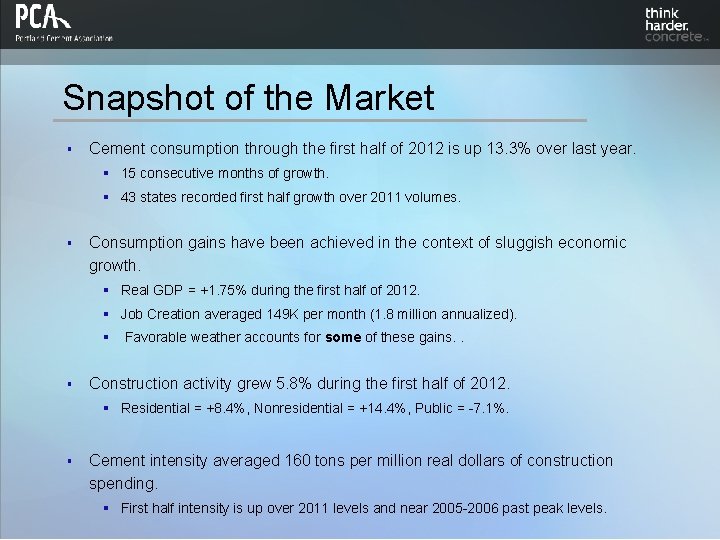
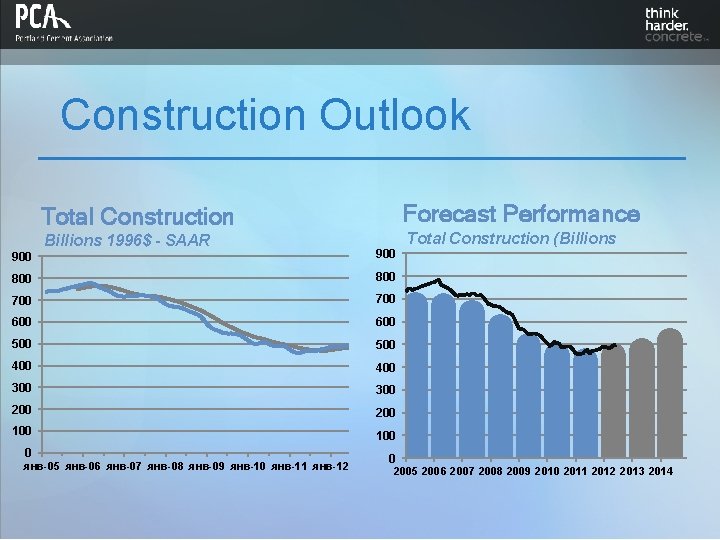
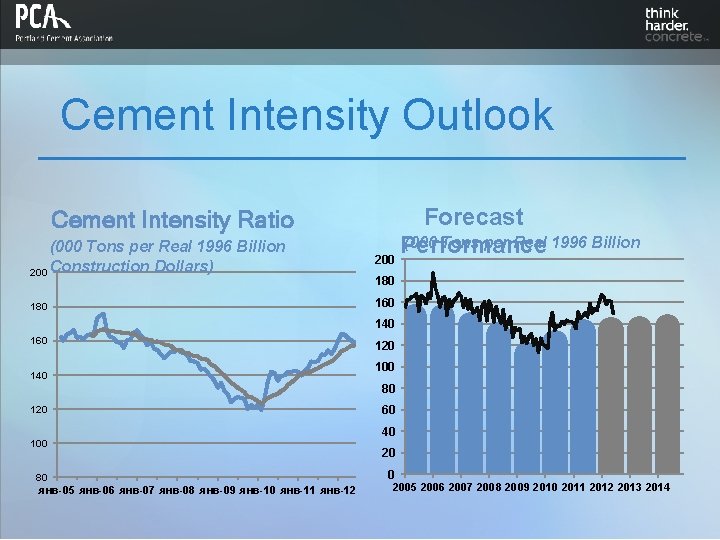
Snapshot of the Market § Cement consumption through the first half of 2012 is up 13. 3% over last year. § 15 consecutive months of growth. § 43 states recorded first half growth over 2011 volumes. § Consumption gains have been achieved in the context of sluggish economic growth. § Real GDP = +1. 75% during the first half of 2012. § Job Creation averaged 149 K per month (1. 8 million annualized). § § Favorable weather accounts for some of these gains. . Construction activity grew 5. 8% during the first half of 2012. § Residential = +8. 4%, Nonresidential = +14. 4%, Public = -7. 1%. § Cement intensity averaged 160 tons per million real dollars of construction spending. § First half intensity is up over 2011 levels and near 2005 -2006 past peak levels.
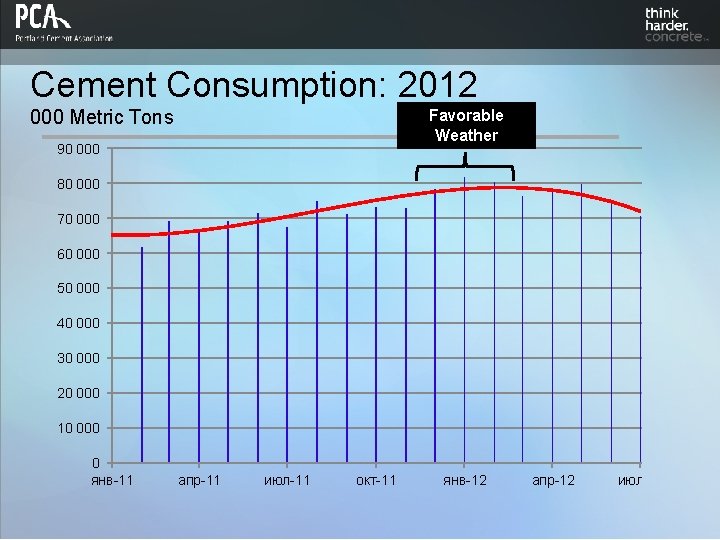
Cement Consumption: 2012 000 Metric Tons Favorable Weather 90 000 80 000 70 000 60 000 50 000 40 000 30 000 20 000 10 000 0 янв-11 апр-11 июл-11 окт-11 янв-12 апр-12 июл-12
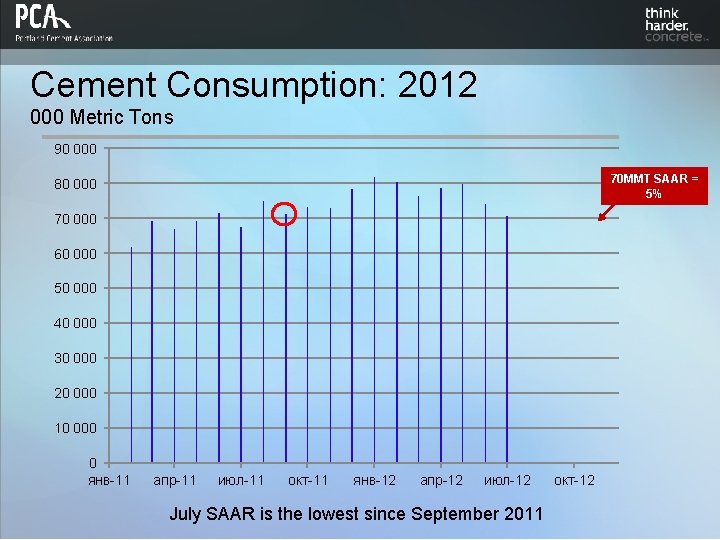
Cement Consumption: 2012 000 Metric Tons 90 000 70 MMT SAAR = 5% 80 000 70 000 60 000 50 000 40 000 30 000 20 000 10 000 0 янв-11 апр-11 июл-11 окт-11 янв-12 апр-12 июл-12 July SAAR is the lowest since September 2011 окт-12
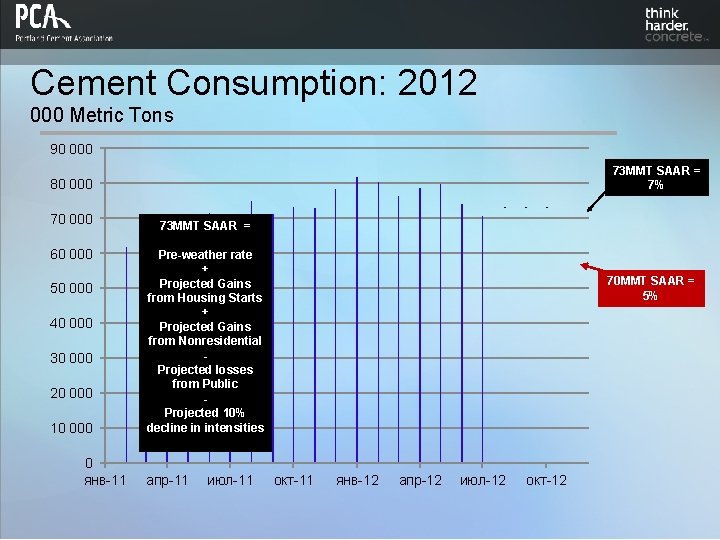
Cement Consumption: 2012 000 Metric Tons 90 000 73 MMT SAAR = 7% 80 000 70 000 60 000 50 000 40 000 30 000 20 000 10 000 0 янв-11 73 MMT SAAR = Pre-weather rate + Projected Gains from Housing Starts + Projected Gains from Nonresidential Projected losses from Public Projected 10% decline in intensities апр-11 июл-11 70 MMT SAAR = 5% окт-11 янв-12 апр-12 июл-12 окт-12
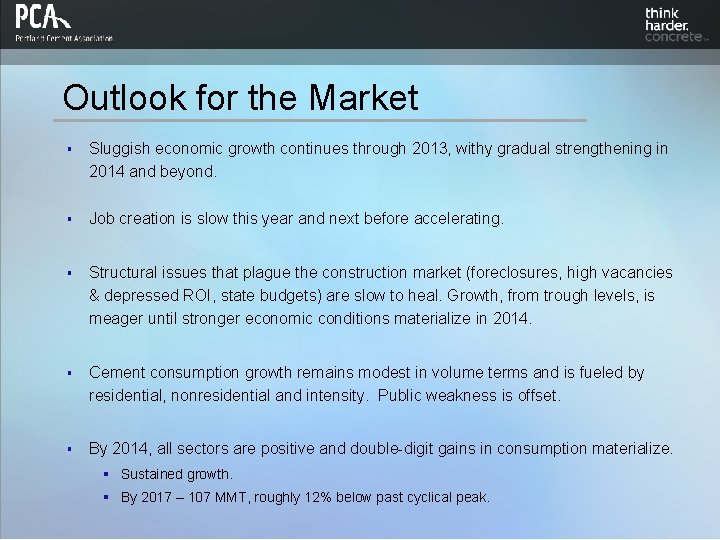
Outlook for the Market § Sluggish economic growth continues through 2013, withy gradual strengthening in 2014 and beyond. § Job creation is slow this year and next before accelerating. § Structural issues that plague the construction market (foreclosures, high vacancies & depressed ROI, state budgets) are slow to heal. Growth, from trough levels, is meager until stronger economic conditions materialize in 2014. § Cement consumption growth remains modest in volume terms and is fueled by residential, nonresidential and intensity. Public weakness is offset. § By 2014, all sectors are positive and double-digit gains in consumption materialize. § Sustained growth. § By 2017 – 107 MMT, roughly 12% below past cyclical peak.
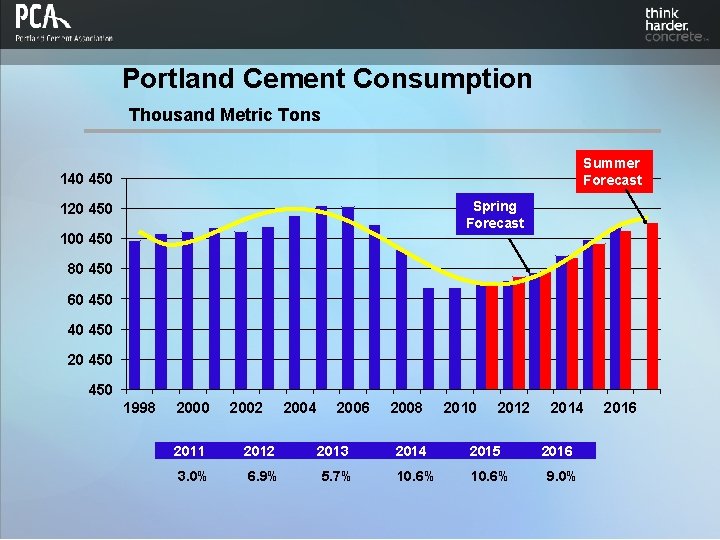
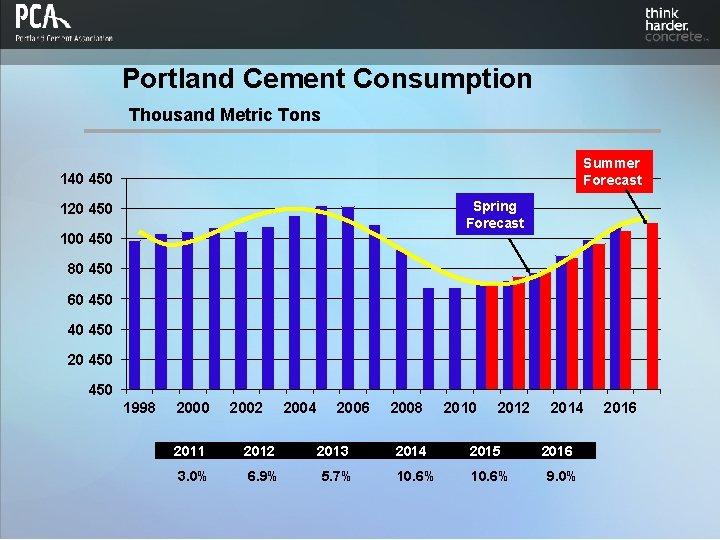
Portland Cement Consumption Thousand Metric Tons Summer Forecast 140 450 Spring Forecast 120 450 100 450 80 450 60 450 40 450 20 450 1998 2000 2002 2011 2012 3. 0% 6. 9% 2004 2006 2013 5. 7% 2008 2010 2012 2014 2015 10. 6% 2014 2016 9. 0% 2016
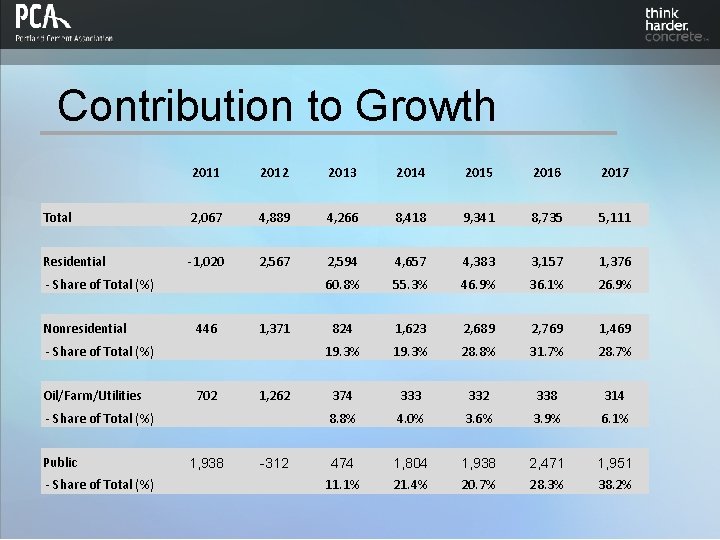
Contribution to Growth 2011 2012 2013 2014 2015 2016 2017 Total 2, 067 4, 889 4, 266 8, 418 9, 341 8, 735 5, 111 Residential -1, 020 2, 567 2, 594 4, 657 4, 383 3, 157 1, 376 60. 8% 55. 3% 46. 9% 36. 1% 26. 9% 824 1, 623 2, 689 2, 769 1, 469 19. 3% 28. 8% 31. 7% 28. 7% 374 333 332 338 314 8. 8% 4. 0% 3. 6% 3. 9% 6. 1% 474 1, 804 1, 938 2, 471 1, 951 11. 1% 21. 4% 20. 7% 28. 3% 38. 2% - Share of Total (%) Nonresidential 446 1, 371 - Share of Total (%) Oil/Farm/Utilities 702 1, 262 - Share of Total (%) Public - Share of Total (%) 1, 938 -312
Economic Outlook
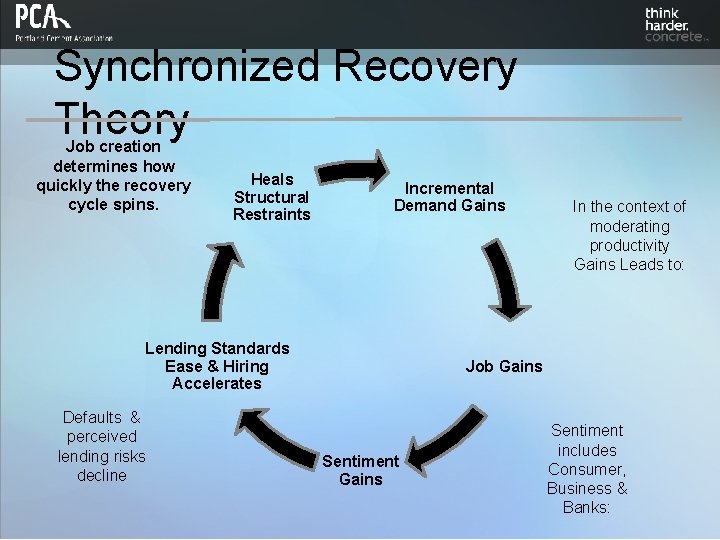
Synchronized Recovery Theory Job creation determines how quickly the recovery cycle spins. Heals Structural Restraints Incremental Demand Gains Lending Standards Ease & Hiring Accelerates Defaults & perceived lending risks decline In the context of moderating productivity Gains Leads to: Job Gains Sentiment includes Consumer, Business & Banks:
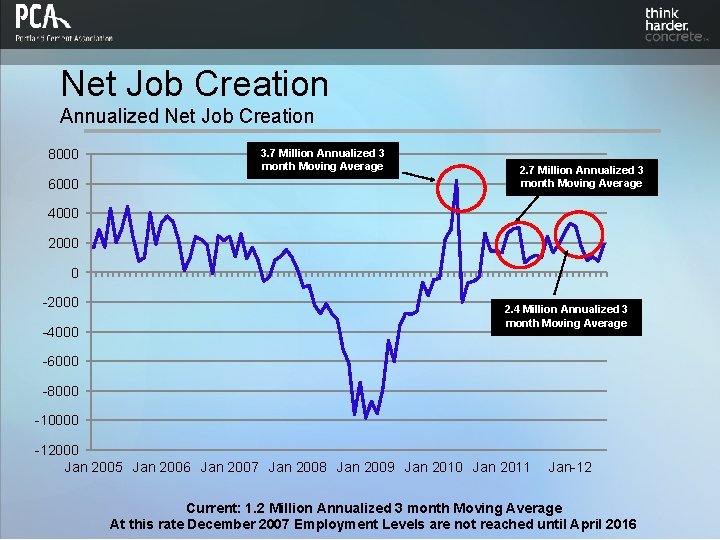
Net Job Creation Annualized Net Job Creation 8000 6000 3. 7 Million Annualized 3 month Moving Average 2. 7 Million Annualized 3 month Moving Average 4000 2000 0 -2000 -4000 2. 4 Million Annualized 3 month Moving Average -6000 -8000 -10000 -12000 Jan 2005 Jan 2006 Jan 2007 Jan 2008 Jan 2009 Jan 2010 Jan 2011 Jan-12 Current: 1. 2 Million Annualized 3 month Moving Average At this rate December 2007 Employment Levels are not reached until April 2016
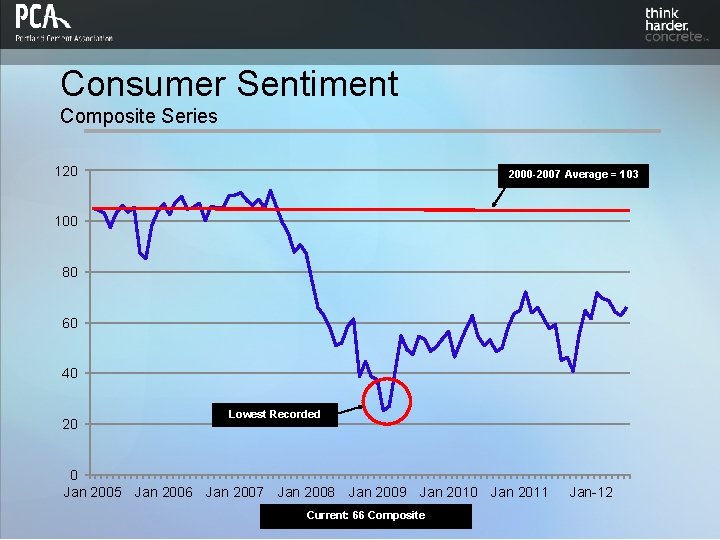
Consumer Sentiment Composite Series 120 2000 -2007 Average = 103 100 80 60 40 20 Lowest Recorded 0 Jan 2005 Jan 2006 Jan 2007 Jan 2008 Jan 2009 Jan 2010 Jan 2011 Current: 66 Composite Jan-12
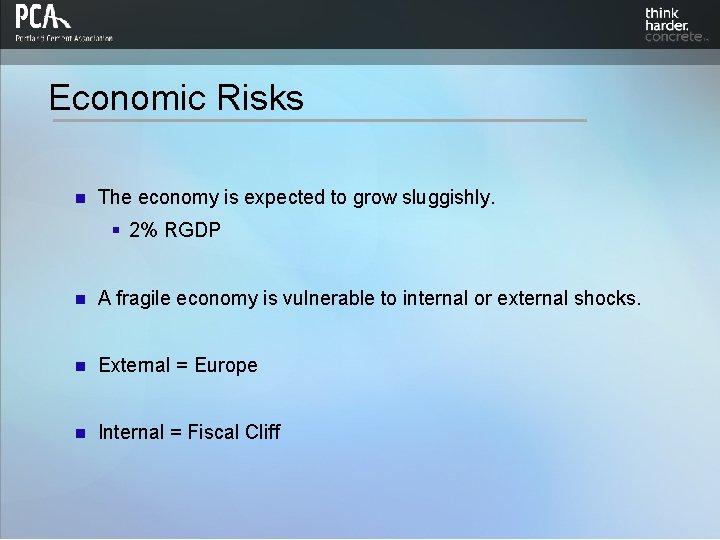
Economic Risks n The economy is expected to grow sluggishly. § 2% RGDP n A fragile economy is vulnerable to internal or external shocks. n External = Europe n Internal = Fiscal Cliff
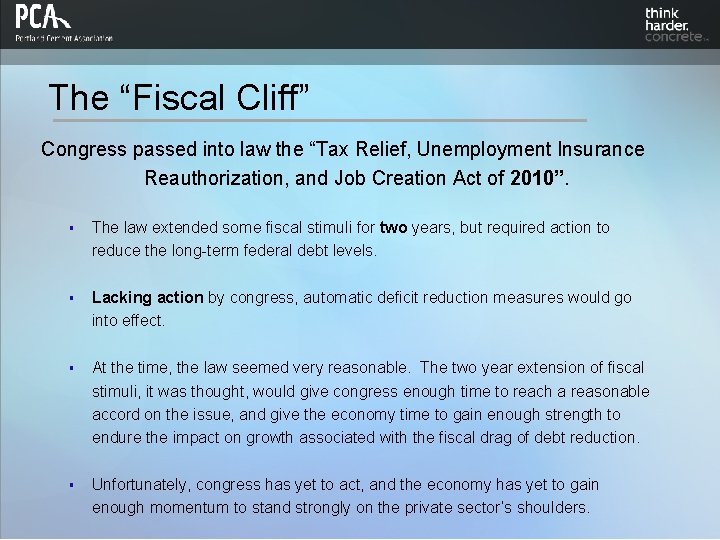
The “Fiscal Cliff” Congress passed into law the “Tax Relief, Unemployment Insurance Reauthorization, and Job Creation Act of 2010”. § The law extended some fiscal stimuli for two years, but required action to reduce the long-term federal debt levels. § Lacking action by congress, automatic deficit reduction measures would go into effect. § At the time, the law seemed very reasonable. The two year extension of fiscal stimuli, it was thought, would give congress enough time to reach a reasonable accord on the issue, and give the economy time to gain enough strength to endure the impact on growth associated with the fiscal drag of debt reduction. § Unfortunately, congress has yet to act, and the economy has yet to gain enough momentum to stand strongly on the private sector’s shoulders.
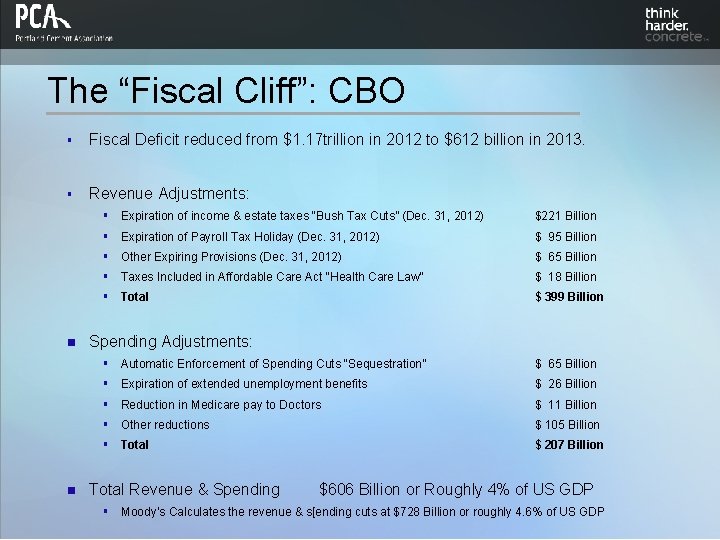
The “Fiscal Cliff”: CBO § Fiscal Deficit reduced from $1. 17 trillion in 2012 to $612 billion in 2013. § Revenue Adjustments: n n § Expiration of income & estate taxes “Bush Tax Cuts” (Dec. 31, 2012) $221 Billion § Expiration of Payroll Tax Holiday (Dec. 31, 2012) $ 95 Billion § Other Expiring Provisions (Dec. 31, 2012) $ 65 Billion § Taxes Included in Affordable Care Act “Health Care Law” $ 18 Billion § Total $ 399 Billion Spending Adjustments: § Automatic Enforcement of Spending Cuts “Sequestration” $ 65 Billion § Expiration of extended unemployment benefits $ 26 Billion § Reduction in Medicare pay to Doctors $ 11 Billion § Other reductions $ 105 Billion § Total $ 207 Billion Total Revenue & Spending $606 Billion or Roughly 4% of US GDP § Moody’s Calculates the revenue & s[ending cuts at $728 Billion or roughly 4. 6% of US GDP
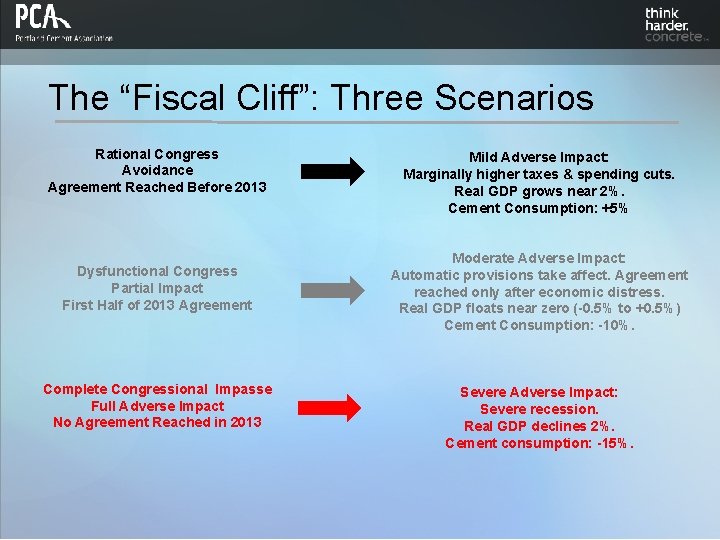
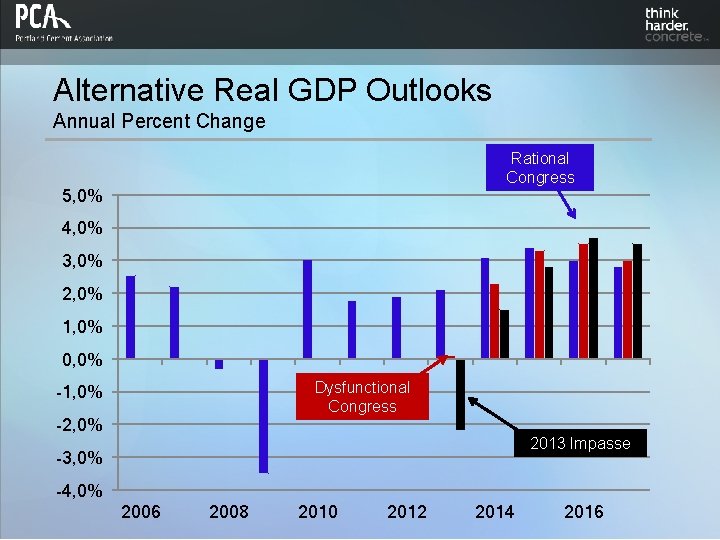
The “Fiscal Cliff”: Three Scenarios Rational Congress Avoidance Agreement Reached Before 2013 Dysfunctional Congress Partial Impact First Half of 2013 Agreement Complete Congressional Impasse Full Adverse Impact No Agreement Reached in 2013 Mild Adverse Impact: Marginally higher taxes & spending cuts. Real GDP grows near 2%. Cement Consumption: +5% Moderate Adverse Impact: Automatic provisions take affect. Agreement reached only after economic distress. Real GDP floats near zero (-0. 5% to +0. 5%) Cement Consumption: -10%. Severe Adverse Impact: Severe recession. Real GDP declines 2%. Cement consumption: -15%.
Alternative Real GDP Outlooks Annual Percent Change Rational Congress 5, 0% 4, 0% 3, 0% 2, 0% 1, 0% 0, 0% Dysfunctional Congress -1, 0% -2, 0% 2013 Impasse -3, 0% -4, 0% 2006 2008 2010 2012 2014 2016
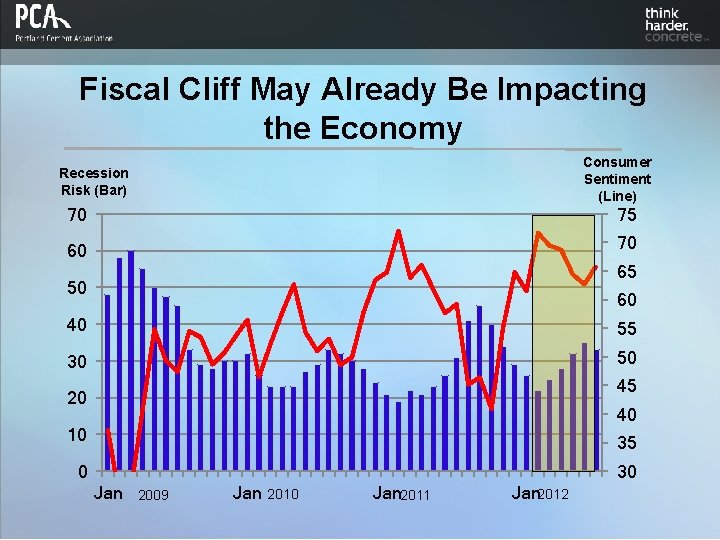
Fiscal Cliff May Already Be Impacting the Economy Consumer Sentiment (Line) Recession Risk (Bar) 70 75 60 70 65 50 60 40 55 30 50 45 20 40 10 35 0 30 Jan 2009 Jan 2010 Jan 2011 Jan 2012
Construction Outlook
Construction Outlook Forecast Performance Total Construction Billions 1996$ - SAAR Total Construction (Billions 900 800 700 600 500 400 300 200 100 0 0 янв-05 янв-06 янв-07 янв-08 янв-09 янв-10 янв-11 янв-12 2005 2006 2007 2008 2009 2010 2011 2012 2013 2014
Cement Intensity Outlook Cement Intensity Ratio (000 Tons per Real 1996 Billion 200 Construction Dollars) 180 Forecast (000 Tons per Real 1996 Billion Performance 200 180 160 140 120 100 80 янв-05 янв-06 янв-07 янв-08 янв-09 янв-10 янв-11 янв-12 60 40 2005 2006 2007 2008 2009 2010 2011 2012 2013 2014
Residential Construction
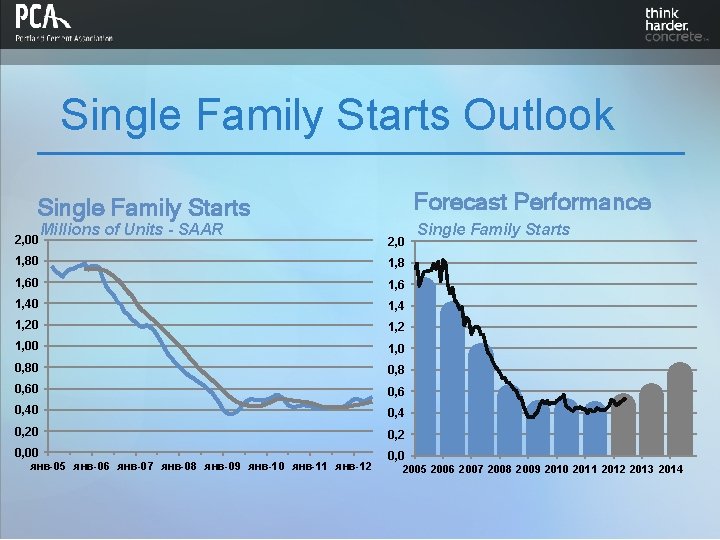
Single Family Starts Outlook Forecast Performance Single Family Starts 2, 00 Millions of Units - SAAR 2, 0 1, 8 1, 60 1, 6 1, 40 1, 4 1, 20 1, 2 1, 00 1, 0 0, 8 0, 60 0, 6 0, 40 0, 4 0, 20 0, 2 0, 00 0, 0 янв-05 янв-06 янв-07 янв-08 янв-09 янв-10 янв-11 янв-12 Single Family Starts 2005 2006 2007 2008 2009 2010 2011 2012 2013 2014
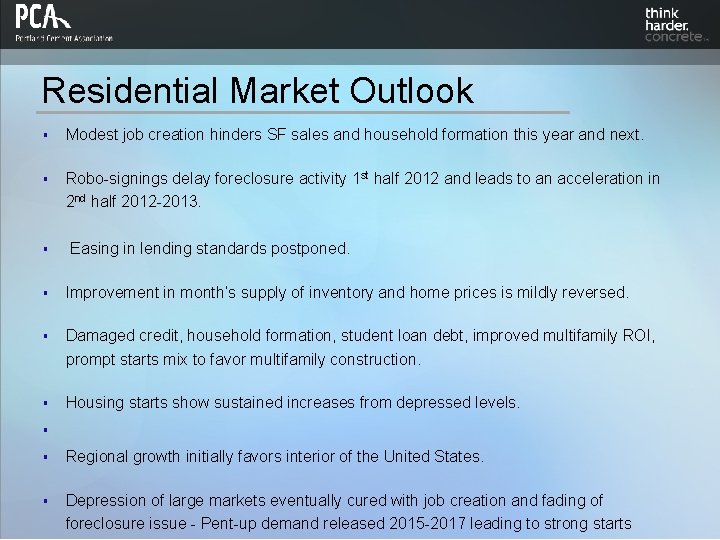
Residential Market Outlook § Modest job creation hinders SF sales and household formation this year and next. § Robo-signings delay foreclosure activity 1 st half 2012 and leads to an acceleration in 2 nd half 2012 -2013. § Easing in lending standards postponed. § Improvement in month’s supply of inventory and home prices is mildly reversed. § Damaged credit, household formation, student loan debt, improved multifamily ROI, prompt starts mix to favor multifamily construction. § Housing starts show sustained increases from depressed levels. § § Regional growth initially favors interior of the United States. § Depression of large markets eventually cured with job creation and fading of foreclosure issue - Pent-up demand released 2015 -2017 leading to strong starts
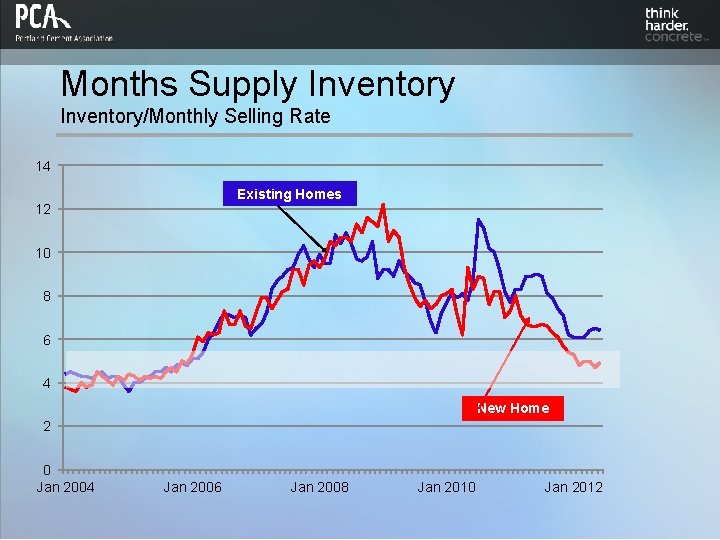
Ingredients for a Starts Recovery Homebuilders Expected ROI Inventory no higher than 5 months supply Carry costs erode expected ROI. Price stability Weaker the price environment…lowers the months’ supply trigger point.
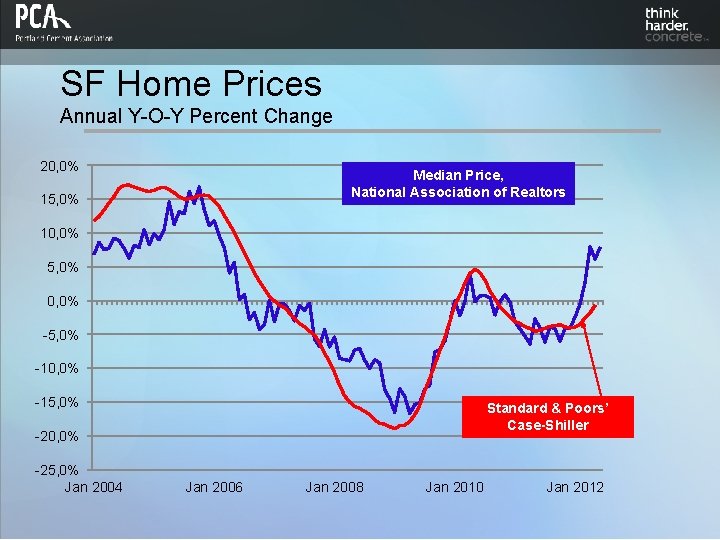
SF Home Prices Annual Y-O-Y Percent Change 20, 0% Median Price, National Association of Realtors 15, 0% 10, 0% 5, 0% 0, 0% -5, 0% -10, 0% -15, 0% Standard & Poors’ Case-Shiller -20, 0% -25, 0% Jan 2004 Jan 2006 Jan 2008 Jan 2010 Jan 2012
Months Supply Inventory/Monthly Selling Rate 14 Existing Homes 12 10 8 6 4 New Home 2 0 Jan 2004 Jan 2006 Jan 2008 Jan 2010 Jan 2012
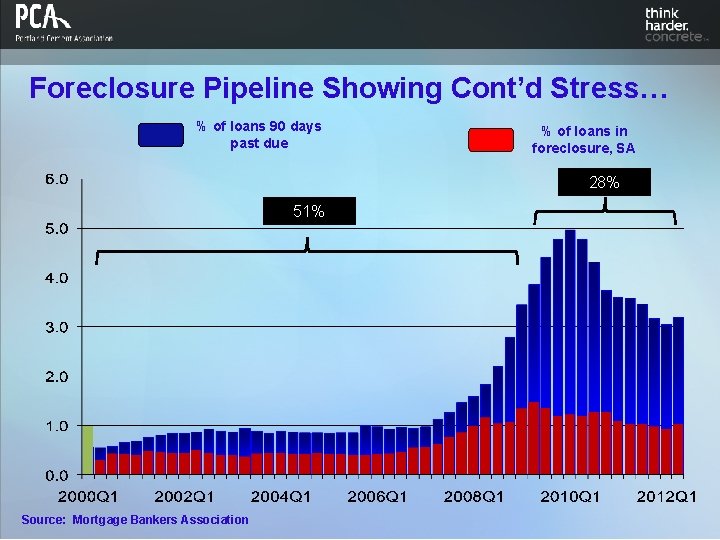
Foreclosure Pipeline Showing Cont’d Stress… % of loans 90 days past due % of loans in foreclosure, SA 28% 51% Source: Mortgage Bankers Association
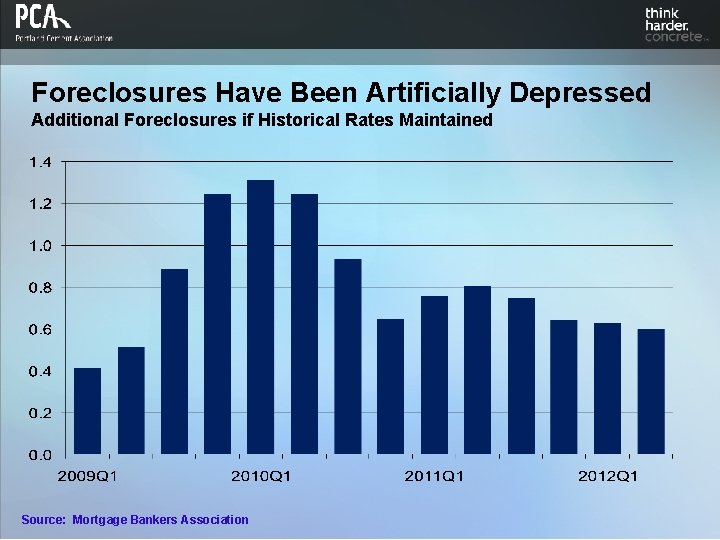
Foreclosures Have Been Artificially Depressed Additional Foreclosures if Historical Rates Maintained Source: Mortgage Bankers Association
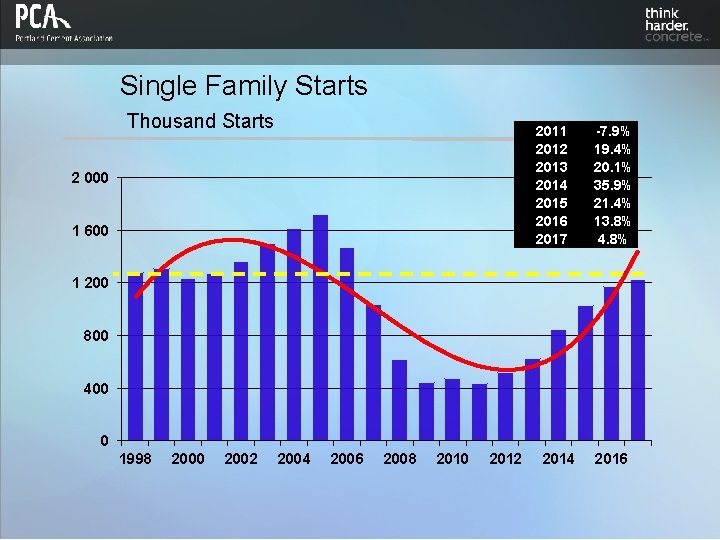
Single Family Starts Thousand Starts 2011 2012 2013 2014 2015 2016 2017 2 000 1 600 -7. 9% 19. 4% 20. 1% 35. 9% 21. 4% 13. 8% 4. 8% 1 200 800 400 0 1998 2000 2002 2004 2006 2008 2010 2012 2014 2016
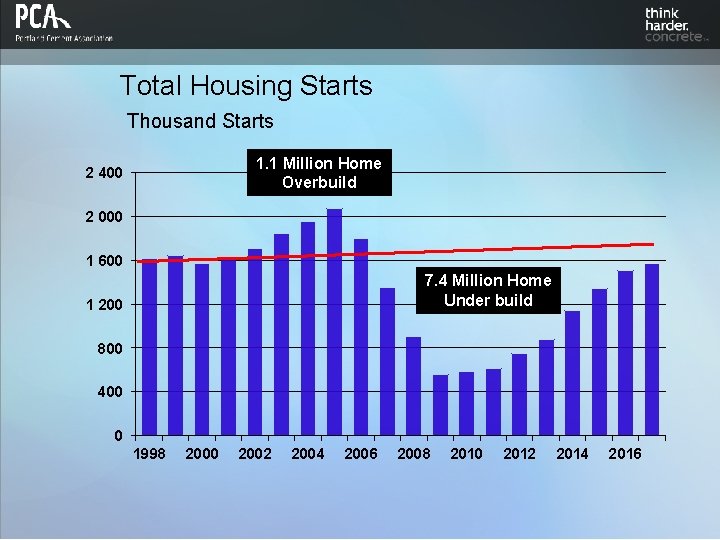
Total Housing Starts Thousand Starts 1. 1 Million Home Overbuild 2 400 2 000 1 600 7. 4 Million Home Under build 1 200 800 400 0 1998 2000 2002 2004 2006 2008 2010 2012 2014 2016
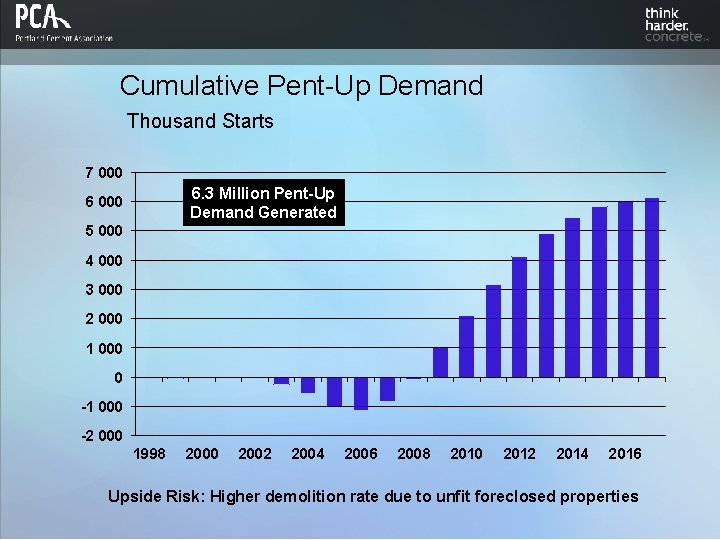
Cumulative Pent-Up Demand Thousand Starts 7 000 6. 3 Million Pent-Up Demand Generated 6 000 5 000 4 000 3 000 2 000 1 000 0 -1 000 -2 000 1998 2000 2002 2004 2006 2008 2010 2012 2014 2016 Upside Risk: Higher demolition rate due to unfit foreclosed properties
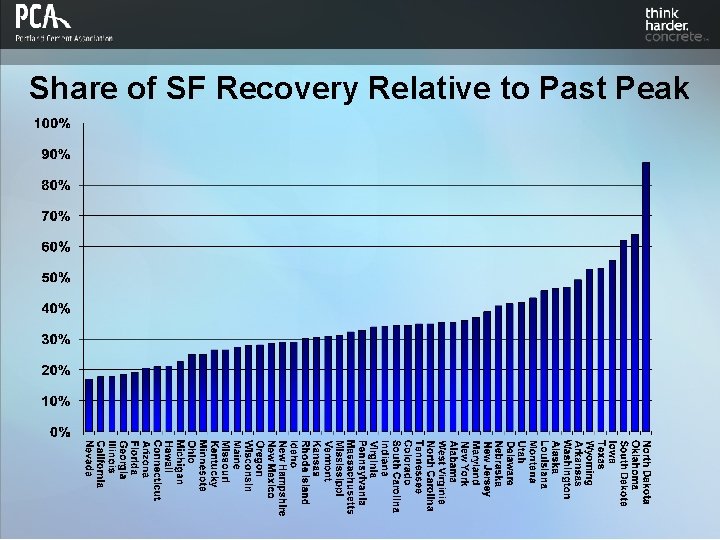
Share of SF Recovery Relative to Past Peak
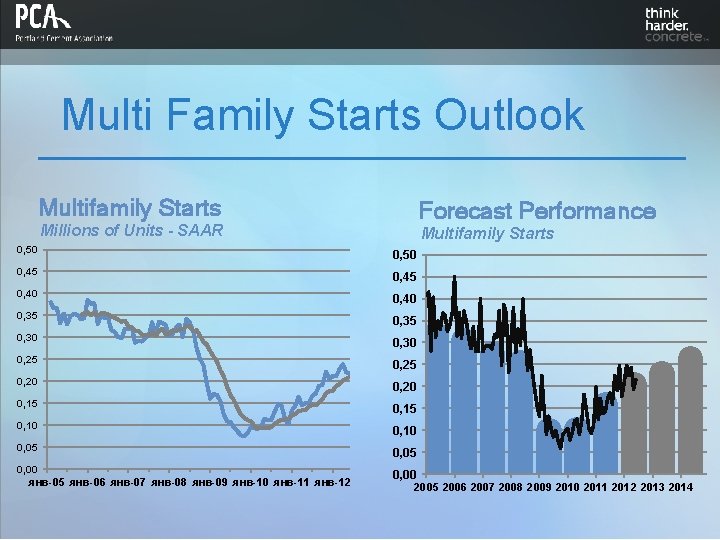
Multi Family Starts Outlook Multifamily Starts Forecast Performance Millions of Units - SAAR Multifamily Starts 0, 50 0, 45 0, 40 0, 35 0, 30 0, 25 0, 20 0, 15 0, 10 0, 05 0, 00 янв-05 янв-06 янв-07 янв-08 янв-09 янв-10 янв-11 янв-12 0, 00 2005 2006 2007 2008 2009 2010 2011 2012 2013 2014
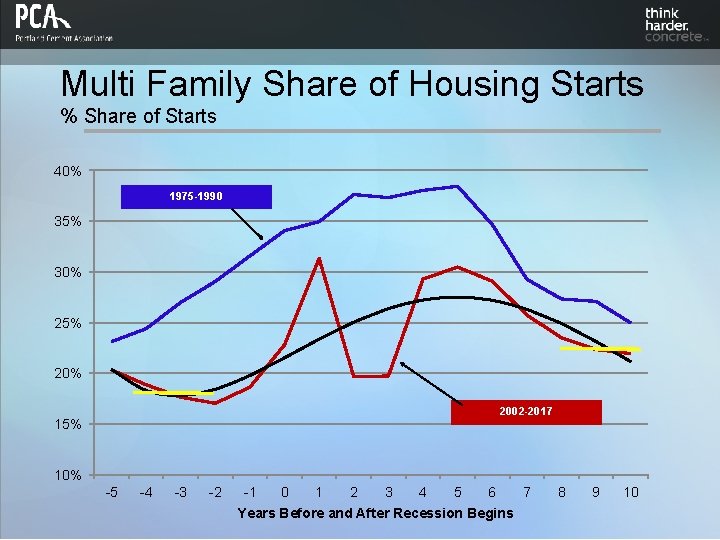
Multi Family Share of Housing Starts % Share of Starts 40% 1975 -1990 35% 30% 25% 2002 -2017 15% 10% -5 -4 -3 -2 -1 0 1 2 3 4 5 6 Years Before and After Recession Begins 7 8 9 10
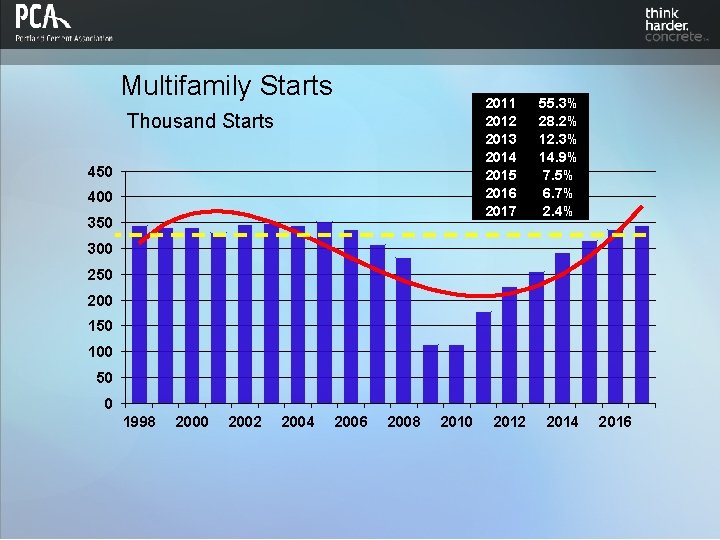
Multifamily Starts 2011 2012 2013 2014 2015 2016 2017 Thousand Starts 450 400 350 55. 3% 28. 2% 12. 3% 14. 9% 7. 5% 6. 7% 2. 4% 300 250 200 150 100 50 0 1998 2000 2002 2004 2006 2008 2010 2012 2014 2016
Nonresidential Construction
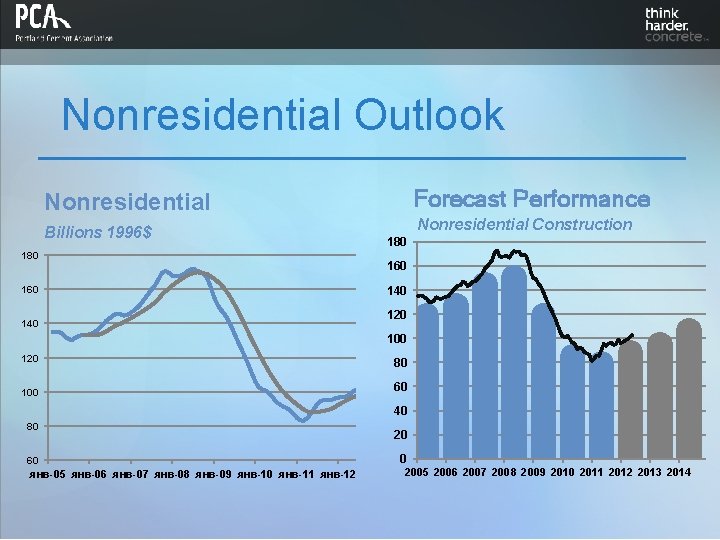
Nonresidential Outlook Forecast Performance Nonresidential Billions 1996$ 180 160 140 Nonresidential Construction 180 160 140 120 100 80 60 40 80 60 янв-05 янв-06 янв-07 янв-08 янв-09 янв-10 янв-11 янв-12 20 0 2005 2006 2007 2008 2009 2010 2011 2012 2013 2014
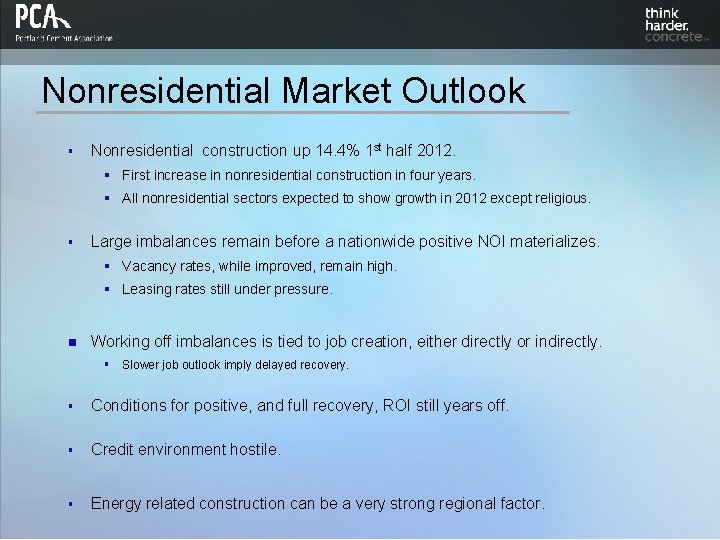
Nonresidential Market Outlook § Nonresidential construction up 14. 4% 1 st half 2012. § First increase in nonresidential construction in four years. § All nonresidential sectors expected to show growth in 2012 except religious. § Large imbalances remain before a nationwide positive NOI materializes. § Vacancy rates, while improved, remain high. § Leasing rates still under pressure. n Working off imbalances is tied to job creation, either directly or indirectly. § Slower job outlook imply delayed recovery. § Conditions for positive, and full recovery, ROI still years off. § Credit environment hostile. § Energy related construction can be a very strong regional factor.
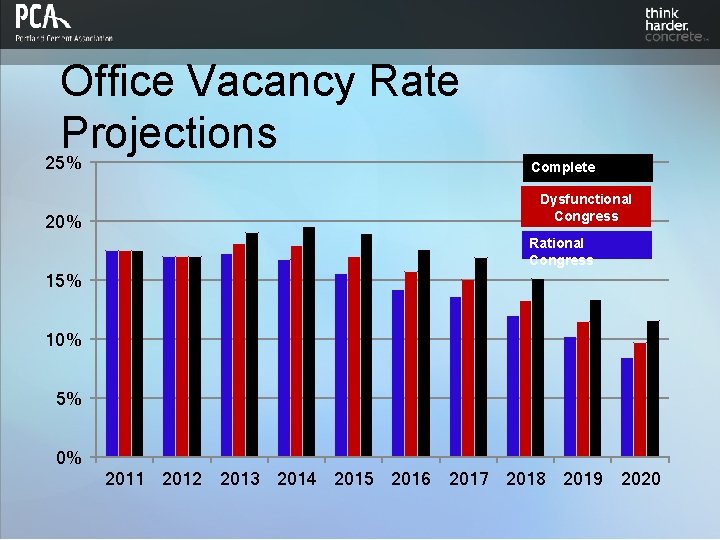
Office Vacancy Rate Projections 25% 20% Complete Dysfunctional Congress Rational Congress 15% 10% 5% 0% 2011 2012 2013 2014 2015 2016 2017 2018 2019 2020
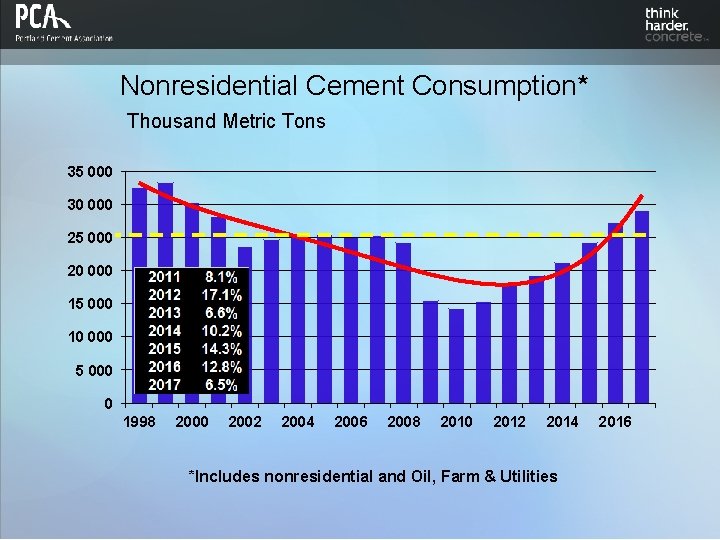
Nonresidential Cement Consumption* Thousand Metric Tons 35 000 30 000 25 000 20 000 15 000 10 000 5 000 0 1998 2000 2002 2004 2006 2008 2010 2012 2014 *Includes nonresidential and Oil, Farm & Utilities 2016
Public Recovery
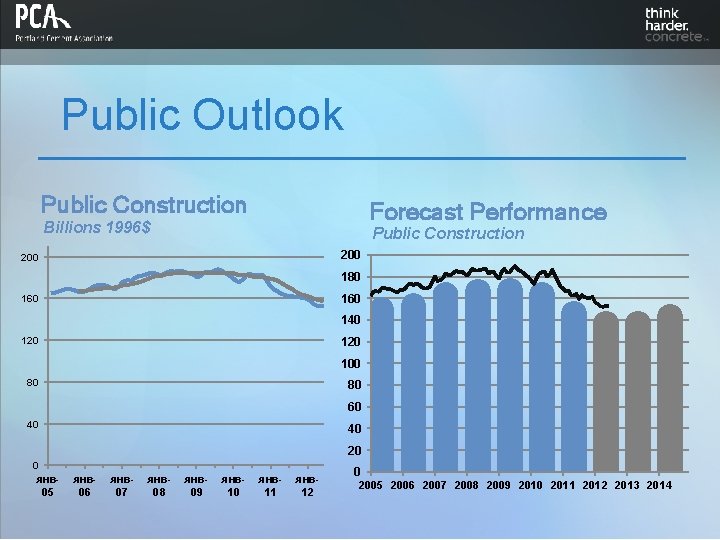
Public Outlook Public Construction Forecast Performance Billions 1996$ Public Construction 200 180 160 140 120 100 80 80 60 40 40 20 0 янв 05 янв 06 янв 07 янв 08 янв 09 янв 10 янв 11 янв 12 0 2005 2006 2007 2008 2009 2010 2011 2012 2013 2014
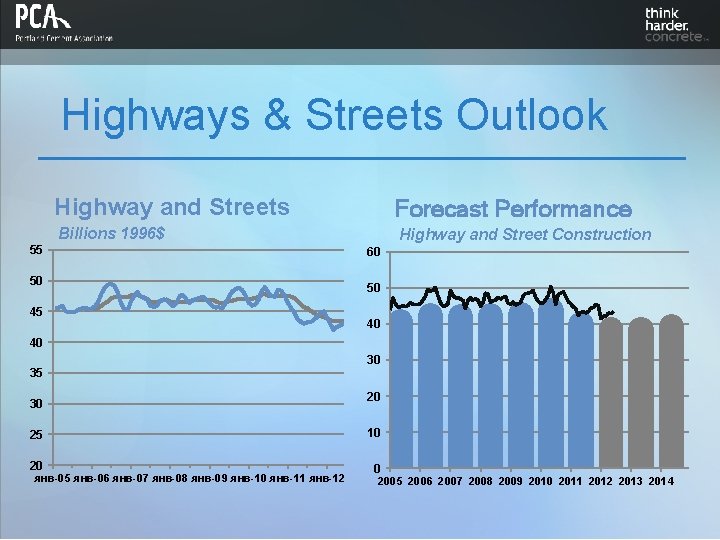
Highways & Streets Outlook Highway and Streets Forecast Performance Billions 1996$ Highway and Street Construction 55 50 45 60 50 40 40 35 30 30 20 25 10 20 0 янв-05 янв-06 янв-07 янв-08 янв-09 янв-10 янв-11 янв-12 2005 2006 2007 2008 2009 2010 2011 2012 2013 2014
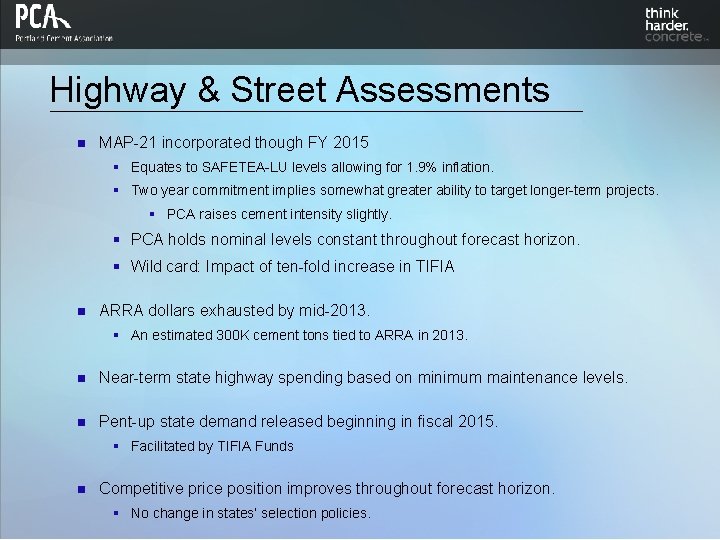
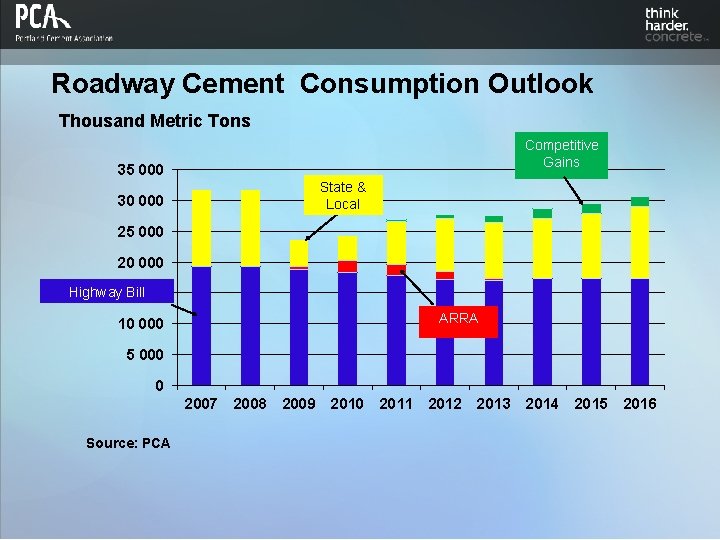
Highway & Street Assessments n MAP-21 incorporated though FY 2015 § Equates to SAFETEA-LU levels allowing for 1. 9% inflation. § Two year commitment implies somewhat greater ability to target longer-term projects. § PCA raises cement intensity slightly. § PCA holds nominal levels constant throughout forecast horizon. § Wild card: Impact of ten-fold increase in TIFIA n ARRA dollars exhausted by mid-2013. § An estimated 300 K cement tons tied to ARRA in 2013. n Near-term state highway spending based on minimum maintenance levels. n Pent-up state demand released beginning in fiscal 2015. § Facilitated by TIFIA Funds n Competitive price position improves throughout forecast horizon. § No change in states’ selection policies.
Roadway Cement Consumption Outlook Thousand Metric Tons Competitive Gains 35 000 State & Local 30 000 25 000 20 000 Highway 15 Bill 000 ARRA 10 000 5 000 0 2007 Source: PCA 2008 2009 2010 2011 2012 2013 2014 2015 2016
Summary
Portland Cement Consumption Thousand Metric Tons Summer Forecast 140 450 Spring Forecast 120 450 100 450 80 450 60 450 40 450 20 450 1998 2000 2002 2011 2012 3. 0% 6. 9% 2004 2006 2013 5. 7% 2008 2010 2012 2014 2015 10. 6% 2014 2016 9. 0% 2016
Cement Outlook Fall Committee Meetings August 2012 Ed Sullivan, Chief Economist PCA