
Celtic Christianity Keypoints The Celts in PreChristian Ireland
- Slides: 7
Celtic Christianity
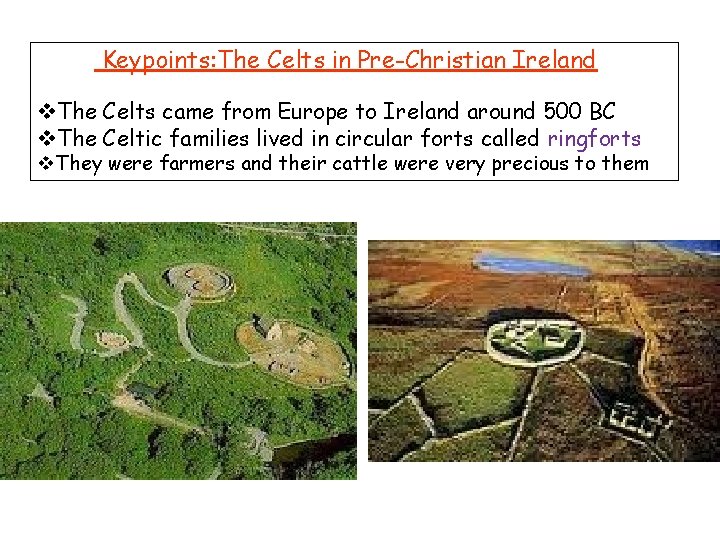
Keypoints: The Celts in Pre-Christian Ireland v. The Celts came from Europe to Ireland around 500 BC v. The Celtic families lived in circular forts called ringforts v. They were farmers and their cattle were very precious to them
v They divided their provinces into “cúigí” and then into smaller kingdoms called “tuatha” v The King was the most important person in the cúige followed by the nobles, the druids, the poets, the judges and the craftspeople. There were also labourers and slaves among them v There was one High King or Ard–Rí over all the others v The Celtic people worshipped many gods and considered many places-such as woods, rivers, lakes, mountains-to be special sacred spaces because their gods lived in them
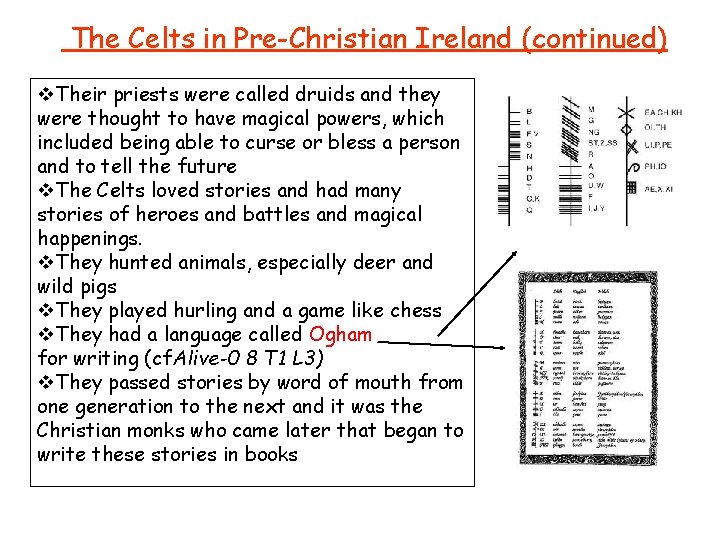
The Celts in Pre-Christian Ireland (continued) v. Their priests were called druids and they were thought to have magical powers, which included being able to curse or bless a person and to tell the future v. The Celts loved stories and had many stories of heroes and battles and magical happenings. v. They hunted animals, especially deer and wild pigs v. They played hurling and a game like chess v. They had a language called Ogham for writing (cf. Alive-0 8 T 1 L 3) v. They passed stories by word of mouth from one generation to the next and it was the Christian monks who came later that began to write these stories in books
Teacher Reflection St Patrick’s Lorica Prayers and Dance Celtic blessing dance. Alive O-6, DVD, p 40 Teacher’s Manual Read the following: ØChristianity comes to Ireland Teacher’s Manual: Alive-O 5 p 73 - Story of St Patrick ØOisín and Tír na nÓg pics
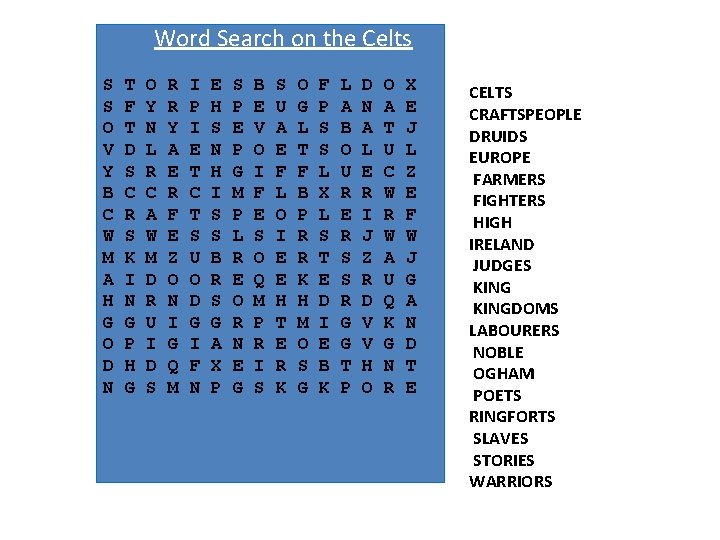
S S O V Y B C W M A H G O D N Word Search on the Celts T F T D S C R S K I N G P H G O Y N L R C A W M D R U I D S R R Y A E R F E Z O N I G Q M I P I E T C T S U O D G I F N E H S N H I S S B R S G A X P S P E P G M P L R E O R N E G B E V O I F E S O Q M P R I S S U A E F L O I E E H T E R K O G L T F B P R R K H M O S G F P S S L X L S T E D I E B K L A B O U R E R S S R G G T P D N A L E R I J Z R D V V H O O A T U C W R W A U Q K G N R X E J L Z E F W J G A N D T E CELTS CRAFTSPEOPLE DRUIDS EUROPE FARMERS FIGHTERS HIGH IRELAND JUDGES KINGDOMS LABOURERS NOBLE OGHAM POETS RINGFORTS SLAVES STORIES WARRIORS
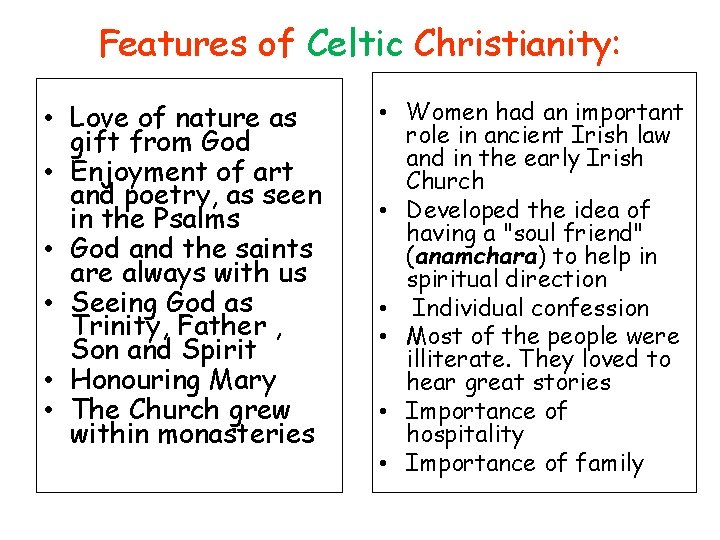
Features of Celtic Christianity: • Love of nature as gift from God • Enjoyment of art and poetry, as seen in the Psalms • God and the saints are always with us • Seeing God as Trinity, Father , Son and Spirit • Honouring Mary • The Church grew within monasteries • Women had an important role in ancient Irish law and in the early Irish Church • Developed the idea of having a "soul friend" (anamchara) to help in spiritual direction • Individual confession • Most of the people were illiterate. They loved to hear great stories • Importance of hospitality • Importance of family