
CELLULAR TRANSPORT THE CELL MEMBRANE REMEMBERThe cell membrane
CELLULAR TRANSPORT
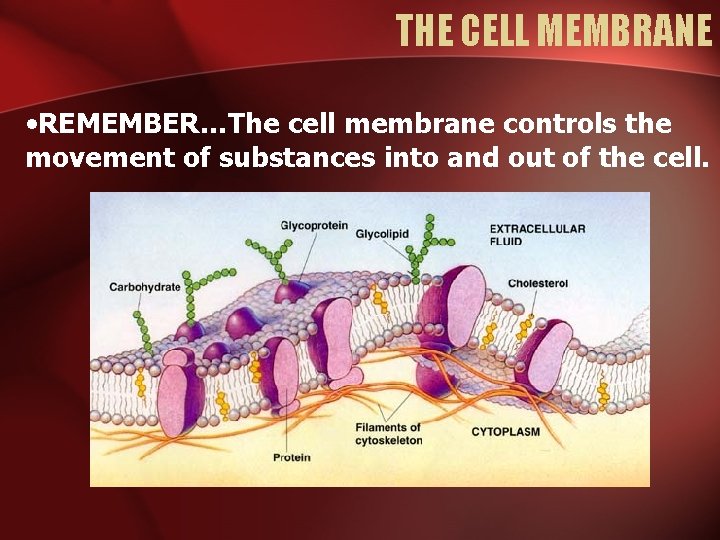
THE CELL MEMBRANE • REMEMBER…The cell membrane controls the movement of substances into and out of the cell.

“COME ON AND TAKE A FREE RIDE” – PASSIVE TRANSPORT No ATP (energy) needed There are three types: 1. DIFFUSION -Small molecules (CO 2, H 2 O, O 2, salts) can move between the phospholipid molecules of the bilayer. -Molecules move from a HIGH concentration ([]) to a LOW [] along a CONCENTRATION GRADIENT until a balance is achieved.

Diffusion
![Passive Transport 2. OSMOSIS -The movement of water (from High to Low [ ])](http://slidetodoc.com/presentation_image_h/a9c3736ccc8485e08a0d69cbde17f6e3/image-5.jpg "Passive Transport 2. OSMOSIS -The movement of water (from High to Low [ ])")
Passive Transport 2. OSMOSIS -The movement of water (from High to Low [ ]) through a selectively permeable membrane.
![Osmotic Conditions Surrounding Cells Isotonic solution – Solute [ ] outside of cell is](http://slidetodoc.com/presentation_image_h/a9c3736ccc8485e08a0d69cbde17f6e3/image-6.jpg "Osmotic Conditions Surrounding Cells Isotonic solution – Solute [ ] outside of cell is")
Osmotic Conditions Surrounding Cells Isotonic solution – Solute [ ] outside of cell is equal to [ ] inside the cell. Cell remains normal. Hypertonic solution – Fluid surrounding the cell has a higher solute [ ] than inside. Water diffuses out and the cell shrinks! Hypotonic solution – [ ] of solute is higher inside the cell than outside. Water will diffuse into the cell. The cell expands!

Passive Transport • Osmosis is a VITAL fluid control process (blood and urine balance)
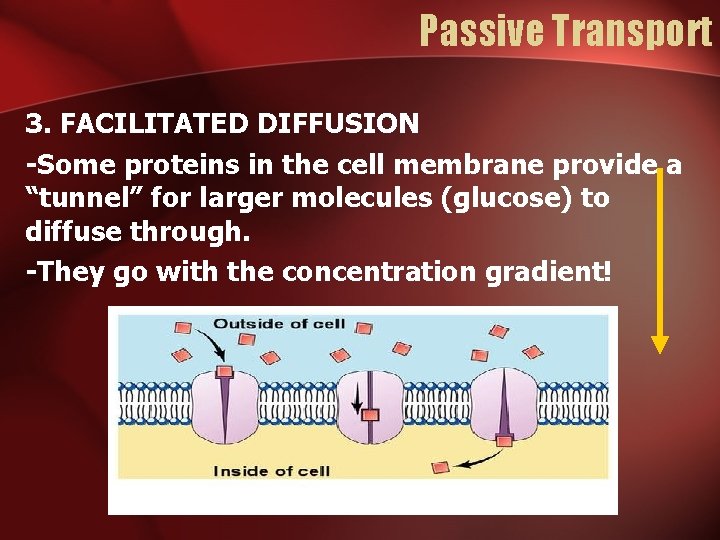
Passive Transport 3. FACILITATED DIFFUSION -Some proteins in the cell membrane provide a “tunnel” for larger molecules (glucose) to diffuse through. -They go with the concentration gradient!

ACTIVE TRANSPORT • ATP is the energy used to “pump” nutrients across cell membranes. • Using ATP, carrier proteins “pump” substances through a membrane from an area of LOW [ ] to an area of HIGH [ ] against the concentration gradient. • Eg. Page 74…the Na+/K+ pump in nerve cells

ACTIVE TRANSPORT

A QUESTION! HOW DO THE REALLY LARGE MOLECULES (Hormones, polysaccharides etc. ) move in and out of cells? ?

An Answer!! By two processes called ENDOCYTOSIS AND EXOCYTOSIS. Both methods require the use of vesicles and ATP!

ENDOCYTOSIS –Moving materials into the cell Three Types… 1. Phagocytosis (Cell Eating): -Used by white blood cells and amoeba. -The cell moves out and surrounds the solid particle.
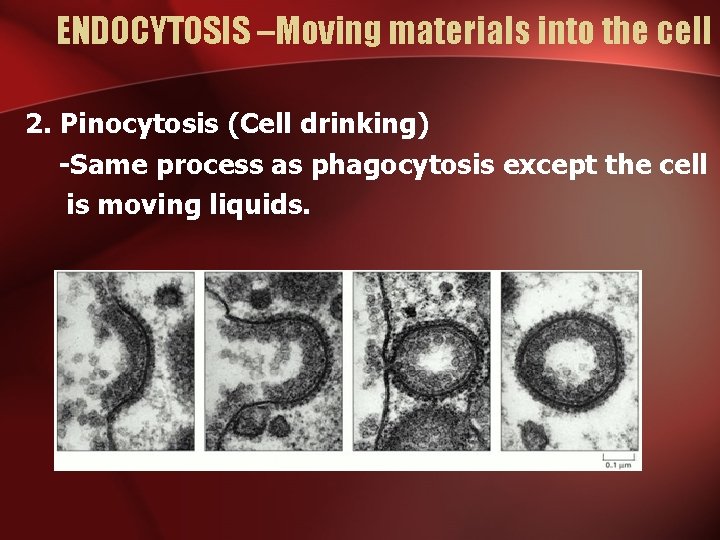
ENDOCYTOSIS –Moving materials into the cell 2. Pinocytosis (Cell drinking) -Same process as phagocytosis except the cell is moving liquids.

ENDOCYTOSIS –Moving materials into the cell 3. RME – Receptor Mediated Endocytosis -Special receptor molecules on the membrane bind with the large molecule to be moved. -When enough receptor molecules have gathered in one place, pinocytosis occurs. -E. g. Moving cholesterol into the cell.

EXOCYTOSIS – Moving materials out of the cell • The reverse of pinocytosis • The vesicle (from the Golgi) fuses with the membrane and releases it’s contents out of the cell. • E. g. Hormones
- Slides: 16