
Cellular Transport Membrane Structure consists of 1 Cell
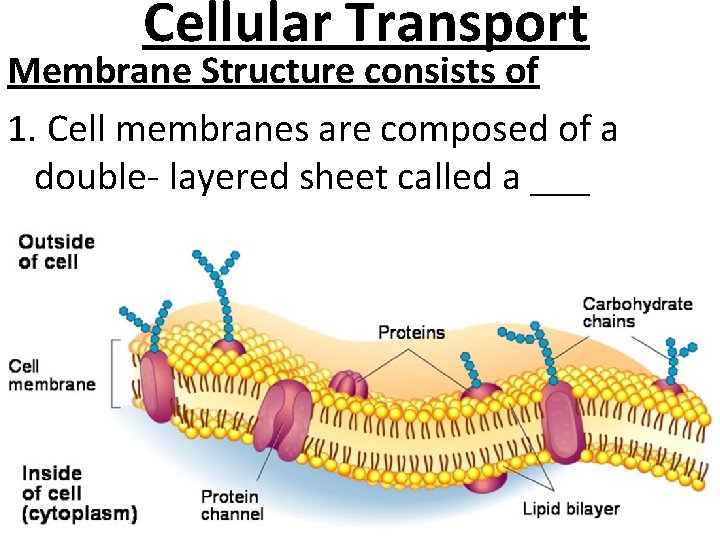
Cellular Transport Membrane Structure consists of 1. Cell membranes are composed of a double- layered sheet called a ___

2. Membrane Proteins • Proteins run through the lipid bilayer and form ______ and ______ to move material across the cell membrane.
3. Carbohydrate Molecules • Polysaccharide chains attach to the _____surfaces of proteins. • Many carbohydrates act like chemical ______ cards, allowing cells to identify one another.
What does a Cell Membrane DO? • The cell membrane ______ what enters and leaves the cell. • The cell membrane provides protection and support. • The cell membrane helps to take in food, water and ions and eliminates wastes. –Some molecules, like water moves freely through the membrane, other molecules must be carried/pumped through channels.
Passive Transport – ______ of molecules across a cell membrane that does NOT use energy Molecules move ______ a concentration gradient from high concentration to low concentration Three types of passive transport…

Concentration Gradient • A ______ in number of molecules (or ions) of a substance between two adjacent regions.
Equilibrium • After the substances move from high to low concentration, then the concentration of the substance on both sides of the membrane will be the same (______ ). –Even after equilibrium is reached, individual molecules ______ to move rapidly across the membrane in both directions.
Types of Passive Transport • Diffusion is the ______ of molecules from high concentration to low concentration. –process by which substances spread through a liquid or gas. • NO ______ required
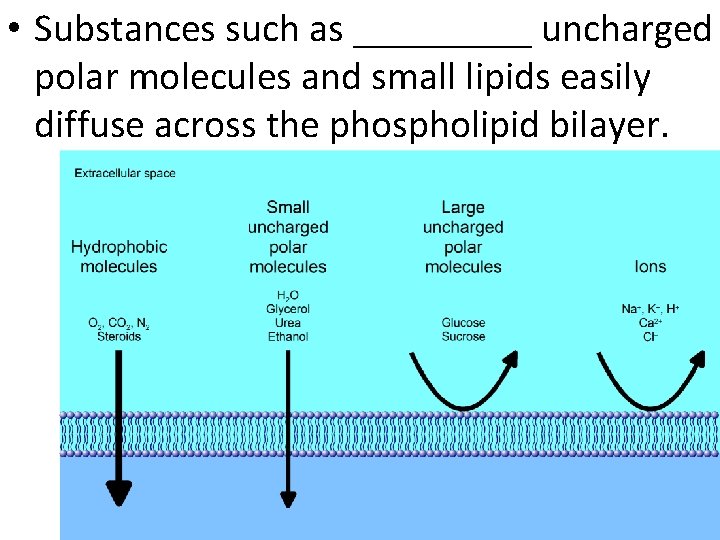
• Substances such as _____ uncharged polar molecules and small lipids easily diffuse across the phospholipid bilayer.
Types of Passive Transport • Osmosis – the diffusion of ______ through a selectively permeable membrane. (water molecules move from high to low concentrations) – Since water molecules are small, they can slip through the gaps between phospholipids in the cell membrane. – As a result, water molecules constantly move back and forth through the cell membrane.

• Permeable- if a substance is ______ to diffuse across a membrane • Impermeable- if things ______ pass across the membrane • Selectively Permeable –some substances can pass across, others cannot.
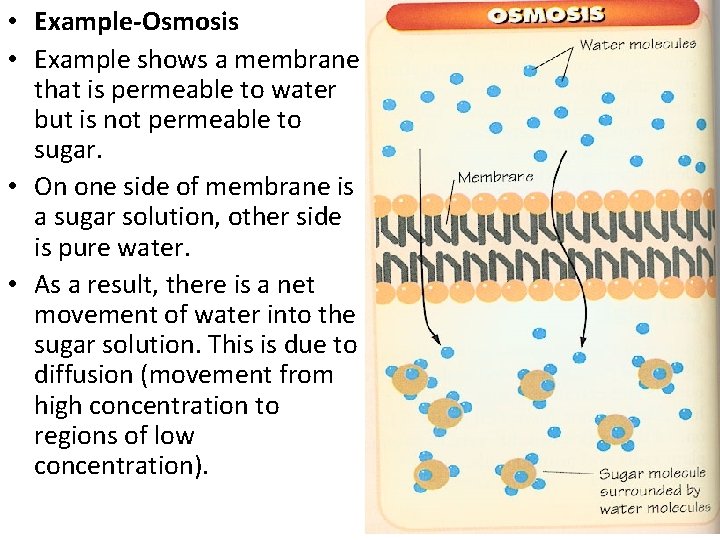
• Example-Osmosis • Example shows a membrane that is permeable to water but is not permeable to sugar. • On one side of membrane is a sugar solution, other side is pure water. • As a result, there is a net movement of water into the sugar solution. This is due to diffusion (movement from high concentration to regions of low concentration).
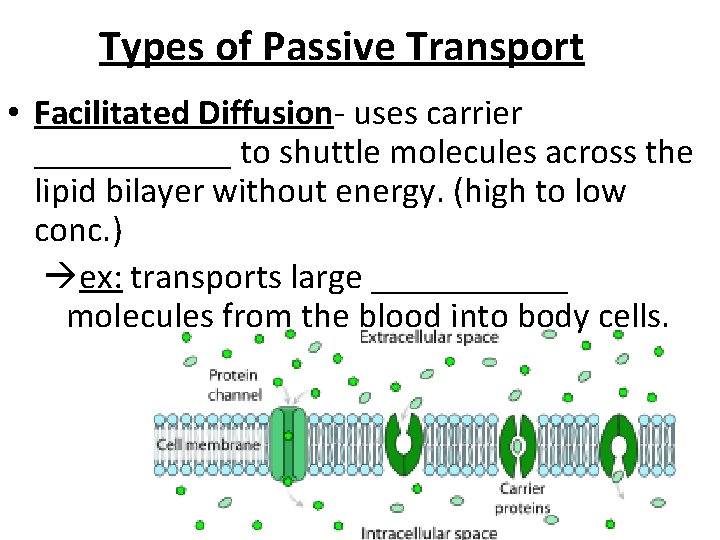
Types of Passive Transport • Facilitated Diffusion- uses carrier ______ to shuttle molecules across the lipid bilayer without energy. (high to low conc. ) ex: transports large ______ molecules from the blood into body cells.
Why do water molecules move with osmosis? • Osmoregulation- the control of ______ movement across the cell membrane. – Water “follows” solute. • Solute- a substance ______ in solvent • Tonic- term used to refer to solvent – Hypertonic- more solute in solvent outside of cell – Hypotonic- less solute in solvent outside of the cell – Isotonic- equal amount of solute outside of cell and inside of cell. • Solute is usually charged and does not move through membrane
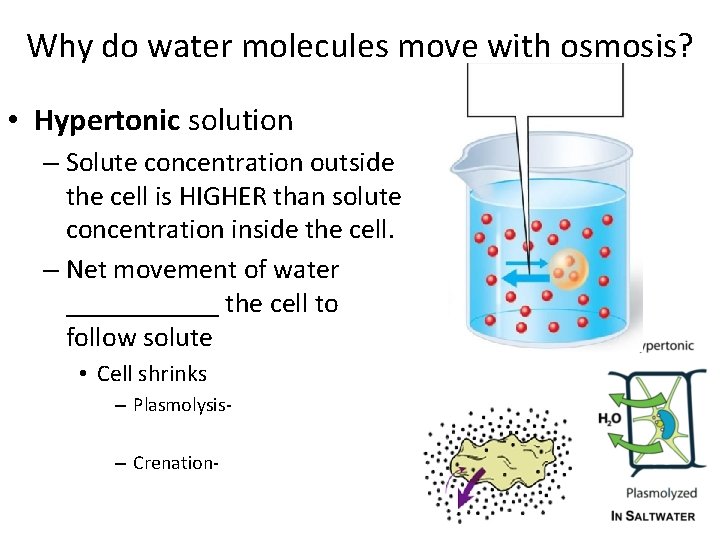
Why do water molecules move with osmosis? • Hypertonic solution – Solute concentration outside the cell is HIGHER than solute concentration inside the cell. – Net movement of water ______ the cell to follow solute • Cell shrinks – Plasmolysis– Crenation-
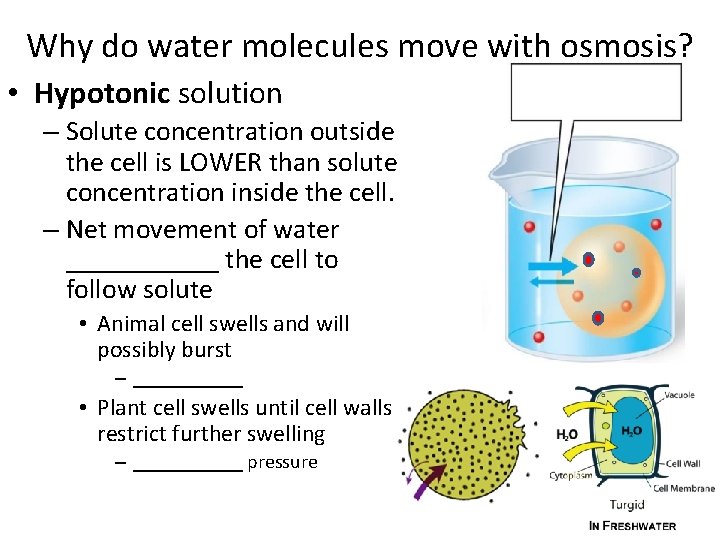
Why do water molecules move with osmosis? • Hypotonic solution – Solute concentration outside the cell is LOWER than solute concentration inside the cell. – Net movement of water ______ the cell to follow solute • Animal cell swells and will possibly burst – ______ • Plant cell swells until cell walls restrict further swelling – ______ pressure
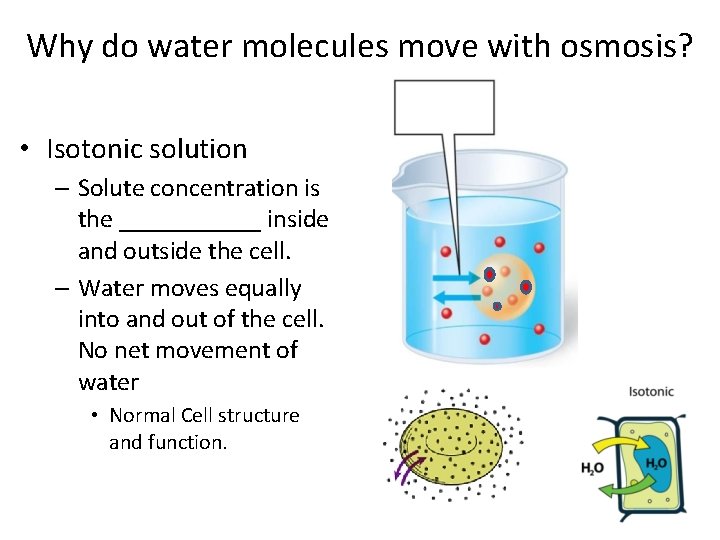
Why do water molecules move with osmosis? • Isotonic solution – Solute concentration is the ______ inside and outside the cell. – Water moves equally into and out of the cell. No net movement of water • Normal Cell structure and function.
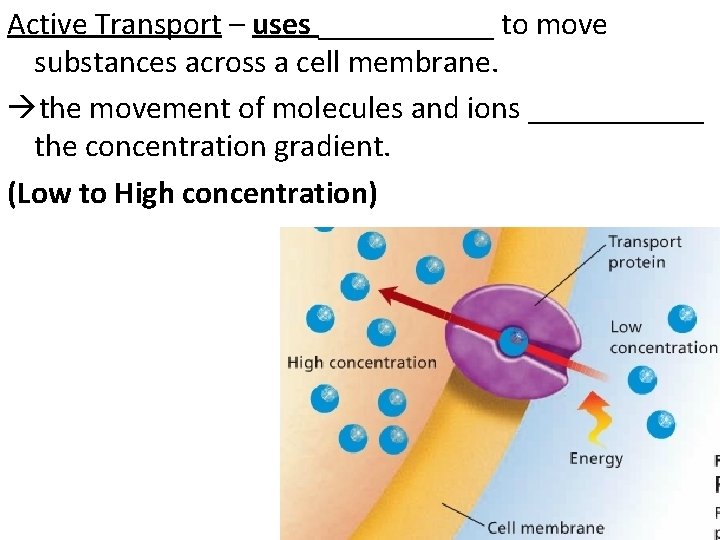
Active Transport – uses ______ to move substances across a cell membrane. the movement of molecules and ions ______ the concentration gradient. (Low to High concentration)
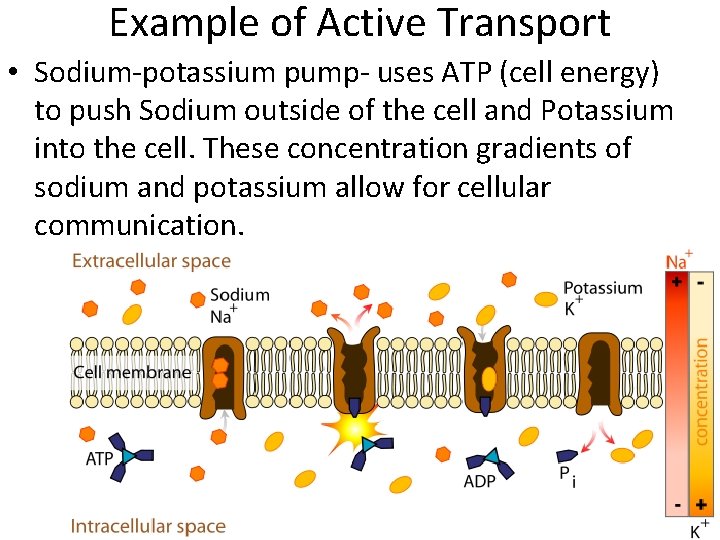
Example of Active Transport • Sodium-potassium pump- uses ATP (cell energy) to push Sodium outside of the cell and Potassium into the cell. These concentration gradients of sodium and potassium allow for cellular communication.
Types of Active Transport • Bulk Movement (______ molecules)- Transporting very large molecules such as polysaccharides or large proteins across the membrane. • Materials all move across the cell membrane packaged in membranebound sacs called ______. The vesicle merges with the cell membrane.
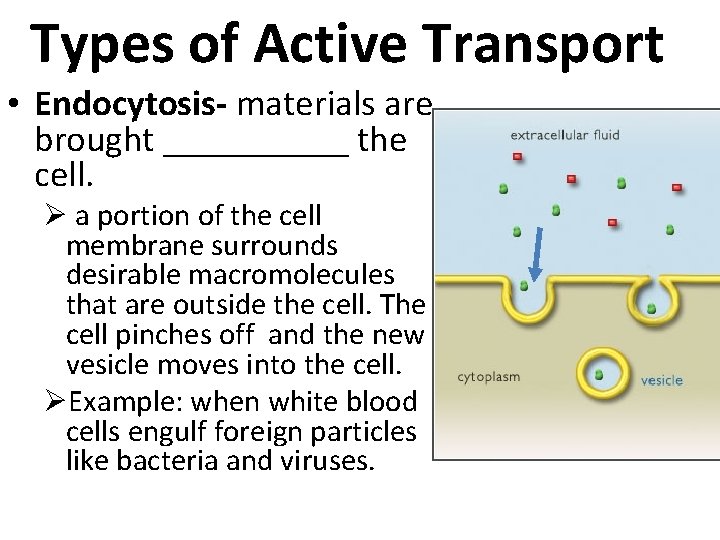
Types of Active Transport • Endocytosis- materials are brought ______ the cell. Ø a portion of the cell membrane surrounds desirable macromolecules that are outside the cell. The cell pinches off and the new vesicle moves into the cell. ØExample: when white blood cells engulf foreign particles like bacteria and viruses.
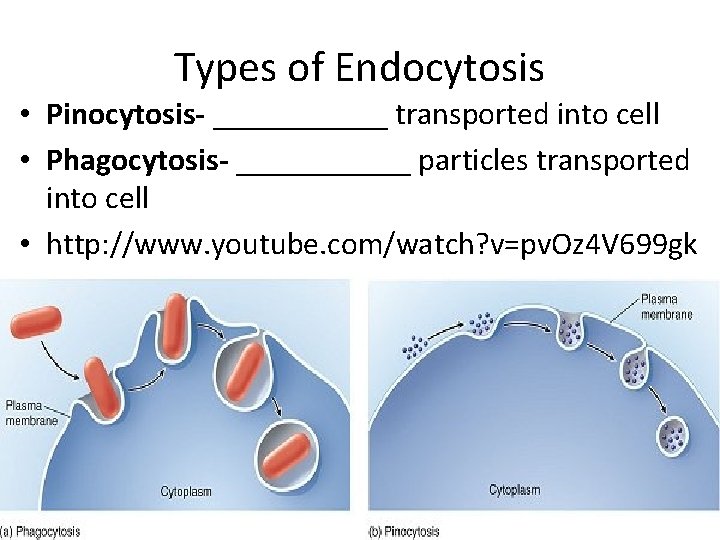
Types of Endocytosis • Pinocytosis- ______ transported into cell • Phagocytosis- ______ particles transported into cell • http: //www. youtube. com/watch? v=pv. Oz 4 V 699 gk
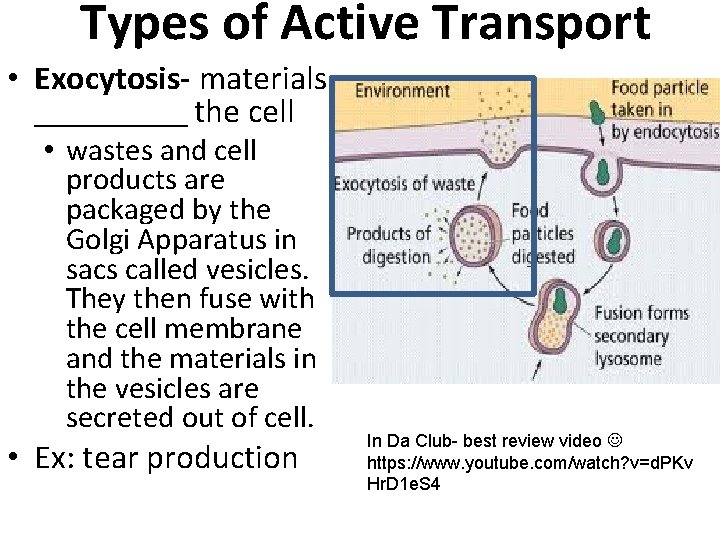
Types of Active Transport • Exocytosis- materials ______ the cell • wastes and cell products are packaged by the Golgi Apparatus in sacs called vesicles. They then fuse with the cell membrane and the materials in the vesicles are secreted out of cell. • Ex: tear production In Da Club- best review video https: //www. youtube. com/watch? v=d. PKv Hr. D 1 e. S 4
- Slides: 23