
Cellular Structure and Function Section 1 Cell Discovery
- Slides: 42
Cellular Structure and Function Section 1: Cell Discovery and Theory Section 2: The Plasma Membrane Section 3: Structures and Organelles Section 4: Cellular Transport Click on a lesson name to select.
Section 1 History of Cell Theory • Pre-microscopic era: – People believed that diseases were caused by supernatural powers. – This was because they had no idea bacteria or viruses existed
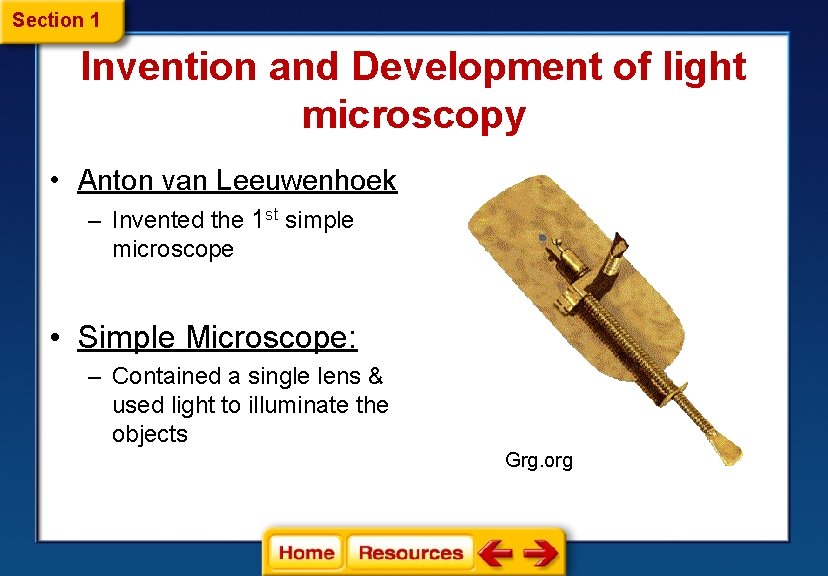
Section 1 Invention and Development of light microscopy • Anton van Leeuwenhoek – Invented the 1 st simple microscope • Simple Microscope: – Contained a single lens & used light to illuminate the objects Grg. org
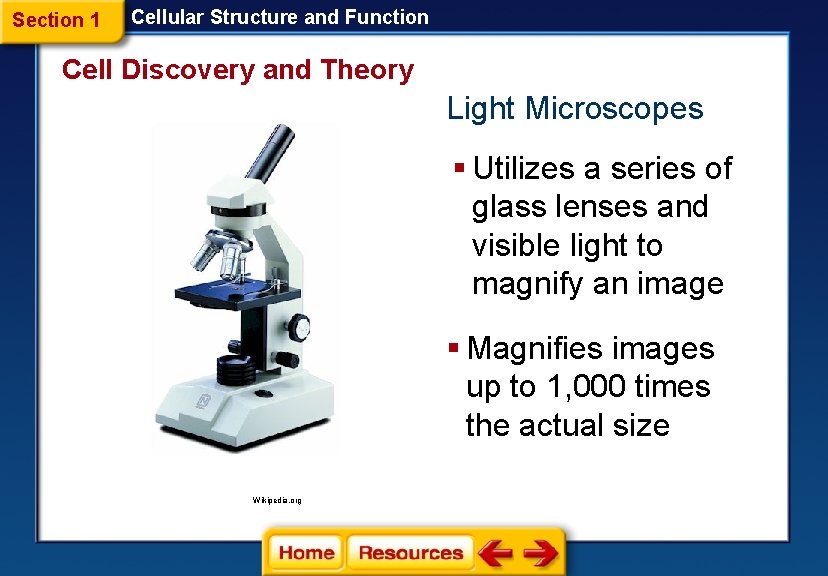
Section 1 Cellular Structure and Function Cell Discovery and Theory Light Microscopes § Utilizes a series of glass lenses and visible light to magnify an image § Magnifies images up to 1, 000 times the actual size Wikipedia. org
Section 1 Cell Discovery and Theory • Robert Hooke 1665 – Used a homemade cpd. Microscope to look at cork cells from and oak tree – He coined the term “cell” because the cork cells reminded him of the rooms that monks lived in at the monastery
Section 1 Cell Discovery and Theory • Schleiden & Schwann – Both German scientists – Schleiden Studied plants and determined that they were made of cells – Schwann Studied animals and determined that they were made of cells
Section 1 Cell Discovery and Theory • Rudolph Virchow: – studied cells under a microscope and discovered them dividing and forming new cells.
Section 1 Cellular Structure and Function Cell Discovery and Theory The Cell Theory § All organisms are composed of one or more cells. § The cell is the basic unit of structure and organization of organisms. § All cells come from preexisting cells.
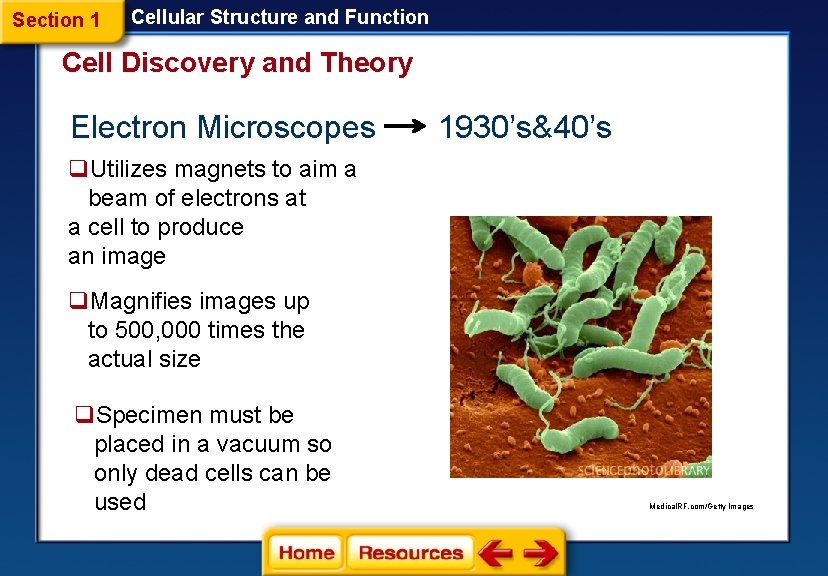
Section 1 Cellular Structure and Function Cell Discovery and Theory Electron Microscopes 1930’s&40’s q. Utilizes magnets to aim a beam of electrons at a cell to produce an image q. Magnifies images up to 500, 000 times the actual size q. Specimen must be placed in a vacuum so only dead cells can be used Medical. RF. com/Getty Images
Section 1 Electron Microscope continued…. . • 3 Types: – S. E. M Scanning Electron Microscope scans the surfaces of cells – T. E. M Transmission Electron Microscope looks inside the cell – S. T. M Scanning Tunneling Microscope makes computer images of atoms on the surface of molecules
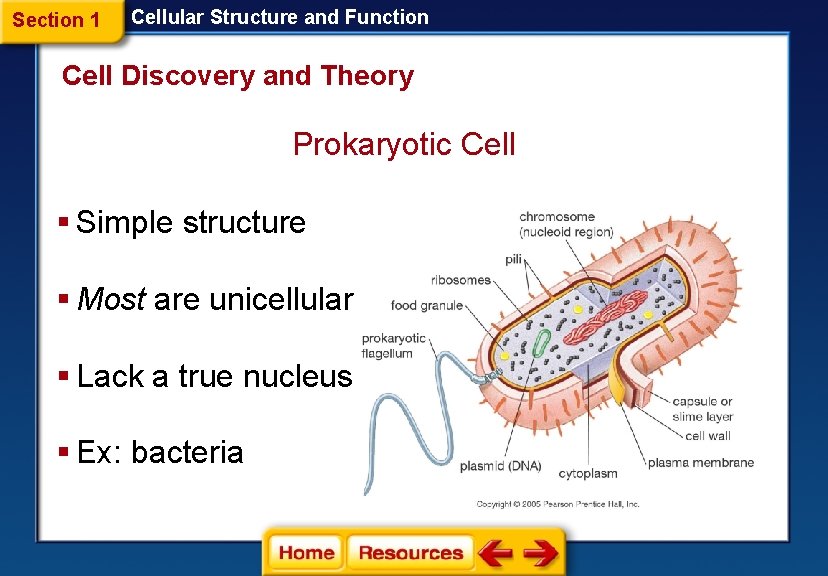
Section 1 Cellular Structure and Function Cell Discovery and Theory Prokaryotic Cell § Simple structure § Most are unicellular § Lack a true nucleus § Ex: bacteria
Section 1 Prokaryotic Cell continued… q. Contains a plasma membrane q. Does NOT contain membrane-bound organelles q. Concentrated region containing DNA/RNA is called the nucleoid q. Most metabolism takes place in the cytoplasm
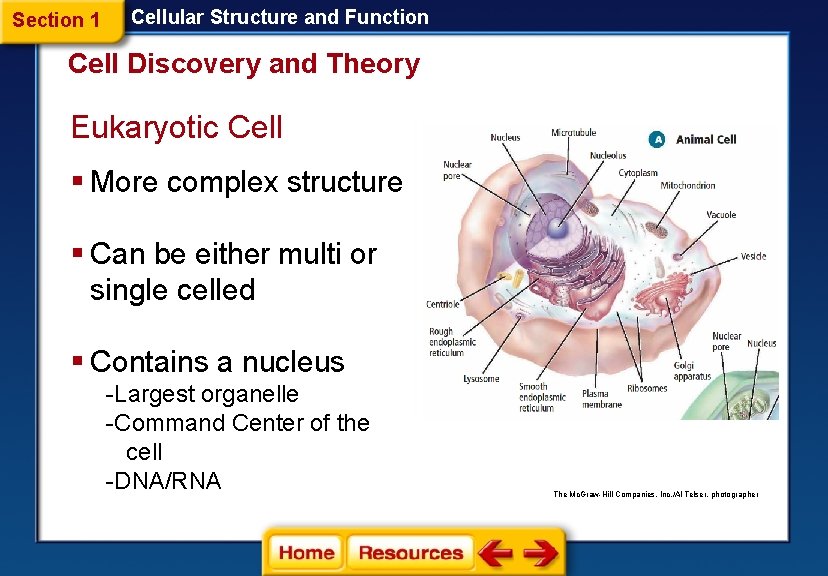
Section 1 Cellular Structure and Function Cell Discovery and Theory Eukaryotic Cell § More complex structure § Can be either multi or single celled § Contains a nucleus -Largest organelle -Command Center of the cell -DNA/RNA The Mc. Graw-Hill Companies, Inc. /Al Telser, photographer
Section 1 Eukaryotic Cell continued… § Contains membrane-bound organelles – Each separate organelle carries out a specialized function § Contains a plasma membrane § Ex: animal, plant, fungi, protist cells
Section 2 -3 Cellular Structure and function
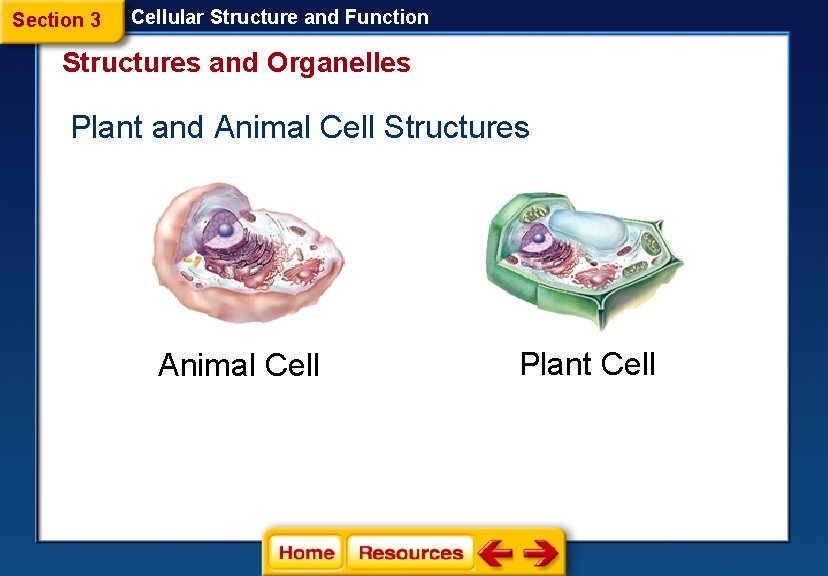
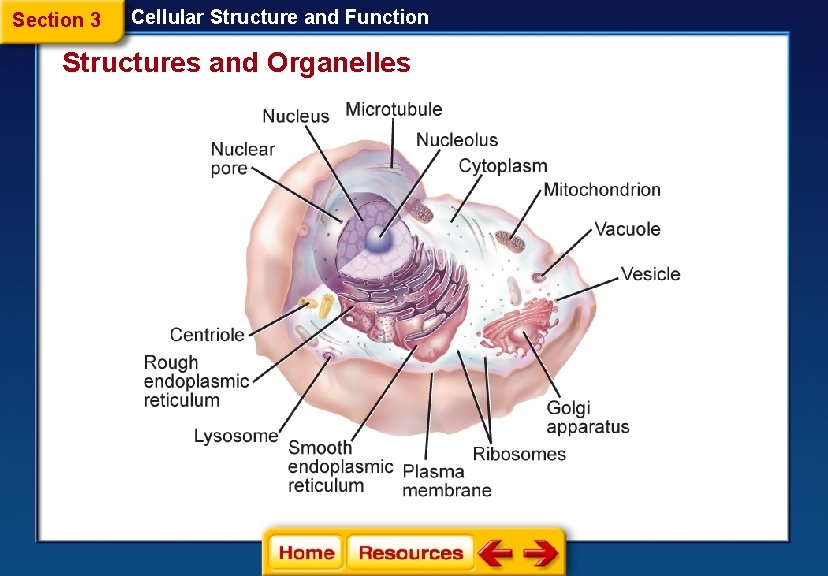
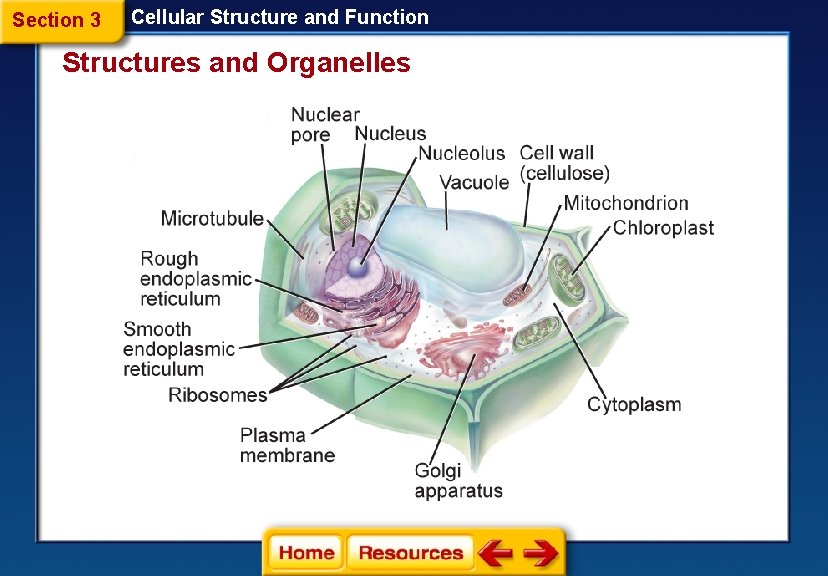
Section 3 Cellular Structure and Function Structures and Organelles Plant and Animal Cell Structures Animal Cell Plant Cell
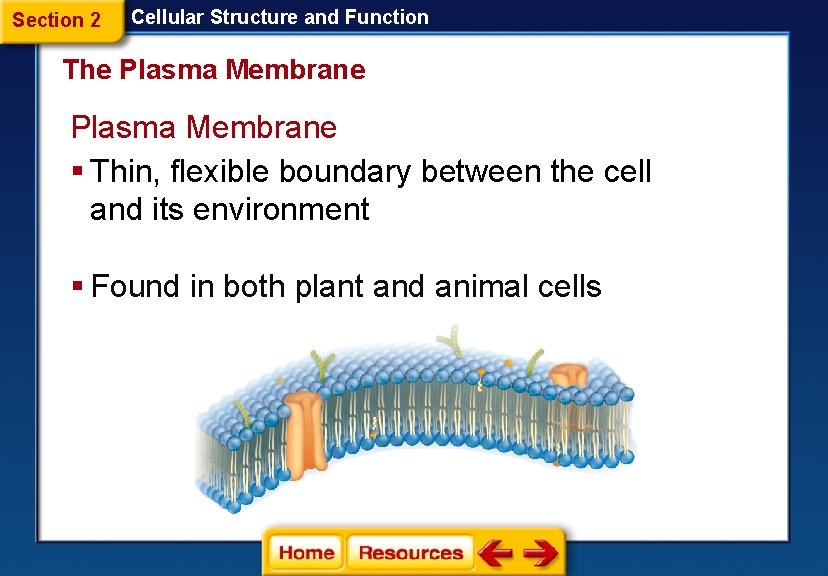
Section 2 Cellular Structure and Function The Plasma Membrane § Thin, flexible boundary between the cell and its environment § Found in both plant and animal cells
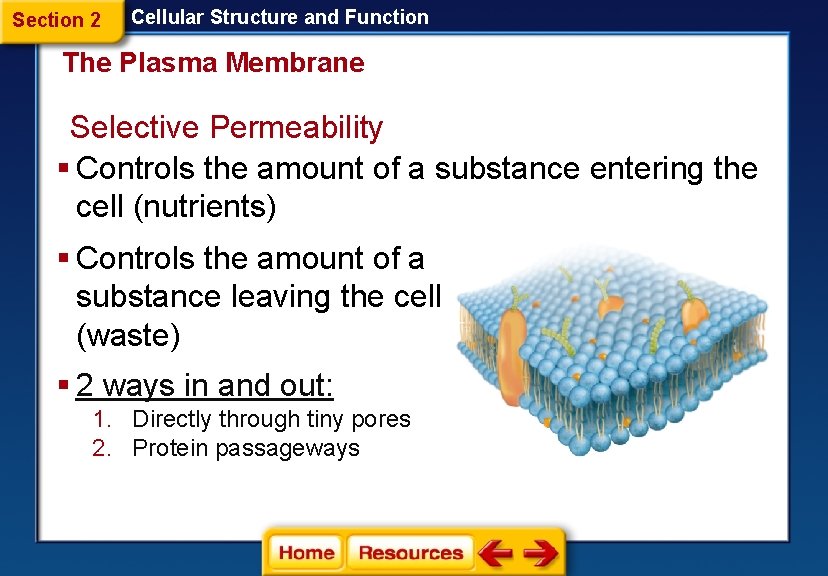
Section 2 Cellular Structure and Function The Plasma Membrane Selective Permeability § Controls the amount of a substance entering the cell (nutrients) § Controls the amount of a substance leaving the cell (waste) § 2 ways in and out: 1. Directly through tiny pores 2. Protein passageways
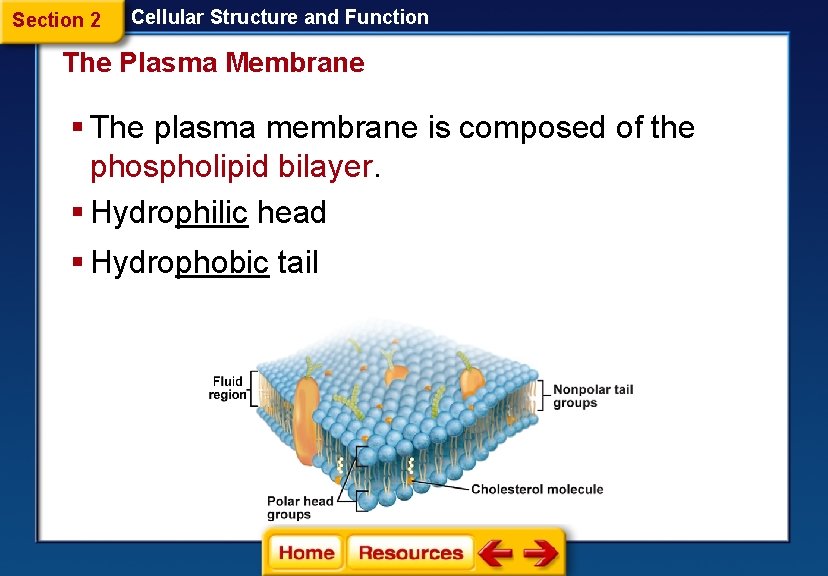
Section 2 Cellular Structure and Function The Plasma Membrane § The plasma membrane is composed of the phospholipid bilayer. § Hydrophilic head § Hydrophobic tail
Section 2 Cellular Structure and Function
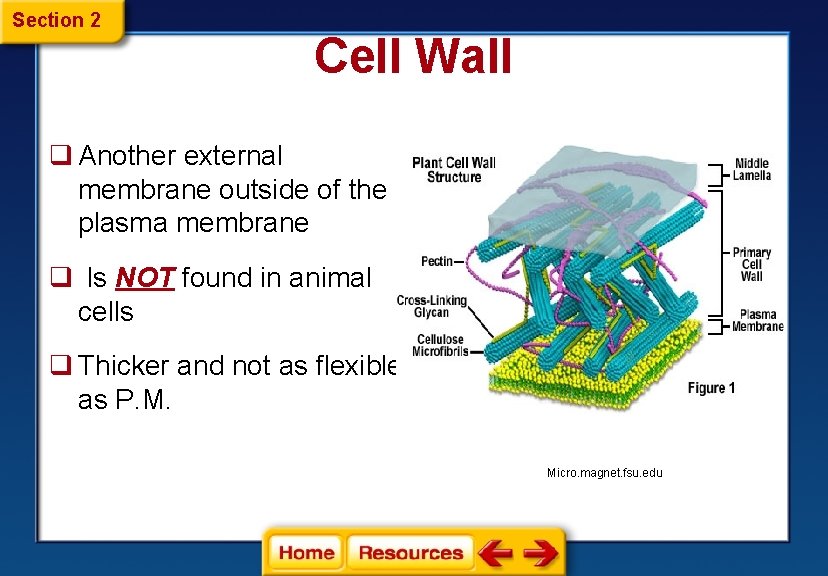
Section 2 Cell Wall q Another external membrane outside of the plasma membrane q Is NOT found in animal cells q Thicker and not as flexible as P. M. Micro. magnet. fsu. edu
Section 2 Cell Wall q. Cell walls provide the cells w/ structure and support. q. Plants-cellulose q. Fungi-chitin q. Bacteria-peptidoglycan
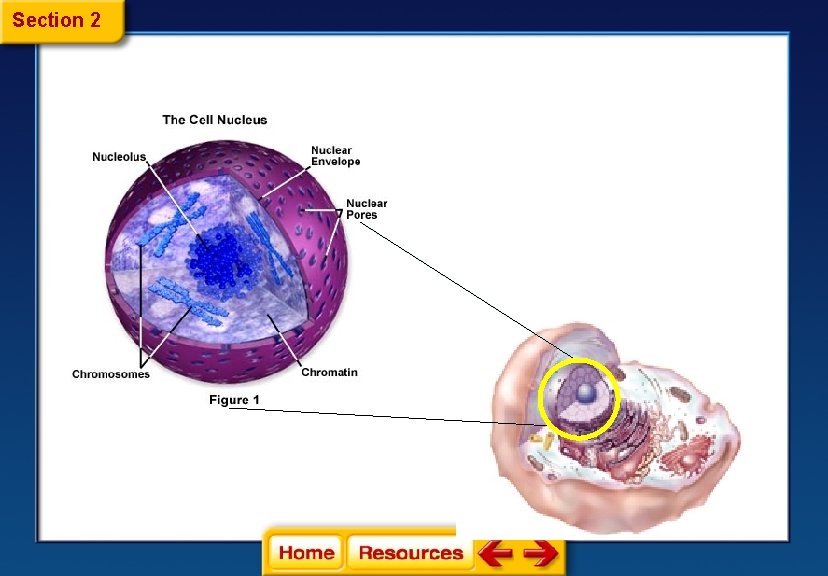
Section 2 Organelles that control cellular functions (little organ) q Nucleus- largest organelle. Called cell manager or command center of cell. - Nuclear envelope: outer 4 layers of the nucleus. Contains pores so materials can pass b/w nucleus and cytoplasm - DNA: (Deoxy ribonucleic acid) found inside of the nucleus & is the master protein prod. - Chromatin: long strands of DNA that form chromosomes during mitosis & meiosis ( Cell reproduction) - Nucleolus & Ribosomes: nucleolus sm/dense region inside nucleus and produces ribosomes. Ribosomes assemble proteins.
Section 2
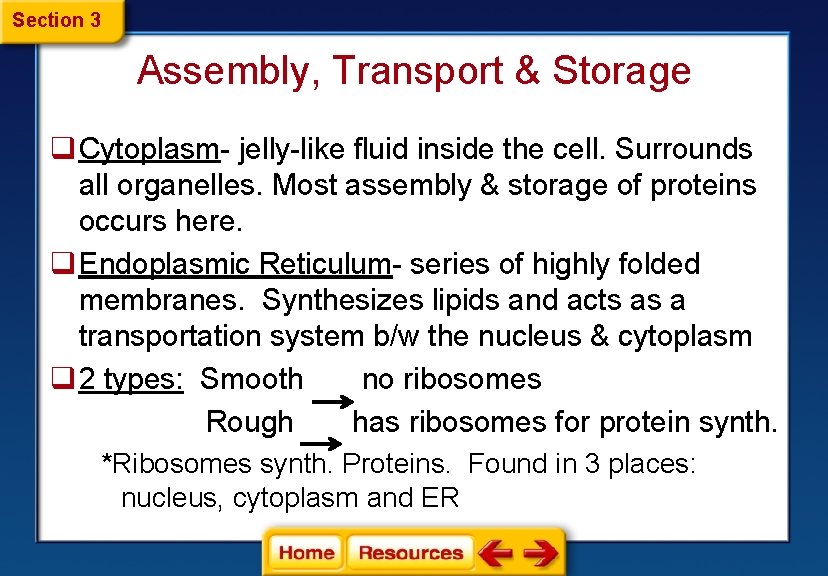
Section 3 Assembly, Transport & Storage q Cytoplasm- jelly-like fluid inside the cell. Surrounds all organelles. Most assembly & storage of proteins occurs here. q Endoplasmic Reticulum- series of highly folded membranes. Synthesizes lipids and acts as a transportation system b/w the nucleus & cytoplasm q 2 types: Smooth no ribosomes Rough has ribosomes for protein synth. *Ribosomes synth. Proteins. Found in 3 places: nucleus, cytoplasm and ER
Section 3 Structures for Storage q 3 Main Places for Storage: 1. Golgi Apparatus 2. Vacuoles 3. Lysosomes
Section 3 Golgi Apparatus q Series of closely stacked, flattened membranes q Function: it receives the newly made proteins & lipids. G. A. may modify these , it then sorts & packages them to be distributed to the P. M. or other organelles q Proteins get pinched off & enclosed in packages called vesicles, then mod. & shipped to their final destination.
Section 3 Vacuoles q. Used for temporary storage of: q. Food q. Enzymes q. Waste products q. Excess H 2 O q. Any other materials needed by the cell *Plants have 1 large vacuole
Section 3 Lysosomes q “suicide sacs” q Function: contain enzymes to digest excess or worn out cell parts, food particles, or invading viruses & bacteria *Enzymes do not digest the cell’s proteins because of a protective membrane.
Section 3 Lysosomes cont. … q What relationship do lysosomes sometimes share w/ vacuoles? Lysosome will sometimes fuse w/ a vacuole to dispense its enzymes into the vacuole to digest the vacuole's contents. q When might a lysosome digest the cell that contains it? Ex. Lysosomes will digest the tail of a tadpole. The digested parts can then be used to form the legs.
Section 3 Energy Transformers • Mitochondria- plants and animals • Chloroplast- plants
Section 3 Mitochondria q. Structure: this is an organelle made of 2 layers. The inner layer is ly folded q. Function: break down food molecules to release E & produce E storing molecules called ATP
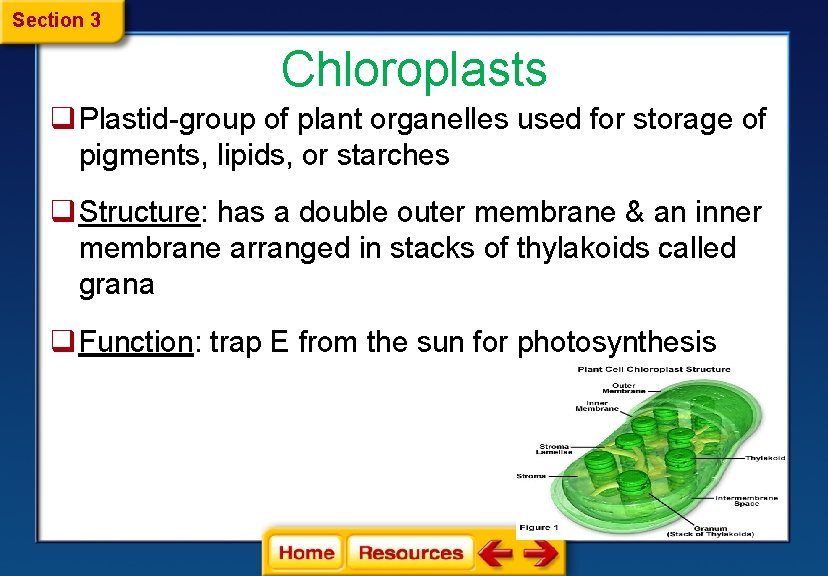
Section 3 Chloroplasts q Plastid-group of plant organelles used for storage of pigments, lipids, or starches q Structure: has a double outer membrane & an inner membrane arranged in stacks of thylakoids called grana q Function: trap E from the sun for photosynthesis
Section 3 Structures for support and Locomotion q. Cytoskeleton q. Cilia & Flagella
Section 3 Cytoskeleton q Support system of cell. Composed of tiny rods & filaments q Rods & filaments would be analogous to our bones q Structure: 1. tiny hollow rods- microtubules 2. tiny solid filaments- microfilaments q Function: supports the cell and give it shape.
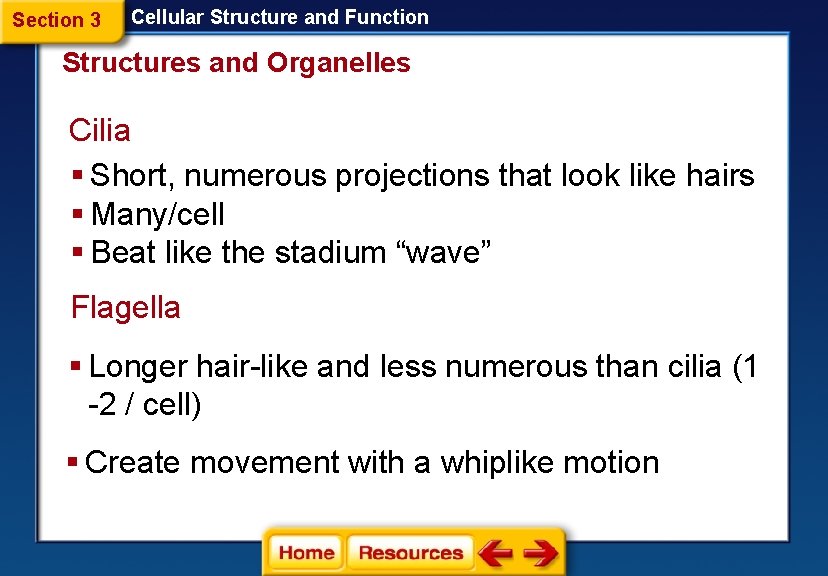
Section 3 Cellular Structure and Function Structures and Organelles Cilia § Short, numerous projections that look like hairs § Many/cell § Beat like the stadium “wave” Flagella § Longer hair-like and less numerous than cilia (1 -2 / cell) § Create movement with a whiplike motion
Section 3 Cellular Structure and Function Structures and Organelles
Section 3 Cellular Structure and Function Structures and Organelles
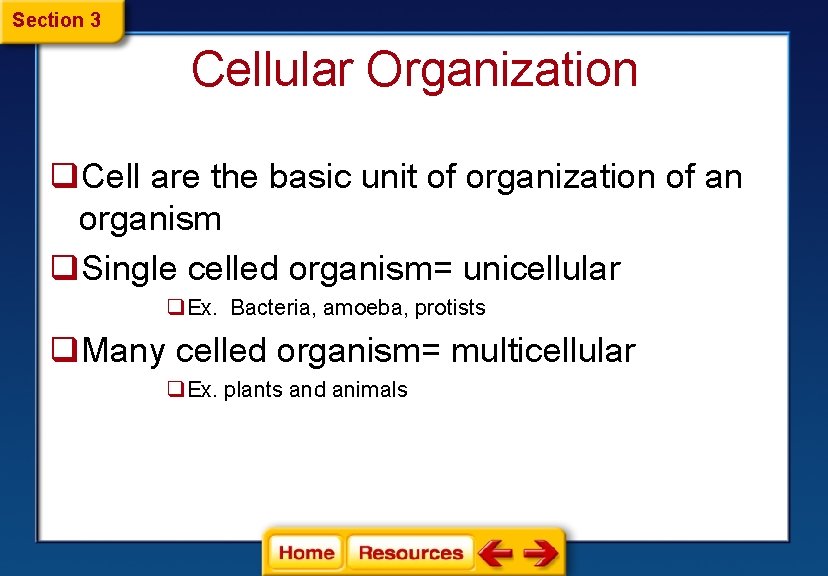
Section 3 Cellular Organization q. Cell are the basic unit of organization of an organism q. Single celled organism= unicellular q. Ex. Bacteria, amoeba, protists q. Many celled organism= multicellular q. Ex. plants and animals
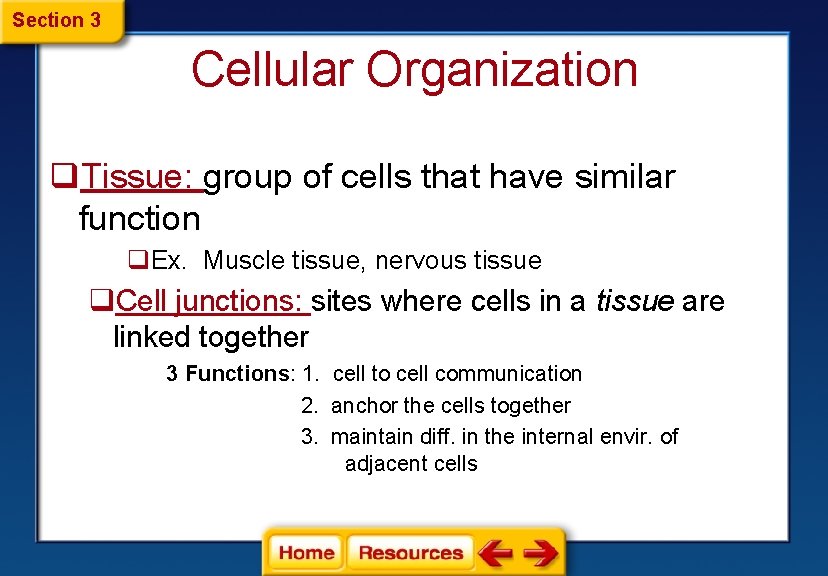
Section 3 Cellular Organization q. Tissue: group of cells that have similar function q. Ex. Muscle tissue, nervous tissue q. Cell junctions: sites where cells in a tissue are linked together 3 Functions: 1. cell to cell communication 2. anchor the cells together 3. maintain diff. in the internal envir. of adjacent cells
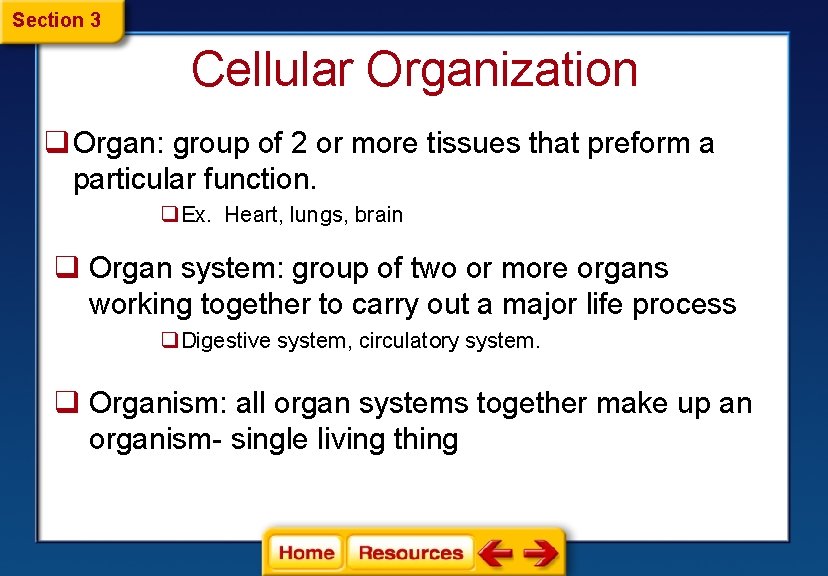
Section 3 Cellular Organization q Organ: group of 2 or more tissues that preform a particular function. q. Ex. Heart, lungs, brain q Organ system: group of two or more organs working together to carry out a major life process q. Digestive system, circulatory system. q Organism: all organ systems together make up an organism- single living thing