
Cellular Signalling Outcome 2 Neuron Synapses electrical Direct
- Slides: 15
Cellular Signalling Outcome 2
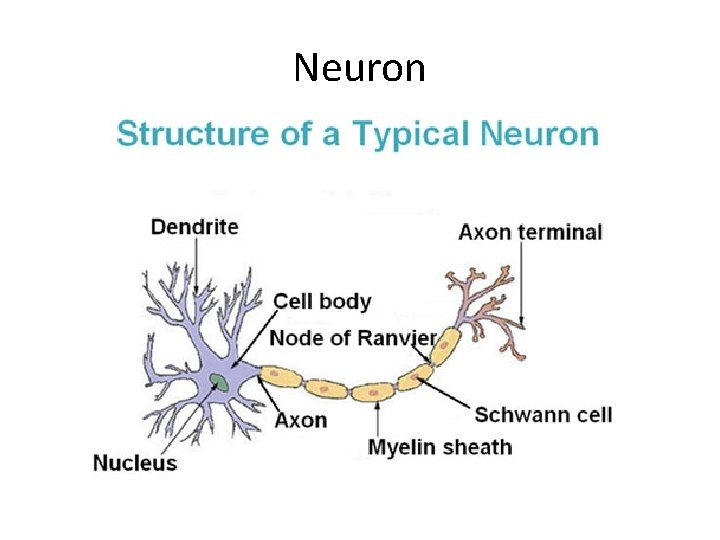
Neuron
Synapses - electrical • Direct contact • Neurons linked by gap junctions – allow ion flow cell to cell. • Rare
Synapses - chemical • Gap = synapse, synaptic cleft • Neurotransmitter synthesised in pre-synaptic neuron, packaged in vesicles • Action potential triggers exocytosis of NT. • NT diffuses across cleft to receptors on postsynaptic membrane • Receptors are ligand-gated ion channels, e. g. if Na+ enters, next AP starts.
Modulation of synaptic transmission • NT binding causes AP – excitatory postsynaptic potential – allow cations in, mostly Na+. • More NT bound to more receptors = bigger signal, more likely to achieve threshold. • If NT binding opens K+ or Cl- channels, threshold less likely, = inhibitory post-synaptic potential.
Summation • No. of NT molecules binding gives different intensity of signal. • If APs come very frequently, and repolariation not possible between, EPSP builds up and more likely to achieve threshold = temporal summation. If IPSP, then less likely. • If NTs come from several neurons/axon terminals to the same post-synaptic membrane, EPSP builds up and more likely to achieve threshold = spatial summation. If IPSP, then less likely. • If both EPSP and IPSP are happening, can counteract and cancel out at a neuron.
Nerve Impulse – resting potential • Caused by changes in the voltage (membrane potential) across the plasma membrane, possible due to the presence of gated ion channels allowing ion movement. • All cells have membrane potential, due to differences in ion concentrations; anions more concentrated inside and cations outside the cell. • The membrane potential of unstimulated neuron (about – 70 m. V) = resting potential. • Maintained by the sodium-potassium pump (Na+K+ ATPase pump), energy from ATP. More K+ inside, more Na+ outside.
Generating Action Potential • Resting State – Membrane potential maintained by active transport; gated ion channels closed. • Threshold – A stimulus opens some Na+ gated channels. Stronger stimulus, more channels open. Na+ suddenly enters axon. Inside becomes more positive, reducing voltage across the membrane: depolarisation. If depolarisation reaches a threshold level in the axon, about – 50 m. V, an action potential can be triggered. • Depolarisation to action potential – Stimulus of threshold potential causes more gated sodium channels to open. Inside the axon becomes more positive than the outside of the cell, i. e. the polarity of the membrane is reversed, up to +40 m. V.
• Repolarisation – Almost immediately the sodium channels close and potassium channels open, K+ leaves the cell, the inside returns to being more negative than the outside. The mebrane is repolarised. • Undershoot – Repolarisation tends to allow too much K+ movement, as the gates react more slowly than sodium gates, so the membrane potential can drop below the resting state, but once the gates close the resting state is restored. • Propagation of the action potential – The action potential does not travel along the axon, but is repeatedly generated. – Local electrical circuits are set up between the region of membrane with the positive membrane potential and the adjacent negative section. Causes the gated Na+ channels in the adjacent region to open, depolarising the membrane and setting up a new action potential there. This is repeated to the end of the axon. – Each action potential is the same as the last, meaning the signal does not degenerate. – The signal cannot go back because the previously active region is recovering (refractory period) which could only be overcome by a very intense stimulus.
Monoaminergic Neurotransmitters Adrenaline, dopamine, serotonin a- or b-adrenergic receptors for adrenaline GPCR – inhibitory or excitatory 5 -HT(3 A) receptor for serotonin only ion-channel receptor in group, faster than GPCR ones. • Synthesis of monoamines: Tyrosine → DOPA → Dopamine → Noradrenaline → Adrenaline • Inactivation: • • – Noradrenaline by monoamine oxidase – Serotonin by 5 -HT reuptake transporter protein
Aminoadrenergic neurotransmitters • Glutamate, GABA • Receptors: • Ionotropic = ligand-gated ion channels; e. g for GABA for Cl-, give IPSP. • Metabotropic = GPCR linked to PLC, mobilises Ca 2+.
Cholinergic neurotransmitters • Acetylcholine • Receptors: • Ionotropic (nicotinic) = ligand-gated ion channels; usually for Na+ and K+. Very rapid, short-lived signal. E. g. Excitatory receptor at neuromuscular junction. • Metabotropic (muscarinic) = GPCR linked to adenylyl cyclase or PLC. • Synthesis: Choline + acetyl (from acetyl Co. A) by choline acetyltransferase. • Inactivation – by cholinesterase to choline + acetate.
Purinergic neurotransmitters • Adenosine • Inhibitory or excitatory receptors linked to adenylyl cyclase. • E. g. Modulation of heartbeat.
Neuropeptide neurotransmitters • Substance P – 11 aa peptide • Pain, mood, anxiety, stress • Excitatory at a GPCR.
NO • No receptor; interacts directly with guanylyl cyclase within the cell; second messenger c. GMP. • Relaxes heart muscle and smooth muscle of arterial walls, leading to vasodilation and increased blood flow.