
Cellular Response Adaptive Non Adaptive Disturbances of growth
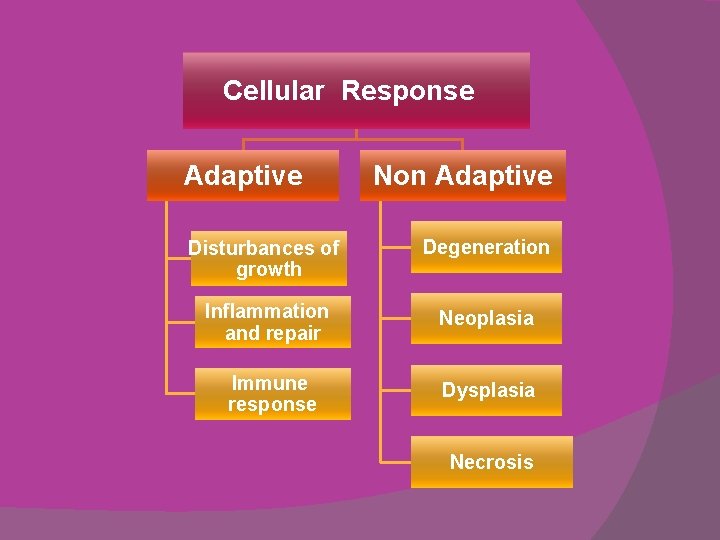
Cellular Response Adaptive Non Adaptive Disturbances of growth Degeneration Inflammation and repair Neoplasia Immune response Dysplasia Necrosis

INFLAMMATION

Definition -it’s a body response against injury , it’s � a first line of defense. -Protective adaptive tissue response to injury. �

Causes of Inflammation: By injurious agents called irritants. It are different types: 1 -Living Irritants: bacteria, virus, parasites. 2 -Non Living Irritants: a-Chemical: Acids, alkalis and poisons. b-Physical: Heat, cold, ionizing radiation. c-Mechanical: Trauma, cut. 3 -Antigens: cause allergic inflammation.

Mechanism: 1. Vascular response 2. Cellular response 1. Vascular Response A-Vasodilatations of arterioles in local blood flow redness and hotness = (hypraemia). B-Increase in capillary permeability leakage of fluid local swelling. C-Release of mediators pain.

1 - inflammatory reaction “dilated blood vessels” The widening of blood vessels resulting from relaxation of smooth muscle cells in vessel walls

Mechanism: 2. Cellular Response: -Margination of WBCs. -Emigration (Diapedesis). -Chemotaxis. -Phagocytosis.

Cellular Response Margination: The polymorphnuclear leucocytes leave the blood and adhesion to the margin of the endothelial lining of the capillaries. Emigration : The polymorphnuclear leucocytes pass between the endothelial cells through the vessels wall by amoeboid movement into damage tissue.

Cellular Response Chemotaxis: Is the directed movement of the polymorph-nuclear leucocytes and macrophages in the area of inflammation. Phagocytosis: Is the ingestion and destruction of the foreign particles by the phagocytic inflammatory cells.

2 - Margination of WBC’s: PMN move to the peripheral B. V & adherent to endothelium B. V wall , this process called "Margination of WBC’s

3 - Emigration of WBC’s PMN or WBCs migration from vessels lumen into area of tissue damage, this process called" Emigration of WBC’s"

Inflammation types: 1 - acute. 2 - chronic. 3 -sub-acute.

Inflammation types: 1 - Acute inflammation: Sudden onset and short duration. -Cellular response Polymorphnuclear leucocytes, pus cells and macrophages. - Vascular response Numerous, thin walled, dilated blood vessels.

4 - Acute inflammatory cells: Mainly we see PMNL & small amount of macrophages. PMNL= WBCs refer to neutrophil , cytoplasm contain fine violet granules , several lobes of nucleus , Pus cells= dead PMN lymphocytes or dead neutrophil. Machrophages=usually seen in acute & chronic inflammationl, Function of machrophages: 1 -phagocytosis &killing of bacteria. 2 -phagocytosis of necrotic debris. 3 -formation of giant cells.

Inflammation types: 2 - Chronic Inflammation: Gradual onset and prolonged duration connective tissue formation). -Cellular response Lymphocytes, macrophages, plasma cells and giant cells. - Vascular response Few, thick walled, narrow blood vessels.

Inflammation types: 3 - Sub-acute Inflammation: in between the acute and the chronic

5 - chronic inflammatory cells Lymphocytes: WBCs, distinguished by dark blue round nuclei & small amount of cytoplasm. Plasma cells : WBCs, it is mature B-cell , identified by extensive basophilic cytoplasma & small eccentric nuclei( specific seen in chronic inflammation), it is produce large antibodies Fibroblast: is type of cell synthesizes C. T &plays critical role in wound healing Foreign body giant cell: is fused macrophages which are generated in response to present large foreign body, nuclei are arranged in disorganized manner. Langhans giant cell: is fusion of macrophages & contain arranged in horse shoeshaped pattern in cell periphery, found in granulomatous & tuberculosis conditions.

6 - chronic inflammatory cells Mainly we have Plasma cell , lymphocytes. &Fibroblast cells to form

7 - chronic inflammatory cells: Mainly plasma cell , small amount of lymphocytes , macrophages & fibroblast cells to form C. T

8 - Giant cell ( langerhan’s) specific : Atypical langhans giant cell formed by fusion of macrophages in tuberculosis granuloma , contain nuclei horse shoe-shaped

9 - Giant cell (foreign body) nonspecific: Giant cell, nuclei arranged in disorganization pattern, fibroblast & few lymphocytes.

10 - Acluster of giant cells around (foreign body) : A cluster of giant cells around (foreign body )&number of lymphocytes.
- Slides: 22