
Cellular Respiration Syllabus Objectives State that respiration takes
Cellular Respiration
Syllabus Objectives State that respiration takes place at the level of the cell Describe the process of aerobic respiration State the function of ATP (adeosine triphosphate) in energy transfer Distinguish between aerobic and anaerobic respiration Carry out and interpret results from simple controlled investigations to demonstrate the products of respiration
Introduction Definition Process living organisms undergo to release energy from food (substrate) The energy released is used to carry out all metabolic activities in living organisms Respiration involves several steps controlled by enzymes There are TWO main types of respiration: AEROBIC ANAEROBIC
AEROBIC Respiration Glucose is oxidized in many small steps to form carbon dioxide, water and energy. The important energy releasing steps take place in the mitochondria The energy is stored temporarily in ATP molecules The energy is readily available for use when required in this form

AEROBIC Respiration Equation The overall equation can be summarized as follows: C 6 H 12 O 6 + 6 O 2 6 CO 2 + 6 H 2 O + Energy glucose + oxygen + ATP carbon + water dioxide
AEROBIC Respiration Summary: Glucose (or fat) is used as a substrate to provide energy Energy is released in slow, controlled process The energy released is temporarily stored in ATP Oxygen is used in the process Carbon dioxide and water are released
ANAEROBIC Respiration The food (sugar) is only partly oxidized producing a little energy In animals that respire anaerobically the sugar is broken down to form LACTIC ACID and energy No CO 2 is given off In plants and yeast (a fungus) the sugar is converted into ETHANOL (alcohol), carbon dioxide and energy. There are microscopic organisms that are Anaerobes They can live without oxygen Larger organisms can survive for short periods without oxygen
ANAEROBIC Respiration During strenuous exercise, mammalian muscle cells can respire anaerobically for a short time Lactic acid accumulates in the cells causing fatigue Lactic acid is toxic in large quantities and must be broken down before the cells can function normally again
ANAEROBIC Respiration The temporary shortage of oxygen results in an OXYGEN DEBT Extra oxygen is required to break down the lactic acid to carbon dioxide and water. Heavy breathing which continues after vigorous exercise is necessary to pay back the oxygen debt
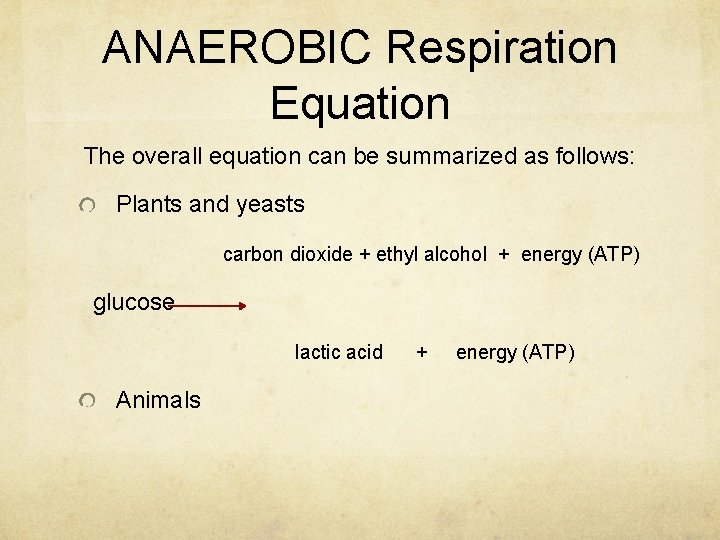
ANAEROBIC Respiration Equation The overall equation can be summarized as follows: Plants and yeasts carbon dioxide + ethyl alcohol + energy (ATP) glucose lactic acid Animals + energy (ATP)
ANAEROBIC Respiration Summary: The events taking place in anaerobic respiration are the same as the first steps in aerobic respiration. During anaerobic respiration: No oxygen is used Little energy is produced Alcohol and carbon dioxide are produced by plants and yeast Only lactic acid is produced by animals
ATP The adenosine triphosphate (ATP) molecule has three phosphate groups. The 3 rd phosphate in adenosine triphosphate (ATP) is easily removed to form adenosine diphosphate (ADP). Energy is released during that reaction The ATP molecule stores energy temporarily and transfers it to the other reactions when necessary
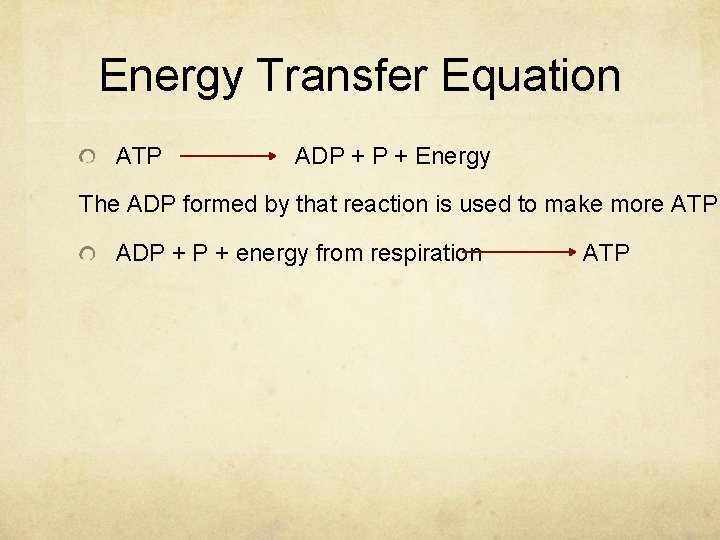
Energy Transfer Equation ATP ADP + Energy The ADP formed by that reaction is used to make more ATP ADP + energy from respiration ATP
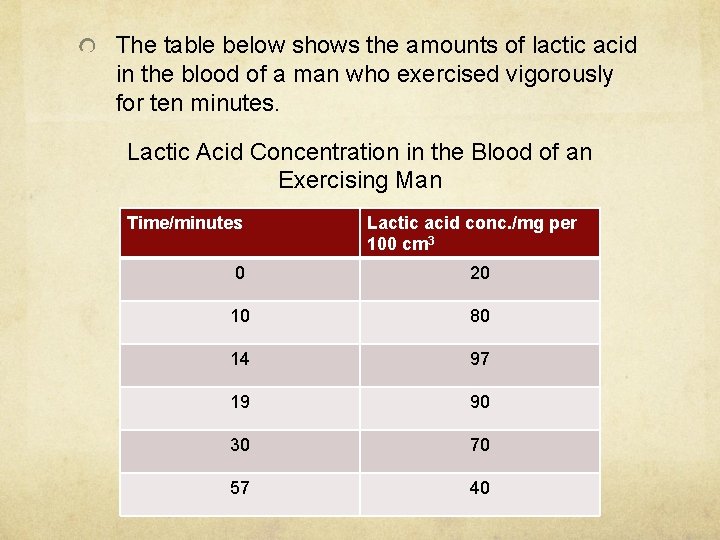
The table below shows the amounts of lactic acid in the blood of a man who exercised vigorously for ten minutes. Lactic Acid Concentration in the Blood of an Exercising Man Time/minutes Lactic acid conc. /mg per 100 cm 3 0 20 10 80 14 97 19 90 30 70 57 40
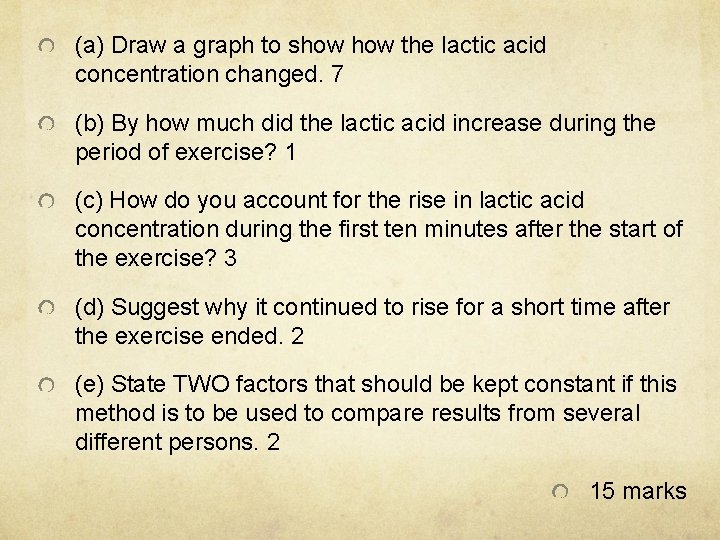
(a) Draw a graph to show the lactic acid concentration changed. 7 (b) By how much did the lactic acid increase during the period of exercise? 1 (c) How do you account for the rise in lactic acid concentration during the first ten minutes after the start of the exercise? 3 (d) Suggest why it continued to rise for a short time after the exercise ended. 2 (e) State TWO factors that should be kept constant if this method is to be used to compare results from several different persons. 2 15 marks
- Slides: 15