
Cellular Respiration Stage 4 Electron Transport Chain AP
- Slides: 21
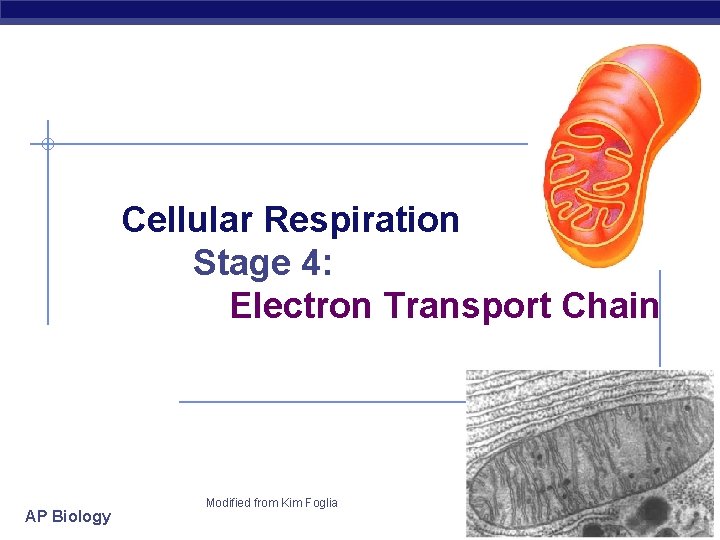
Cellular Respiration Stage 4: Electron Transport Chain AP Biology Modified from Kim Foglia 2006 -2007
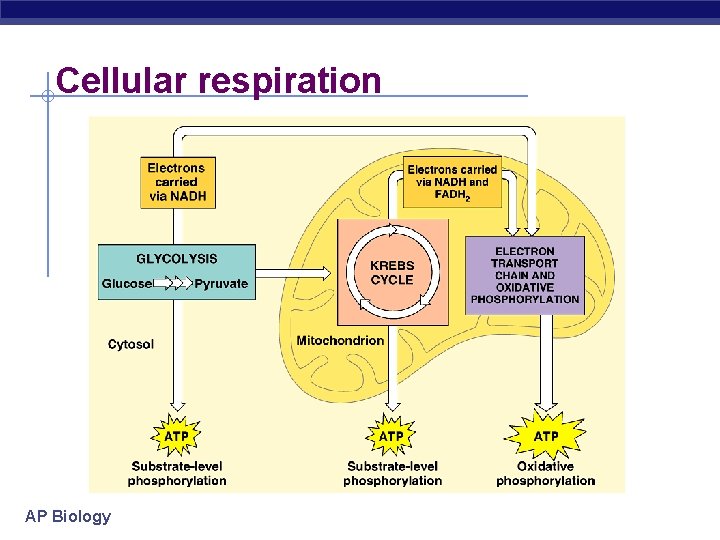
Cellular respiration AP Biology
What’s the point? ATP The Point is to Make ATP! AP Biology 2006 -2007
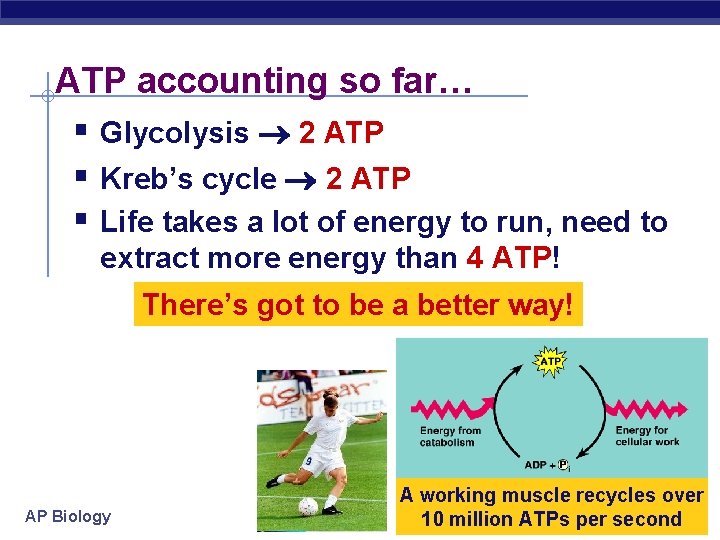
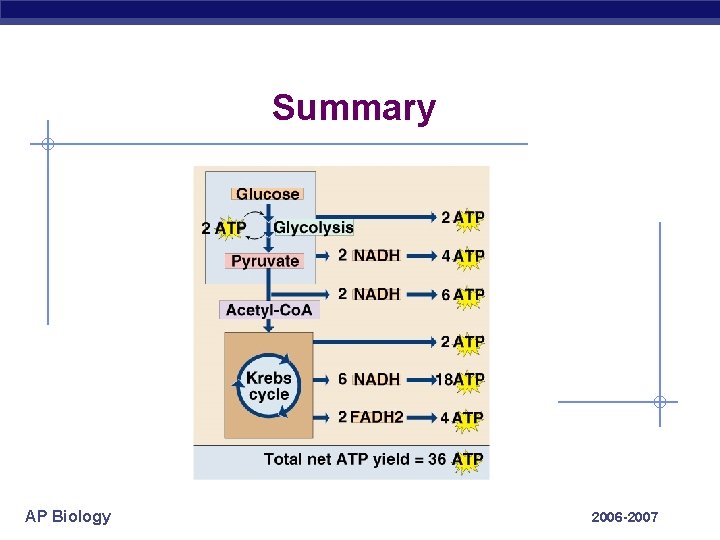
ATP accounting so far… § Glycolysis 2 ATP § Kreb’s cycle 2 ATP § Life takes a lot of energy to run, need to extract more energy than 4 ATP! There’s got to be a better way! AP Biology A working muscle recycles over 10 million ATPs per second
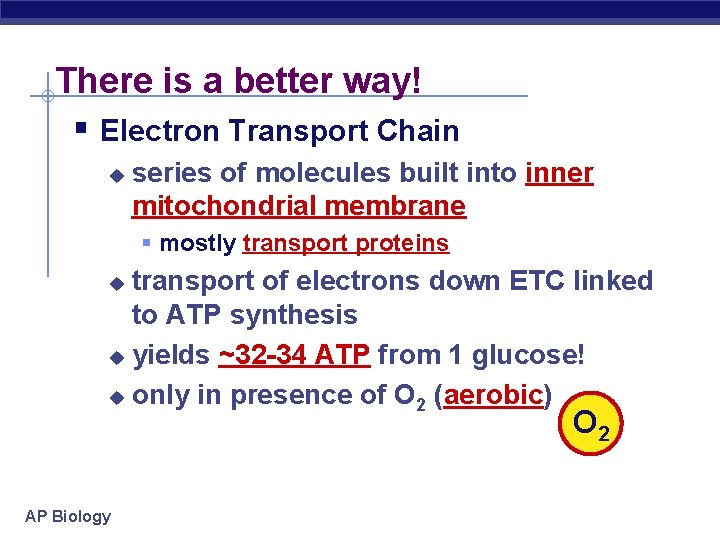
There is a better way! § Electron Transport Chain u series of molecules built into inner mitochondrial membrane § mostly transport proteins transport of electrons down ETC linked to ATP synthesis u yields ~32 -34 ATP from 1 glucose! u only in presence of O 2 (aerobic) u O 2 AP Biology
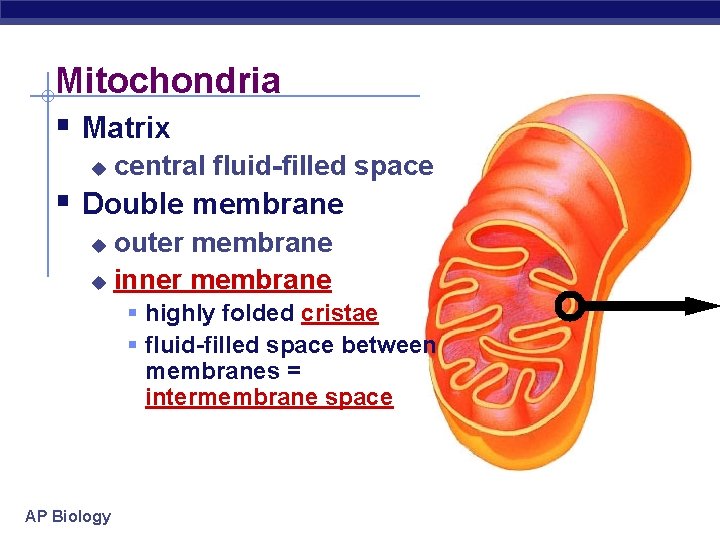
Mitochondria § Matrix u central fluid-filled space § Double membrane outer membrane u inner membrane u § highly folded cristae § fluid-filled space between membranes = intermembrane space AP Biology
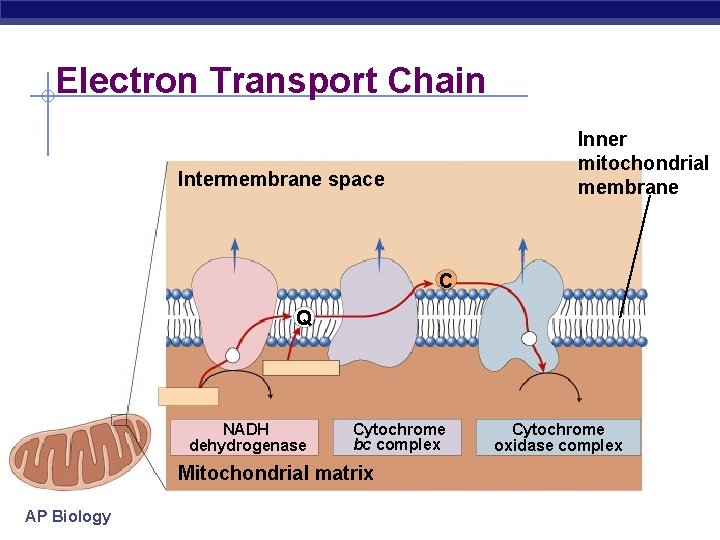
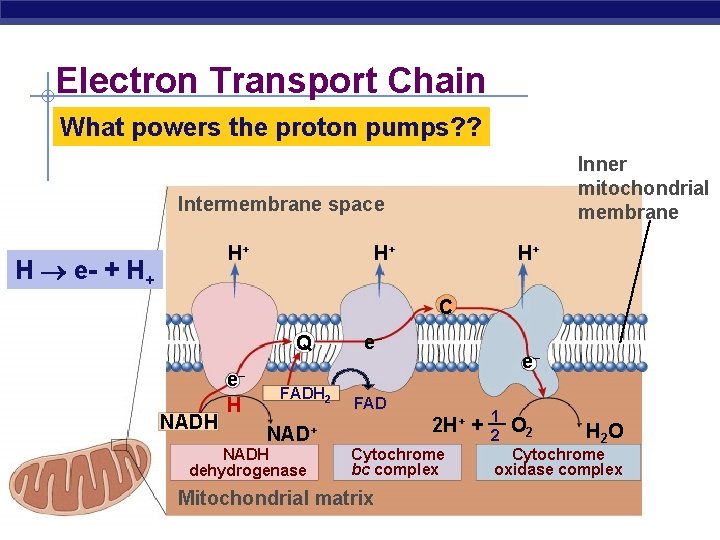
Electron Transport Chain Inner mitochondrial membrane Intermembrane space C Q NADH dehydrogenase Cytochrome bc complex Mitochondrial matrix AP Biology Cytochrome oxidase complex
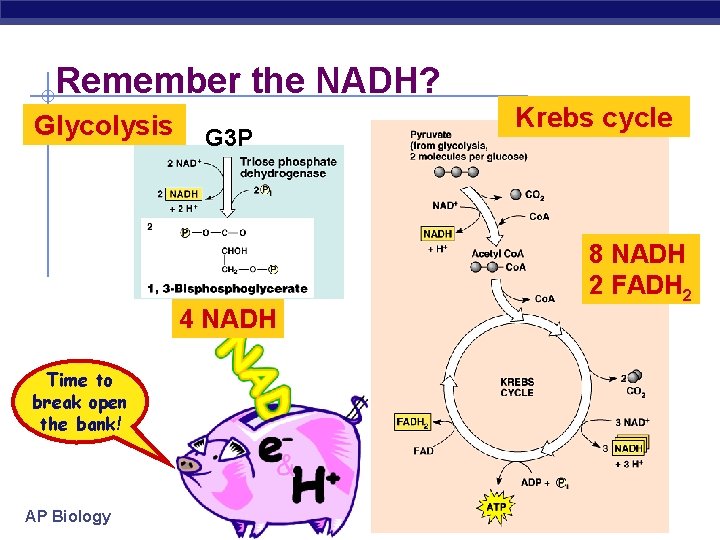
Remember the NADH? Glycolysis G 3 P Krebs cycle 8 NADH 2 FADH 2 4 NADH Time to break open the bank! AP Biology
Electron Transport Chain What powers the proton pumps? ? Inner mitochondrial membrane Intermembrane space H+ H e- + H+ H+ H+ C NADH e– H Q e– FADH 2 FAD AP Biology 2 H+ + NADH dehydrogenase e– Cytochrome bc complex Mitochondrial matrix 1 2 O 2 H 2 O Cytochrome oxidase complex
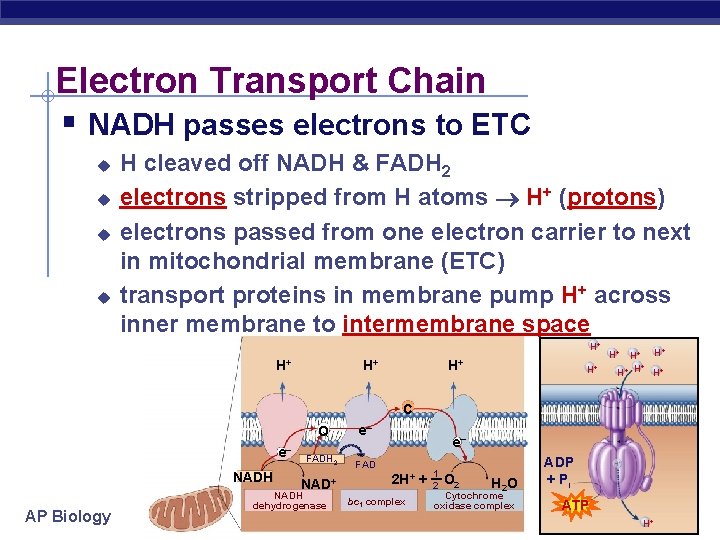
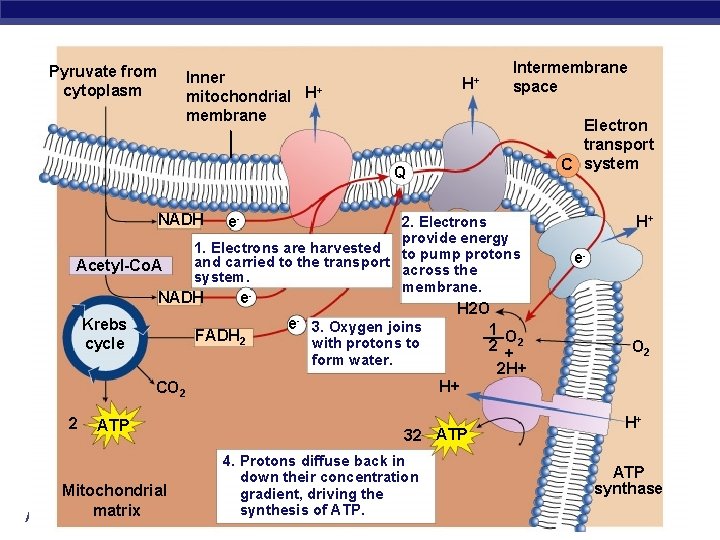
Electron Transport Chain § NADH passes electrons to ETC u u H cleaved off NADH & FADH 2 electrons stripped from H atoms H+ (protons) electrons passed from one electron carrier to next in mitochondrial membrane (ETC) transport proteins in membrane pump H+ across inner membrane to intermembrane space H+ H+ H+ H H+ C e– NADH AP Biology Q e– FADH 2 FAD NAD+ NADH dehydrogenase e– 2 H+ bc 1 complex + 1 2 O 2 H 2 O Cytochrome oxidase complex ADP + Pi ATP H+
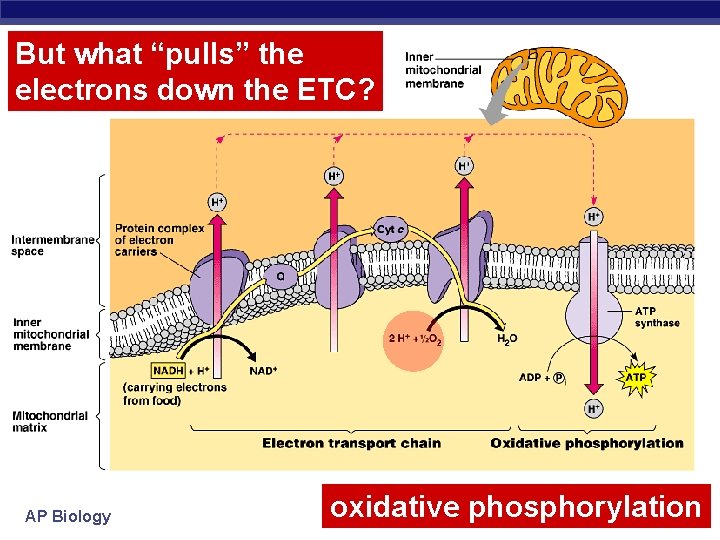
But what “pulls” the electrons down the ETC? AP Biology oxidative phosphorylation
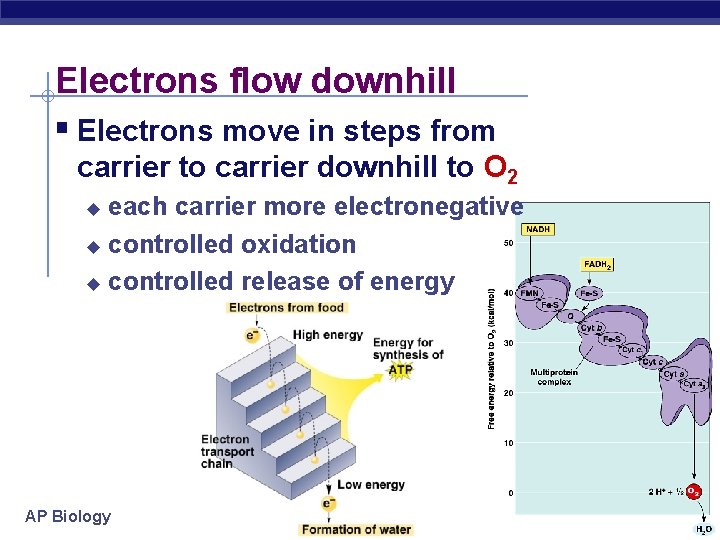
Electrons flow downhill § Electrons move in steps from carrier to carrier downhill to O 2 each carrier more electronegative u controlled oxidation u controlled release of energy u AP Biology
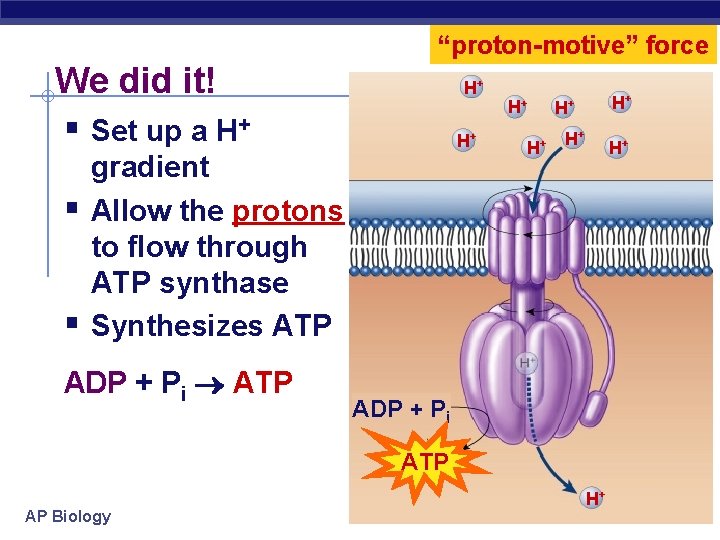
“proton-motive” force We did it! § Set up a H+ § § H+ H+ gradient Allow the protons to flow through ATP synthase Synthesizes ATP ADP + Pi ATP H+ H+ H+ ADP + Pi ATP AP Biology H+
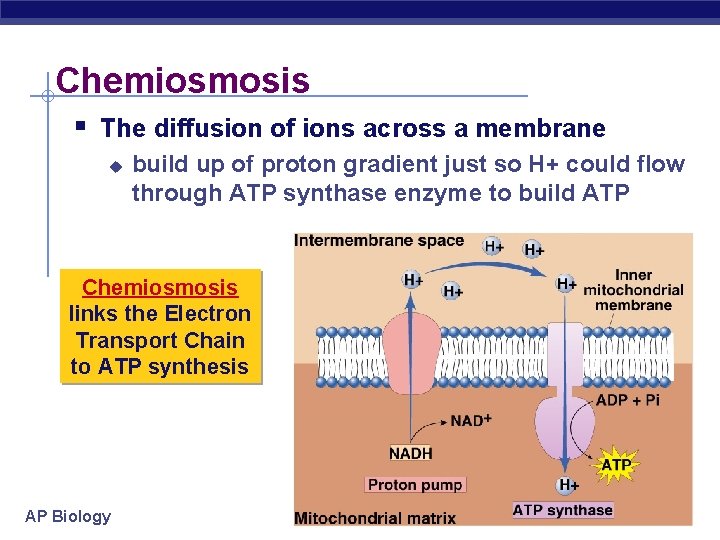
Chemiosmosis § The diffusion of ions across a membrane u build up of proton gradient just so H+ could flow through ATP synthase enzyme to build ATP Chemiosmosis links the Electron Transport Chain to ATP synthesis AP Biology
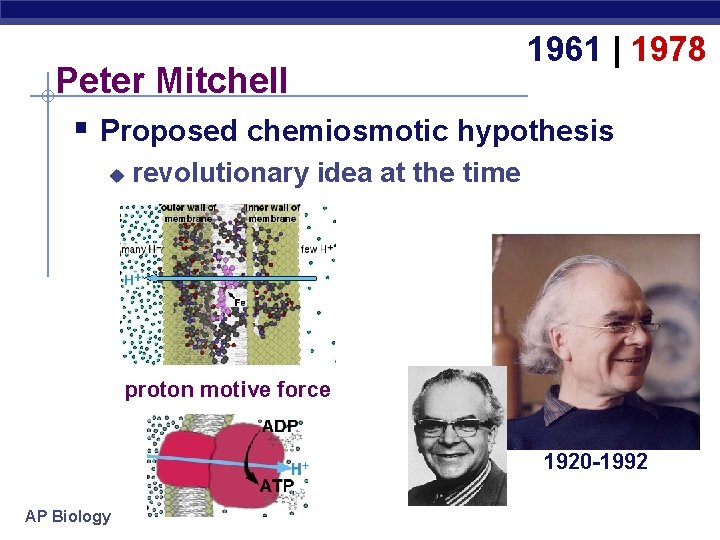
1961 | 1978 Peter Mitchell § Proposed chemiosmotic hypothesis u revolutionary idea at the time proton motive force 1920 -1992 AP Biology
Pyruvate from cytoplasm Inner + mitochondrial H membrane H+ Intermembrane space Electron transport C system Q NADH Acetyl-Co. A 2. Electrons provide energy 1. Electrons are harvested to pump protons and carried to the transport across the system. membrane. - NADH Krebs cycle e- e FADH 2 e- 3. Oxygen joins with protons to form water. CO 2 2 ATP Mitochondrial matrix AP Biology H 2 O 1 O 2 +2 2 H+ H+ 32 ATP 4. Protons diffuse back in down their concentration gradient, driving the synthesis of ATP. H+ e- O 2 H+ ATP synthase
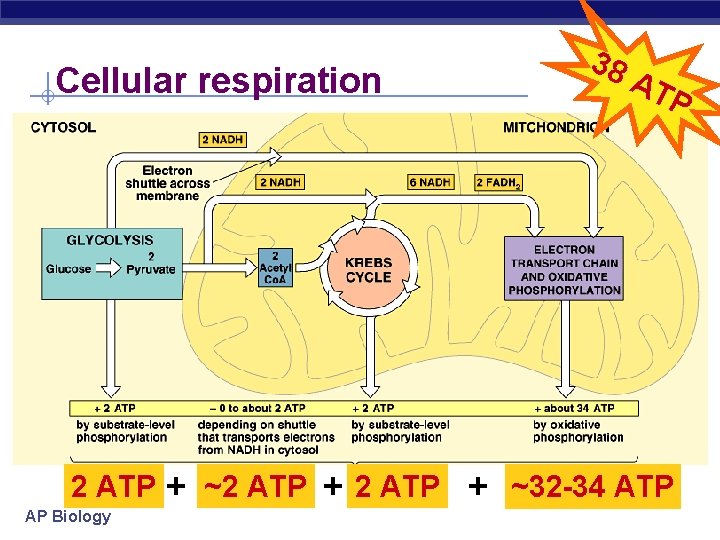
Cellular respiration 2 ATP AP Biology 38 AT P + ~2 ATP + ~32 -34 ATP
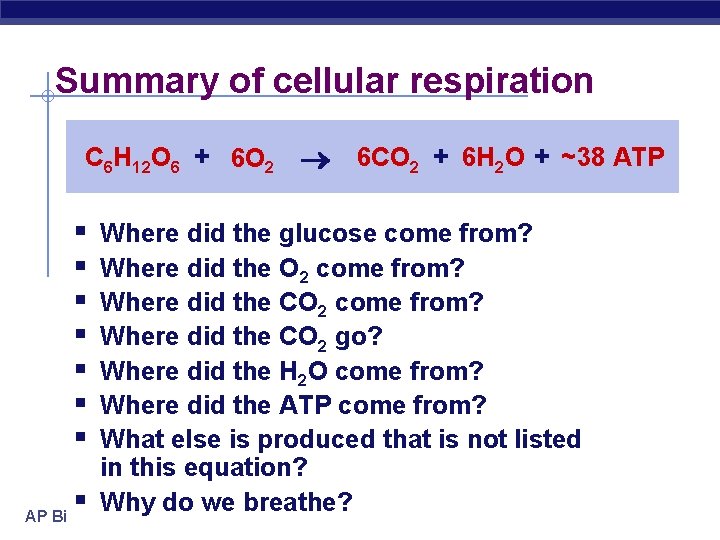
Summary of cellular respiration C 6 H 12 O 6 + 6 O 2 § § § § 6 CO 2 + 6 H 2 O + ~38 ATP Where did the glucose come from? Where did the O 2 come from? Where did the CO 2 go? Where did the H 2 O come from? Where did the ATP come from? What else is produced that is not listed in this equation? § Why do we breathe? AP Biology
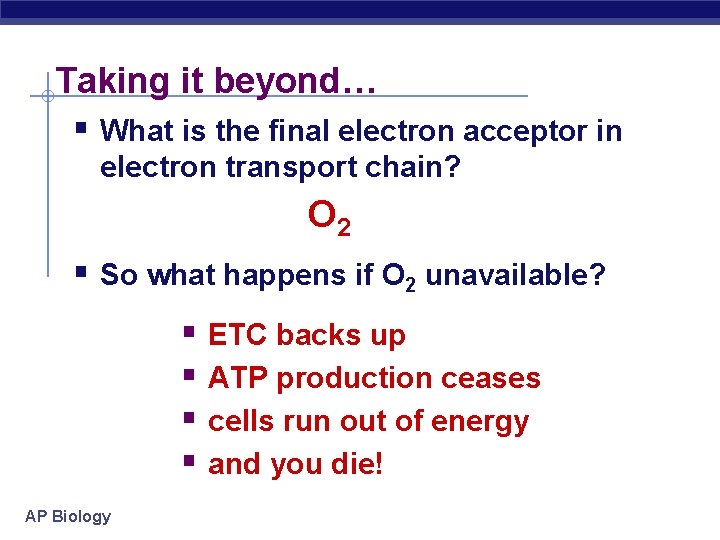
Taking it beyond… § What is the final electron acceptor in electron transport chain? O 2 § So what happens if O 2 unavailable? § ETC backs up § ATP production ceases § cells run out of energy § and you die! AP Biology
What’s the point? ATP The Point is to Make ATP! AP Biology 2006 -2007
Summary AP Biology 2006 -2007