
Cellular Respiration Process where living organisms convert the
- Slides: 6
Cellular Respiration Process where living organisms convert the energy in glucose into usable cellular energy (ATP) Too much energy in glucose to be released at once, needs to be converted into smaller ATP molecules � High energy C-C & C-H bonds converted into C-O & O-H bonds Each glucose can be broken down to form 36 or 38 ATP Only 36% of energy in glucose is converted to ATP; rest is lost as heat (a car uses ~25% of energy from fuel)
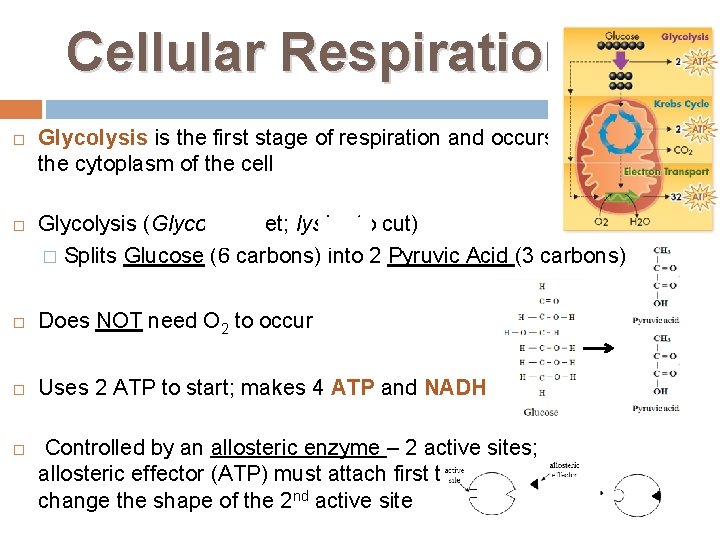
Cellular Respiration Glycolysis is the first stage of respiration and occurs in the cytoplasm of the cell Glycolysis (Glyco= sweet; lysis= to cut) � Splits Glucose (6 carbons) into 2 Pyruvic Acid (3 carbons) Does NOT need O 2 to occur Uses 2 ATP to start; makes 4 ATP and NADH Controlled by an allosteric enzyme – 2 active sites; allosteric effector (ATP) must attach first to change the shape of the 2 nd active site
Cellular Respiration 2 Types of Cellular Respiration: 1. Anaerobic Respiration (aka: Fermentation) Occurs without O 2 Occurs in the cytoplasm Uses pyruvic acid from glycolysis Enzymes required Makes 2 ATP per glucose A) Alcohol Fermentation – creates ATP, alcohol, & CO 2 Ex: Yeast B) Lactic Acid Fermentation – creates ATP, CO 2, & lactic acid Ex: Muscle cells
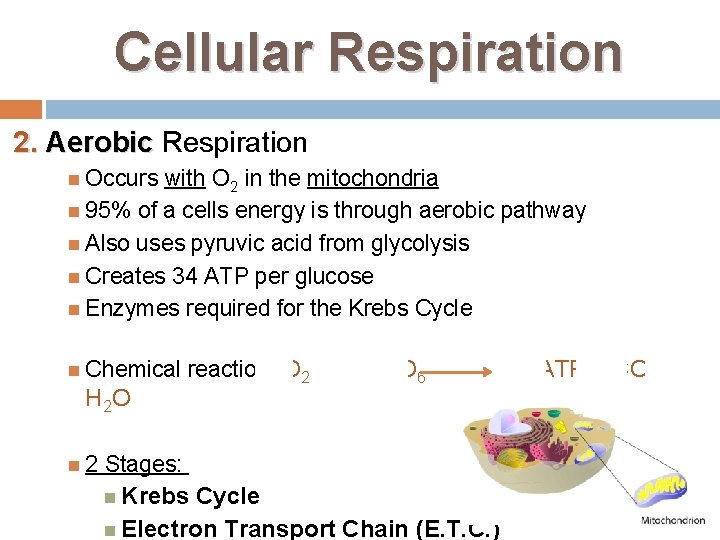
Cellular Respiration 2. Aerobic Respiration Occurs with O 2 in the mitochondria 95% of a cells energy is through aerobic pathway Also uses pyruvic acid from glycolysis Creates 34 ATP per glucose Enzymes required for the Krebs Cycle Chemical H 2 O 2 reaction: O 2 + C 6 H 12 O 6 Stages: Krebs Cycle Electron Transport Chain (E. T. C. ) ATP + CO 2 +
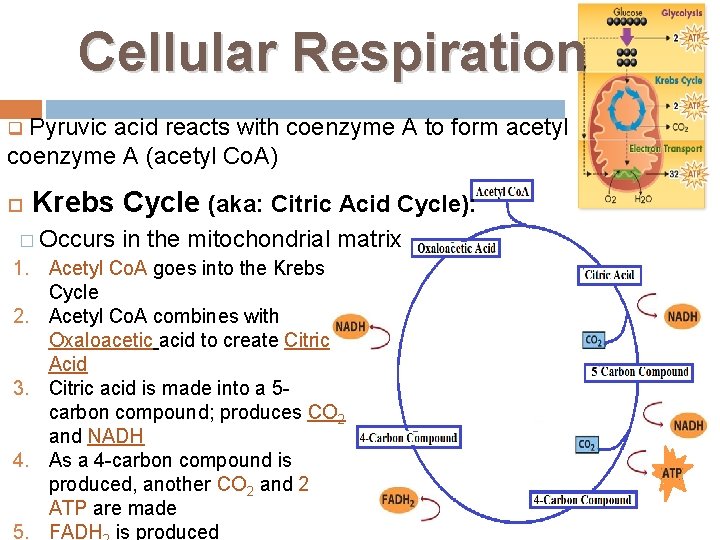
Cellular Respiration q Pyruvic acid reacts with coenzyme A to form acetyl coenzyme A (acetyl Co. A) Krebs Cycle (aka: Citric Acid Cycle): � Occurs in the mitochondrial matrix 1. Acetyl Co. A goes into the Krebs Cycle 2. Acetyl Co. A combines with Oxaloacetic acid to create Citric Acid 3. Citric acid is made into a 5 carbon compound; produces CO 2 and NADH 4. As a 4 -carbon compound is produced, another CO 2 and 2 ATP are made 5. FADH is produced
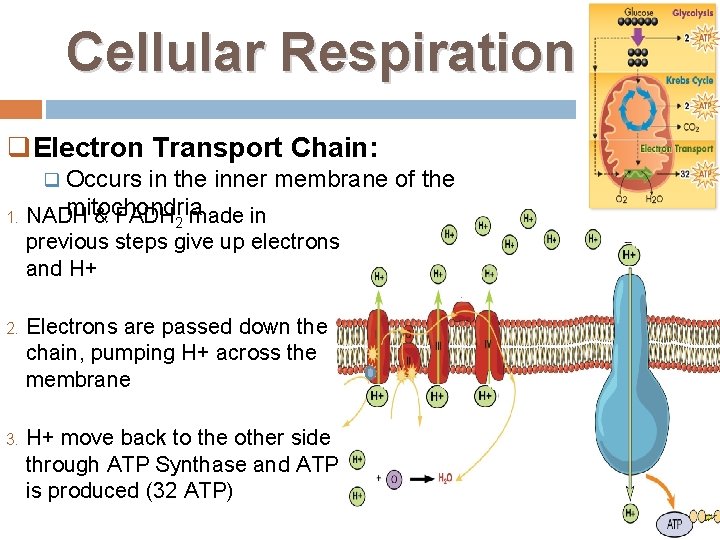
Cellular Respiration q. Electron Transport Chain: q Occurs 1. in the inner membrane of the mitochondria NADH & FADH made in 2 previous steps give up electrons and H+ 2. Electrons are passed down the chain, pumping H+ across the membrane 3. H+ move back to the other side through ATP Synthase and ATP is produced (32 ATP)