
CELLULAR RESPIRATION HARVESTING CHEMICAL ENERGY Section B The
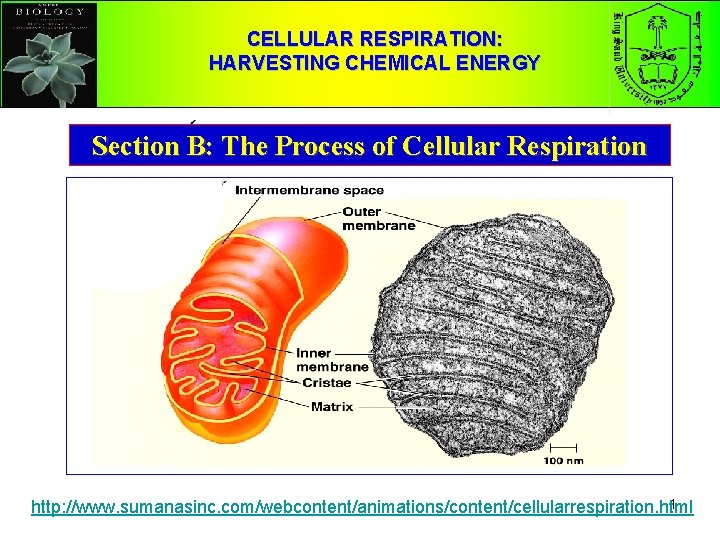
CELLULAR RESPIRATION: HARVESTING CHEMICAL ENERGY Section B: The Process of Cellular Respiration 1 http: //www. sumanasinc. com/webcontent/animations/content/cellularrespiration. html
Section B: The Process of Cellular Respiration involves three stages: 1. Glycolysis harvests chemical energy by oxidizing glucose to pyruvate and produces about 5% of ATP (in cytoplasm). 2. Krebs cycle completes the energy-yielding oxidation of organic molecules and produces about 5% of ATP (in mitochondrial matrix). 3. Electron transport chain to synthesis ATP and produces about 90% of ATP (inner mitochondrial membrane). Cellular respiration generates many ATP molecules. For each sugar molecule it oxidizes (38 ATP molecule). 2
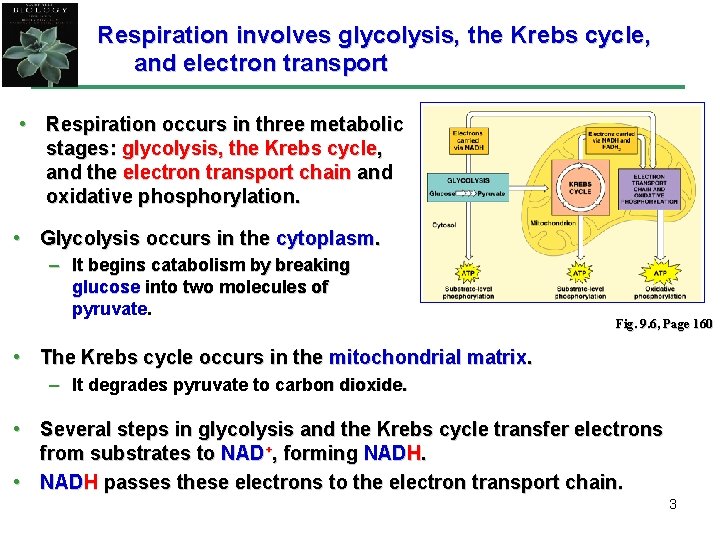
Respiration involves glycolysis, the Krebs cycle, and electron transport • Respiration occurs in three metabolic stages: glycolysis, the Krebs cycle, and the electron transport chain and oxidative phosphorylation. • Glycolysis occurs in the cytoplasm. – It begins catabolism by breaking glucose into two molecules of pyruvate. Fig. 9. 6, Page 160 • The Krebs cycle occurs in the mitochondrial matrix. – It degrades pyruvate to carbon dioxide. • Several steps in glycolysis and the Krebs cycle transfer electrons from substrates to NAD+, forming NADH. • NADH passes these electrons to the electron transport chain. 3

Phosphorylation I- Substrate-level phosphorylation: • Some ATP is generated in glycolysis and in Krebs cycle by Substrate-level phosphorylation. Phosphate group is transferred from an organic molecule (the substrate) to ADP, forming 10% ATP (4 ATP). II- Oxidative phosphorylation: • As electrons passed along the chain, their energy stored in the mitochondrion in a form that can be used to synthesize the rest 90% of the ATP (34 ATP). • via Oxidative phosphorylation. • Ultimately 38 ATP are produced per mole of glucose that is degraded to carbon CO 2 and H 2 O by respiration. 4
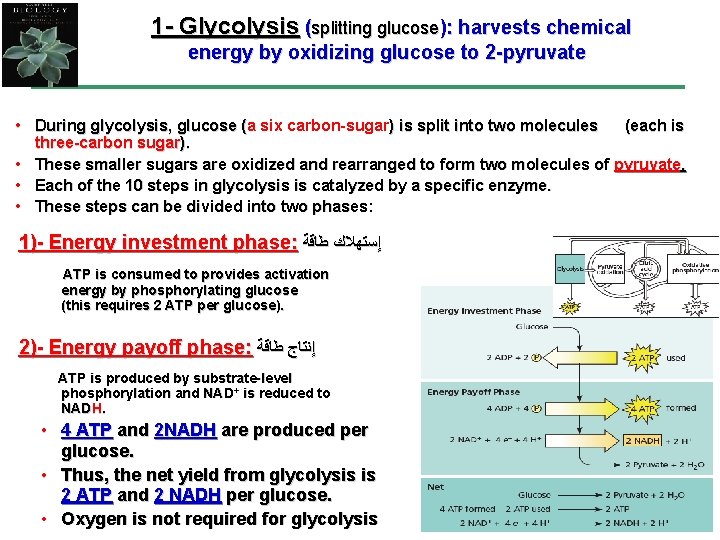
1 - Glycolysis (splitting glucose): harvests chemical energy by oxidizing glucose to 2 -pyruvate • During glycolysis, glucose (a (each is ( six carbon-sugar) is split into two molecules three-carbon sugar). • These smaller sugars are oxidized and rearranged to form two molecules of pyruvate. • Each of the 10 steps in glycolysis is catalyzed by a specific enzyme. • These steps can be divided into two phases: 1)- Energy investment phase: ﺇﺳﺘﻬﻼﻙ ﻃﺎﻗﺔ ATP is consumed to provides activation energy by phosphorylating glucose (this requires 2 ATP per glucose). 2)- Energy payoff phase: ﺇﻧﺘﺎﺝ ﻃﺎﻗﺔ ATP is produced by substrate-level phosphorylation and NAD+ is reduced to NADH. • 4 ATP and 2 NADH are produced per glucose. • Thus, the net yield from glycolysis is 2 ATP and 2 NADH per glucose. • Oxygen is not required for glycolysis
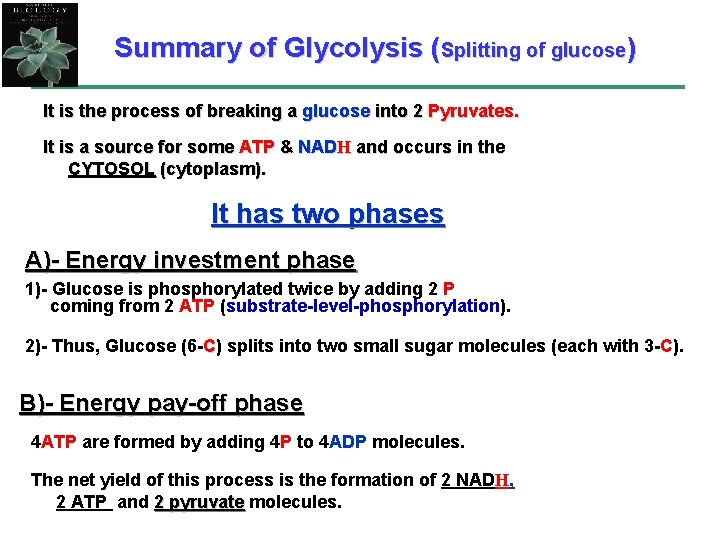
Summary of Glycolysis (Splitting of glucose) It is the process of breaking a glucose into 2 Pyruvates. It is a source for some ATP & NADH and occurs in the CYTOSOL (cytoplasm). It has two phases A)- Energy investment phase 1)- Glucose is phosphorylated twice by adding 2 P coming from 2 ATP (substrate-level-phosphorylation). 2)- Thus, Glucose (6 -C) splits into two small sugar molecules (each with 3 -C). B)- Energy pay-off phase 4 ATP are formed by adding 4 P to 4 ADP molecules. The net yield of this process is the formation of 2 NADH, 2 ATP and 2 pyruvate molecules.
2. The Krebs cycle completes the energy-yielding oxidation of organic molecules (in mitochondrial matrix): It is the process of producing some of the remaining energy (ATP) from the Pyruvate molecules. It occurs mainly in mitochondrial matrix if oxygen is present. It is the main source for preparing most of the cellular NADH (storing energy molecule), and for producing some more of the cellular ATP. It includes two cycles : Pre-Krebs cycle ﺍﻟﻤﺮﺣﻠﺔ ﺍﻟﺘﺤﻀﻴﺮﻳﺔ Krebs cycle
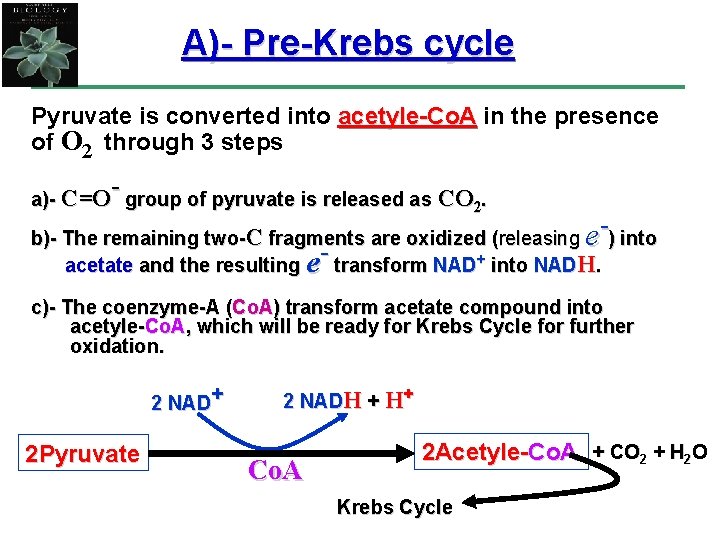
A)- Pre-Krebs cycle Pyruvate is converted into acetyle-Co. A in the presence of O 2 through 3 steps - a)- C=O group of pyruvate is released as CO 2. e- b)- The remaining two-C fragments are oxidized (releasing ) into - transform NAD+ into NADH. acetate and the resulting e c)- The coenzyme-A (Co. A) transform acetate compound into acetyle-Co. A, which will be ready for Krebs Cycle for further oxidation. 2 NAD+ 2 Pyruvate 2 NADH + H+ Co. A 2 Acetyle-Co. A + CO 2 + H 2 O Krebs Cycle
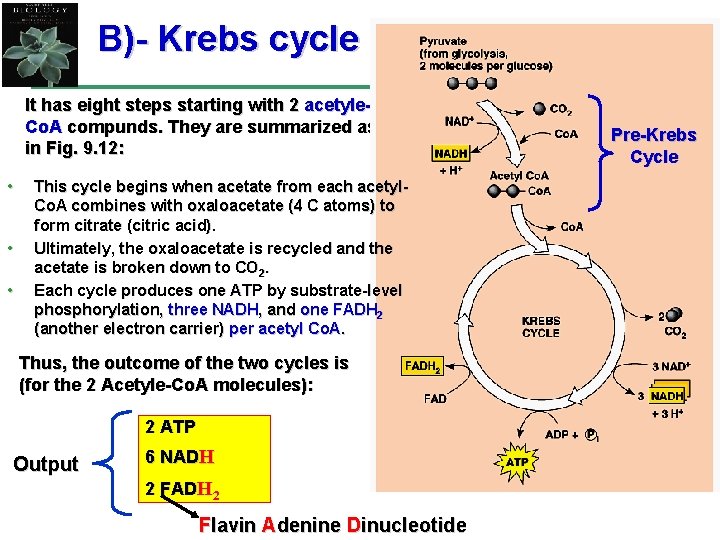
B)- Krebs cycle It has eight steps starting with 2 acetyle. Co. A compunds. They are summarized as in Fig. 9. 12: • • • This cycle begins when acetate from each acetyl. Co. A combines with oxaloacetate (4 C atoms) to form citrate (citric acid). Ultimately, the oxaloacetate is recycled and the acetate is broken down to CO 2. Each cycle produces one ATP by substrate-level phosphorylation, three NADH, and one FADH 2 (another electron carrier) per acetyl Co. A. Thus, the outcome of the two cycles is (for the 2 Acetyle-Co. A molecules): 2 ATP Output 6 NADH 2 Flavin Adenine Dinucleotide Pre-Krebs Cycle
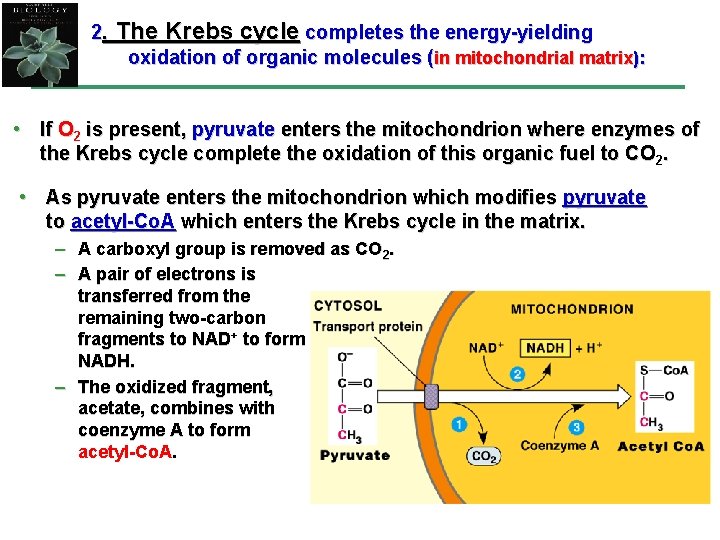
2. The Krebs cycle completes the energy-yielding oxidation of organic molecules (in mitochondrial matrix): • If O 2 is present, pyruvate enters the mitochondrion where enzymes of the Krebs cycle complete the oxidation of this organic fuel to CO 2. • As pyruvate enters the mitochondrion which modifies pyruvate to acetyl-Co. A which enters the Krebs cycle in the matrix. – A carboxyl group is removed as CO 2. – A pair of electrons is transferred from the remaining two-carbon fragments to NAD+ to form NADH. – The oxidized fragment, acetate, combines with coenzyme A to form acetyl-Co. A.
- Slides: 10