
Cellular Respiration Harvesting Chemical Energy n Aerobic metabolism
Cellular Respiration: Harvesting Chemical Energy
n Aerobic metabolism (oxygen is present) q n When enough oxygen reaches cells to support energy needs Anaerobic metabolism (oxygen is not present) q When the demand for oxygen outstrips the body’s ability to deliver it
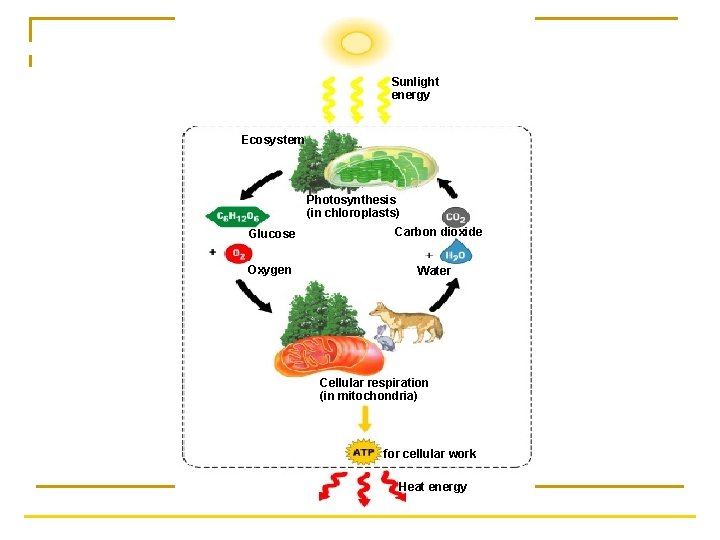
Sunlight energy Ecosystem Photosynthesis (in chloroplasts) Glucose Oxygen Carbon dioxide Water Cellular respiration (in mitochondria) for cellular work Heat energy
Cellular Respiration q q q is the step-wise release of energy from carbohydrates and other molecules Energy from these reactions is used to synthesize ATP molecules This is an aerobic process—it requires oxygen
Don’t mix up Cellular Respiration and Respiratory Breathing! n Cellular respiration and breathing are closely related q q Cellular respiration requires a cell to exchange gases with its surroundings Breathing exchanges these gases between the blood and outside air
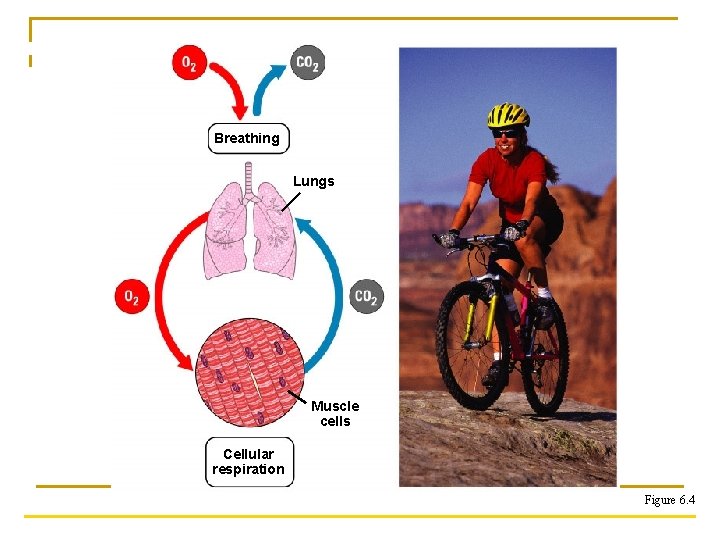
Breathing Lungs Muscle cells Cellular respiration Figure 6. 4
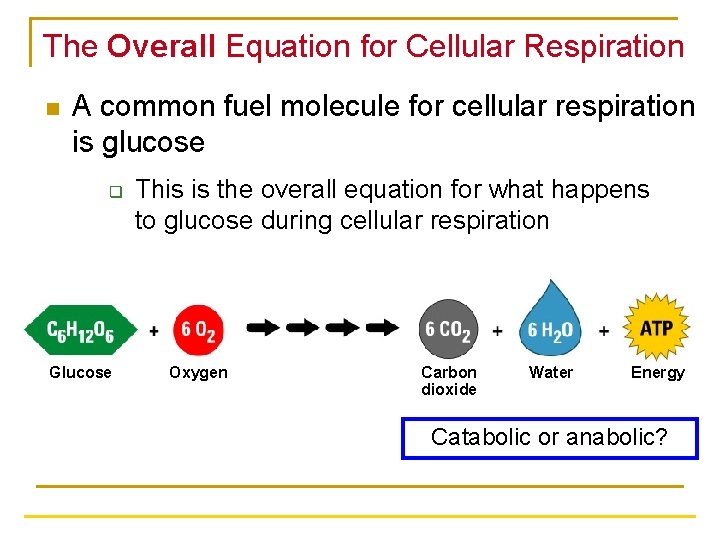
The Overall Equation for Cellular Respiration n A common fuel molecule for cellular respiration is glucose q Glucose This is the overall equation for what happens to glucose during cellular respiration Oxygen Carbon dioxide Water Energy Catabolic or anabolic?
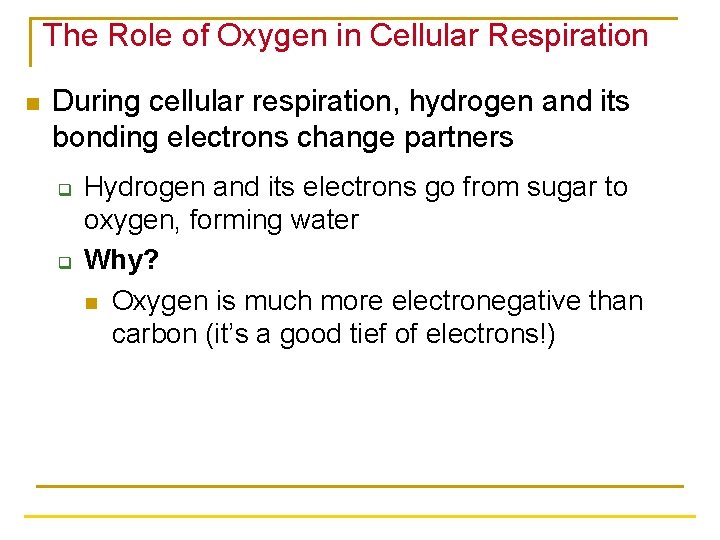
The Role of Oxygen in Cellular Respiration n During cellular respiration, hydrogen and its bonding electrons change partners q q Hydrogen and its electrons go from sugar to oxygen, forming water Why? n Oxygen is much more electronegative than carbon (it’s a good tief of electrons!)
The Reactions We’ll See n 1. 2. 3. 4. 5. There are several types of reactions that we will encounter along the way. REDOX – Electrons being taken from one and added to another. Phosphorylation/Dephosphorylation – The adding/removal of a phosphate group (PO 4). Carboxylation/Decarboxylation – The adding/removal of a carbon. Hydration/Dehydration - The adding/removal of a water molecule (H 2 O). Isomerization – Making a molecule into its isomer – same parts, different arrangement.
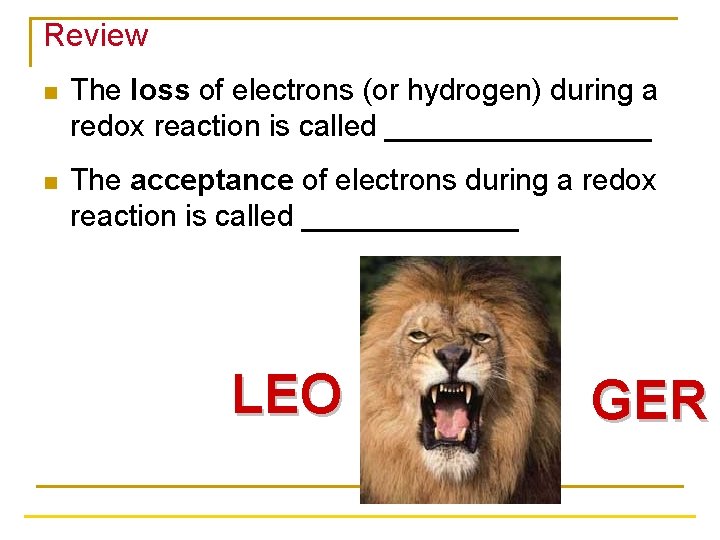
Review n The loss of electrons (or hydrogen) during a redox reaction is called ________ n The acceptance of electrons during a redox reaction is called _______ LEO GER
![Oxidation [Glucose loses electrons (and hydrogens)] Glucose Oxygen Carbon dioxide Water Reduction [Oxygen gains](http://slidetodoc.com/presentation_image_h2/0c61261559d9e8f884c9d31eeed30bae/image-11.jpg "Oxidation [Glucose loses electrons (and hydrogens)] Glucose Oxygen Carbon dioxide Water Reduction [Oxygen gains")
Oxidation [Glucose loses electrons (and hydrogens)] Glucose Oxygen Carbon dioxide Water Reduction [Oxygen gains electrons (and hydrogens)]
Breakdown of Cellular Respiration Four main parts (reactions): 1. Glycolysis (splitting of sugar) n cytosol, just outside of mitochondria. 2. Pyruvate Oxidation n migration from cytosol to matrix.
Breakdown of Cellular Respiration 3. Krebs Cycle (Citric Acid Cycle) n mitochondrial matrix 4. Electron Transport Chain (ETC) and Oxidative Phosphorylation n Also called Chemiosmosis n inner mitochondrial membrane
Goals of Cellular Respiration n To break the bonds between the six carbon atoms in glucose (this creates 6 molecules of carbon dioxide) n To move hydrogen atom electrons from glucose to oxygen to form 6 molecules of water n While the various reactions take place, free energy is released from the bonds as they break; thus the cell works to trap as much of the released free energy in the form of ATP
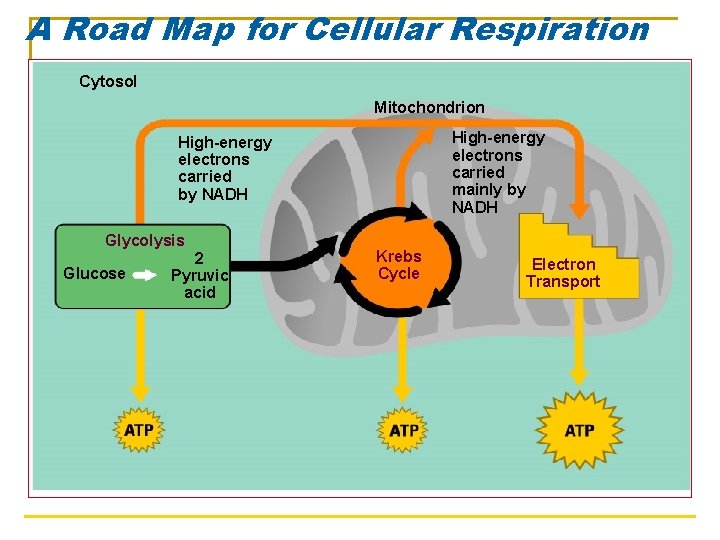
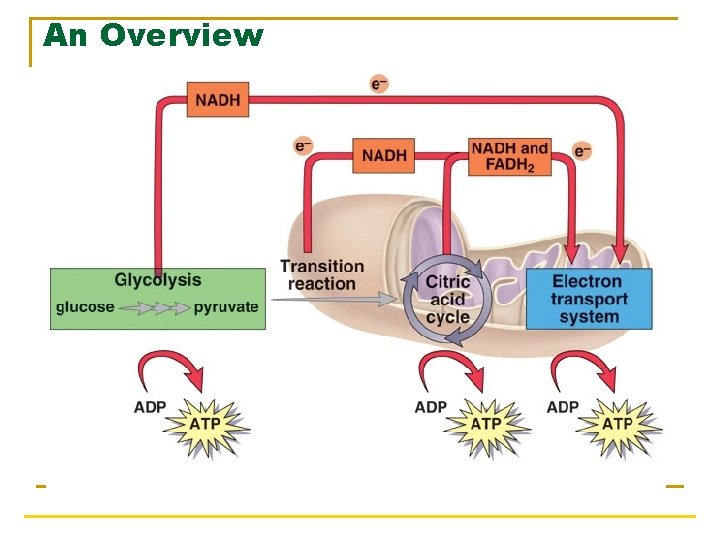
A Road Map for Cellular Respiration Cytosol Mitochondrion High-energy electrons carried mainly by NADH High-energy electrons carried by NADH Glycolysis Glucose 2 Pyruvic acid Krebs Cycle Electron Transport

Substrate-Level Phosphorylation n ATP is formed directly when an enzyme transfers a phosphate group from a substrate to ADP
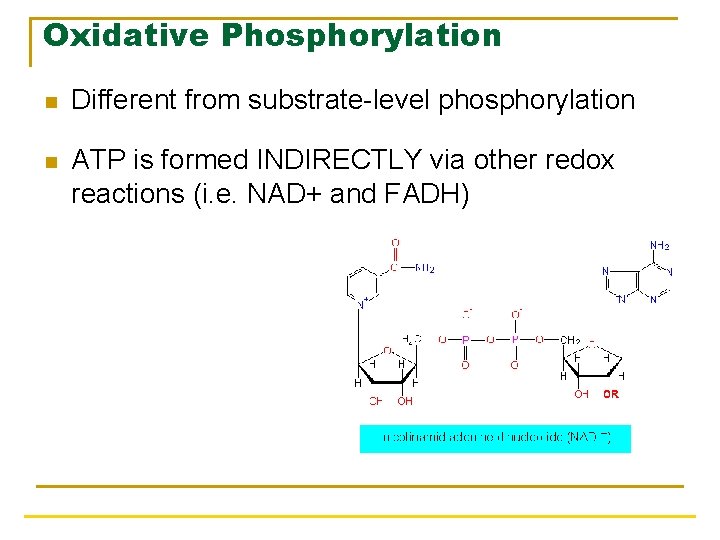
Oxidative Phosphorylation n Different from substrate-level phosphorylation n ATP is formed INDIRECTLY via other redox reactions (i. e. NAD+ and FADH)
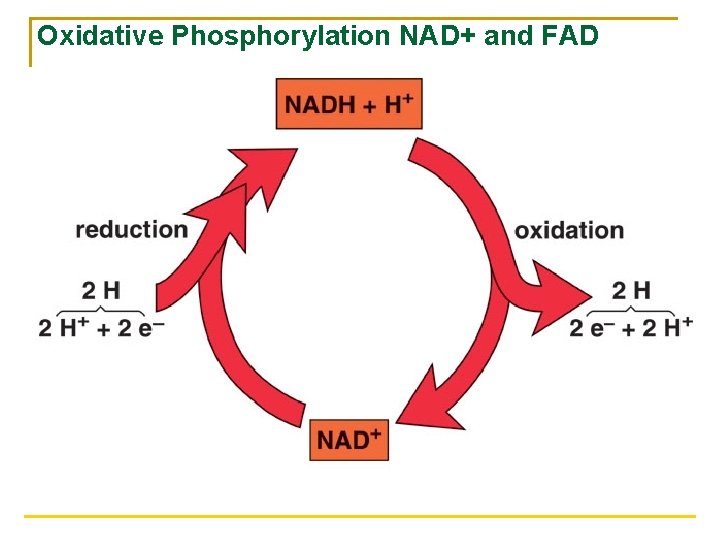
Oxidative Phosphorylation NAD+ and FAD • Oxidation-reduction reactions use NAD+ or FADH (nicotinamide adenine dinucleotide, flavin adenine dinucleotide) which are coenzymes (A molecule that binds to an enzyme and is essential for its is not permanently altered. NAD+ by the accepts reaction). two • activity, When but a metabolite is oxidized, NAD+ electrons and FAD can be a used over andion over again. plus hydrogen (H+) and. They NADH are likeresults, trucks that carry and deliver where its leaving a free H+ energy ion in the cell needed. - NAD+ is reduced to NADH • Conversely, NADH can also reduce a metabolite by giving up electrons - NADH is oxidized to NAD+
Oxidative Phosphorylation NAD+ and FAD
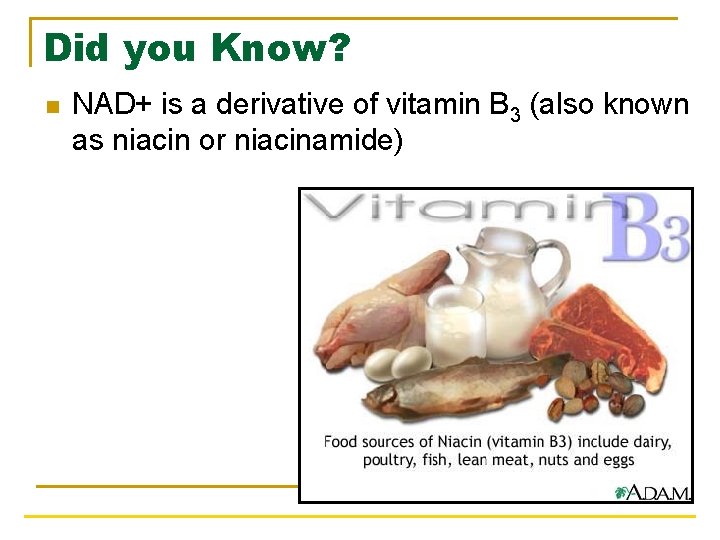
Did you Know? n NAD+ is a derivative of vitamin B 3 (also known as niacin or niacinamide)
An Overview
Glycolysis = ‘Sugar-breaking’ Where? • Occurs in the cytoplasm What? • It is the breakdown of glucose Start with: glucose End with: two pyruvate molecules. • Glycolysis is universally found in all organisms. • Glycolysis does not require oxygen (anaerobic).
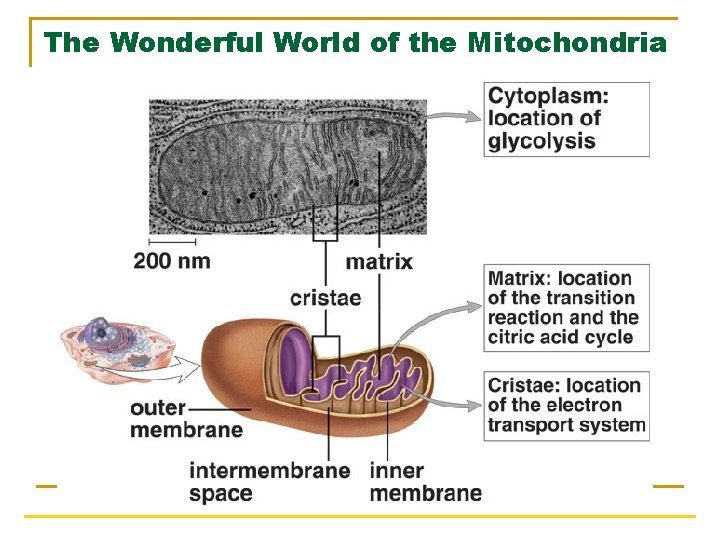
The Wonderful World of the Mitochondria
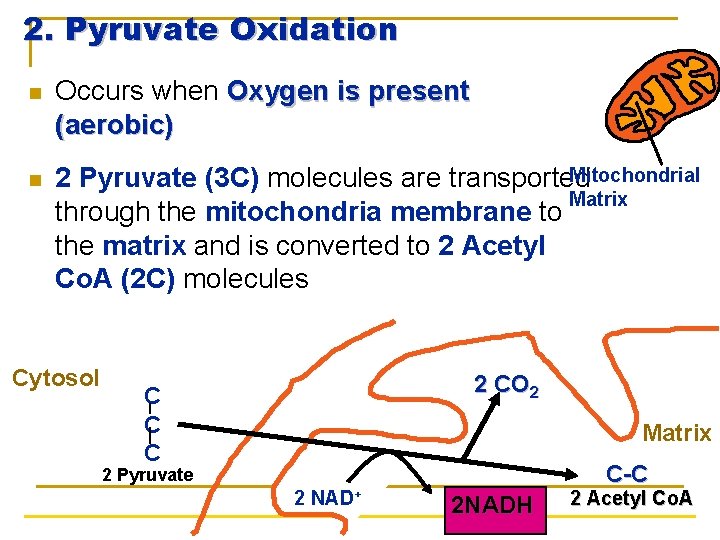
2. Pyruvate Oxidation n Occurs when Oxygen is present (aerobic) n Mitochondrial 2 Pyruvate (3 C) molecules are transported Matrix through the mitochondria membrane to the matrix and is converted to 2 Acetyl Co. A (2 C) molecules Cytosol 2 CO 2 C C C Matrix C-C 2 Pyruvate 2 NAD+ 2 NADH 2 Acetyl Co. A
Pyruvate Oxidation • This stage connects glycolysis to the Krebs cycle • Pyruvate is converted to acetyl Co. A and CO 2 is released • During this oxidation reaction, NAD+ is converted to NADH + H+ • This reaction occurs twice per glucose molecule
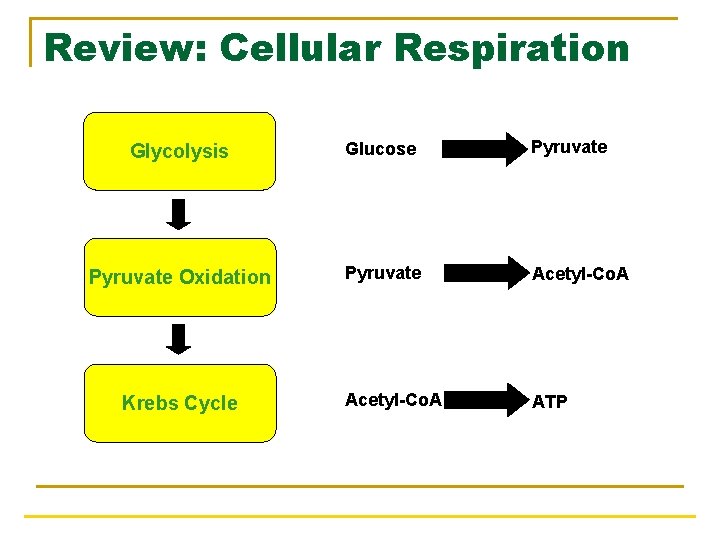
Review: Cellular Respiration Glycolysis Glucose Pyruvate Oxidation Pyruvate Acetyl-Co. A ATP Krebs Cycle
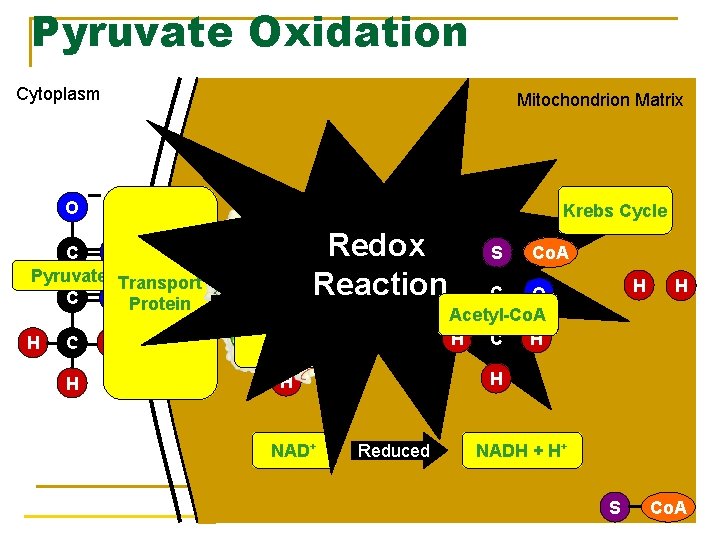
Pyruvate Oxidation Cytoplasm Mitochondrion Matrix O O Krebs Cycle d O C Pyruvate Transport C O Protein H C H H e z i O xid C O Pyruvate C Redox Reaction O Decarboxylase Acetic Acid H Group C H Co. A H C O Acetyl-Co. A H C H H NAD+ S Reduced NADH + H+ S Co. A
Summary of Pyruvate Oxidation n n Pyruvate oxidation occurs twice to use one molecule of glucose One molecule of NADH produced One molecule of CO 2 is released The product of pyruvate oxidation is acetyl. Co. A In cellular respiration, acetyl-Co. A enters Krebs Cycle to eventually produce molecules of ATP
- Slides: 28