
Cellular Respiration Harvesting Chemical Energy ATP AP Biology
Cellular Respiration Harvesting Chemical Energy ATP AP Biology
What’s the point? The point is to make ATP! ATP AP Biology 2006 -2007
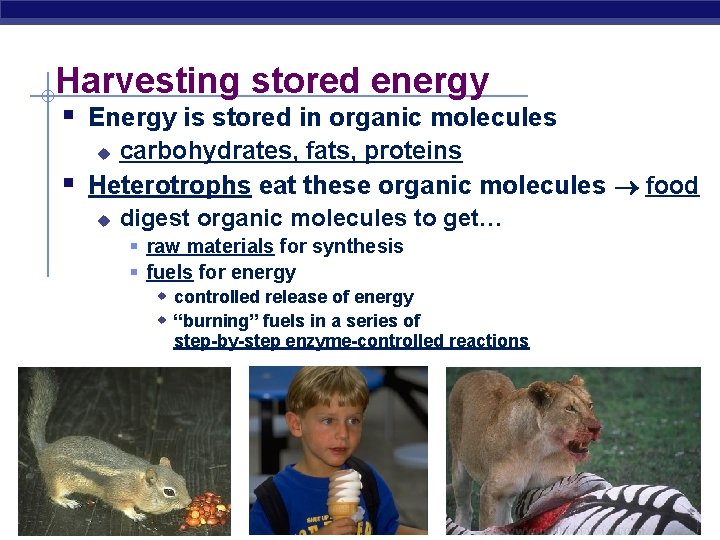
Harvesting stored energy § Energy is stored in organic molecules carbohydrates, fats, proteins Heterotrophs eat these organic molecules food u digest organic molecules to get… u § § raw materials for synthesis § fuels for energy w controlled release of energy w “burning” fuels in a series of step-by-step enzyme-controlled reactions AP Biology
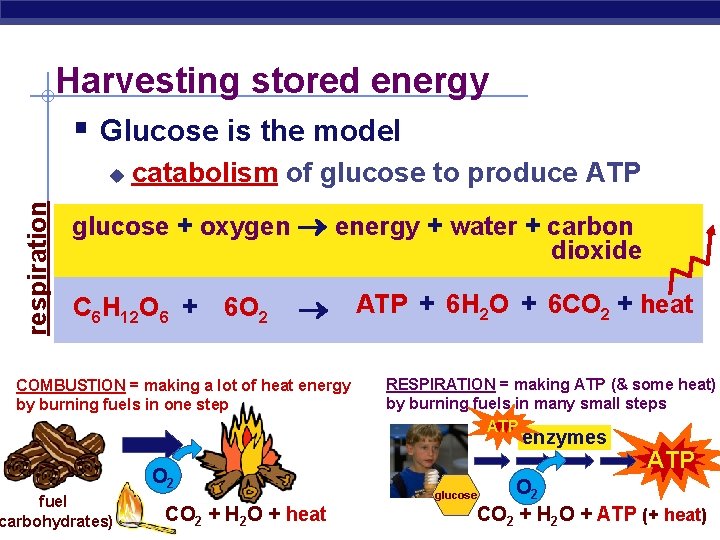
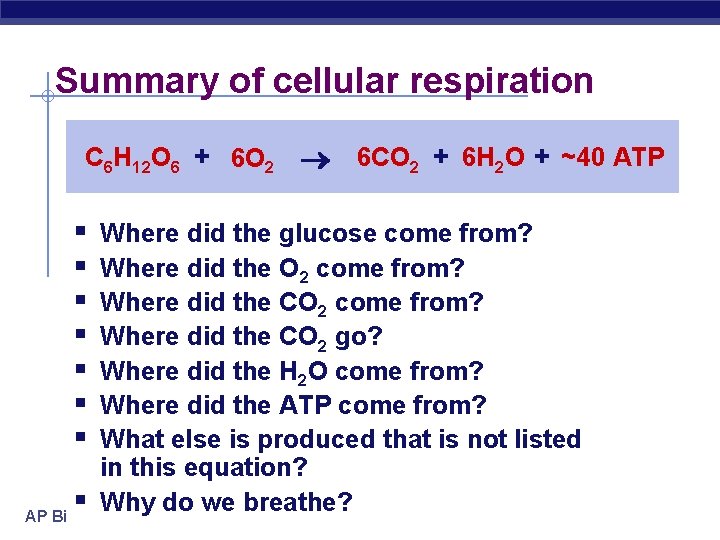
Harvesting stored energy § Glucose is the model respiration u catabolism of glucose to produce ATP glucose + oxygen energy + water + carbon dioxide C 6 H 12 O 6 + 6 O 2 ATP + 6 H 2 O + 6 CO 2 + heat COMBUSTION = making a lot of heat energy by burning fuels in one step fuel AP Biology carbohydrates) RESPIRATION = making ATP (& some heat) by burning fuels in many small steps ATP enzymes O 2 CO 2 + H 2 O + heat ATP O 2 CO 2 + H 2 O + ATP (+ heat) glucose
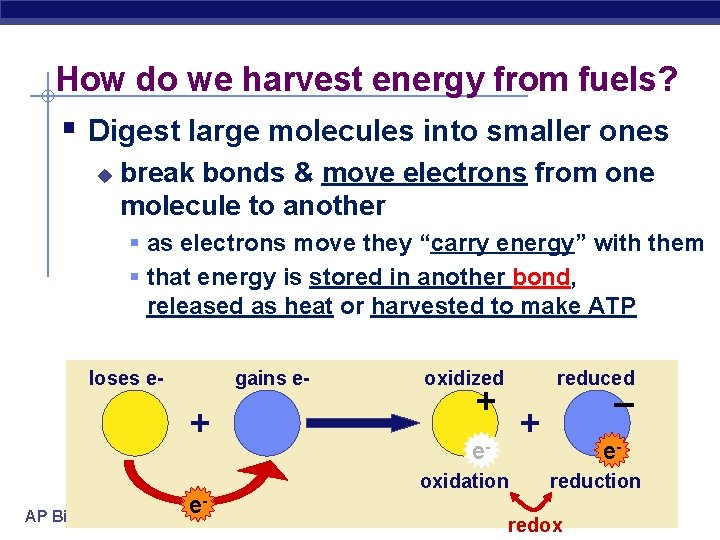
How do we harvest energy from fuels? § Digest large molecules into smaller ones u break bonds & move electrons from one molecule to another § as electrons move they “carry energy” with them § that energy is stored in another bond, released as heat or harvested to make ATP loses e- gains e- + AP Biology e- oxidized reduced + – + eoxidation ereduction redox
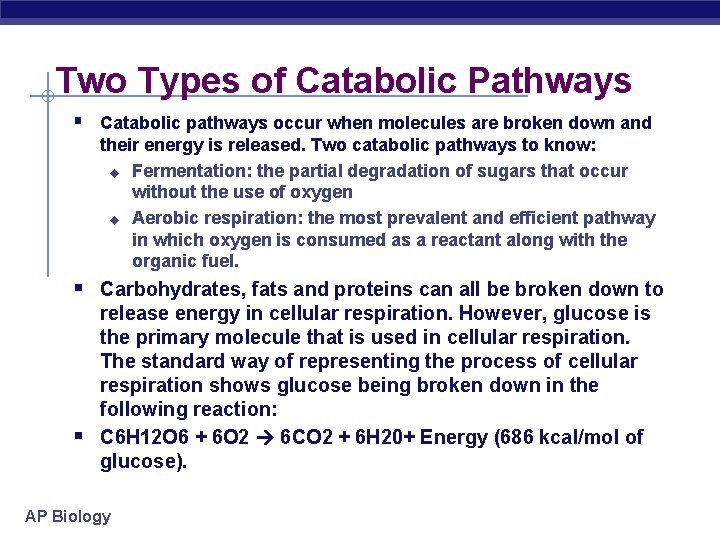
Two Types of Catabolic Pathways § Catabolic pathways occur when molecules are broken down and their energy is released. Two catabolic pathways to know: u Fermentation: the partial degradation of sugars that occur without the use of oxygen u Aerobic respiration: the most prevalent and efficient pathway in which oxygen is consumed as a reactant along with the organic fuel. § Carbohydrates, fats and proteins can all be broken down to § release energy in cellular respiration. However, glucose is the primary molecule that is used in cellular respiration. The standard way of representing the process of cellular respiration shows glucose being broken down in the following reaction: C 6 H 12 O 6 + 6 O 2 6 CO 2 + 6 H 20+ Energy (686 kcal/mol of glucose). AP Biology
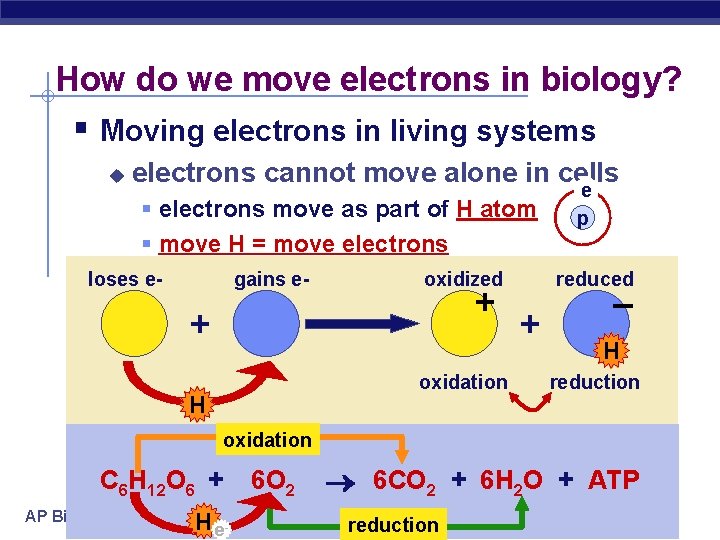
How do we move electrons in biology? § Moving electrons in living systems u electrons cannot move alone in cells § electrons move as part of H atom § move H = move electrons loses e- gains e- oxidized + + oxidation H e p reduced + – H reduction oxidation C 6 H 12 O 6 + AP Biology H e- 6 O 2 6 CO 2 + 6 H 2 O + ATP reduction
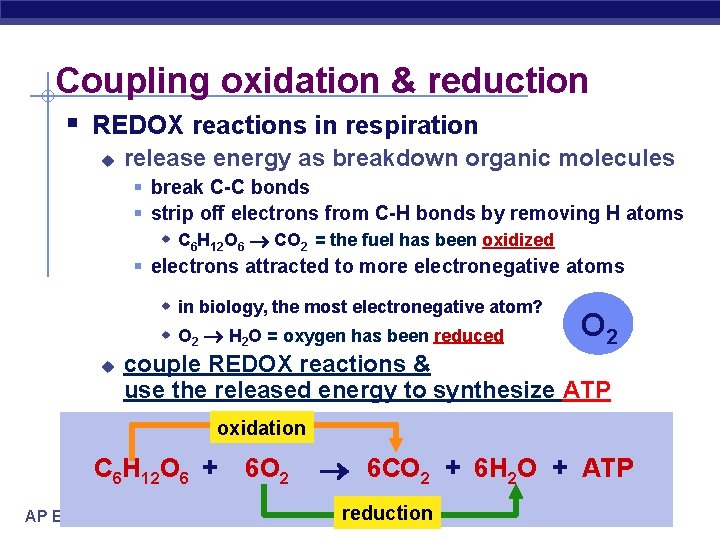
Coupling oxidation & reduction § REDOX reactions in respiration u release energy as breakdown organic molecules § break C-C bonds § strip off electrons from C-H bonds by removing H atoms w C 6 H 12 O 6 CO 2 = the fuel has been oxidized § electrons attracted to more electronegative atoms w in biology, the most electronegative atom? w O 2 H 2 O = oxygen has been reduced u O 2 couple REDOX reactions & use the released energy to synthesize ATP oxidation C 6 H 12 O 6 + AP Biology 6 O 2 6 CO 2 + 6 H 2 O + ATP reduction
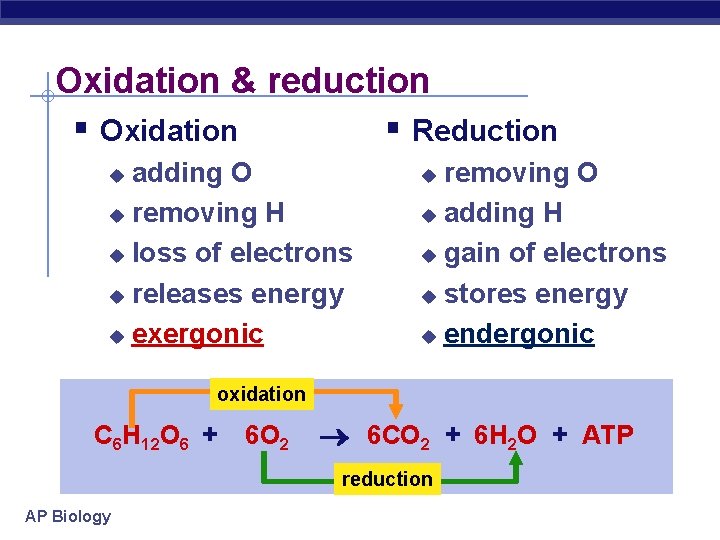
Oxidation & reduction § Oxidation § Reduction adding O u removing H u loss of electrons u releases energy u exergonic u removing O u adding H u gain of electrons u stores energy u endergonic u oxidation C 6 H 12 O 6 + 6 O 2 6 CO 2 + 6 H 2 O + ATP reduction AP Biology
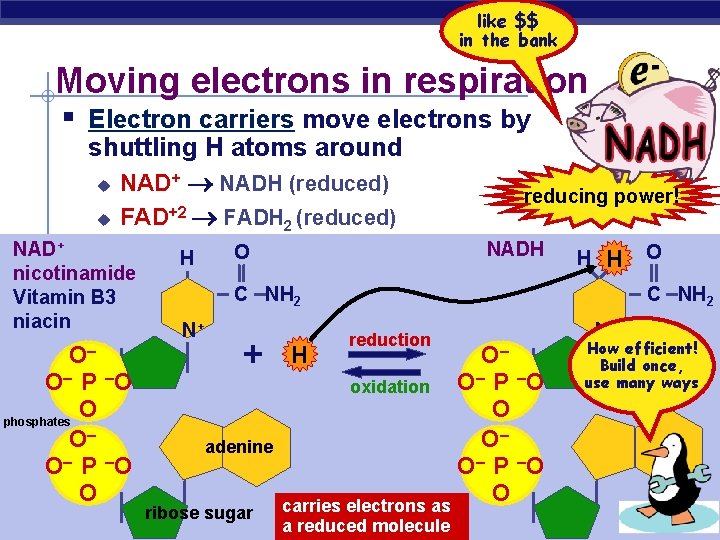
like $$ in the bank Moving electrons in respiration § Electron carriers move electrons by shuttling H atoms around u NAD+ NADH (reduced) u FAD+2 FADH 2 (reduced) NAD+ nicotinamide Vitamin B 3 niacin O– O – P –O O phosphates O– O – P –O O AP Biology H reducing power! NADH O H H O C NH 2 N+ + adenine ribose sugar H C NH 2 reduction O– O – P –O oxidation O O– O – P –O O carries electrons as a reduced molecule N+ How efficient! Build once, use many ways
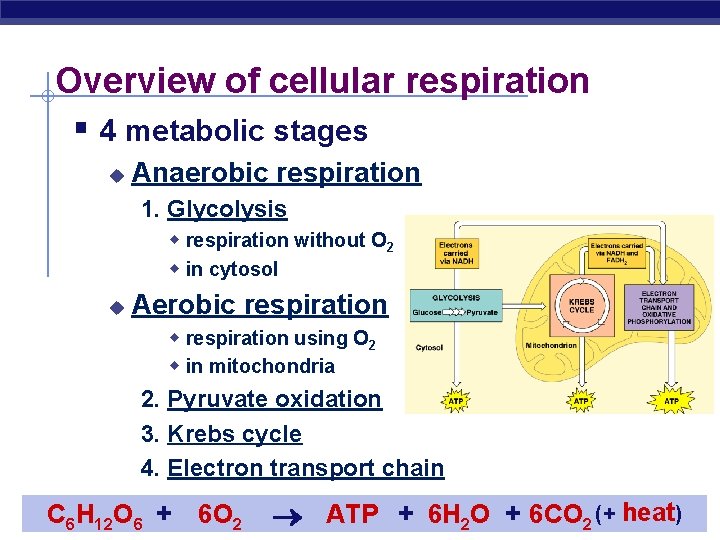
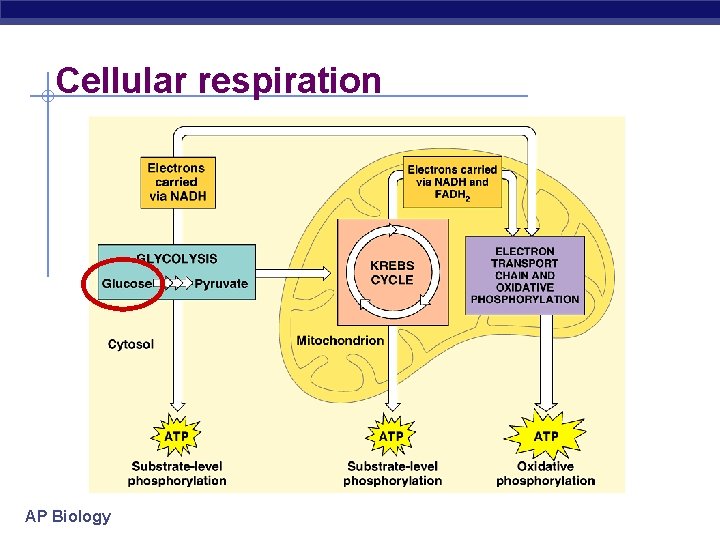
Overview of cellular respiration § 4 metabolic stages u Anaerobic respiration 1. Glycolysis w respiration without O 2 w in cytosol u Aerobic respiration w respiration using O 2 w in mitochondria 2. Pyruvate oxidation 3. Krebs cycle 4. Electron transport chain C H O 6 + AP Biology 6 12 6 O 2 ATP + 6 H 2 O + 6 CO 2 (+ heat)
Cellular Respiration Stage 1: Glycolysis AP Biology 2007 -2008
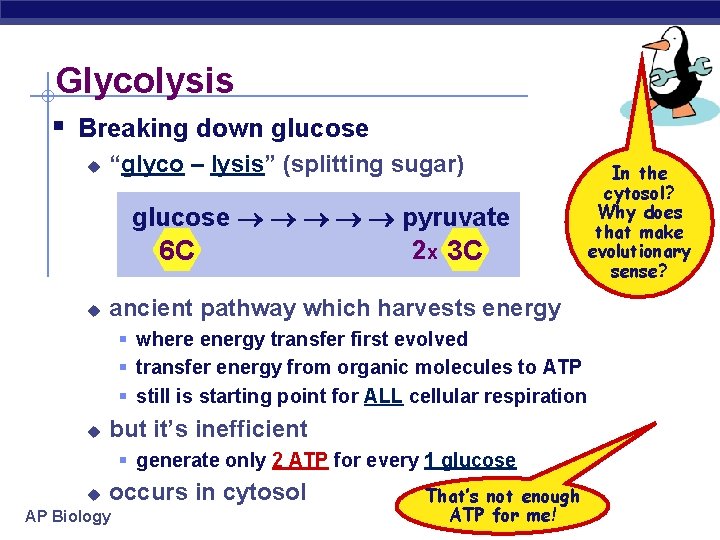
Glycolysis § Breaking down glucose u “glyco – lysis” (splitting sugar) glucose pyruvate 2 x 3 C 6 C u ancient pathway which harvests energy § where energy transfer first evolved § transfer energy from organic molecules to ATP § still is starting point for ALL cellular respiration u but it’s inefficient § generate only 2 ATP for every 1 glucose u occurs in cytosol AP Biology That’s not enough ATP for me! In the cytosol? Why does that make evolutionary sense?
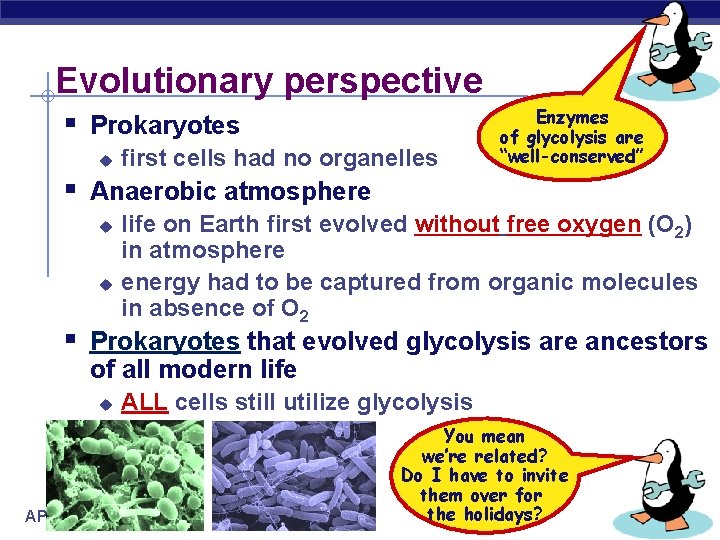
Evolutionary perspective § Prokaryotes u first cells had no organelles Enzymes of glycolysis are “well-conserved” § Anaerobic atmosphere u u life on Earth first evolved without free oxygen (O 2) in atmosphere energy had to be captured from organic molecules in absence of O 2 § Prokaryotes that evolved glycolysis are ancestors of all modern life u AP Biology ALL cells still utilize glycolysis You mean we’re related? Do I have to invite them over for the holidays?
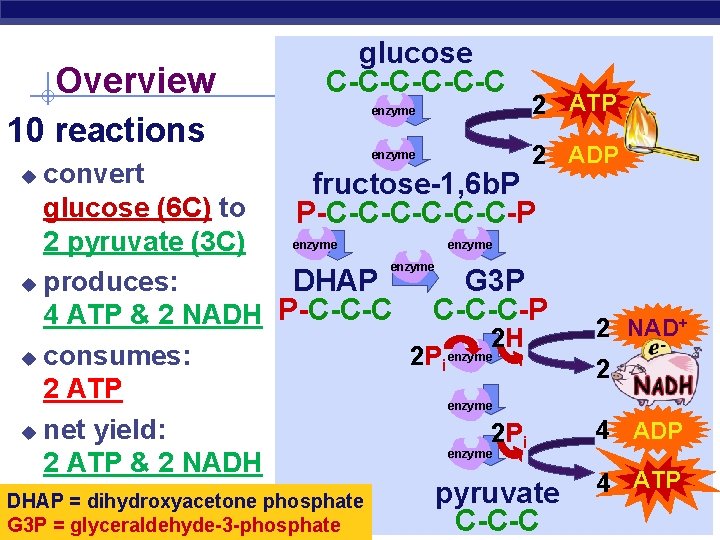
Overview glucose C-C-C-C 10 reactions enzyme 2 ATP 2 ADP convert fructose-1, 6 b. P glucose (6 C) to P-C-C-C-P enzyme 2 pyruvate (3 C) enzyme u produces: DHAP G 3 P 4 ATP & 2 NADH P-C-C-C-P 2 H u consumes: 2 Pi enzyme 2 ATP enzyme u net yield: 2 Pi enzyme 2 ATP & 2 NADH u DHAP = dihydroxyacetone phosphate AP Biology G 3 P = glyceraldehyde-3 -phosphate pyruvate C-C-C 2 NAD+ 2 4 ADP 4 ATP
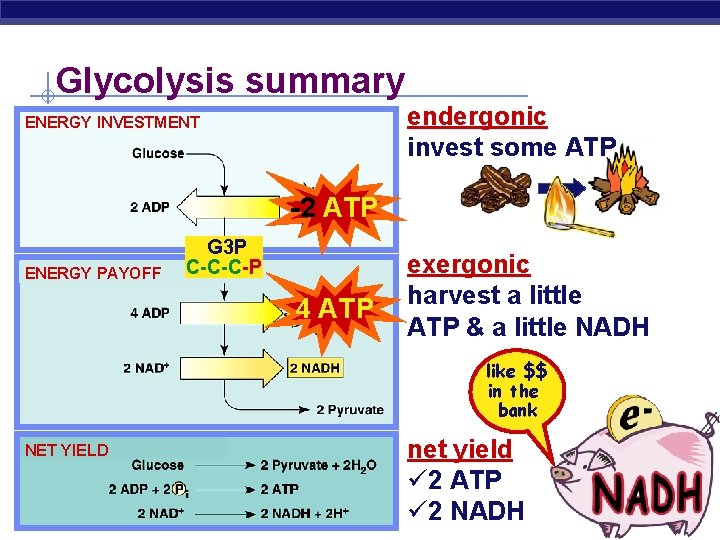
Glycolysis summary endergonic invest some ATP ENERGY INVESTMENT -2 ATP ENERGY PAYOFF G 3 P C-C-C-P 4 ATP exergonic harvest a little ATP & a little NADH like $$ in the bank NET YIELD AP Biology net yield ü 2 ATP ü 2 NADH
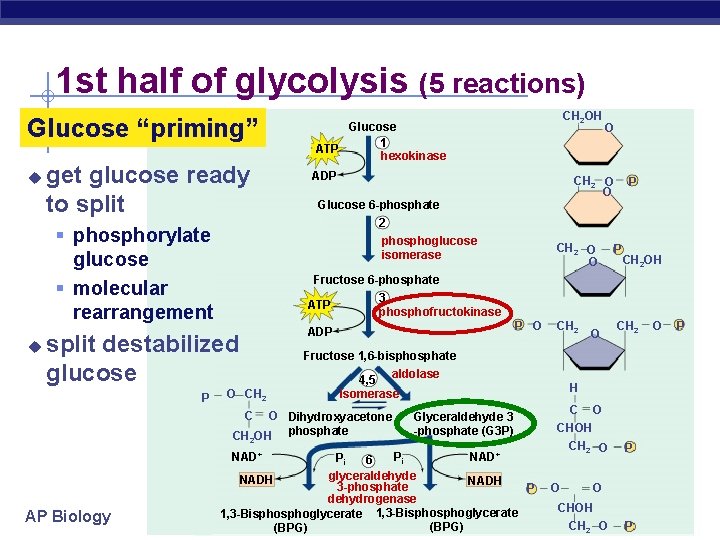
1 st half of glycolysis (5 reactions) Glucose “priming” u get glucose ready to split § phosphorylate glucose § molecular rearrangement u ADP Glucose 6 -phosphate 2 Fructose 6 -phosphate 3 ATP phosphofructokinase ADP P O P CH 2 O CH 2 OH Fructose 1, 6 -bisphosphate O CH 2 4, 5 aldolase isomerase C O Dihydroxyacetone CH 2 OH phosphate NAD+ AP Biology O CH 2 O O phosphoglucose isomerase split destabilized glucose P CH 2 OH Glucose 1 ATP hexokinase H Glyceraldehyde 3 -phosphate (G 3 P) Pi NAD 6 glyceraldehyde NADH 3 -phosphate P dehydrogenase 1, 3 -Bisphosphoglycerate (BPG) Pi + C O CHOH CH 2 O O P O CHOH CH 2 O P
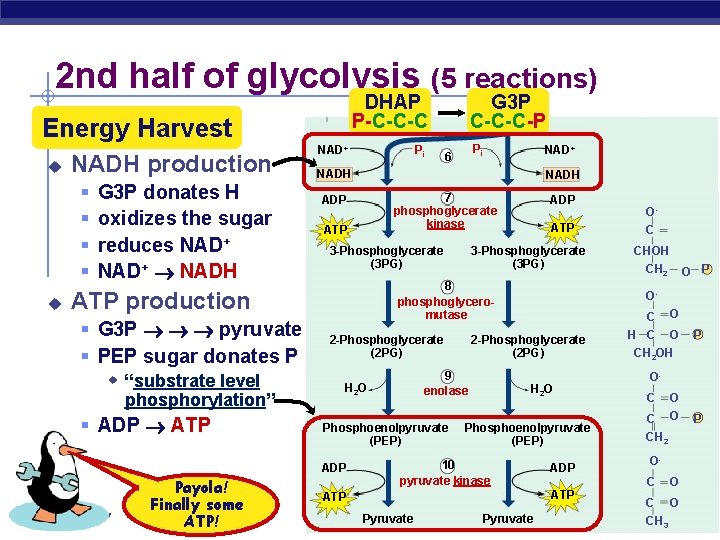
2 nd half of glycolysis (5 reactions) DHAP P-C-C-C Energy Harvest u NADH production § § u G 3 P donates H oxidizes the sugar reduces NAD+ NADH Pi NAD+ phosphorylation” § ADP ATP AP Biology NAD+ NADH 7 phosphoglycerate kinase ADP ATP 3 -Phosphoglycerate (3 PG) 8 phosphoglyceromutase 2 -Phosphoglycerate (2 PG) Phosphoenolpyruvate (PEP) H 2 O Phosphoenolpyruvate (PEP) 10 pyruvate kinase ADP ATP Pyruvate OC CHOH CH 2 O P O- 2 -Phosphoglycerate (2 PG) 9 enolase H 2 O ADP Payola! Finally some ATP! Pi 6 NADH ATP production § G 3 P pyruvate § PEP sugar donates P w “substrate level G 3 P C-C-C-P Pyruvate C O H C O CH 2 OH P OC C CH 2 O O OC O CH 3 P
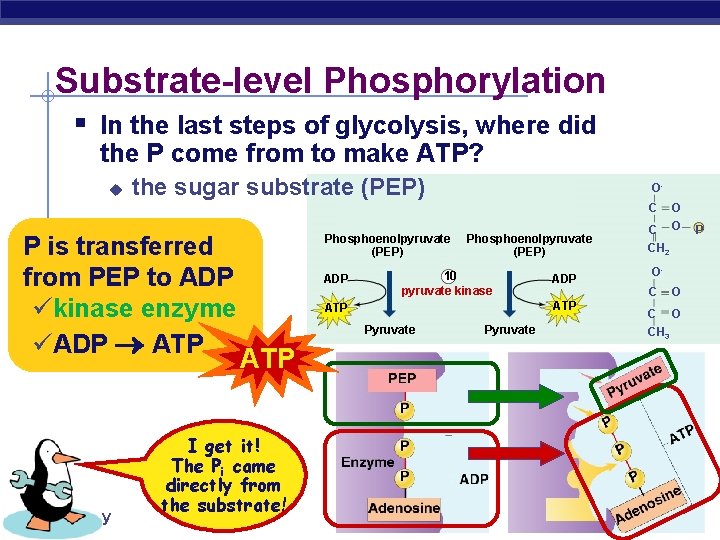
Substrate-level Phosphorylation § In the last steps of glycolysis, where did the P come from to make ATP? u 9 the sugar substrate. H O(PEP) enolase H 2 O 2 P is transferred from PEP to ADP ükinase enzyme üADP ATP AP Biology Phosphoenolpyruvate (PEP) ADP Phosphoenolpyruvate (PEP) 10 pyruvate kinase ATP Pyruvate ATP I get it! The Pi came directly from the substrate! ADP Pyruvate OC O CH 2 OC O CH 3 P
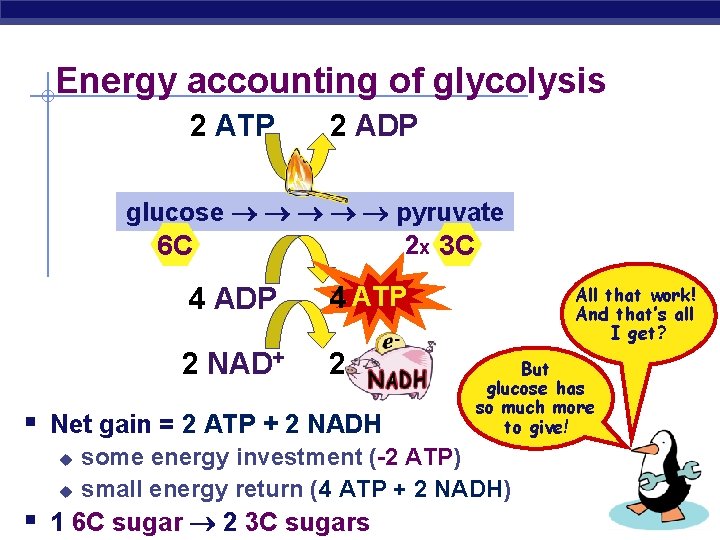
Energy accounting of glycolysis 2 ATP 2 ADP glucose pyruvate 2 x 3 C 6 C 4 ADP 4 ATP 2 NAD+ 2 § Net gain = 2 ATP + 2 NADH u u All that work! And that’s all I get? But glucose has so much more to give! some energy investment (-2 ATP) small energy return (4 ATP + 2 NADH) §AP 1 Biology 6 C sugar 2 3 C sugars
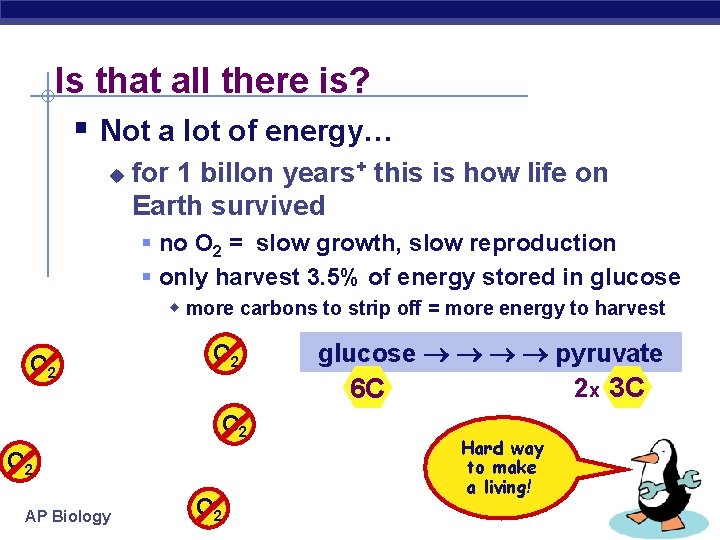
Is that all there is? § Not a lot of energy… u for 1 billon years+ this is how life on Earth survived § no O 2 = slow growth, slow reproduction § only harvest 3. 5% of energy stored in glucose w more carbons to strip off = more energy to harvest O 2 O 2 AP Biology O 2 glucose pyruvate 2 x 3 C 6 C Hard way to make a living!
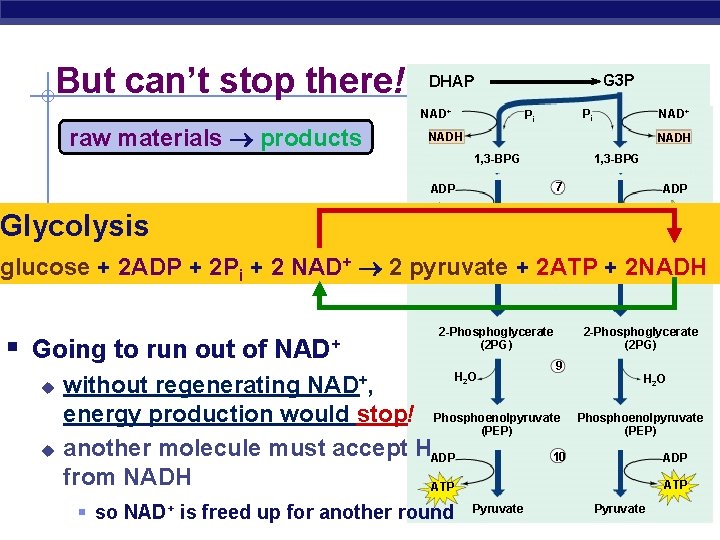
But can’t stop there! G 3 P DHAP NAD+ raw materials products Pi + NADH Pi 1, 3 -BPG NAD+ Pi + NADH NAD 1, 3 -BPG NADH 7 ADP Glycolysis 6 Pi ADP ATP 3 -Phosphoglycerate (3 PG) 2 -Phosphoglycerate (2 PG) glucose + 2 ADP + 2 Pi + 2 NAD+ 2 pyruvate + 2 ATP + 2 NADH 8 § Going to run out of NAD+ u u H 2 O 9 without regenerating NAD+, energy production would stop! Phosphoenolpyruvate (PEP) another molecule must accept HADP 10 from NADH ATP § so AP Biology NAD+ is freed up for another round Pyruvate H 2 O Phosphoenolpyruvate (PEP) ADP ATP Pyruvate
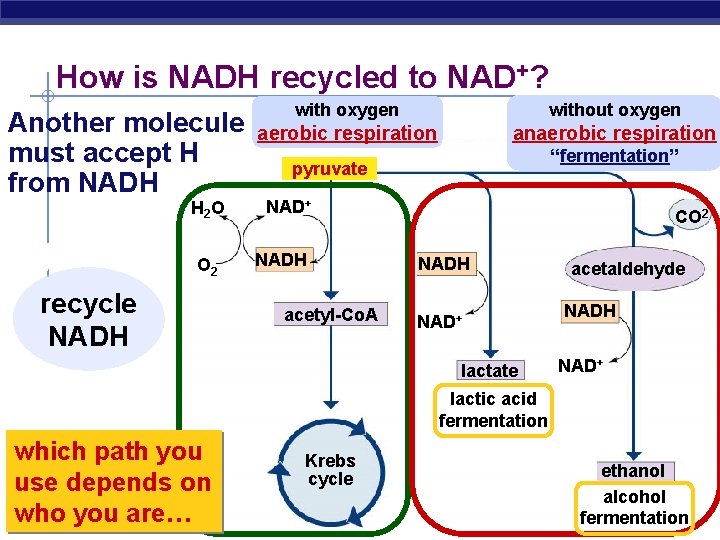
How is NADH recycled to NAD+? Another molecule must accept H from NADH H 2 O O 2 recycle NADH with oxygen without oxygen aerobic respiration anaerobic respiration “fermentation” pyruvate NAD+ NADH acetyl-Co. A CO 2 NADH NAD+ lactate acetaldehyde NADH NAD+ lactic acid fermentation which path you use depends on AP Biology who you are… Krebs cycle ethanol alcohol fermentation
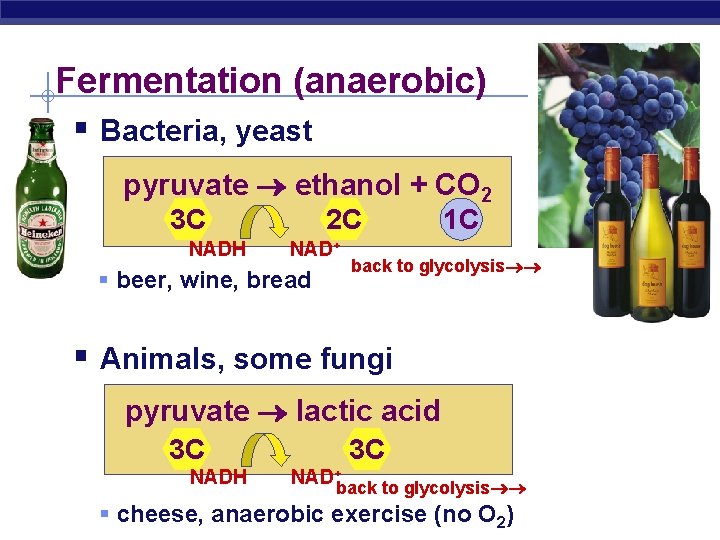
Fermentation (anaerobic) § Bacteria, yeast pyruvate ethanol + CO 2 3 C NADH 2 C NAD+ § beer, wine, bread 1 C back to glycolysis § Animals, some fungi pyruvate lactic acid 3 C NADH AP Biology § 3 C NAD+back to glycolysis cheese, anaerobic exercise (no O 2)
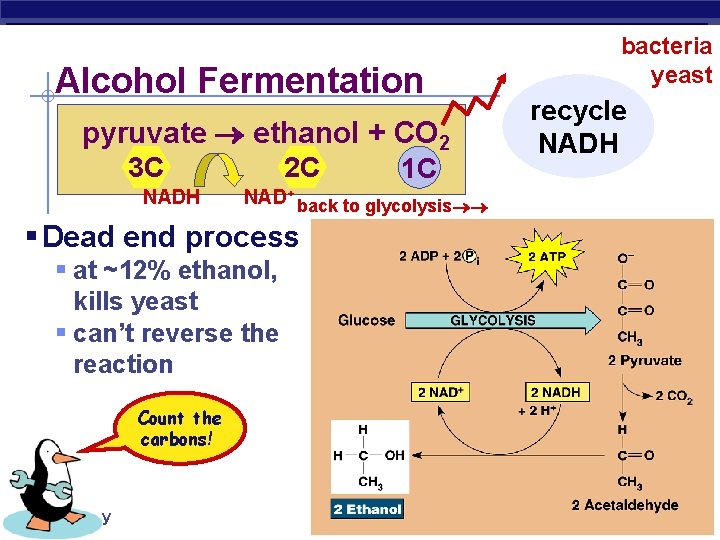
Alcohol Fermentation pyruvate ethanol + CO 2 3 C NADH 2 C NAD+ back to glycolysis § Dead end process § at ~12% ethanol, kills yeast § can’t reverse the reaction Count the carbons! AP Biology 1 C bacteria yeast recycle NADH
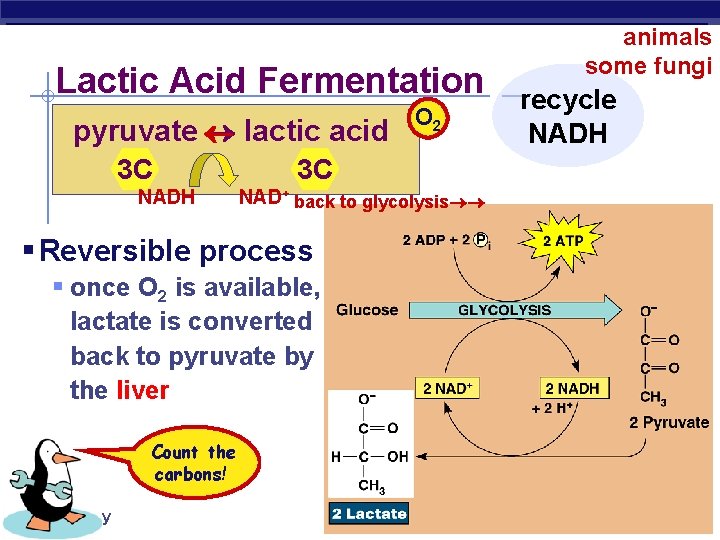
Lactic Acid Fermentation pyruvate lactic acid 3 C NADH 3 C NAD+ back to glycolysis § Reversible process § once O 2 is available, lactate is converted back to pyruvate by the liver Count the carbons! AP Biology O 2 animals some fungi recycle NADH
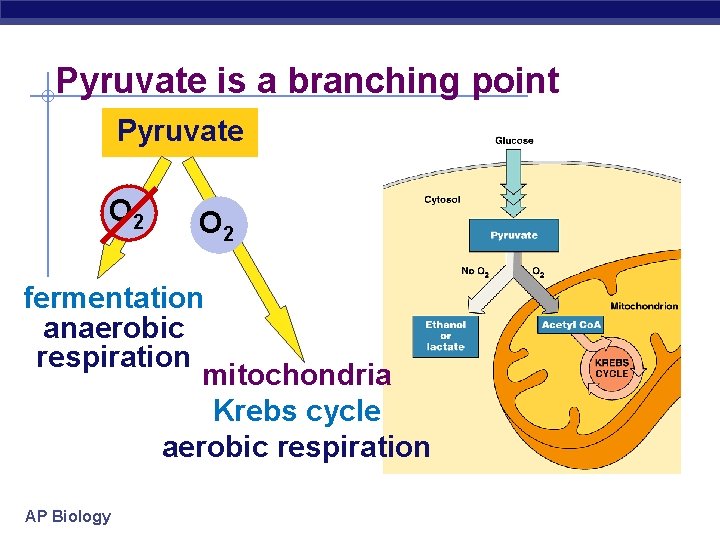
Pyruvate is a branching point Pyruvate O 2 fermentation anaerobic respiration mitochondria Krebs cycle aerobic respiration AP Biology
Cellular Respiration Stage 2 & 3: Oxidation of Pyruvate Krebs Cycle AP Biology
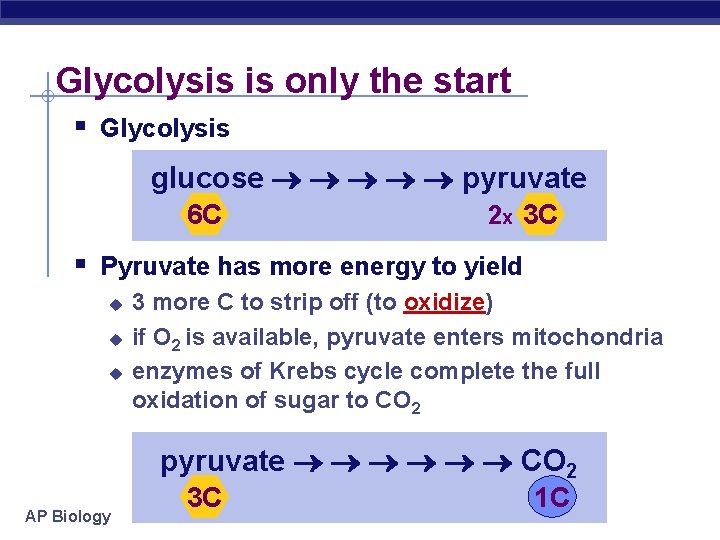
Glycolysis is only the start § Glycolysis glucose pyruvate 6 C 2 x 3 C § Pyruvate has more energy to yield u u u 3 more C to strip off (to oxidize) if O 2 is available, pyruvate enters mitochondria enzymes of Krebs cycle complete the full oxidation of sugar to CO 2 pyruvate CO 2 AP Biology 3 C 1 C
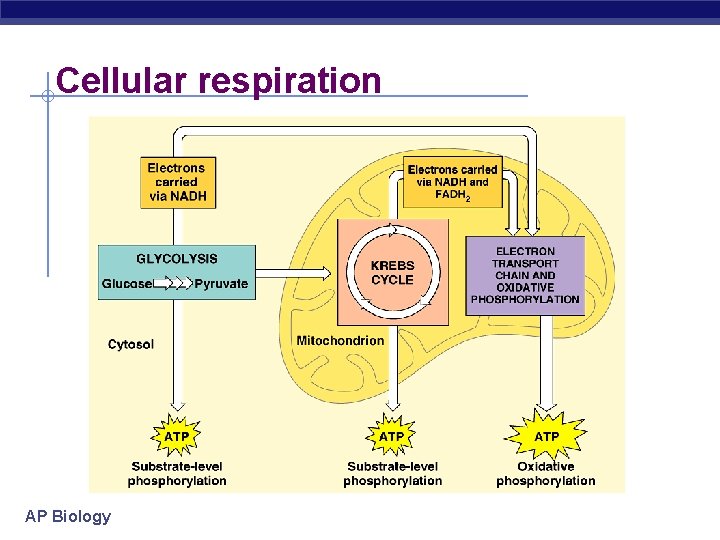
Cellular respiration AP Biology
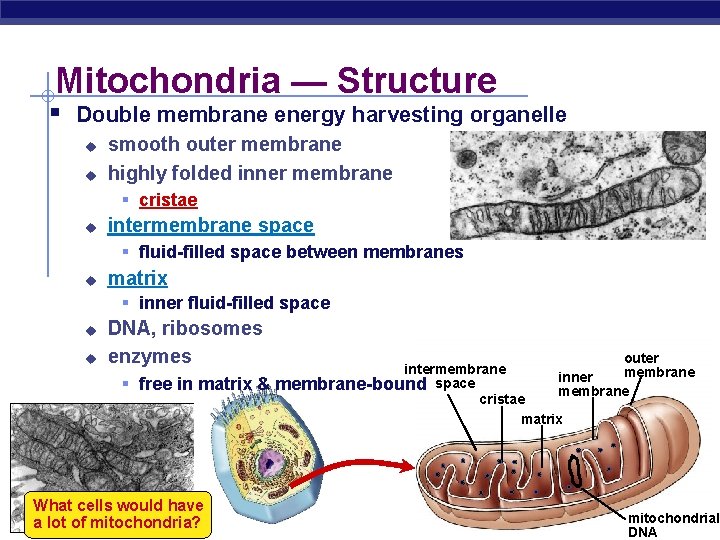
Mitochondria — Structure § Double membrane energy harvesting organelle u u smooth outer membrane highly folded inner membrane § cristae u intermembrane space § fluid-filled space between membranes u matrix § inner fluid-filled space u u DNA, ribosomes enzymes § free in matrix & What cells would have AP Biology a lot of mitochondria? outer intermembrane inner membrane-bound space membrane cristae matrix mitochondrial DNA
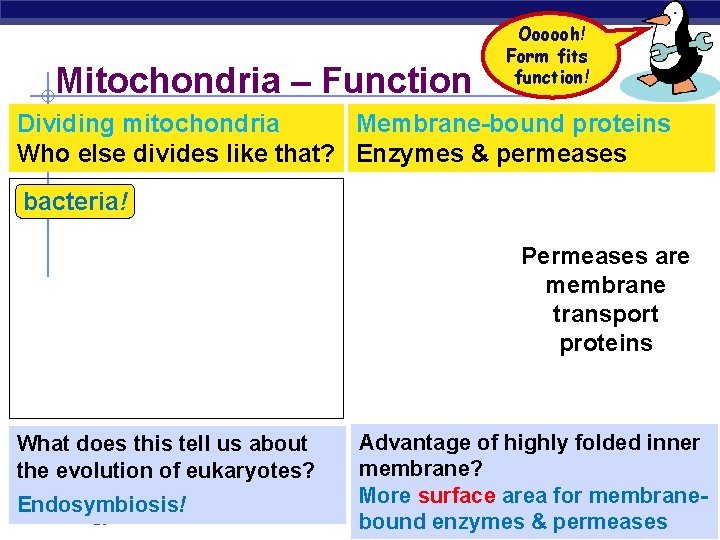
Mitochondria – Function Oooooh! Form fits function! Dividing mitochondria Membrane-bound proteins Who else divides like that? Enzymes & permeases bacteria! Permeases are membrane transport proteins What does this tell us about the evolution of eukaryotes? Endosymbiosis! AP Biology Advantage of highly folded inner membrane? More surface area for membranebound enzymes & permeases
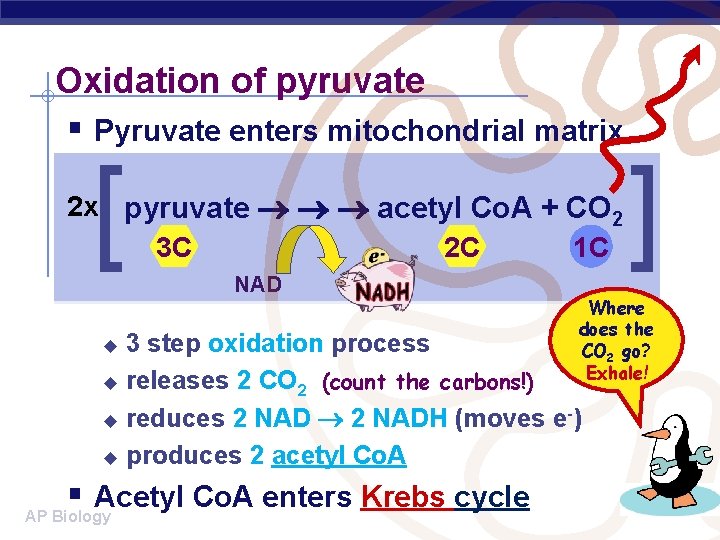
Oxidation of pyruvate § Pyruvate enters mitochondrial matrix [ 2 x pyruvate acetyl Co. A + CO 2 1 C 3 C 2 C NAD Where does the CO 2 go? Exhale! 3 step oxidation process u releases 2 CO 2 (count the carbons!) u reduces 2 NADH (moves e-) u produces 2 acetyl Co. A u § Acetyl Co. A enters Krebs cycle AP Biology ]
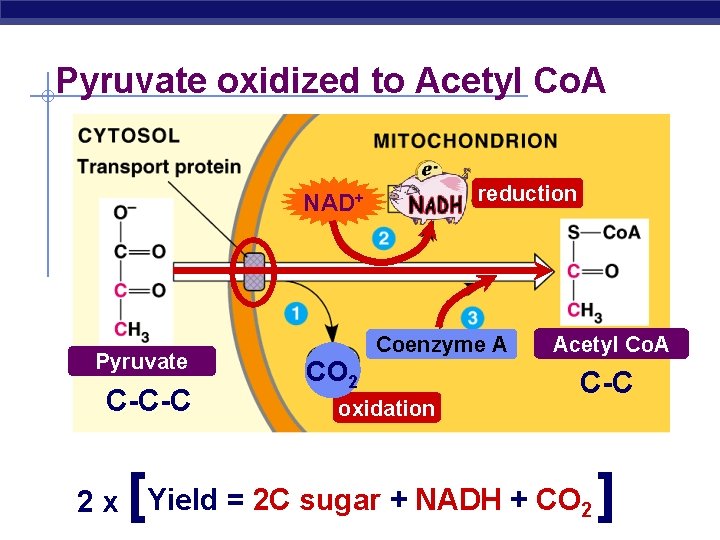
Pyruvate oxidized to Acetyl Co. A reduction NAD+ Pyruvate C-C-C [ CO 2 Coenzyme A oxidation Acetyl Co. A C-C 2 x Yield = 2 C sugar + NADH + CO 2 AP Biology ]
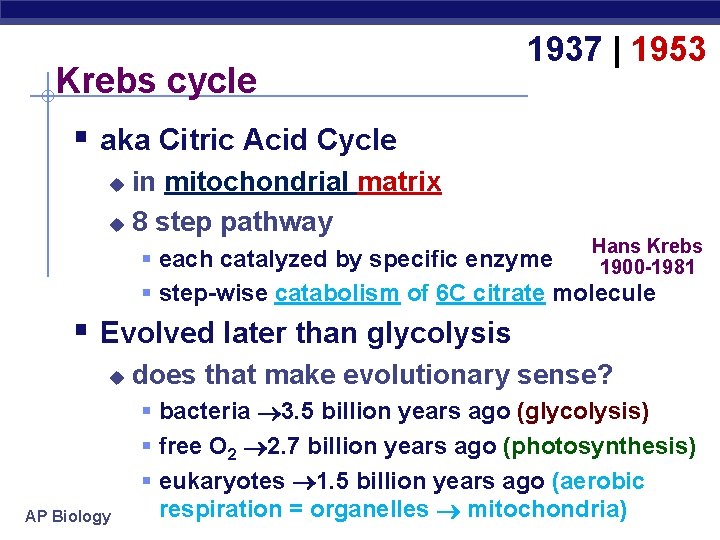
Krebs cycle 1937 | 1953 § aka Citric Acid Cycle in mitochondrial matrix u 8 step pathway u Hans Krebs § each catalyzed by specific enzyme 1900 -1981 § step-wise catabolism of 6 C citrate molecule § Evolved later than glycolysis u AP Biology does that make evolutionary sense? § bacteria 3. 5 billion years ago (glycolysis) § free O 2 2. 7 billion years ago (photosynthesis) § eukaryotes 1. 5 billion years ago (aerobic respiration = organelles mitochondria)
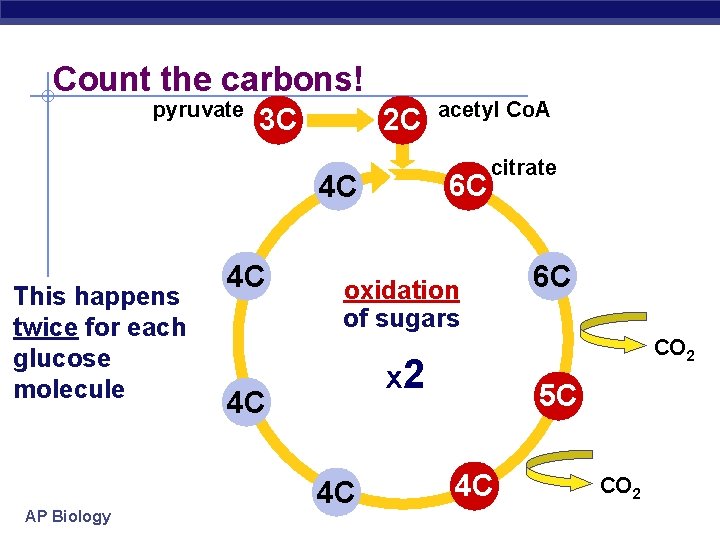
Count the carbons! pyruvate 3 C 2 C 6 C 4 C This happens twice for each glucose molecule AP Biology 4 C acetyl Co. A citrate oxidation of sugars CO 2 x 2 4 C 4 C 6 C 5 C 4 C CO 2
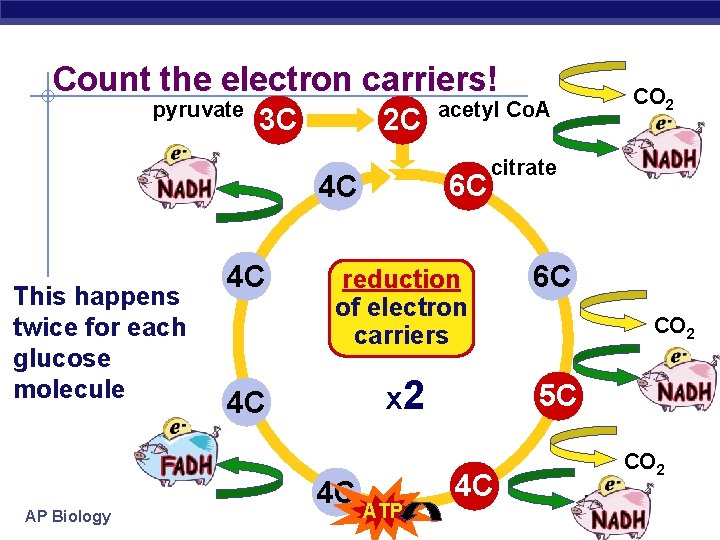
Count the electron carriers! pyruvate 3 C FADH 2 AP Biology 6 C 4 C NADH This happens twice for each glucose molecule 2 C 4 C 4 C acetyl Co. A citrate reduction of electron carriers x 2 4 C ATP CO 2 NADH 6 C CO 2 NADH 5 C 4 C CO 2 NADH
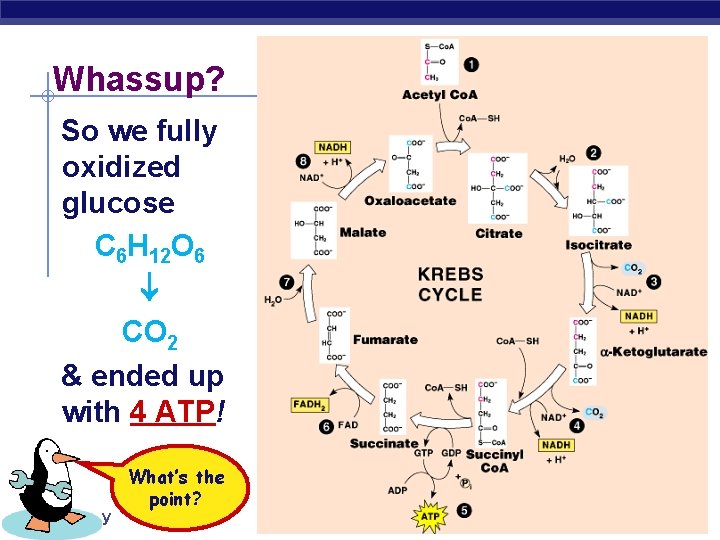
Whassup? So we fully oxidized glucose C 6 H 12 O 6 CO 2 & ended up with 4 ATP! AP Biology What’s the point?
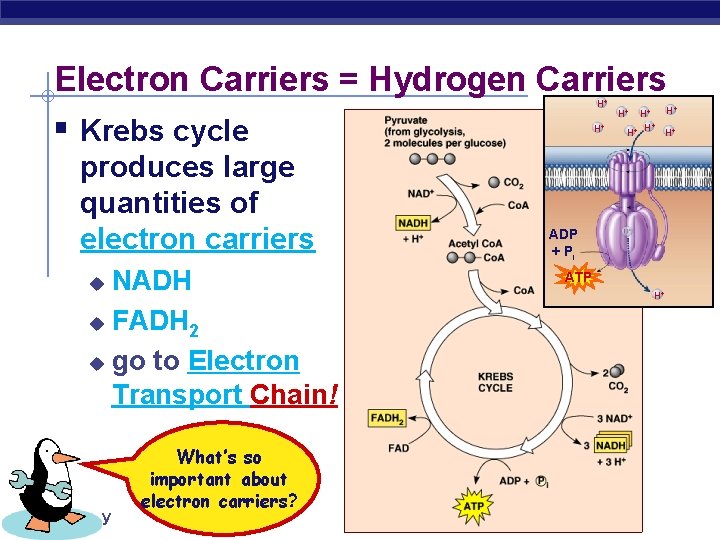
Electron Carriers = Hydrogen Carriers H+ § Krebs cycle produces large quantities of electron carriers NADH u FADH 2 u go to Electron Transport Chain! u AP Biology What’s so important about electron carriers? H+ H+ H+ H+ ADP + Pi ATP H+
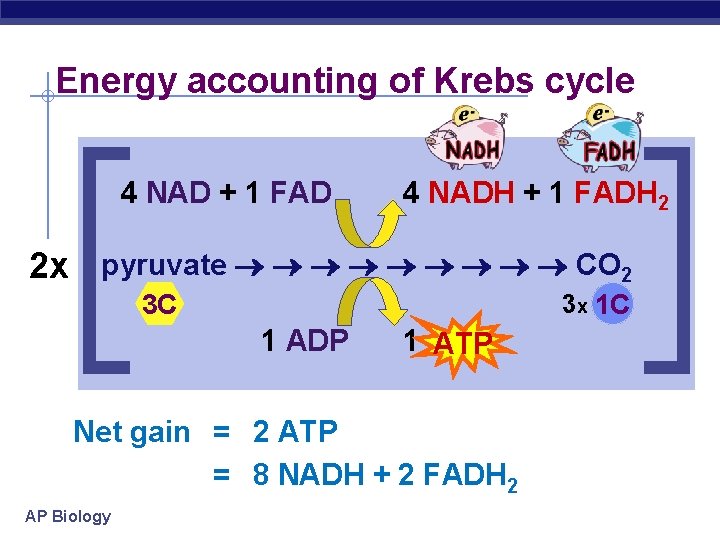
Energy accounting of Krebs cycle 4 NAD + 1 FAD 4 NADH + 1 FADH 2 2 x pyruvate CO 2 3 x 1 C 3 C 1 ADP 1 ATP Net gain = 2 ATP = 8 NADH + 2 FADH 2 AP Biology
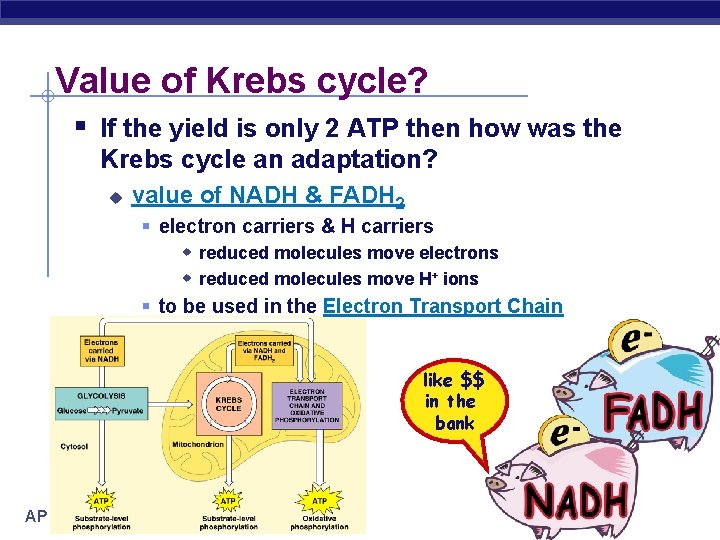
Value of Krebs cycle? § If the yield is only 2 ATP then how was the Krebs cycle an adaptation? u value of NADH & FADH 2 § electron carriers & H carriers w reduced molecules move electrons w reduced molecules move H+ ions § to be used in the Electron Transport Chain like $$ in the bank AP Biology
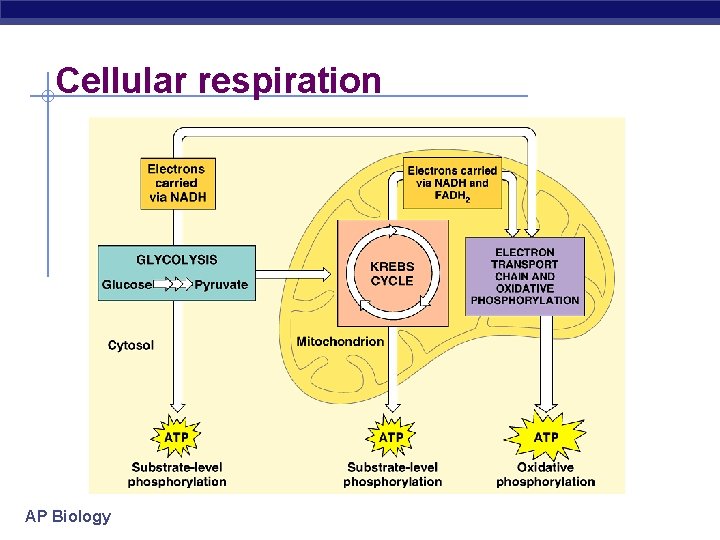
Cellular respiration AP Biology
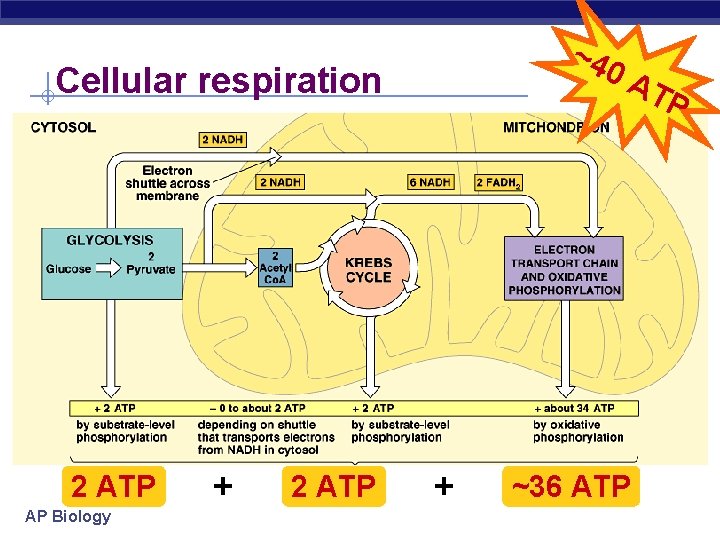
There is a better way! § Electron Transport Chain u series of proteins built into inner mitochondrial membrane § along cristae § transport proteins & enzymes transport of electrons down ETC linked to pumping of H+ to create H+ gradient u yields ~36 ATP from 1 glucose! u only in presence of O 2 (aerobic respiration) u AP Biology That sounds more like it! O 2
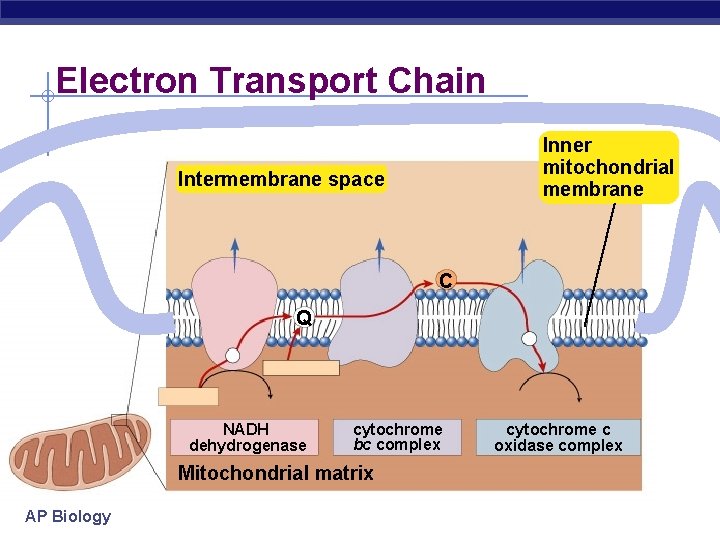
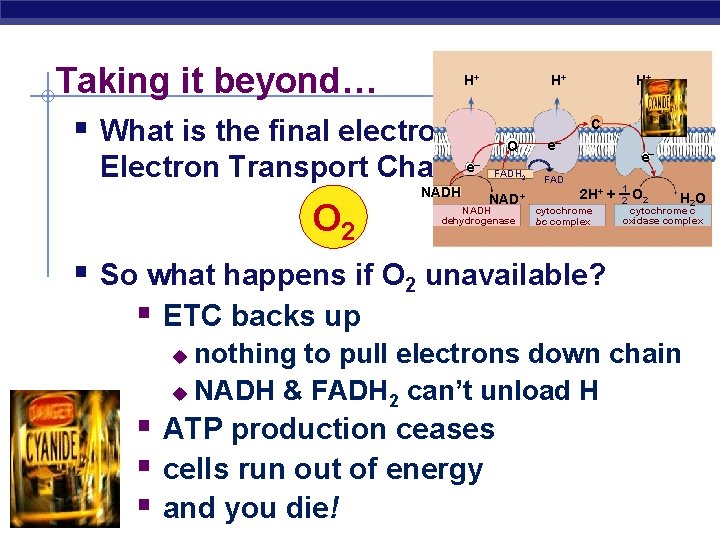
Electron Transport Chain Inner mitochondrial membrane Intermembrane space C Q NADH dehydrogenase cytochrome bc complex Mitochondrial matrix AP Biology cytochrome c oxidase complex
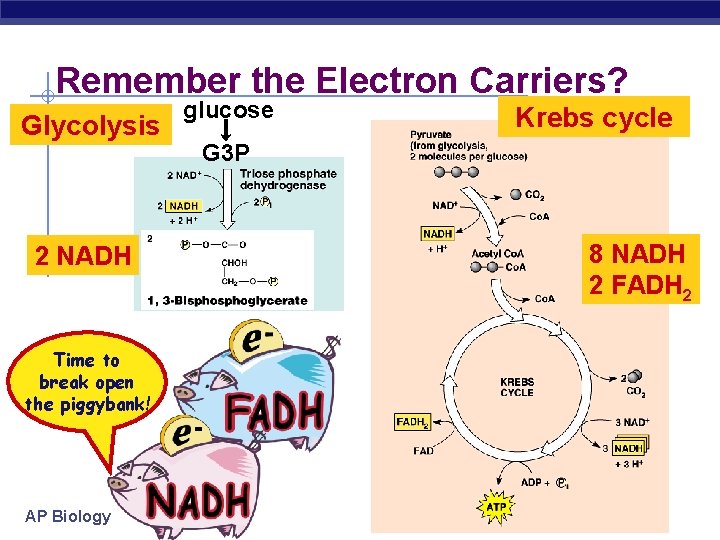
Remember the Electron Carriers? Glycolysis 2 NADH Time to break open the piggybank! AP Biology glucose Krebs cycle G 3 P 8 NADH 2 FADH 2
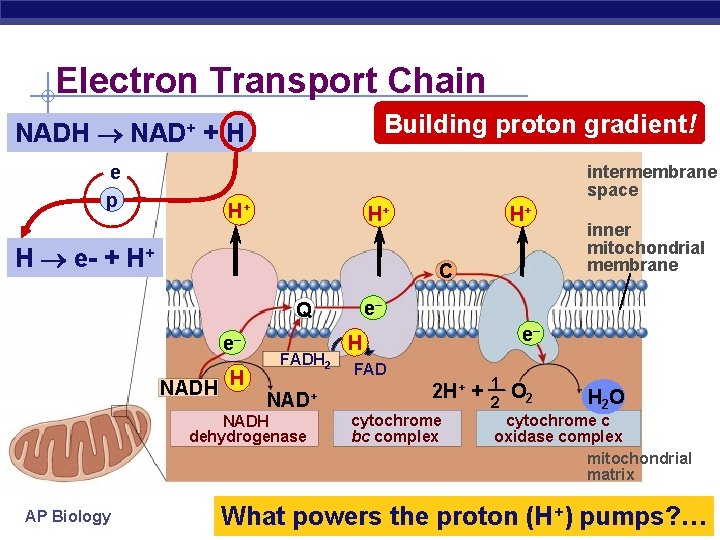
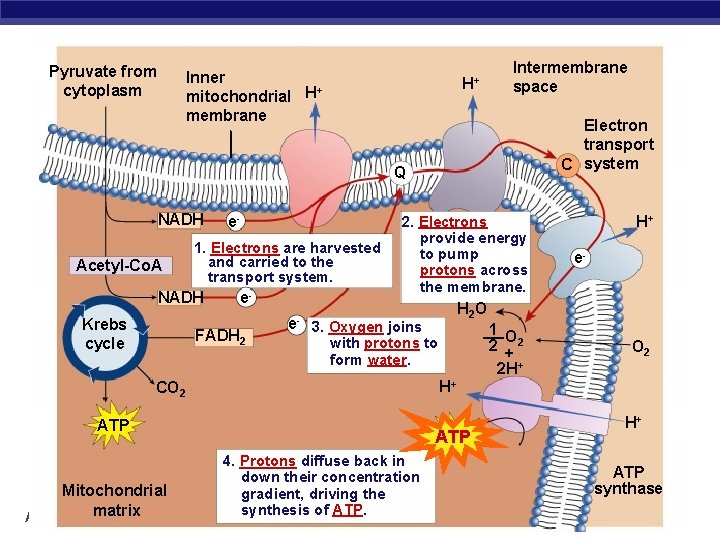
Electron Transport Chain Building proton gradient! NADH NAD+ + H e p intermembrane space H+ H+ H e- + H+ C e– NADH H FADH 2 NAD+ NADH dehydrogenase inner mitochondrial membrane e– Q AP Biology H+ e– H FAD 2 H+ + cytochrome bc complex 1 2 O 2 H 2 O cytochrome c oxidase complex mitochondrial matrix What powers the proton (H+) pumps? …
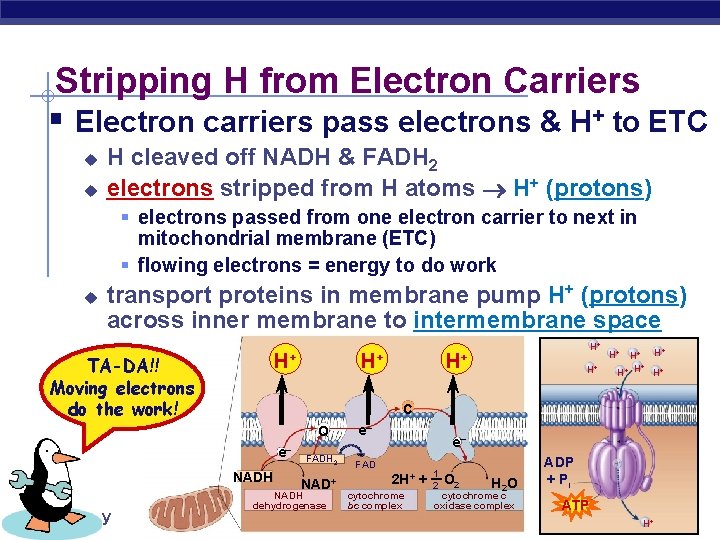
Stripping H from Electron Carriers § Electron carriers pass electrons & H+ to ETC u u H cleaved off NADH & FADH 2 electrons stripped from H atoms H+ (protons) § electrons passed from one electron carrier to next in mitochondrial membrane (ETC) § flowing electrons = energy to do work u transport proteins in membrane pump H+ (protons) across inner membrane to intermembrane space + H H+ TA-DA!! Moving electrons do the work! + H H+ H+ H+ H H+ C e– NADH AP Biology + H H+ H+ Q e– FADH 2 FAD NAD+ NADH dehydrogenase e– 2 H+ cytochrome bc complex + 1 2 O 2 H 2 O cytochrome c oxidase complex ADP + Pi ATP H+
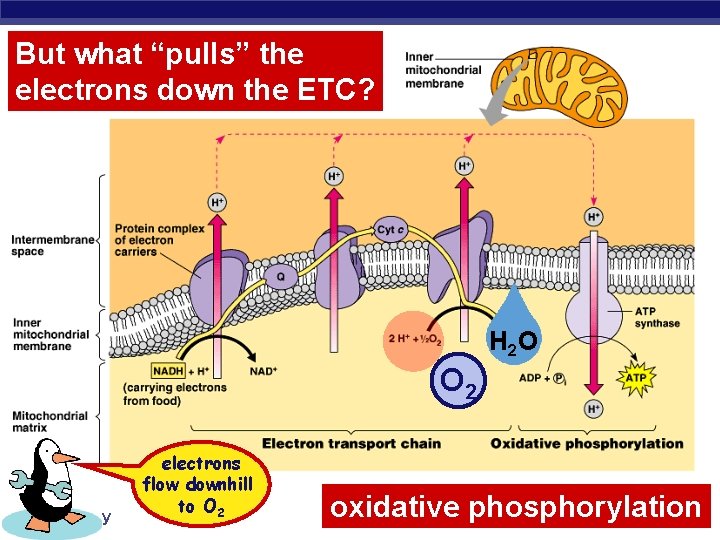
But what “pulls” the electrons down the ETC? H 2 O O 2 AP Biology electrons flow downhill to O 2 oxidative phosphorylation
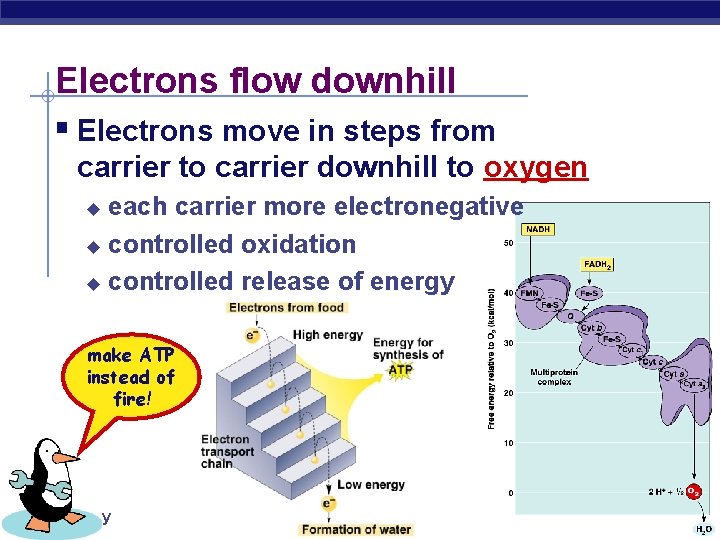
Electrons flow downhill § Electrons move in steps from carrier to carrier downhill to oxygen each carrier more electronegative u controlled oxidation u controlled release of energy u make ATP instead of fire! AP Biology
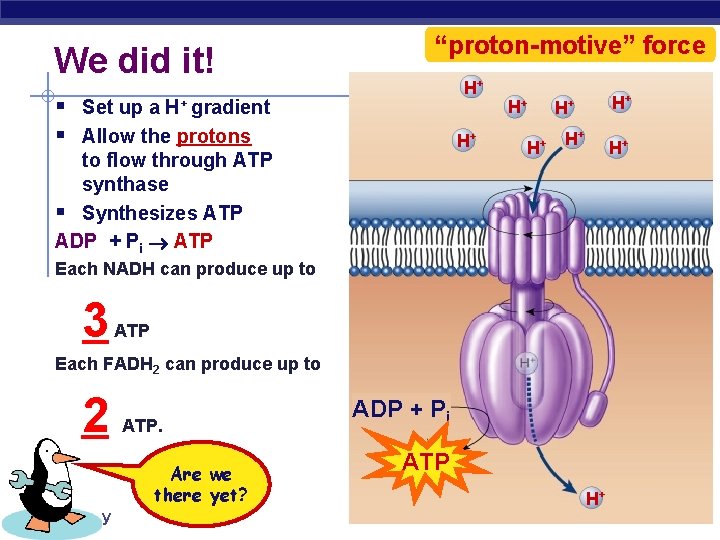
We did it! “proton-motive” force H+ § Set up a H+ gradient § Allow the protons H+ to flow through ATP synthase § Synthesizes ATP ADP + Pi ATP H+ H+ H+ Each NADH can produce up to 3 ATP Each FADH 2 can produce up to 2 ATP. Are we there yet? AP Biology ADP + Pi ATP H+
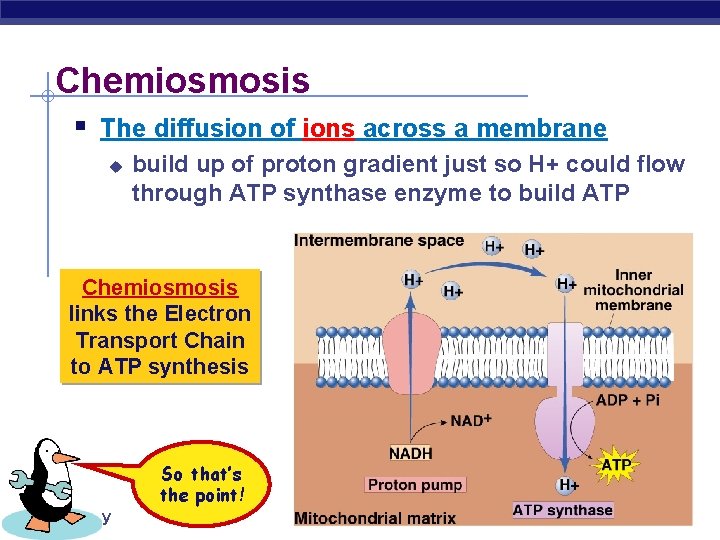
Chemiosmosis § The diffusion of ions across a membrane u build up of proton gradient just so H+ could flow through ATP synthase enzyme to build ATP Chemiosmosis links the Electron Transport Chain to ATP synthesis So that’s the point! AP Biology
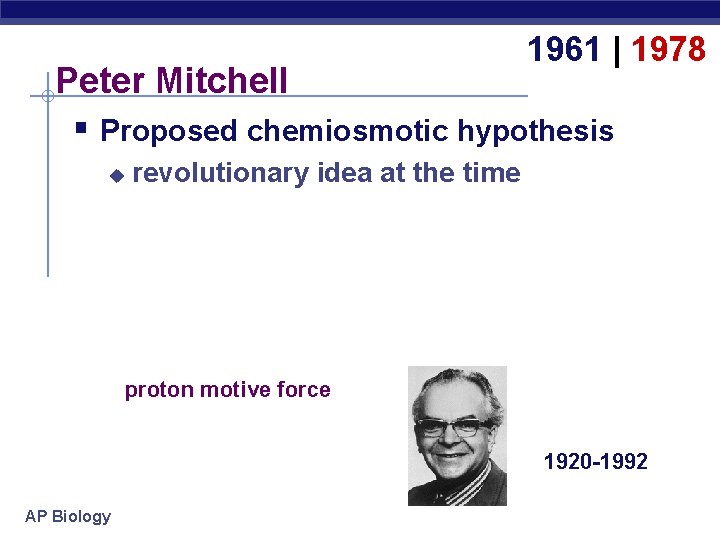
1961 | 1978 Peter Mitchell § Proposed chemiosmotic hypothesis u revolutionary idea at the time proton motive force 1920 -1992 AP Biology
Pyruvate from cytoplasm Inner + mitochondrial H membrane H+ Intermembrane space Electron transport C system Q NADH Acetyl-Co. A 1. Electrons are harvested and carried to the transport system. NADH Krebs cycle e- e- FADH 2 e- 2. Electrons provide energy to pump protons across the membrane. e- H 2 O 3. Oxygen joins with protons to form water. 1 O 2 +2 2 H+ O 2 H+ CO 2 ATP Mitochondrial matrix AP Biology H+ ATP 4. Protons diffuse back in down their concentration gradient, driving the synthesis of ATP. H+ ATP synthase
~4 0 A Cellular respiration 2 ATP AP Biology + 2 ATP + ~36 ATP TP
Summary of cellular respiration C 6 H 12 O 6 + 6 O 2 § § § § 6 CO 2 + 6 H 2 O + ~40 ATP Where did the glucose come from? Where did the O 2 come from? Where did the CO 2 go? Where did the H 2 O come from? Where did the ATP come from? What else is produced that is not listed in this equation? § Why do we breathe? AP Biology
Taking it beyond… § What is the final electron acceptor in H+ H+ H+ C Electron Transport Chain? e– O 2 NADH Q e– FADH 2 FAD NAD+ NADH dehydrogenase e– 2 H+ + cytochrome bc complex 1 2 O 2 H 2 O cytochrome c oxidase complex § So what happens if O 2 unavailable? § ETC backs up nothing to pull electrons down chain u NADH & FADH 2 can’t unload H u AP Biology § ATP production ceases § cells run out of energy § and you die!
Cellular Respiration Other Metabolites & Control of Respiration AP Biology 2006 -2007
Cellular respiration AP Biology
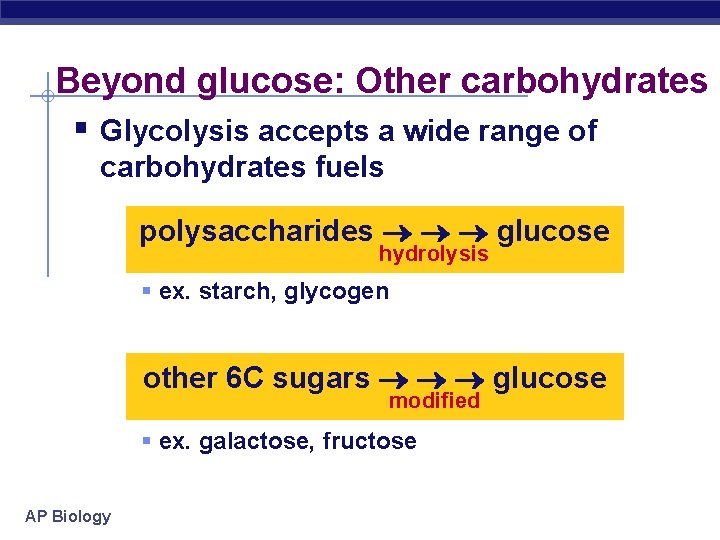
Beyond glucose: Other carbohydrates § Glycolysis accepts a wide range of carbohydrates fuels polysaccharides glucose hydrolysis § ex. starch, glycogen other 6 C sugars glucose modified § ex. galactose, fructose AP Biology
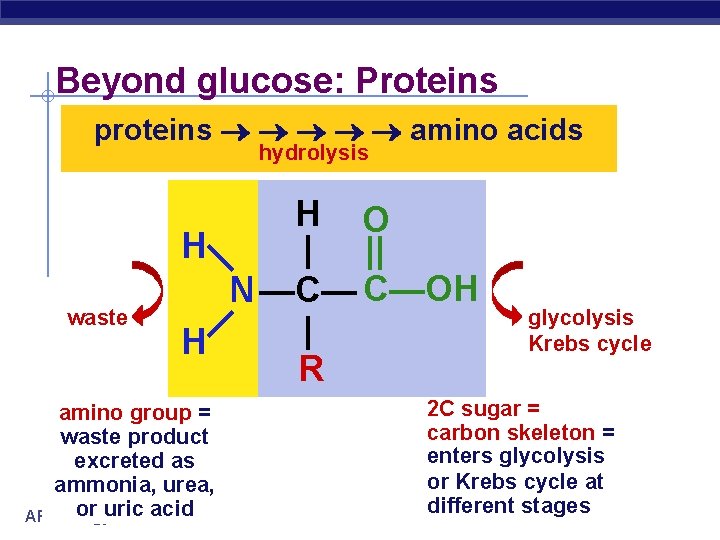
Beyond glucose: Proteins proteins amino acids hydrolysis waste H O H | || N —C— C—OH | H R amino group = waste product excreted as ammonia, urea, or uric acid AP Biology glycolysis Krebs cycle 2 C sugar = carbon skeleton = enters glycolysis or Krebs cycle at different stages
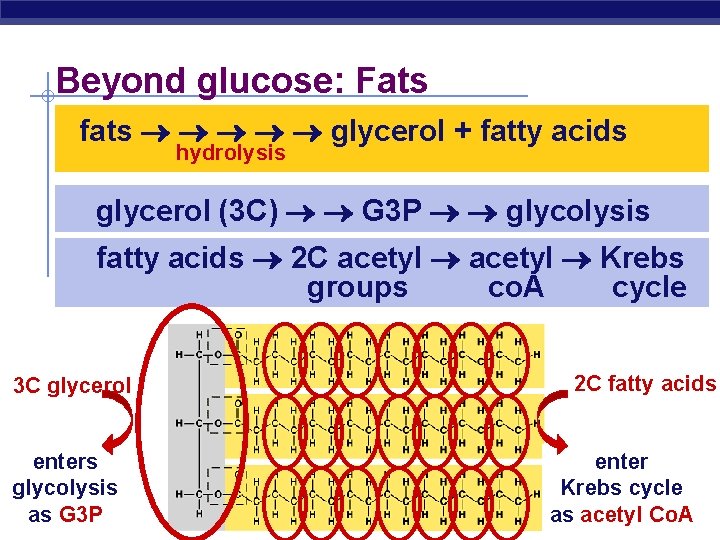
Beyond glucose: Fats fats glycerol + fatty acids hydrolysis glycerol (3 C) G 3 P glycolysis fatty acids 2 C acetyl Krebs groups co. A cycle 3 C glycerol enters glycolysis as. Biology G 3 P AP 2 C fatty acids enter Krebs cycle as acetyl Co. A
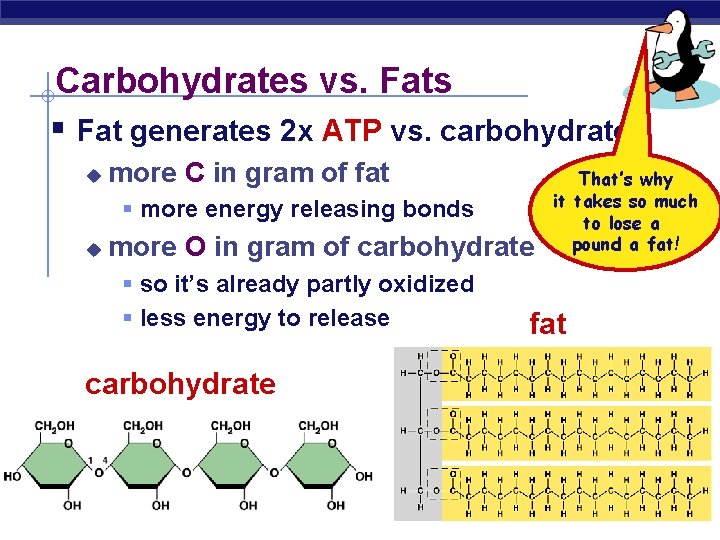
Carbohydrates vs. Fats § Fat generates 2 x ATP vs. carbohydrate u more C in gram of fat § more energy releasing bonds u more O in gram of carbohydrate § so it’s already partly oxidized § less energy to release carbohydrate AP Biology That’s why it takes so much to lose a pound a fat! fat
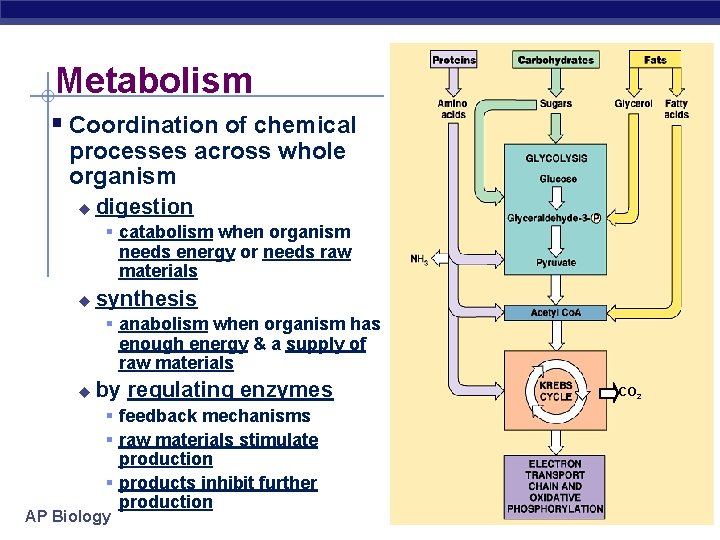
Metabolism § Coordination of chemical processes across whole organism u digestion § catabolism when organism needs energy or needs raw materials u synthesis § anabolism when organism has enough energy & a supply of raw materials u by regulating enzymes § feedback mechanisms § raw materials stimulate production § products inhibit further production AP Biology CO 2
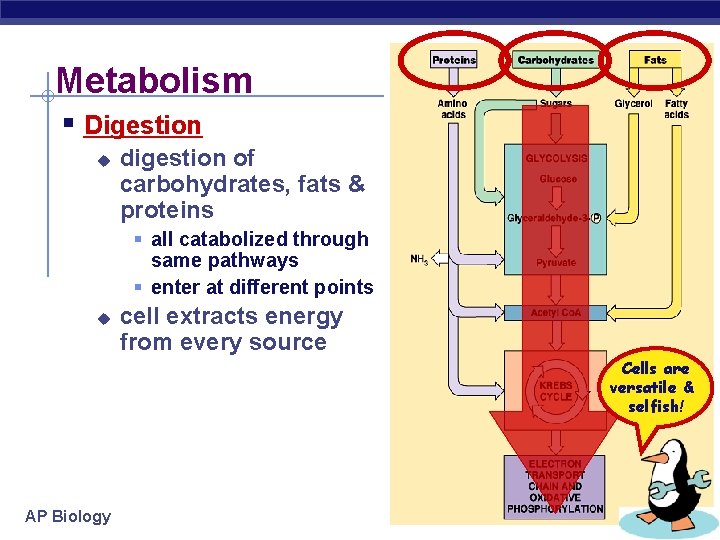
Metabolism § Digestion u digestion of carbohydrates, fats & proteins § all catabolized through same pathways § enter at different points u cell extracts energy from every source Cells are versatile & CO 2 selfish! AP Biology
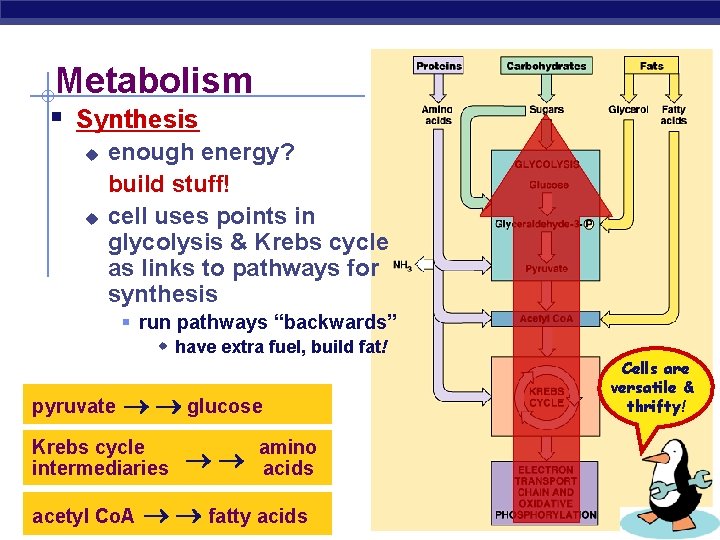
Metabolism § Synthesis u u enough energy? build stuff! cell uses points in glycolysis & Krebs cycle as links to pathways for synthesis § run pathways “backwards” w have extra fuel, build fat! pyruvate glucose Krebs cycle intermediaries AP Biology acetyl Co. A amino acids fatty acids Cells are versatile & thrifty!
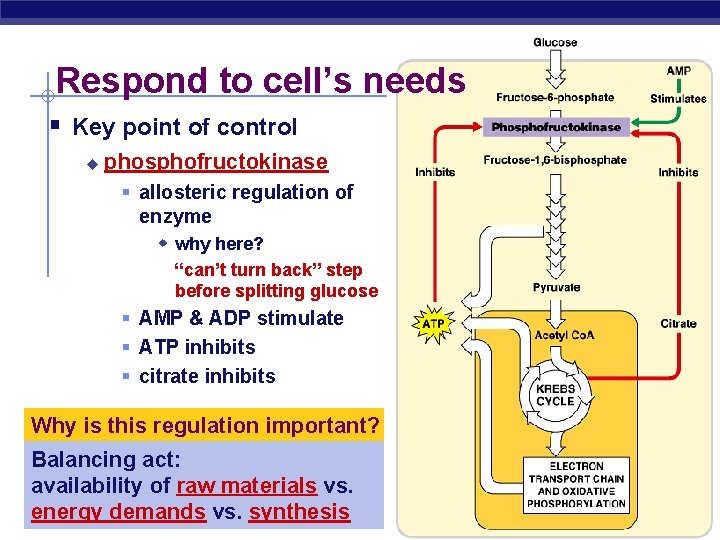
Respond to cell’s needs § Key point of control u phosphofructokinase § allosteric regulation of enzyme w why here? “can’t turn back” step before splitting glucose § AMP & ADP stimulate § ATP inhibits § citrate inhibits Why is this regulation important? Balancing act: availability of raw materials vs. energy AP Biologydemands vs. synthesis
A Metabolic economy § Basic principles of supply & demand regulate metabolic economy u balance the supply of raw materials with the products produced these molecules become feedback regulators AP Biology § they control enzymes at strategic points in glycolysis & Krebs cycle w levels of AMP, ADP, ATP n regulation by final products & raw materials w levels of intermediates compounds in pathways n regulation of earlier steps in pathways w levels of other biomolecules in body n regulates rate of siphoning off to synthesis pathways u
- Slides: 67