
Cellular Respiration Energy from Food Defining Cellular Respiration
- Slides: 11
Cellular Respiration: Energy from Food
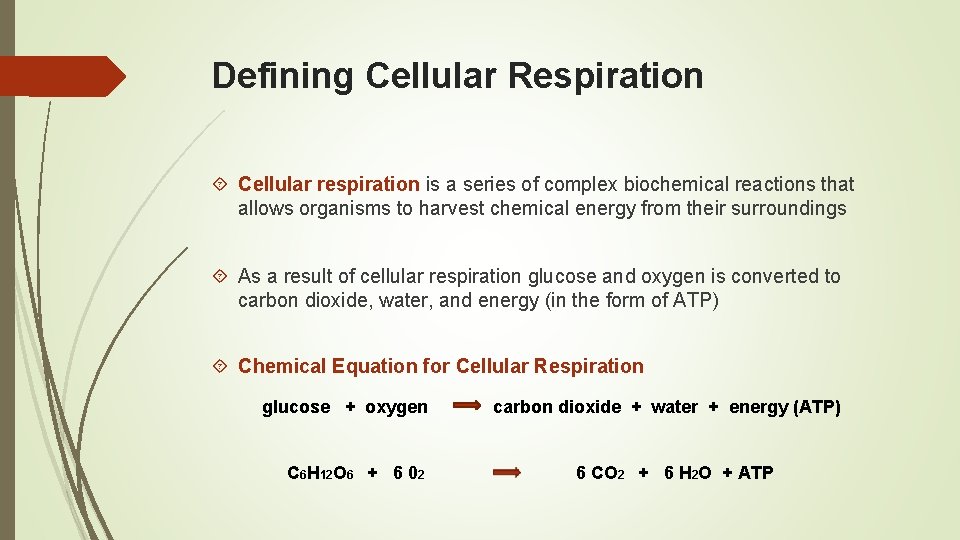
Defining Cellular Respiration Cellular respiration is a series of complex biochemical reactions that allows organisms to harvest chemical energy from their surroundings As a result of cellular respiration glucose and oxygen is converted to carbon dioxide, water, and energy (in the form of ATP) Chemical Equation for Cellular Respiration glucose + oxygen C 6 H 12 O 6 + 6 02 carbon dioxide + water + energy (ATP) 6 CO 2 + 6 H 2 O + ATP
Why Cellular Respiration is Important It allows plant and animals to extract energy from energy-rich compounds, such as carbohydrates and fats, and convert it to an energy rich compound called adenosine triphosphate (ATP) The energy in ATP (produced by cellular respiration) can be used by cells to grow, reproduce, move, and perform other essential cell functions Both plants and animals carry out cellular respiration Occurs in all living parts of an organism
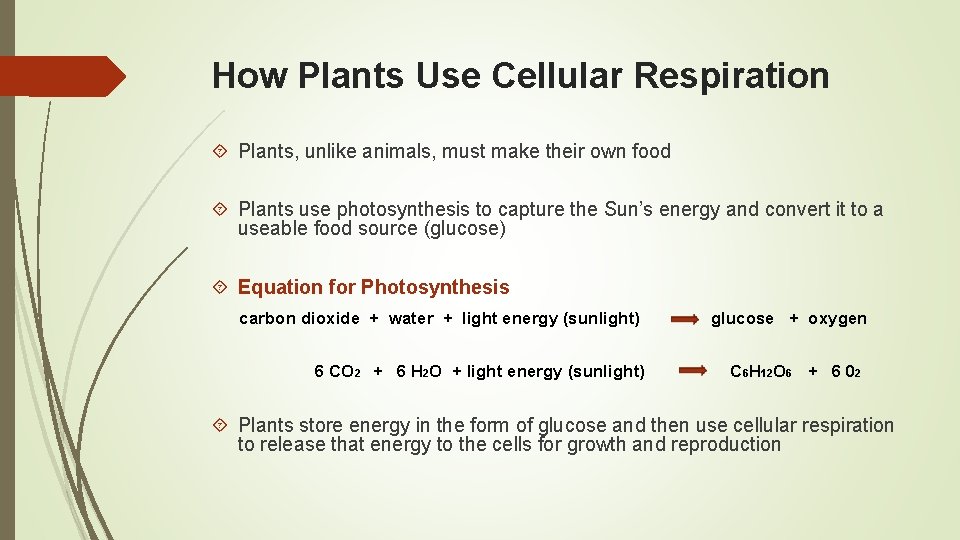
How Plants Use Cellular Respiration Plants, unlike animals, must make their own food Plants use photosynthesis to capture the Sun’s energy and convert it to a useable food source (glucose) Equation for Photosynthesis carbon dioxide + water + light energy (sunlight) 6 CO 2 + 6 H 2 O + light energy (sunlight) glucose + oxygen C 6 H 12 O 6 + 6 02 Plants store energy in the form of glucose and then use cellular respiration to release that energy to the cells for growth and reproduction
What Happens During Cellular Respiration is a series of chemical reactions that break down nutrients for energy In most organisms, this process requires oxygen The molecules that serve as energy sources are called macronutrients because cells can digest them into smaller units Macronutrients include carbohydrates, proteins, and fats The overall process of cellular respiration involves three complex steps: glycolysis, the Krebs cycle, and the electron transport chain
The First Step of Cellular Respiration: Glycolysis occurs in the cell’s cytoplasm (The cell doesn’t need oxygen for this step, so it is characterized as an anaerobic reaction) During glycolysis, a molecule of glucose is split into two small pyruvate molecules, releasing two molecules of ATP and two electron carriers The pyruvate molecules then travel to the mitochondria, the main site of ATP production Once in the mitochondria, the pyruvates are converted into acetyl Co. A, additional ATP, and carbon dioxide (This process is consider aerobic because it requires the presence of oxygen)
The Second Step of Cellular Respiration: The Krebs Cycle Occurs inside the mitochondrion This process is consider aerobic because it requires the presence of oxygen During the Krebs cycle, the acetyl Co. A molecules are broken down, yielding two more molecules of ATP and eight additional electron carriers Carbon dioxide and water are created as waste products of this reaction The carbon dioxide that is a by-product of this reaction is released by exhaling
The Third Step of Cellular Respiration: The Electron Transport Chain The electron transport chain is a series of chemical reactions where electrons, produced in the first two steps of cellular respirations, are passed down the “chain” from one reaction to the next As the electrons move down the electron transport chain, energy is released The released energy is captured and stored in ATP molecules This step creates the greatest number of ATP molecules At the end of this step, oxygen and hydrogen molecules bond together to make water
How are Respiration and Cellular Respiration Different Respiration (also know as breathing) is the exchange of oxygen and carbon dioxide between the external environment and the body Cellular respiration is an internal chemical reaction that makes energy (ATP) y breaking down glucose within the cells
How is Respiration (Breathing) like Cellular Respiration Both respiration and cellular respiration require oxygen In both, respiration and cellular respiration, oxygen is taken in and carbon dioxide is produced
The Connection Between Respiration and Cellular Respiration Cellular respiration is dependent on respiration Respiration makes cellular respiration possible by bringing oxygen into the body Transports oxygen to the cells Removes the carbon dioxide that is produced in the cells In humans, oxygen is transported by the blood to the cells where it is used to breakdown the glucose into water, carbon dioxide, and useable energy (ATP)